Archive
02/13/2018 – Ephemeris – The Big Dipper as a pointer to other stars and constellations
Ephemeris for Tuesday, March 13th. The Sun will rise at 7:58. It’ll be up for 11 hours and 47 minutes, setting at 7:46. The Moon, 4 days before new, will rise at 6:42 tomorrow morning.
With the Big Dipper up in the northeastern sky it is a sign that spring is coming. At 9 p.m. The Big Dipper can be used to find other stars and constellations. The Big Dipper’s most famous function is in locating Polaris the North Star. It’s a good way of finding directions at night. The altitude of Polaris, that is angle above the horizon, will give one’s approximate latitude north of the equator. Another constellation that can be found is Leo the lion. It is rising in the east in the evening, but it can also be found from the Big Dipper by imagining that a hole were drilled in the bottom of the bowl to let the water leak out. It would fall on Leo’s back. The Big Dipper can be used to find two more stars, but they have not yet risen.
The times given are for the Traverse City/Interlochen area of Michigan. They may be different for your location.
Addendum
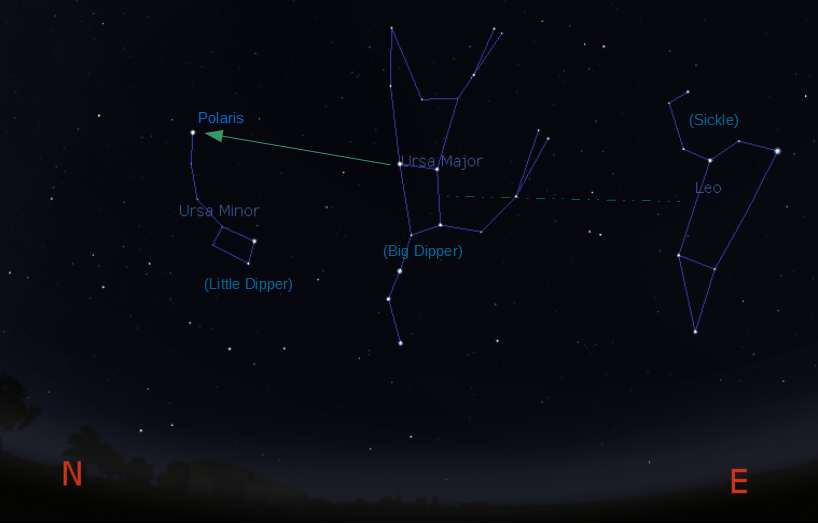
The Big Dipper points to Polaris, the, North Star, and to Leo the lion at 9 p.m., March 13th. In another hour the 4th brightest night-time star Arcturus will appear above the eastern horizon pointed to by the arc of the handle of the Big Dipper. We’ll revisit the Big Dipper next month when Arcturus and Spica will also be found by the use of the Big Dipper. Created using Stellarium and Libre Office.
11/09/2017 – Ephemeris – Cassiopeia the queen and her husband
Ephemeris for Thursday, November 9th. The Sun will rise at 7:31. It’ll be up for 9 hours and 49 minutes, setting at 5:20. The Moon, 1 day before last quarter, will rise at 10:59 this evening.
The stars of the autumn skies hold forth now, but one prominent autumn constellation never leaves us, here in northern Michigan. Look high in the northeastern sky by 8 p.m. and you can find the W shaped constellation of Cassiopeia the queen. It is opposite the pole star Polaris from the Big Dipper, slinking low in the north-northwest. There’s a dim star that appears above the middle star of the W which turns the W into a very crooked backed chair. Above and left of Cassiopeia is a dim upside down church steeple shaped constellation of Cepheus the king. The Milky Way flows through a corner of Cepheus and Cassiopeia toward the northeastern horizon and through the constellation of Perseus the hero, and the bright star Capella in Auriga the Charioteer.
The times given are for the Traverse City/Interlochen area of Michigan. They may be different for your location.
Addendum
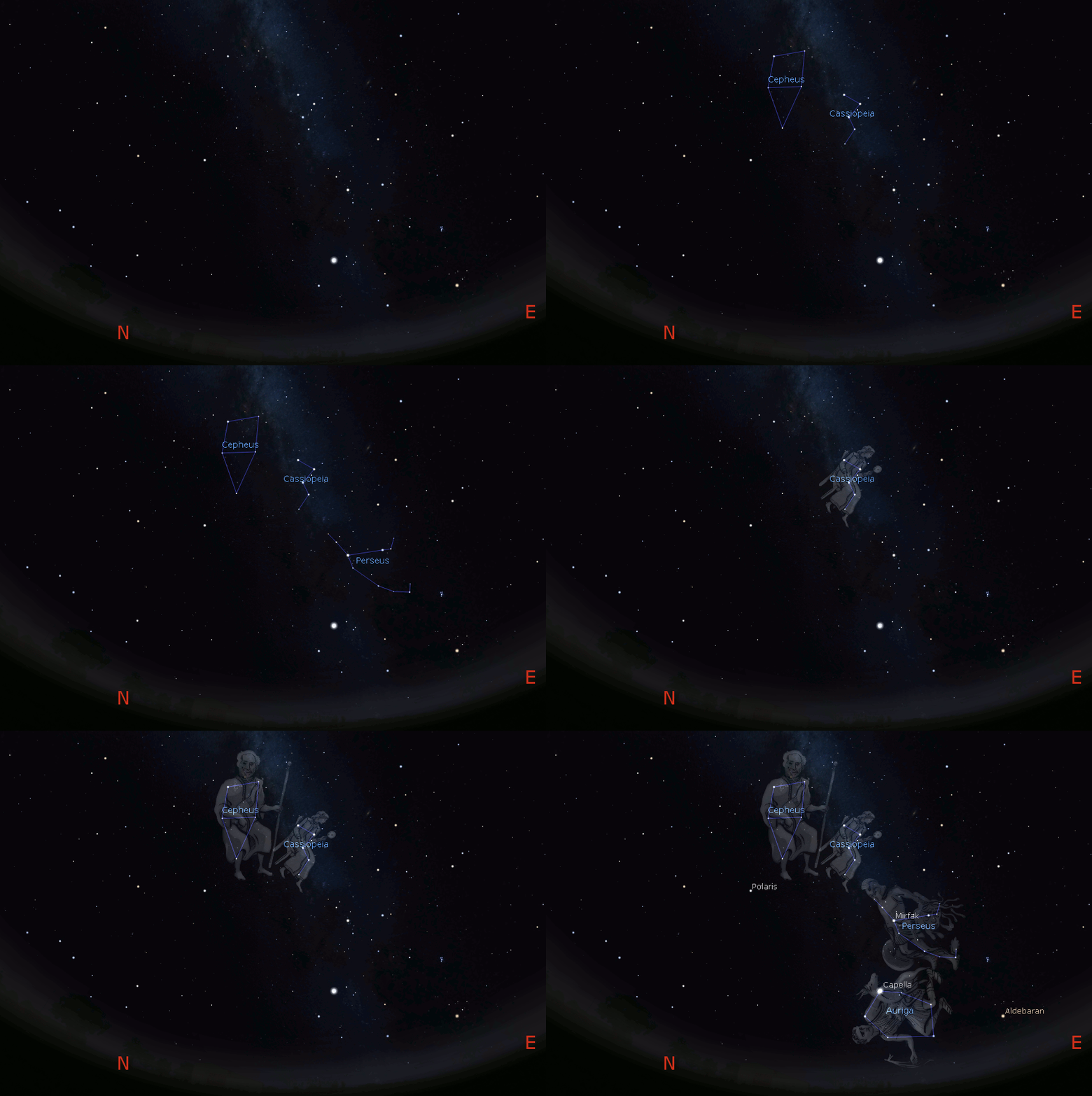
Cassiopeia and constellations along the Milky Way in the northeast these autumn evenings. (8 p.m. November 9, 2017). Click on image to enlarge. Created using Stellarium and GIMP.
08/28/2017 – Ephemeris – Polaris the North Star
Ephemeris for Monday, August 28th. The Sun will rise at 7:00. It’ll be up for 13 hours and 25 minutes, setting at 8:25. The Moon, 1 day before first quarter, will set at 12:19 tomorrow morning.
The bright star Polaris is a very important star. It is also known as the North Star and the Pole Star. Its unique position is nearly directly at the zenith at the Earth’s north pole, making it a very important navigational star. It’s about 40 minutes of arc, or about one and a third Moon diameters away from the extension of the Earth’s axis into the sky. As a rule of thumb, it’s angular altitude above the northern horizon is approximately one’s latitude, and it stands about at the due north compass point. Polaris is found using the Big Dipper, using the two stars at the front of the dipper bowl to point to it. It’s located at the tip of the handle of the very dim Little Dipper, which this time of year in the evening appears to standing on its handle.
The times given are for the Traverse City/Interlochen area of Michigan. They may be different for your location.
Addendum
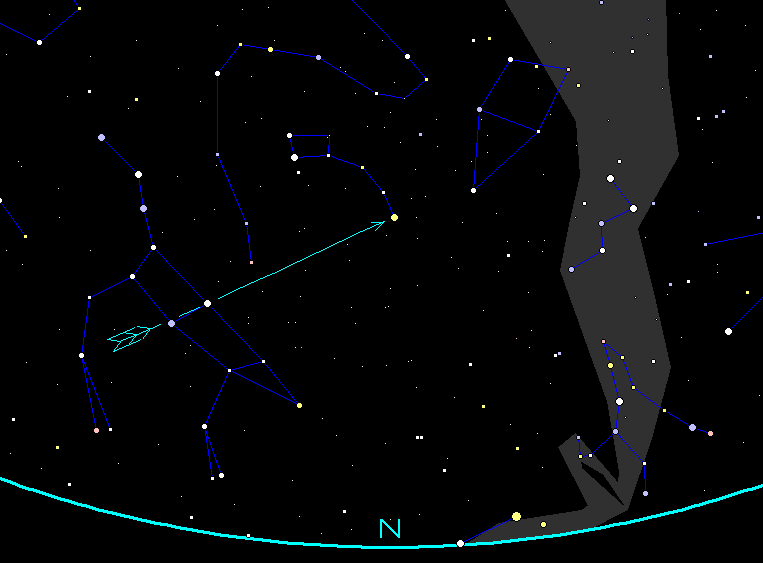
Polaris finder chart for 10 p.m., August 28th. Created using my LookingUp program
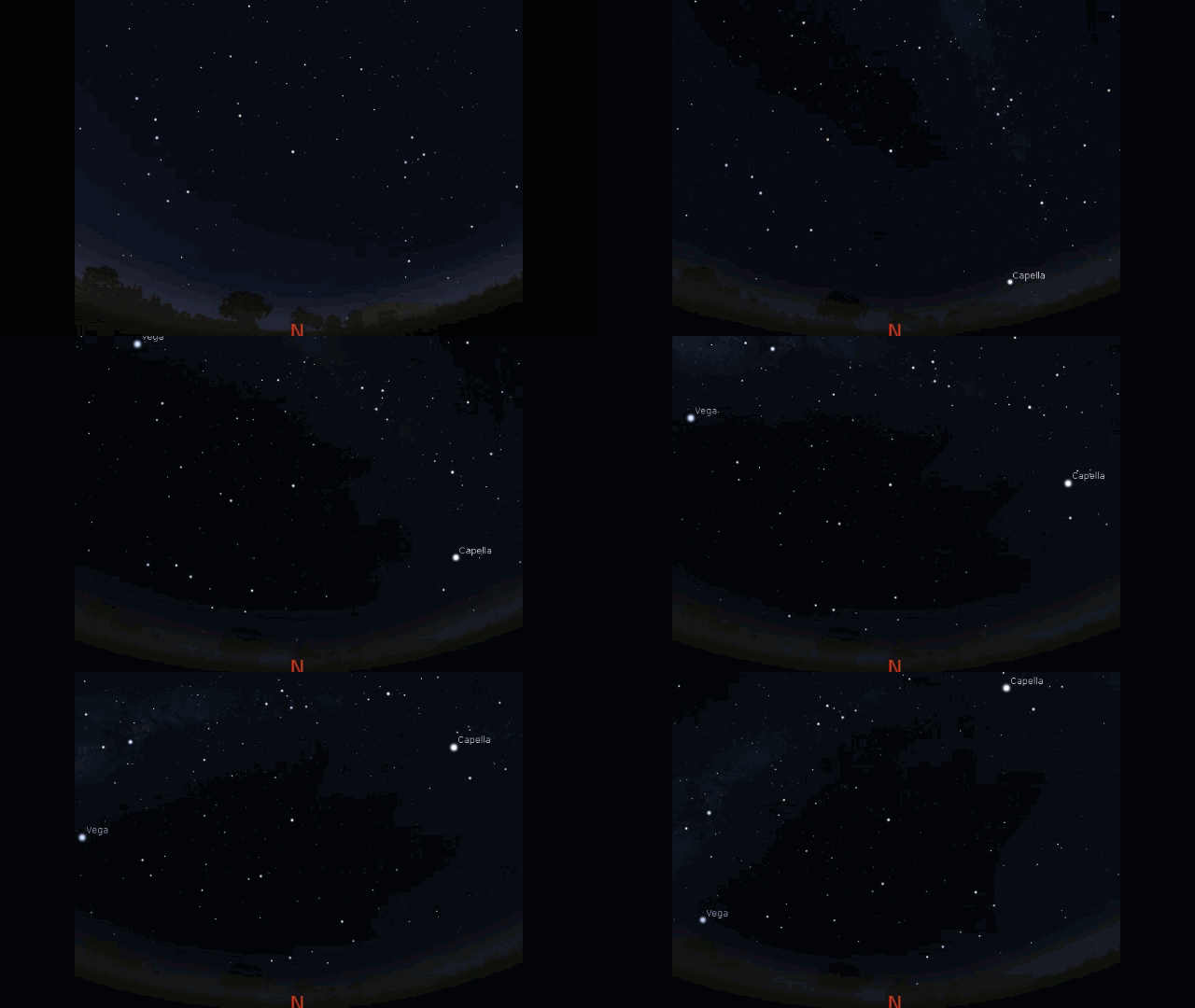
Animation of the rotation of the sky around Polaris on the night of August 28/29, 2017. Created using Stellarium and Filmora.
I’ve left the constellation lines off. The Big Dipper is seen easily as is Cassiopeia’s “W” opposite it around the stationary Polaris.
05/26/2016 – Ephemeris – Polaris the North Star
Ephemeris for Thursday, May 26th. Today the Sun will be up for 15 hours and 12 minutes, setting at 9:16, and will rise tomorrow at 6:03. The Moon, 3 days before last quarter, will rise at 1:02 tomorrow morning.
The star Polaris is perhaps the most important star in the northern hemisphere sky. That’s because it is nearly over the Earth’s north pole. It’s also called the North Star or the Pole Star. Polaris can be found by using the two stars at the front of the bowl of the Big Dipper, These two stars, we call Pointer Stars do point very accurately to Polaris. It is not the brightest star as some think, but a brighter than average star in a most unique position in the sky. During the lifetimes of those now living Polaris will be getting slowly closer to the pole. It won’t reach it, but in 100 years will begin to recede from the pole. The altitude of Polaris in degrees approximately equals ones latitude.
Times are for the Traverse City/Interlochen area of Michigan. They may be different for your location.
Addendum
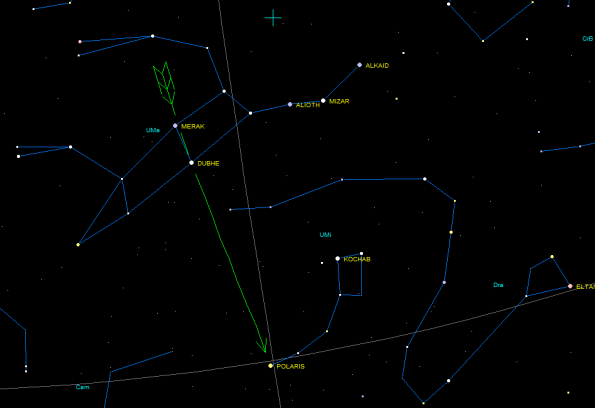
Looking North at the Big Dipper pointing at Polaris. Created using my Looking Up program.
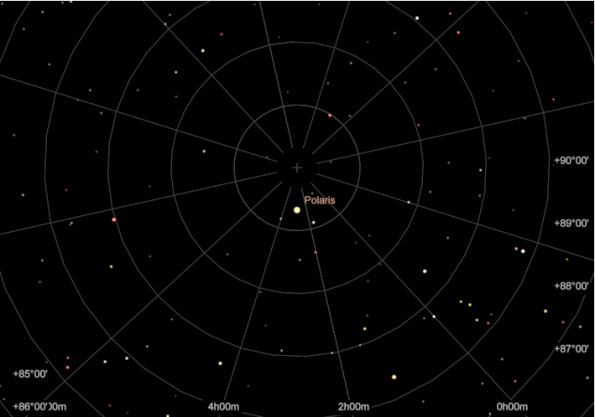
Closeup of Polaris and the Celestial North Pole. The declination lines are 1 degree apart. Created using Cartes du Ciel (Sky Charts).
08/18/2015 – Ephemeris – The autumn queen is rising
Ephemeris for Tuesday, August 18th. The Sun rises at 6:48. It’ll be up for 13 hours and 55 minutes, setting at 8:44. The Moon, half way from new to first quarter, will set at 10:31 this evening.
A look to the northeast at 10 p.m. or later will reveal a letter W pattern of stars. This is the constellation of Cassiopeia the queen. Cassiopeia is so far north that it never sets for us in Michigan. It is opposite the pole star Polaris from the Big Dipper. So as the Big Dipper is rotating down the sky in the northwest, Cassiopeia is rotating up in the northeast. The pivot is the star Polaris, the north star. There’s a dim star that appears above the middle star of the W which turns the W into a very crooked backed chair. Above Cassiopeia is a dim church steeple shaped constellation of Cepheus the king. The Milky Way flows through Cassiopeia and a corner of Cepheus and up through Cygnus, and on to the south.
Times are for the Traverse City/Interlochen area of Michigan. They may be different for your location.
Addendum
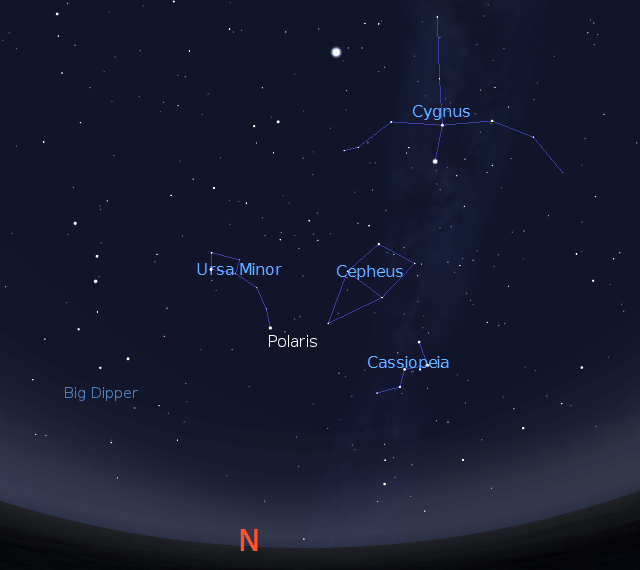
Cassiopeia and nearby constellations mentioned in the above program. Created using Stellarium.
03/27/2015 – Ephemeris – The North Star, Polaris
Ephemeris for Friday, March 27th. The Sun will rise at 7:33. It’ll be up for 12 hours and 30 minutes, setting at 8:03. The Moon, at first quarter today, will set at 3:49 tomorrow morning.
Tonight we turn our eyes northward to Polaris, the North Star. It is the closest bright star to the north pole of the sky. It appears nearly stationary as all the other stars appear to revolve around it as the Earth rotates. Some folks, think that Polaris is the brightest star in the sky. It’s not. It is a good solid second magnitude star, about the brightness of a Big Dipper star. The Big Dipper can be used to point to it, by using the two stars at the front of the bowl. Polaris is at the end of the handle of the Little Dipper. The Little Dipper has four dim stars in its rather oddly bent handle and back of its bowl. The two stars at the front of the bowl of the Little Dipper are Kochab and the dimmer Pherkad, which are also called the Guard Stars or the Guardians of the Pole.
Times are for the Traverse City/Interlochen area of Michigan. They may be different for your location.
Addendum
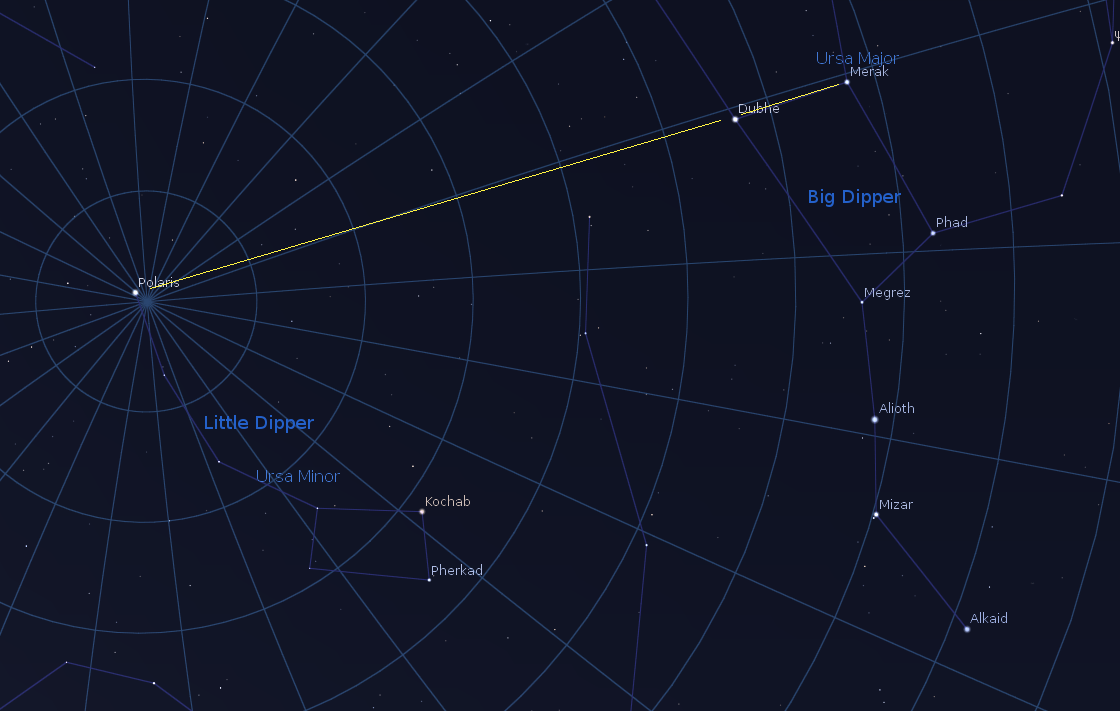
How to find Polaris. The grid is the equatorial grid showing the proximity to the pole. Created using Stellarium.
08/22/2014 – Ephemeris – Cassiopeia Rising
Ephemeris for Friday, August 22nd. The sun rises at 6:53. It’ll be up for 13 hours and 43 minutes, setting at 8:36. The moon, 3 days before new, will rise at 5:08 tomorrow morning.
Now in the northeastern sky at 10 p.m. or later is the constellation of Cassiopeia the queen, which looks like, in its current orientation like the letter W. The Milky Way runs through it, if you trace the Milky Way from the zenith back to the northeast. The milky band isn’t as bright here as it is in the teapot shaped Sagittarius to the south. That’s because in looking to the south we are looking toward the star clouds of the dense spiral arm toward the center of the galaxy. In Cassiopeia, and in the winter sky, we are looking out to the less populated galactic arms farther out from the center of the Milky Way. Cassiopeia can be found using the Big Dipper. A line from the star Mizar at the bend of the handle of the dipper through Polaris points to Cassiopeia. Cassiopeia doesn’t set for us in northern Michigan.
Times are for the Traverse City/Interlochen area of Michigan. They may be different for your location.
Addendum
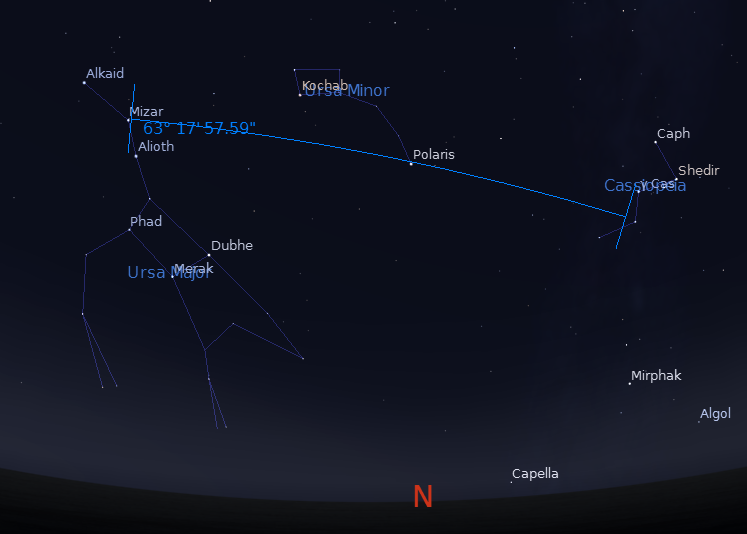
Finding Cassiopeia using the Big Dipper or Ursa Major at 10 p.m. August 22, 2014 using the angle measurement tool as a pointer. Created using Stellarium.
06/02/2014 – Ephemeris – The Big Dipper points to other stars and constellations
Ephemeris for Monday, June 2nd. Today the sun will be up for 15 hours and 21 minutes, setting at 9:21. The moon, 3 days before first quarter, will set at 12:41 tomorrow morning. Tomorrow the sun will rise at 5:59.
The Big Dipper points to other stars and constellations. Right now the Big Dipper is nearly overhead. The front bowl stars point to Polaris, the North Star which never seems to move in the sky. The handle can be used to find two stars. First follow the arc of the handle away from the bowl to find the fourth brightest night time star Arcturus in the base of the kite shaped constellation of Boötes. Straighten the arc to a spike and continue to the south and you will come to the bright blue-white star Spica in Virgo the virgin. Don’t confuse it with reddish Mars to the right of it now. You can remember these stars with the phrase “Follow the arc of the handle to Arcturus and then spike to Spica”
Times are for the Traverse City/Interlochen area of Michigan. They may be different for your location.
Addendum
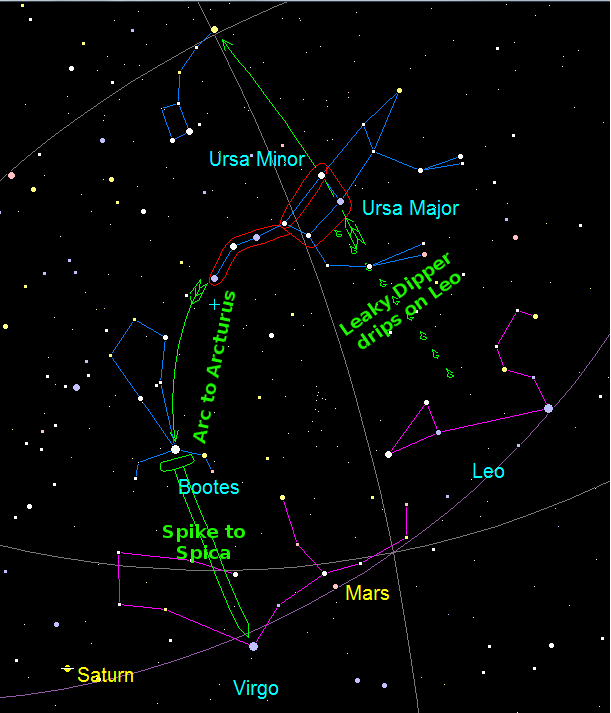
The Big Dipper can be used to point to other stars and constellations in the spring sky. Credit: My LookingUp program.
09/30/2013 – Ephemeris – The constellation of Cassiopeia the queen
Ephemeris for Monday, September 30th. The sun will rise at 7:39. It’ll be up for 11 hours and 44 minutes, setting at 7:24. The moon, half way from last quarter to new, will rise at 4:07 tomorrow morning.
The stars of the autumn skies slowly are replacing the summer stars from the east. Look in the northeastern sky by 9 p.m. and you can find the W shaped constellation of Cassiopeia the queen. Cassiopeia is so far north that it never sets for us in Michigan. It is opposite the pole star Polaris from the Big Dipper. There’s a dim star that appears above the middle star of the W which turns the W into a very crooked backed chair. Cassiopeia, in Greek mythology, represents a queen of ancient Ethiopia, the W represents the profile of her throne. She enters in to the great autumn story whose other characters are also seen in the stars as the constellations Andromeda, Pegasus, Perseus, Cetus and her husband Cepheus.
Times are for the Traverse City/Interlochen area of Michigan. They may be different for your location.
Addendum
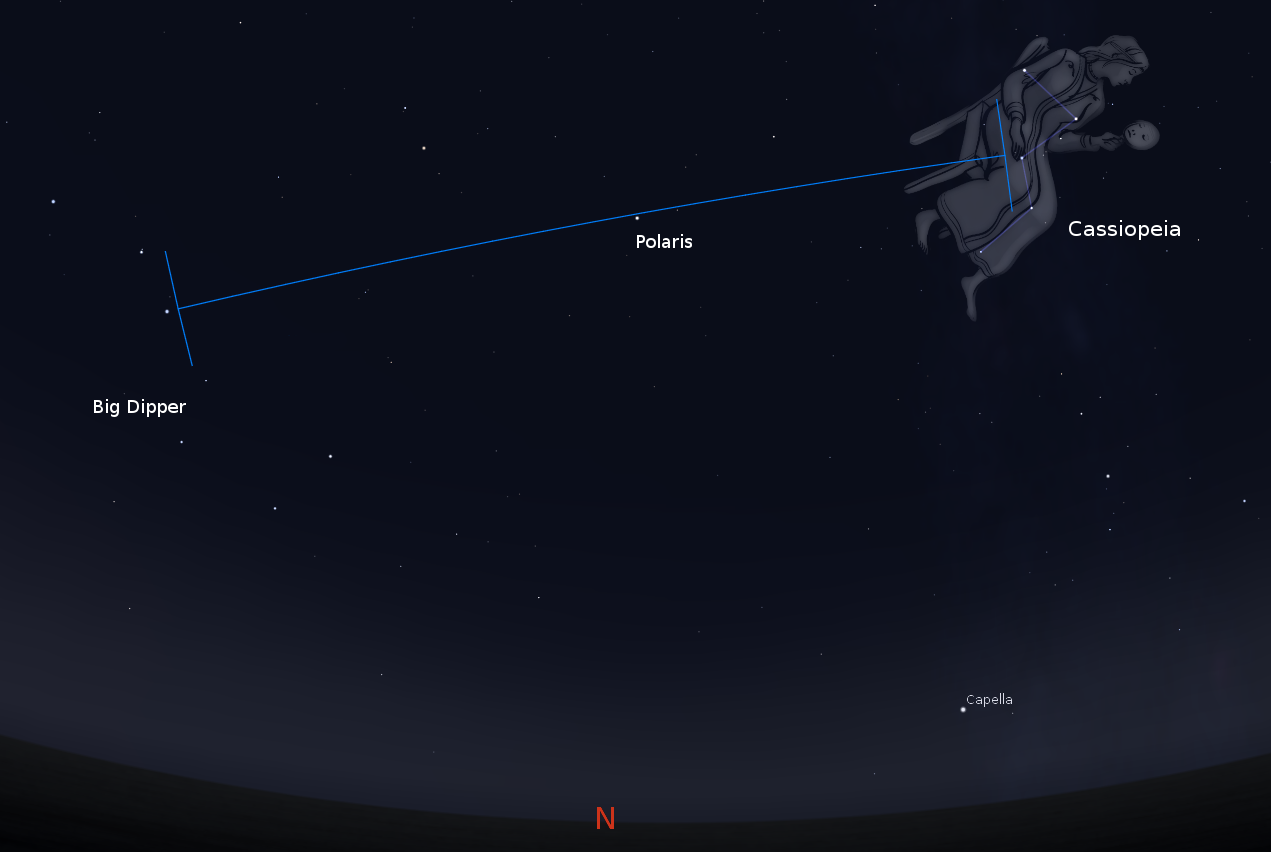
Cassiopeis, in the northeast is opposite Polaris from the Big Dipper. For 9 p.m. on September 30th. Created using Stellarium. Artistic credit: Johan Meuris. Click to enlarge.
11/22/2012 – Ephemeris – Celestial navigation in the days of the Pilgrims
Ephemeris for Thanksgiving Day, Thursday, November 22nd. The sun will rise at 7:48. It’ll be up for 9 hours and 19 minutes, setting at 5:08. The moon, 2 days past first quarter, will set at 2:58 tomorrow morning.
Back in the days of the Pilgrims navigation was much less certain than it is today. At the mercy of the winds and weather, sailing took a lot of courage. Celestial navigation took the form of measuring the altitude of the pole star Polaris at night and the sun at noon. That and tossing a log overboard attached to a rope with knots at regular interval to gauge their speed and progress. That’s where we get the term knots as a measure of speed for nautical and aviation use. Today we have GPS to tell us where we are. However that is based on the position of not stars, but quasars, bright nuclei of distant galaxies, whose motions are currently too small to measure. Have a happy Thanksgiving.
Times are for the Traverse City/Interlochen area of Michigan. They may be different for your location.
Addendum
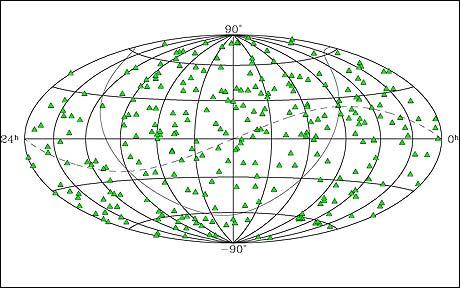
All sky map of quasar locations used as the celestial markers for the GPS system. Chart by David Bobolz, US Naval Observatory.
The chart above is from an article in the Telegraph.
 Bob Moler's Ephemeris Blog