Archive
03/03/2014 – Ephemeris – The dim zodiacal constellation of Cancer the Crab
Ephemeris for Monday, March 3rd. The sun will rise at 7:16. It’ll be up for 11 hours and 16 minutes, setting at 6:33. The moon, 2 days past new, will set at 9:44 this evening.
At 9 this evening, the faint constellation, and member of the Zodiac, Cancer the crab is located in the south-southeast half way between the bright stars Castor and Pollux of the constellation Gemini, high in the south and the bright star Regulus in Leo the lion in the east Cancer is very dim, looking like an upside-down Y. In the center of Cancer is a fuzzy spot to the unaided eye. In binoculars or a low power telescope this fuzzy spot becomes a cluster of stars. It is the Beehive cluster. At 525 light years away, it is one of the closest star clusters, but more distant than the Pleiades and Hyades the face of Taurus the bull. Back a few thousand years ago Cancer was the farthest north of the constellations, Gemini has that honor today.
Times are for the Traverse City/Interlochen area of Michigan. They may be different for your location.
Addendum
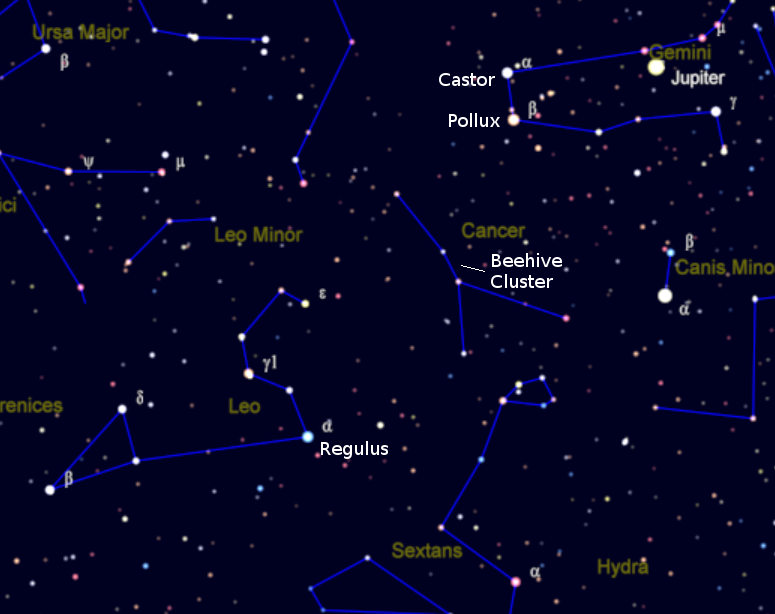
The constellation Cancer the crab at 9 p.m. March 3, 2014. Created using Cartes du Ciel (Skycharts).
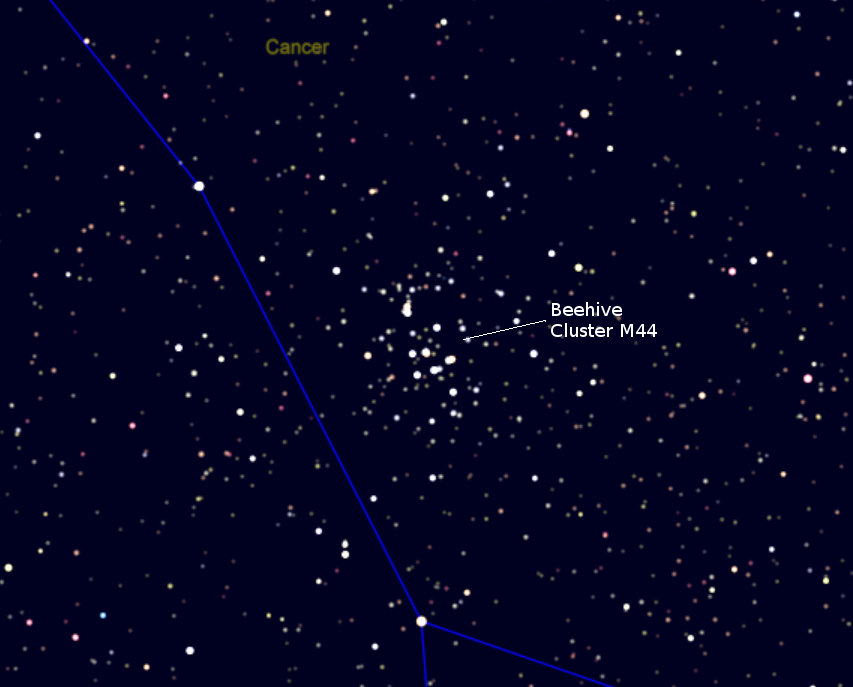
The Beehive star cluster, M44. Its ancient name was the Praesepe or manger when glimpsed by the naked eye. Created using Cartes du Ciel (Skycharts)
02/20/2014 – Ephemeris – Winter Circle plus 1
Ephemeris for Thursday, February 20th. The sun will rise at 7:34. It’ll be up for 10 hours and 43 minutes, setting at 6:18. The moon, 2 days before last quarter, will rise at 12:27 tomorrow morning.
The winter skies are blessed with more first magnitude stars than any other season. Six of these stars lie in a large circle centered on the seventh. This circle is up at 9 p.m. Starting high overhead is Capella in Auriga the charioteer. Moving down clockwise is Aldebaran in the face of Taurus the Bull. Then down to Orion’s knee we find Rigel. Down and left is the brightest star of all Sirius the Dog Star in Canis Major, lowest of these stars in the south-southeast. Moving up and left is Procyon in Canis Minor, Above Procyon is Pollux in Gemini the twins. All these are centered on Betelgeuse the bright red star in Orion’s shoulder. The interloper this year is Jupiter which is situated in Gemini and outshines them all.
Times are for the Traverse City/Interlochen area of Michigan. They may be different for your location.
Addendum
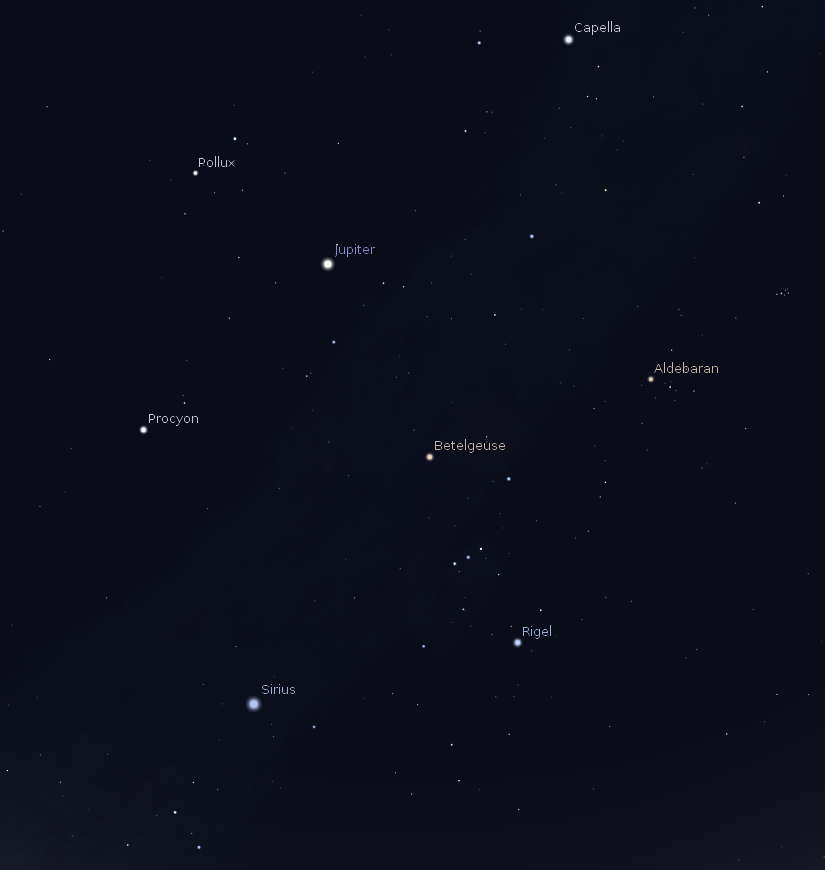
The Winter Circle plus Jupiter at 9 p.m. on February 20, 2014. Created using Stellarium.
03/04/2013 – Ephemeris – The Winter Circle
Ephemeris for Monday, March 4th. The sun will rise at 7:14. It’ll be up for 11 hours and 20 minutes, setting at 6:34. The moon, at last quarter today, will rise at 2:34 tomorrow morning.
The winter skies are blessed with more first magnitude stars than any other season. Six of these stars lie in a large circle centered on the seventh. This circle is up all evening now that we are in the heart of winter. Starting high overhead is Capella in Auriga the charioteer. Moving clockwise and downward, we come to Aldebaran in the face of Taurus the Bull and brighter nearby Jupiter. Then down to Orion’s knee we find Rigel. Down and left is the brightest star of all Sirius the Dog Star in Canis Major Orion’s large hunting dog, lowest of these stars in the south. Moving up and left there is Procyon in Canis Minor Orion’s other hunting dog, Then above is Pollux in Gemini the twins. All are centered on Betelgeuse in Orion.
Times are for the Traverse City/Interlochen area of Michigan. They may be different for your location.
Addendum
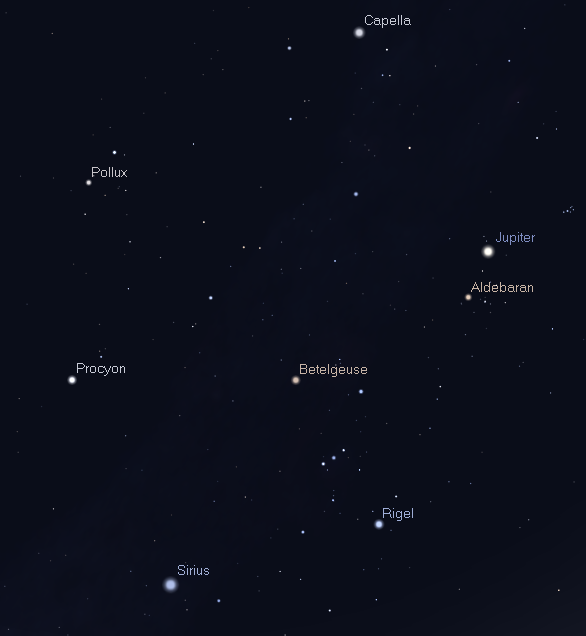
The Winter Circle and Jupiter for March. Created using Stellarium.
02/07/2013 – Ephemeris – The brother stars Castor and Pollux
Ephemeris for Thursday, February 7th. The sun will rise at 7:53. It’ll be up for 10 hours and 6 minutes, setting at 6:00. The moon, 3 days before new, will rise at 6:22 tomorrow morning.
At 9 p.m. the constellation of Gemini the twins will be seen high in the southeast. The namesake stars of the two lads are the two bright stars at the top of the constellation. Pollux the pugilist, or boxer, is the lower of the two, while Castor, the horseman, is the other star, or rather a six star system. In telescopes two close stars may be seen each is a spectroscopic binary, meaning the lines of two stars can be seen in the spectrum. A faint nearby spectroscopic binary also belong. Pollux, though a single star, does have at least one planet, one over twice the mass of Jupiter orbiting the star at a distance somewhat greater than Mars is from the sun. Pollux is 34 light years away while Castor is 50 light years away. Not too far away as stars go.
Times are for the Traverse City/Interlochen area of Michigan. They may be different for your location.
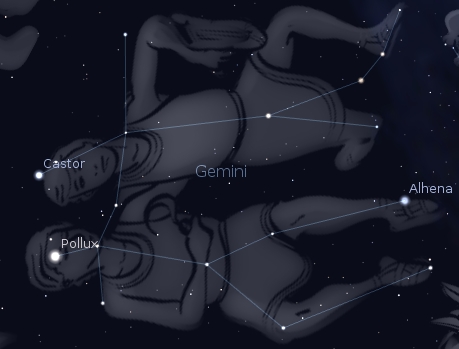
Gemini with Castor and Pollux. Created with Stellarium.
Addendum
02/05/2013 – Ephemeris – The bright stars Castor and Pollux of Gemini
Ephemeris for Tuesday, February 5th. The sun will rise at 7:56. It’ll be up for 10 hours and 1 minute, setting at 5:57. The moon, 2 days past last quarter, will rise at 4:42 tomorrow morning.
The constellation Gemini, the Twins is visible high in the southeast at 9 p.m. The namesake stars of the two lads, will be on the upper left edge of the constellation, diagonally aligned. Castor is to the upper right, while Pollux, a slightly brighter star is below left. Lines of stars from castor and Pollux to the lower right delineate the lads. In Greek mythology Castor and Pollux were twins, and half brothers, Castor was fathered by a mere mortal, while Pollux was fathered by Zeus in the famous Leda and the swan affair. The brothers, however were inseparable, and when Castor was killed during the quest for the Golden Fleece, Pollux pleaded with Zeus to let him die also. Zeus granted his wish, so both appear in the sky together forever.
Times are for the Traverse City/Interlochen area of Michigan. They may be different for your location.
Addendum
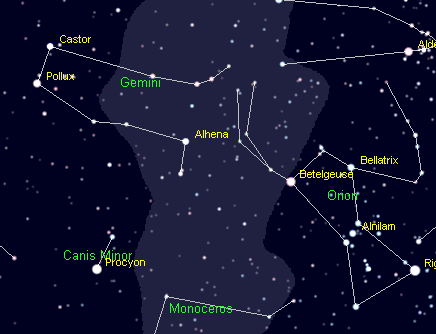
Gemini and Orion. Created using Cartes du Ciel
06/28/2012 – Ephemeris – Mercury near greatest elongation from the sun
Ephemeris for Thursday, June 28th. Today the sun will be up for 15 hours and 31 minutes, setting at 9:31. The moon, 2 days past first quarter, will set at 2:16 tomorrow morning. Tomorrow the sun will rise at 6:00.
Saturday will be the greatest eastern elongation of Mercury from the sun. It’s a whopping 26 degrees angle east from the sun. Mercury has a markedly elliptical orbit. And when we have a spring eastern elongation, its around 18 degrees from the sun. The best western elongations for us are in the autumn when again the elongation angle is 18 degrees. I won’t go into the why of all this here. But we’re getting an extra good view of this tiny planet. The best time to look for Mercury starts about 10:15 p.m. and ends about 10:45 when Mercury is too close to the horizon. The stars Pollux and Castor of Gemini will appear just to the right of Mercury, and will provide a check that you really have found it.
Times are for the Traverse City/Interlochen area of Michigan. They may be different for your location.
Addendum
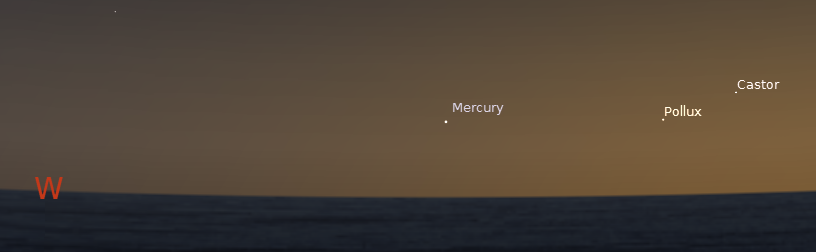
Mercury with the bright stars Pollux and Castor at 10:30 p.m. June 28, 2012. Created using Stellarium.
02/23/2012 – Ephemeris – The star Castor in Gemini
Ephemeris for Thursday, February 23rd. The sun will rise at 7:30. It’ll be up for 10 hours and 50 minutes, setting at 6:21. The moon, 2 days past new, will set at 8:34 this evening.
High in the south southeast at 9 p.m. is the constellation of Gemini the twins. The heads of the two lads contain bright stars with their names. Brighter Pollux is below and Castor is above. Stars that delineate their bodies lie to the lower right of them stretching out in the direction of Orion. Castor is an interesting star because it is actually six stars. Two are easily seen. The two brightest component stars can be resolved in a small telescope. Each has a red dwarf companion detectable only by indirect means. The fifth and sixth stars makes a faint eclipsing binary of red dwarf stars some distance away and very faint. The Castor system resides some 50 light years away.
* Times are for the Traverse City/Interlochen area of Michigan. They may be different for your location.
Addendum
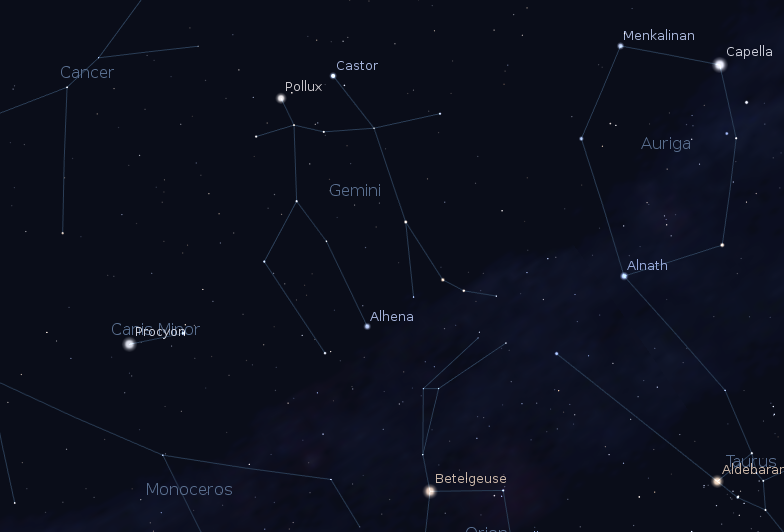
Gemini with the stars Castor and Pollux. Created using Stellarium.
02/20/2012 – Ephemeris – The Winter Circle
Ephemeris for President’s Day, Monday, February 20th. The sun will rise at 7:35. It’ll be up for 10 hours and 41 minutes, setting at 6:17. The moon, 1 day before new, will rise at 7:01 tomorrow morning. | The winter skies are blessed with more first magnitude stars than any other season. Six of these stars lie in a large circle centered on the seventh. This circle is up at 9 p.m. Starting high overhead is Capella in Auriga the charioteer. Moving down clockwise is Aldebaran in the face of Taurus the Bull. Then down to Orion’s knee we find Rigel. Down and left is the brightest star of all Sirius the Dog Star in Canis Major, lowest of these stars in the south southeast. Moving up and left is Procyon in Canis Minor, Above Procyon is Pollux in Gemini the twins. All these are centered on Betelgeuse the bright red star in Orion’s shoulder.
* Times are for the Traverse City/Interlochen area of Michigan. They may be different for your location.
Addendum
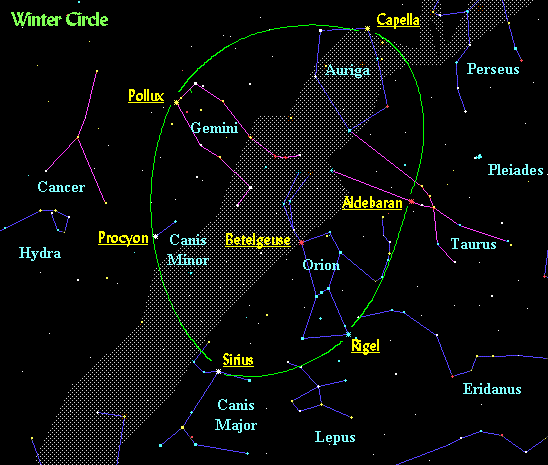
The Winter Circle of 1st magnitude stars
01/23/2012 -Ephemeris – The constellation Gemini the twins
Ephemeris for Monday, January 23rd. The sun will rise at 8:10. It’ll be up for 9 hours and 27 minutes, setting at 5:38. The moon is new today, and won’t be visible.
The constellation of Gemini the twins appears high in the southeast. It appears to the upper left of Orion and the stars that portray his club raised high. Gemini’s two brightest stars are the namesakes of the twins. Castor above and Pollux below. From them there are two lines of stars that form the silhouette of the lads heading to the lower right. In Greek mythology these twins each had a different father, not unheard of in medical history, with Pollux being fathered by the god Zeus and thus immortal. Castor was not. But the brothers were inseparable, so when Castor was killed in the search for the golden fleece Pollux begged his father to let him die too and join his brother. His wish was granted and his devotion was so great that they were placed in the sky where we see them today.
* Times, as always are for the Traverse City/Interlochen area of Michigan.
Addendum
Gemini and Orion. Created using Cartes du Ciel
03/25/11 – Ephemeris – The stars Castor and Pollux
Friday, March 25th. The sun will rise at 7:36. It’ll be up for 12 hours and 24 minutes, setting at 8:00. The moon, 1 day before last quarter, will rise at 3:20 tomorrow morning
Castor and Pollux are the two brightest stars in the constellation Gemini, at the heads of their namesakes. They are high in the south at 10 p.m. Castor, the horseman is on top. It is actually 6 stars orbiting about a common center of gravity in pairs. The two brightest unresolved pairs, named Castor A and Castor B are discernible in telescopes. They all lie 45 light years away. Pollux the pugilist is a single star, slightly brighter than Castor, and somewhat closer to us at 33.7 light years. In his 1603 atlas of the heavens Johannes Bayer gave Castor the alpha designation to Pollux’s beta, even though Pollux is slightly brighter. I once took a photograph of Pollux during the daytime under special circumstances: it happened to be near the totally eclipsed sun.
* Times are for the Traverse City/Interlochen area of Michigan. They may be different for your location.
Addendum
Gemini with the stars Castor and Pollux. Created using Stellarium.
Click to enlarge.
 Bob Moler's Ephemeris Blog