Archive
07/29/2014 – Ephemeris – The celestial Teapot
Ephemeris for Tuesday, July 29th. The sun rises at 6:25. It’ll be up for 14 hours and 45 minutes, setting at 9:11. The moon, 3 days past new, will set at 10:14 this evening.
The Milky Way runs from north to south through the heavens at 11 p.m. You’ll notice that the Milky Way is brighter and broader just above the horizon in the south. In that glow in the south is a star pattern that looks like a stout little teapot, with a bright stream of the Milky Way rising from the spout, which faces the west. This pattern of stars is the major part of the constellation called Sagittarius. According to Greek mythology Sagittarius is a centaur with a bow and arrow poised to shoot Scorpius the scorpion to the right. This centaur is called Chiron, the most learned of the breed, centaurs usually being a rowdy bunch. The center of the pin wheel of our Milky Way galaxy lies hidden beyond the stars and clouds above the spout of the teapot.
Times are for the Traverse City/Interlochen area of Michigan. They may be different for your location.
Addendum
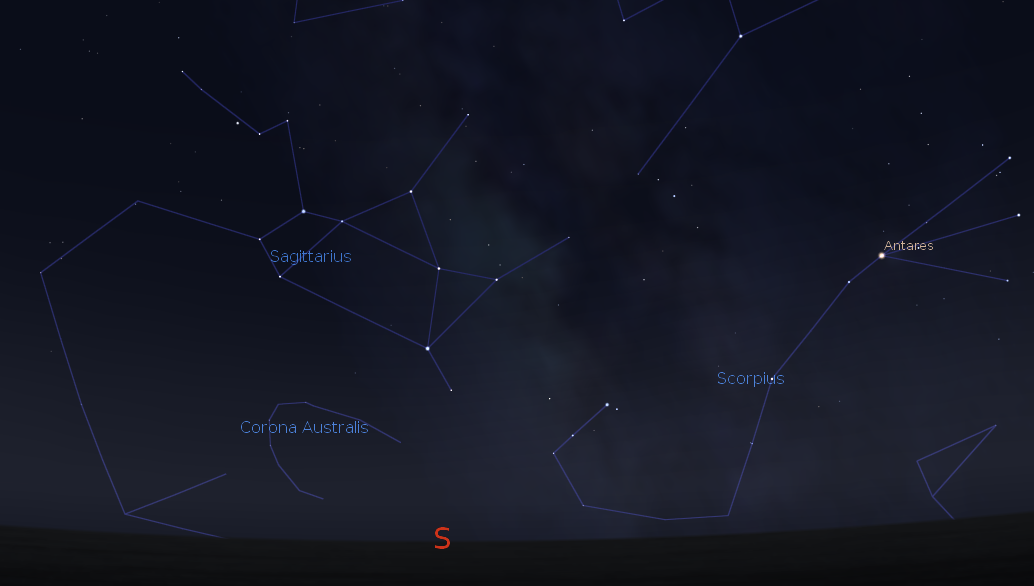
Sagittarius and Scorpius. Created using Stellarium.
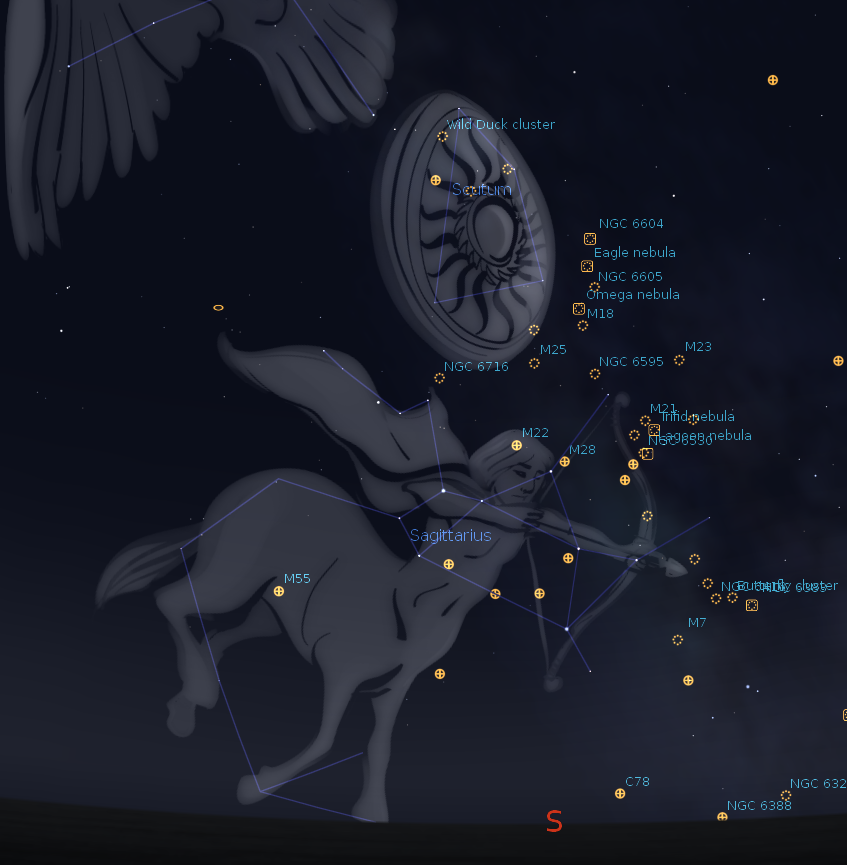
Binocular and telescope deep sky objects in Scutum and Sagittarius. Created using Stellarium.
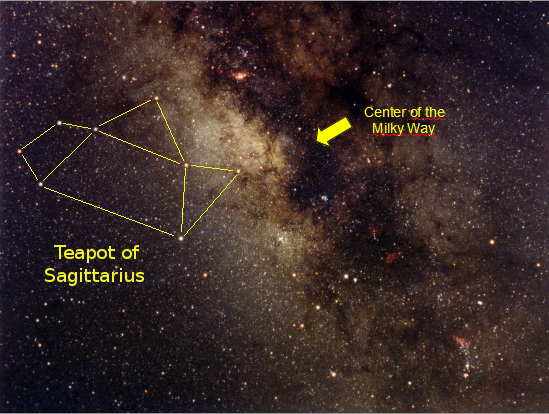
Location of the center of the Milky Way and the Teapot of Sagittarius.
06/30/2014 – Ephemeris – The celestial snake handler
Ephemeris for Monday, June 30th. Today the sun will be up for 15 hours and 30 minutes, setting at 9:31. The moon, 3 days past new, will set at 11:14 this evening. Tomorrow the sun will rise at 6:01. | The red star Antares shines in the south at 11 p.m. In the constellation of Scorpius. In the area of sky above and a little to the left lies a large constellation of faint stars called Ophiuchus, the serpent bearer. The constellation shape is like a large bell, which reminds me of the head, shoulders and arms of a fellow that’s holding the snake-like a weight lifter pulling up a heavy bar bell. The serpent he’s holding is Serpens, the only two-part constellation in the heavens. The head rises to Ophiuchus’ right and the tail extends up to the left. In legend Ophiuchus was a great physician, educated by the god Apollo, and the centaur Chiron, also found in the stars as Sagittarius, now rising below and left of him.
Times are for the Traverse City/Interlochen area of Michigan. They may be different for your location.
Addendum
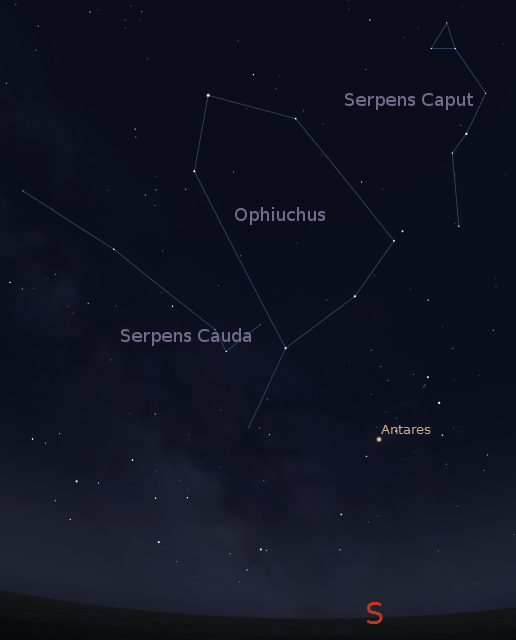
Ophiuchus and Serpens at 11 p.m.. Created using Stellarium.
09/26/2013 – Ephemeris – The Milky Way is crossing overhead
Ephemeris for Thursday, September 26th. The sun will rise at 7:34. It’ll be up for 11 hours and 57 minutes, setting at 7:31. The moon, at last quarter today, will rise at 12:17 tomorrow morning. | At 10 this evening the Milky Way will pass directly overhead. The bright star Deneb of the Summer Triangle and at the head of the Northern Cross is directly overhead at that time. Deneb is incidentally the tail of Cygnus the swan. The Milky Way stretches from the northeast to the southwest where the Teapot of Sagittarius is tipping, pouring out its tea on the horizon. The Milky Way can be enjoyed with the naked eye, binoculars or telescope. With the naked eye, we see it as the pre-scientific cultures did. The Milky way was a pathway of milk, the path that the American Indian warriors journeyed to the hereafter, the stars their camp fires shining in the night. In reality it is what we can see of our galaxy.
Times are for the Traverse City/Interlochen area of Michigan. They may be different for your location.
Addendum
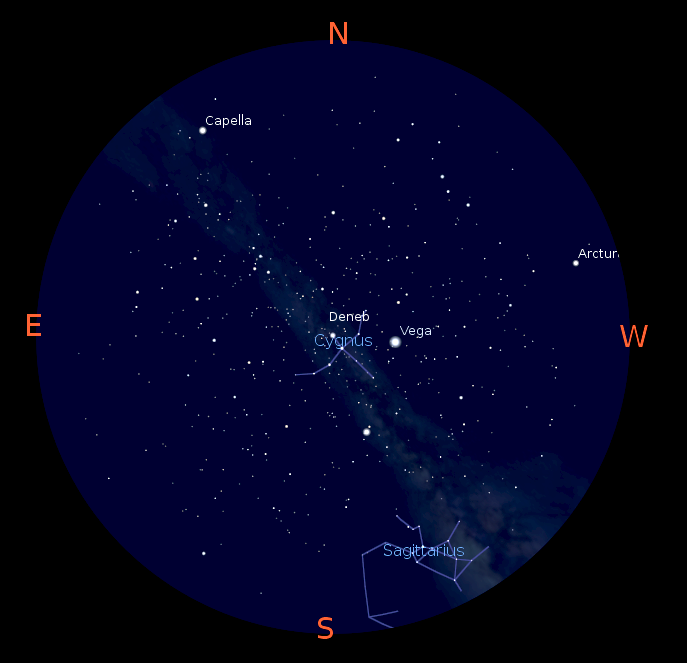
The Milky Way crosses the sky overhead at 10 p.m., September 26, 2013. Horizon to horizon view. Created using Stellarium.
08/08/2013 – Ephemeris – The wonders located in Scutum the shield
Ephemeris for Thursday, August 8th. The sun rises at 6:37. It’ll be up for 14 hours and 20 minutes, setting at 8:58. The moon, 2 days past new, will set at 9:28 this evening.
The teapot pattern of stars that is the constellation of Sagittarius lies at the southern end of the Milky Way this evening. It appears that the Milky Way is steam rising from the spout. The area above Sagittarius in the brightest part of the Milky Way is the dim constellation of Scutum the shield. Don’t bother looking for the stars that make up the constellation; what’s important is the star clouds of the Milky Way. Scan this area with binoculars or small telescope for star clusters and nebulae or clouds of gas. In binoculars both clusters and nebulae will appear fuzzy, but a small telescope will tell most of them apart. Even if you’ve never been able to find anything in your telescope, put on the lowest power eyepiece you have and scan back and forth for these wonders.
Times are for the Traverse City/Interlochen area of Michigan. They may be different for your location.
Addendum
Binocular and telescope deep sky objects in Scutum and Sagittarius. Created using Stellarium.
The symbols mean:
Circle with embedded cross – Globular star cluster (Very old compact star cluster)
Open dotted circle – Open or galactic star cluster (Young loose star cluster)
Square – Nebula (Here emission nebulae. In many cases with associated open clusters)
Ellipse – Galaxy
08/06/2013 – Ephemeris – The constellation of Sagittarius: centaur or teapot?
Ephemeris for Tuesday, August 6th. The sun rises at 6:34. It’ll be up for 14 hours and 26 minutes, setting at 9:00. The moon is new today, and won’t be visible.
The Milky Way runs from north to south through the heavens at 11 p.m. You’ll notice that the Milky Way is brighter and broader just above the horizon in the south. In that glow in the south is a star pattern that looks like a stout little teapot, with a bright stream of the Milky Way rising from the spout, which faces the west. This pattern of stars is the major part of the constellation called Sagittarius. According to Greek mythology Sagittarius is a centaur with a bow and arrow poised to shoot Scorpius the scorpion to the right. This centaur is named Chiron, the most learned of the breed, centaurs usually being a rowdy bunch. The center of the pin wheel of our galaxy lies hidden beyond the stars near the spout of the teapot.
Times are for the Traverse City/Interlochen area of Michigan. They may be different for your location.
Addendum
Location of the center of the Milky Way behind gas and dust clouds and the Teapot of Sagittarius.
Sagittarius and Scorpius at 11 p.m. on August 6, 2013. Created using Stellarium.
10/09/2012 – Ephemeris – Capricornus the sea-goat
Ephemeris for Tuesday, October 9th. The sun will rise at 7:50. It’ll be up for 11 hours and 16 minutes, setting at 7:07. The moon, 1 day past last quarter, will rise at 2:16 tomorrow morning.
The sky around 9 p.m. when it gets dark is that of summer stars overhead and to the west while the stars of autumn approach from the east. The southern terminus of the Milky Way will reach the horizon in the southwest. The teapot shaped constellation of Sagittarius is tipped as if pouring its contents on the southwestern horizon. To the south is found the next constellation of the Zodiac Capricornus the sea goat. Capricornus doesn’t have as bright a stars as Sagittarius. It looks like the stars trace a sagging triangle. Capricornus used to be the southernmost constellation of the Zodiac in ancient times, but precession, the slow wobbling of the earth’s axis, has shifted Sagittarius to that position now.
Times are for the Traverse City/Interlochen area of Michigan. They may be different for your location.
Addendum
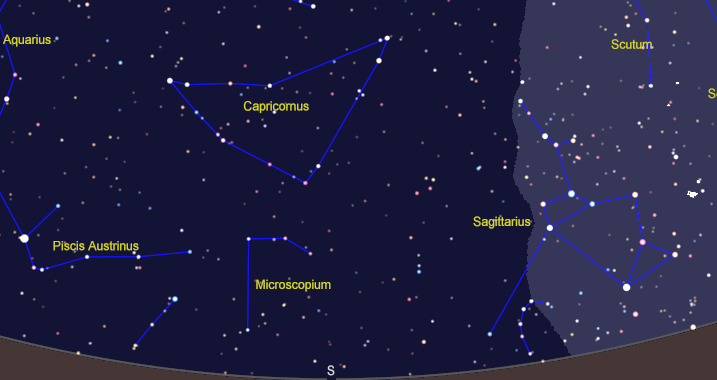
Capricornus the way I see it. Created using Cartes duCiel.
09/11/2012 – Ephemeris – The constellation Sagittarius the archer
Ephemeris for Tuesday, September 11th. The sun will rise at 7:17. It’ll be up for 12 hours and 42 minutes, setting at 7:59. The moon, 3 days past last quarter, will rise at 3:28 tomorrow morning.
Low in the south at 10 p.m. lies the constellation of Sagittarius. The name means archer, but this isn’t just any old fellow with a bow and arrow. It’s a centaur with a bow and arrow. These half man half horse creatures were a rowdy bunch; kind of the ancient Greek counterpart of a motorcycle gang. The one exception is this centaur, Chiron by name. He was highly educated, and learned medicine from the great physician Aesculapius, whom we see in the sky to the upper right as the constellation Ophiuchus. His drawn bow and arrow can also be seen in the stars here, pointing to Scorpius the scorpion’s heart. If it’s hard seeing a Centaur here don’t be disappointed. To most of us the constellation looks like a stout little teapot.
Times are for the Traverse City/Interlochen area of Michigan. They may be different for your location.
Addendum
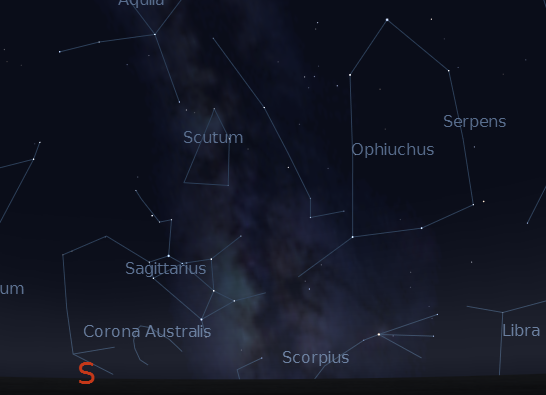
Sagittarius and the Milky Way September 11, 2012 10 p.m. Created using Stellarium.
08/14/2012 – Ephemeris – The asterism of the Teapot (Sagittarius)
Ephemeris for Tuesday, August 14th. The sun rises at 6:44. It’ll be up for 14 hours and 4 minutes, setting at 8:48. The moon, 3 days before new, will rise at 4:40 tomorrow morning. | If the ancient Greeks had teapots the constellation we call Sagittarius might have been Teapotius or something. It’s low in the south at 11 p.m. with the Milky Way rising like steam from its spout. Sagittarius is supposed to be a centaur with a bow and arrow. However to us the dearth of centaurs around outside of Harry Potter movies, and lots of teapots, and that great children’s song that perfectly describes the Sagittarius teapot that’s what we imagine. So the teapot is an asterism, like the Big Dipper, not one of the official constellations. A pair of binoculars is all you need to spot many fuzzy objects in and around Sagittarius. Pay special attention to that steam of the Milky way above the teapot’s spout for many fuzzy objects.
Times are for the Traverse City/Interlochen area of Michigan. They may be different for your location.
Addendum
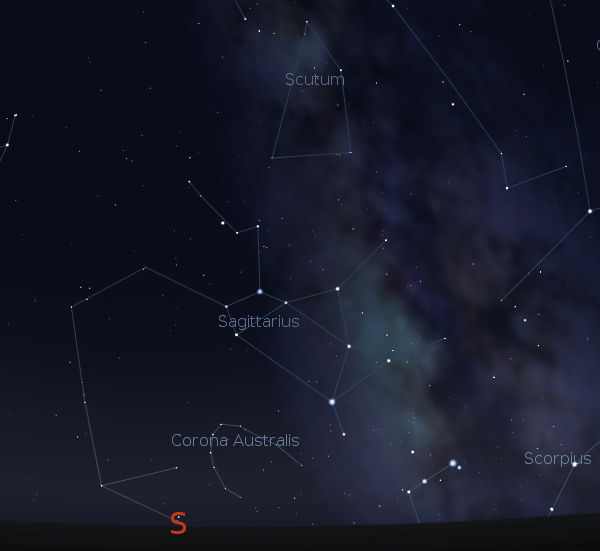
The constellations Sagittarius and Scutum. Created using Stellarium.
08/22/11 – Ephemeris – The constellation Sagittarius
Monday, August 22nd. The sun rises at 6:52. It’ll be up for 13 hours and 44 minutes, setting at 8:36. The moon, 1 day past last quarter, will rise at 12:50 tomorrow morning.
The Milky Way runs from north to south through the heavens at 11 p.m. You’ll notice that the Milky Way is brighter and broader just above the horizon in the south. In that glow in the south is a star pattern that looks like a stout little teapot, with a the Milky way like steam rising from the spout, which faces the west. This pattern of stars is the major part of the constellation called Sagittarius. According to Greek mythology Sagittarius is a centaur with a bow and arrow poised to shoot Scorpius the scorpion to the right. This centaur is called Chiron, the most learned of the breed, centaurs usually being a rowdy bunch. The center of the pinwheel of our galaxy lies hidden beyond the stars above the spout of the teapot.
* Times are for the Traverse City/Interlochen area of Michigan. They may be different for your location.
Addendum
The constellations Sagittarius and Scutum. Created using Stellarium.
 Bob Moler's Ephemeris Blog