Archive
12/21/2020 – Ephemeris – Jupiter and Saturn will appear super close tonight
This is Ephemeris for Monday, December 21st. Today the Sun will be up for 8 hours and 48 minutes, setting at 5:05, and it will rise tomorrow at 8:17. The Moon, at first quarter today, will set at 12:45 tomorrow morning.
Today we begin winter and the conjunction or extremely close grouping of Jupiter and Saturn low in the southwestern sky from about 6 to 7 pm. At that time they will be a fifth of the diameter of the Moon apart. Depending on sky conditions, Saturn may not even be visible, lost in twilight or in the glare of Jupiter which is 11 times brighter. A pair of binoculars, or a low power telescope will confirm their appearance, with Saturn to the upper right of Jupiter. Conjunctions of Jupiter and Saturn occur about every 20 years, the last in 2000. The conjunction before that was a triple conjunction like has been proposed for the Star of Bethlehem occurring during the first 11 months of 1981. The next conjunction will be on November 5th, of 2040.
The event times given are for the Traverse City/Interlochen area of Michigan. They may be different for your location.
Addendum
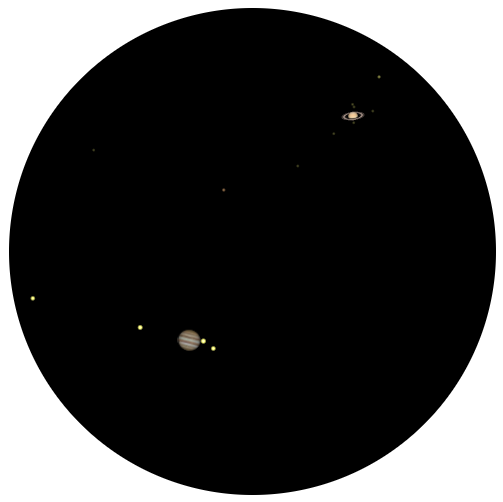
Jupiter and Saturn as they would appear in a low power telescope field tonight December 21, 2020, between 6 and 7 pm. Created using Cartes du Ciel (Sky Charts)
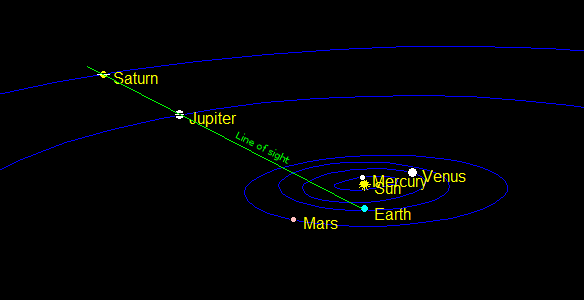
The Earth-Jupiter-Saturn conjunction line of sight. Created using my LookingUp for Windows program.
12/16/2020 – Ephemeris – Let’s look for the naked-eye planets for this week
This is Bob Moler with Ephemeris for Wednesday, December 16th. Today the Sun will be up for 8 hours and 48 minutes, setting at 5:03, and it will rise tomorrow at 8:14. The Moon, 2 days past new, will set at 7:09 this evening.
Let’s look for the naked-eye planets for this week. Jupiter and Saturn are both low in the southwestern sky from 6 to 7 pm. Jupiter is the very bright one. Above and left it by half a degree or one moon width will be dimmer Saturn. Below them tonight will be the thin crescent Moon. They will cross paths for us on the evening of December 21st and be seen in the same low power telescope field that evening. Jupiter will set first tonight at 7:40 pm with Saturn following four minutes later. Quite high in the southeast at that hour will be Mars, still in Pisces. Mars’ distance is increasing to 71 million miles (114 million kilometers) away. It will set at 2:55 tomorrow morning. Brilliant Venus will rise at 6:16 am in the east-southeast as it seems to retreat slowly toward the Sun, but actually it’s heading way around behind the Sun.
The event times given are for the Traverse City/Interlochen area of Michigan. They may be different for your location.
Addendum
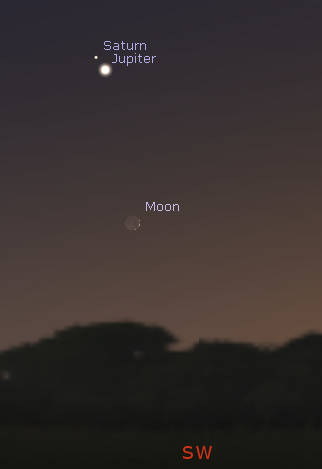
Jupiter and Saturn with Moon at 6 pm tonight December 16, 2020. Created using Stellarium.
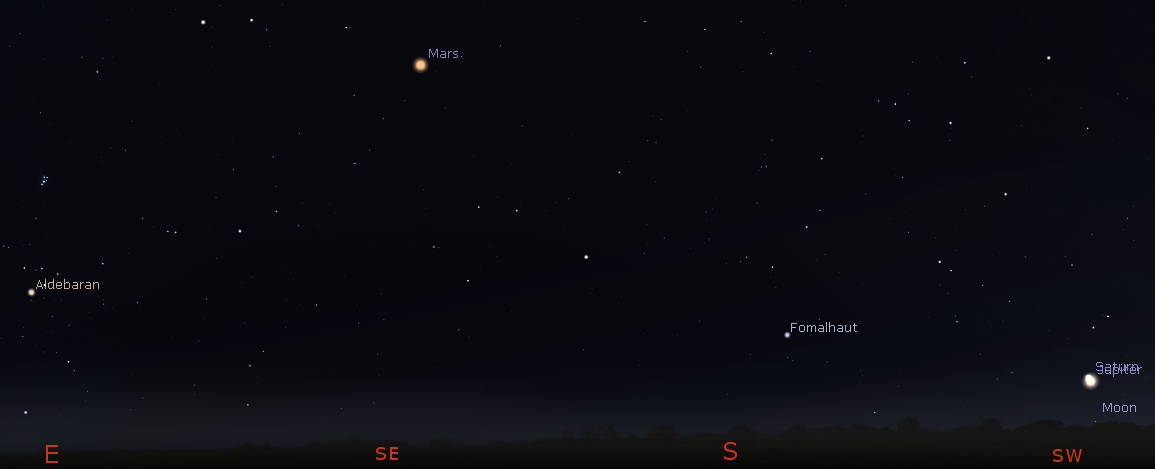
Evening planet panorama showing Mars, Jupiter, Saturn and the Moon setting at 6:30 pm December 16, 2020. Click on the image to enlarge. Created using Stellarium.
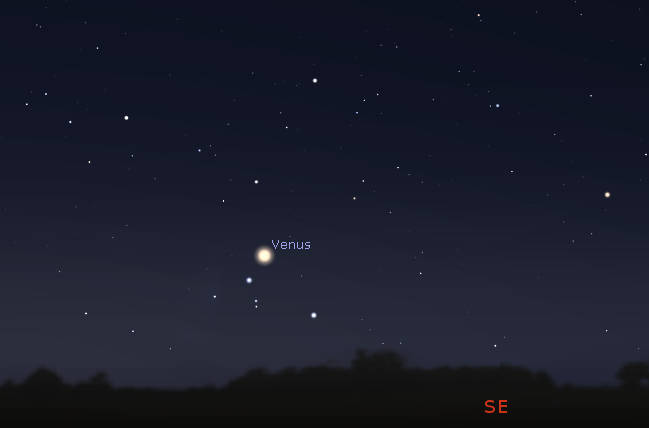
Venus low in the southeast at 7 am December17, 2020. Venus is all by its lonesome in the morning sky. No need for a panorama, so we’re zoomed in a bit. The morning sky has is not as friendly to morning planets as it was earlier in autumn season as we embark into winter next week. Created using Stellarium.
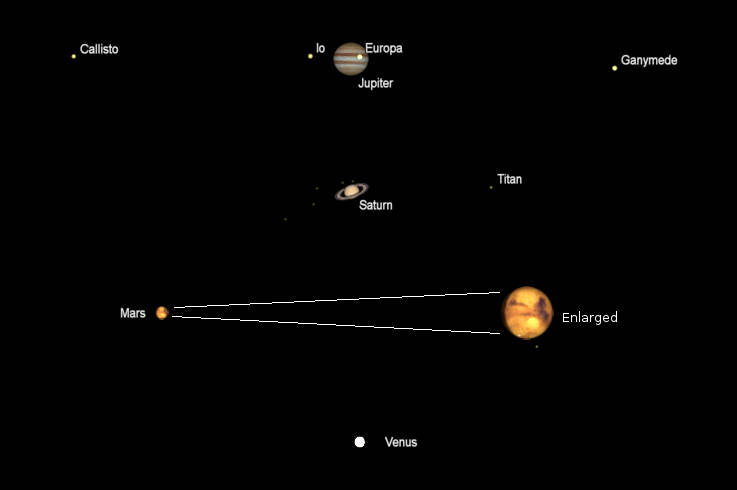
The planets as seen in a telescope (north up) with the same magnification for the night of December 16/17, 2020. Times of the display are: Jupiter and Saturn, 6 pm and Mars, 8 pm; Venus, 7 am. Apparent diameters: Jupiter, 33.49″; Saturn, 15.41″, rings, 35.90″; Mars, 12.20″, and Venus, 11.10″. Europa is transiting Jupiter and will be generally invisible. Mars also displays an enlargement showing surface detail. Mars was closest to the Earth this go-a-round on October 6. The ” symbol means seconds of arc (1/3600th of a degree.) Created using Cartes du Ciel (Sky Charts).
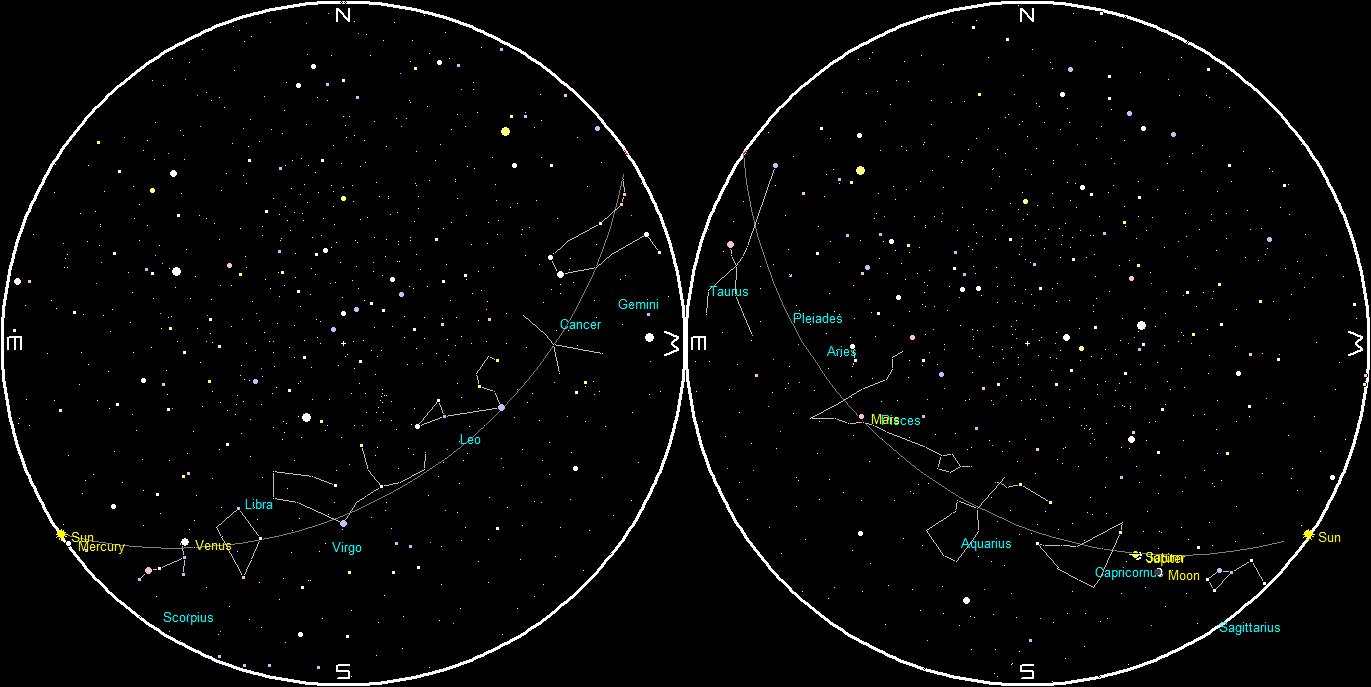
Planets and the Moon at sunset and sunrise of a single night starting with sunset on the right on December 16, 2020. The night ends on the left with sunrise on the 17th. I’m afraid that the labels for Jupiter and Saturn will overlap, since the planets are getting very close. Click on the image to enlarge. Created using my LookingUp program.
12/09/2020 – Ephemeris – A look at the naked-eye planets for this week
This is Ephemeris for Wednesday, December 9th. Today the Sun will be up for 8 hours and 53 minutes, setting at 5:02, the earliest sunset, and it will rise tomorrow at 8:09. The Moon, 2 days past last quarter, will rise at 2:55 tomorrow morning.
Let’s look for the naked-eye planets for this week. Jupiter and Saturn are both low in the southwestern sky from 6 to 7 pm. Jupiter is the very bright one. Above and left it by one and a half degrees or three moon widths will be dimmer Saturn. They are slowly closing, so they will cross paths for us on the evening of December 21st and be seen in the same low power telescope field that evening. Jupiter will set first tonight at 8 pm with Saturn following at 8:08. Quite high in the southeast at that hour will be Mars, still in Pisces. Mars’ distance is increasing to 65.3 million miles (105.2 million km) away. It will set at 3:10 tomorrow morning. Brilliant Venus will rise at 5:58 am in the east-southeast as it retreats slowly towards the Sun, but actually it’s heading around behind the Sun.
The event times given are for the Traverse City/Interlochen area of Michigan. They may be different for your location.
Addendum
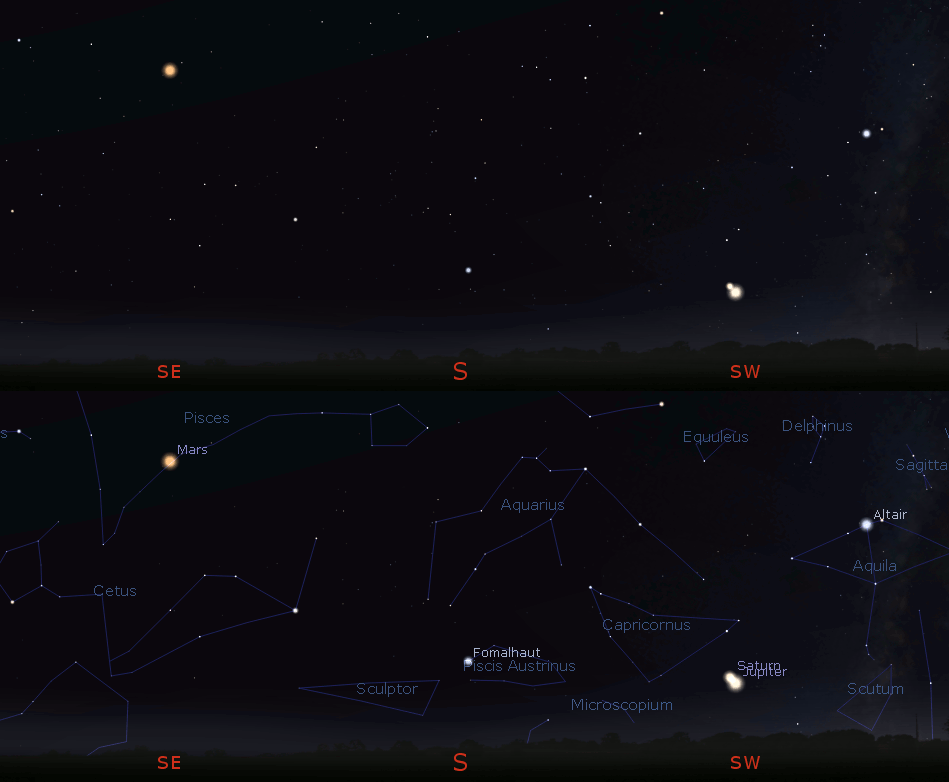
The evening planets seen at 6:30 pm or about an hour and a half after sunset December 9, 2020. Animation showing non-annotated sky and then with annotations. Click on the image to enlarge. Created using Stellarium and GIMP.
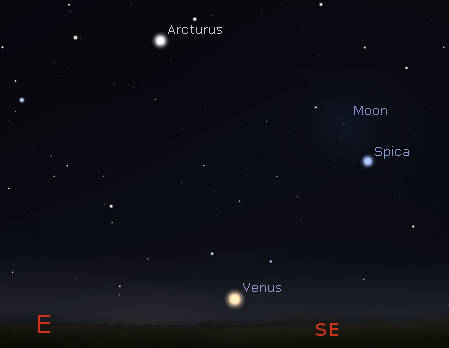
Venus and the waning crescent Moon at 6:30 am on December 10, 2020. Created using Stellarium.
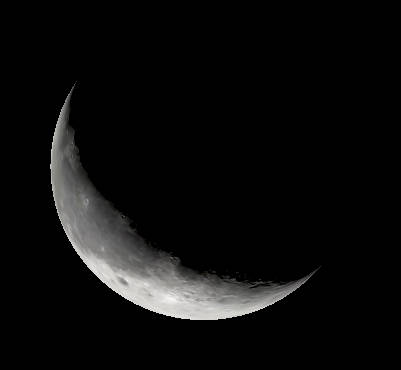
The waning crescent Moon as it might appear in binoculars or a small telescope at 6:30 am December 10, 2020. Created using Stellarium.
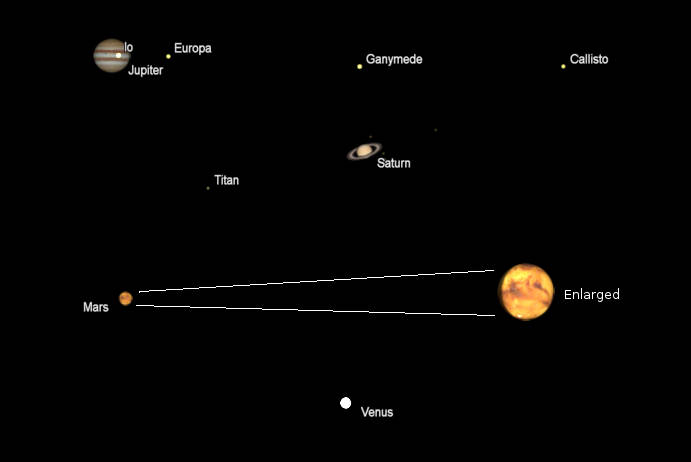
The planets as seen in a telescope (north up) with the same magnification for the night of December 9/10, 2020. Times of the display are: Jupiter, Saturn and Mars, 6:30 pm; Venus, 6:30 am. Apparent diameters: Jupiter, 33.85″; Saturn, 15.51″, rings, 36.13″; Mars, 13.18″, and Venus 11.32″. Io is transiting Jupiter and will be generally invisible. Mars also displays an enlargement showing surface detail. Mars was closest to the Earth this go-a-round on October 6. The ” symbol means seconds of arc (1/3600th of a degree). Created using Cartes du Ciel (Sky Charts).
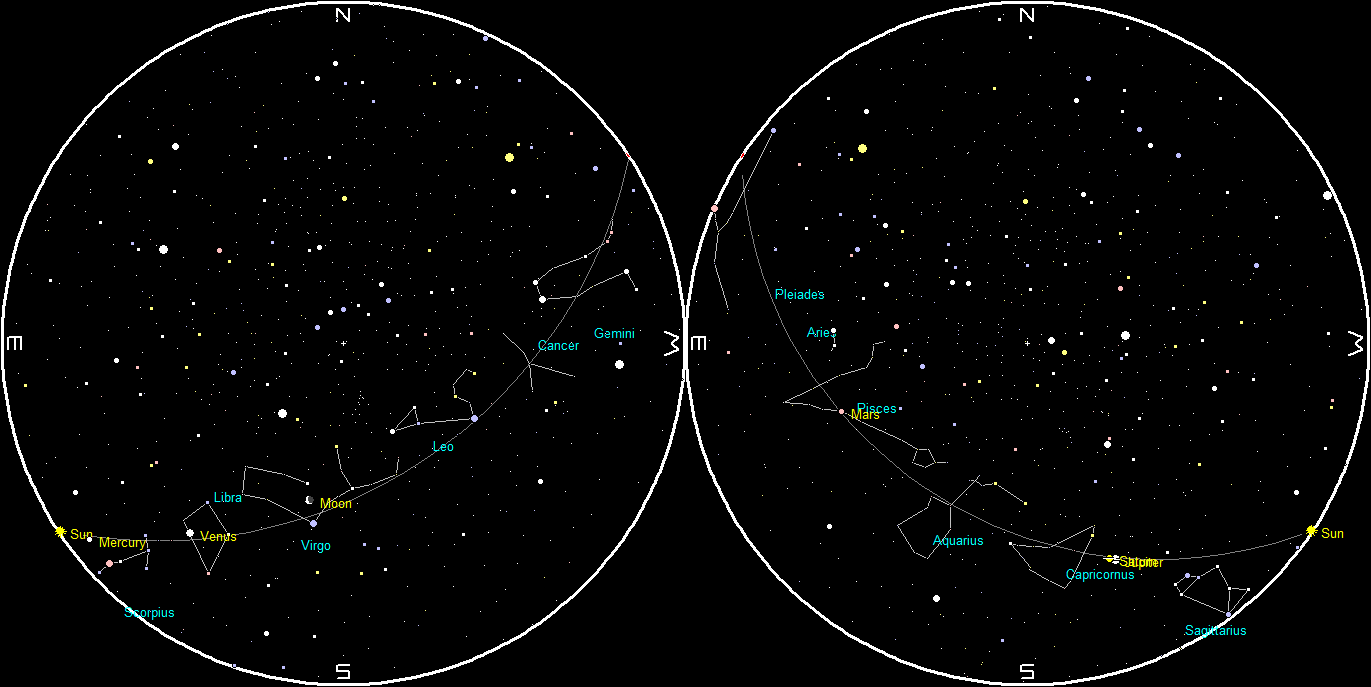
Planets and the Moon at sunset and sunrise of a single night starting with sunset on the right on December 9, 2020. The night ends on the left with sunrise on the 10th. I’m afraid that the labels for Jupiter and Saturn will overlap, since the planets are getting very close. Click on the image to enlarge. Created using my LookingUp program.
12/02/2020 – Ephemeris – A look at the naked-eye planets for this week
This is Ephemeris for Wednesday, December 2nd. Today the Sun will be up for 9 hours and 1 minute, setting at 5:03, and it will rise tomorrow at 8:02. The Moon, 2 days past full, will rise at 6:51 this evening.
Let’s look for the naked-eye planets for this week. Jupiter and Saturn are both low in the southwestern sky from 7 to 8 pm. Jupiter is the very bright one. Above and left it by 2 degrees or 4 moon widths will be dimmer Saturn. They are slowly closing, so they will cross paths on the evening of December 21st and be seen in the same telescope field that evening. Jupiter will set first tonight at 8:20 with Saturn following at 8:32. Quite high in the southeast at that hour will be Mars, still in Pisces. Mars’ distance is increasing to 60.2 million miles (97.0 million km) away. Mars will set at 3:27 tomorrow morning. Brilliant Venus will rise at 5:40 am in the east-southeast as it retreats slowly towards the Sun, but actually it’s heading around behind the Sun.
The event times given are for the Traverse City/Interlochen area of Michigan. They may be different for your location.
Addendum
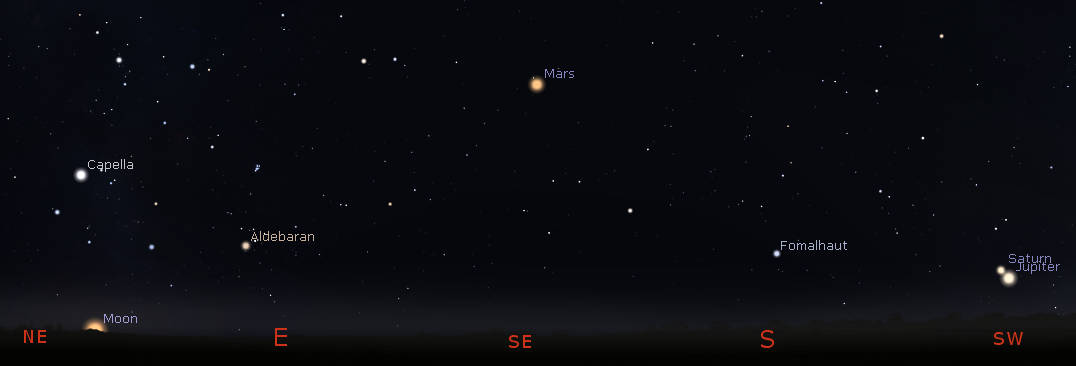
The evening planets with the Mon rising at 7 pm tonight December 2, 2020. Click on the image to enlarge. Created using Stellarium.
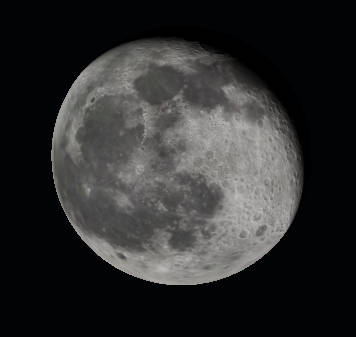
The Moon as it might be seen tonight at 9 pm, December 2, 2020. Created using Stellarium.
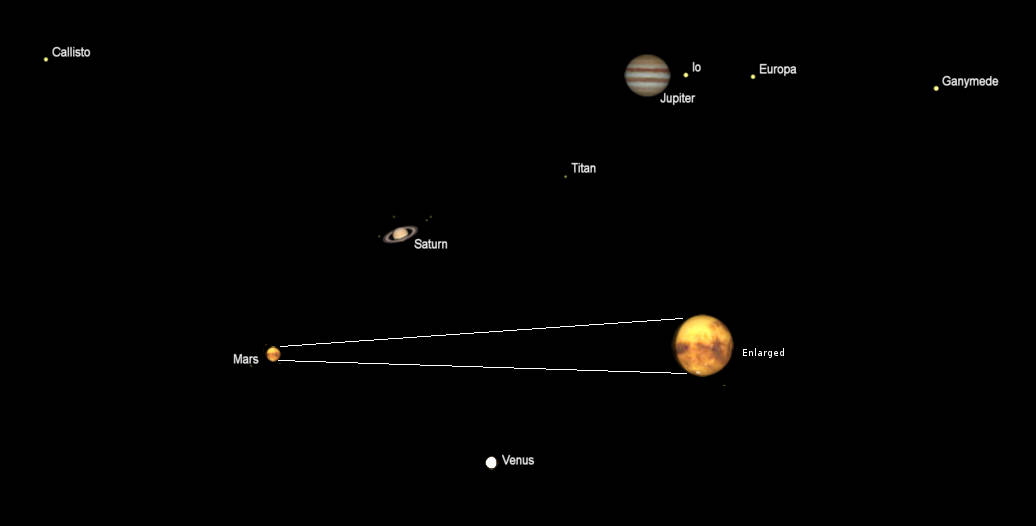
The planets as seen in a telescope (north up) with the same magnification for the night of November 25/26, 2020. Times of the display are: Jupiter, Saturn and Mars, 7 pm; Venus, 6:30 am. Apparent diameters: Jupiter, 34.28″; Saturn, 15.63″, rings, 36.41″; Mars, 14.27″; and Venus, 11.57″. Mars also displays an enlargement showing surface detail. Mars was closest to the Earth this go-a-round on October 6. The ” symbol means seconds of arc (1/3600th of a degree.) Click on the image to enlarge. Created using Cartes du Ciel (Sky Charts).
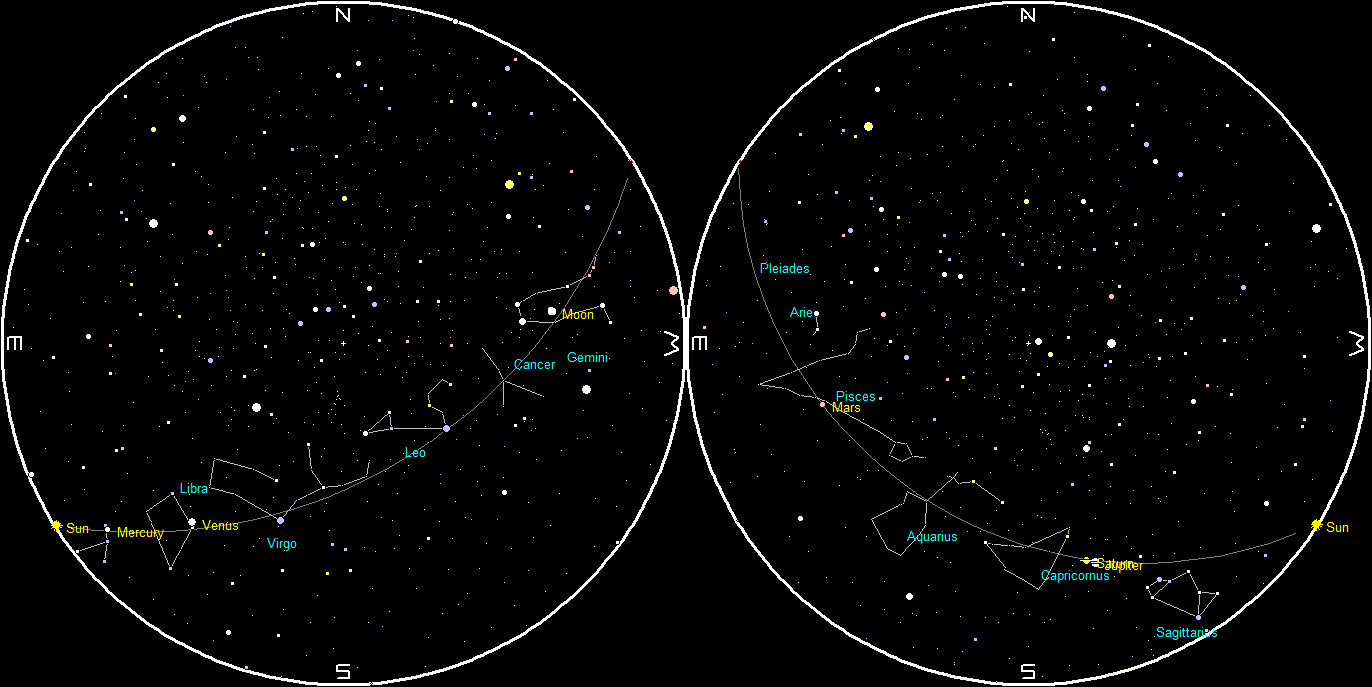
Planets and the Moon at sunset and sunrise of a single night starting with sunset on the right on December 2, 2020. The night ends on the left with sunrise on the 3rd. I’m afraid that the labels for Jupiter and Saturn will overlap, since the planets are getting very close. Click on the image to enlarge. Created using my LookingUp program.
11/26/2020 – Ephemeris – A look at Saturn (planet and god) in mythology
This is Ephemeris for Thanksgiving Day, Thursday, November 26th. Today the Sun will be up for 9 hours and 11 minutes, setting at 5:05, and it will rise tomorrow at 7:55. The Moon, 4 days before full, will set at 4:59 tomorrow morning.
Over the next 25 days Jupiter and Saturn will draw together to be in conjunction. And like I said Tuesday, I don’t know what that means astrologically, since I don’t believe in that stuff. I find the universe quite indifferent to my fate or the fate of anything happening on the third rock. Saturn, which will seem to cross paths with Jupiter on the evening of December 21st, a few hours after winter starts is named after the Roman god of agriculture and periodic renewal among others. He is depicted carrying a scythe, and even today we see him as the Grim Reaper, and at the end of the year as Father Time. The Saturn is the Roman counterpart of the Greek Cronus a Titan, the bringer of old age. It’s a fitting name for the slowest of the naked-eye planets, known from antiquity, taking almost 30 years to shuffle its way around the Sun.
The event times given are for the Traverse City/Interlochen area of Michigan. They may be different for your location.
Addendum
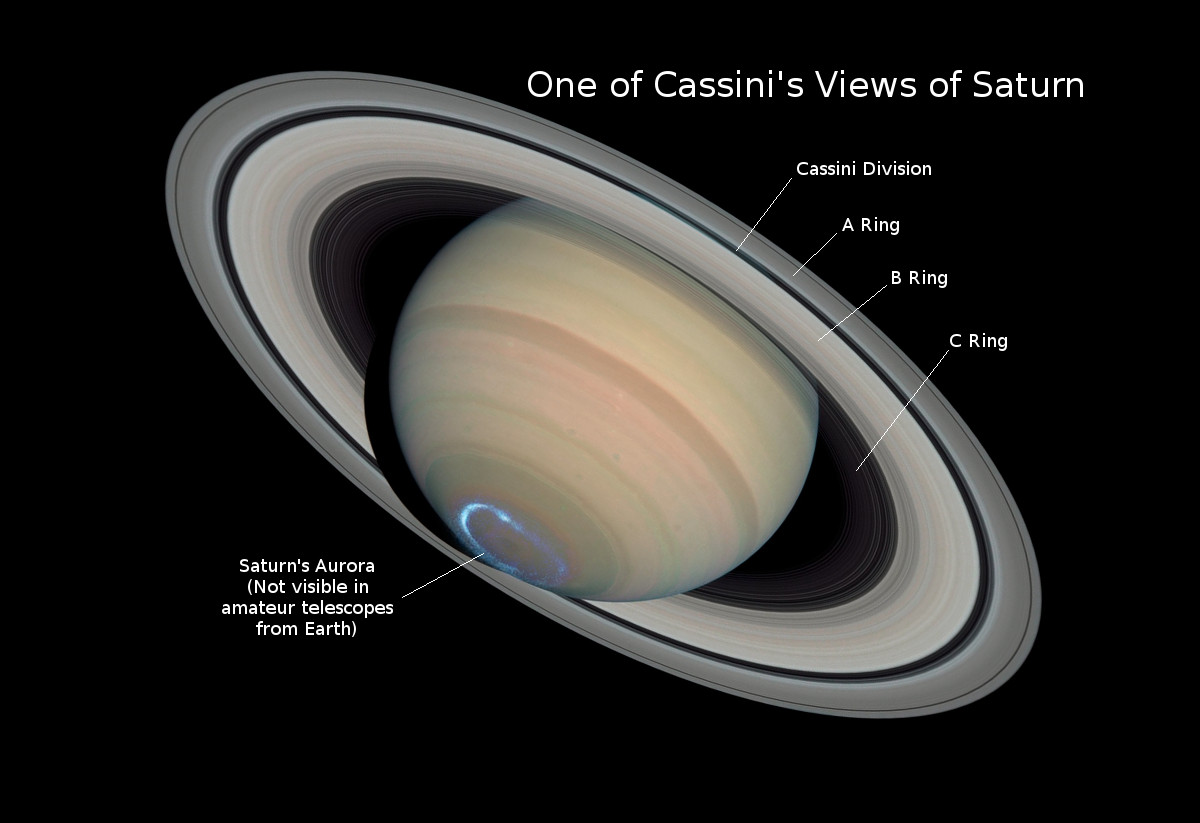
Saturn and rings from the Cassini spacecraft, plus the aurora oval in ultraviolet. Credit: NASA/JPL/Space Science Institute
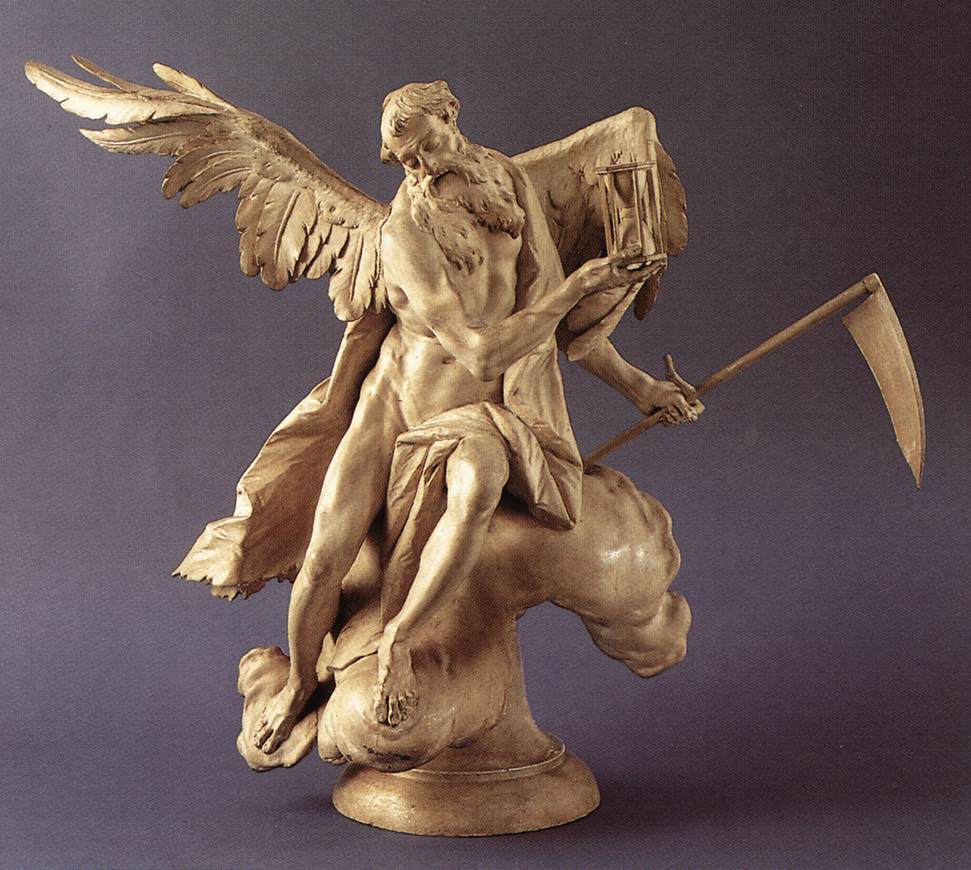
A statuette of Cronus (Saturn) shown holding a scythe and an hour glass. Source: https://respuestas.tips/quien-es-cronos-en-la-mitologia-griega/
11/25/2020 – Ephemeris – Let’s look for the naked-eye planets for this week
This is Ephemeris for Wednesday, November 25th. Today the Sun will be up for 9 hours and 12 minutes, setting at 5:06, and it will rise tomorrow at 7:54. The Moon, 4 days past first quarter, will set at 3:58 tomorrow morning.
Let’s look for the naked-eye planets for this week. Jupiter and Saturn are both low in the southwestern sky from 7 to 8 pm. Jupiter is the very bright one. Above and left will be dimmer Saturn. They are slowly closing, so they will cross paths on the evening of December 21st and be seen in the same telescope field that evening. Jupiter will set first tonight at 8:41 with Saturn following at 8:56. Off in the southeast at that hour will be Mars above the bright gibbous Moon tonight. Mars’ distance is increasing to 55.6 million miles (89.6 million kilometers) away. Mars will set at 3:47 tomorrow morning. Brilliant Venus will rise at 5:21 am in the east-southeast as it retreats slowly toward, but actually around the back of the Sun.
The event times given are for the Traverse City/Interlochen area of Michigan. They may be different for your location.
Addendum
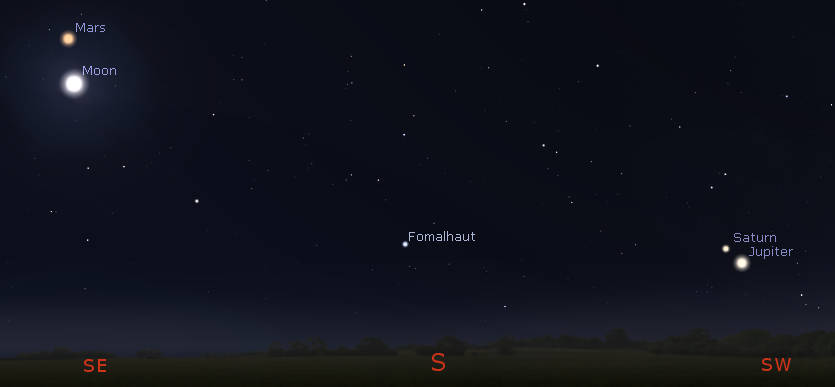
Evening planets and the Moon for 7 pm tonight November 25, 2020. Click on the image to enlarge. Created using Stellarium.
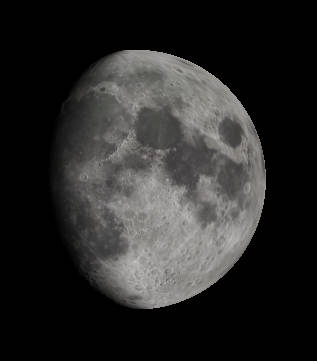
The gibbous Moon as it might be seen in binoculars this evening at 7 pm November 25, 2020. Created using Stellarium.
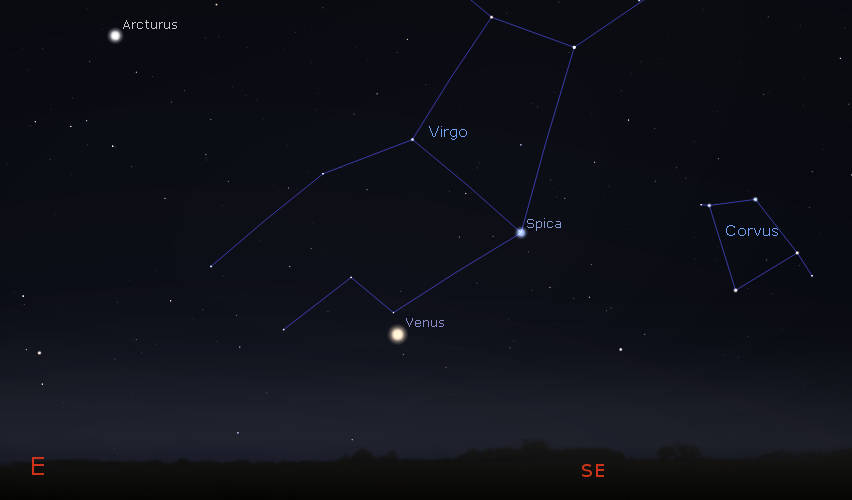
Venus and the morning constellations at 6:30 am tomorrow November 26, 2020. Created using Stellarium.
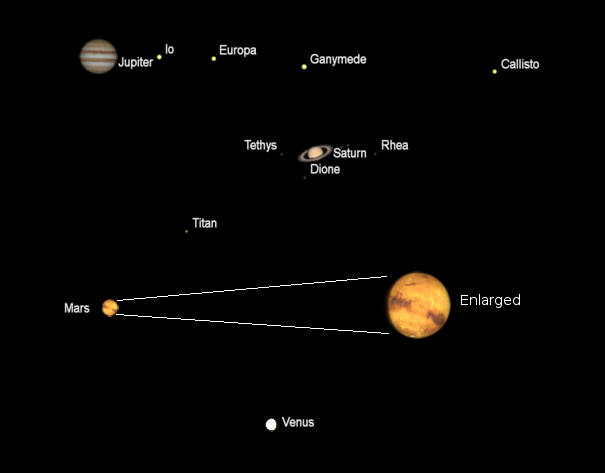
The planets as seen in a telescope (north up) with the same magnification for the night of November 25/26, 2020. Times of the display are: Jupiter and Saturn, 7 pm; Mars, 10 pm; Venus, 6:30 am. Apparent diameters: Jupiter, 34.76″; Saturn, 15.76″, rings, 36.72″; Mars, 15.45″, and Venus 11.85″. Mars also displays an enlargement showing surface detail. Mars was closest to the Earth this go-a-round on October 6. The ” symbol means seconds of arc (1/3600th of a degree.) Created using Cartes du Ciel (Sky Charts).
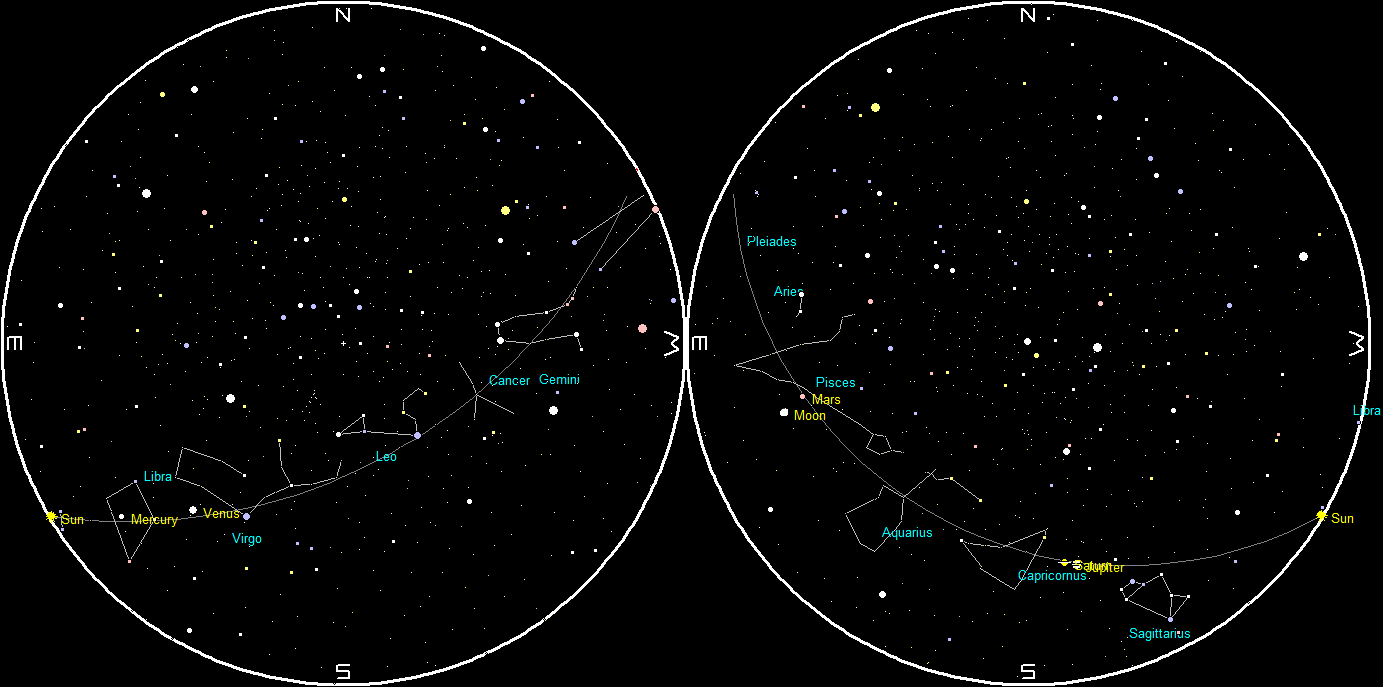
Planets and the Moon at sunset and sunrise of a single night starting with sunset on the right on November 25, 2020. The night ends on the left with sunrise on the 26th. I’m afraid that the labels for Jupiter and Saturn will overlap, since the planets are getting very close. Click on the image to enlarge. Created using my LookingUp program.
11/24/2020 – Ephemeris – Next month’s conjunction of Jupiter and Saturn
This is Ephemeris for Tuesday, November 24th. Today the Sun will be up for 9 hours and 14 minutes, setting at 5:06, and it will rise tomorrow at 7:53. The Moon, 3 days past first quarter, will set at 2:57 tomorrow morning.
Over the next 27 days Jupiter and Saturn will draw together to be in conjunction. I don’t know what that means astrologically, since I don’t believe in that stuff. It just means that Jupiter and Saturn lie near the same line of sight from the Earth. Though they will be almost as close as they get to each other, that won’t be that close. They were closest to each other earlier this month, at about 450 million miles (724 million kilometers). Jupiter is now about 525 million miles (845 million kilometers) away from us. Both, of course, are on the other side of the Sun from us. Jupiter, in its nearly 12 year orbit of the Sun laps the slower Saturn in it’s nearly 30 year orbit about every 20 years. It will do so again on November 5th of 2040.
The event times given are for the Traverse City/Interlochen area of Michigan. They may be different for your location.
Addendum
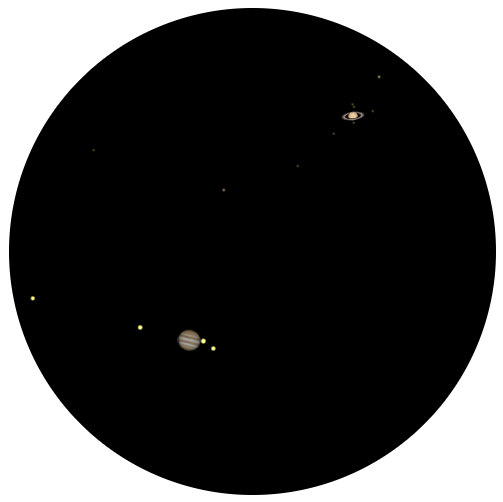
Possible telescopic view of Jupiter-Saturn conjunction 6 pm, December 21, 2020. Created using Cartes du Ciel (Sky Charts).
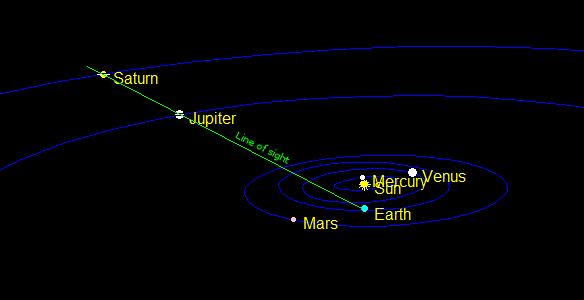
Jupiter and Saturn along the same line of sight from the Earth on December 21, 2020. Created using my LookingUp program.
11/17/2020 – Ephemeris – Let’s look for the naked-eye planets for this week
This is Bob Moler with Ephemeris for Wednesday, November 18th. Today the Sun will be up for 9 hours and 26 minutes, setting at 5:11, and it will rise tomorrow at 7:45. The Moon, halfway from new to first quarter, will set at 8:24 this evening.
Let’s look for the naked-eye planets for this week. Jupiter and Saturn are both low in the southwestern sky 7 to 8 pm. Jupiter is the very bright one. Above and left it will be the somewhat dimmer Saturn. They are near the Moon tonight. They are slowly closing, so they will cross paths on December 21st and be seen in the same telescope field that evening. Jupiter will set first tonight at 9:02 with Saturn following at 9:21. Off in the southeast at that hour will be Mars. Its distance is increasing to 51.5 million miles (82.9 million kilometers) away. Mars will set at 4:10 tomorrow morning. Brilliant Venus will rise at 5:03 am in the east-southeast as it retreats slowly toward the Sun. Close to ending its morning appearance now is Mercury which will rise at 6:15 am in the east.
The event times given are for the Traverse City/Interlochen area of Michigan. They may be different for your location.
Addendum
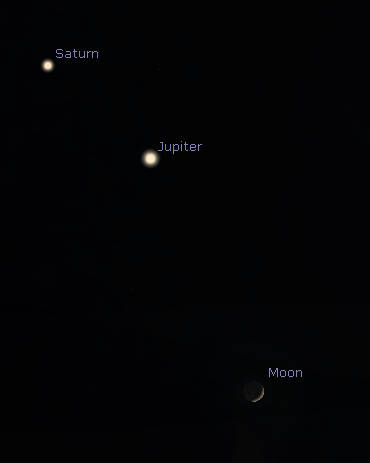
Jupiter, Saturn and Moon low in the southwest at 7:30 pm tonight, November 18, 2020. Created using Stellarium.
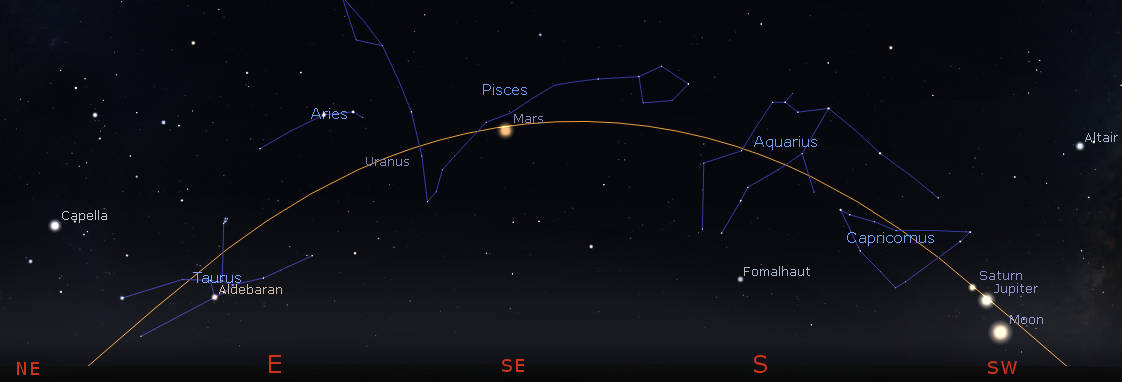
Evening planets, Moon, ecliptic and zodiac at 7:30 pm tonight November 18, 2020. Click on the image to enlarge. Created using Stellarium.
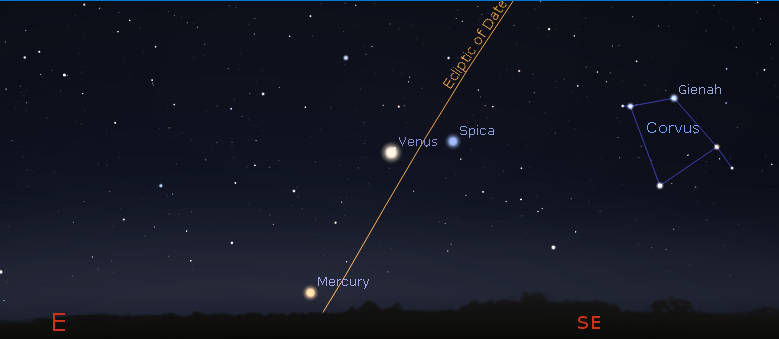
Venus and Mercury with the star Spica, the ecliptic (path of the Sun) and the constellation Corvus at 6:30 tomorrow morning November 19, 2020. Created using Stellarium.
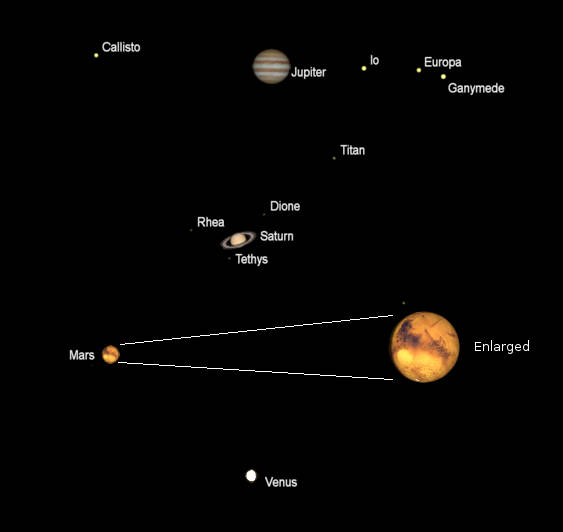
The planets as seen in a telescope (north up) with the same magnification for the night of November 18/19, 2020. Times of the display are: Jupiter and Saturn, 7:30 pm; Mars, 10 pm; Venus, 6:30 am. Apparent diameters: Jupiter, 35.30″; Saturn, 15.91″, rings, 37.06″; Mars, 16.72″, and Venus 12.15″. Mars also displays an enlargement showing surface detail. Mars was closest to the Earth this go-a-round on October 6. The ” symbol means seconds of arc (1/3600th of a degree.) Created using Cartes du Ciel (Sky Charts).
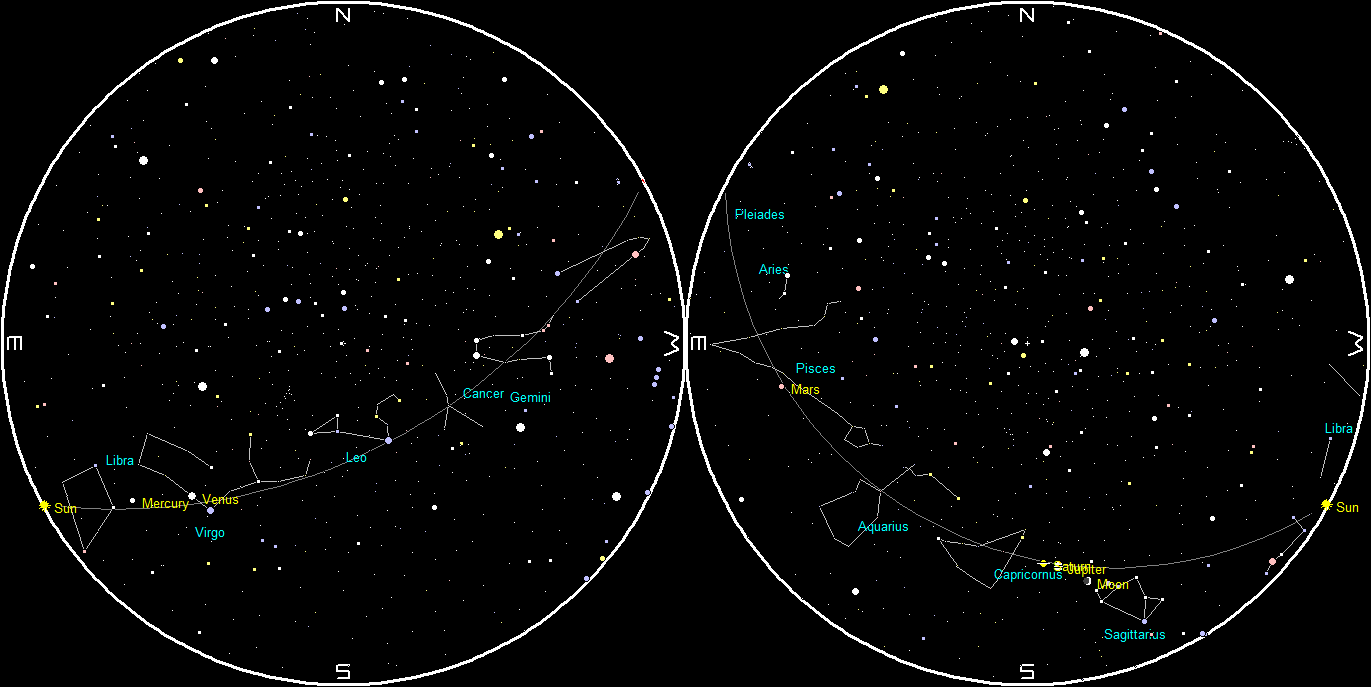
Planets and the Moon at sunset and sunrise of a single night starting with sunset on the right on November 18, 2020. The night ends on the left with sunrise on the 19th. I’m afraid that the labels for Jupiter and Saturn will overlap, since the planets are getting very close. Click on the image to enlarge. Created using my LookingUp program.
11/11/2020 – Ephemeris – Let’s look for the naked-eye planets for this week
This is Ephemeris for Veteran’s Day, Wednesday, November 11th. Today the Sun will be up for 9 hours and 43 minutes, setting at 5:18, and it will rise tomorrow at 7:36. The Moon, 3 days past last quarter, will rise at 4:00 tomorrow morning.
Let’s look for the naked-eye planets for this week. Jupiter and Saturn are both low in the southwestern sky at 8 pm. Jupiter is the very bright one. Above and left it will be the somewhat dimmer Saturn. They are closing slowly, so they will cross paths on December 21st and be seen in the same telescope field that evening. Jupiter will set first tonight at 9:24 with Saturn following at 9:46. Off in the southeast at that hour will be Mars. Its distance is increasing to 47.7 million miles (76.9 million km) away. Mars will set at 4:35 tomorrow morning. Brilliant Venus will rise at 4:46 am in the east as it retreats slowly toward the Sun. Making a morning appearance this week is Mercury which will rise at 5:52 am in the east.
The event times given are for the Traverse City/Interlochen area of Michigan. They may be different for your location.
Addendum
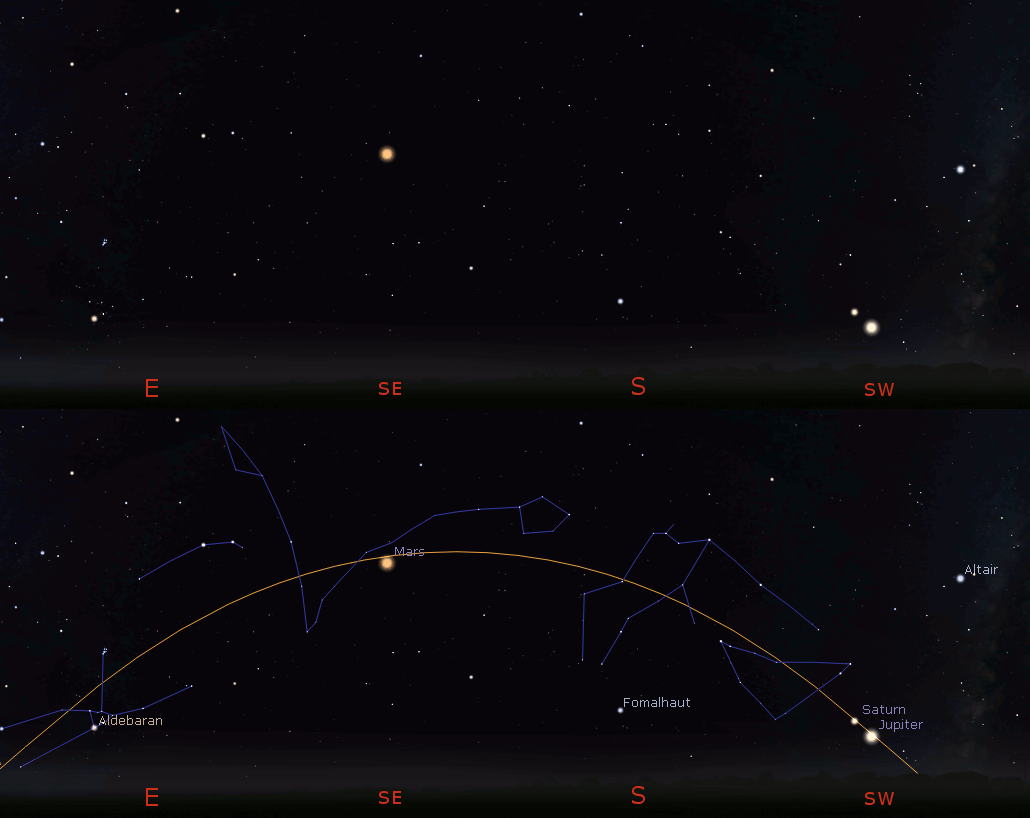
Evening planet finder animation for 8 pm November 11, 2020. The orange line is the ecliptic, the plane of the Earth’s orbit projected on the sky, and the path of the Sun through the year. All the planets can be found near that line. The zodiacal constellations from Taurus on the left to Capricornus on the right are shown without labels. Click on the image to enlarge. Created using Stellarium and GIMP.
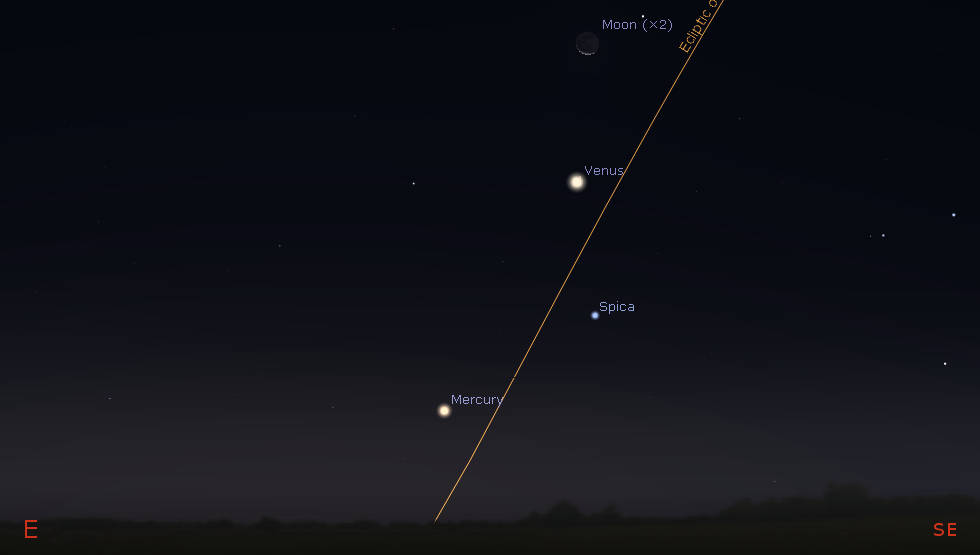
Mercury, Venus, and the Moon tomorrow morning November 12, 2020 at 6:30 am. The orange line is the ecliptic, the plane of the Earth’s orbit. It is the path of the Sun in the sky, The Moon is a crescent, and displayed at twice its apparent size. Over the next week Venus and Mercury will slide downward along the ecliptic in relation to the stars. Created using Stellarium.
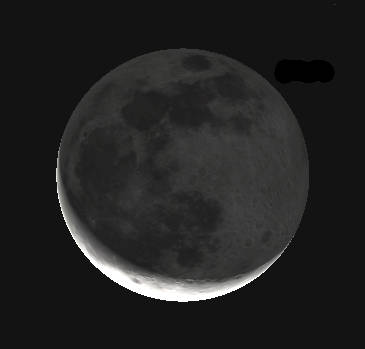
The thin crescent Moon as it might appear in binoculars with earthshine at 6:30 am, November 12, 2020. The very dark crater visible is Grimaldi a 134 mile or 222 kilometer diameter crater named after Francesco Grimaldi a 17th century Jesuit astronomer and physicist. Created using Stellarium.
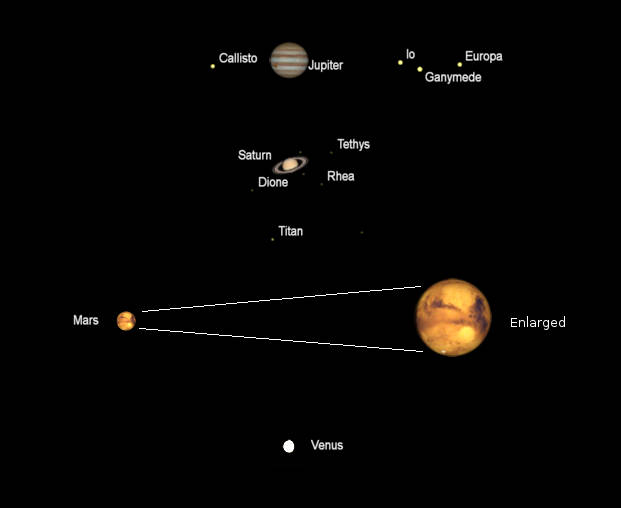
The planets as seen in a telescope (north up) with the same magnification for the night of November 11/12, 2020. Times of the display are: Jupiter and Saturn, 8 pm; Mars, 11 pm; Venus, 6:30 am. Apparent diameters: Jupiter, 35.90″; Saturn, 16.07″, rings, 37.43″. Mars, 18.04″, and Venus 12.49″. Mars also displays an enlargement showing surface detail. Mars was closest to the Earth this go round on October 6. The ” symbol means seconds of arc (1/3600th of a degree.) Created using Cartes du Ciel (Sky Charts).
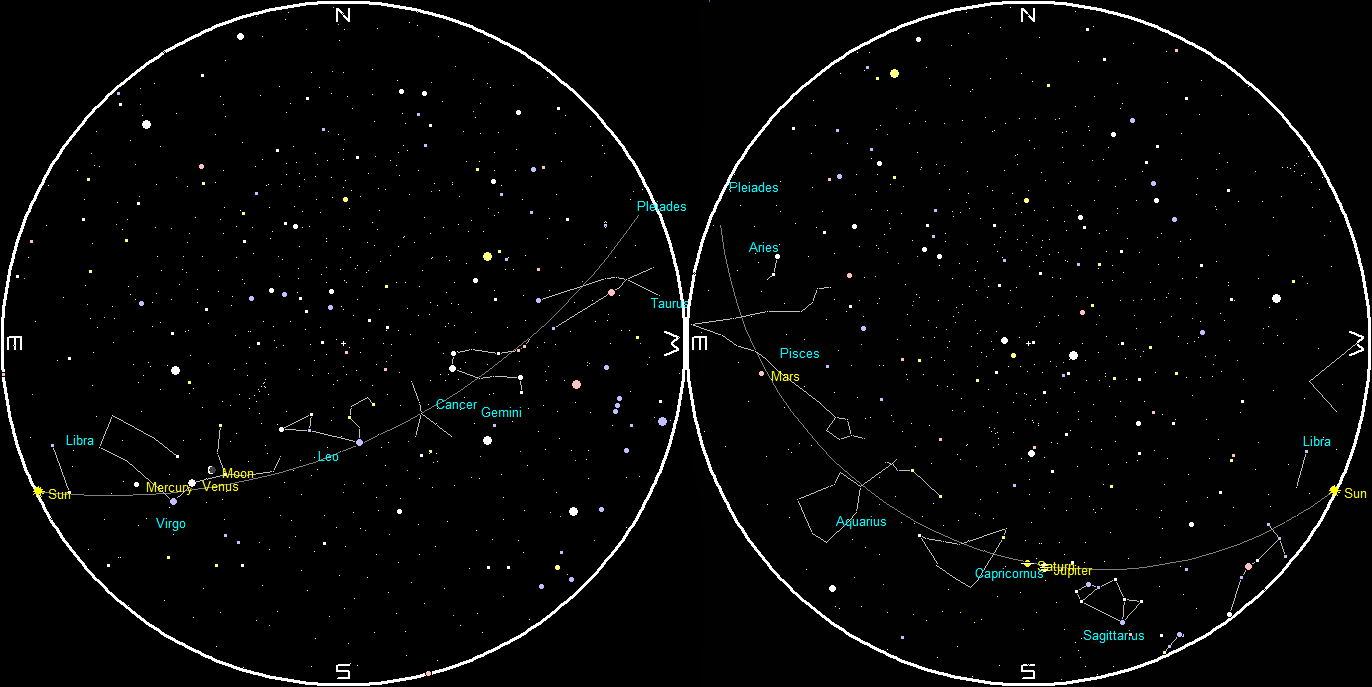
Planets and the Moon at sunset and sunrise of a single night starting with sunset on the right on November 11, 2020. The night ends on the left with sunrise on 12th. Click on the image to enlarge. Created using my LookingUp program.
11/04/2020 – Ephemeris – Let’s find the naked-eye planets for this week
This is Ephemeris for Wednesday, November 4th. Today the Sun will be up for 10 hours and 1 minute, setting at 5:26, and it will rise tomorrow at 7:26. The Moon, half way from full to last quarter, will rise at 8:04 this evening.
Let’s find the naked-eye planets for this week. Jupiter and Saturn are both low in the southwestern sky at 8 pm. Jupiter is the very bright one. Above and left it will be the somewhat dimmer Saturn. They are closing slowly, so they will cross paths on December 21st and be in the same telescope field that evening. Jupiter will set first tonight at 9:42 with Saturn following at 10:07. Off in the southeast at that hour will be Mars. Since the it was closest 29 days ago its distance has increased to 45.0 million miles (72.4 million kilometers) away. Mars will set at 5:04 tomorrow morning. Brilliant Venus will rise at 4:29 am in the east as it retreats slowly toward the Sun. Beginning to make a morning appearance now will be Mercury rising at 5:52 a.m. in the east.
The event times given are for the Traverse City/Interlochen area of Michigan. They may be different for your location.
Addendum
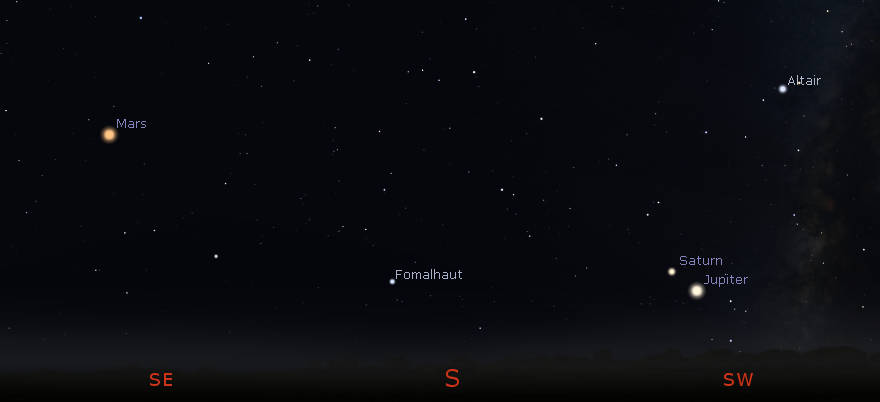
The evening planets and the Moon at 8 pm, just before the Moon will rise, tonight, November 4, 2020. Created using Stellarium.
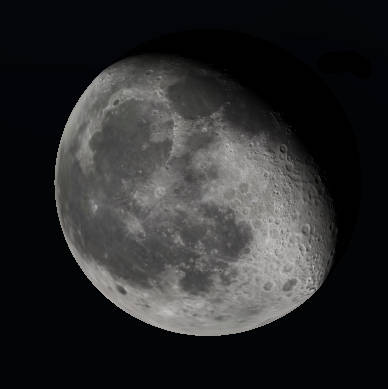
The waning gibbous Moon as it might be seen in binoculars or a small telescope at 9 pm tonight November 4, 2020. Created using Stellarium.
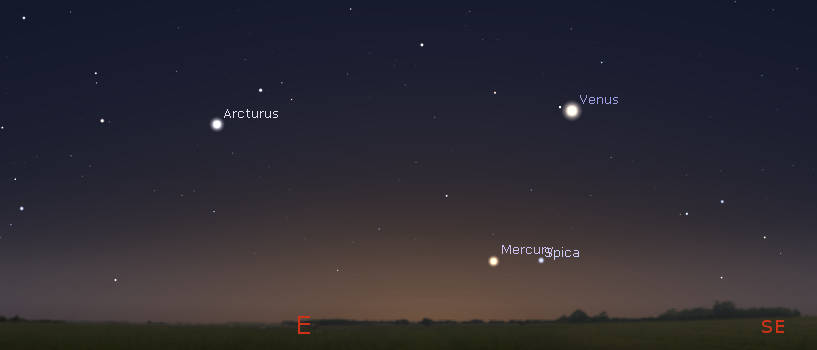
The morning planets Venus and Mercury visible tomorrow at 6:30 am, November 5, 2020 with some of the stars of morning. Click on the image to enlarge. Created using Stellarium.
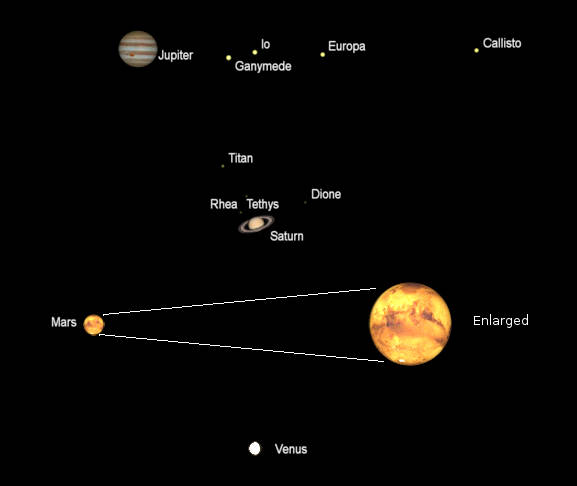
The planets as seen in a telescope (north up) with the same magnification for the night of November 4/5, 2020. Times of the display are: Jupiter and Saturn, 8 pm; Mars, 10 pm; Venus, 6:30 am. Apparent diameters: Jupiter, 36.55″; Saturn, 16.24″, rings, 37.83″. Mars, 19.34″, and Venus 12.87″. Mars also displays an enlargement showing surface detail. Mars was closest to the Earth this go-a-round on October 6. The ” symbol means seconds of arc (1/3600th of a degree.) Created using Cartes du Ciel (Sky Charts).
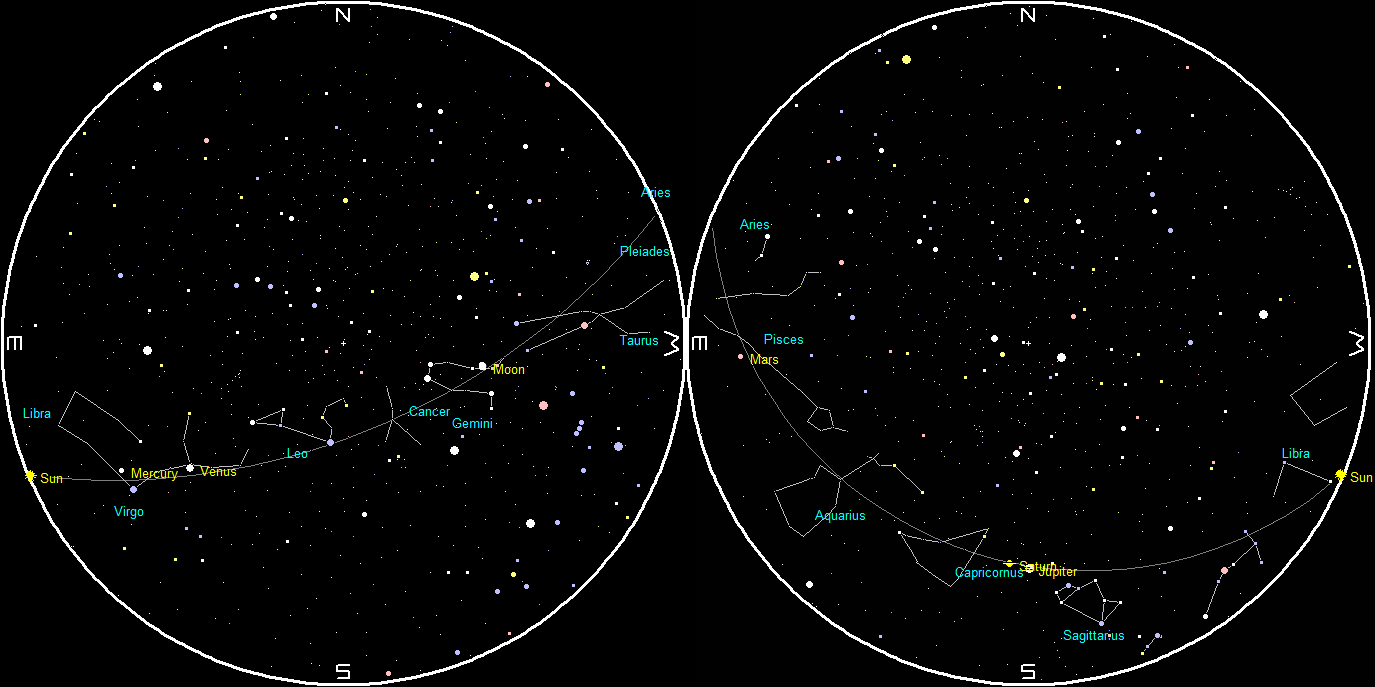
Planets and the Moon at sunset and sunrise of a single night starting with sunset on the right on November 4, 2020. The night ends on the left with sunrise on 5th. Click on the image to enlarge. Created using my LookingUp program.

