Archive
03/09/2016 – Ephemeris – With Venus and Mercury lost in twilight, Mars and Saturn are the only official morning planets easily seen now
Ephemeris for Wednesday, March 9th. The Sun will rise at 7:05. It’ll be up for 11 hours and 36 minutes, setting at 6:41. The Moon, 1 day past new, will set at 7:43 this evening.
Let’s check out the whereabouts of the bright naked eye planets. Jupiter is up at sunset, and will pass due south, astronomers call it a transit, at 12:47 a.m., and will set at 7:14 a.m. It’s below the stars of Leo now. Binoculars can make out some of Jupiter’s moons, but a telescope is required to see Jupiter’s cloud formations. Mars will rise next at 12:45 a.m. in the east-southeast. It’s seen in eastern Libra almost entering the territory of Scorpius. Saturn will rise at 1:56 a.m. in the east-southeast. It’s above the stars of Scorpius, actually in Ophiuchus. Its rings are a telescopic treat. Venus will rise at 6:20 a.m. again in the east-southeast. Mercury is lost in the bright morning twilight and will pass behind the Sun in superior conjunction on the 23rd.
Times are for the Traverse City/Interlochen area of Michigan. They may be different for your location.
Addendum
Sorry for the late post, but preparation for my visit to Mill Creek Elementary school in Williamsburg, MI took some extra preparation. Of course too I was watching the solar eclipse from Micronesia, both channels.
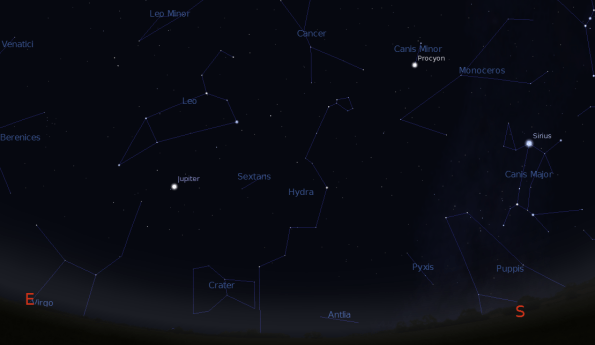
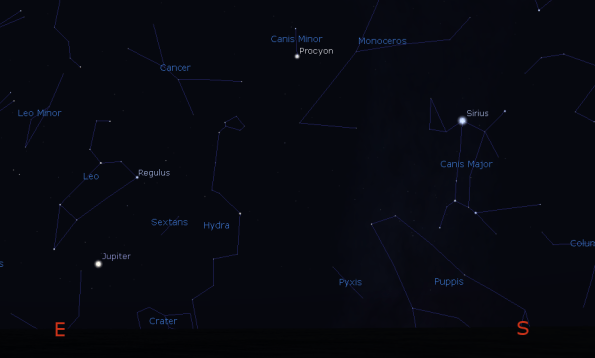
Jupiter appears with the coming spring stars and constellations at 9 p.m., March 9, 2016. Created using Stellarium.
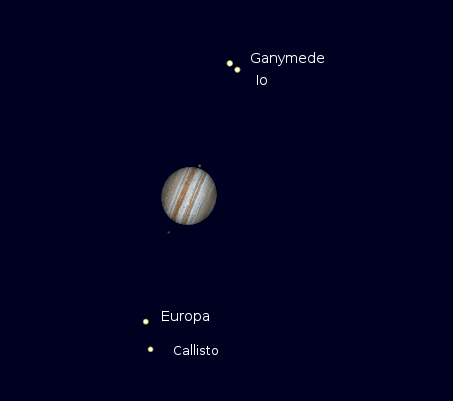
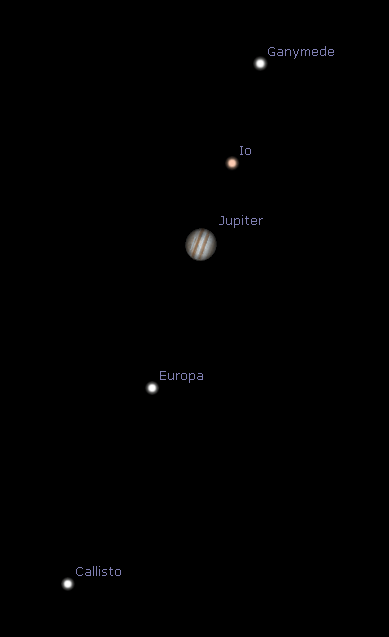
Jupiter and its moons in a telescope at 9 p.m. March 9, 2016. It’s apparent diameter is 44.4″. Created using Cartes du Ciel (Sky Charts).
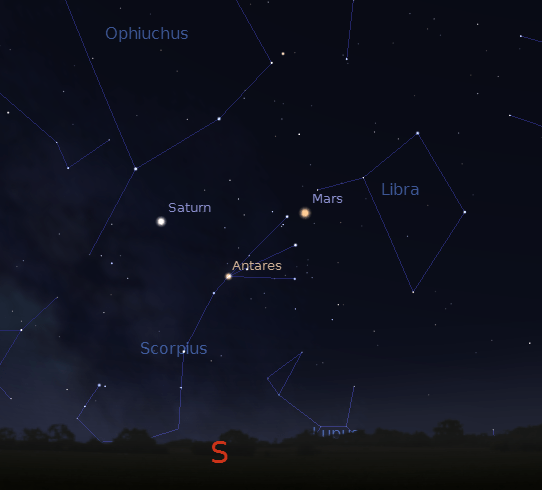
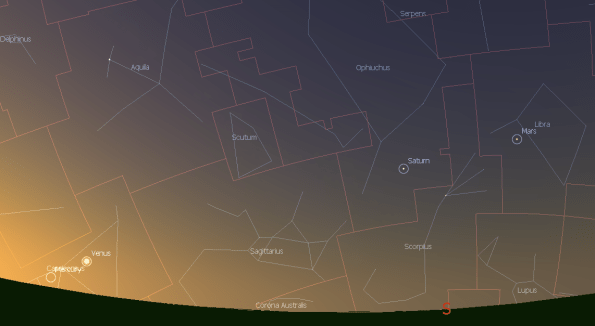
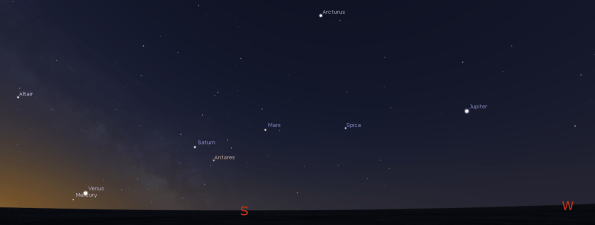
The morning planets Mars and Saturn are near each other in the south morning sky at 6 a.m. March 10, 2016. Created using Stellarium.
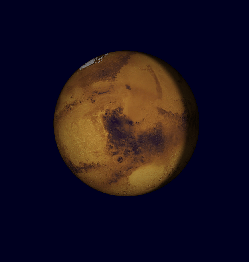
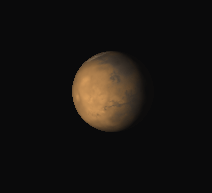
Mars as seen in a large telescope at high power. It’s only 9.5″ in diameter, about a quarter of Jupiter’s diameter. The large dark area in the center is Syrtis Major which sounds cooler than its English translation “Great Swamp”. South of it is the bright elliptical Hellas Basin. Created using Cartes du Ciel (Sky Charts).
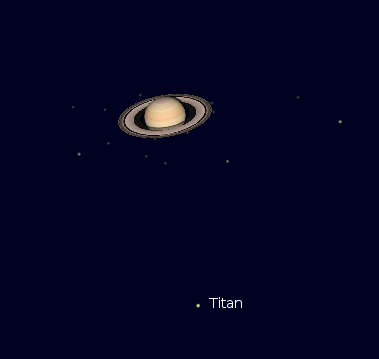
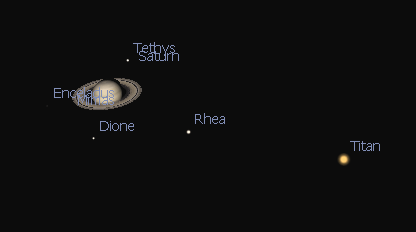
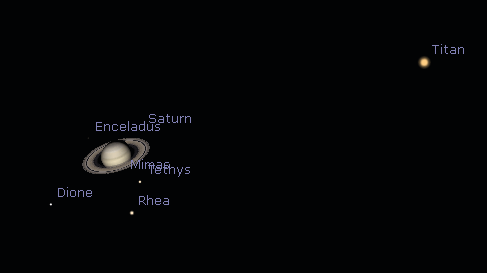
Saturn and its moon Titan as they might be seen through a telescope at 6 a.m. March 10, 2016. The planet diameter is 16.8″ while the rings span 38.1″. Created using Created using Cartes du Ciel (Sky Charts).
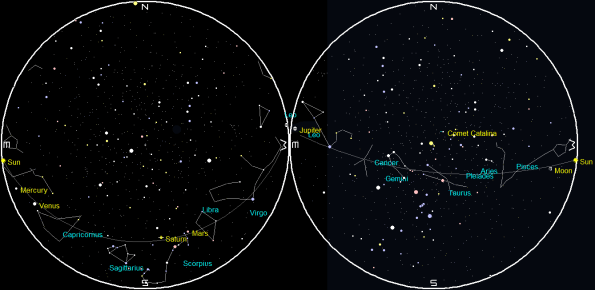
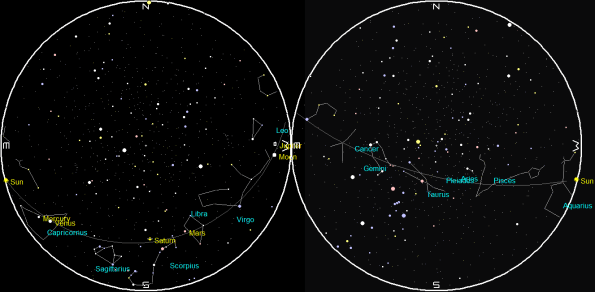
This is a chart showing the sunrise and sunset skies for March 9, 2016 showing the location of the planets and the Moon at that time. Created using my LookingUp program.
03/02/2016 – Ephemeris – The morning planet gang is breaking up
Ephemeris for Wednesday, March 2nd. The Sun will rise at 7:17. It’ll be up for 11 hours and 14 minutes, setting at 6:32. The Moon, 1 day past last quarter, will rise at 3:08 tomorrow morning.
Let’s check out the whereabouts of the bright naked eye planets. All the classical planets visible from antiquity are officially now in the morning sky. I won’t be able to say that next week. Mercury is too close to the Sun and too dim to be spotted. Jupiter will rise at 6:53 p.m., in the east. Jupiter is going to be the morning sky defector as of next Tuesday. It’s below the stars of Leo. Mars will rise next at 12:59 a.m. in the east-southeast. It’s seen against the stars of Libra now. Saturn will rise at 2:23 a.m. in the east-southeast. It’s above the stars of Scorpius, actually in Ophiuchus. Venus will rise at 6:24 a.m. again in the east-southeast. Mercury will pass behind the Sun in superior conjunction on the 23rd.
Times are for the Traverse City/Interlochen area of Michigan. They may be different for your location.
Addendum
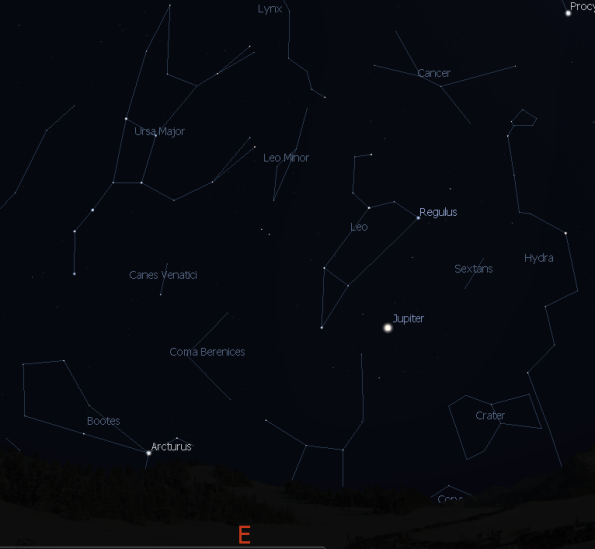
Jupiter and the rising spring constellations at 10 p.m. March 2, 2016. Created using Stellarium.
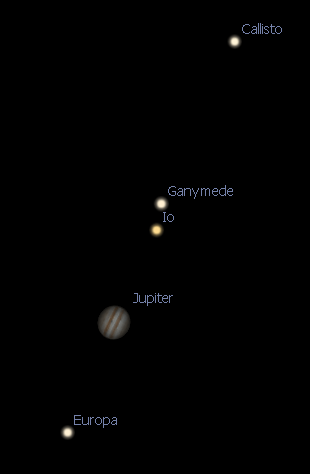
Jupiter and its moons as they would be seen in a telescope, at 10 p.m. March 2, 2016. Jupiter has an apparent diameter of 44.4″ Created using Stellarium.
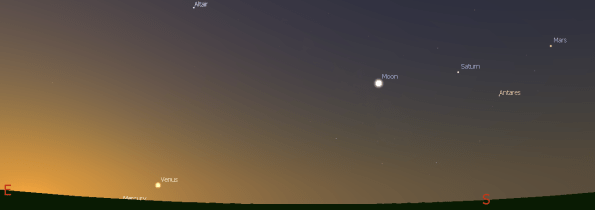
The morning planets and the Moon with the bright stars at 6:45 a.m. March 3, 2016. Created using Stellarium.
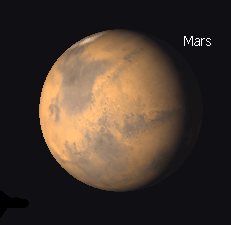
Mars as might look through a large amateur telescope at 6:45 a.m. March 3, 2016. North is at top. Apparent diameter is 8.9″.
In the Mars map below the center of the map pretty well matches the center of the Mars image above. The dark area to the upper left is Acidalia. The There’s a long dark feature to the right that has a blob at the end. The blob is Meridiani, where Mars’ prime meridian runs through. It is Meridiani where Opportunity landed, marked be MER-B.
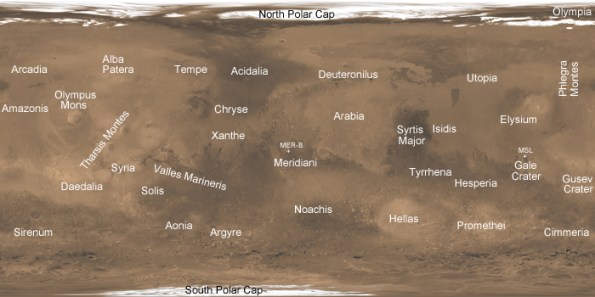
Annotated Mars Map. Credit NASA.
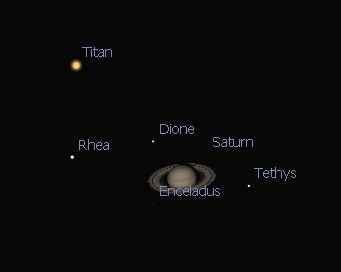
Saturn and its large satellite Titan and other moons as they should appear in a telescope in the morning of March 3, 2016. The planet is 16.6″ in diameter while the rings span 38.7″. Created using Stellarium.
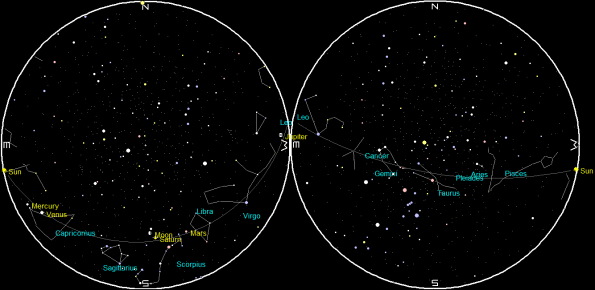
This is a chart showing the sunrise and sunset skies for March 2, 2016 showing the location of the planets and the Moon at that time. Created using my LookingUp program.
Some of these images above are shown smaller than actual size. Image expansion lately hasn’t worked. If you are using Firefox, right-click on the image, and then click on View Image.
02/24/2016 – Ephemeris – The planets are all hanging out in the morning for another 2 weeks
Ephemeris for Wednesday, February 24th. The Sun will rise at 7:29. It’ll be up for 10 hours and 53 minutes, setting at 6:23. The Moon, 2 days past full, will rise at 8:31 this evening.
Let’s check out the whereabouts of the bright naked eye planets. All the classical planets visible from antiquity are officially now in the morning sky. Though Mercury is too close to the Sun to be spotted. Jupiter will rise at 7:25 p.m., in the east. Jupiter is still a morning planet since it’s not up at sunset. It’s among the stars of Leo. Mars will rise next at 1:12 a.m. in the east-southeast. It’s seen against the stars of Libra now. Saturn will rise at 2:49 a.m. in the east-southeast. It’s above the stars of Scorpius, actually in Ophiuchus. Venus will rise at 6:27 a.m. again in the east-southeast. Comet Catalina is up all night and is a telescopic object and fading fast. At 10 p.m. is above the constellation of Cassiopeia and right of Perseus.
Times are for the Traverse City/Interlochen area of Michigan. They may be different for your location.
Addendum
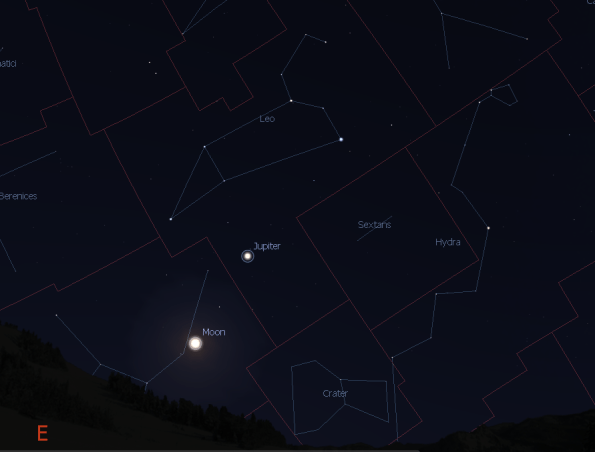
Jupiter, the Moon in the official constellation boundaries as set up by the International Astronomical Union at 10 p.m. February 24, 2016. Created using Stellarium.
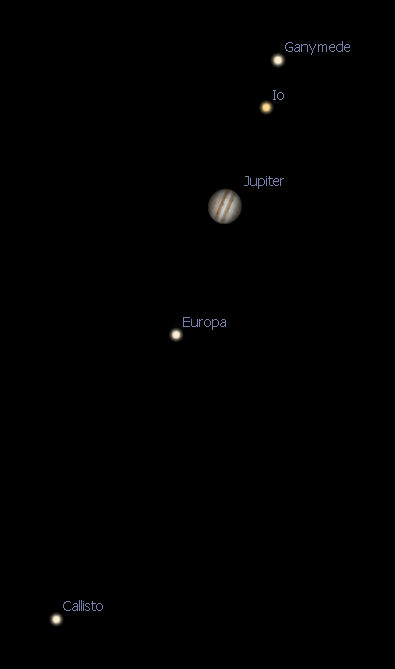
Jupiter and its moons as they would be seen in a telescope, at 10 p.m. February 24, 2016. Jupiter has an apparent diameter of 44.2″ Created using Stellarium.
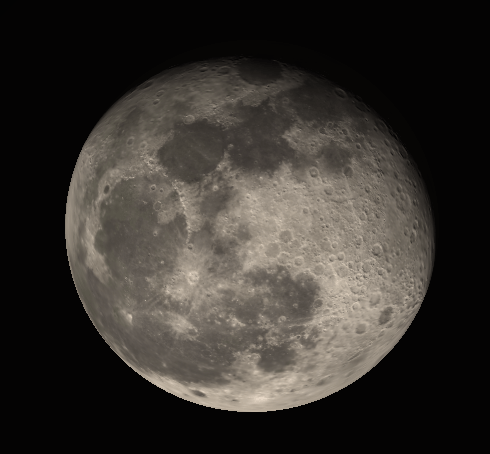
The Moon as it might be seen in binoculars at 10 p.m. February 24, 2016. Created using Stellarium.
The morning planets with constellation boundaries at 7 a.m. February 25, 2016. Created using Stellarium.
Mars in a telescope at high power. It’s apparent diameter is 8.4″. At 7 a.m. February 25, 2016. Created using Stellarium.
Saturn and its large satellite Titan and other moons as they should appear in a telescope in the morning of February 25, 2016. The planet is 16.4″ in diameter while the rings span 38.2″. Created using Stellarium.
The telescopic planet images are not to the same scale. Use the diameters in seconds of arc (“) as a way to compare the sizes.
Comet Catalina has become too faint to be seen in binoculars as it heads out of the solar system. To follow the comet further go to Seiichi Yashida’s Weekly Bright Comets page. Comet Catalina is n longer the brightest comet on the list, and is currently listed second. Click on it [C/2013 US10 ( Catalina )] for finder charts and other information.
This is a chart showing the sunrise and sunset skies for February 24, 2016 showing the location of the planets and the Moon at that time. Created using my LookingUp program.
Some of these images above are shown smaller than actual size. Image expansion lately hasn’t worked. If you are using Firefox, right-click on the image, and then click on View Image.
02/17/2016 – Ephemeris – All the bright planets are in the morning sky, but two of them are trying to sneak out
Ephemeris for Wednesday, February 17th. The Sun will rise at 7:40. It’ll be up for 10 hours and 32 minutes, setting at 6:13. The Moon, 2 days past first quarter, will set at 4:39 tomorrow morning.
Let’s check out the whereabouts of the bright naked eye planets. All the classical planets visible from antiquity are officially now in the morning sky. Though Mercury is too close to the Sun to be spotted. Jupiter will rise at 7:57 p.m., in the east. Jupiter is still a morning planet since it’s not up at sunset. Mars will rise next at 1:24 a.m. in the east-southeast. It’s brighter than the bright star Spica growing even farther to the right of it.. Saturn will rise at 3:40 a.m. in the east-southeast. Venus will rise at 6:27 a.m. again in the east-southeast. Mercury is too deep in the twilight glare to be seen. Comet Catalina is up all night and is a binocular object and fading fast. At 10 p.m. is above the constellation of Cassiopeia and right of Perseus.
Times are for the Traverse City/Interlochen area of Michigan. They may be different for your location.
Addendum
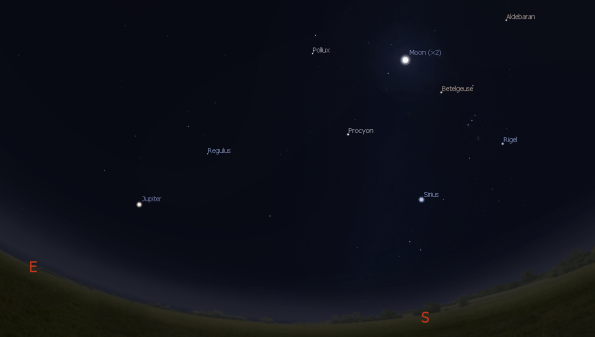
Jupiter, the Moon and the bright winter stars at 10 p.m. February 17, 2016. Created using Stellarium.
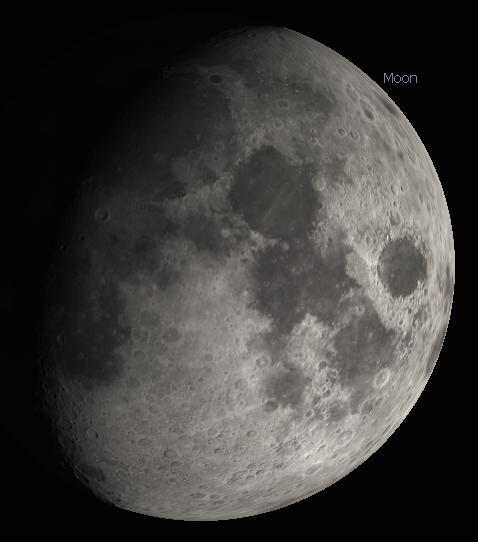
The Moon as it might be seen in binoculars at 10 p.m. February 17, 2016. Created using Stellarium.
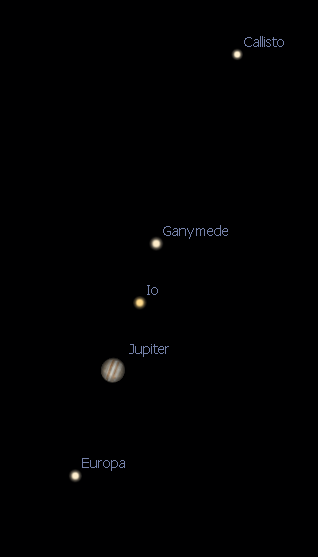
Jupiter and its moons as they would be seen in a telescope, at 10 p.m. February 17, 2016. Jupiter has an apparent diameter of 43.9″ Created using Stellarium.
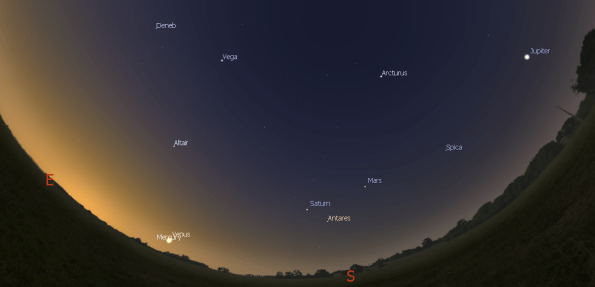
Morning planets and the bright s tar preview of summer. Mercury, though labeled can’t compete with the bright twilight. Observers south of here may have better luck. At 7 a.m. February 18, 2016. Created using Stellarium.
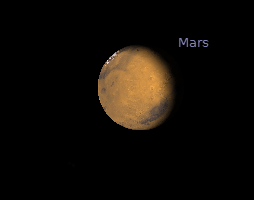
Mars in a telescope at high power. It’s apparent diameter is 7.9″. At 6 a.m. February 18, 2016. Created using Stellarium.
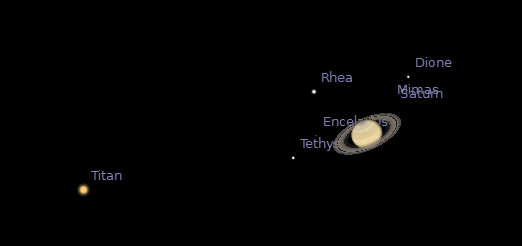
Saturn and its large satellite Titan and other moons as they should appear in a telescope at 6 a.m. February 18, 2016. The planet is 16.2″ in diameter while the rigs span 37.8″. Created using Stellarium.
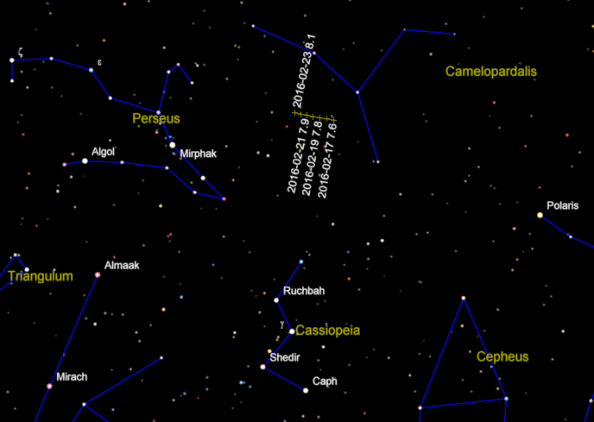
Comet Catalina’s path for the next week. Note that it is fading fast. It will take binoculars or a small telescope to spot the comet which will not show a tail visually. Created using Stellarium.
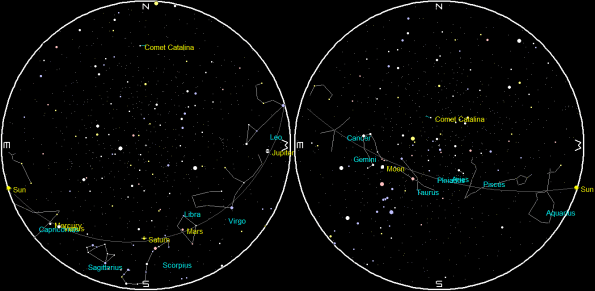
This is a chart showing the sunrise and sunset skies for February 17, 2016 showing the location of the planets, the Moon and Comet Catalina at that time. Created using my LookingUp program.
Some of these images above are shown smaller than actual size. Image expansion lately hasn’t worked. If you are using Firefox, right-click on the image, and then click on View Image.
02/10/2016 – Ephemeris – The morning planet gang will be around for 9 more days
Ephemeris for Ash Wednesday, Wednesday, February 10th. The Sun will rise at 7:51. It’ll be up for 10 hours and 12 minutes, setting at 6:03. The Moon, 2 days past new, will set at 8:53 this evening.
Let’s check out the whereabouts of the bright naked eye planets. All the classical planets visible from antiquity are officially now in the morning sky. However Jupiter actually will rise at 8:29 p.m., in the east. Jupiter is still a morning planet since it’s not up at sunset. Mars will rise next at 1:35 a.m. in the east-southeast. It’s brighter than the bright star Spica growing even farther to the right of it.. Saturn will rise at 3:40 a.m. in the east-southeast. Venus will rise at 6:25 a.m. again in the east-southeast. Mercury will rise behind Venus at 6:39. Comet Catalina is up all night and is a binocular object in the dark expanse of the constellation Camelopardalis between the bowl of the Big Dipper and the constellation of Perseus.
Times are for the Traverse City/Interlochen area of Michigan. They may be different for your location.
Addendum
Jupiter low in the east-southeast at 10 p.m. on February 10th, 2016. Created using Stellarium.
Jupiter and its moons as they would be seen in a telescope, at 10 p.m. February 10, 2016. Created using Stellarium.
The planets in the morning sky at 7 a.m. on February 11, 2016. Jupiter is far to the west. Created using Stellarium.
Saturn and its large satellite Titan and other moons as they should appear in a telescope at 7 a.m. February 11, 2016.
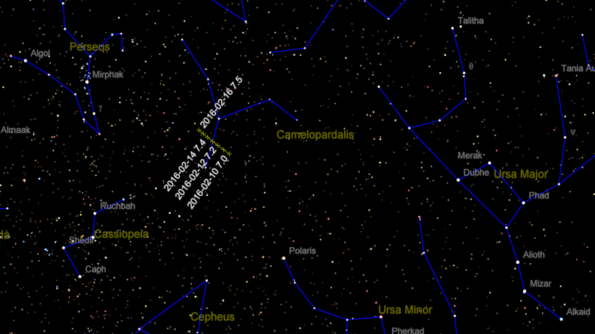
Comet Catalina’s path for the next week. Note that it is fading fast. It will take binoculars or a small telescope to spot the comet which will not show a tail visually. Created using Stellarium.
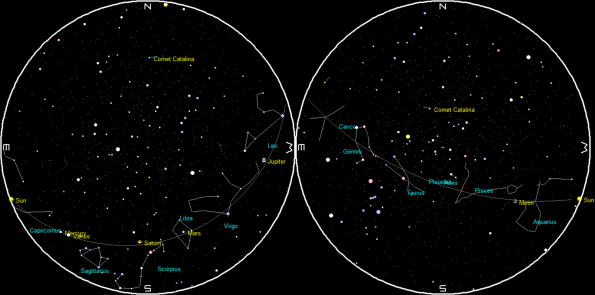
This is a chart showing the sunrise and sunset skies for February 10, 2016 showing the location of the planets, the Moon and Comet Catalina at that time. Created using my LookingUp program.
Some of these images above are shown smaller than actual size. Image expansion lately hasn’t worked. If you are using Firefox, right-click on the image, and then click on View Image.
02/03/2016 – Ephemeris – Though a morning planet, Jupiter can be seen in the late evening
Ephemeris for Wednesday, February 3rd. The Sun will rise at 8:00. It’ll be up for 9 hours and 53 minutes, setting at 5:53. The Moon, 3 days past last quarter, will rise at 4:27 tomorrow morning.
Let’s check out the whereabouts of the bright naked eye planets. All the classical planets visible from antiquity are officially now in the morning sky. However Jupiter actually will rise at 9 p.m., in the east. Jupiter is still a morning planet since it’s not up at sunset. Mars will rise next at 1:45 a.m. in the east-southeast. It’s left of the bright star Spica. Saturn will rise at 4:05 a.m. in the east-southeast. The Moon will be below, left of it tomorrow morning. Venus will rise at 6:19 a.m. again in the east-southeast. Mercury will rise behind Venus at 6:36. Comet Catalina is up all night and is a binocular object in the dark expanse of the constellation Camelopardalis between the bowl of the Big Dipper and the W shape of Cassiopeia.
Times are for the Traverse City/Interlochen area of Michigan. They may be different for your location.
Addenda
Planets
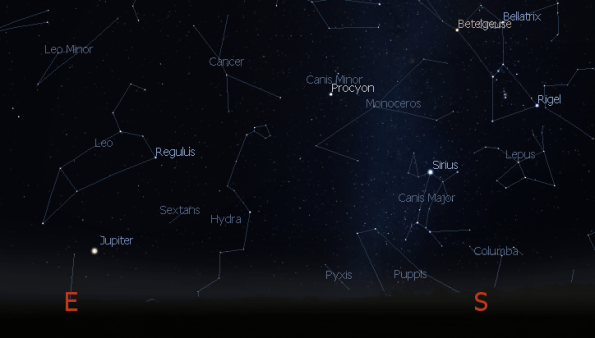
Jupiter low in the east at 10 p.m. on February 3rd, 2016. Created using Stellarium.
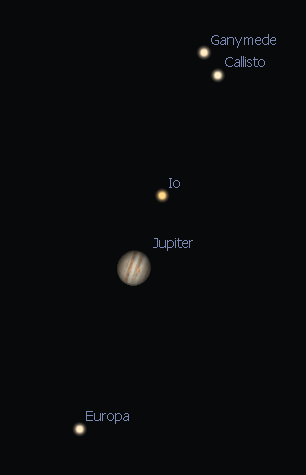
Jupiter and its moons as they would be seen in a telescope, at 10 p.m. February 3, 2016. I’d wait for an hour to let Jupiter rise above the thick atmosphere near the horizon for better clarity. Created using Stellarium.
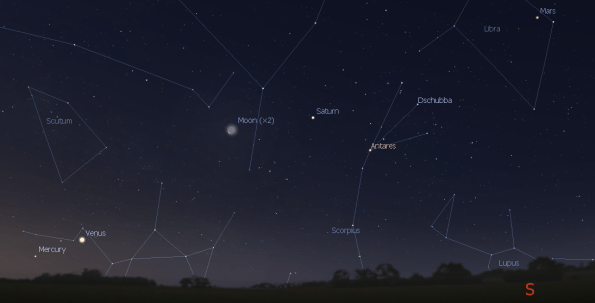
The planets in the morning sky at 7 a.m. on February 4, 2016. Jupiter is far to the west and out of this view. Created using Stellarium.
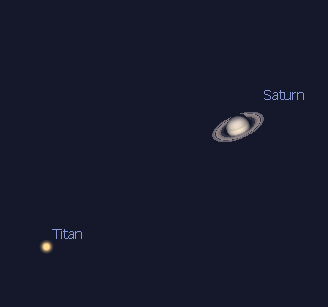
Saturn and its satellite Titan as they should appear in a telescope at 7 a.m. February 4, 2016
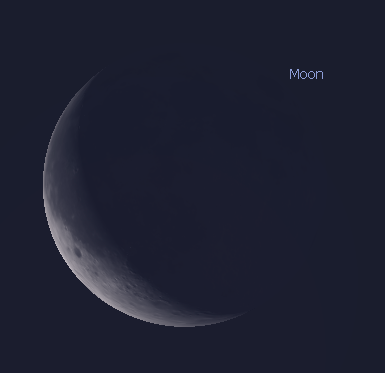
The Moon as it should appear in binoculars tomorrow morning at 7 a.m., February 4, 2016. Created using Stellarium.
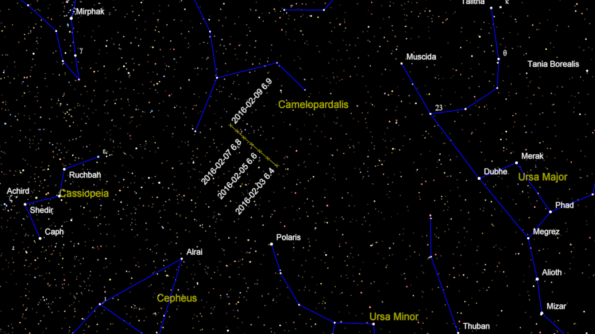
Comet Catalina’s path for the next week. Note that the magnitudes for the comet are about correct. It will take binoculars or a small telescope to spot the comet which will not show a tail visually. Created using Stellarium.
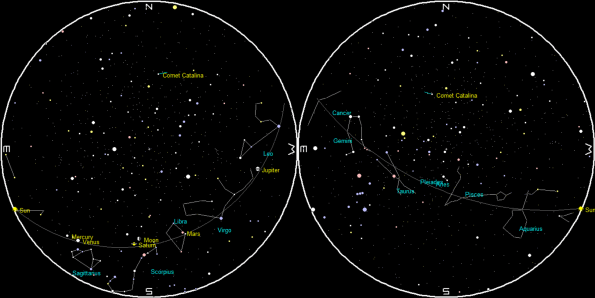
This is a chart showing the sunrise and sunset skies for February 3, 2016 showing the location of the planets, the Moon and Comet Catalina at that time. Created using my LookingUp program.
Off Topic
Stellarium
I’m now using Stellarium 0.14. It can detect older PCs and will not always crash, though I’m not thrilled with how it operates and some screen faults. The Portable Apps version has a patch that can be added to the application. The instructions for the patch are in the download page. Simply search “portable apps” to get started. The portable apps version worked better than the installed version, so I use the portable apps version. It turns out that my laptop can run 0.14, while my desktop cannot. The legacy version of Stellarium is 0.12.5.
It finally cleared up. For a while.
I bought myself a DSLR camera for my birthday/Christmas present a month and a half ago. I used to do a fair amount of astrophotography back before CCDs took over. I had some point and shoot digital cameras, which were not suitable for astrophotography. My last big spurge with film was for Comet Hale-Bopp in 1997.
But with the solar eclipse coming up next year the bug is biting again. I hate to brag but I’ve seen 4 total solar eclipses (1963, 1970, 1972, and 1979), plus 2 annular eclipses. I will recount my experiences with those eclipses in the year leading up to August 21, 2017.
In my film days I had developed a system for setting exposures for the Moon, planets, solar and lunar eclipses, and other possibly faint objects. It took a search to locate the data and used it when it finally cleared up on Ground Hog day. Below is one of the photos.
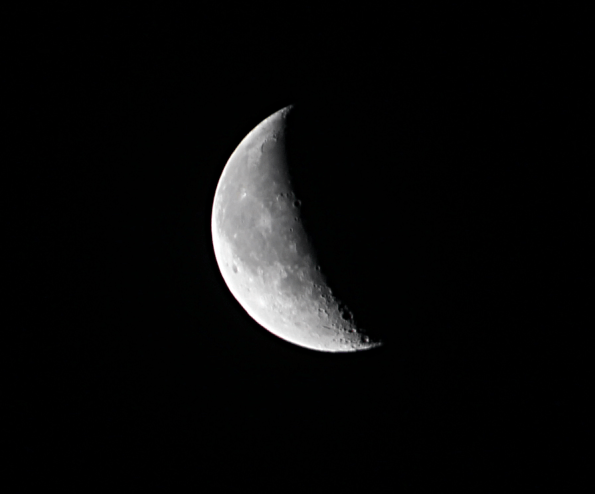
The fat crescent Moon at 7:02 a.m. February 2, 2016. ISO 100, 300mm focal length, f/11, 1/15 second.
01/27/2016 – Ephemeris – The Moon rises near Jupiter tonight
Ephemeris for Wednesday, January 27th. The Sun will rise at 8:07. It’ll be up for 9 hours and 36 minutes, setting at 5:43. The Moon, half way from full to last quarter, will rise at 9:43 this evening.
Let’s check out the whereabouts of the bright naked eye planets. All the classical planets visible from antiquity are officially now in the morning sky. However Jupiter actually will rise at 9:30 p.m., in the east. The Moon will be right below it tonight. Jupiter’s still a morning planet since it’s not up at sunset. Mars will rise next at 1:54 a.m. in the east-southeast. It’s below and left of the bright star Spica. Saturn will rise at 4:30 a.m. in the east-southeast. Venus will rise at 6:11 a.m. again in the east-southeast. Mercury is not favorably placed for northern hemispheric observers now. Comet Catalina is up all night and is a binocular object crossing the line from the pointer stars in the Big Dipper and the North Star Polaris tonight.
Times are for the Traverse City/Interlochen area of Michigan. They may be different for your location.
Addendum
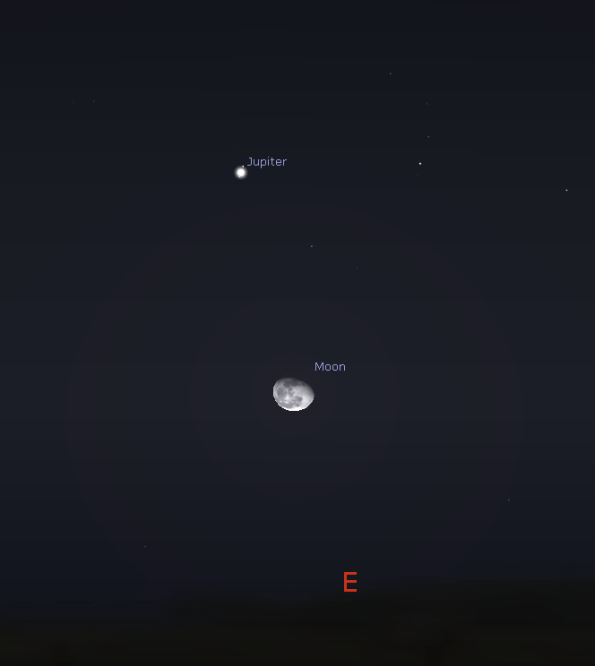
Jupiter and the Moon at 10 p.m. January 27, 2016. Created using Stellarium.
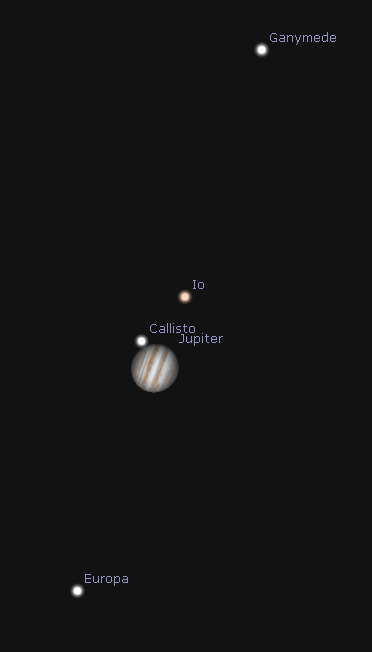
Jupiter and moons as they would appear in a telescope at 10 p.m. January 27, 2016. Created using Stellarium.
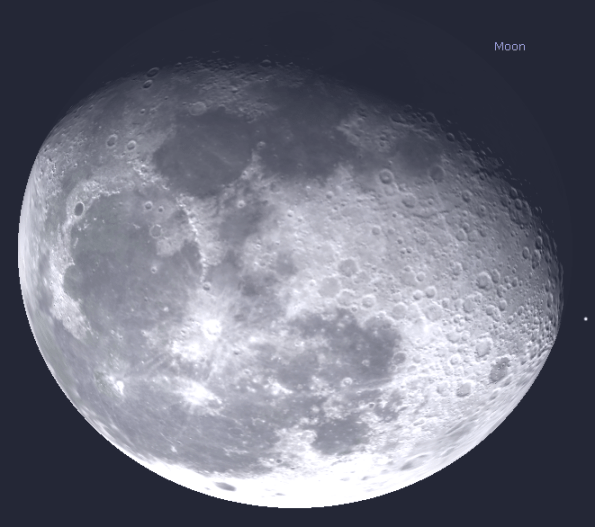
The Moon rising. Note the distortion of the atmospheric refraction squishes the Moon vertically being only a quarter-hour after it rose. 10 p.m., January 27, 2016. Created using Stellarium.
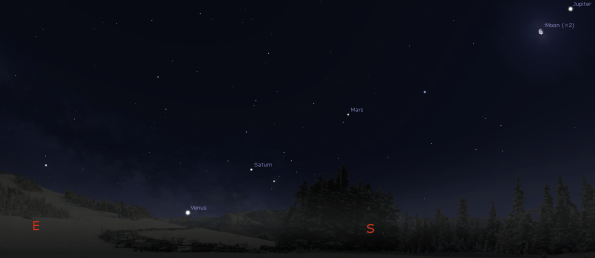
The morning planets and the Moon at 6:45 a.m., January 28, 2016. Created using Stellarium.
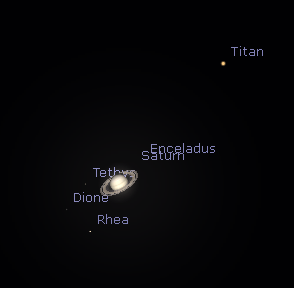
Saturn and its moons in a telescope on the morning of January 28, 2016. Created using Stellarium.
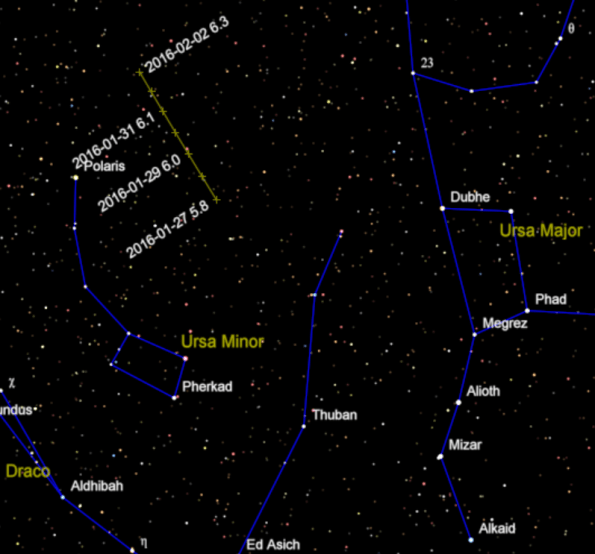
Comet Catalina’s path for the next week. Note the magnitudes for the comet are about correct. It will take binoculars or a small telescope to spot the comet which will not show a tail visually. Created using Stellarium.
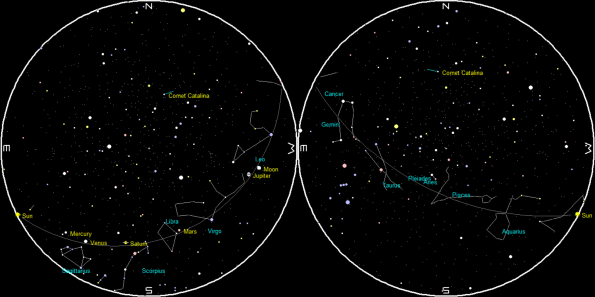
This is a chart showing the sunrise and sunset skies for January 27, 2016 showing the location of the planets, the Moon and Comet Catalina at that time. Created using my LookingUp program.
Some of these images above are shown smaller than actual size. Image expansion lately hasn’t worked. If you are using Firefox, right-click on the image, and then click on View Image.
01/20/2016 – Ephemeris – The planet action is in the morning sky
Update: This is the proper text for today
Ephemeris for Wednesday, January 20th. The Sun will rise at 8:13. It’ll be up for 9 hours and 20 minutes, setting at 5:34. The Moon, 3 days before full, will set at 5:51 tomorrow morning.
Let’s check out the whereabouts of the bright naked eye planets. All the classical planets visible from antiquity are now in the morning sky. However Mercury is too close to the Sun, and may remain too low in the sky to spot when it’s farther from the Sun. Jupiter will be the first to rise, actually at 10 p.m., in the east. It’s still a morning planet since it’s not up at sunset. Mars will rise next at 2:03 a.m. in the east-southeast. It’s below and left of the bright star Spica. Saturn will rise at 4:55 a.m. in the east-southeast. Venus will rise at 6 a.m. again in the east-southeast. Comet Catalina is a binocular object between the bowls of the Big and Little Dippers. It’s heading across the tail of Draco the dragon.
Times are for the Traverse City/Interlochen area of Michigan. They may be different for your location.
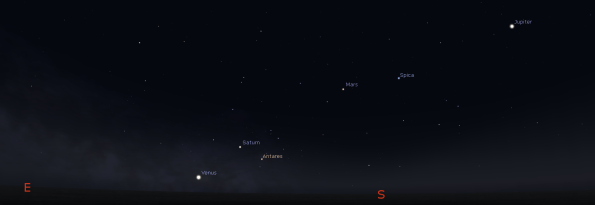
Here of the morning planets. From right to left, Jupiter, Mars, Saturn and Venus. Time: 6:30 a.m., January 21, 2016. Created using Stellarium.
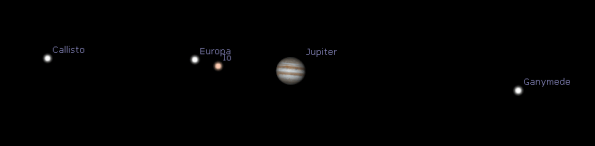
Jupiter and its 4 Galilean moons at 6:30 a.m., January 21, 2016. Created using Stellarium.
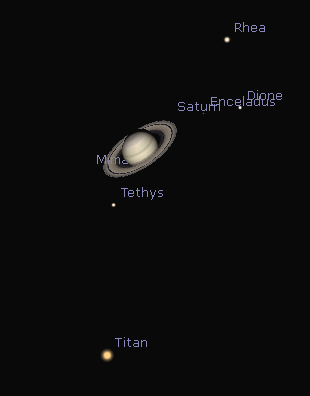
Saturn and its moons at a greater magnification as for Jupiter above at 6:30 a.m., January 21, 2016. Small telescopes will show only the moon Titan. Created using Stellarium.
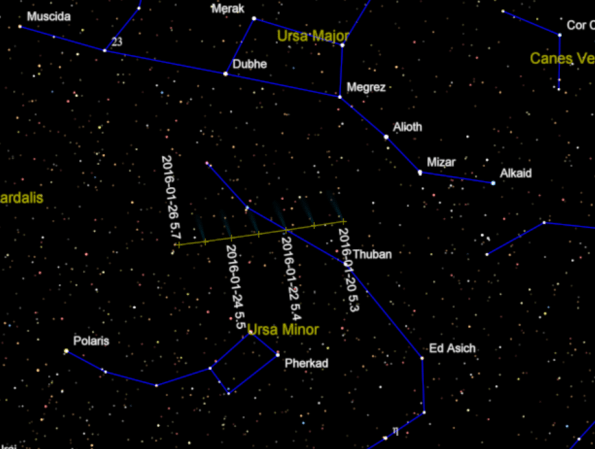
Comet Catalina’s path for the next week. Note the magnitudes for the comet are about correct. It will take binoculars or a small telescope to spot the comet which will not show a tail visually. Created using Stellarium.
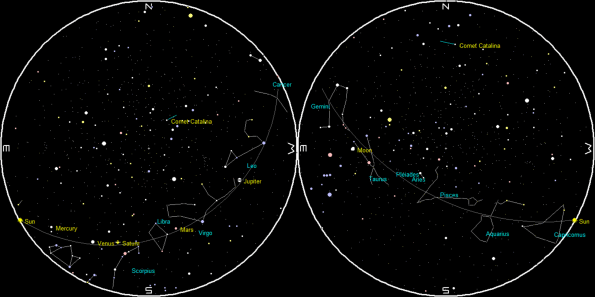
This is a chart showing the sunrise and sunset skies for January 20, 2016 showing the location of the planets, the Moon and Comet Catalina at that time. Created using my LookingUp program.
The top and bottom images above are shown smaller than actual size. Image expansion lately hasn’t worked. If you are using Firefox, right-click on the image, and then click on View Image.
01/13/2016 – Ephemeris – Four bright planets are in the morning sky but one more is hiding
Ephemeris for Wednesday, January 13th. The Sun will rise at 8:17. It’ll be up for 9 hours and 7 minutes, setting at 5:25. The Moon, 3 days before first quarter, will set at 9:57 this evening.
Let’s check out the whereabouts of the bright naked eye planets. Mercury is now only one day from inferior conjunction, passing between the Earth and the Sun. The next inferior conjunction after this, May 9th Mercury will pass across the face of the Sun. In the morning sky there are four bright planets. Jupiter will be the first to rise, actually at 10:28 p.m., in the east. Mars will rise next at 2:11 a.m. in the east-southeast. It’s left of the bright star Spica. Saturn will rise at 5:19 a.m. Venus will rise at 5:47 a.m. again in the east-southeast, following Saturn. Comet Catalina is a binocular object near the star at the end of the handle of the Big Dipper named Alkaid. It’s heading to go between the Big and Little Dippers this week.
Times are for the Traverse City/Interlochen area of Michigan. They may be different for your location.
Addendum
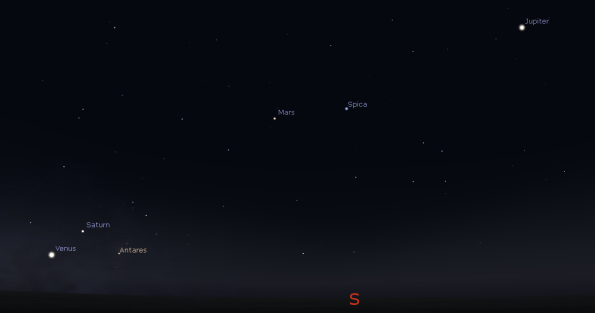
Here of the morning planets. From right to left, Jupiter, Mars, Saturn and Venus. Time: 6:30 a.m., January 14, 2016. Created using Stellarium.
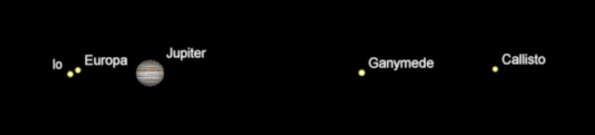
Jupiter and its 4 Galilean moons at 6:30 a.m., January 14, 2016. Created using Cartes du Ciel (Sky Charts).
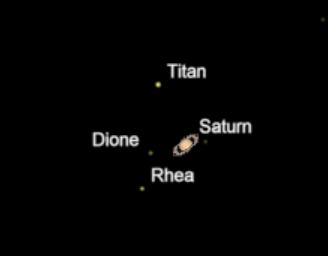
Saturn and its moons through a telescope at 6:30 a.m., January 14, 2016. Small telescopes will show only the moon Titan. Created using Cartes du Ciel (Sky Charts).
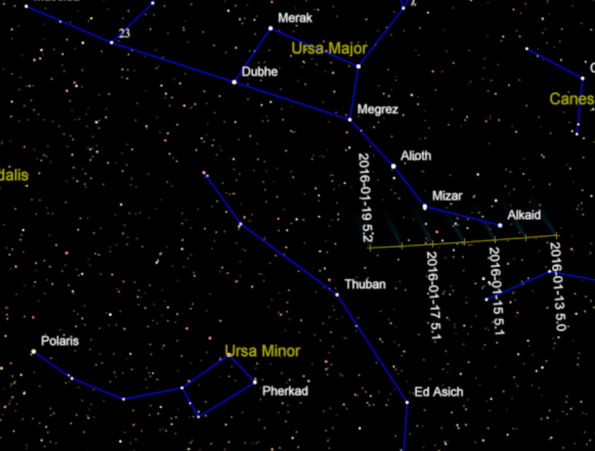
Comet Catalina’s path for the next week. Note the magnitudes for the comet are about correct. It will take binoculars or a small telescope to spot the comet which will not show a tail visually. Created using Cartes du Ciel (Sky Charts).
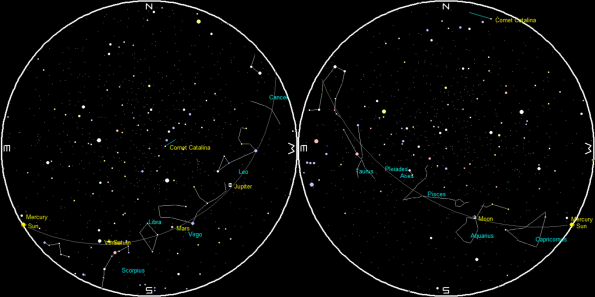
This is a chart showing the sunrise and sunset skies for January 13, 2016 showing the location of the planets, the Moon and Comet Catalina at that time. Created using my LookingUp program.
Several of the images above are shown smaller than actual size. Image expansion lately hasn’t worked. If you are using Firefox, right-click on the image, and then click on View Image.
01/08/2016 – Ephemeris – A telescope clinic tonight and Venus and Saturn get cozy tomorrow morning
Ephemeris for Friday, January 8th. The Sun will rise at 8:19. It’ll be up for 9 hours even, setting at 5:19. The Moon, 1 day before new, will rise at 7:35 tomorrow morning.
If you’ve received a telescope for Christmas and are having trouble setting it up, or have an unused one in a closet somewhere, bring them to Northwestern Michigan College’s Rogers Observatory tonight at 8 p.m. The Grand Traverse Astronomical Society will be holding their annual telescope clinic to help you understand and use your telescope. The clinic will extend through the period that will be set aside for a star party if it’s clear. Tomorrow morning the planets Venus and Saturn will appear close together low on the southeastern horizon. They should be high enough to spot by 6 a.m. and will be visible in the brightening twilight til about quarter to eight a.m. Dimmer Saturn will be about 2/3rds of a Moon width to the right of Venus.
Times are for the Traverse City/Interlochen area of Michigan. They may be different for your location.
Addendum
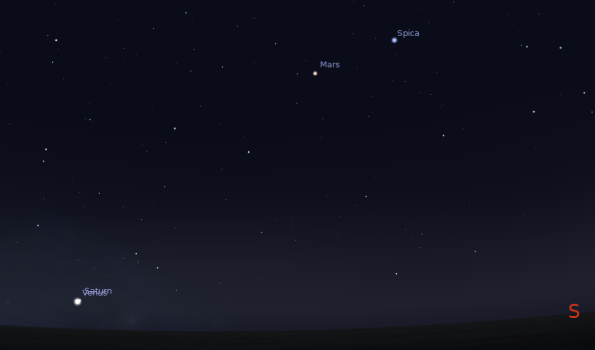
Mars with Venus and Saturn close together. at 6 a.m. January 9, 2016. Created using Stellarium.
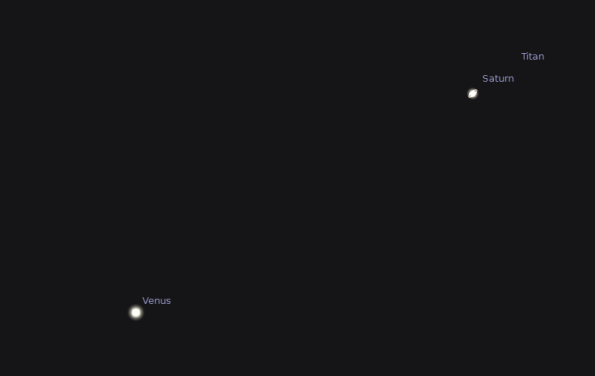
Low power telescope view of Venus and Saturn at 6 a.m. January 9, 2016. At this time the planets are about 20 minutes of arc apart, about 2/3rds the width of the Moon apart. Created using Stellarium.
The actual conjunction of these two planets will occur at 2:42 a.m. (7:42 Hrs UT). Folks in the UK and Europe will spot these two planets even closer together.

