Archive
Ephemeris: 03/03/2026 – Eclipse prospects for the rest of the year
This is Ephemeris for Tuesday, March 3rd. Today the Sun will be up for 11 hours and 16 minutes, setting at 6:33, and it will rise tomorrow at 7:14. The Moon, at full today, will rise at 7:04 this evening.
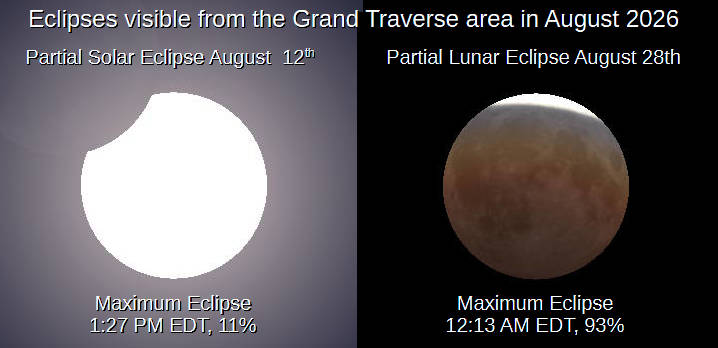
If you’re listening to me right now the total lunar eclipse this morning has ended or will shortly end. In any case it’s invisible because, even if it’s ongoing, twilight has wiped it out. Then there is the possibility of clouds, which I can’t predict from when I’m recording this Sunday night. We do have another chance to view a lunar eclipse, this year, on the night of August 27-28th. It’ll be a little bit earlier. It will start late in the evening and be almost total after midnight. There’s also going to be a solar eclipse on August 12th, but it will be just a little nibble of the moon on the sun for us. It’s going to be total for the east coast of Greenland, the northern Atlantic, and northern Spain, before ending at sunset in the Mediterranean Sea.
The astronomical event times given in this blog are for the Traverse City/Interlochen area of Michigan (Lat 44.7° N, Long 85.7° W; EST, UT – 5 hours) unless stated otherwise. Times will be different for other locations.
Addendum
Ephemeris: 12/30/2025 – 2026 a year of eclipses
This is Bob Moler with Ephemeris for Tuesday, December 30th. Today the Sun will be up for 8 hours and 51 minutes, setting at 5:11, and it will rise tomorrow at 8:20. The Moon, 3 days past first quarter, will set at 5:28 tomorrow morning.
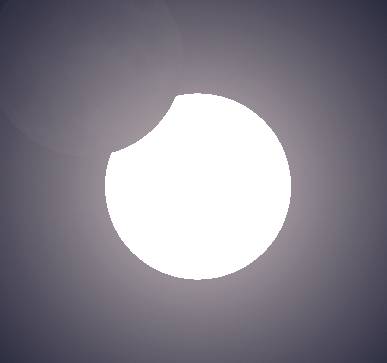
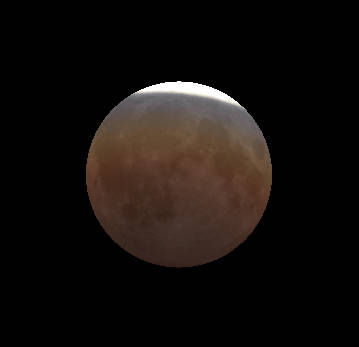
In each calendar year there are at least 4 eclipses. Two of the Sun and two of the moon. Usually we see one or maybe 2 or none. However, in 2026 we get to see three of the four eclipses, 2 lunar eclipses and a solar eclipse. The first eclipse is on March 3rd it is a total lunar eclipse, which we get to see most of. It actually ends in its final partial phase at sunrise. The next eclipse is a solar eclipse, The Moon just grazes the Sun. That will be on August 12th just before the peak of the Perseid meteor shower that night. Last on August 27th late that evening and morning of the 28th there will be a very deep partial eclipse of the Moon where 93% of its disk will be covered by the Earth’s inner shadow.
The astronomical event times given in this blog are for the Traverse City/Interlochen area of Michigan (Lat 44.7° N, Long 85.7° W; EST, UT – 5 hours) unless stated otherwise. Times will be different for other locations.
Addendum
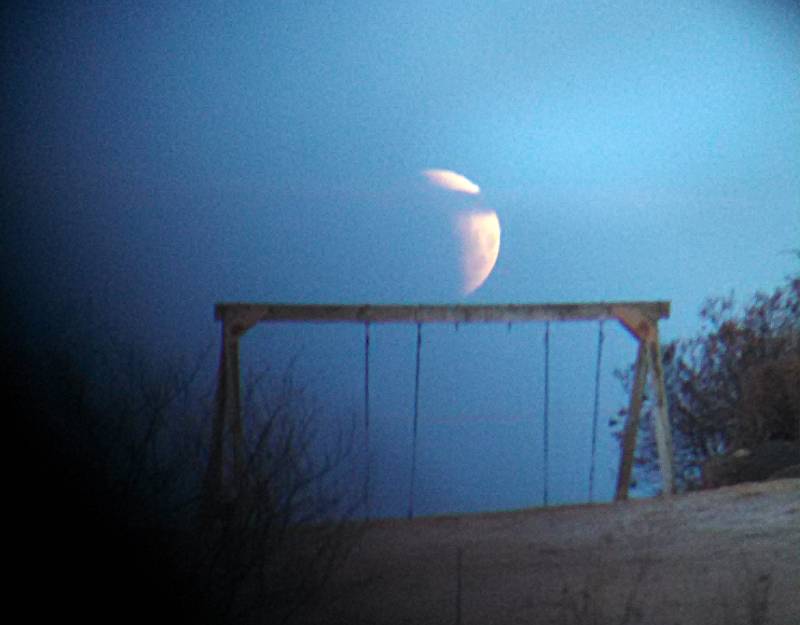
The end of the March 3rd eclipse will look something like this. The totally eclipsed Moon will disappear in twilight. Later the partially illuminated parts of the Moon will appear out of the blue before moonset.
Ephemeris: 03/14/2025 – Viewing today’s eclipse from the Moon
This is Ephemeris for Pi Day, Friday, March 14th. Today the Sun will be up for 11 hours and 51 minutes, setting at 7:48, and it will rise tomorrow at 7:54. The Moon, at full today, will rise at 8:27 this evening.
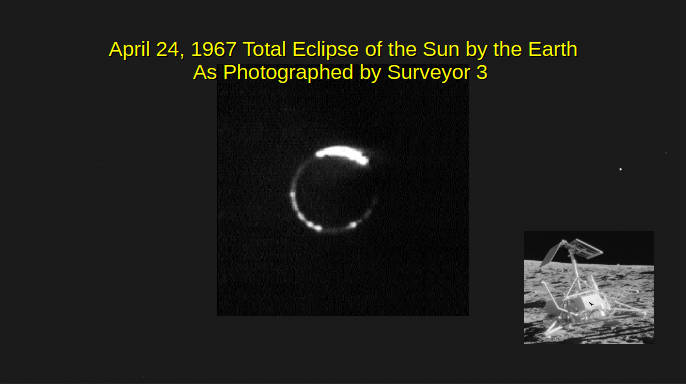
I hope you had a good look at the eclipse this morning I don’t know if it was clear or cloudy because I’m recording this last Sunday night. One entity got a cloudless shot at seeing the eclipse without any obstructions. That was the Blue Ghost lander on Mare Crisium on the Moon. However, it was on the Moon so it was seeing a total eclipse of the Sun. I’ll be really interested to see the photographs coming back from that. There was a satellite and one lander, the Surveyor 3 Lander on the Moon that took pictures of the Earth during the solar eclipse. Of course, we saw a lunar eclipse. It just saw a ring of light around the Earth where the Sun’s light was being bent through the Earth’s atmosphere into it’s shadow to dully illuminate the Moon.
The astronomical event times given are for the Traverse City/Interlochen area of Michigan (EDT, UT – 4 hours). Times will be different for other locations.
Addendum
Sorry, I couldn’t spend any time on the program to celebrate Pi day, so I’ll give it a token appreciation here:

Update
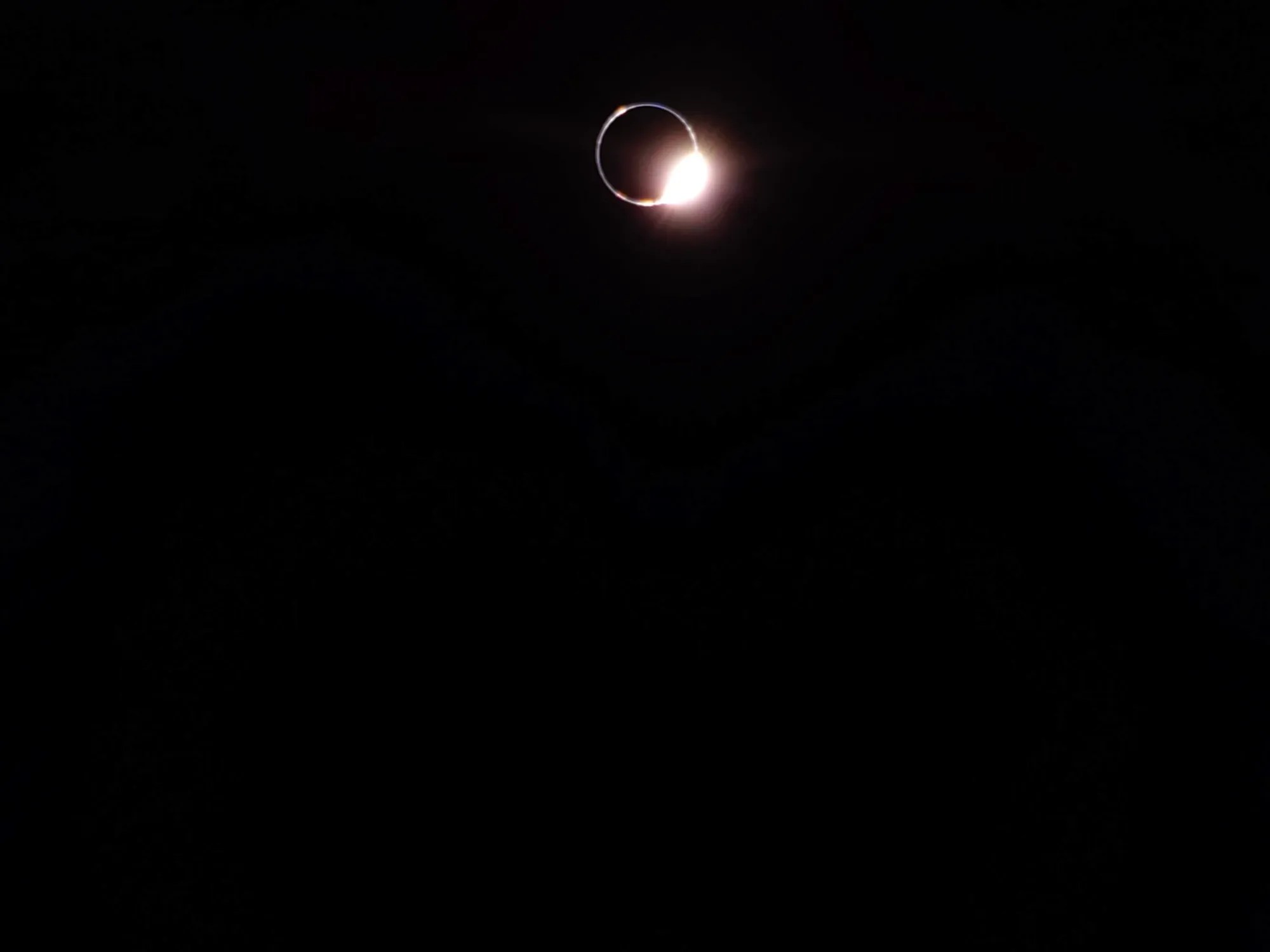
Firefly Aerospace.
Ephemeris: 05/03/2024 – GTAS meeting tonight: Eclipse Tales
This is Ephemeris for Friday, May 3rd. Today the Sun will be up for 14 hours and 21 minutes, setting at 8:50, and it will rise tomorrow at 6:27. The Moon, 2 days past last quarter, will rise at 4:48 tomorrow morning.
The Grand Traverse Astronomical Society will meet this evening at 8:00 PM at the NMC’s Joseph Rogers observatory which is on Birmley Road, south of Traverse City. The program will consist of returning members from the total solar eclipse last month showing their photographs, and recounting their adventures of going down to the path of totality. And in my case a video of the changes in the sky at totality, as the Moon’s shadow passed over us. Afterward, if it’s clear, will be viewing the skies, though there will be no planets or the Moon out. In the morning hours before dawn tomorrow and Sunday morning there will be a meteor shower, the Eta Aquariid meteor shower of particles from Halley’s Comet striking the Earth’s atmosphere.
The astronomical event times given are for the Traverse City/Interlochen area of Michigan (EDT, UT–4 hours). They may be different for your location.
Addendum
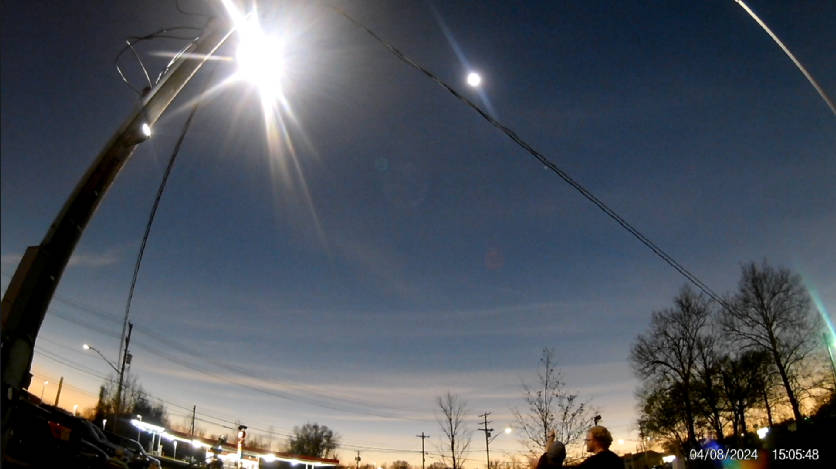
There will be more photos and stories at the meeting.
Ephemeris: 10/12/2023 – Saturday’s (October 14, 2023) Annular Solar Eclipse
This is Bob Moler with Ephemeris for Thursday, October 12th. Today the Sun will be up for 11 hours and 9 minutes, setting at 7:03, and it will rise tomorrow at 7:55. The Moon, 2 days before new, will rise at 6:39 tomorrow morning.
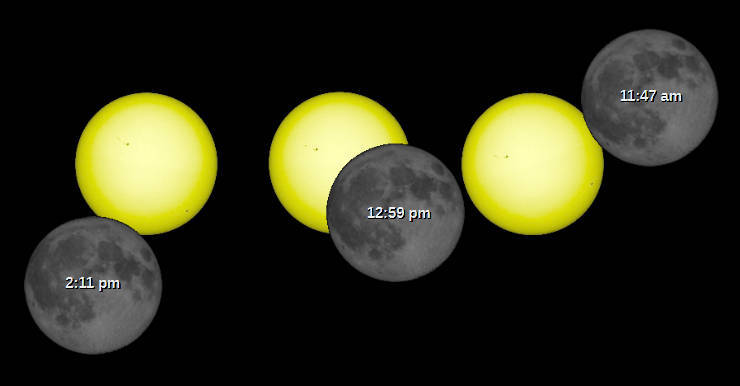
There will be a partial solar eclipse Saturday for most of the unit for the 48 Continental United States. It will be maximum on a line from Oregon through Texas. It’s called an annular eclipse. At its maximum an annular eclipse is an eclipse where the Moon is too far away to completely cover the face of the Sun so at maximum it leaves a ring of the Sun. Some call it a Ring of Fire. We’re well north of that line so we will see a partial eclipse where about 35% of the Sun will be covered by the Moon at its peak, although the Moon will encroach about 45% of the diameter of the Sun. For northern Michigan the eclipse will start at about 11:42 am, maximum eclipse is about 1 pm and the eclipse will end at 2:18 pm. I’ll talk about eclipse viewing safety tomorrow.
The astronomical event times given are for the Traverse City/Interlochen area of Michigan (EDT, UT –4 hours). They may be different for your location.
Addendum
07/28/2022 – Ephemeris – Why don’t we have solar eclipses every new moon?
This is Bob Moler with Ephemeris for Thursday, July 28th. Today the Sun will be up for 14 hours and 48 minutes, setting at 9:13, and it will rise tomorrow at 6:25. The Moon is new today, and won’t be visible.
The actual time when the moon is New will be 1:55 pm. The Moon will not eclipse the Sun this time. Why? Because the Moon is nearly 5 degrees, or 10 moon-diameters, north of the Sun. If the Moon orbited the Earth nearly in the same plane that the Earth orbited the Sun, we could have solar eclipses for somewhere on the Earth every new moon. As it is, the Moon orbits the Earth with about a 5-degree tilt to the Earth’s orbit of the Sun. So we get eclipse opportunities of eclipses about one in six new moons for solar eclipse and about the same for full moons and lunar eclipses. Of course, one has to be at the proper location to see them. If the Moon orbited the Earth over the Earth’s equator, like many other moons of other planets, eclipses would be much more rare and only occur around the equinoxes.
The astronomical event times given are for the Traverse City/Interlochen area of Michigan (EDT, UT – 4 hours). They may be different for your location.
Addendum
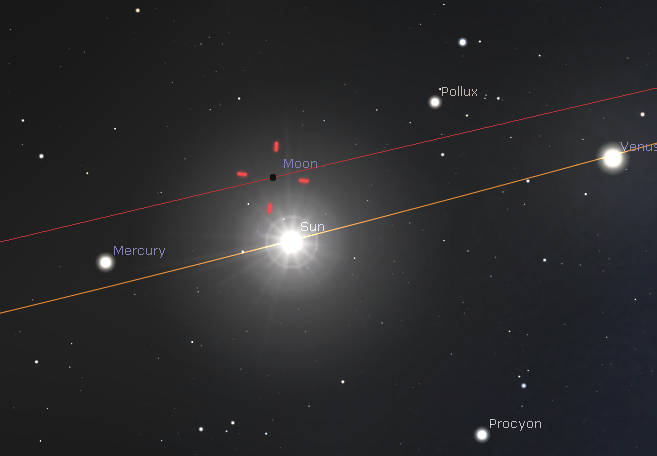
The Sun and Moon at New Moon at 1:55 pm today, seen as if the Earth had no atmosphere and one could see the Sun and stars at the same time. The orange line is the path of the Sun in the sky, called the ecliptic. The red line is the orbit of the Moon. Created using Stellarium.
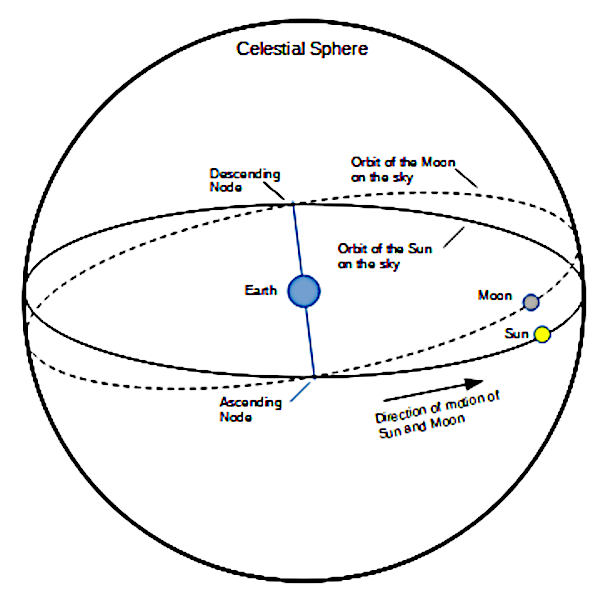
Earth centered (geocentric) diagram of the heavens called the celestial sphere, showing the apparent orbits of the Sun and Moon. The Moon’s orbit has about a 5-degree tilt (exaggerated here) to the Sun’s apparent orbit, which we call the ecliptic. Solar eclipses occur when the new moon and Sun are near a node. Lunar eclipses occur when the full moon and Sun are near opposite nodes. My diagram.
The orbit of the Moon precesses, so the line of the nodes regresses, that is slowly rotating clockwise, backwards to the motion of the Sun and Moon (and all the rest of the planets), one rotation in 18.6 years.
09/11/2015 – Ephemeris – Astronomy from the dark skies of the Sleeping Bear Dunes this Saturday
Ephemeris for Friday, September 11th. The Sun will rise at 7:16. It’ll be up for 12 hours and 44 minutes, setting at 8:01. The Moon, 2 days before new, will rise at 6:39 tomorrow morning.
Tomorrow night will be the next to the last Star Party at the Sleeping Bear Dunes National Lakeshore of the year. It will be at the Dune Climb in the Parking lot nearest to the dunes. Featured will be the wonders of the Milky Way including globular and galactic star clusters and planetary and emission nebulae. The event starts at 9 p.m. We are entering the second eclipse season of the year.
On Sunday there will be a partial solar eclipse visible from South Africa, the Southern Ocean and part of Antarctica. Eclipses occur in no less a grouping than pairs, solar and lunar, the next eclipse is 16 days away. It will be total lunar eclipse visible from here on Sunday evening the 27th. In the week after next I’ll tell you all about it.
Times are for the Traverse City/Interlochen area of Michigan. They may be different for your location.
Addendum
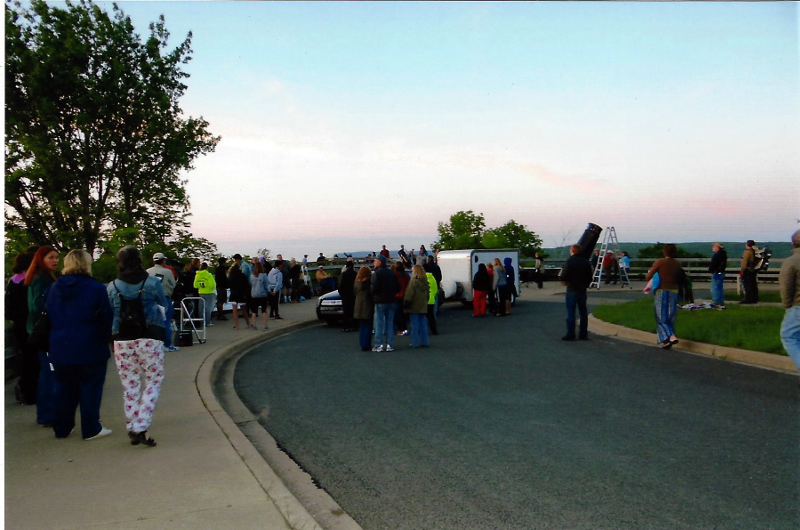
Star Party at the Dunes Overlook. Credit: Eileen Carlisle. I still don’t have a good picture of a star party at the Dune Climb where the dune rises up and blocks the lower 20º of the western sky.
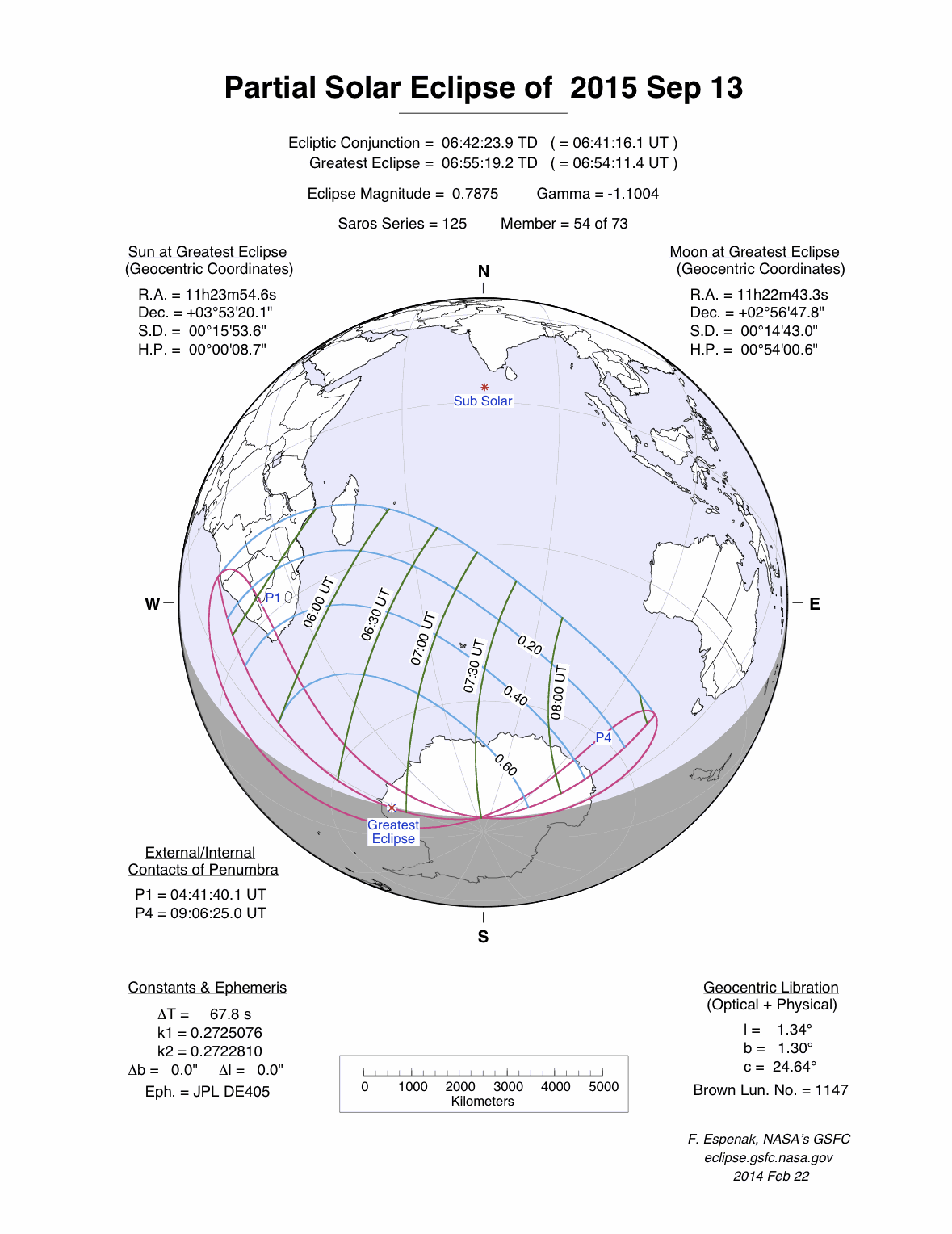
Partial Solar Eclipse of September 13, 2-15. Credit: NASA/GSFC/Fred Espenak.
07/20/2015 – Ephemeris – July 20th anniversaries
Ephemeris for Monday, July 20th. Today the Sun will be up for 15 hours and 5 minutes, setting at 9:21. The Moon, 4 days before first quarter, will set at 11:34 this evening, and tomorrow the Sun will rise at 6:16.
July 20th is a special date for this country’s space program and a personal one. On July 20, 1969 Apollo 11 landed on the Moon, the greatest achievement in the history of space flight. Seven years later the robot lander Viking 1 landed on Mars. NASA wanted it to be July 4th, 1976, the Bicentennial, but couldn’t find a smooth landing site in time. My own connection to the date came in 1963, my first total solar eclipse. We traveled to Quebec province along side the St. Maurice River. To view 60 seconds of totality. It was the first of four successful total solar eclipse trips I’ve been on.. I’m looking forward to my 5th on August 21st 2017, two years from now which is related to my first, I’ll tell you about that in my blog.
Times are for the Traverse City/Interlochen area of Michigan. They may be different for your location.
Addendum
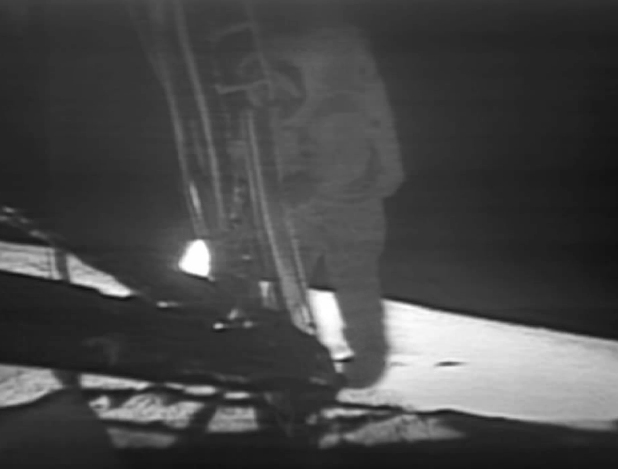
Neil Armstrong about to step off the LM onto the surface of the moon, July 20, 1969. Credit: NASA.
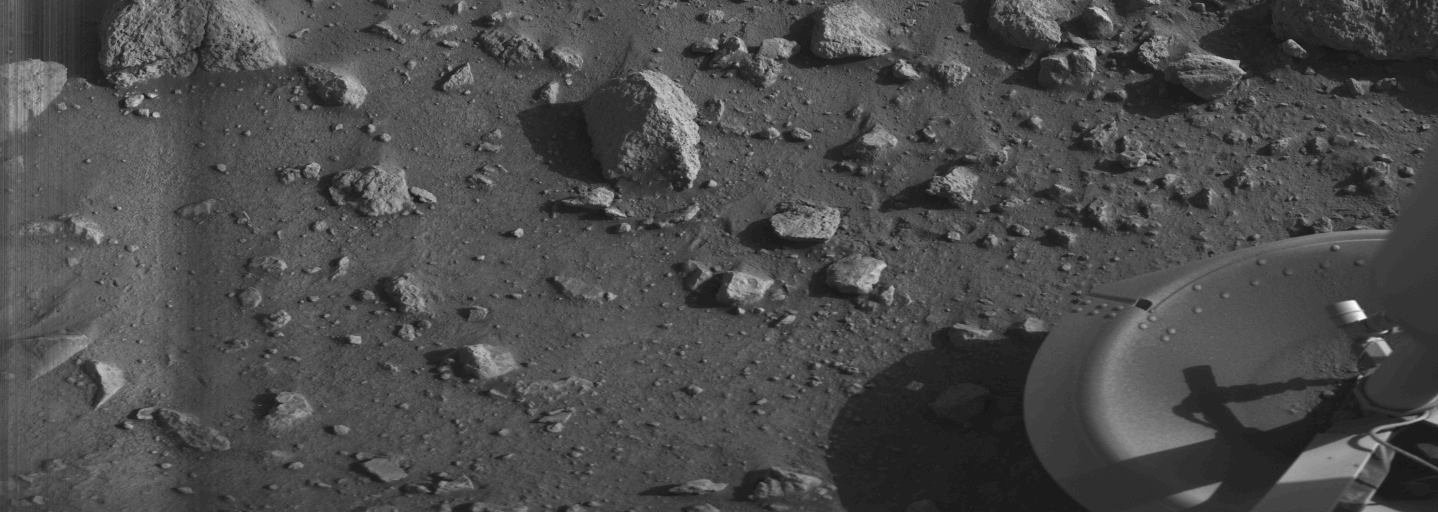
First image sent back from Viking 1 after landing on Mars, July 20, 1976. Credit: NASA/JPL. Click on image to enlarge.
Video of July 20, 1963 eclipse from the air. I got only one picture of the eclipse and it wasn’t very good. https://www.youtube.com/watch?v=OT3EW0KIjCc.
The date on the YouTube page is incorrect. It is July 20, 1963. I remember the corona being somewhat wedge-shaped, wider to one side than the other. Other than that it was a typical quiet sun corona.
In the program above I mentioned that the August 21, 2017 solar eclipse was related to my first total solar eclipse. This is the relationship: A couple of centuries BC the Chaldean astronomers of ancient Babylonia discovered that eclipses repeated in a cycle lasting 6,585 1/3 days. That’s 18 years 10 or 11 and 1/3 days depending on the number of leap years spanned. That period was called the Saros by Sir Edmund Halley or comet fame. So each eclipse would be visible 1/3 of the Earth farther west. Note that there are many Saros cycles occurring at the same time, and that eclipses of a particular Saros gradually move northward or southward. So to have an eclipse recur at the approximate same longitude one must wait 3 Saros cycles. or 54 years and one month approximately. Thus the third Saros of the July 20, 1963 total solar eclipse will be August 21, 2017. This Saros series (145) is moving southward. In 1963 it crosses the US at Alaska and Maine. Quebec was closer for us, s we went there. Good thing too. Maine was clouded and rained out. For us the clouds parted at the beginning of the eclipse. The 2015 eclipse will cross the continental US from Oregon to South Carolina.
A squished image of the July 20, 1963 eclipse path. Right click on the image and select view image to get a correct image. (works in Firefox).

A squished image of the August 21, 2017 eclipse path. Right click on the image and select view image to get a correct image. (works in Firefox).

10/22/2014 – Ephemeris – The bright planets this week plus a preview of Thursday’s partial solar eclipse
Ephemeris for Wednesday, October 22nd. The sun will rise at 8:06. It’ll be up for 10 hours and 39 minutes, setting at 6:46. The moon, 1 day before new, will rise at 7:46 tomorrow morning.
Tonight Saturn will be low in the west-southwest before it sets at 7:56 p.m. Mars will be low in the southwest at 9 p.m. and will set at 9:40 p.m. The sky will stay devoid of bright planets until Jupiter rises at 1:56 a.m. tomorrow morning. Jupiter is visible this morning in twilight in the south-southeast along with the brighter stars of winter visible, a preview of colder evenings to come. Tomorrow evening, weather permitting, we will get to see part of a partial solar eclipse. The exact times depend on your location, though shouldn’t deviate from these by a few minutes for the Interlochen Public Radio listening area (northwestern lower Michigan). The eclipse will start around 5:32 p.m. and will continue till sunset around 6:44 p.m. Use proper eye protection or use pinhole projection.
Times are for the Traverse City/Interlochen area of Michigan. They may be different for your location.
Addendum
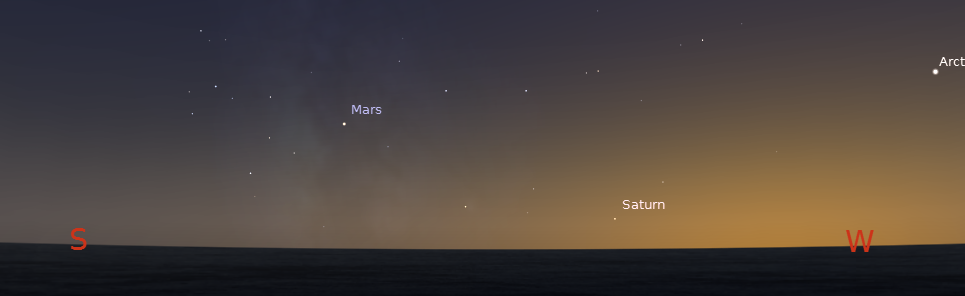
Saturn and Mars at 7:30 p.m. on October 22, 2014. Created using Stellarium.
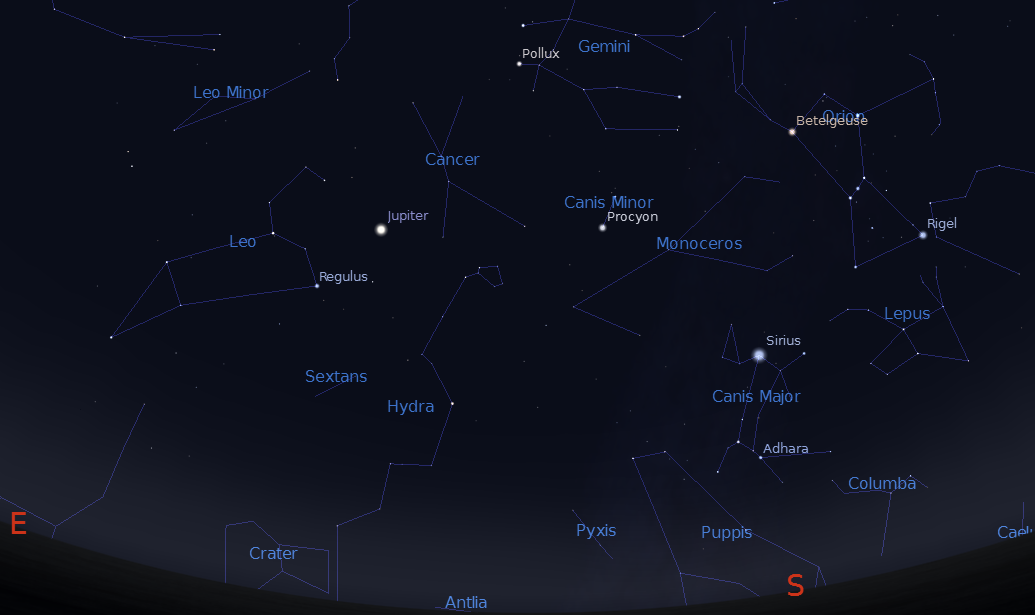
Jupiter and the morning constellations at 6:30 a.m., October 23, 2014. Created using Stellarium.
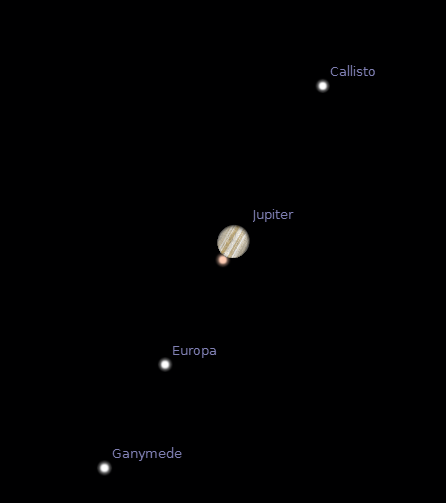
Jupiter through a telescope at 6:30 a.m. October 23, 2014. The unnamed moon is Io. Created using Stellarium.
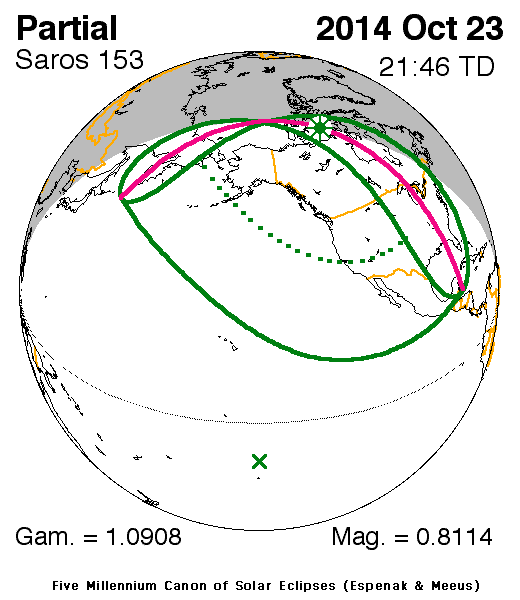
Coverage of the partial solar eclipse of October 23, 2014. Credit: NASA. Click image for more information.

The setting partially eclipsed sun from Traverse City. Created using Stellarium.
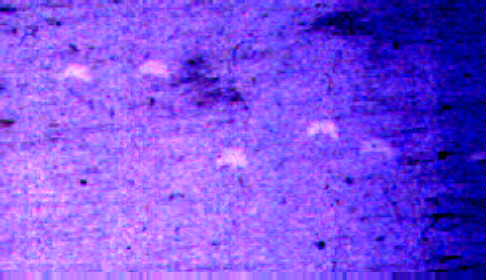
Partially eclipsed sun using a series of pinholes projected on a reasonably white surface.
10/09/2014 – Ephemeris – The next lunar eclipses and recollections of what happened with yesterday’s eclipse
Ephemeris for Thursday, October 9th. The sun will rise at 7:50. It’ll be up for 11 hours and 18 minutes, setting at 7:08. The moon, 1 day past full, will rise at 8:01 this evening.
With the two total lunar eclipses done for this year, we can look forward to two more next year. The April 4th, 2015 eclipse won’t appear total here because the moon will set before totality. However the September 28th, 2015 lunar eclipse will be an evening eclipse. These 4 eclipses make a rare tetrad of total lunar eclipses that won’t be repeated until 2032 and 2033. After September 28th the next total lunar eclipse visible from northern Michigan will be in 2021. On the solar eclipse side there’s one on the 23rd of this month, a partial eclipse at sunset. I’ll have more on that later. After that is the big event, the total solar eclipse on August 21, 2017. The path of totality will run from coast to coast, running just south of St. Louis Missouri, and just north of Nashville Tennessee.
Times are for the Traverse City/Interlochen area of Michigan. They may be different for your location.
Addendum
What follows is my recollection of the October 8th lunar eclipse. Originally relayed in an email to Pat Stinson, freelance writer and author of the wonderful article in the Grand Traverse Insider about the activities of Space Week and the astronomical events in October:
The skies were trending clearer at midnight and again at 2:30 a.m. when I took a shower to prepare for the eclipse. After that it got slowly worse. That afternoon Ranger Marie Scott of the Sleeping Bear Dunes National Lakeshore said she’d go to our site, Platte River Point, clouds or not, and I was willing. In setting up the eclipse observing sites,earlier in the year, this site was the one place that if it were clear, we could see either the moon or the sun set onto the Lake Michigan horizon for the three eclipses this year. I loaded my van with my two telescopes, the C8 and an 11″ Dobsonian and lots of coffee.
I got to the site at 4:30 and began to set up. Marie arrived a few minutes later and another Grand Traverse Astronomical Society member Don Flegel arrived shortly after that. They had some rain in Kingsley, where he lived that morning. We had a strong, cold northwest wind. When we’re at the Point we commandeer the small parking lot to the north of the road that’s up against a hill. That hill and my van offered some protection from the wind. I got the C8 set up just in time to spot the moon emerging from the clouds a few minutes after first contact. We were able to follow the eclipse intermittently until about 5:45 when a large cloud covered the moon big time. We could see the glint of the moon off the water until after totality.
This was our situation until about 7:30 when the clouds began to break up, By then the moon was so low that the foreshortened breaks weren’t all that open. Then about 10 minutes before moon set it did peek out at intervals. Unlike the Cheshire Cat’s smile, the moon (cat) had a frown because the upper edge of the moon was coming back into sunlight. 5 minutes later the moon finally disappeared for good in a cloud bank as the puffy clouds overhead caught the sun’s golden sunrise rays.
Marie Scott counted 18 folks that at one time or another came out to witness the event. Marie also posted some pictures she took of the eclipse on the park’s Facebook page.
 Bob Moler's Ephemeris Blog