Archive
Ephemeris: 01/09/2026 – Mars is behind the Sun today
This is Bob Moler with Ephemeris for Friday, January 9th. Today the Sun will be up for 9 hours and 2 minutes, setting at 5:21, and it will rise tomorrow at 8:18. The Moon, 1 day before last quarter, will rise at 12:51 tomorrow morning.
Mars is in conjunction with the Sun today. That means that it is behind the Sun, and it will enter our morning sky so that the Earth can be in an approximately 13 month pursuit of Mars for the next opposition. This is the center of a two-week period where communication with our satellites and Rovers on Mars is disrupted by the Sun which is a great generator of radio noise. Our radio telescopes on the Earth can hear transmissions from these assets on Mars a lot better than they can hear transmissions from the Earth. Just before conjunction we apparently have lost the Maven satellite that investigated the atmosphere of Mars, and helped relay communications from the rovers Perseverance and Curiosity.
The astronomical event times given in this blog are for the Traverse City/Interlochen area of Michigan (Lat 44.7° N, Long 85.7° W; EST, UT – 5 hours) unless stated otherwise. Times will be different for other locations.
Addendum
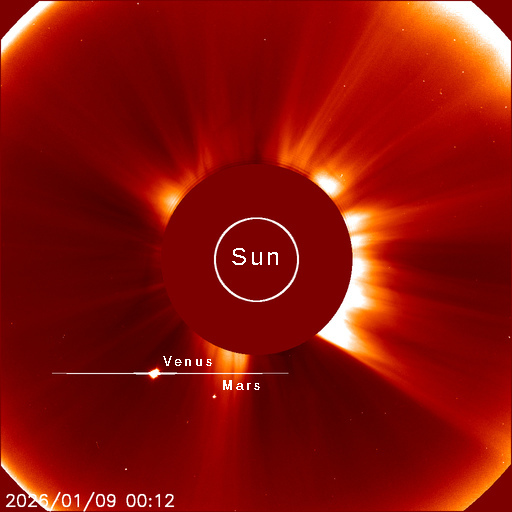
Distances to the solar system objects above
The Sun: 91.3 million miles, 147.1 million kilometers
Venus: 159.0 million miles, 255.0 million kilometers
Mars 223.3 million miles, 360.0 million kilometers
Ephemeris: 11/15/2024 – What causes the tides?
This is Ephemeris for Friday, November 15th. Today the Sun will be up for 9 hours and 33 minutes, setting at 5:14, and it will rise tomorrow at 7:41. The Moon, at full today, will rise at 4:48 this evening.
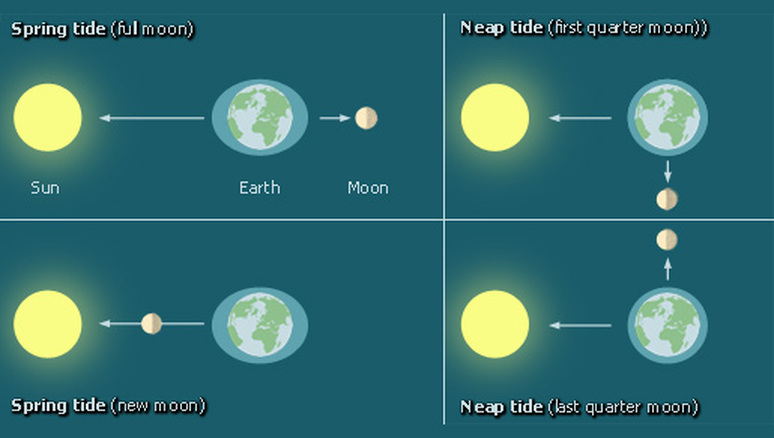
Today, at full moon, is one of the two highest tides of the month, the lunar month that is. The other highest tide comes at new moon. Both the Moon and the Sun cause tides because of their gravitational pull on the Earth. At new and full moon’s their gravitational pull gangs up on us. Since Earth is not a point body the gravitational pull of an object on the near side of the Earth pulls harder than it does on the opposite side of the Earth. Gravitational force diminishes with the square of the distance so it is the difference in the gravitational pull from one side to the other of the Earth that causes the tides to rise up on the side nearest and farthest from the gravitational pull of the moon and/or Sun. Since the Earth has a worldwide ocean, the water is free to slosh around and cause the tides.
The astronomical event times given are for the Traverse City/Interlochen area of Michigan (EST, UT – 5 hours). Times will be different for other locations.
Addendum
Ephemeris: 04/08/2024 – Solar Eclipse Today!
This is Ephemeris for Monday, April 8th. Today the Sun will be up for 13 hours and 10 minutes, setting at 8:19, and it will rise tomorrow at 7:08. The Moon is new today, and won’t be visible.
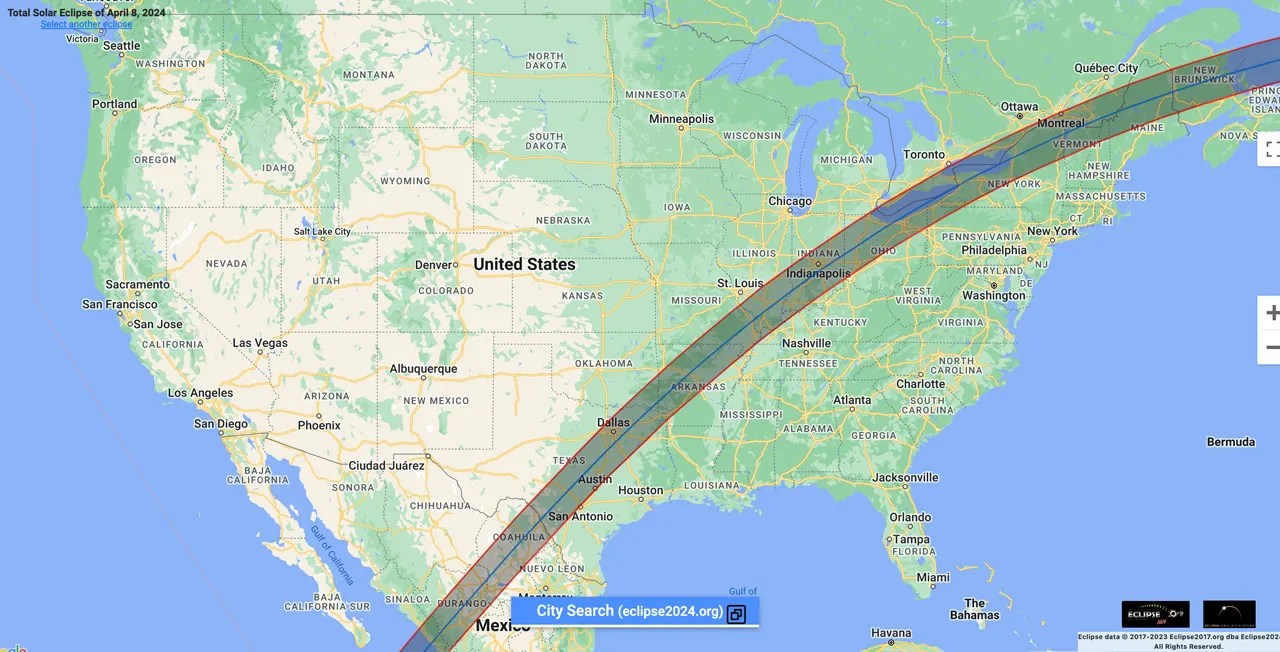
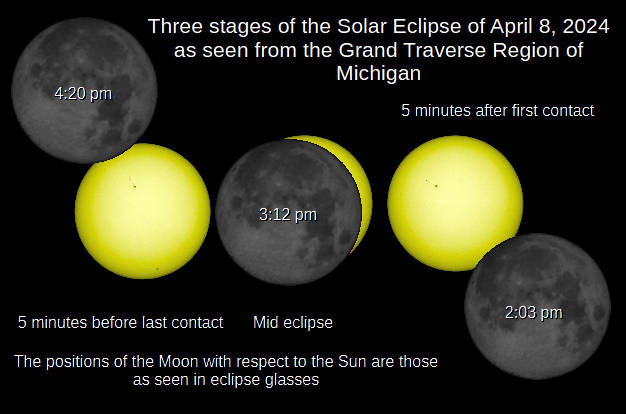
This afternoon there will be a total eclipse of the sun in the United States. But right here it’ll be a very deep partial eclipse, with the moon covering nearly 90% of the sun. For the Grand Traverse Area of Michigan, it will begin at 1:58 PM, mid-eclipse will be at 3:12 PM and the eclipse will end at 4:25 PM. In deep partial eclipses I’ve noticed that the sunlight has a slight yellowish hue. It’s possible effect of the Sun’s edge being cooler than the rest of the disk. Even if it’s cloudy here NASA will broadcast the eclipse from eight points along its route from Texas to Maine. It’s on the Internet on NASA’s YouTube channel, or in an Internet browser type NASA and ECLIPSE. Look for a link for nasa.gov, and you should be able to find out where that feed is. Good Luck!
The astronomical event times given are for the Traverse City/Interlochen area of Michigan (EDT, UT–4 hours). They may be different for your location.
Addendum
05/19/2023 – Ephemeris – It’s new moon, why is there no solar eclipse today?
This is Bob Moler with Ephemeris for Friday, May 19th. Today the Sun will be up for 14 hours and 58 minutes, setting at 9:08, and it will rise tomorrow at 6:09. The Moon is new today, and won’t be visible.
We are five months from witnessing a solar eclipse. That’s five lunar months, of approximately 29 and a half days. Solar eclipses can only happen at new moon, when the Moon is in the same direction as the Sun. Today, at 11:53 am, the instant of new moon, the Moon will be about two and a half of its diameters north of the Sun, so it won’t create a solar eclipse for us in Northern Michigan, or for any other place on the Earth for that matter. For locations south of Michigan, that Moon will appear somewhat farther from the Sun. For locations north of us, the Moon will appear closer to the Sun. But nobody will get a solar eclipse today. We will have to wait for the new moon of October 14th to see an eclipse of the Sun.
The astronomical event times given are for the Traverse City/Interlochen area of Michigan (EDT, UT –4 hours). They may be different for your location.
Addendum
The orbit of the Moon is tilted by about 5 degrees from the orbital plane of the Earth, so there’s a solar eclipse visible somewhere on the planet one out of six new moons on average. If our moon orbited near the earth’s equator like most major moons of their planet, eclipses would be much rarer than they are now, and only occur around the spring or autumn equinoxes. That’s because the Moon’s orbit would be tilted, on average, of 23½ degrees to Earth’s orbital plane.
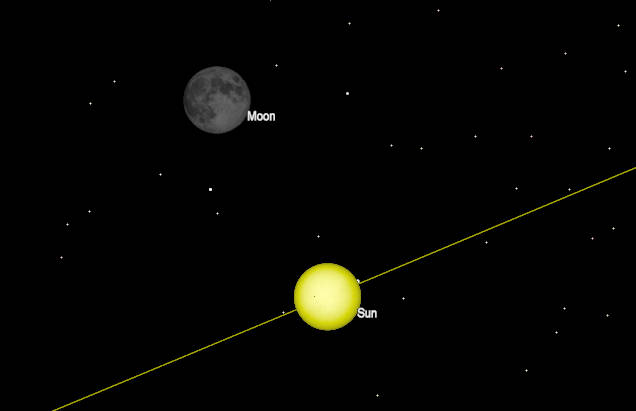
The new moon’s position north of the Sun at 11:53 am EDT. The yellow line is the ecliptic, which is the path of the Sun against the stars, or Earth’s orbital plane projected on the sky. If one could see the stars in the daytime, the Sun and Moon are below the Pleiades star cluster, which will make their first appearance in the evening sky this fall. While 11:53 am is only 7 minutes from noon EDT, for our location, local apparent solar noon, when the Sun is actually due south, isn’t until 1:39 pm. Our Eastern Daylight Saving Time meridian is off the coast of the US in the Atlantic Ocean at longitude 60 degrees west. We are located between 85 and 86 degrees west. Created using Cartes du Ciel (Sky Charts).
04/28/2023 – Ephemeris – International Astronomy Day is tomorrow
This is Bob Moler with Ephemeris for Arbor Day, Friday, April 28th. Today the Sun will be up for 14 hours and 6 minutes, setting at 8:43, and it will rise tomorrow at 6:36. The Moon, 1 day past first quarter, will set at 4:23 tomorrow morning.
Tomorrow is International Astronomy Day. The Grand Traverse Astronomical Society (GTAS) will celebrate the event with a Sun and Star Party at the Dune Climb area of the Sleeping Bear Dunes National Lakeshore. There will be a solar viewing period from 6 pm to about 7:30 pm or so, when the Sun will set over the dune. The society has two hydrogen alpha solar telescopes, and members have another two, to view the Sun’s chromosphere and prominences. Plus, other members have white light filtered telescopes to view sunspots on the face of the Sun. Night viewing will start at 9 pm with the Moon and Venus featured, along with the brighter telescopic wonders of spring. But only if the skies are clear or mostly clear.
The next GTAS event at the Sleeping Bear Dunes will be Saturday, May 27th, with a program like this Saturday’s. What we call a Sun ‘n Star Party.
The astronomical event times given are for the Traverse City/Interlochen area of Michigan (EST, UT –4 hours). They may be different for your location.
Addendum
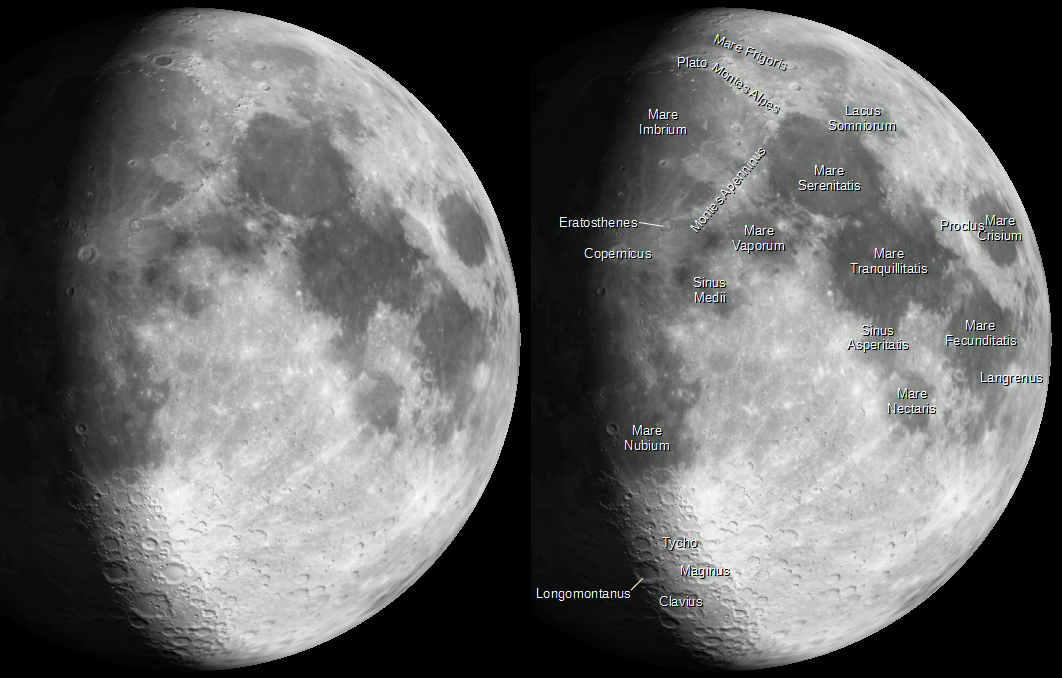
The Moon for Astronomy Day, 2023, two days after first quarter or 9 days old. Some of the more prominent features labeled. Created using Virtual Moon Atlas, GIMP and LibreOffice Draw.
09/03/2019 – Ephemeris – Yesterday and today conjunctions of Mars and Mercury with the Sun
Ephemeris for Tuesday, September 3rd. Today the Sun will be up for 13 hours and 8 minutes, setting at 8:16, and it will rise tomorrow at 7:08. The Moon, 2 days before first quarter, will set at 10:59 this evening.
Yesterday morning Mars passed in conjunction with the Sun. For astronomers Mars was either just north or south of the Sun. In this case it was north of the Sun, moving from the evening or east side of the Sun to the west or morning side. Later this evening Mercury will pass in superior conjunction with the Sun. Mercury, being an inferior planet, that is one whose orbit is within Earth’s orbit of the Sun can pass between the Earth and the Sun in what we call an inferior conjunction or around the back side of the Sun in superior conjunction. In doing so Mercury is moving from the morning to the evening sky. Today the SOHO satellite will show both planets, the Sun and even Venus in its coronagraph.
The times given are for the Traverse City/Interlochen area of Michigan. They may be different for your location.
Addendum
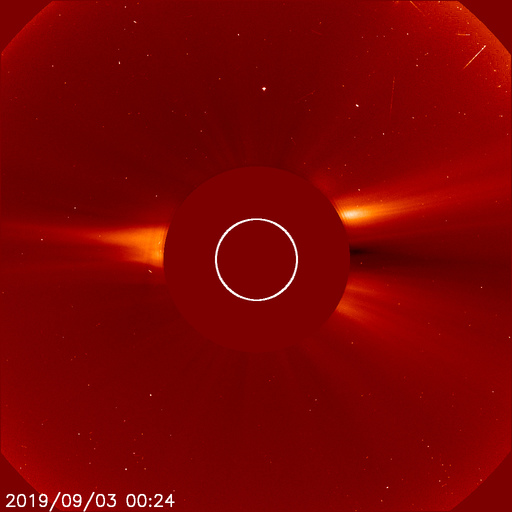
Solar and Heliospheric Observatory (SOHO) LASCO C2 Coronagraph image of the solar atmosphere at 8:24 p.m. September 2, 2019. A disk, called an occulting disk covers the bright Sun. The white circle is the size of the Sun’s photosphere. The white dot just about directly above the Sun is Mars, which is slowly heading to the right (west).
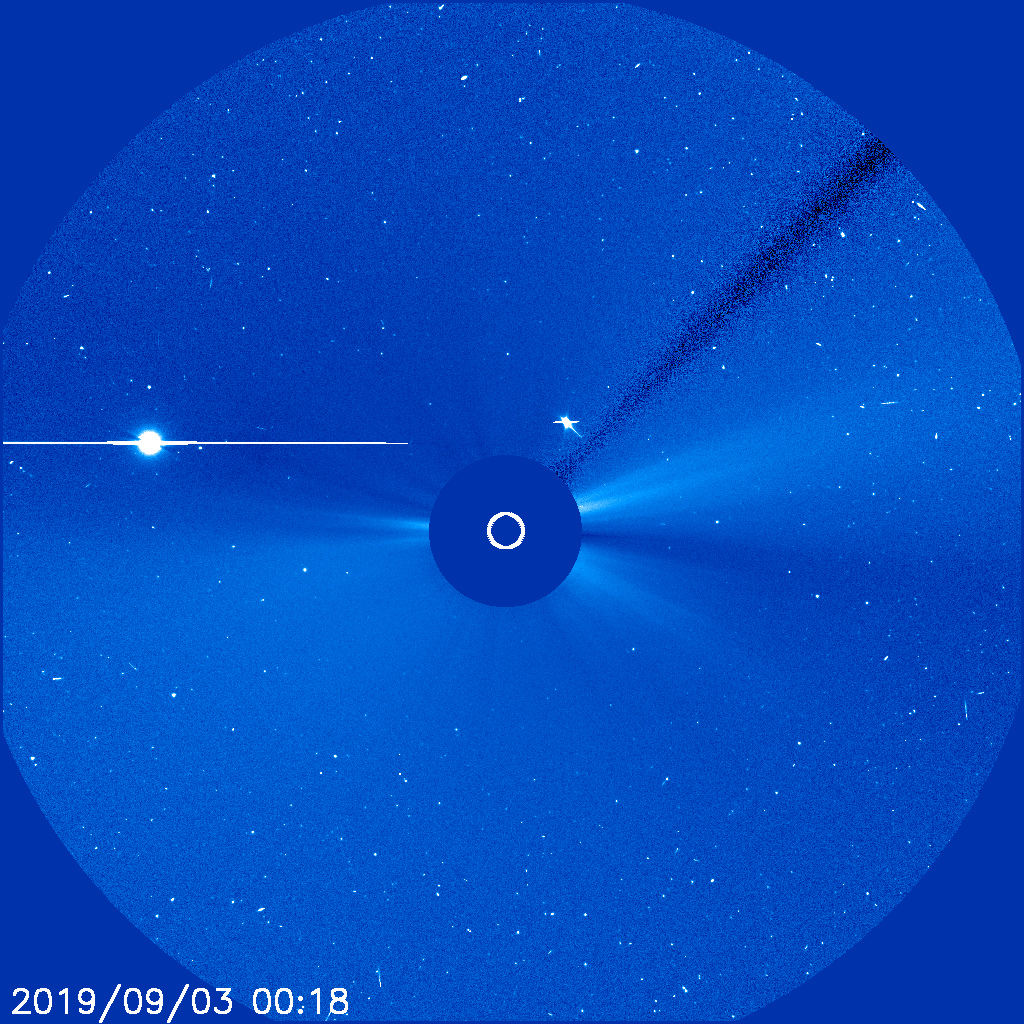
SOHO LASCO C3 Coronagraph image of the solar atmosphere at 8:14 p.m. September 2, 2019. A disk, called an occulting disk covers the bright Sun. The white circle is the size of the Sun’s photosphere. Venus is the bright object to the left. It passed superior conjunction of the Sun back on September 14th. Mercury is just to the upper right of the occulting disk. Both planets are heading to the left (east).
07/25/2017 – Ephemeris – Why do solar eclipses happen?
Ephemeris for Tuesday, July 25th. The Sun rises at 6:21. It’ll be up for 14 hours and 54 minutes, setting at 9:15. The Moon, 2 days past new, will set at 10:48 this evening.
We have a day less than 4 weeks before the Great American Total Solar Eclipse on August 21st will occur. Solar eclipses occur at new moon, when the moon is aligned so its shadow falls on the Earth. It doesn’t happen every new moon because the Moon is a long ways away, and its orbit is tipped some 5 degrees from the Earth’s orbit of the Sun, so usually the Moon is north or south of the Sun at new moon. About one in every 6 new moons produces an eclipse. They occur when the Moon is near the crossing point of the two orbital planes, called nodes. The point where the Moon is passing the node in northward direction is called the ascending node, and 180 degrees around the orbit there is the descending node, but you have to be in the right spot to see an eclipse.
The times given are for the Traverse City/Interlochen area of Michigan. They may be different for your location.
Addendum
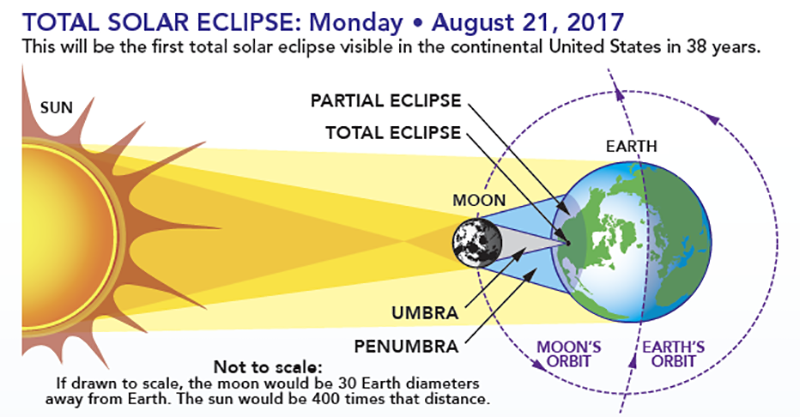
What happens to create a total solar eclipse. Note the Sun’ distance as being 400 times the distance of the Moon. The Sun is also 400 times the Moon’s diameter, so they appear nearly the same size from the Earth. Credit NASA and the Eclipse2017.NASA.gov website.
08/28/2015 – Ephemeris – The last Friday Night Live of the summer
Ephemeris for Friday, August 28th. The Sun will rise at 7:00. It’ll be up for 13 hours and 26 minutes, setting at 8:27. The Moon, 1 day before full, will set at 6:47 tomorrow morning.
The Grand Traverse Astronomical Society will be at the last Friday Night Live of the year this evening to view the Sun and will stay after if its clear to view the Moon and Saturn in the telescopes. For the Sun members have equipped their telescopes with solar filters to greatly diminish the sun’s light to make it safe to view the bright photosphere of the Sun with it’s sunspots. The society itself has a solar telescope, that not only filters the Sun’s light, but filters the light to isolate the red light of the element hydrogen. The special filter, called an etalon has to be tuned to the exact frequency or wavelength of the hydrogen atoms on the sun which will reveal the layer of gas above the photosphere and the clouds of hydrogen above.
Times are for the Traverse City/Interlochen area of Michigan. They may be different for your location.
Addendum

Viewing the Sun with a while light filter at Friday Night Live using Ron Uthe’s telescope at Friday Night Live. Credit Bob Moler.
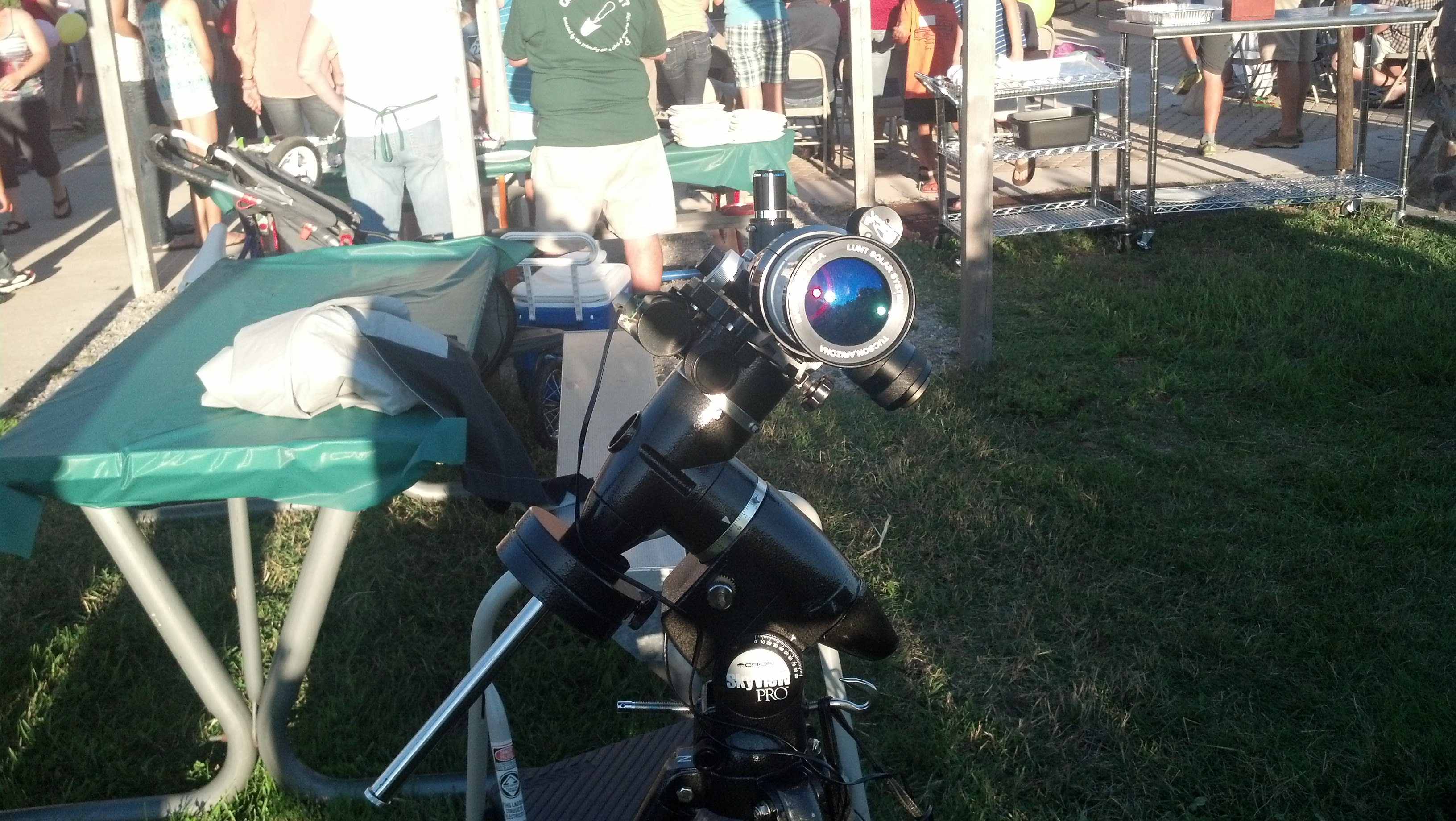
The Lunt solar telescope at another event. Credit Bob Moler.
06/22/2015 – Ephemeris – The summer full moon and the winter Sun trade places
Ephemeris for Monday, June 22nd. Today the Sun will be up for 15 hours and 34 minutes, setting at 9:32. The Moon, 2 days before first quarter, will set at 1:04 tomorrow morning. Tomorrow the Sun will rise at 5:57.
Summer’s here, and it’s a few days before the latest sunset and latest end of twilight. It might be instructive to check out the height of the moon over the next two weeks or so. The moon is heading south in front of the Sun. The Sun besides its apparent westward motion during the day caused by the Earth’s rotation also moves about twice its diameter each day eastward against the stars caused by the earth’s motion in its orbit of the Sun. Around July 1st, the moon will be about where the Sun will be next winter solstice, 4 days before Christmas. Actually it will be about 8 moon widths above where the Sun will be because its orbit is tilted a bit to the Earth’s. But it will serve as an illustration of the seasonal difference.
Times are for the Traverse City/Interlochen area of Michigan. They may be different for your location.
Addendum
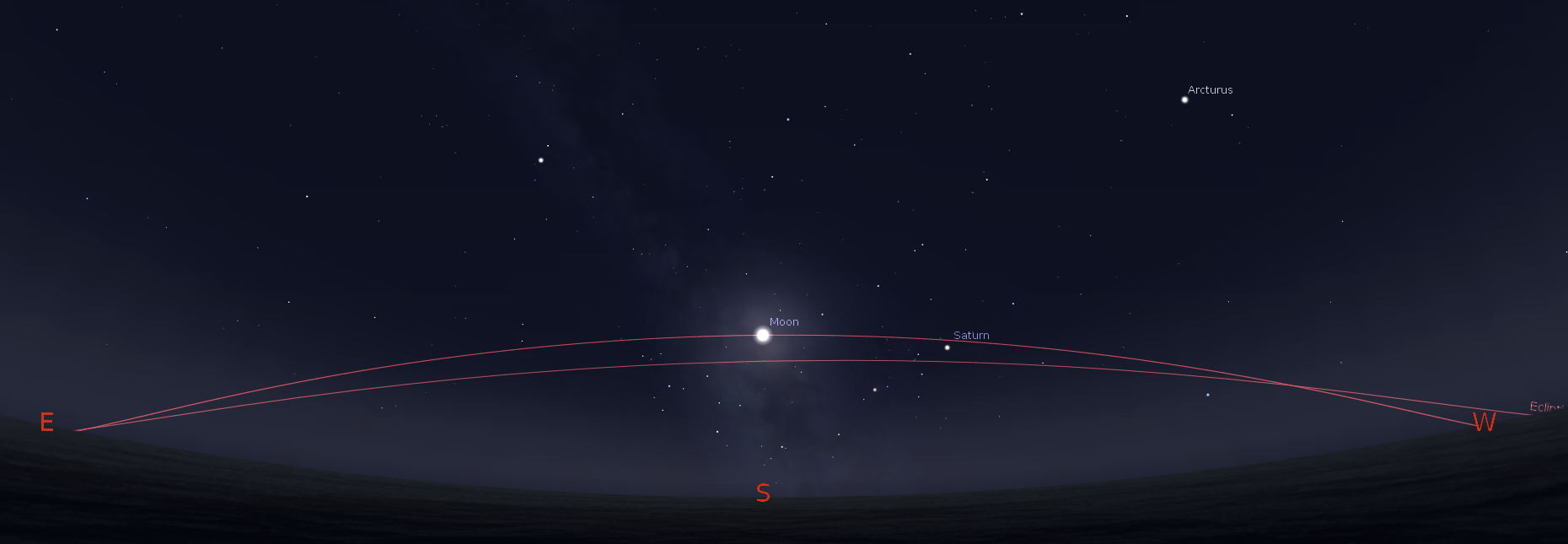
The full moon nearest the summer solstice. The full moon appears near where the sun would appear low in the south at the winter solstice. The bottom red line is the ecliptic, the path of the Sun. Created using Stellarium.
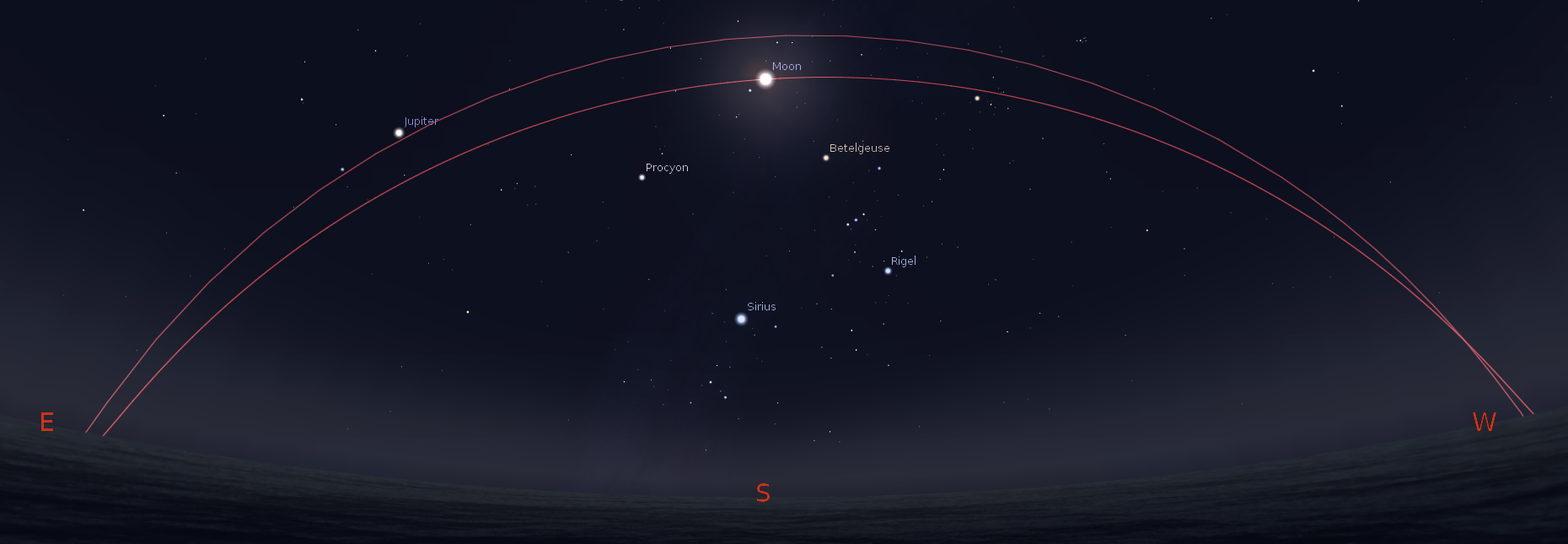
The full moon nearest the winter solstice. The full moon appears near where the sun would appear high in the south at the summer solstice. The top red line is the ecliptic, the path of the Sun. Created using Stellarium.
The Moon’s orbit has a slight tilt of a bit more than 5 degrees from the ecliptic, or plane of the Earth’s orbit of the sun. The crossing point is called a node. In the bottom image the node near the western horizon is called the descending node due to the fact that the Moon is heading south of the ecliptic. When the Sun and Moon are near the same node the Moon will be new and we have a chance for a solar eclipse. When at opposite nodes, a lunar eclipse. The nodes slowly slide westward slowly one revolution in about 18.6 years, which causes eclipse seasons, about 6 months apart to occur a bit earlier each year.
05/03/2013 – Ephemeris – Explore the sun and the stars tonight
Ephemeris for Friday, May 3rd. The sun rises at 6:29. It’ll be up for 14 hours and 20 minutes, setting at 8:49. The moon, 1 day past last quarter, will rise at 3:39 tomorrow morning.
Yours truly will present a talk about the sun and its effects on the earth at this evening’s meeting of the Grand Traverse Astronomical Society at Northwestern Michigan College’s Rogers Observatory starting at 8 p.m. This is a talk that is prepared to be given to the Friendly Garden Club later this month. It explores how the sun gets its energy and it emphases the life-giving radiation we receive from the sun and how plants, especially use it to create our green oxygenated world. Starting at 9 p.m. Is our first of our star parties for May at the observatory. Highlights, if its clear will be the planets Jupiter and Saturn, plus some of the bright wonders of the spring skies and maybe a star cluster or two. All are welcome.
Times are for the Traverse City/Interlochen area of Michigan. They may be different for your location.
 Bob Moler's Ephemeris Blog