Archive
Ephemeris: 11/11/2025 – The difference between a nova and a Type 1a supernova
This is Bob Moler with Ephemeris for Veterans Day, Tuesday, November 11th. Today the Sun will be up for 9 hours and 43 minutes, setting at 5:18, and it will rise tomorrow at 7:36. The Moon, 1 day before last quarter, will rise at 11:37 this evening.
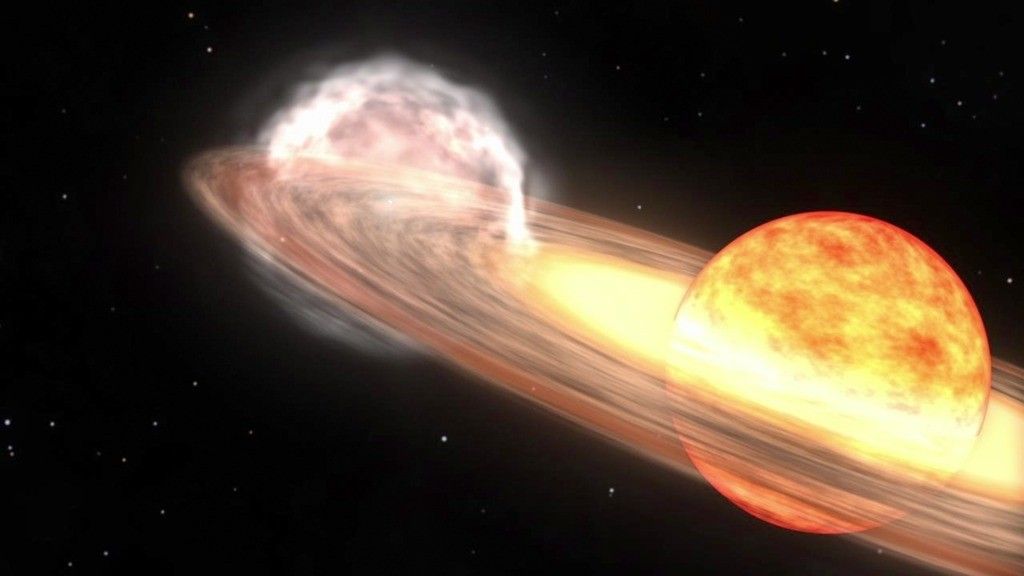
I’ve always wondered what the difference is between a nova like T Coronae Borealis, sometimes called the Blaze Star, and a Type 1a supernova. Both involve a white dwarf star and a larger star and having the mass of the larger star being drawn off onto the surface of the white dwarf until an explosion happens. If the detonation, which is a thermonuclear detonation of the hydrogen drawn off the larger star, is on the surface only, involving the outer layers of the white dwarf, the star becomes thousands of times brighter for a short period of time. The star survives. In the Type 1a supernova, the accretion of the hydrogen onto the white dwarf causes a more massive explosion involving the core of the white dwarf because its mass approaches or will surpass 1.4 times the Sun’s mass. At that point the star explodes.
The astronomical event times given in this blog are for the Traverse City/Interlochen area of Michigan (Lat 44.7° N, Long 85.7° W; EDT, UT – 4 hours) unless stated otherwise. Times will be different for other locations.
Addendum
Ephemeris: 11/10/2025 – Waiting on a stellar explosion
This is Ephemeris for Monday, November 10th. Today the Sun will be up for 9 hours and 46 minutes, setting at 5:19, and it will rise tomorrow at 7:34. The Moon, 2 days before last quarter, will rise at 10:22 this evening.
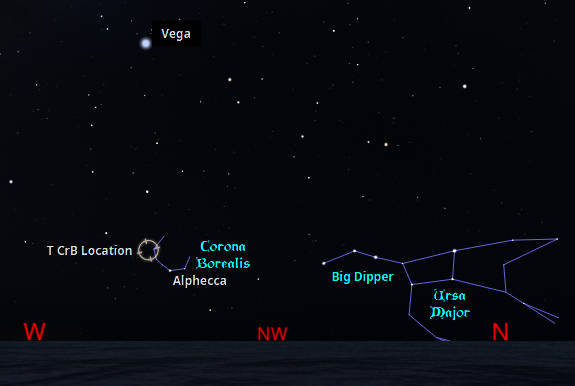
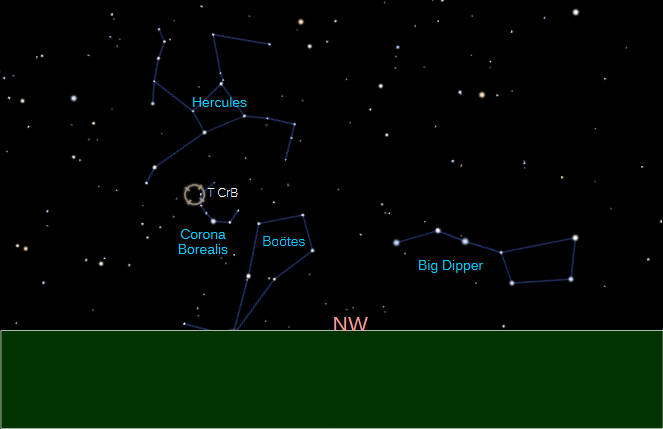
According to one astronomer, that I mentioned last Thursday, today is about the day he expects a star to erupt as a nova in the constellation Corona Borealis, the Northern Crown. In the early evening, it will appear low in the west northwest. The star is designated T Coronae Borealis (T CrB). Its appearance should make the normal news outlets, because it will be the brightest stellar outburst in a very long time. It will appear just left of the constellation Corona Borealis and be about as bright as its brightest normal star. However, it will soon fade and to be less the naked eye brightness in about a week. So we’re hoping for clear skies, if it happens. If it’s not this time, the next predicted time is June 25th, next year. Or he could be wrong, and it could go off at any time. Spaceweather.com has more information.
The astronomical event times given in this blog are for the Traverse City/Interlochen area of Michigan (Lat 44.7° N, Long 85.7° W; EDT, UT – 4 hours) unless stated otherwise. Times will be different for other locations.
Addendum
According to a paper in the Research Notes of the American Astronomical Society, Jean Schneider with the Paris Observatory predicted that the next eruption of T Coronae Borealis would be somewhere around November 10th 2025, or June 25th 2026. The first prediction of the 27th of March earlier this year turned out to not have occurred. These were tentative predictions based on the orbit around each other, of the two stars involved. The period of 80 years between eruptions is an approximation. There is an additional periodicity due to the fact that the two stars involved, a red giant and a white dwarf, have an orbital period of about 228 days which is why the predictions are 228 days apart. There have been four previous eruptions of the star observed. The first was in 1217, the next in 1787, then in 1866 and then finally in 1946. The reason for the big gap between 1217 and 1787 is unknown. Either the star didn’t erupt, or more likely, nobody observed and recorded it. The times of the first two eruptions weren’t accurately reports, but fell within what the 228-day periodicity would explain.
T Coronae Borealis is far enough north in the sky so that it is visible sometime during the night, year round. Currently, it would be best seen at the end of twilight in the west northwest. This will shift over to the morning sky, before morning twilight, after about the 25th of November, only 15 days from now in the east northeast. This star like any other star that rises and sets does so approximately 4 minutes earlier each night, or 28 minutes per week. So after the 25th the best observing opportunity will be before dawn in the morning until much later in the late winter, when it will be available also in the evening sky again.
Ephemeris: 11/06/2025 – An astronomer thinks a nova will appear soon
This is Ephemeris for Thursday, November 6th. Today the Sun will be up for 9 hours and 56 minutes, setting at 5:24, and it will rise tomorrow at 7:29. The Moon, 1 day past full, will rise at 5:50 this evening.
We’ve been waiting for the past year or so for the eruption of a nova in the constellation Corona Borealis the Northern Crown. It last erupted in 1946. Eruptions are about 80 years apart. Astronomer Jean Schneider of the Paris Observatory has made a study of this particular nova. It occurs in a binary star system with a white dwarf and a much larger star that orbit each other every 228 days. So it is possible that the Nova occurs at one point in that orbit. And based on the last eruption in 1946, November 10th, give or take, is one of the days we might look to see the eruption. If it doesn’t happen that day its next likely occurrence is around June 25th next year. It will appear just left of Corona Borealis low in the west northwest around 7 PM, and as bright as the normally brightest star in that constellation.
The astronomical event times given in this blog are for the Traverse City/Interlochen area of Michigan (Lat 44.7° N, Long 85.7° W; EDT, UT – 4 hours) unless stated otherwise. Times will be different for other locations.
Addendum
The website Spaceweather.com monitors reports of the brightness of the star on the right side of its page under the heading of T CrB NOVA WATCH. It is currently around 10th magnitude, invisible to the naked eye and barely visible in binoculars. It is expected to grow to 2nd magnitude or 1,600 times it’s normal brightness, about as bright as a Big Dipper star or Alphecca, near it, in Corona Borealis. The nova will fade rapidly, and will be visible to the naked eye for only about a week.
Ephemeris: 08/26/2025 – Update on our expected nova T Coronae Borealis
This is Ephemeris for Tuesday, August 26th. Today the Sun will be up for 13 hours and 31 minutes, setting at 8:29, and it will rise tomorrow at 6:59. The Moon, 3 days past new, will set at 9:44 this evening.
There is a star in the constellation of Corona Borealis, the Northern Crown, which astronomers are expecting to become a nova which means become rapidly very bright. The initial predictions favored last year, 2024, but it has yet to explode. The star’s designation is T Coronae Borealis, or T CrB for short. It’s a variable star designation. And an explosion occurs on one member of this binary star system about every 80 years. The last time was in 1946. Jean Schneider* of the Paris Observatory thinks they found a pattern within the 80-year time frame. The 227.6-day period of the white dwarf star orbiting its much larger primary. This seems to match the last three explosions. So the next likely date will be November 10th this year. We’ll see.
The astronomical event times given in this blog are for the Traverse City/Interlochen area of Michigan (Lat 44.7° N, Long 85.7° W; EDT, UT – 4 hours) unless stated otherwise. Times will be different for other locations.
* I found a link to this on the spaceweather.com website in a section called T CrB Nova Watch.
Addendum
Ephemeris: 05/20/2025 – Corona Borealis, Ariadne’s Crown
This is Ephemeris for Tuesday, May 20th. Today the Sun will be up for 15 hours and 1 minute, setting at 9:10, and it will rise tomorrow at 6:08. The Moon, at last quarter today, will rise at 3:12 tomorrow morning.
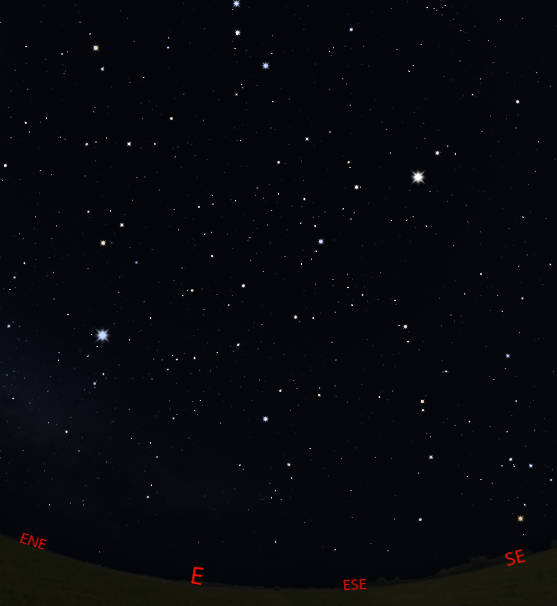
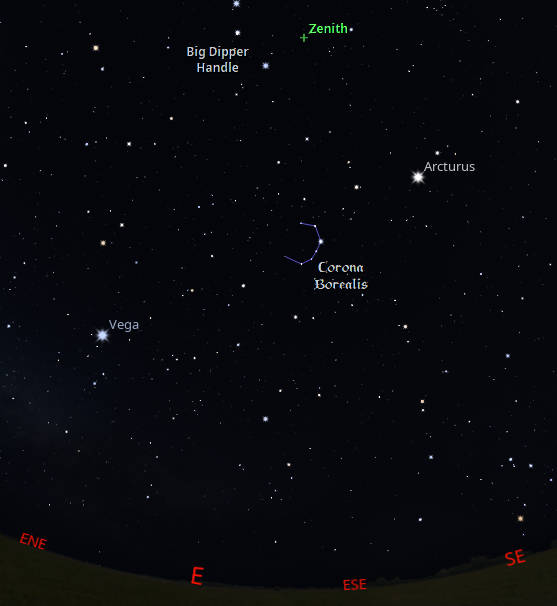
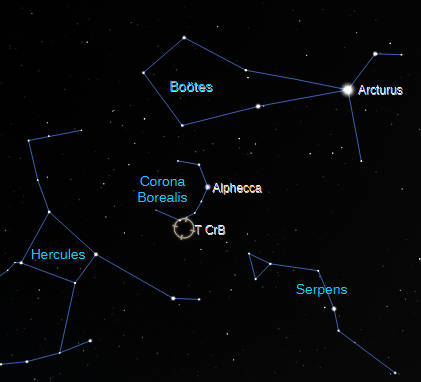
There are two bright stars in the eastern part of the sky. High in the southeast at 11 PM is Arcturus, and in the east northeast, lower down is the star Vega. A third of the way between Arcturus and Vega is a small arc of stars called Corona Borealis, the northern crown. It is a small constellation. The brightest star in it is called Alphecca. According to Greek mythology it is the crown given to Princess Ariadne, daughter of King Minos of Crete. Of interest in the next year or so is a possibility of a nova or bright star appearing just south of that arc of stars for about a week. It is a recurrent nova, which explodes about every 80 years. The last time was in 1946, so the next time would be within the next year or so. And astronomers are breathlessly waiting for that to happen.
The astronomical event times given in this blog are for the Traverse City/Interlochen area of Michigan (Lat 44.7° N, Long 85.7° W; EDT, UT – 4 hours) unless stated otherwise. Times will be different for other locations.
Addendum
Ephemeris: 11/11/2024 – Still waiting for the promised nova
This is Ephemeris for Veterans Day, Monday, November 11th. Today the Sun will be up for 9 hours and 43 minutes, setting at 5:18, and it will rise tomorrow at 7:36. The Moon, 2 days past first quarter, will set at 3:19 tomorrow morning.
We’ve been waiting all year so far for the appearance of a nova or Blaze Star, as they called it, in the constellation of Corona Borealis. The astronomical name For it is T Coronae Borealis or T CrB for short. It last erupted in 1946 and the time before that it was 1866 an interval of 80 years. This year would be 78 years since 1946 so we could be waiting another two years. Observations of the star, which is still visible, though faint, between eruptions, were not as comprehensive in the prior 80 years, as they are today. It’s possible that observations of pre-nova activity were missed during war years preceding the 1946 outburst.
The astronomical event times given are for the Traverse City/Interlochen area of Michigan (EST, UT – 5 hours). Times will be different for other locations.
Addendum
Ephemeris: 06/27/2024 – Why do astronomers think a nova will appear this year?
This is Ephemeris for Thursday, June 27th. Today the Sun will be up for 15 hours and 33 minutes, setting at 9:32, and it will rise tomorrow at 5:59. The Moon, 1 day before last quarter, will rise at 1:18 tomorrow morning.
Our expected nova this year, T Coronae Borealis, is expected by some astronomers to erupt sometime in September give or take, but nobody knows for sure. The last eruption was seen in 1946. And if the average time between outbursts is 80 years, it seems to be two years early this time. In 1946 there were observations showing that there were some precursor effects going on before the eruption, and those have been noticed this time too, which is which why we assume that the nova will occur this year. Stars that vary in brightness are denoted in a constellation by a letter starting with R through Z, then RR, RS, etcetera through ZZ. After that it’s V and a number plus the constellation name or abbreviation.
The astronomical event times given are for the Traverse City/Interlochen area of Michigan (EDT, UT–4 hours). They may be different for your location.
Addendum
Ephemeris: 04/29/2024 – Corona Borealis, the Northern Crown
This is Ephemeris for Monday, April 29th. Today the Sun will be up for 14 hours and 11 minutes, setting at 8:46, and it will rise tomorrow at 6:33. The Moon, 2 days before last quarter, will rise at 2:58 tomorrow morning.
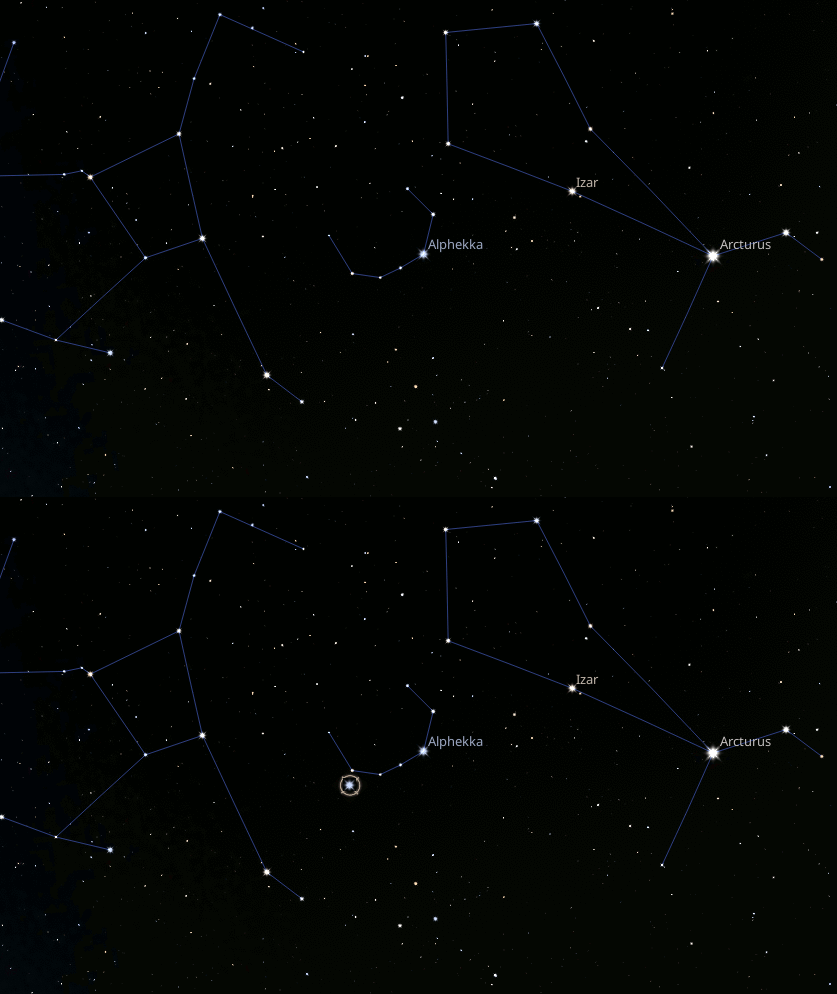
About a third of the way up the sky in the east at 10 p.m. can be found a small but easily spotted constellation of Corona Borealis, the Northern Crown. It is located just below the kite shaped constellation of Boötes, with its bright star Arcturus at the right. The Northern Crown is a three-quarter circle of stars, like a tiara, with a brighter star Alphecca at the bottom. Alphecca in Arabic means “The bright star of the broken ring of stars”, which is an accurate description of it. Check it out now for later this year we expect to have a bright star appear just below it. That star is T Coronae Borealis a recurrent Nova or exploding star. They occur when a white dwarf star is orbiting with a large red giant star and accumulating gas from that red giant star until it explodes.
The astronomical event times given are for the Traverse City/Interlochen area of Michigan (EDT, UT–4 hours). They may be different for your location.
Addendum
Ephemeris: 04/23/2024 – We are awaiting a bright nova
This is Bob Moler with Ephemeris for Tuesday, April 23rd. Today the Sun will be up for 13 hours and 54 minutes, setting at 8:38, and it will rise tomorrow at 6:42. The Moon, at full today, will rise at 8:40 this evening.
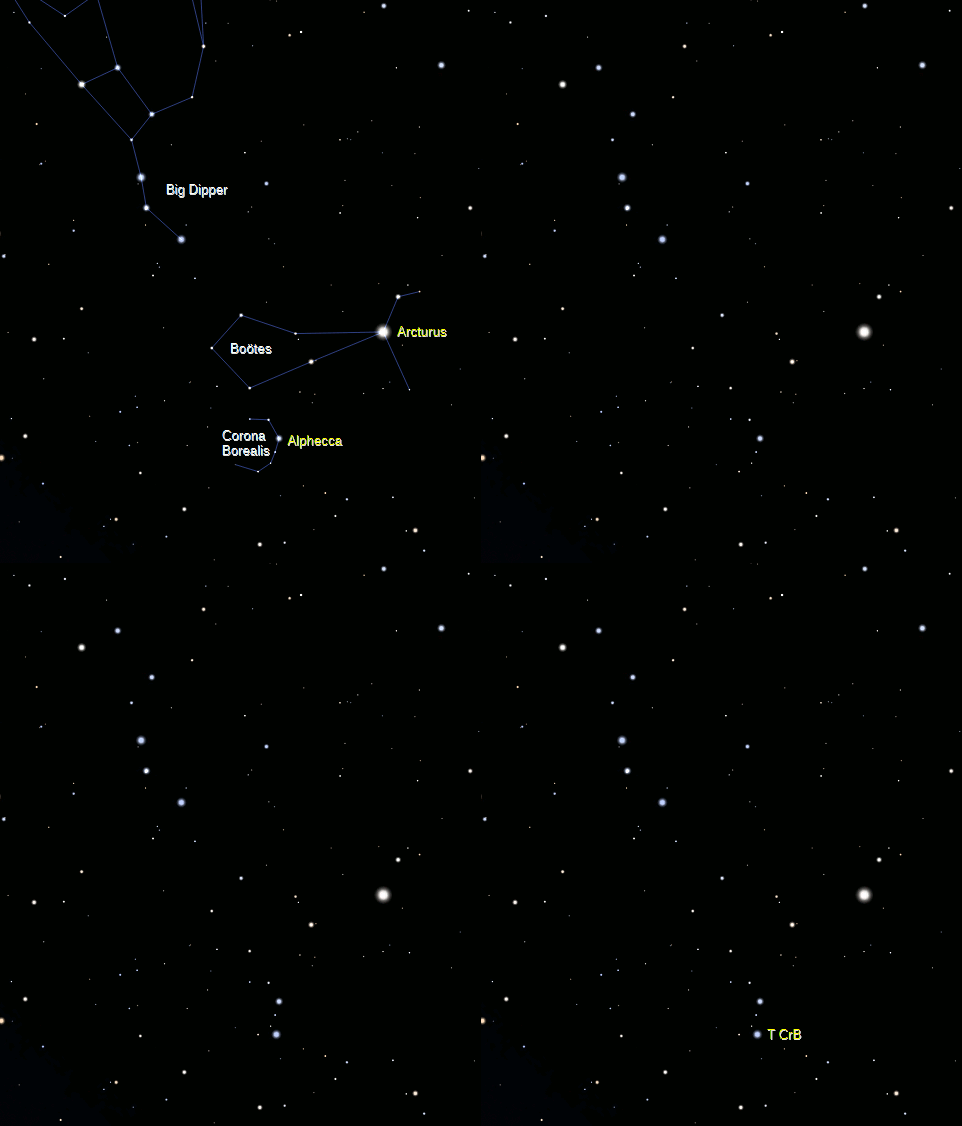
There is an event rarer than the appearance of Halley’s Comet. It’s an explosion of a star called T Coronae Borealis which means it’s in the constellation of the Northern Crown. Corona is a semicircle of stars located left of the bright star Arcturus, pointed to by the handle of the Big Dipper. The letter T means that it’s a variable star. It is something called a cataclysmic variable, or recurrent nova, and it blows up about every 80 years. The last time it did this was in 1946. Its brightness dips about 11 months before it goes kablooey. That dip has already happened. The star doesn’t destroy itself. It’s actually a white dwarf that’s siphoning off gases from a red giant star that it’s orbiting. When enough hydrogen gets accumulated, it ignites.
The astronomical event times given are for the Traverse City/Interlochen area of Michigan (EDT, UT–4 hours). They may be different for your location.
Addendum
 Bob Moler's Ephemeris Blog