Archive
02/26/2016 – Ephemeris – The lion roars into the evening sky
Ephemeris for Friday, February 26th. The Sun will rise at 7:26. It’ll be up for 10 hours and 59 minutes, setting at 6:25. The Moon, half way from full to last quarter, will rise at 10:27 this evening.
Besides the advancing sunset times, there is another sign that spring is coming. That’s the appearance of the constellation Leo the lion rising in the east in the evening. The front of this beast is a backward question mark of stars with the bright star Regulus as the dot at the bottom. That’s his head, mane and chest. His haunches are a triangle of stars to the lower left, the last star is in the east above brilliant planet Jupiter. just clearing the horizon at 9 p.m. One way to find Leo is to remember that cat’s aren’t supposed to like water, though mine have always had a certain fascination with the toilet. Find the Big Dipper standing on its handle and imagine drilling a hole in the bottom of the bowl. The water, falling from the north, will fall on Leo’s back.
Times are for the Traverse City/Interlochen area of Michigan. They may be different for your location.
Addendum
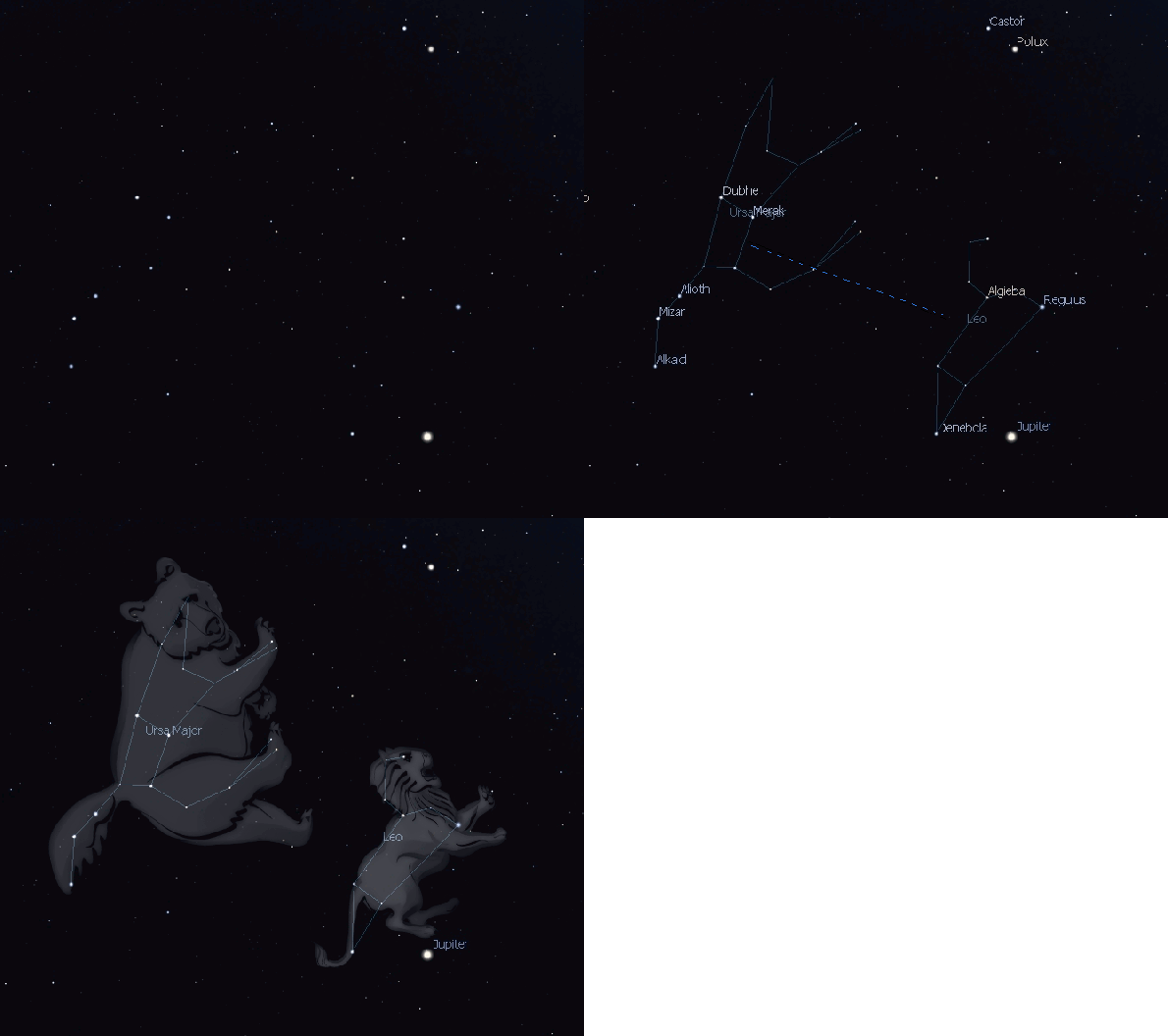
How to find Leo with Jupiter and the Big Dipper. At 10 p.m. on February 26, 2016. Created using Stellarium and GIMP.
04/14/2015 – Ephemeris – Arcas and Callisto
Ephemeris for Tuesday, April 14th. The Sun will rise at 7:00. It’ll be up for 13 hours and 25 minutes, setting at 8:26. The Moon, 3 days past last quarter, will rise at 5:08 tomorrow morning.
Rising in the eastern sky at 10 p.m. tonight is the kite shaped constellation of Boötes the herdsman. The bright star Arcturus is at the bottom of the kite, pointed to by the arc of the handle of the Big Dipper, overhead. In one story Boötes represents a young hunter named Arcas, son of Callisto, a beautiful young lady who had the misfortune of being loved by Zeus the chief Greek god. Zeus’ wife Hera, found out about it, and since she couldn’t punish Zeus, turned Callisto into an ugly bear. Arcas, unaware of why his mother disappeared in his youth was about to kill the bear when Zeus intervened and placed them both in the sky. Now Arcas as Boötes chases the Great Bear forever around the pole of the sky each night.
Times are for the Traverse City/Interlochen area of Michigan. They may be different for your location.
Addendum
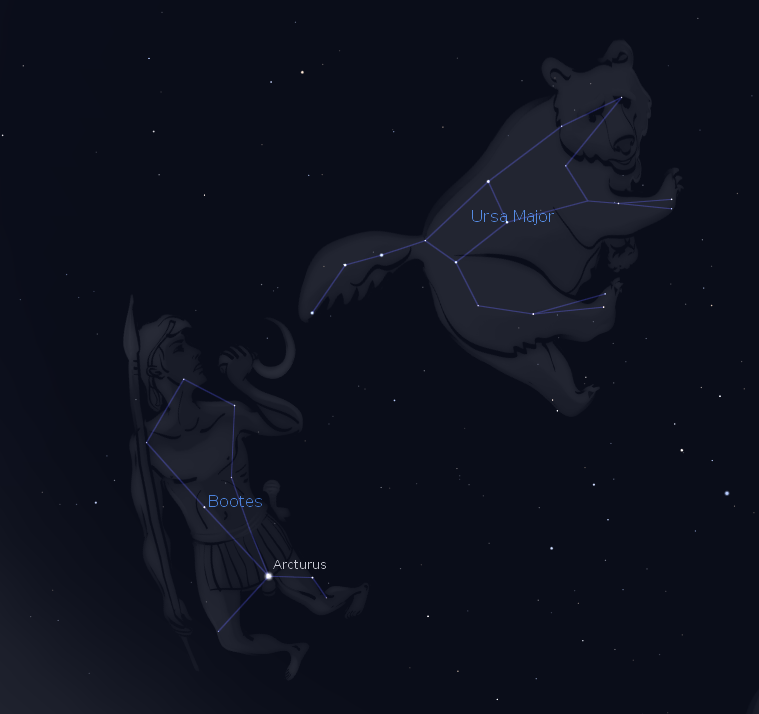
Bootes and Ursa Major aka Arcas chasing Callisto around the pole of the sky. Created using Stellarium.
öö
03/09/2015 – Ephemeris – The Big Dipper, a sign of spring
Ephemeris for Monday, March 9th. The Sun will rise at 8:06. It’ll be up for 11 hours and 34 minutes, setting at 7:40. The Moon, 4 days before last quarter, will rise at 11:43 this evening.
There’s a sign of spring appearing in the sky, rising high in the northeast. It’s the Big Dipper standing on its handle. In the native story of the Fisher Star, it’s the sign that it’s time for the maple sugar season. The Big Dipper is part of Ursa Major the great bear or a weasel-like creature called Fisher or Fisher Star. Draw a line through the bottom of the bowl of the dipper as if it leaks, and it will drip on the back of Leo the lion in the southeast. The handle of the Big Dipper will arc to Arcturus after 10 p.m. when that star rises. The most important guide that the Big Dipper provides is to point to Polaris, the north star. The two stars at the front of the bowl of the dipper point to Polaris, that alone of all the stars appears fixed in the north.
Times are for the Traverse City/Interlochen area of Michigan. They may be different for your location.
Addendum
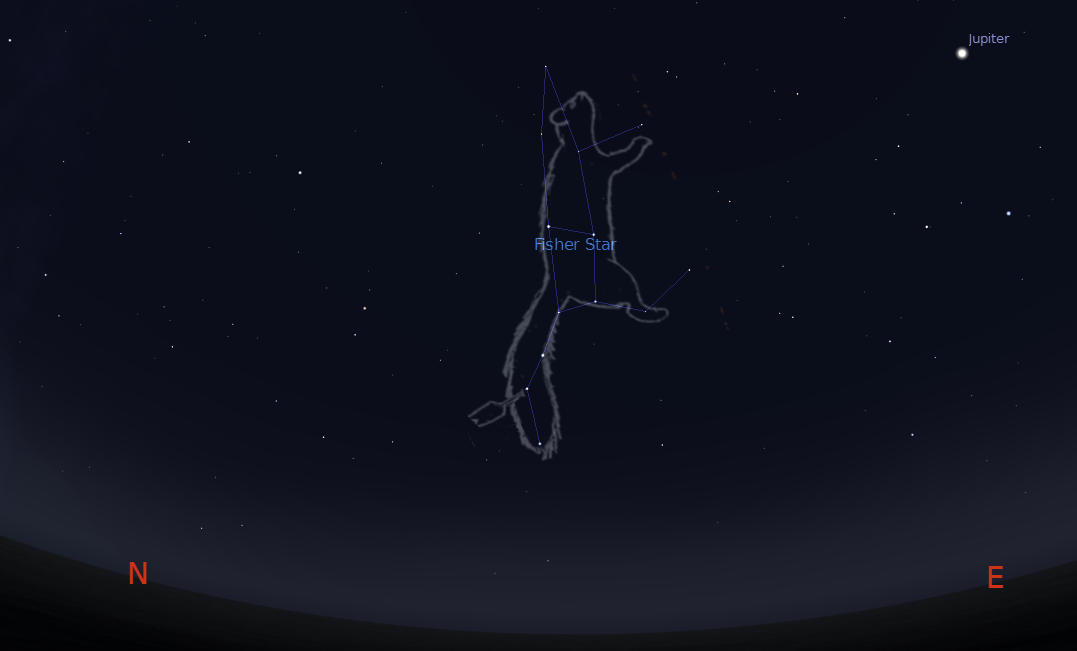
The Big Dipper, part of Ursa Major and also part of Fisher Star in the northeastern sky at 9 p.m. March 9, 2015
For the story of Fisher Star follow this link.
05/29/2014 – Ephemeris – Boötes the Herdsman
Ephemeris for Thursday, May 29th. Today the sun will be up for 15 hours and 15 minutes, setting at 9:18. The moon, 1 day past new, will set at 10:04 this evening. Tomorrow the sun will rise at 6:01.
High in the south southeastern sky at 10:30 tonight can be found the kite shaped constellation of Boötes the herdsman, chasing or herding the Great Bear Ursa Major of which the Big Dipper is the hind end, across the sky. The bright star at the base of the kite is the 4th brightest night-time star Arcturus. It can be found and name remembered by first locating the Big Dipper and by following the arc or curve of the handle to Arcturus. This star is an orange-colored giant star, 37 light years away. Its light was used open the 1933 Chicago Worlds Fair believing its light left the star in 1893 the year of the previous Chicago Worlds Fair. It turns out that Arcturus is 3 light years closer than what they thought.
Addendum
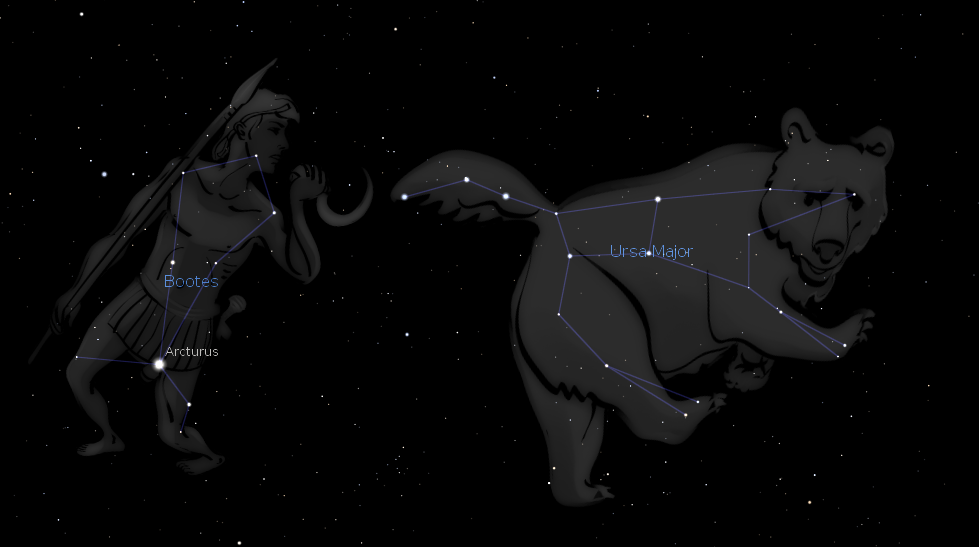
Bootes and Ursa Major high overhead on late spring evenings at 11 p.m. Created using Stellarium.
04/22/2014 – Ephemeris – The Great Bear and the Fisher Star
Ephemeris for Earth Day, Tuesday, April 22nd. The sun rises at 6:46. It’ll be up for 13 hours and 49 minutes, setting at 8:36. The moon, at last quarter today, will rise at 3:31 tomorrow morning.
This evening the Big Dipper is practically overhead. The Europeans and some Native Americans say it as the hind end of a bear with dimmer stars making up the rest of the bear. The official constellation of which the Big dipper is a part is Ursa Major, the Great Bear. The native Americans were smart enough to depict the handle stars of the dipper as three hunters following the bear, rather than the bear’s unnaturally long tail. The Anishinabek Indians who settled around here saw instead of a bear a weasel like creature, who did have a long tail called Fisher or Fisher Star, who through a great adventure, with his other animal friends, brought summer and the rest of the seasons to the frozen earth.
Times are for the Traverse City/Interlochen area of Michigan. They may be different for your location.
Addendum
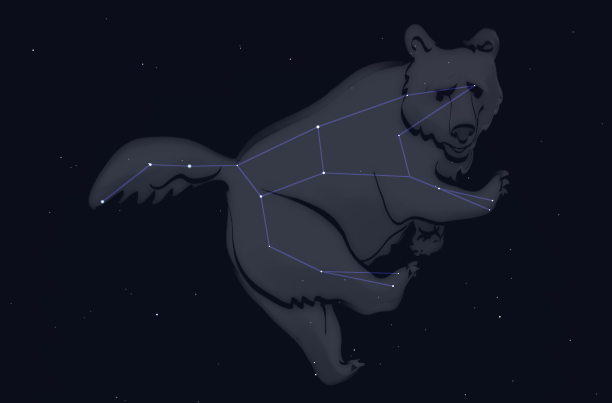
The Great Bear as the Europeans saw it. Created using Stellarium.
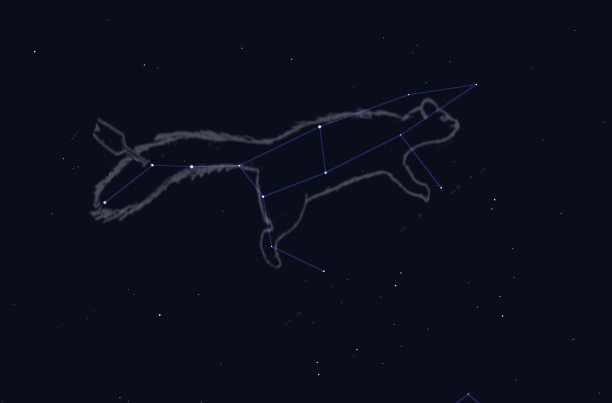
The Fisher Star. Created using Stellarium.
05/28/2013 – Ephemeris – Boötes the bear chaser
Ephemeris for Tuesday, May 28th. Today the sun will be up for 15 hours and 14 minutes, setting at 9:17. The moon, half way from full to last quarter, will rise at 12:34 tomorrow morning. Tomorrow the sun will rise at 6:02.
Appearing high in the southeastern sky at 10:30 tonight is the kite shaped constellation of Boötes the herdsman. The bright star Arcturus is at the bottom of the kite, pointed to by the arc of the handle of the Big Dipper, overhead. In one story Boötes represents a young hunter named Arcas, son of Callisto, a beautiful young lady who had the misfortune of being loved by Zeus the chief Greek god. Zeus’ wife Hera, found out about it, and since she couldn’t punish Zeus, turned Callisto into an ugly bear. Arcas, unaware of why his mother disappeared in his youth was about to kill the bear when Zeus intervened and placed them both in the sky. Now Arcas as Boötes chases the Great Bear forever around the pole of the sky each day and night.
Times are for the Traverse City/Interlochen area of Michigan. They may be different for your location.
Addendum
Bootes and Ursa Major high overhead on late spring evenings at 11 p.m. Created using Stellarium.
04/11/2013 – Ephemeris – The Big Dipper and Ursa Major the Great Bear
Ephemeris for Thursday, April 11th. The sun will rise at 7:04. It’ll be up for 13 hours and 17 minutes, setting at 8:22. The moon, 1 day past new, will set at 10:01 this evening.
The Big Dipper is now nearly overhead in the northeast at 10 p.m. The seven bright stars are second to Orion in the west as the seven brightest stars in a constellation. If you looked up a list of constellations, you’d find that the Big Dipper isn’t there. Ursa Major or the Great Bear is the constellation of which the Big Dipper is a part. The seven bright stars of the dipper is the rump and long tail of this constellation. The rest of the bear, including his head and legs are delineated by dimmer stars. An anatomical problem is its long tail, which was drawn in by the ancients of the old world. Many Native Americans, also saw a bear in the stars here, but the handle of the dipper became three hunters following the bear.
Times are for the Traverse City/Interlochen area of Michigan. They may be different for your location.
Addendum
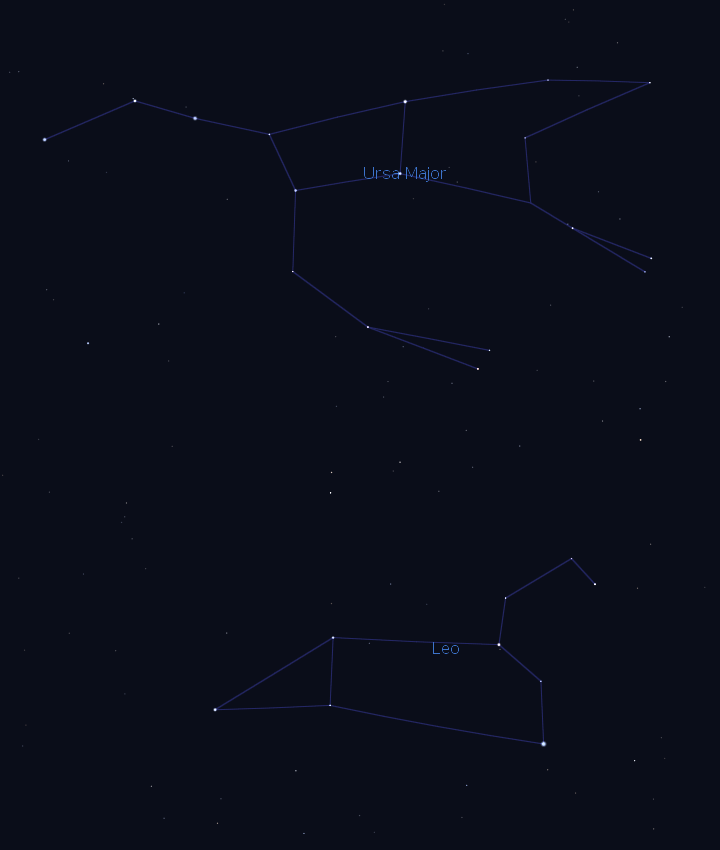
The Big Dipper part of Ursa Major with Leo right below in spill range. This is for 10 p.m. on April 11, 2013. Created using Stellarium.
01/21/2013 – Ephemeris – MLK Day, Jupiter above the Moon tonight
Ephemeris for Martin Luther King Day and Inauguration Day, Monday, January 21st. The sun will rise at 8:11. It’ll be up for 9 hours and 24 minutes, setting at 5:36. The moon, 3 days past first quarter, will set at 4:33 tomorrow morning.
Today is the holiday commemorating the life of Dr. Martin Luther King Jr., and his struggle for civil rights. Today we will have the second inauguration of the first African American President. Another chapter in the struggle for the equality of all people. Back before the Civil War, runaway slaves used the stars to steer their flight northward. The prominent pattern of northern stars that aided their journey was the Drinking Gourd. We know it as the Big Dipper. which is starting to rise higher in the northeast. Also in the sky tonight the planet Jupiter will appear above the moon, their closest approach will be at 10:30 p.m. For us closest approach will be at 2 moon diameters. A couple of thousand miles south of here the moon will cover the planet.
Times are for the Traverse City/Interlochen area of Michigan. They may be different for your location.
Addendum
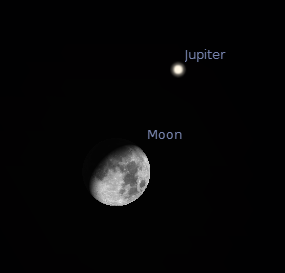
Jupiter and the moon at 10:30 p.m. January 21, 2013. Created using Stellarium.
04/13/2012 – Ephemeris – The story of Boötes and Ursa Major
Ephemeris for Friday, April 13th. The sun will rise at 7:01. It’ll be up for 13 hours and 24 minutes, setting at 8:25. The moon, at last quarter today, will rise at 3:37 tomorrow morning.
Rising higher in the eastern sky at 10 p.m. tonight is the kite shaped constellation of Boötes the herdsman. The bright star Arcturus is at the bottom of the kite, pointed to by the arc of the handle of the Big Dipper, much higher in the east north east. In one story Boötes represents a young hunter named Arcas, son of Callisto, a beautiful young lady who had the misfortune of being loved by Zeus the chief Greek god. Zeus’ wife Hera, found out about it, and since she couldn’t punish Zeus, turned Callisto into an ugly bear. Arcas, unaware of why his mother disappeared in his youth was about to kill the bear when Zeus intervened and placed them both in the sky. Now Arcas as Boötes chases the Great Bear (Ursa Major) forever around the pole of the sky each night.
* Times are for the Traverse City/Interlochen area of Michigan. They may be different for your location.
Addendum
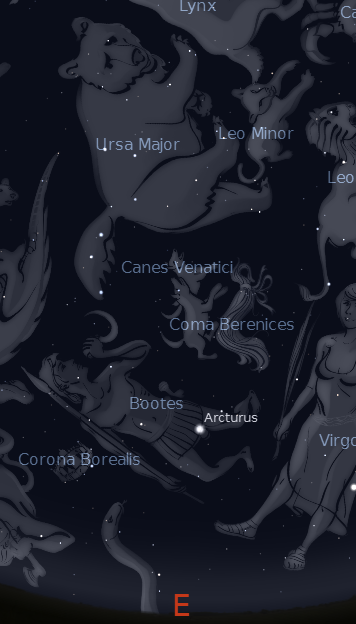
Boötes & Ursa Major at 10 p.m. on April 13, 2012. Created using Stellarium.
The constellation artist for Stellarium has Boötes facing the wrong way for my story to work. Officially Boötes is the herdsman.
04/07/11 – Ephemeris – The Ursa Major Association
April 7th. The sun will rise at 7:12. It’ll be up for 13 hours and 4 minutes, setting at 8:17. The moon, half way from new to first quarter, will set at 12:45 tomorrow morning.
The usual impression is to think that the stars of a constellation are actually located close together. This is usually not true. The stars of a constellation can be at vastly different distances. The Big Dipper is different. The five stars, excepting the two end stars of the dipper and 12 other dimmer stars in the general area are of similar distance and have the same motion through space. The group is called the Ursa Major Moving Cluster or Ursa Major Association, and is moving about 9 miles per second relative to us to the east and south. An association is a rather loose, sparse star cluster. This association lies about 75 light years away. If it were five times farther away, it would be the same distance as the Pleiades.
* Times are for the Traverse City/Interlochen area of Michigan. They may be different for your location.
 Bob Moler's Ephemeris Blog