Archive
06/26/2013 – Ephemeris – Latest sunset and the Summer Triangle
Ephemeris for Thursday, June 27th. Today the sun will be up for 15 hours and 32 minutes, setting at 9:31. The moon, 3 days before last quarter, will rise at 12:14 tomorrow morning. Tomorrow the sun will rise at 5:59.
Last night we had the latest sunset of the year. The sun is really beginning to head south. Other than the sunrise and sunset numbers, we’ll begin to notice it for real in a few weeks. At first that realization strikes me a sad note that summer is beginning to end. However the astronomer in me realizes that means more night-time hours, and that the summer Milky Way is coming. Of the three bright stars of the Summer Triangle overhead and in the east, two of its stars are in the milky band. They are Deneb to the north and Altair to the south. Vega, closest to the zenith is not in the band. Actually all the stars we see with the naked eye or small telescopes belong to the Milky Way galaxy.
Times are for the Traverse City/Interlochen area of Michigan. They may be different for your location.
Addendum
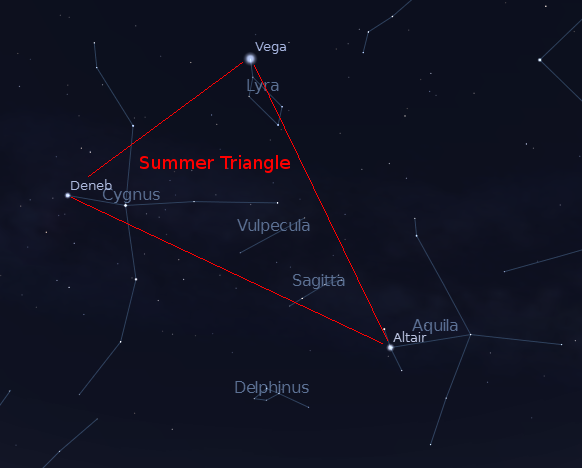
The Summer Triangle at 11 p.m. Created using Stellaruim and The Gimp.
07/23/2012 – Ephemeris – The star Vega up close
Ephemeris for Monday, July 23rd. The sun rises at 6:19. It’ll be up for 14 hours and 57 minutes, setting at 9:17. The moon, 3 days before first quarter, will set at 11:14 this evening.
The star Vega, which is high in the east, near overhead or the zenith is a special star for astronomers. It’s part of the small constellation or Lyra the harp, which includes the parallelogram of stars near it. Vega is kind of a standard calibration star. It is the 5th brightest night time star with a brightness of 0.0 magnitude, although recent measurements place it at 0.03. Of the spectral types which denote the star’s color and surface temperature, Vega comes out to be pure white, with a surface temperature nearly twice the sun’s. It’s almost exactly 25 light years away, and so is one of the closer stars. It’s a tenth the sun’s age and 40 times the sun’s brightness. [It has perhaps a Jupiter sized planet, and a Kuiper belt of Pluto like objects.]
Times are for the Traverse City/Interlochen area of Michigan. They may be different for your location.
Addendum
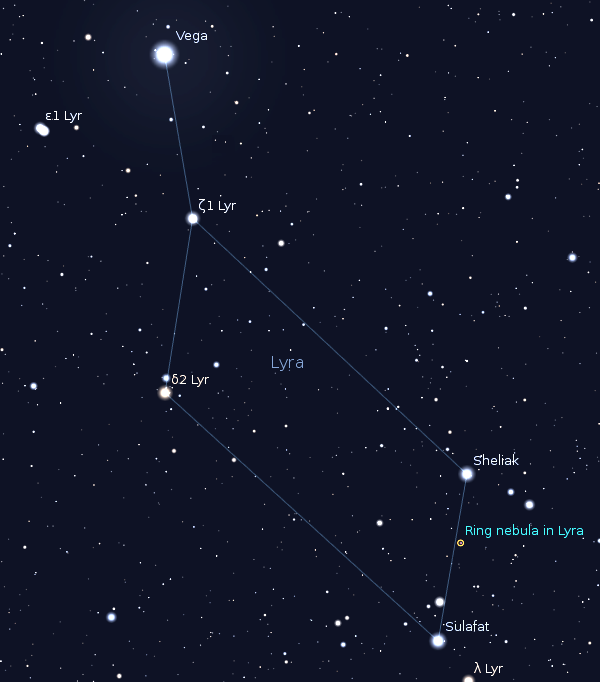
Lyra in Binoculars. Created using Stellarium.
07/16/2012 – Ephemeris – The constellation Draco the dragon
Ephemeris for Monday, July 16th. Today the sun will be up for 15 hours and 10 minutes, setting at 9:23. The moon, 3 days before new, will rise at 4:50 tomorrow morning. Tomorrow the sun will rise at 6:13.
High in the northern sky at 11 p.m. lies a twisted constellation, that of Draco the dragon. This dragon is more like the snake-like Chinese dragon than the dinosaur like Hungarian Horntail of Harry Potter fame. At least that’s how I see it. I find it better to start at the tail of Draco, to trace him out in the stars. Draco’s tail starts between the bowl of the Big Dipper and the Little Dipper. The Dragon is seen in a line of stars that extends parallel to the handle of the Big Dipper before curving around the bowl of the Little Dipper then bends back toward the south. The head of Draco is an odd box of stars near the bright star Vega, nearly overhead. Though not made up of very bright stars, Draco has an easy shape to trace.
Times are for the Traverse City/Interlochen area of Michigan. They may be different for your location.
Addendum
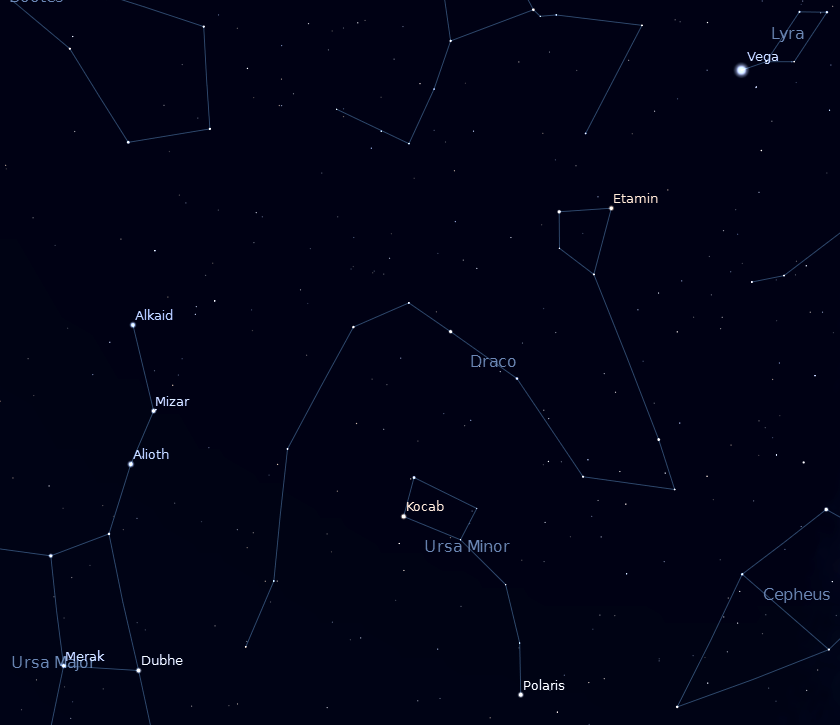
Draco the dragon at 11 p.m. July 16th looking high in the north. Created using Stellarium.
Click on the image to enlarge.
07/12/2012 – Ephemeris – The constellation Lyra the harp
Thursday, July 12th. Today the sun will be up for 15 hours and 17 minutes, setting at 9:26. The moon, 2 days past last quarter, will rise at 1:50 tomorrow morning. Tomorrow the sun will rise at 6:10.
High in the east at 11 p.m. can be found a bright star called Vega just above a small, narrow, but very distinctive parallelogram of stars. They are the stars of the constellation Lyra the harp. Vega, the 5th brightest night time star, is one of the twenty one brightest stars, called first magnitude stars. The harp, according to Greek mythology, was invented by the god Hermes. The form of the harp in the sky, is as he had invented it: by stretching strings across a tortoise shell. Hermes gave it to his half-brother Apollo, who in turn gave it to the great musician Orpheus. In binoculars, near Vega, two stars appear together. They barely appear to the unaided eye as a single star, designated Epsilon Lyrae.
Times are for the Traverse City/Interlochen area of Michigan. They may be different for your location.
Addendum
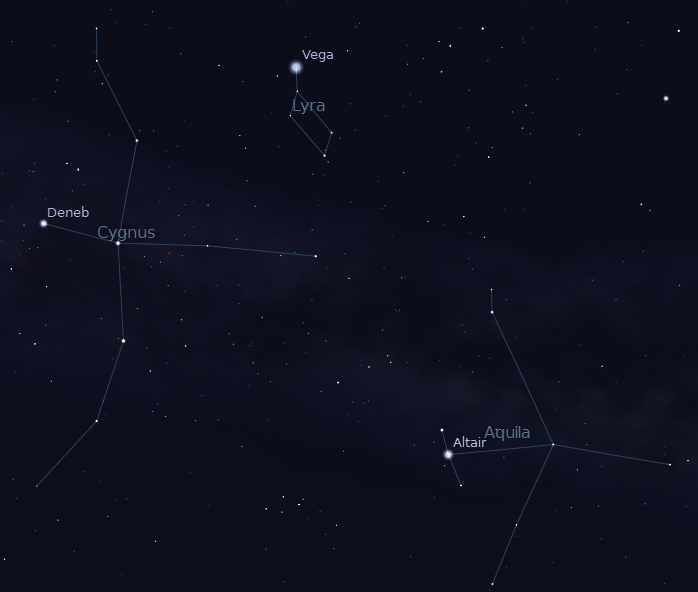
Summer Triangle and the constellation Lyra at 07-12-12 at 11 p.m. Created using Stellarium.
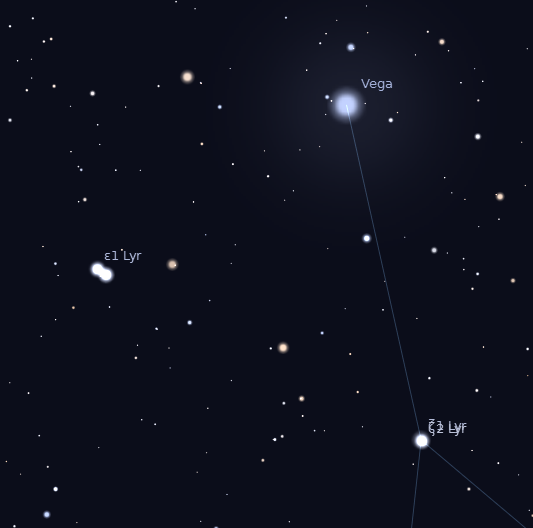
Closeup on Vega and Epsilon Lyrae. Created using Stellarium.
ε1 Lyrae is one of the stars of Epsilon Lyrae. The pair can be split better than this image with binoculars. Looking at the two with a good telescope and over 100 power can split each component into two more stars. We amateur astronomers call it the “Double-Double Star” Note too that Zeta (ζ) Lyrae is also a double star that can be split with a low power telescope.
06/14/2012 – Ephemeris – Flag Day: Red, White and Blue Stars
Ephemeris for Flag Day, Thursday, June 14th. Today the sun will be up for 15 hours and 32 minutes, setting at 9:29. The moon, 3 days past last quarter, will rise at 3:16 tomorrow morning. Tomorrow the sun will rise at 5:56.
Since it’s Flag Day, lets look for some red white and blue stars. Red is easy, I talked about it Tuesday, It is Antares now low in the southeast in the evening in the heart of the constellation of Scorpius the scorpion. For the white star there is no purer white star than Vega, spectral type A0 (A zero), the astronomers definition of white. It is located midway up the sky in the east. It is the 5th brightest night time star, and is seen off a small parallelogram of stars that make up the body of Lyra the harp. For the blue star, the best is Spica, below Saturn this year and in the south in the evening. It is the bluest of the 21 brightest first magnitude stars. Color in stars is often subtle, so try to see these colors.
Times are for the Traverse City/Interlochen area of Michigan. They may be different for your location.
Addendum
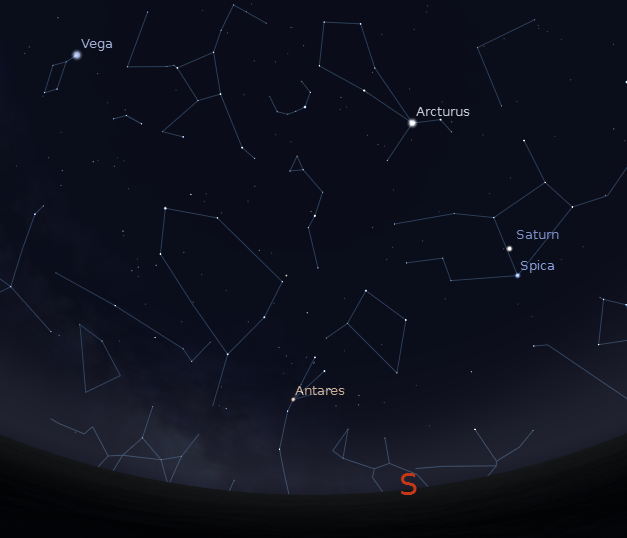
Red (Antares), White (Vega) and Blue (Spica) stars of spring. Created using Stellarium.
07/19/11 – Ephemeris – The brightest stars visible now in the evening
Tuesday, July 19th. Today the sun will be up for 15 hours and 6 minutes, setting at 9:21. The moon, half way from full to last quarter, will rise at 11:11 this evening. Tomorrow the sun will rise at 6:15.
Let’s check out all the bright stars in the evening sky, as it gets dark tonight. High in the west is the bright yellow-orange star Arcturus. In the northwest is the Big Dipper, whose curved handle points to Arcturus. Straightening that curve to a spike will point to Spica a blue-white star low in the southwest. The bright star to its right isn’t. It’s the planet Saturn. In the south is the red star Antares which usually twinkles merrily. High in the east is the bright white star Vega. To its lower right is Altair, and to its lower left the star Deneb. Vega, Altair and Deneb make the Summer Triangle, whose rising in the east signals the coming of summer. Always present for us in northern Michigan is Capella very low in the north.
* Times are for the Traverse City/Interlochen area of Michigan. They may be different for your location.
Addendum
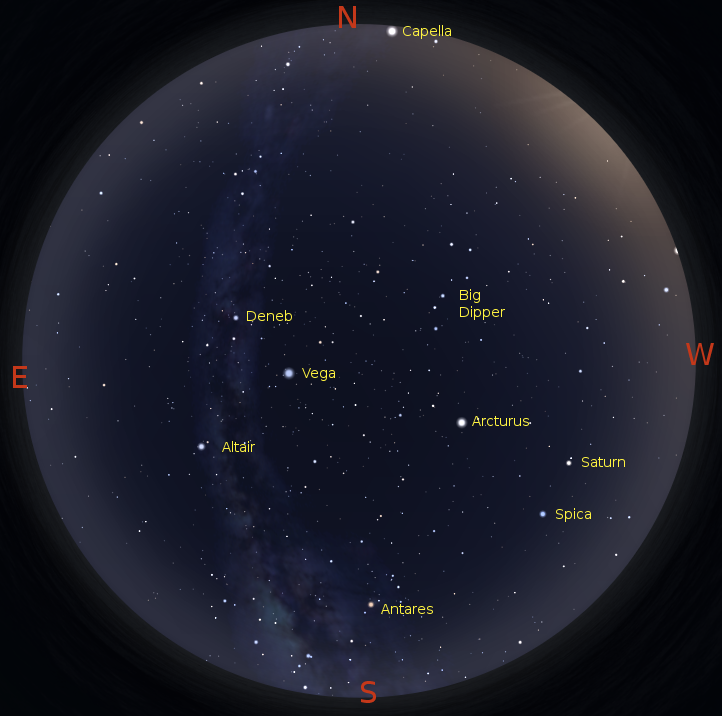
Bright Summer Stars. Created using Stellarium.
Click on the image to enlarge. This is a whole sky chart. The round edge is the horizon. BTW the star Capella, very low in the north, is a winter star, but it’s visible all year round for folks north of 44 degrees north latitude.
07/04/11 – Ephemeris – Red, white and blue stars
Independence Day, Monday, July 4th. Today the sun will be up for 15 hours and 27 minutes, setting at 9:30. The moon, 3 days past new, will set at 11:22 this evening. Tomorrow the sun will rise at 6:03.
Today’s Independence Day so let’s look for some red, white, and blue stars. Red is easy, the red star Antares is seen in the south at 11 p.m. White is easy too, the official white calibration star Vega high in the east at 11 p.m. The blue star is really blue-white. The brightest of these out at 11 p.m. is Spica, low in the southwest. The color is best seen in binoculars. Star colors are quite subtle, and are an indicator of the temperature of their outer gaseous layers. The temperature of a stars outer layers, in order of their increasing temperatures, red, white and blue, is not related to the temperature in their cores. Of these three the coolest on the outside, Antares is really the hottest inside, using helium as fuel.
* Times are for the Traverse City/Interlochen area of Michigan. They may be different for your location.
 Bob Moler's Ephemeris Blog