Archive
02/22/2012 – Ephemeris – Where are the bright planets this week?
Ephemeris for Ash Wednesday, Wednesday, February 22nd. The sun will rise at 7:32. It’ll be up for 10 hours and 47 minutes, setting at 6:20. The moon, 1 day past new, will set at 7:31 this evening.
Let’s see what’s happening with the bright planets for this week. Venus is brilliant in the western sky after sunset and will set at 10:08 in the west. Jupiter the second brightest planet after Venus is located high in the west as it gets dark and is seen against the stars of the constellation Aries. Venus is approaching it now. Jupiter will set at 11:39 p.m.. Mars is the up and coming planet. It will rise near sunset in the east and is below the hind end of the constellation Leo the lion. It is 64.0 million miles away and closing and is getting brighter. It’s now as bright as most first magnitude stars. Mars will pass due south at 1:52 a.m. Saturn will rise at 10:58 p.m. just to the left of the bright star Spica in the east southeast.
* Times are for the Traverse City/Interlochen area of Michigan. They may be different for your location.
Addendum
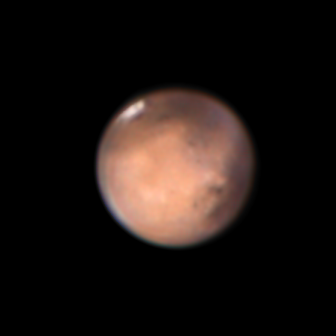
Mars on February 20, 2012 at 5:57 UT (12:57 a.m.). Photograph by Scott Anttila.
We are nor a couple of weeks from the opposition of Mars with the sun on March 3rd. (March is named for Mars, by the way.) It will be closest on March 5th at 62.6 million miles.
02/15/2012 – Ephemeris – Where are the bright planets this week?
Ephemeris for Wednesday, February 15th. The sun will rise at 7:43. It’ll be up for 10 hours and 27 minutes, setting at 6:10. The moon, 1 day past last quarter, will rise at 3:45 tomorrow morning.
Let’s see what’s happening with the bright planets for this week. Venus is brilliant in the southwestern sky after sunset and will set at 9:52 in the west. Jupiter is the second brightest planet after Venus. It’s located high in the southwest as it gets dark and is seen against the stars of the constellation Aries. And Venus is approaching it now. Jupiter will set at 12:03 a.m.. Mars is the up and coming planet. It will rise at 7:54 p.m in the east and is below the hind end of the constellation Leo the lion. It is 66.1 million miles away and closing and is getting brighter. It’s now as bright as most first magnitude stars. Mars will pass due south at 2:27 a.m. Saturn will rise at 11:26 p.m. just to the left of the bright star Spica in the east southeast.
* Times are for the Traverse City/Interlochen area of Michigan. They may be different for your location.
02/08/2011 – Ephemeris – Where are the bright planets?
Ephemeris for Wednesday, February 8th. The sun will rise at 7:53. It’ll be up for 10 hours and 7 minutes, setting at 6:00. The moon, 1 day past full, will rise at 7:24 this evening.
Let’s see what’s happening with the bright planets for this week. Venus is brilliant in the southwestern sky after sunset and will set at 9:35 in the west. Jupiter the second brightest planet after Venus. It’s located high in the southwest as it gets dark and is seen against the stars of the constellation Aries. It will set at 12:25 a.m.. Mars is the up and coming planet. It will rise at 8:31 p.m in the east and is below the hind end of the constellation Leo the lion. It is 69.2 million miles away and closing and is getting brighter. It’s now as bright as most first magnitude stars. Mars will pass due south at 3:01 a.m. Saturn will rise at 11:54 p.m. just to the left of the bright star Spica in the east southeast.
* Times are for the Traverse City/Interlochen area of Michigan. They may be different for your location.
Addendum
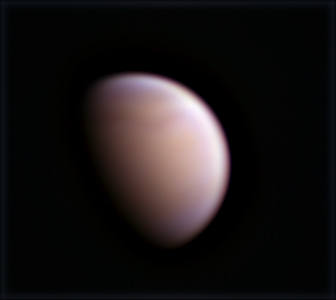
Venus by Scott Anttila. Taken Monday evening February 6, 2012
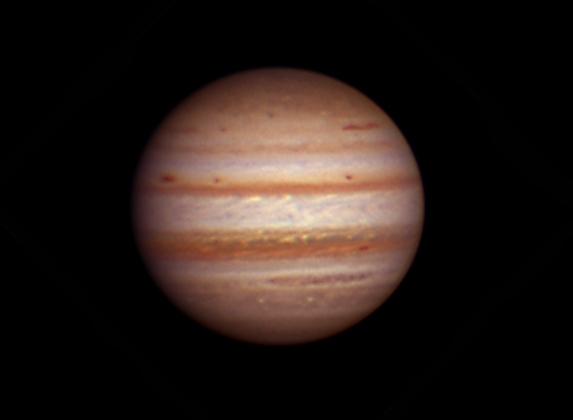
Jupiter by Scott Anttila. Taken Monday evening February 6, 2012
02/01/2012 – Ephemeris – Where are the bright planets this week?
Ephemeris for Wednesday, February 1st. The sun will rise at 8:01. It’ll be up for 9 hours and 48 minutes, setting at 5:50. The moon, 2 days past first quarter, will set at 3:46 tomorrow morning.
Let’s see what’s happening with the bright planets for this week. Venus is brilliant in the southwestern sky after sunset and will set at 9:19 in the west. Jupiter is the most prominent planet of the evening sky, once Venus sets. It’s located high in the southwest as it gets dark and is seen against the stars of the constellation Aries. It will set at 12:48 a.m.. Mars is the up and coming planet. It will rise at 9:05 p.m in the east and is below the hind end of the constellation Leo the lion. It is 73 million miles away and closing and is getting brighter. It’s now as bright as most first magnitude stars. Mars will pass due south at 3:33 a.m. Saturn will rise at 12:22 a.m. just to the left of the bright star Spica in the east southeast.
* Times, as always are for the Traverse City/Interlochen area of Michigan.
01/25/2012 – Ephemeris – Where are the planets this week?
Ephemeris for Wednesday, January 25th. The sun will rise at 8:08. It’ll be up for 9 hours and 31 minutes, setting at 5:40. The moon, 2 days past new, will set at 8:42 this evening.
It’s time again to take a look at the whereabouts of the bright planets. Venus is brilliant in the southwestern sky after sunset and will set at 9:01 in the west. Jupiter is the most prominent planet of the evening sky, once Venus sets. It’s located high in the south southeast as it gets dark and is seen against the stars of the constellation Aries. It will pass due south at 6:21 p.m. and it will set at 1:08 a.m.. Mars will rise at 9:36 p.m in the east northeast and is below the hind end of the constellation Leo the lion. It is 76.7 million miles away and closing and has been getting brighter. It’s now as bright as most first magnitude stars. Mars will pass due south at 4:02 a.m. Saturn will rise at 12:49 a.m. just to the left of the bright star Spica in the east southeast.
* Times, as always are for the Traverse City/Interlochen area of Michigan.
Addendum
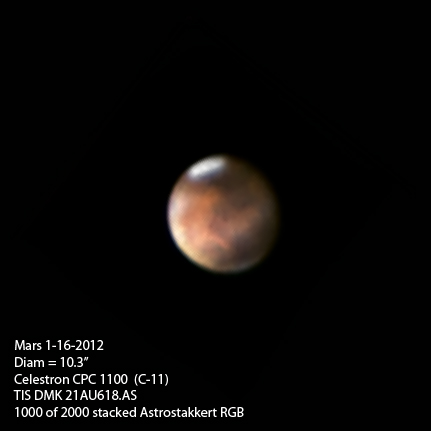
Mars 9 days ago. Photograph by Scott Anttila
Another gorgeous shot of Mars by Scott Anttila. At the time Mars appeared 10.3 seconds of arc in diameter. By comparison the moon and sun appear about 1,800 seconds of arc in diameter. Note that Mars appears slightly gibbous in shape. It will appear full on March 3rd. when it will be in opposition from the sun. It will be closest to us on March 5th. at about 62.6 million miles. At that time it will have an apparent diameter of 13.9 seconds of arc.
01/18/2012 – Ephemeris – Where are the bright planets this week
Ephemeris for Wednesday, January 18th. The sun will rise at 8:14. It’ll be up for 9 hours and 17 minutes, setting at 5:31. The moon, 2 days past last quarter, will rise at 4:51 tomorrow morning.
It’s time again to take a look at the whereabouts of the bright planets. Venus is brilliant in the southwestern sky after sunset and will set at 8:44. Jupiter is the most prominent planet of the evening sky, once Venus sets. It’s located high in the south and is seen against the stars of the constellation Aries. It will pass due south at 6:49 p.m. It will set at 1:36 a.m. Mars will rise at 10:03 p.m in the east northeast and is below the hind end of the constellation Leo the lion. It is 82.4 million miles away and closing. Mars will pass due south at 4:29 a.m. Saturn will rise at 1:15 a.m. just to the left of the bright star Spica in the east southeast.
* Times, as always are for the Traverse City/Interlochen area of Michigan.
01/11/2012 – Ephemeris – Where are the planets tonight?
Wednesday, January 11th. The sun will rise at 8:17. It’ll be up for 9 hours and 5 minutes, setting at 5:22. The moon, 2 days past full, will rise at 8:29 this evening.
It’s time again to take a look at the whereabouts of the bright planets. Venus is brilliant in the southwestern sky after sunset and will set at 8:25. Jupiter is the most prominent planet of the evening sky, once Venus sets. It’s located high in the south and is seen against the stars of the constellation Aries. It will pass due south at 7:15 p.m. It will set at 2:00 a.m.. Jupiter is a great sight in a small telescope with its four moons which change position from night to night. Mars will rise at 10:27 p.m in the east northeast and is below the hind end of the constellation Leo the lion. It is 88 million miles away and closing. Mars will pass due south at 4:54 a.m. Saturn will rise at 1:41 a.m. just to the left of the bright star Spica in the east southeast.
* Times, as always are for the Traverse City/Interlochen area of Michigan.
Addendum
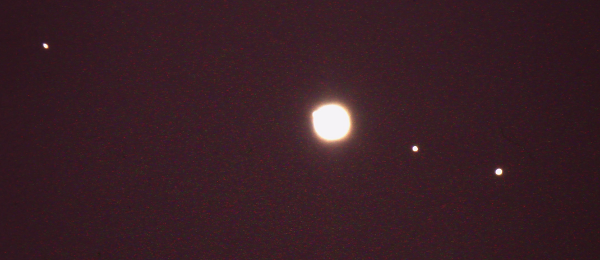
Overexposed Jupiter and its moons. My archival image.
The four Galilean satellites or moons of Jupiter are in order of distance from Jupiter Io, Europa, Ganymede and Callisto. They all orbit near Jupiter’s equator, and Jupiter itself has a very small axial tilt of about 3 degrees so the satellites seem to shuffle from one side to the other of Jupiter. The pattern is different night.
The programs Stellarium, Cartes du Ciel, and other sources including http://www.calsky.com can be used to determine the positions of the satellites. But there are clues by just looking at them.
- Io is closest to Jupiter and generally appears so. In the photograph above it appears as a bump on the left edge of Jupiter. It has a slight reddish tinge.
- Europa is dimmer than Io and also is usually close to Jupiter.
- Ganymede is easy. It’s the brightest.
- Callisto is usually found the farthest from Jupiter and is also the dimmest of the four.
Based on the photograph alone, which is undated, I’d guess that from left to right we have Callisto and Io to the left of Jupiter, Europa and Ganymede to the right.
Sometimes fewer than four satellites can be seen. They can hide in front of Jupiter, usually casting their shadow on the planet, behind Jupiter or in its shadow. Calsky will give you the times for your location.
Update
I located the date of the above image. It was taken the evening of March 17, 1989. A check with Cartes du Ciel (Sky Charts) confirm the satellite’s locations and order. Io was just ending a transit (passing in front ) of Jupiter.
01/10/2012 – Ephemeris – Venus, the evening star
Tuesday, January 10th. The sun will rise at 8:18. It’ll be up for 9 hours and 3 minutes, setting at 5:21. The moon, 1 day past full, will rise at 7:18 this evening.
Venus is getting brighter and is appearing higher in the southwest after sunset. This is our sister planet of the earth in size only. It is now nearly 115 million miles away, but it is getting closer. Venus is in an orbit inside the earth’s and is currently 67 million miles from the sun. It orbits the sun in 225 days, compared to earth’s 365 days. Right now Venus appears as a small gibbous orb. On March 27th it will appear at its greatest separation from the sun. It then will appear as half illuminated. Thereafter as it gets closer to the earth Venus will grow in size as its crescent gets thinner and thinner. When Venus passes between the earth and sun on the evening of June 5th, it will pass directly in front of the sun, an extremely rare event.
* Times, as always are for the Traverse City/Interlochen area of Michigan.
01/05/2012 – Ephemeris – Viewing planets with that new telescope
Thursday, January 5th. The sun will rise at 8:19. It’ll be up for 8 hours
and 57 minutes, setting at 5:16. The moon, half way from first quarter to full, will set at 5:59 tomorrow morning.
Trying out that new Christmas telescope can be challenging on cold winter nights. Set it up indoors first and get used to it. The moon and planets are the easiest targets for the new telescope owner. Locate the moon first if it’s out as it is tonight and make sure that small telescope or reflex finder that pots a red dot on the object is aligned with the telescope. Then you can go off and locate the planets. Venus is nice and bright in the southwest early in the evening. A telescope will show a tiny nearly circular orb. But wait a couple of months and it will become a large crescent. Jupiter is always a great sight with its four moon shuttling from one side to the other of the planet from night to night. And don’t forget Jupiter itself with its cloud bands.
* Times, as always are for the Traverse City/Interlochen area of Michigan.
01/04/2012 – Ephemeris – The planets this week and the earth at perihelion
Wednesday, January 4th. The sun will rise at 8:19. It’ll be up for 8 hours and 56 minutes, setting at 5:15. The moon, 3 days past first quarter, will set at 5:03 tomorrow morning.
It’s the first Wednesday of 2012 and time again to take a look at the whereabouts of the bright planets. The planet Venus is brilliant in the southwestern sky after sunset setting at 8:07. Jupiter is the most prominent planet of the evening sky, once Venus sets. It’s located high in the south and is seen against the stars of the constellation Aries. It will pass due south at 7:41 p.m. It will set at 2:26 a.m.. Mars will rise at 10:52 p.m in the east northeast and is below the hind end of the constellation Leo the lion. It is 92.4 million miles away and closing. Saturn will rise at 2:07 a.m. just to the left of the bright star Spica in the east southeast. The sun is its closest to earth of the entire year today. Only 91.3 million miles away.
* Times, as always are for the Traverse City/Interlochen area of Michigan.

