Archive
04/15/11 – Ephemeris – Naming lunar features
Friday, April 15th. The sun rises at 6:58. It’ll be up for 13 hours and 28 minutes, setting at 8:27. The moon, 2 days before full, will set at 5:41 tomorrow morning.
If you’ve notices that the names we use for features on the moon sound familiar when used in other contexts, you’re right. Lunar craters are named for astronomers, scientists, philosophers and explorers. The mountains on the moon are named for earthly mountain ranges. The great lava plains, misnames seas are given fanciful names like the Sea of Tranquility, which I usually leave in the original Latin. In this case Mare Tranquilitatis. The naming convention for craters pretty much holds for the other bodies of the solar system. The next bodies to get crater names will be Mercury, which the MESSENGER spacecraft went into orbit of last month and the asteroid Vesta, which the Dawn spacecraft will reach in July.
* Times are for the Traverse City/Interlochen area of Michigan. They may be different for your location.
Addendum
See this Wikipedia article on planetary nomenclature.
04/14/11 – Ephemeris – The gibbous moon
Thursday, April 14th. The sun will rise at 7:00. It’ll be up for 13 hours and 25 minutes, setting at 8:25. The moon, half way from first quarter to full, will set at 5:13 tomorrow morning.
The moon tonight is in its gibbous phase. The word gibbous means hump backed. At this phase the moon is severely interfering with the dimmer stars. So looking at the moon with a telescope becomes a good option. The moon will be bright and ruin any dark adaption your eye had before looking at it. Remember the sun shines on the moon with the same strength that it does on the earth, since it’s at roughly the same distance from the sun as the earth. The brightest spot on the earth facing side of the moon will be emerging into the lunar morning light this evening. It will be showing that brightness in a few days, but now it is the crater at the upper left edge of the moon, just coming into light. It is the crater Aristarchus.
* Times are for the Traverse City/Interlochen area of Michigan. They may be different for your location.
Addendum
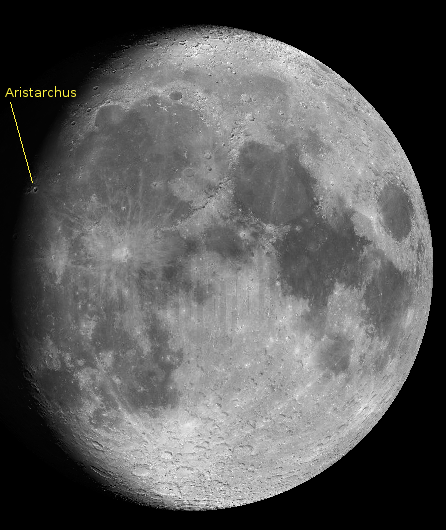
The gibbous moon for April 14, 2011. Created using Virtual Moon Atlas.
The crater Aristarchus is moving into the morning lunar daylight.
04/13/11 – Ephemeris – The Bright planets this week
Wednesday, April 13th. The sun will rise at 7:02. It’ll be up for 13 hours and 22 minutes, setting at 8:24. The moon, 2 days past first quarter, will set at 4:45 tomorrow morning.
It’s Wednesday and time again to take a look at the whereabouts of the bright planets for this week. The ringed planet Saturn is rising before sunset and will be visible low in the southeast as it gets dark. It will cross the meridian due south at 1:07 a.m. and will set at 7:12 a.m. In telescopes Saturn shows its rings which are a year and a half along their seven and a half year period of opening along with at least one satellite, the large moon Titan. Venus is brilliant in the morning sky and will rise at 6:00 a.m. in the east.. It is really a beautiful sight in the morning twilight, though disappointingly small in a telescope. Jupiter, Mars and Mercury are all too close to the direction of the sun to be visible.
* Times are for the Traverse City/Interlochen area of Michigan. They may be different for your location.
04/12/11 – Ephemeris – Saturn and its moon Titan
Tuesday, April 12th. The sun will rise at 7:04. It’ll be up for 13 hours and 19 minutes, setting at 8:23. The moon, 1 day past first quarter, will set at 4:16 tomorrow morning.
The planet Saturn, now rising up in the southeastern sky is always the most wonderful sight in a small telescope. The rings are slowly opening to the sun, however for us on the earth, whose orbit is tilted by about 2 and a half degrees to the Saturn’s orbit of the sun, the rings appear to be closing just a bit right now. After June they will open up again. Tonight a small telescope will also reveal Saturn’s largest satellite or moon which will be off the edge of the longest extent of the rings to the east of Saturn. Titan is the second largest moon in the solar system, after Jupiter’s Ganymede. It is larger than the planet Mercury and the only moon with a substantial atmosphere. Titan’s surface atmospheric pressure is slightly greater than the earth’s.
* Times are for the Traverse City/Interlochen area of Michigan. They may be different for your location.
Addendum
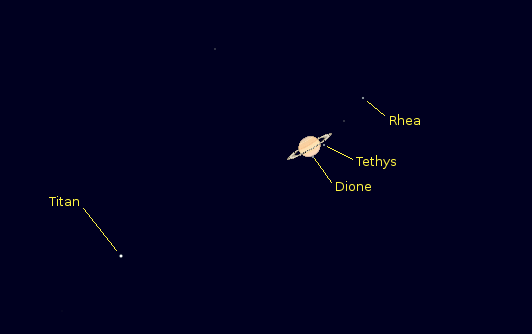
Saturn and some of its bright moons for April 12, 2011. Created using Cartes du Ciel
Titan is the easiest moon to see. Rhea is more difficult. The others being close to Saturn tonight may be impossible to spot. The free programs Cartes du Ciel and Stellarium will show the positions of Saturn’s satellites. See the Free Astronomical Software links in the right. Stellarium does have a problem getting the satellite brightness right, they’re too bright.
04/11/11 – Ephemeris – First quarter moon
Monday, April 11th. The sun will rise at 7:05. It’ll be up for 13 hours and 16 minutes, setting at 8:22. The moon, at first quarter today, will set at 3:45 tomorrow morning.
Lets take a look at the moon tonight. It’ll be about 14 hours after first quarter and we see features at the terminator, the sunrise line that cuts the moon in half. In small telescopes, at the north or top end of the moon, the wide flat crater Plato has just entered sunlight. Long shadows from its crater walls will retreat across its flat floor. If you look closely you’ll notice that the floor of Plato is slightly convex to conform with the curvature of the moon itself. Nearby is the straight gash in the Alps Mountains, called the Alpine Valley. Supposedly the crater Plato formed shortly after Mare Imbrium formed throwing up the Alps and the Apennine mountains to the south. The Straight wall, another straight feature can be seen on the south end of the moon.
* Times are for the Traverse City/Interlochen area of Michigan. They may be different for your location.
Addendum
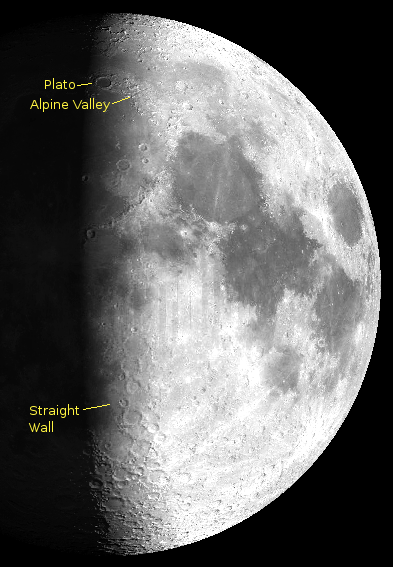
First quarter moon April 11, 2011 Created using Virtual Moon Atlas
What’s wrong with this picture?
I received this in an email. The picture’s pretty but is it real? If not, what’s wrong? Answer in the comments.
Sunset at the North Pole. This is one of the rarest picture that you mayever see in your life when the moon was closest to the earth. The date: Jan 13, 2011.This is the sunset at the North Pole with the moon at its closest point last week. a scene you will probably never get to see in person, so take a moment and enjoy God at work at the North Pole. And, you also see the sun below the moon, an amazing photo and not one easily duplicated. You may want to pass it on to others so they can enjoy it. The Chinese have a saying that goes something like this: 'When someone shares with you something of value, you have an obligation to share it with others!'

04/08/11 – Ephemeris – Looking out the thin side of the Milky Way
Friday, April 8th. The sun will rise at 7:11. It’ll be up for 13 hours and 7 minutes, setting at 8:18. The moon, 3 days before first quarter, will set at 1:39 tomorrow morning.
In winter and summer we see the Milky Way crossing the sky from north to south. In the autumn we see it cross nearly overhead from east to west. In the spring, especially next month the Milky way is barely visible low in the north. The Milky Way circles the sky as a great circle. It is what we see of our own galaxy. It is a spiral galaxy 100,000 light years in diameter and less than 5,000 light years thick where we are. So in the spring we look out the thin side of our galaxy. The stars are sparser than in other parts of the sky, the constellations generally are larger. The really cool part is that in telescopes we can see other galaxies, other Milky Ways beyond. In the spring we have a huge cluster of thousands of galaxies out there about 50 million light years away.
* Times are for the Traverse City/Interlochen area of Michigan. They may be different for your location.
Addendum
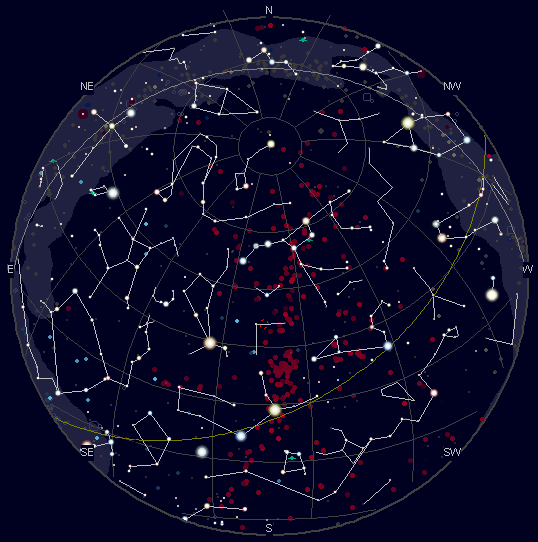
Looking out the thin side of the Milky Way. Created using Cartes duCiel
This is the entire dome of the sky on May 15th at 11 p.m. Note the Milky Way ringing the horizon. The red dots are galaxies, the blue and gray dots are star clusters in our galaxy, the green ones are nebulae, also in our galaxy.
04/07/11 – Ephemeris – The Ursa Major Association
April 7th. The sun will rise at 7:12. It’ll be up for 13 hours and 4 minutes, setting at 8:17. The moon, half way from new to first quarter, will set at 12:45 tomorrow morning.
The usual impression is to think that the stars of a constellation are actually located close together. This is usually not true. The stars of a constellation can be at vastly different distances. The Big Dipper is different. The five stars, excepting the two end stars of the dipper and 12 other dimmer stars in the general area are of similar distance and have the same motion through space. The group is called the Ursa Major Moving Cluster or Ursa Major Association, and is moving about 9 miles per second relative to us to the east and south. An association is a rather loose, sparse star cluster. This association lies about 75 light years away. If it were five times farther away, it would be the same distance as the Pleiades.
* Times are for the Traverse City/Interlochen area of Michigan. They may be different for your location.
04/05/11 – Ephemeris – Zodiacal Light
Tuesday, April 5th. The sun will rise at 7:16. It’ll be up for 12 hours and 58 minutes, setting at 8:14. The moon, 2 days past new, will set at 10:45 this evening.
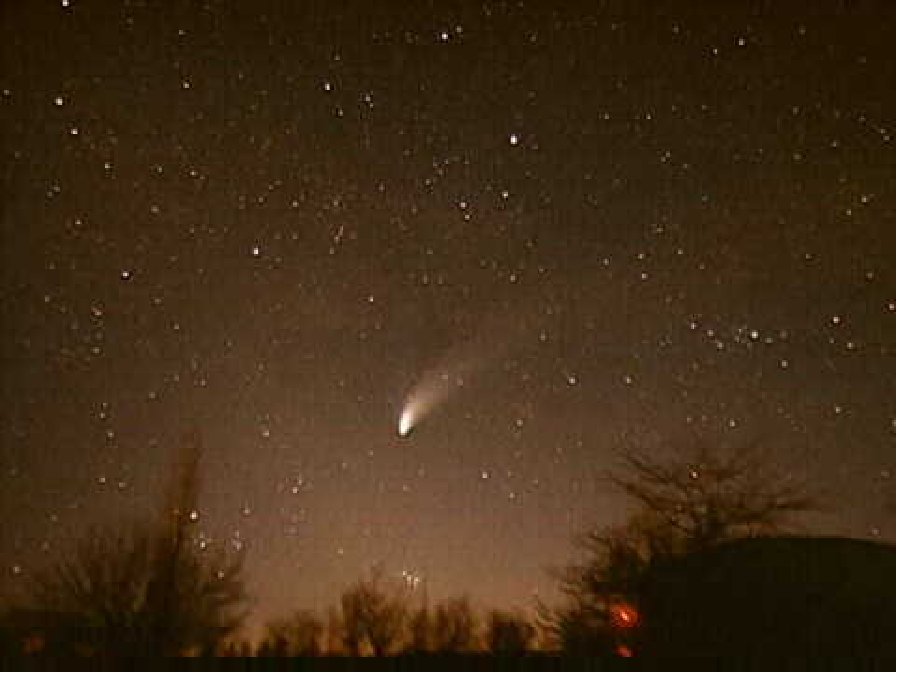
After you spot the moon tonight, hang around outside at the end of astronomical twilight, about 9:37 p.m. look to the west at Taurus the bull and Gemini. Then broaden your gaze. There will be a very faint triangular glow with broad base at the horizon leaning a bit to the left, with its apex near the V of the face of Taurus the bull and the bright star Aldebaran to the right of Orion. This glow is called Zodiacal Light, caused by the reflected sunlight off a cloud of dust located in the plane of the solar system. Most of the large bodies of the solar system orbit the sun close to a single plane. The exceptions to this are comets, which orbit at all angles to the sun and Kuiper belt objects. Zodiacal Light is best seen on spring evenings and autumn mornings.
* Times are for the Traverse City/Interlochen area of Michigan. They may be different for your location.
Addendum
Back in 1997 I caught the zodiacal light when I photographed Comet Hale-Bopp. This was taken later in April when the apex of the zodiacal glow extended almost to Gemini. Click on the image to enlarge.
 I
IZodiacal Light and Comet Hale-Bopp April 1997. My image.
Here is an enhanced image in black and white.
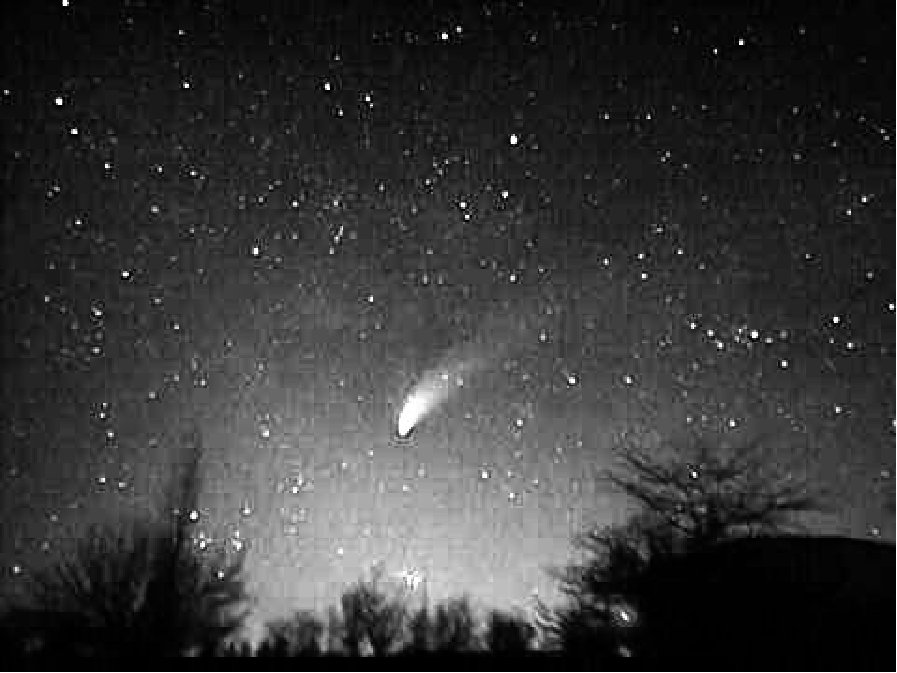
Zodiacal Light and Comet Hale-Bopp April 1997. Enhanced contrast.
04/06/11 – Ephemeris – The bright planets for this week
Wednesday, April 6th. The sun will rise at 7:14. It’ll be up for 13 hours and 1 minute, setting at 8:15. The moon, 3 days past new, will set at 11:46 this evening.
It’s Wednesday and time again to take a look at the whereabouts of the bright planets for this week. Jupiter is in conjunction with the sun today and will enter the morning sky. It’ll be more than a month before it’s easily spotted in the morning twilight. The ringed planet Saturn is rising before sunset and will be visible low in the southeast as it gets dark. It will cross the meridian due south at 1:37 a.m. and will set at 7:27 a.m. In telescopes Saturn shows its rings which are a year and a half along their seven and a half year opening along with at least one satellite, the large moon Titan. Venus is brilliant in the morning sky and will rise at 6:09 a.m. in the east southeast. It is really a beautiful sight in the morning twilight, though disappointingly small in a telescope.
* Times are for the Traverse City/Interlochen area of Michigan. They may be different for your location.
 Bob Moler's Ephemeris Blog