Archive
10/31/11 – Ephemeris – The spookiest star
Halloween, Monday, October 31st. The sun will rise at 8:18. It’ll be up for 10 hours and 14 minutes, setting at 6:33. The moon, 2 days before first quarter, will set at 11:04 this evening.
On the spookiest night of the year, lets look at the spookiest star of all. It’s Algol, from Ghoul Star or Demon Star. The Chinese had a name for it that meant ‘piled up corpses’. It’s the second brightest star in the constellation Perseus the hero, rising in the northeast this evening. The star is located where artists have drawn the severed head of Medusa, whom he had slain. Medusa was so ugly that she turned all who gazed upon her to stone. Algol is her still glittering eye. Astronomers finally found out what was wrong with Algol. It does a slow 6 hour wink every two days 21 hours, because it is two stars that eclipse each other. It will be winking this evening, dimmer than usual. My ephemeris blog has a finder chart. Just Google Bob Moler.
* Times are for the Traverse City/Interlochen area of Michigan. They may be different for your location.
10/28/11 – Ephemeris – The Great Andromeda Galaxy
Friday, October 28th. The sun will rise at 8:14. It’ll be up for 10 hours and 23 minutes, setting at 6:37. The moon, 2 days past new, will set at 7:53 this evening.
The Great Andromeda Galaxy is the closest large spiral galaxy to our own Milky Way Galaxy. It’s visible to the unaided eye in the east off the left star of the Great Square of Pegasus. Move left two stars and up two stars to the fuzzy spot. That is the heart of a galaxy that’s actually 6 moon diameters wide. It’s close too as galaxies go, only two and a half million light years away. Andromeda appears to be be somewhat larger than our galaxy, though may be less massive than the Milky Way because our galaxy seems to have more dark matter. It is approaching us at somewhat less than 100 miles per second, and will collide with the Milky Way in four or five billion years, about the time the sun will begin to bloat toward a red giant. Mark those down on your calendar.
* Times are for the Traverse City/Interlochen area of Michigan. They may be different for your location.
Addendum
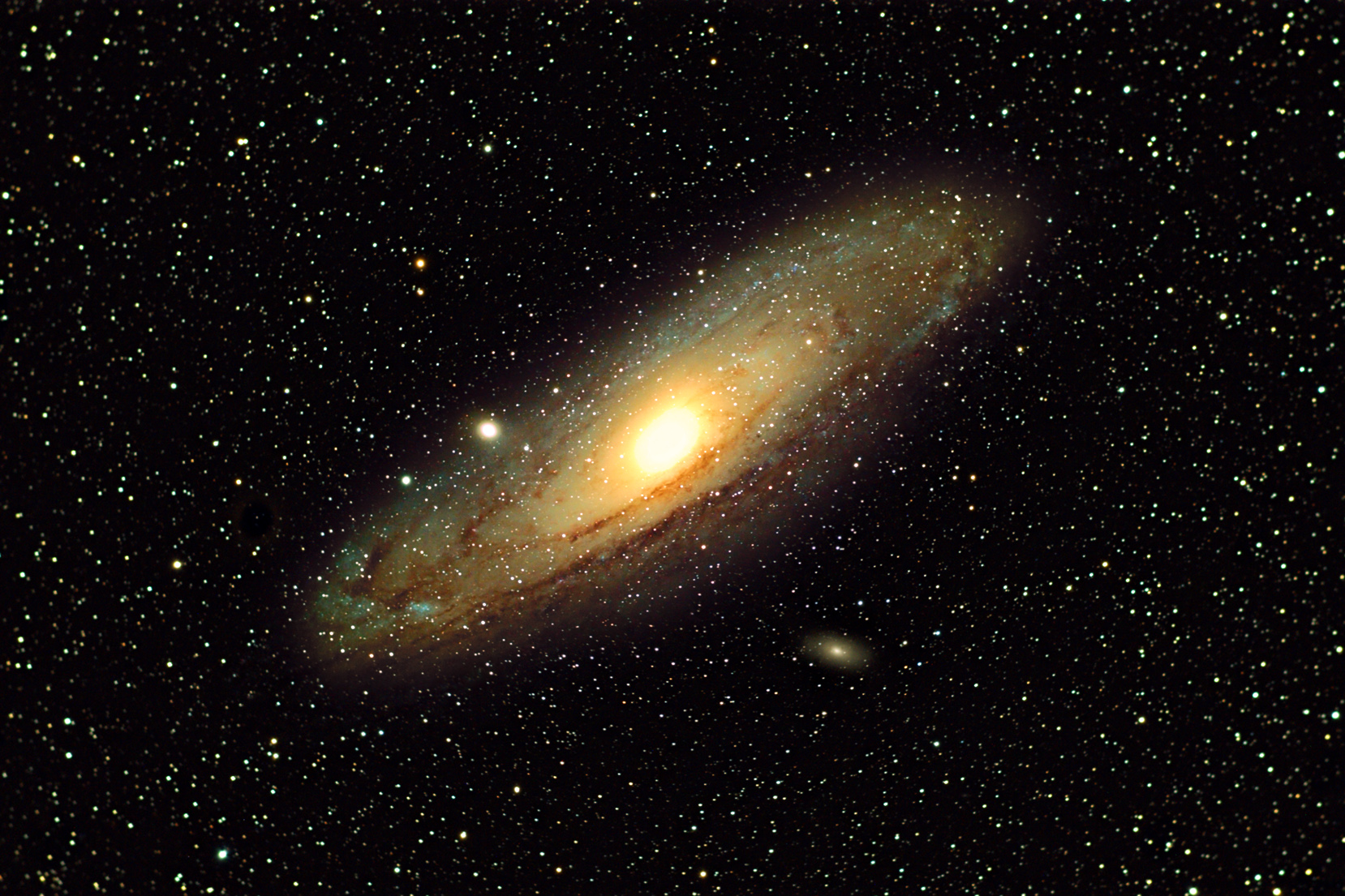
The Great Andromeda Galaxy (M31). Image taken by Scott Anttila.
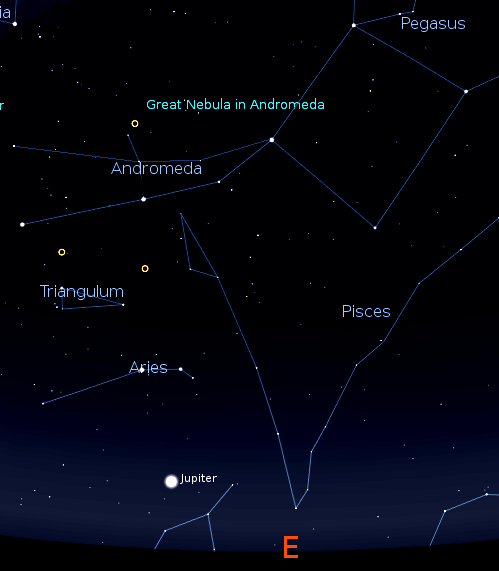
The Constellation Andromeda. Created using Stellarium.
10/27/11 – The Harbinger of Winter – Capella
Thursday, October 27th. The sun will rise at 8:13. It’ll be up for 10 hours and 25 minutes, setting at 6:39. The moon, 1 day past new, will set at 7:02 this evening.
A bright star called Capella has slowly been rising in the northeastern sky in the evenings for the past few months. At 9 p.m. now it is low in the north northeast far below the letter “W” shaped constellation of Cassiopeia. This winter Capella will be overhead the highest of winter’s seven brilliant first magnitude stars. Capella never quite sets for anyone north of Ludington. Due to its brightness, and being the closest first magnitude star to the pole Capella appears to move slowly as the earth rotates, and spends summer and autumn evenings close to the horizon. In the sky Capella represents a mamma goat held on the shoulders of a charioteer. There’s a thin triangle of three stars to Capella’s lower right. It’s a group of stars called the Kids. Her kids.
* Times are for the Traverse City/Interlochen area of Michigan. They may be different for your location.
Addendum
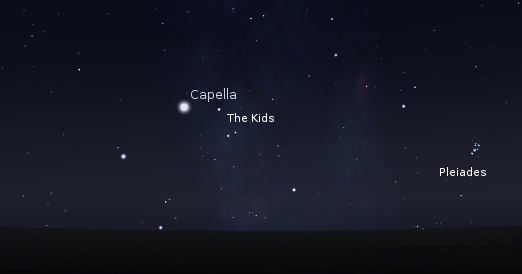
Capella and the Kids in the early evening. Created using Stellarium.
10/26/11 – Ephemeris – Where are the bright planets this week?
Wednesday, October 26th. The sun will rise at 8:11. It’ll be up for 10 hours and 28 minutes, setting at 6:40. The moon is new today, and won’t be visible.
Well it’s Wednesday and time again to take a look at the whereabouts of the bright planets. The planet Venus is still rather close to the sun in the evening setting 48 minutes after the sun and not really visible. Jupiter is now the prominent planet of the evening sky located in the east and is seen against the stars of the constellation Aries. It will pass due south at 1:36 a.m. In a telescope it will be accompanied by its 4 brightest moons, and as the planet rises higher Jupiter’s image becomes sharper, and its cloud bands will become visible. The moons and planetary features change from night to night and sometimes while you watch. Mars will rise at 1:54 a.m also in the east northeast and is moving between the constellations of Cancer and Leo.
* Times are for the Traverse City/Interlochen area of Michigan. They may be different for your location.
10/25/11 – Ephemeris – The lonely star Fomalhaut
Tuesday, October 25th. The sun will rise at 8:10. It’ll be up for 10 hours and 31 minutes, setting at 6:42. The moon, 1 day before new, will rise at 8:02 tomorrow morning
There’s a bright and lonely star that appears low in the south for only seven and a half hours a night on autumn evenings. It’s appearance is a sign as sure as the falling leaves that autumn is here At 9 p.m. tonight it’s low in the south southeast. The star’s name is Fomalhaut, which means fish’s mouth. This is appropriate because it’s in the constellation of Piscis Austrinus, the southern fish. At our latitude it’s the fish that got away, because Fomalhaut appears to be quite alone. The dimness of the constellation’s other stars and location close to the horizon make the fainter stars hard to spot. They would be overhead in Australia. The earth’s thick atmosphere near the horizon reduces the stars brightness by a factor of two or more, so Fomalhaut appears to keep a lonely vigil in the south.
* Times are for the Traverse City/Interlochen area of Michigan. They may be different for your location.
Addendum
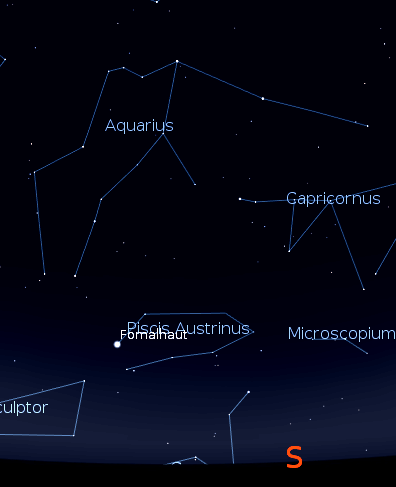
Aquarius and Fomalhaut as visualized by Stellarium
Aurora visible tonight 10/24/11
Check out this image:
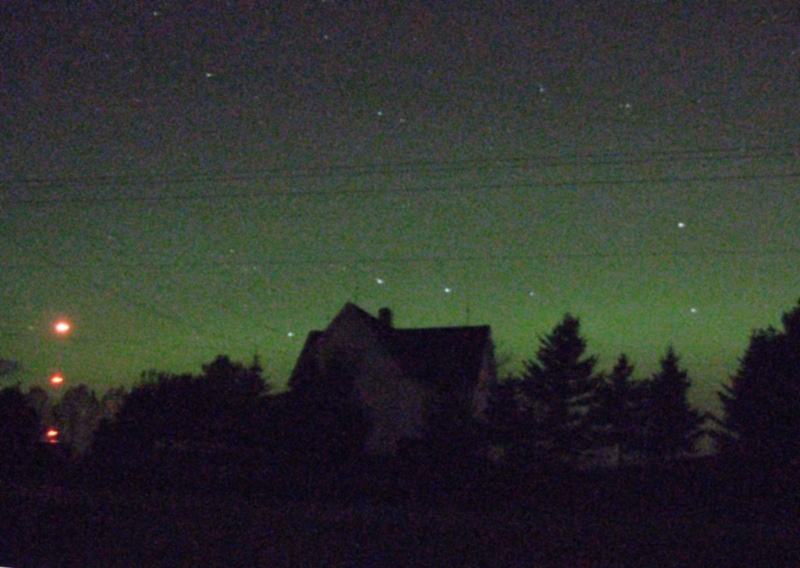
Aurora looking north at 10/24/2011 at 10:52 p.m.
According to SpaceWeather.com the earth was hit by a CME (Coronal Mass Ejection) at 2 p.m. eastern time. My thanks go to Sarah Johnson of Greenspire School for giving me the heads up on this. I’ve been busy working on my blog entries for later this week and was oblivious to the outside world.
Bad.
10/24/11 – Ephemeris – The Constellation Aquarius
Monday, October 24th. The sun will rise at 8:09. It’ll be up for 10 hours and 34 minutes, setting at 6:43. The moon, 2 days before new, will rise at 6:41 tomorrow morning. | One of the constellations of the zodiac is in the south southeastern sky at 9 in the evening. It’s the constellation of Aquarius the water bearer. The image that is supposed to be depicted in the stars is that of a hapless fellow spilling a stone jar of water across the sky. Aquarius is fairly hard to spot because it is made of faint stars. One part of him is easy to spot, the Water Jar, an asterism or informal constellation. It’s a distinctive small nearly equilateral triangle of stars with another star in the center. Stars to the right depict the stream of water being spilled. The body of Aquarius is below, a misshapen balloon of stars that is seen above the bright star Fomalhaut, low in the south.
* Times are for the Traverse City/Interlochen area of Michigan. They may be different for your location.
Addenda
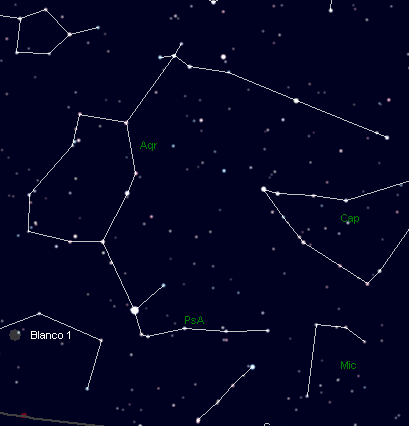
Aquarius as visualized by Cartes du Ciel.
Aquarius as visualized by Stellarium
10/21/11 – Ephemeris – Star Party at the Sleeping Bear Dunes National Lakeshore
Friday, October 21st. The sun will rise at 8:05. It’ll be up for 10 hours and 43 minutes, setting at 6:48. The moon, 2 days past last quarter, will rise at 2:52 tomorrow morning. | Tonight if it’s clear The Grand Traverse Astronomical Society will be holding the last Star Party of the year at the Sleeping Bear Dunes National Lakeshore. This time we’ll be at Stop 3 on the Pierce Stocking Scenic Drive starting at 7 p.m. Parking will be at Picnic Mountain, adjacent to Stop 3, which is a cul-de-sac off the main drive. Celestial wonders that will be visible include the planet Jupiter and three of its moons, shy Io will be hiding behind the planet til after 9. Some of the northern summer wonders including the great globular star cluster in Hercules are still visible. Rising, while we’re viewing will be the Pleiades the Seven Sisters, better seen in binoculars than a telescope, actually, and many more autumn wonders will be visible..
* Times are for the Traverse City/Interlochen area of Michigan. They may be different for your location.
10/20/11 – Ephemeris – The Orionid meteor shower
Thursday, October 20th. The sun will rise at 8:03. It’ll be up for 10 hours and 46 minutes, setting at 6:50. The moon, 1 day past last quarter, will rise at 1:40 tomorrow morning. | The Orionid meteor shower will reach its peak tomorrow morning. Like most meteor showers, this is best seen just before dawn. As the name suggests the so-called shooting stars will seem to come from the constellation Orion the hunter. They will appear to come from above the rectangular torso of the giant. These meteors actually have nothing to do with Orion, but they are the light flashes from bits of rock that were once part of Halley’s comet, as they burn up in the earth’s atmosphere. In Halley’s many passes close to the sun, much of its solid material has been liberated by the evaporating gasses, leaving a trail of litter in its orbit. The earth passes through this debris every May and now, in October.
* Times are for the Traverse City/Interlochen area of Michigan. They may be different for your location.
Addendum
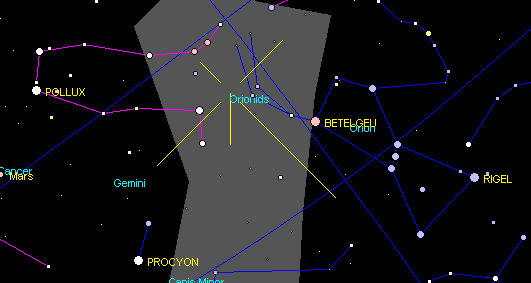
Orionid Radiant
10/19/11 – Ephemeris – The bright planets visible this week
Wednesday, October 19th. The sun will rise at 8:02. It’ll be up for 10 hours and 49 minutes, setting at 6:51. The moon, at last quarter today, will rise at 12:31 tomorrow morning. | Well it’s Wednesday and time again to take a look at the whereabouts of the bright planets. The planet Venus is still rather close to the sun in the evening setting 42 minutes after the sun and not really visible. Jupiter is now the prominent planet of the evening sky after it rises at 7:15 p.m. in the east northeast and is seen against the stars of the constellation Aries. It will move due south at 2:07 a.m. In a telescope it will be accompanied by its 4 brightest moons, and as the planet rises higher Jupiter’s image becomes sharper, and its cloud bands will become visible. The moons and planetary features change from night to night and sometimes while you watch. Mars will rise at 2:01 a.m also in the east northeast and is going through the constellation of Cancer heading to Leo.
* Times are for the Traverse City/Interlochen area of Michigan. They may be different for your location.
 Bob Moler's Ephemeris Blog