Archive
01/31/2012 – Ephemeris – February preview
Ephemeris for Tuesday, January 31st. The sun will rise at 8:02. It’ll be up for 9 hours and 46 minutes, setting at 5:49. The moon, 1 day past first quarter, will set at 2:50 tomorrow morning.
Let’s preview the month of February. It will be a day longer this year because it’s a leap year, the adjustment to keep the calendar in sync with the seasons. The daylight hours throughout February will be getting longer. Daylight hours will increase from 9 hours and 48 minutes tomorrow to 11 hours and 8 minutes on the 29th. The altitude of the sun at noon will increase from 28 degrees tomorrow to nearly 38 degrees at month’s end. The straits area will see the sun a degree lower. Local noon, by the way for Interlochen and Traverse City is about 12:55 p.m, which is mainly due to the fact that our standard time meridian happens to run through Philadelphia and the sun is currently running 12 minutes slow.
* Times, as always are for the Traverse City/Interlochen area of Michigan.
Addendum
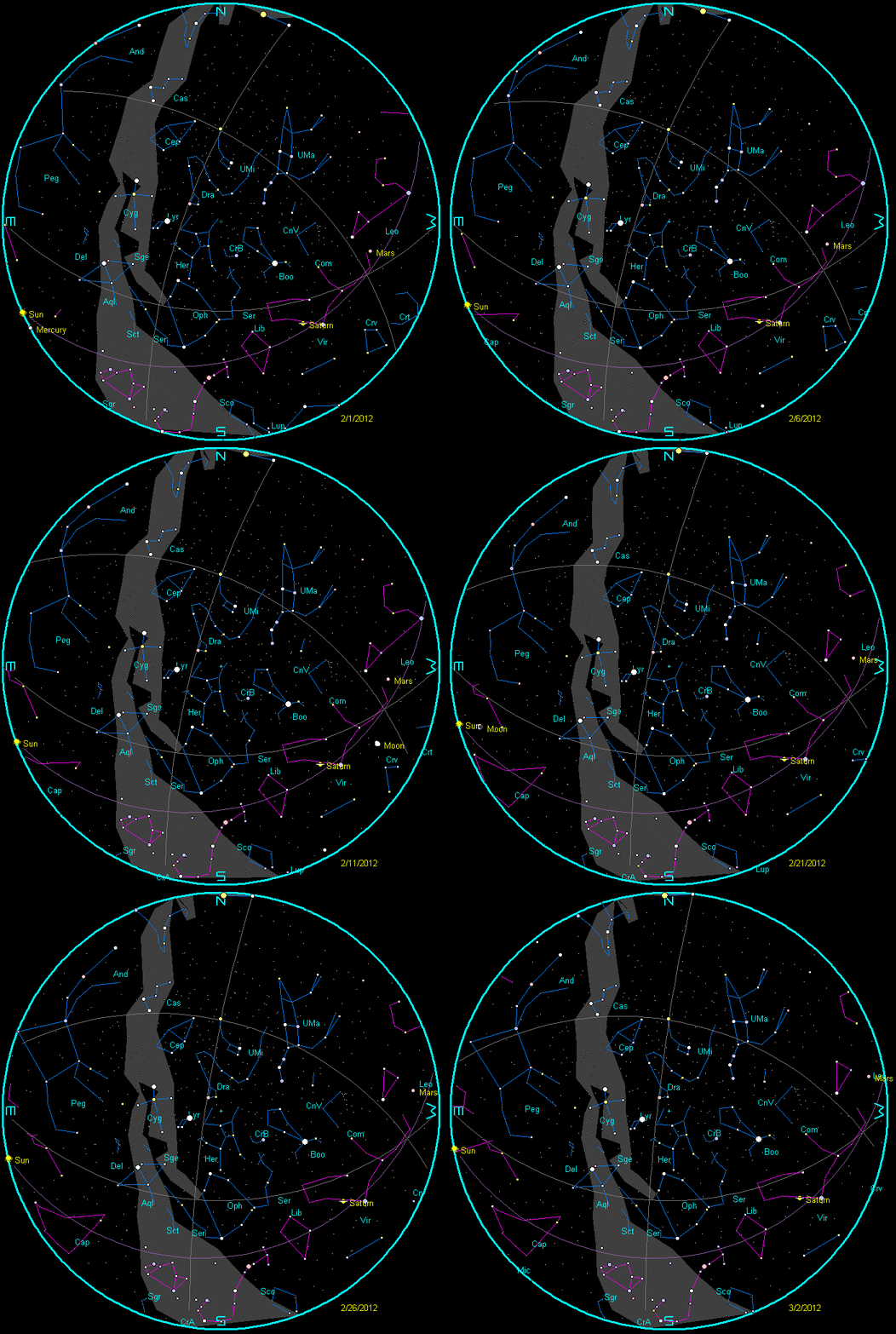
Sunrise planets at 5 day intervals for February 2012
Click on the image to animate.
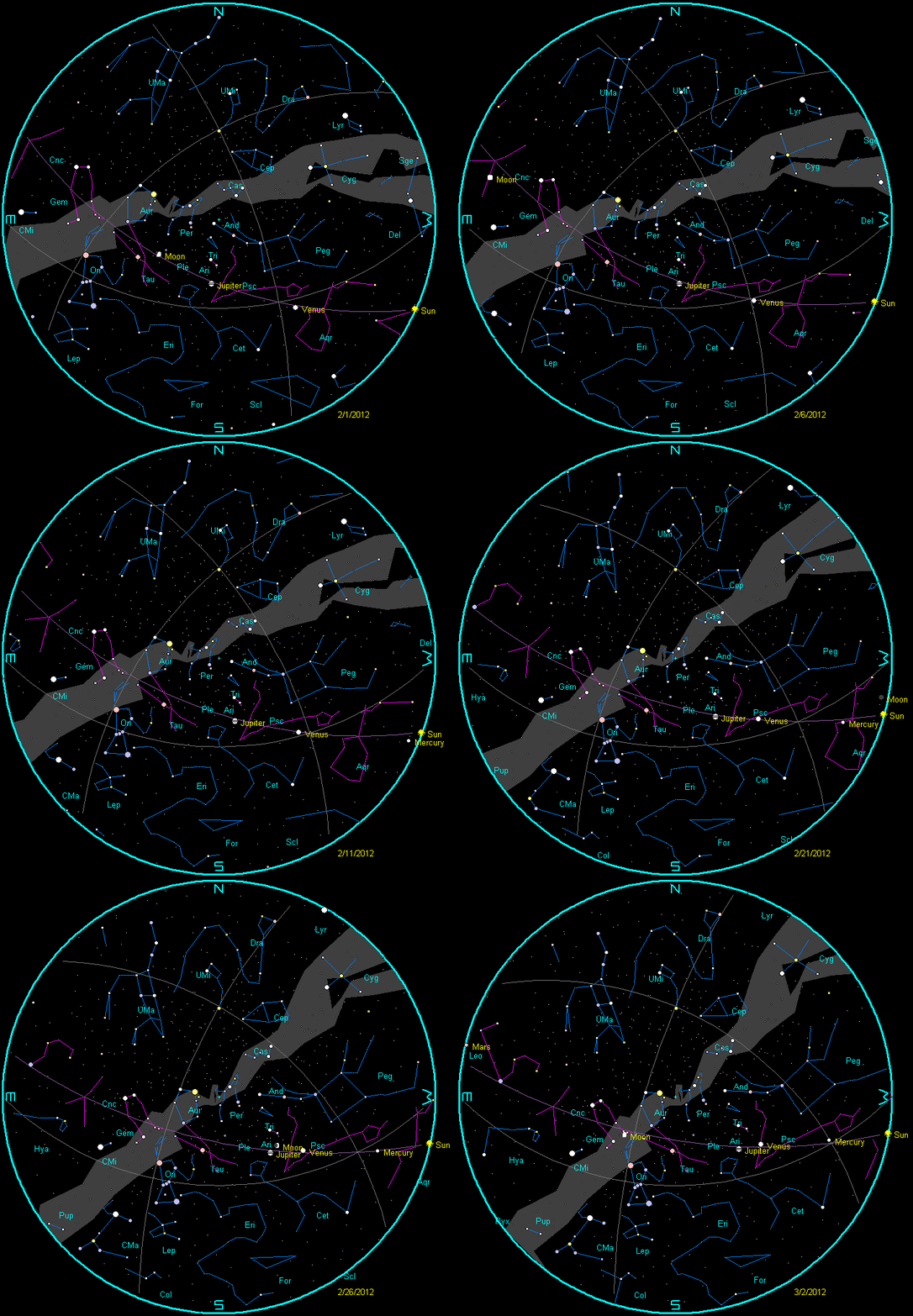
Sunset planets at 5 day intervals for February 2012
Click on the image to animate.
01/30/2012 – Ephemeris – Getting Sirius about color
Ephemeris for Monday, January 30th. The sun will rise at 8:04. It’ll be up for 9 hours and 43 minutes, setting at 5:47. The moon, at first quarter today, will set at 1:51 tomorrow morning.
The bright star shining so bright low in the south southeast at 9 p.m. is Sirius the Dog Star. I talked about it Friday in the context of its constellation Canis Major, Orion’s larger hunting dog. Sirius itself is a remarkable star. It’s name means dazzling one and a look at it in binoculars or a telescope will prove it.. The twinkling effects are due to the earth’s atmosphere, but the bright arc light color is all his. Sirius is a perfect white star. Compare it with the brightest star now overhead Capella which has the same color as our sun. Star colors tell us the temperature of the star surfaces, which run from cool red to hot blue. On our Fahrenheit temperature scale, the sun’s surface is about 10,000 degrees, Sirius is nearly twice that.
* Times, as always are for the Traverse City/Interlochen area of Michigan.
Addendum
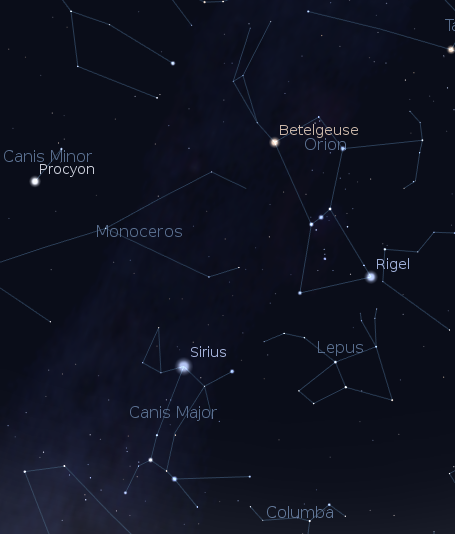
Orion and his Hunting Dogs. Created using Stellarium.
Sirius actually looks blue-white to me. Of course during the day our yellow sun looks white. I think it has to do with out night vision.
01/27/2012 – Ephemeris – The constellation Canis Major
Ephemeris for Friday, January 27th. The sun will rise at 8:07. It’ll be up for 9 hours and 36 minutes, setting at 5:43. The moon, 3 days before first quarter, will set at 10:49 this evening.
What kind of a hunter would the constellation Orion be without his trusty hunting dogs. The larger of the dogs is Canis Major which can be found if you extend Orion’s belt stars down to the left. There in the south southeast will appear the brightest night time star Sirius the Dog Star. It is in the heart of the dog, which appears to be begging. Well it’s tilted funny. Other than that it’s a pretty good representation of a dog as a stick figure. The name Sirius doesn’t mean Dog Star, but means Dazzling One due to its great brightness. It outshines all other night stars, only to be out shown by the planets Venus, Jupiter and occasionally Mars. Binoculars will show a nice little star cluster a short ways below Sirius known as M41.
* Times, as always are for the Traverse City/Interlochen area of Michigan.
Addendum
Orion and his Hunting Dogs. Created using Stellarium.
01/26/2012 – Ephemeris – The moon will appear near Venus tonight
Ephemeris for Thursday, January 26th. The sun will rise at 8:08. It’ll be up for 9 hours and 34 minutes, setting at 5:42. The moon, 3 days past new, will set at 9:46 this evening.
The waxing crescent moon will appear near the bright planet Venus tonight in the southwestern sky after sunset. They were actually closer earlier today, although not that close. The moon happens to be north of the ecliptic plane, which is actually the plane of the earth’s orbit of the sun. Venus is a bit below. The moon has to be close to that plane at new or full moon for eclipses to take place. The moon’s orbit is tilted at 5 degrees to that plane, and crosses it twice a month. So we get eclipse seasons twice a year. The next eclipse is a solar eclipse May 20th, which we’ll see the start of at sunset here. Venus will be close to that plane at its inferior conjunction June 5th when it passes in front of the sun in transit. We’ll see the first 3 hours of that before sunset.
* Times, as always are for the Traverse City/Interlochen area of Michigan.
Addendum
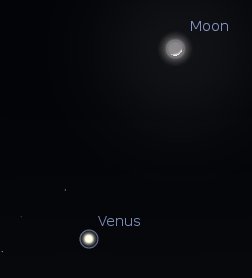
Venus and the moon on the evening January 26, 2012. Created using Stellarium.
01/25/2012 – Ephemeris – Where are the planets this week?
Ephemeris for Wednesday, January 25th. The sun will rise at 8:08. It’ll be up for 9 hours and 31 minutes, setting at 5:40. The moon, 2 days past new, will set at 8:42 this evening.
It’s time again to take a look at the whereabouts of the bright planets. Venus is brilliant in the southwestern sky after sunset and will set at 9:01 in the west. Jupiter is the most prominent planet of the evening sky, once Venus sets. It’s located high in the south southeast as it gets dark and is seen against the stars of the constellation Aries. It will pass due south at 6:21 p.m. and it will set at 1:08 a.m.. Mars will rise at 9:36 p.m in the east northeast and is below the hind end of the constellation Leo the lion. It is 76.7 million miles away and closing and has been getting brighter. It’s now as bright as most first magnitude stars. Mars will pass due south at 4:02 a.m. Saturn will rise at 12:49 a.m. just to the left of the bright star Spica in the east southeast.
* Times, as always are for the Traverse City/Interlochen area of Michigan.
Addendum
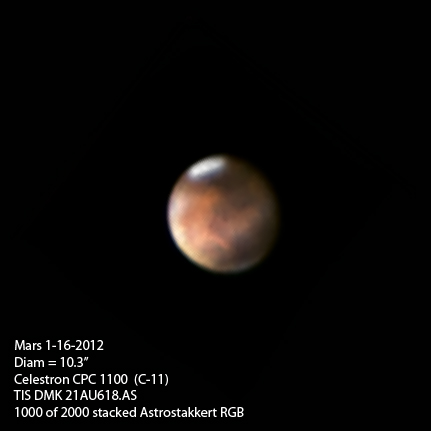
Mars 9 days ago. Photograph by Scott Anttila
Another gorgeous shot of Mars by Scott Anttila. At the time Mars appeared 10.3 seconds of arc in diameter. By comparison the moon and sun appear about 1,800 seconds of arc in diameter. Note that Mars appears slightly gibbous in shape. It will appear full on March 3rd. when it will be in opposition from the sun. It will be closest to us on March 5th. at about 62.6 million miles. At that time it will have an apparent diameter of 13.9 seconds of arc.
The CME from Monday hit the earth’s magnetic field at 10:10 a.m. EST
A geomagnetic storm is now raging above us and is inducing currents in the ground and transmission lines.. On the bright side look for a aurorae (Norther or Southern Lights) tonight!
01/24/2012 – Ephemeris – The face of the constellation Taurus – The Hyades
Ephemeris for Tuesday, January 24th. The sun will rise at 8:09. It’ll be up for 9 hours and 29 minutes, setting at 5:39. The moon, 1 day past new, will set at 7:36 this evening.
To the upper right of the constellation Orion in the south in the evening is a letter V of stars with a bright orange star at one tip. This is the face of Taurus the bull. In some constellation depictions the bull is charging Orion who is turned to face him. The V of stars isn’t very bright and are outshone by the Pleiades star cluster to the right in Taurus’ shoulder. In Greek mythology the V of stars are the Hyades, half sisters of the Pleiades. It is a star cluster like the Pleiades and very important, because it is the closest star cluster to us at 153 light years distant. It helped determine the scale of the universe. The bright star at the tip is Aldebaran the follower (of the Pleiades). It is not part of the Hyades and is less than half way to it at 65 light years.
* Times, as always are for the Traverse City/Interlochen area of Michigan.
Addendum
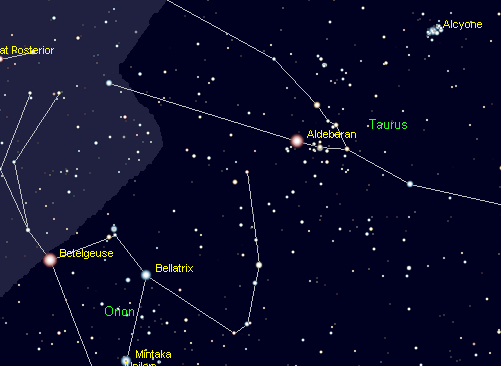
The Hyades, Orion and the Pleiades. Created using Cartes du Ciel
Another possible aurora due Tuesday January 24th, 2012
Just got this from http://www.spaceweather.com that a CME erupted from the sun today. It should reach the earth later tomorrow or early Wednesday. Look for aurorae (northern or southern lights depending on your hemisphere).
01/23/2012 -Ephemeris – The constellation Gemini the twins
Ephemeris for Monday, January 23rd. The sun will rise at 8:10. It’ll be up for 9 hours and 27 minutes, setting at 5:38. The moon is new today, and won’t be visible.
The constellation of Gemini the twins appears high in the southeast. It appears to the upper left of Orion and the stars that portray his club raised high. Gemini’s two brightest stars are the namesakes of the twins. Castor above and Pollux below. From them there are two lines of stars that form the silhouette of the lads heading to the lower right. In Greek mythology these twins each had a different father, not unheard of in medical history, with Pollux being fathered by the god Zeus and thus immortal. Castor was not. But the brothers were inseparable, so when Castor was killed in the search for the golden fleece Pollux begged his father to let him die too and join his brother. His wish was granted and his devotion was so great that they were placed in the sky where we see them today.
* Times, as always are for the Traverse City/Interlochen area of Michigan.
Addendum
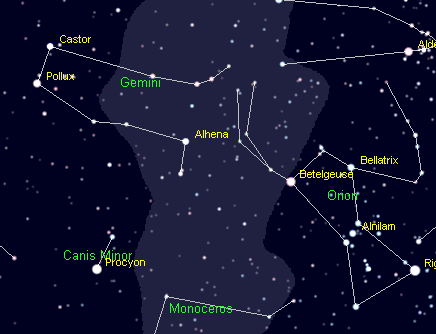
Gemini and Orion. Created using Cartes du Ciel
Look for an aurora tonight
On Thursday the 19th a CME (Coronal Mass Ejection) erupted from the sun headed earthward. Generally these things take about 2 days give or take to get to the earth. When they do they tangle with the earth’s magnetic field and cause huge currents to flow toward the earth’s magnetic poles causing among other things the aurora or northern and southern lights.
So check the skies tonight, especially northward if you are in the northern hemisphere or southward if you’re in the southern.
The higher your latitude the better your chances of seeing it. But who knows. Check out http://spaceweather.com/.
 Bob Moler's Ephemeris Blog