Archive
02/15/2012 – Ephemeris – Where are the bright planets this week?
Ephemeris for Wednesday, February 15th. The sun will rise at 7:43. It’ll be up for 10 hours and 27 minutes, setting at 6:10. The moon, 1 day past last quarter, will rise at 3:45 tomorrow morning.
Let’s see what’s happening with the bright planets for this week. Venus is brilliant in the southwestern sky after sunset and will set at 9:52 in the west. Jupiter is the second brightest planet after Venus. It’s located high in the southwest as it gets dark and is seen against the stars of the constellation Aries. And Venus is approaching it now. Jupiter will set at 12:03 a.m.. Mars is the up and coming planet. It will rise at 7:54 p.m in the east and is below the hind end of the constellation Leo the lion. It is 66.1 million miles away and closing and is getting brighter. It’s now as bright as most first magnitude stars. Mars will pass due south at 2:27 a.m. Saturn will rise at 11:26 p.m. just to the left of the bright star Spica in the east southeast.
* Times are for the Traverse City/Interlochen area of Michigan. They may be different for your location.
02/14/2012 – Ephemeris – St. Valentine’s day
Ephemeris for St Valentine’s Day, Tuesday, February 14th. The sun will rise at 7:44. It’ll be up for 10 hours and 24 minutes, setting at 6:09. The moon, at last quarter today, will rise at 2:43 tomorrow morning.
As I said before today is St. Valentine’s day. However one of the symbols of this Christian Saint’s day, beside the red hearts, is the pagan Roman god of love Cupid, the cute counterpart of the erotic Greek god Eros. Cupid supposedly made people fall in love by shooting them with little love darts with his bow. One of those darts is in the sky as the constellation Sagitta the arrow which is visible on summer evenings and now in the early morning. The Roman goddess of love is represented, brilliantly, in the evening sky as the planet Venus. On St Valentine’s Day, 2000 the NEAR spacecraft entered orbit of the asteroid Eros, and soft landed on it 364 days later. They say love is in the air. Apparently love is in space too.
* Times are for the Traverse City/Interlochen area of Michigan. They may be different for your location.
Addendum
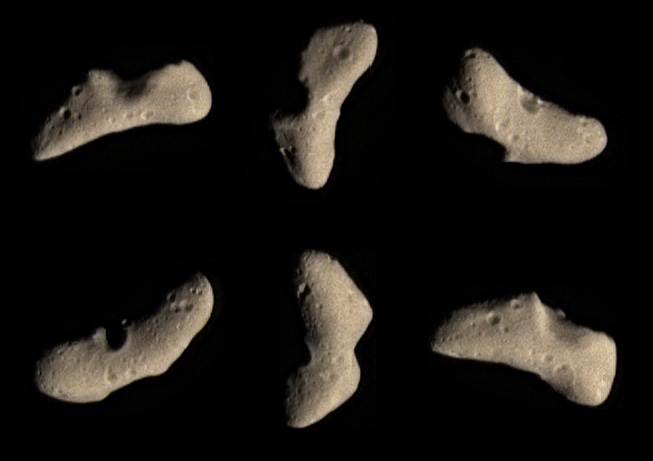
Six views of asteroid 433-Eros in February 2000. Images from NASA's NEAR-Shoemaker spacecraft.
Sagitta the arrow represents Cupid’s dart in the summer sky.
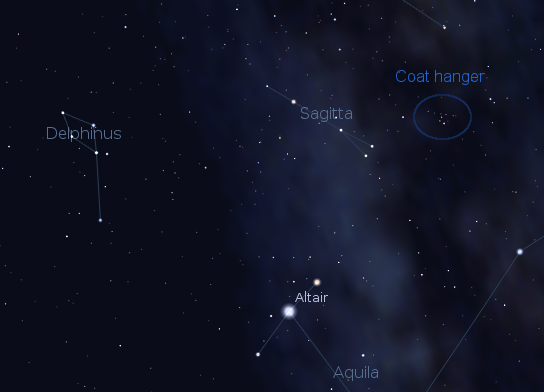
Delphinus, Sagitta and the Coat hanger. Diagram created using Stellarium.
02/13/2012 – Ephemeris – Orion and Scorpius
Ephemeris for Monday, February 13th. The sun will rise at 7:46. It’ll be up for 10 hours and 21 minutes, setting at 6:07. The moon, 1 day before last quarter, will rise at 1:34 tomorrow morning.
The most prominent constellation of the winter sky is Orion, and is most astronomer’s favorite. It seems odd that such a minor personage of Greek myth would have such a prominent constellation named for him. He is even mentioned twice in the book of Job, though in the the original Hebrew the word for Orion means fool. And that pretty much sums Orion’s life up. A luckless fool. One of several contradictory stories of his death has Orion dying of a Scorpion sting. And when placing Orion in the heavens the gods made sure that Orion and Scorpius are never in the sky at the same time. This however doesn’t work in the southern hemisphere. Orion can be found in the south at 9 p.m. an upright rectangle of bright stars framing the three stars as his belt.
* Times are for the Traverse City/Interlochen area of Michigan. They may be different for your location.
Addendum
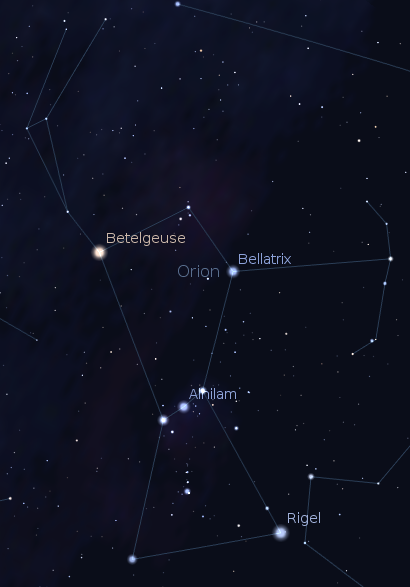
Orion upright and due south. Created using Stellarium.
02/10/2011 – Ephemeris – The moon will be near Saturn Sunday morning
Ephemeris for Friday, February 10th. The sun will rise at 7:50. It’ll be up for 10 hours and 12 minutes, setting at 6:03. The moon, 3 days past full, will rise at 9:52 this evening.
Sunday morning the moon will pass Saturn in our sky. The ringed planet is just to the left of the bright blue-white star Spica in the constellation of Virgo. Saturn and Spica rise around midnight now. Saturn will be best seen in the evening this spring and early summer. Its rings are still opening up from their edge on passage in 2009. Saturn’s rings can be seen in any telescope with 20 power or over. In fact in sturdily mounted binoculars, Saturn will appear not point-like as stars do but may appear somewhat oblong, due to its rings. The rings are not solid, a fact that’s been known for a few centuries. A solid disk would be tour asunder by the tidal forces on it by the difference in the gravitational forces across the rings.
* Times are for the Traverse City/Interlochen area of Michigan. They may be different for your location.
Addendum
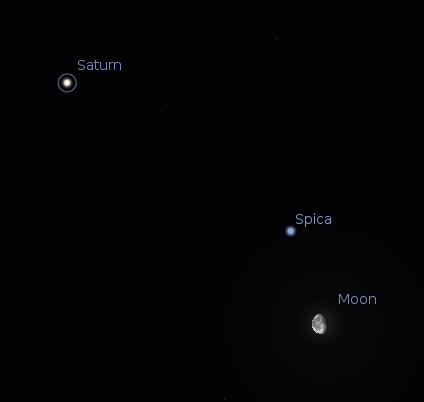
Saturn, Spica and the moon at 6 a.m. February 12, 2012. Created using Stellarium.
02/09/2012 – Ephemeris – The star Betelgeuse
Ephemeris for Thursday, February 9th. The sun will rise at 7:51. It’ll be up for 10 hours and 10 minutes, setting at 6:02. The moon, 2 days past full, will rise at 8:38 this evening.
The bright red star at the upper left corner of the constellation Orion, high in the south at 9 p.n. Is Betelgeuse. The name is a contraction of an Arabic phrase that means “Armpit of the Central One”. Betelgeuse is a huge star with a diameter four times that of the earth’s orbit of the sun. It is throwing of gas and creating a nebula around itself. It’s distance from us isn’t accurately known, since it doesn’t have a companion star. It’s about 643 light years away, give or take 148 light years. Betelgeuse is about 18 times the mass of the sun and 140 thousand times brighter. It is in the latter stages of its short life,of 10 million year so far. Within another million years or so it will probably explode in a supernova. The good news is that it’s moving away from us.
* Times are for the Traverse City/Interlochen area of Michigan. They may be different for your location.
Addendum
Orion upright and due south. Created using Stellarium.
Betegeuse in Orion
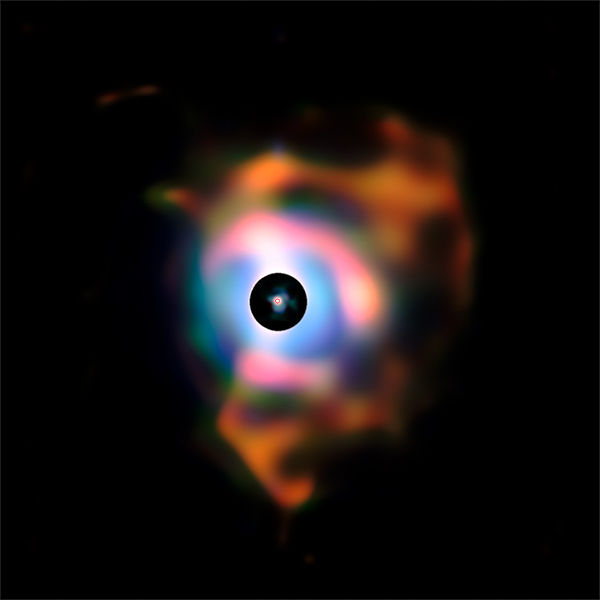
Betelgeuse and its nebula. From ESO's Very Large Telescope.
More information on the image above: http://www.eso.org/public/images/eso1121a/
02/08/2011 – Ephemeris – Where are the bright planets?
Ephemeris for Wednesday, February 8th. The sun will rise at 7:53. It’ll be up for 10 hours and 7 minutes, setting at 6:00. The moon, 1 day past full, will rise at 7:24 this evening.
Let’s see what’s happening with the bright planets for this week. Venus is brilliant in the southwestern sky after sunset and will set at 9:35 in the west. Jupiter the second brightest planet after Venus. It’s located high in the southwest as it gets dark and is seen against the stars of the constellation Aries. It will set at 12:25 a.m.. Mars is the up and coming planet. It will rise at 8:31 p.m in the east and is below the hind end of the constellation Leo the lion. It is 69.2 million miles away and closing and is getting brighter. It’s now as bright as most first magnitude stars. Mars will pass due south at 3:01 a.m. Saturn will rise at 11:54 p.m. just to the left of the bright star Spica in the east southeast.
* Times are for the Traverse City/Interlochen area of Michigan. They may be different for your location.
Addendum
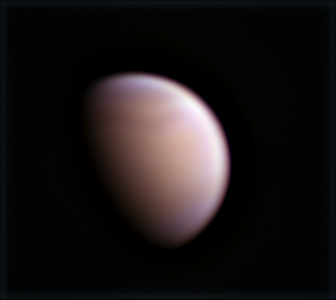
Venus by Scott Anttila. Taken Monday evening February 6, 2012
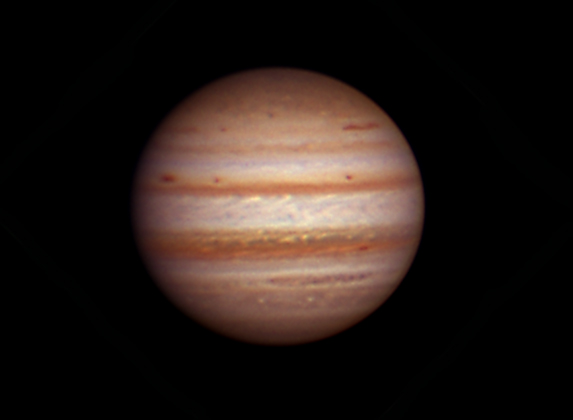
Jupiter by Scott Anttila. Taken Monday evening February 6, 2012
02/07/2012 – Ephemeris – The Dark Side of the moon
Ephemeris for Tuesday, February 7th. The sun will rise at 7:54. It’ll be up for 10 hours and 4 minutes, setting at 5:59. The moon, at full today, will rise at 6:11 this evening.
What is the dark side of the moon? If you said it was the part of the moon we don’t see, you are right, but only for today only. The proper name for the part of the moon that doesn’t face the earth is the far side. Every part of the moon has a chance to be on the dark side, which is just the night side, just as any solar system body illuminated by the sun has a day side and a night or dark side. The reason we can see only one side of the moon from the earth is that it’s tidally locked to the earth. The moon is trying to do the same to the earth and is slowing the earth’s rotation down. This is shown by the occasional leap second that’s added to our time. The moon does rotate, but it rotates once as it revolves about the earth once.
* Times are for the Traverse City/Interlochen area of Michigan. They may be different for your location.
02/06/2012 – Ephemeris – It’s about Time
Ephemeris for Monday, February 6th. The sun will rise at 7:55. It’ll be up for 10 hours and 1 minute, setting at 5:57. The moon, 1 day before full, will set at 7:21 tomorrow morning.
What time is it? Don’t bother to check. This time It’s a rhetorical question. The basis of time keeping has always been astronomical. Astronomers almost lost it last month. There are now two time scales. Universal Time, that’s roughly in sync with the earth’s rotation and Atomic Time, which uses the vibrations of cesium atoms which are set to count seconds of the length they were in 1900. Thanks mostly to the moon and the drag of the tides the earth is slowing its rotation. The difference between the two time scales is over a minute, accumulated over that past 112 years. Universal Time has been tied to the earth’s rotation by the occasional addition of a leap second every year or two. The next leap second will be added on June 30th.
* Times are for the Traverse City/Interlochen area of Michigan. They may be different for your location.
02/03/2012 – Ephemeris – A Star Bowl quiz and a viewing opportunity tonight
Ephemeris for Friday, February 3rd. The sun will rise at 7:59. It’ll be up for 9 hours and 54 minutes, setting at 5:53. The moon, half way from first quarter to full, will set at 5:28 tomorrow morning.
A Star Bowl quiz will be held this evening between the NMC Astronomy Association and the Grand Traverse Astronomical Society at this evening’s meeting of the society at 8 p.m. at Northwestern Michigan College’s Rogers Observatory. The society will accept anyone to help us. These NMC students are smart. After the Star Bowl there will be a viewing night starting at 9 p.m. On tap if its clear will be the last gasp of the planet Venus before it sets, Jupiter will be high up as well as the moon. Mars will rise as the viewing starts, but we will need to wait until at least 10 p.m. for it to clear the thick earth’s atmosphere lower down in the sky. The Observatory is located south of Traverse City on Birmley Road off either Garfield or Keystone roads.
* Times, as always are for the Traverse City/Interlochen area of Michigan.
02/02/2012 – Ephemeris – February 2nd isn’t just for groundhogs
Ephemeris for Groundhog Day, Thursday, February 2nd. The sun will rise at 8:00. It’ll be up for 9 hours and 51 minutes, setting at 5:52. The moon, 3 days past first quarter, will set at 4:39 tomorrow morning.
I’m not sure if Punxsutawney Phil will see his shadow this morning or not, but February 2nd was a special day to the ancients. It is also Candlemas day for the Catholic Church. It is also celebrated as a cross-quarter day. The middle of the season of Winter, though the exact date of the middle of winter is the 4th. And if Phil sees his shadow and we do get 6 more weeks of winters, that’s OK too. By the calendar it actually more like 7 weeks to the vernal or spring equinox and the official end of winter. Of the other cross-quarter days, only one stands out today. It’s May 1st, May Day. The way this year has been going, winter has had a hard time getting started. The temperatures are above normal and the snowfall below normal.
* Times, as always are for the Traverse City/Interlochen area of Michigan.
 Bob Moler's Ephemeris Blog