Archive
Heading to work the morning before the equinox
Turning onto M72 east in Acme I was presented with the sun half risen on top of the hill. This was taken a minute or so later.

03/19/2012 – Ephemeris – The last day of winter
Ephemeris for Monday, March 19th. The sun will rise at 7:46. It’ll be up for 12 hours and 7 minutes, setting at 7:54. The moon, 3 days before new, will rise at 6:30 tomorrow morning.
This is the last full day of winter. And a strange winter it is, ending today with record high temperatures. Tomorrow at 1:14 a.m. spring will officially start. At that time the earth will move to a point in its orbit where the sun will appear to cross the equator in the sky, and will appear to pass directly overhead if you lived on the equator. The event of the crossing and the point on the celestial sphere that the sun crosses the equator is called the vernal equinox. It’s the Greenwich of the heavens. All measurements east and west in the sky are measured from this point. And its position in relation to the prime meridian on the earth at Greenwich, near London is the fundamental measure of the earth’s rotational position.
* Times are for the Traverse City/Interlochen area of Michigan. They may be different for your location.
Addendum
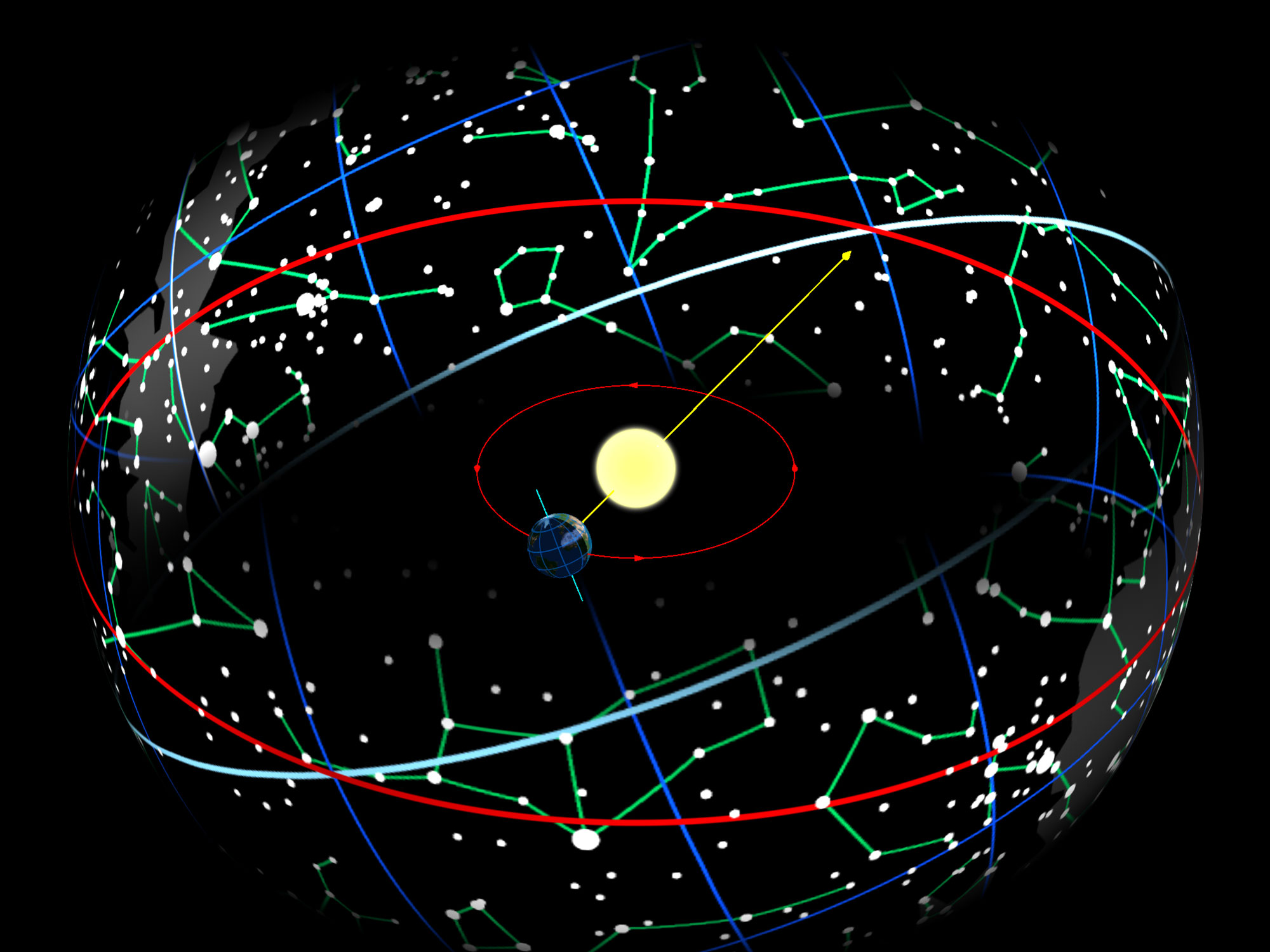
The sun at the vernal equinox. Diagram by Wikipedia contributor Tauʻolunga GNU Free Document License
Click on image to enlarge.
03/16/2012 – Ephemeris – Jupiter and Venus: Where do they go from here?
Ephemeris for Friday, March 16th. The sun will rise at 7:52. It’ll be up for 11 hours and 58 minutes, setting at 7:50. The moon, 2 days past last quarter, will rise at 5:02 tomorrow morning.
Now that the conjunction of Jupiter and Venus us over, what happens next? Well, Jupiter will continue to head westward toward the sun, and soon will be caught up into twilight. Its and principally the earths motion will move it behind the sun on May 13th. Venus still has 11 days before it reaches its greatest elongation from the sun, then it too will appear to head back toward the sun. It will actual cross in front of the sun on the evening of June 5th, where we will see the first part of the extremely rare transit of Venus. These transits occur in pairs 8 years apart separated by more than a century. The last was in 2004, the next will occur in 2117. Observations of these in the 18th century helped determine the distance to the sun.
* Times are for the Traverse City/Interlochen area of Michigan. They may be different for your location.
Addendum
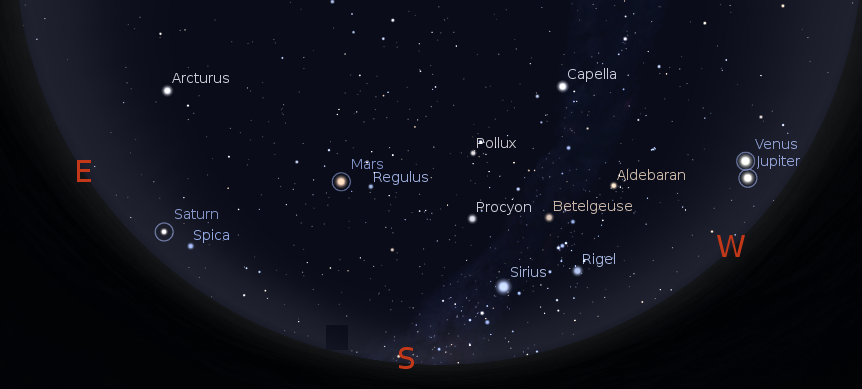
The planets at 11 p.m. March 14, 2012. Created using Stellarium.
The last step of the animation shows Jupiter and Venus tonight.
03/15/2012 – Ephemeris – Astronomical Conjunction of Jupiter and Venus
Ephemeris for Thursday, March 15th. The sun will rise at 7:53. It’ll be up for 11 hours and 55 minutes, setting at 7:49. The moon, 1 day past last quarter, will rise at 4:22 tomorrow morning.
This morning is the actual conjunction of Jupiter and Venus according to astronomers. They may have looked closest yesterday or the day before, but this morning is the time they appear at the same right ascension. Right ascension is the celestial equivalent to longitude on the earth. Meaning that Venus would be directly north of Jupiter. The terms celestial longitude and latitude have already been taken, and are actually oriented to the plane of the earth’s orbit, rather to the earth’s axis and equator. First year astronomy students accuse instructors of using such terms just to confuse them. Astronomers call the angle for the tilt of the earth’s axis the obliquity of the ecliptic. How’s that for a tongue twister.
* Times are for the Traverse City/Interlochen area of Michigan. They may be different for your location.
Addendum
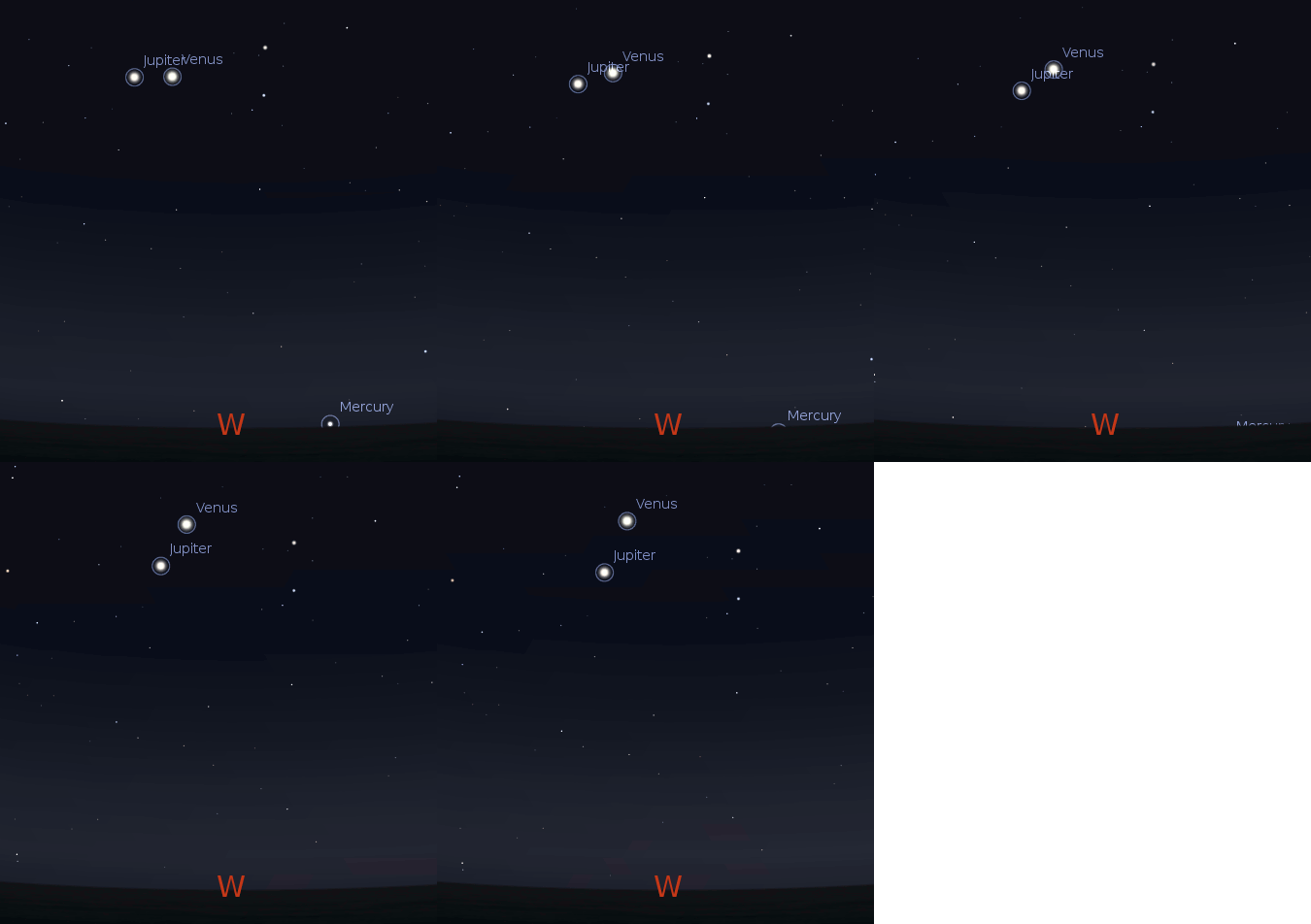
Jupiter and Venus at nightly intervals from March 12 to 16, 2012. Created using Stellarium.
The 4th step, the one before the last is where Jupiter and Venus are tonight.
03/14/2012 – Ephemeris – Where are the bright planets this week?
Wednesday, March 14th. The sun will rise at 7:55. It’ll be up for 11 hours and 52 minutes, setting at 7:47. The moon, at last quarter today, will rise at 3:35 tomorrow morning.
Let’s see what’s happening with the bright planets for this week. Mercury will make a brief appearance in the west after sunset. It will set at 8:54. Venus and Jupiter are brilliant in the western sky after sunset. Jupiter will be just below left of Venus, the brighter planet. Jupiter will set first at 11:40 p.m. followed by Venus at 11:53. Mars is up in the east in the evening with its unmistakable bright reddish color. It’s in the constellation Leo the lion now. It is 63.5 million miles and moving away. Mars will pass due south at 1:04 a.m. and will be setting in the west near sunrise. Saturn will rise at 10:31 p.m. just to the left of the bright star Spica in the east southeast.
* Times are for the Traverse City/Interlochen area of Michigan. They may be different for your location.
Addendum
The planets at 11 p.m. March 14, 2012. Created using Stellarium.
03/13/2012 – Ephemeris – Jupiter now to the lower left of Venus
Ephemeris for Tuesday, March 13th. The sun will rise at 7:57. It’ll be up for 11 hours and 49 minutes, setting at 7:46. The moon, 1 day before last quarter, will rise at 2:38 tomorrow morning.
Tonight the planet Jupiter will begin to tuck under Venus coming from the left as they appear together in the west after sunset. Venus and Jupiter are the two brightest planets seen in the sky. Venus is the brightest for two reasons. Number one, its close to us. It is actually the closest planet to the earth. When it passes between us and the sun June 5th, it will be only 26.8 million miles away. That’s a bit farther than normal, since the earth will be a month away from its farthest point from the sun. Also Venus’ sulfuric acid cloud tops reflect most of the light it receives from the sun. Jupiter is bright due to its great size with a surface area over 120 times that of the earth. Still sunlight is diluted to one twenty fifth that of earth.
* Times are for the Traverse City/Interlochen area of Michigan. They may be different for your location.
Addendum
Jupiter and Venus at nightly intervals from March 12 to 16, 2012. Created using Stellarium.
Tonight’s position of the planets is the second frame of the animation.
03/12/2012 – Ephemeris – Jupiter is level with Venus, also possible northern lights tonight
Ephemeris for Monday, March 12th. The sun will rise at 7:59. It’ll be up for 11 hours and 45 minutes, setting at 7:45. The moon, 2 days before last quarter, will rise at 1:33 tomorrow morning.
In the western evening sky, Jupiter and Venus are making a pass at each other. They shouldn’t, in the modern sense since Venus or Aphrodite of the Greeks was the daughter of Jupiter or Zeus. .Over this week we’ll watch as Jupiter slips below Venus to lead Venus in setting. Tonight Jupiter is level with and left of Venus. Venus will always be the brighter of the two. We also have an aurora watch for this evening. The sun has been active this weekend with a series of flares emanating from the largest sunspot group now visible called active region 1429. This group is rotating off so it’s flares soon won’t affect the earth. Check spaceweather.com for the latest. And check bobmoler.wordpress.com for an animation of the planet conjunction.
* Times are for the Traverse City/Interlochen area of Michigan. They may be different for your location.
Addendum
Jupiter and Venus at nightly intervals from March 12 to 16, 2012. Created using Stellarium.
The first frame of the animation is for tonight.
The sun is staying active – Check out the skies for the northern lights for the next few nights
Solar flares erupting from AR (Active Region) 1429, the big sunspot group now seen on the face of the sun, are sending clouds of charged particles toward the earth. Three flares in the last three days will provide an enhanced chance for auroral displays over the next few nights.
That’s both aurora borealis, northern lights and auroral australis, southern lights for or southern hemisphere friends.
Keep checking www.spaceweather.com for the latest information.
Also keep checking the western sky after sunset for Jupiter and Venus passing each other. These are the two brightest planets.
03/09/2012 – Ephemeris – The moon will pass Spica and Saturn tomorrow
Ephemeris for Friday, March 9th. The sun will rise at 7:04. It’ll be up for 11 hours and 36 minutes, setting at 6:41. The moon, 1 day past full, will rise at 8:47 this evening.
The moon will be passing by the bright star Spica and the planet Saturn tomorrow evening. They will make a neat triangle with the moon at the point below. I should remind everyone that the moon will only pass these object from our point of view. We are lining up the nearby moon, only a quarter million miles away with Saturn, nearly a billion miles away, and Spica trillion and trillions of miles away. Though the heavens appear as a sphere overhead, it is unimaginably deep. The ancients called the heavens the firmament, meaning that it was literally solid. It was, according to Genesis, placed there to divide the waters above from that below. We find now that time is as deep into the past as space is deep, some 13.7 billion years.
Not mentioned in the program: Daylight Time will start at 2 a.m. Sunday March 11th at 2 a.m.
* Times are for the Traverse City/Interlochen area of Michigan. They may be different for your location.
Addendum
Below is The moon below Spica and Saturn at 11 p.m. on Saturday, march 10, 2012.
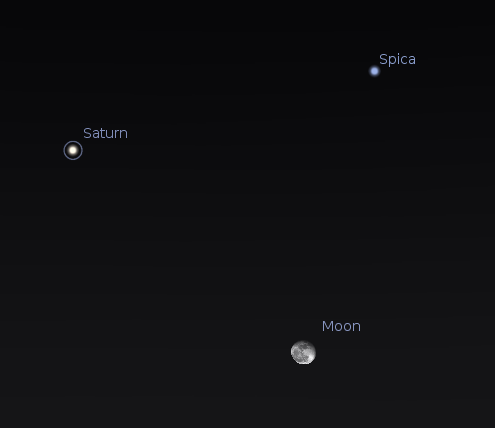
The Moon, Spica and Saturn at 11 p.m March 10, 2012. Chart created using Stellarium.
Good possibility of seeing northern lights tonight
We’ve got a full moon tonight, so that will affect visibility somewhat. But what we really need is clear skies!
Check out http://www.spaceweather.com for more information.
 Bob Moler's Ephemeris Blog