Archive
09/28/2012 – Ephemeris – Harvest moon tomorrow
Ephemeris for Friday, September 28th. The sun will rise at 7:37. It’ll be up for 11 hours and 50 minutes, setting at 7:27. The moon, 1 day before full, will set at 7:10 tomorrow morning.
Tomorrow is the Harvest Moon, the nearest full moon to the autumnal equinox. Here the path of the moon in the sky against the stars is shallow causing the moon to rise only a little later each night. Back before electricity was available to farms this gave extra time for farmers to gather in their crops each day. This effect lasts for a bit less than a week both before and after the full moon. We astronomers aren’t big fans of the effect because the sky stays bright longer and masks the faint things they want to see. Not all astronomers are bummed by bright moonlight. There’s plenty to study when the moon is out: planets and reasonably bright stars. It’s just that the fainter objects are lost.
Times are for the Traverse City/Interlochen area of Michigan. They may be different for your location.
Addendum
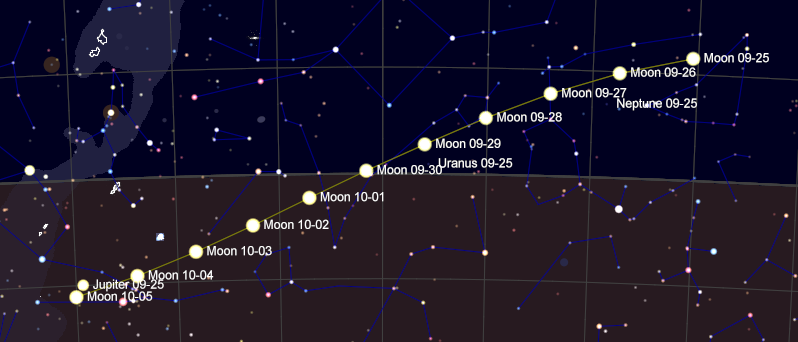
Shallow path of the moon for 11 nights centered on the Harvest Moon in 2012. Created using Cartes duCiel (Sky Charts).
Click on the image to enlarge.
09/27/2012 – Ephemeris – The Fisher in the stars
Ephemeris for Thursday, September 27th. The sun will rise at 7:36. It’ll be up for 11 hours and 53 minutes, setting at 7:29. The moon, 2 days before full, will set at 6:06 tomorrow morning.
The Big Dipper is swooping low in the northwestern sky in the evening now. The Big Dipper is not a constellation but part of the Great Bear for most peoples, and is enshrined by the International Astronomical Union as Ursa Major. To some of the Anishinabek peoples native to our region the stars of the Big Dipper belonged to a small weasel like animal call the Fisher. In a story I can’t relate here Fisher brought summer to the earth, and for his trouble was killed by an arrow to his only vulnerable spot, his tail. The Great Spirit would not let Fisher fall to earth, but placed him in the sky. His rising in the northeast signals the coming of spring, and when his bloody tail brushes the horizon in autumn his blood paints the maple trees red.
Times are for the Traverse City/Interlochen area of Michigan. They may be different for your location.
Addendum
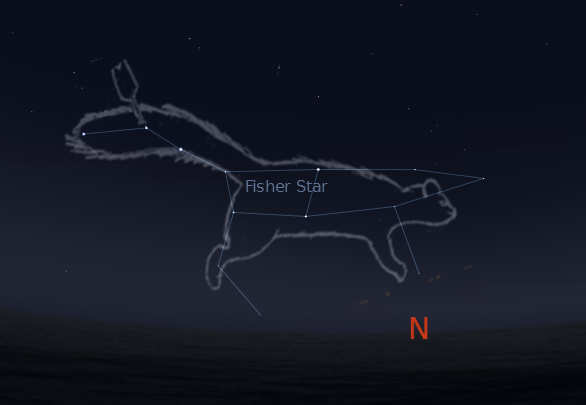
The Fisher heads towards the northern horizon. Created using Stellarium and an unknown artist which I took liberties with.
The Fisher is also known as the Fisher Star (Ojiig’anung). I’ll have my version of the story posted soon.
The Fisher heads towards the northern horizon. Created using Stellarium and an unknown artist which I took liberties with.
09/26/2012 – Ephemeris – Where are the bright planets this week
Ephemeris for Wednesday, September 26th. The sun will rise at 7:34. It’ll be up for 11 hours and 56 minutes, setting at 7:31. The moon, 3 days before full, will set at 5:00 tomorrow morning.
Let’s see how many bright planets we can find this week. Mars and Saturn now set too close to the sun to be easily seen in the evening sky. Both are in the west southwestern sky and very low in twilight. Saturn sets at 8:36 p.m., while Mars sets at 9:21. The planetary action moves to later in the evening and the morning. Jupiter, will rise at 10:40 p.m. in the east northeast. It is located in the constellation of Taurus. The last bright planet of the night is the morning star Venus which will rise at 3:56 a.m. also in the east northeast. Venus is now moving between Cancer and Leo. The planets Venus and Jupiter and the winter constellations are a great sight for early risers. You can enjoy them without danger of frost bite.
Times are for the Traverse City/Interlochen area of Michigan. They may be different for your location.
Addendum
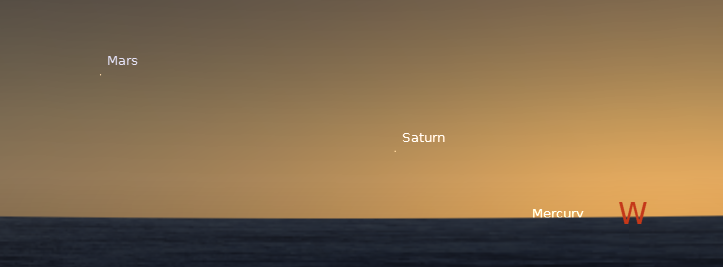
Mars and Saturn low in twilight September 26, 2012 8 p.m. Created using Stellarium.
Note that Mercury has already set.
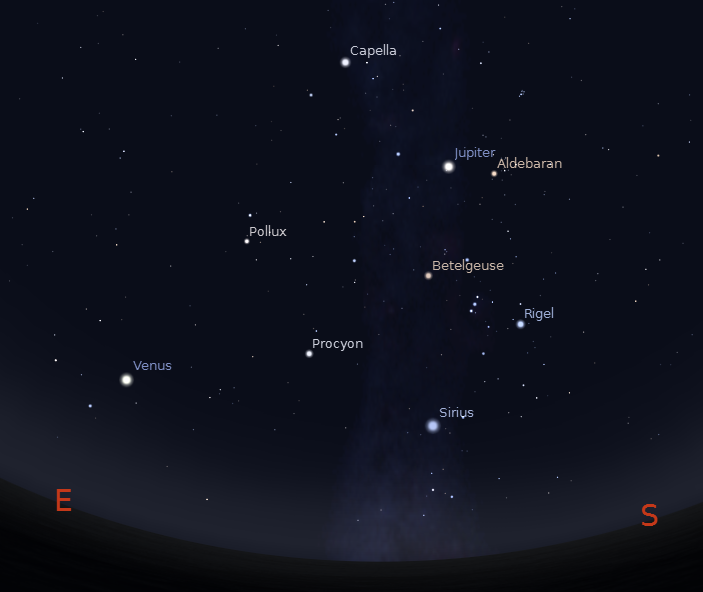
The winter stars in the morning with Jupiter and Venus on September 27, 2012 at 6 a.m. Created using Stellarium.
09/25/2012 – Ephemeris – Sinus Iridium greets the sun
Ephemeris for Tuesday, September 25th. The sun will rise at 7:33. It’ll be up for 11 hours and 59 minutes, setting at 7:33. The moon, 3 days past first quarter, will set at 3:53 tomorrow morning.
Lets look at the moon again tonight. One of my favorite formations is coming into light it is called Sinus Iridium or Bay of Rainbows. Sorry there’s no color here. But if caught at right time this ruined crater will appear as a hook out into night off the upper left edge of the moon. Officially its a bay to the Sea of Showers or Mare Imbrium. The north edge of the bay are mountains called the Jura Mountains. The south edge disappears into Mare Imbrium. The floor of the Sinus Iridium is about twelve hundred feet lower than Imbrium. The transition is gradual because it isn’t very noticeable. The formation is large enough to be seen in binoculars. Sinus Iridium is 242 miles wide, a good tenth the diameter of the moon itself.
Times are for the Traverse City/Interlochen area of Michigan. They may be different for your location.
Addendum
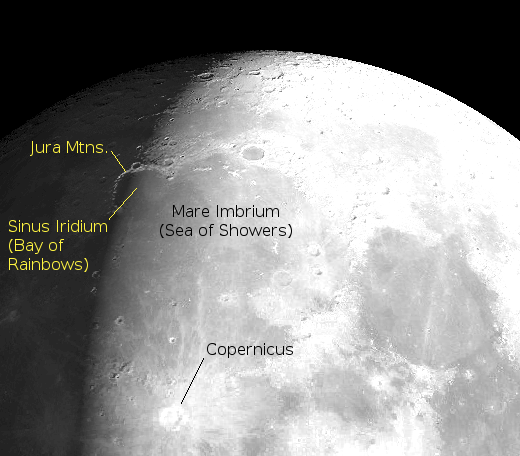
Bay of Rainbows and the crater Copernicus. Created using Virtual Moon Atlas.
09/24/2012 – Ephemeris – The lunar crater Copernicus
Ephemeris for Monday, September 24th. The sun will rise at 7:32. It’ll be up for 12 hours and 2 minutes, setting at 7:35. The moon, 2 days past first quarter, will set at 2:44 tomorrow morning.
Since the International Observe the Moon Night was cloudy in our area if its clear tonight there are still great views of the moon. You’re on your own, so dig out those binoculars and dust off that telescope for a great view of the moon. The sun will have risen on one of the great craters Copernicus. It’s near the terminator, the sunrise line on the moon on the left, close to half way from north to south. Copernicus was named for the Polish astronomer who put forth the heliocentric solar system in the 16th century. The crater is 56 miles in diameter with a vaguely hexagonal form and two miles deep. It has terraced walls and three central peaks. It may look deeper than that due to the low sun angle exaggerating its depth.
Times are for the Traverse City/Interlochen area of Michigan. They may be different for your location.
Addendum
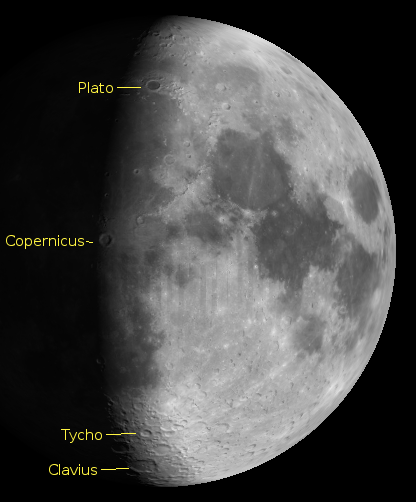
The moon on showing Copernicus and other large craters on the terminator. Created using Virtual Moon Atlas.
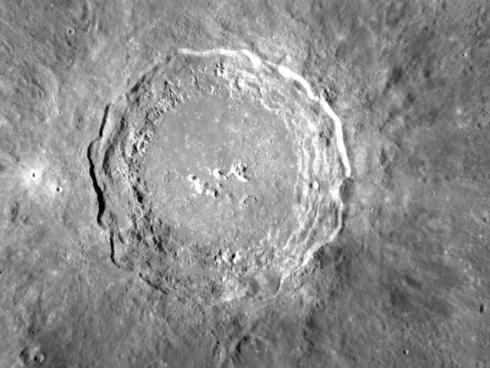
The crater Copernicus. Credit: NASA/GSFC/Arizona State University.
09/21/2012 – Ephemeris – International Observe the Moon Night
Ephemeris for Friday, September 21st. The sun will rise at 7:28. It’ll be up for 12 hours and 11 minutes, setting at 7:40. The moon, 1 day before first quarter, will set at 11:26 this evening.
Tomorrow evening the Grand Traverse Astronomical Society will host a star party at Northwestern Michigan College’s Rogers Observatory starting at 9 p.m. It is also the International Observe the Moon Night. A first quarter moon is what I consider the best of all moons to observe. But that’s just my opinion. It shows a great number of craters near the terminator, the sunrise line that cuts the moon in two at first quarter. Also the moon won’t be too bright to mask some of the wonders of the summer Milky way. The observatory is located south of Traverse City on Birmley Road, between Garfield and Keystone roads. Speaking of summer, It will end at 10:49 a.m. When autumn will begin as the sun passes the celestial equator heading south.
Times are for the Traverse City/Interlochen area of Michigan. They may be different for your location.
update
Members of the GTAS will also be stationed in downtown Traverse City on Front St. near the State Theater. Thats only if its clear.
09/20/2012 – Ephemeris – Tides and the moon
Ephemeris for Thursday, September 20th. The sun will rise at 7:27. It’ll be up for 12 hours and 14 minutes, setting at 7:42. The moon, 2 days before first quarter, will set at 10:29 this evening.
The moon and the earth gravitationally attract each other. And the moon raises tides in the earth itself and its oceans. The earth’s tides on the mass of the moon has slowed its rotation so it continually shows the earth the same face. The moon, only one 81st the mass of the earth hasn’t been as successful at slowing the earth’s rotation. It caused the world’s timekeepers to add one second this June to the time stream after several years to match our atomic clocks to the earth’s rotation. The most noticeable effects of the moons tidal force is the tides in the earth’s oceans. The highest tides are when the sun and moon are in line at new and full moon. Small bodies of water like the Great Lakes don’t have luni-solar tides.
Times are for the Traverse City/Interlochen area of Michigan. They may be different for your location.
Note
I can’t explain much about tides in one minute. Here I’m not explaining the force, but am explaining that it affects the solid bodies as well as the oceans on the earth.
09/19/2012 – Ephemeris – Where are the bright planets this week?
Ephemeris for Wednesday, September 19th. The sun will rise at 7:26. It’ll be up for 12 hours and 18 minutes, setting at 7:44. The moon, 3 days before first quarter, will set at 9:40 this evening.
Let’s see how many bright planets we can find this week. Mars and Saturn now set too close to the sun to be easily seen in the evening sky. Both are in the west southwestern sky and very low in twilight. Saturn sets at 9:02 p.m., while Mars sets at 9:33. The planetary action moves to later in the evening and the morning. Jupiter, will rise at 11:07 p.m. in the east northeast. It is located in the constellation of Taurus. The last bright planet of the night is the morning star Venus which will rise at 3:45 a.m. also in the east northeast. Venus is now moving through Cancer towards Leo. The planets Venus and Jupiter and the winter constellations are a great sight for early risers.
Times are for the Traverse City/Interlochen area of Michigan. They may be different for your location.
Addendum
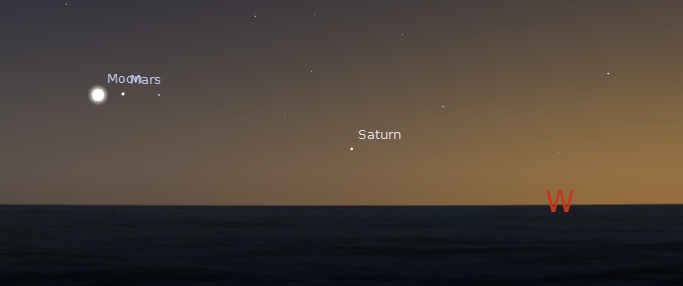
Mars, the moon and Saturn at 8:30 p.m. on September 19, 2012. Created using Stellarium.
Note that the sky will be brighter than this. The moon will be a thin crescent, and not at all bright. tell me if you can spot these guys.
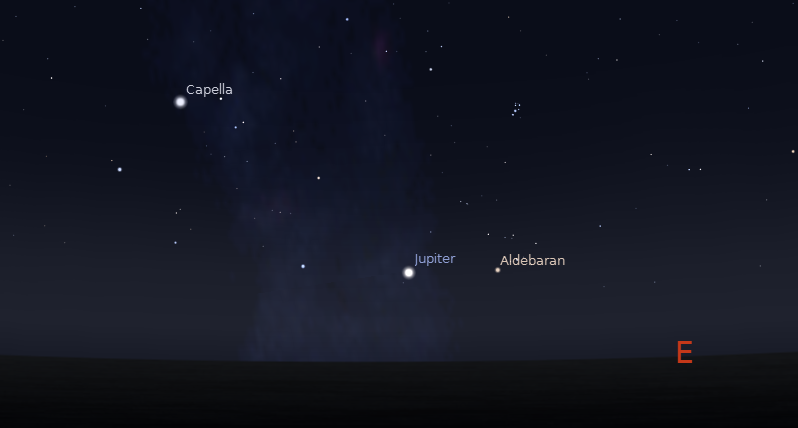
Jupiter, nearly an hour after rising – midnight September 20, 2012. Created using Stellarium.
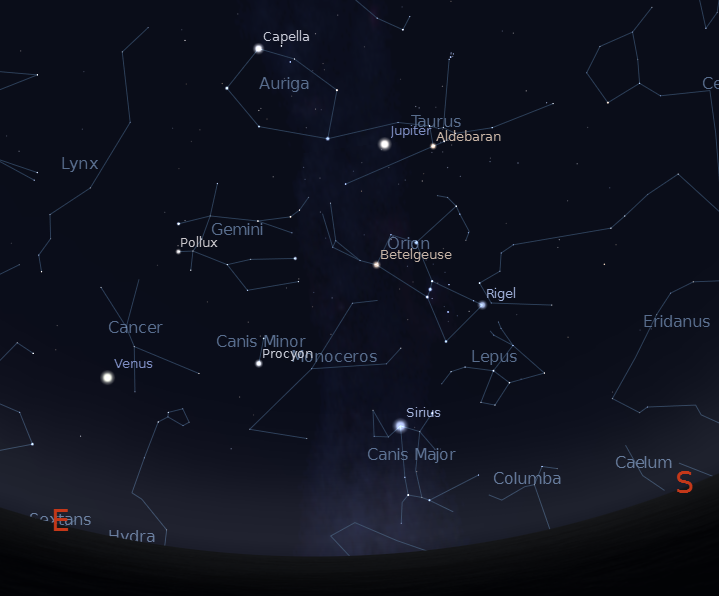
Jupiter and Venus among the star of winter at 6 a.m. on September 20, 2012. Created using Stellarium.
On a personal note
This would have been my mother’s 100th birthday. She passed away 34 years ago. It is she who first taught me the constellations.
09/18/2012 – Ephemeris – The center of the Milky Way
Ephemeris for Tuesday, September 18th. The sun will rise at 7:25. It’ll be up for 12 hours and 21 minutes, setting at 7:46. The moon, 3 days past new, will set at 8:58 this evening.
Look to the south southwest at 10 p.m. At the constellation of Sagittarius, which looks like a teapot. It’s located at the south end of the Milky Way. Just off the spout of the teapot lies, beyond the clouds of stars, gas and dust, at a distance of about 27,000 light years, the center of the Milky Way. The center contains a 4 million sun mass black hole with a bevy of stars orbiting around it like planets orbit the sun. Black holes are so massive that, nothing, not even light can escape their gravity. Lots of energy is released by matter falling in to a black hole. Currently our Milky Way’s black hole is quiet, nothing of note is falling in. However there is a cloud of gas and dust approaching the black hole, so its quiet phase may end next year.
Times are for the Traverse City/Interlochen area of Michigan. They may be different for your location.
Addendum
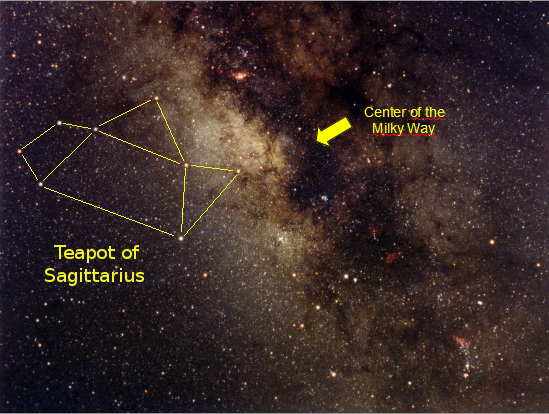
Location of the center of the Milky Way and the Teapot of Sagittarius.
While the actual center of the galaxy cannot be seen in optical wavelengths it is visible in radio, infrared and x-rays. The black hole at the center of the Milky Way is designated Sagittarius A* (pronounced Sagittarius A Star). Check it out in Wikipedia and other sources.
09/17/2012 – Ephemeris – Cygnus and the search for exo-planets
Ephemeris for Monday, September 17th. The sun will rise at 7:24. It’ll be up for 12 hours and 24 minutes, setting at 7:48. The moon, 2 days past new, will set at 8:21 this evening.
Nearly overhead at 10 p..m. is the constellation Cygnus the swan. The bright star Deneb is at the tail of this flying swan with its wings outstretched, flying south through the Milky Way. Cygnus is located at a point in the Milky Way in the direction the sun’s orbiting the center of the Milky Way. That is the approximate direction the Kepler spacecraft is staring. Launched in 2009 the Kepler spacecraft has been slowly drifting away from the earth in a trailing orbit of the sun. It is monitoring over 100,000 stars continuously looking for transits of planets across their stars. So far some 2300 suspects have been found. They have to be confirmed by ground based telescopes before being officially cataloged. So far close in planets to their stars have been discovered.
Addendum
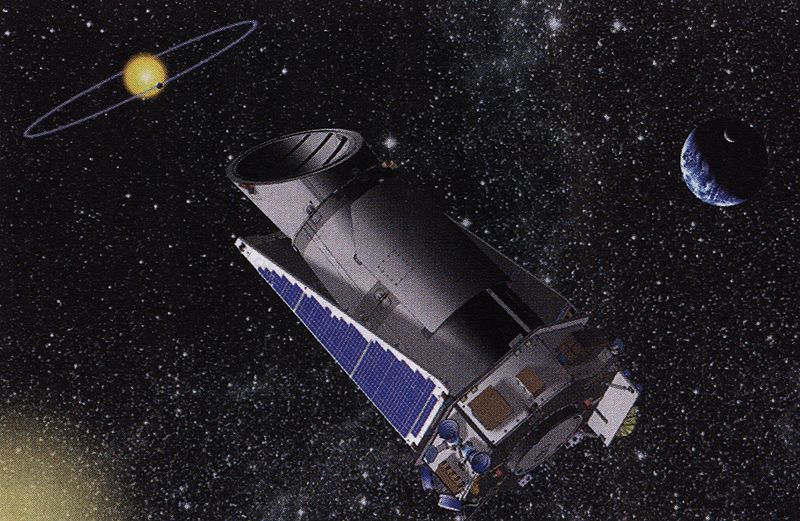
Kepler Spacecraft. Credit NASA.
Click image to enlarge.
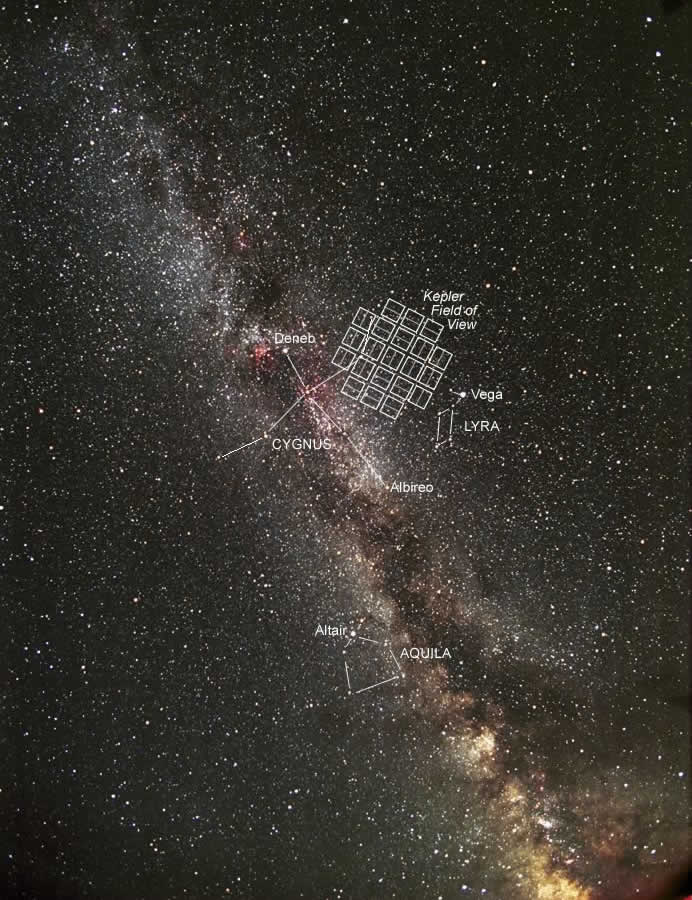
Kepler field of view. Credit C. Roberts, NASA.
Click image to enlarge.
Link to Kepler’s home page: http://kepler.nasa.gov/
 Bob Moler's Ephemeris Blog