Archive
10/31/2012 – Epmeneris – The Ghoul Star
Ephemeris for Halloween, Wednesday, October 31st. The sun will rise at 8:19. It’ll be up for 10 hours and 12 minutes, setting at 6:32. The moon, 2 days past full, will rise at 7:37 this evening.
Not all the ghosts and goblins out tonight will be children. One will be out every night, because it’s a star. Its name is Algol, from the Arabic for Ghoul Star or Demon Star. The Chinese had a name for it that meant a mausoleum or more ominously ‘piled up corpses’. It’s the second brightest star in the constellation Perseus the hero, rising in the northeast this evening. The star is located where artists have drawn the severed head of Medusa, whom he had slain. Medusa was so ugly that she turned all who gazed upon her to stone. Algol is her still glittering eye. Astronomers finally found out what was wrong with Algol. It does a slow 6 hour wink every two days 21 hours, because it is two very close stars that eclipse each other in that period.
Times are for the Traverse City/Interlochen area of Michigan. They may be different for your location.
Addendum
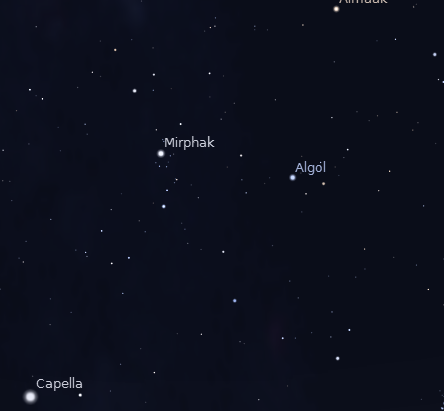
The constellation Perseus in the northeast at 9 p.m. on October 31, 2012. Created using Stellarium.
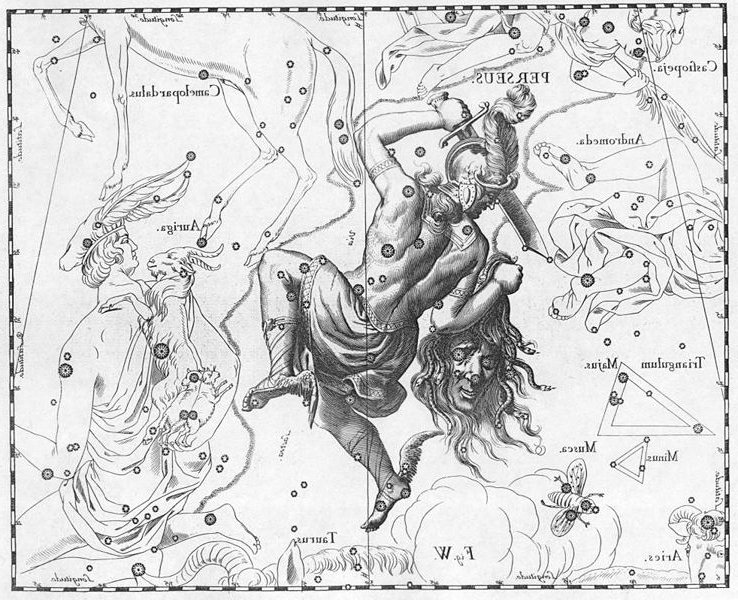
Perseus and the head of Medusa from the 1690 Uranographia by Johannes Hevelius. Image found with the article on Algol in Wikipedia.
Note that this is a mirror image. The star charts in the 17th century were based on celestial globes, which represented the constellations as seen from the outside of the celestial sphere instead of from the inside. I reversed the image to match Perseus as we see him.
10/30/2012 – Ephemeris – Where are the bright planets this week?
Ephemeris for Tuesday, October 30th. The sun will rise at 8:18. It’ll be up for 10 hours and 15 minutes, setting at 6:33. The moon, 1 day past full, will rise at 6:58 this evening.
Let’s check out the planets for this week, a day early. At 7:30 p.m. Mars can be seen low in the southwest moving away from the red star Antares, whose name means rival of Mars. Mars will set at 8:26. The planetary action will have already picked up on the other side of the sky. Jupiter, will rise at 8:18 p.m. in the east northeast. It is located in the constellation of Taurus. It will transit or pass due south at 3:54 a.m. The last bright planet of the night is the morning star Venus which will rise at 5:16 a.m. also in the east. Venus is now below the hind end of Leo, and entering the constellation of Virgo. The planets Venus and Jupiter and the winter constellations are a great sight for early risers. It’s starting to feel like winter in the early morning.
Times are for the Traverse City/Interlochen area of Michigan. They may be different for your location.
Addendum
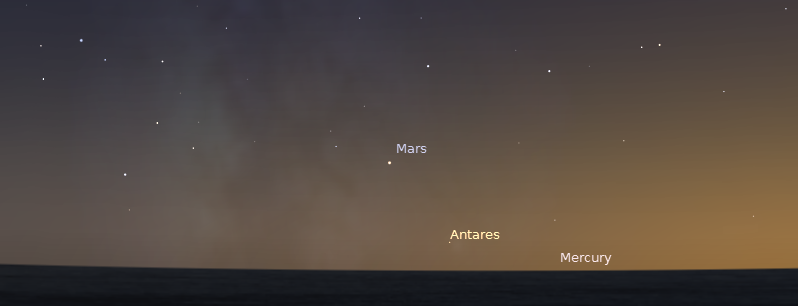
Mars and stars at 7:20 p.m. on October 30, 2012. Created using Stellarium.
Mercury, though labeled, is not visible. Folks much farther south of us have a better shot at seeing it.
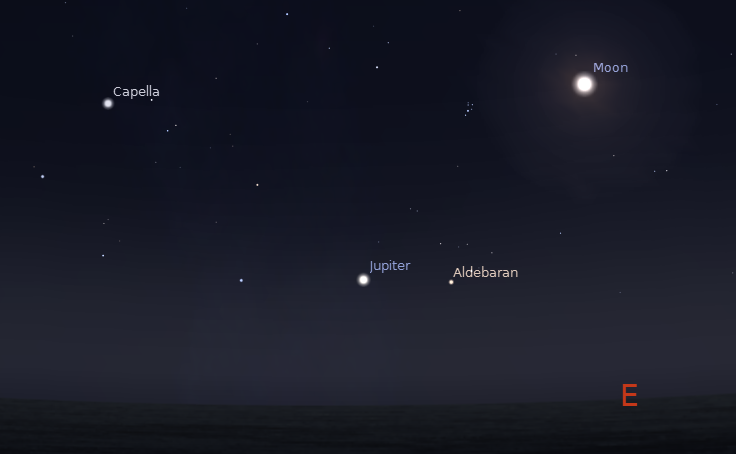
Jupiter, the moon and the stars of Taurus and Auriga at 9:30 p.m. October 30, 2012. Created using Stellarium.
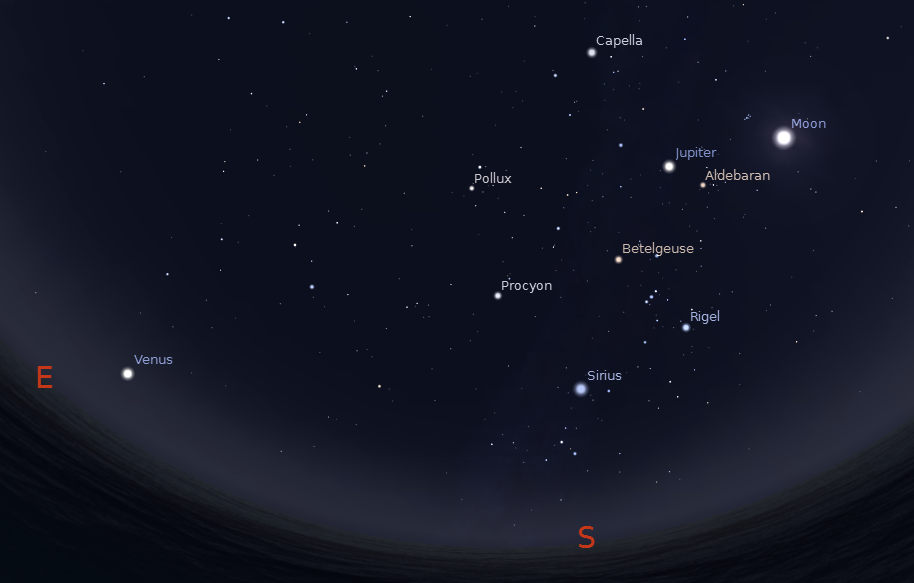
Jupiter and Venus with the winter stars at 6 a.m. on October 31, 2012. Created using Stellarium.
10/29/2012 – Ephemeris – The full Hunters Moon and Tycho’s rays
Ephemeris for Monday, October 29th. The sun will rise at 8:16. It’ll be up for 10 hours and 18 minutes, setting at 6:34. The moon, at full today, will rise at 6:24 this evening.
The full moon tonight is the full Hunters Moon. As down as I am about full moons due to the fact that they light up the sky and flood out the dimmer objects in the sky, I once and a while stop and view it. The time of the full moon is about 3 this afternoon, so when it rises tonight we will be looking at the moon from very nearly the direction of the sun, so there will be few shadows to be had. Last week I talked about the crater Tycho near the bottom or south end of the moon and its long rays of ejecta. The full moon is the best time to see these rays, which are easily visible in binoculars, through which Tycho itself looks like a bright dot. In telescopes Tycho looks like a small bright ring. The full moon is super bright. It’s daytime there.
Times are for the Traverse City/Interlochen area of Michigan. They may be different for your location.
Addendum
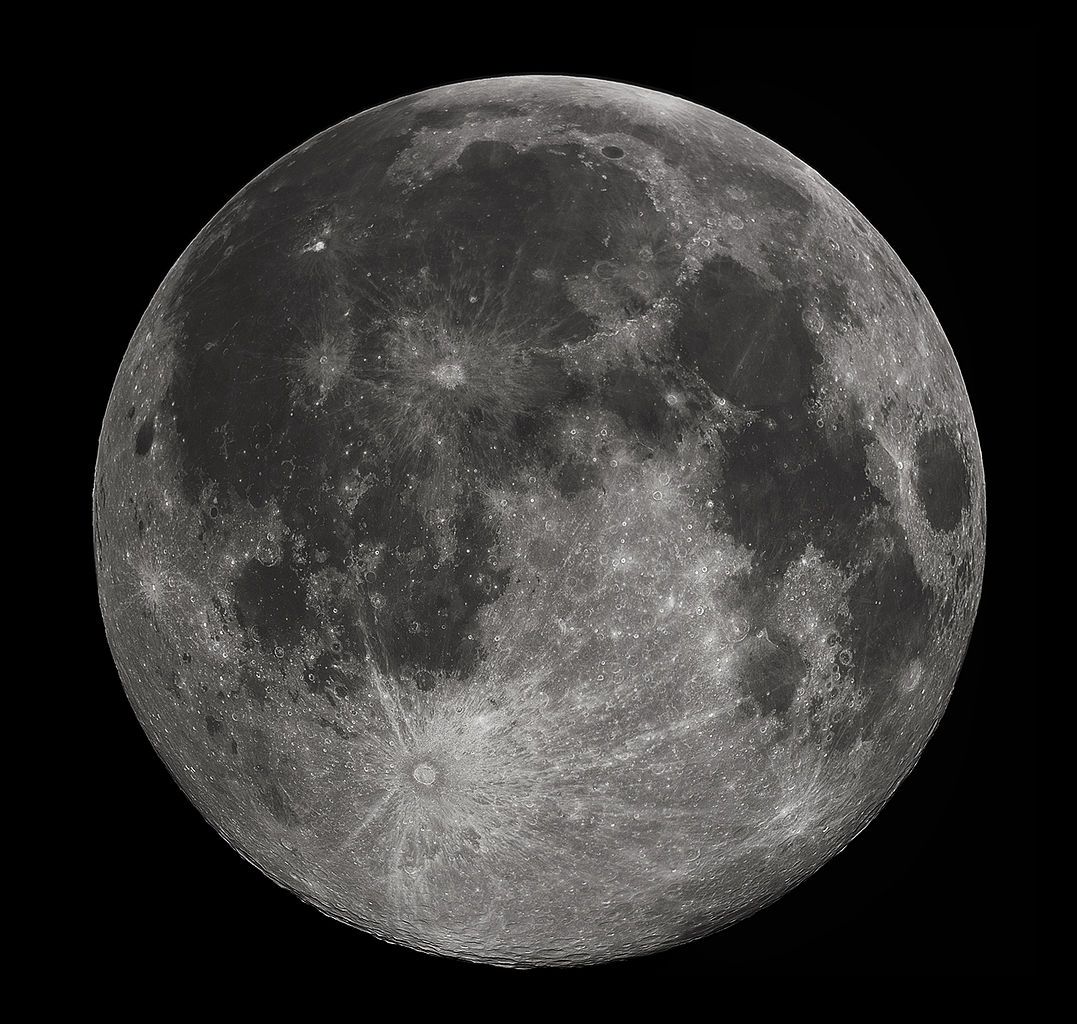
Photographed with a Celestron 9.25 Schmidt-Cassegrain telescope. Acquired with a Canon EOS Rebel T1i (EOS 500D), 20 images stacked to reduce noise. 200 ISO 1/640 sec. Gregory H. Revera
Tycho and its rays are prominent in the photo above. I found this image in the article Moon in Wikipedia.
10/26/2012 – Ephemeris – The planet next door
Ephemeris for Friday, October 26th. The sun will rise at 8:12. It’ll be up for 10 hours and 26 minutes, setting at 6:39. The moon, 3 days before full, will set at 6:05 tomorrow morning.Last week some astronomers announced the discovery of a planet in the star system next door. Rigel Kentaurus, better known for some reason as Alpha Centauri, only 4.3 light years away, 25 trillion miles, if your odometer goes that high, is the closest star system to the solar system. I say star system, because it contains 3 stars. Star A is much like the sun, star B, somewhat larger and dimmer is orange in color. These two orbit each other at distances the range from Saturn’s distance from the sun to Pluto’s in about 80 years. The third star is a distant red dwarf, slightly closer to us than the other two and named Proxima Centauri. The new planet discovered is in essence hugging star B. Its designation is Alpha Centauri Capital B lower case b (Bb).
Times are for the Traverse City/Interlochen area of Michigan. They may be different for your location.
Addendum
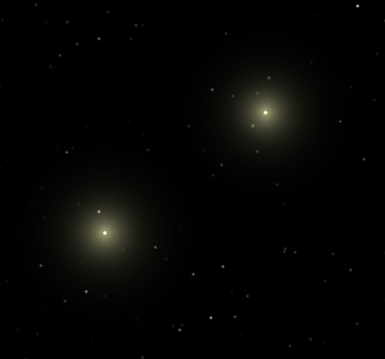
Alpha Centauri A and B. Created using Celestia.
Celestia doesn’t do Alpha Centauri justice. The A star, to the lower left, is about 1.5 times brighter than the sun. The B star is half the sun’s brightness. I wonder how far a planet could be from either star without being in an orbit that would be unstable and be ejected from the system.
10/25/2012 – Ephemeris – Exploring the bright gibbous moon
Ephemeris for Thursday, October 25th. The sun will rise at 8:11. It’ll be up for 10 hours and 29 minutes, setting at 6:40. The moon, half way from first quarter to full, will set at 5:02 tomorrow morning.
The moon tonight is very bright, so looking at it with a telescope can be almost painful. There are moon filters sold at telescope stores for standard sized eyepieces that will alleviate that problem. Remember it’s daytime on the moon and the sunlight is as strong on the moon as it is on the earth. Concentrate the telescope on the left edge of the moon, the sunrise line where the shadows are. The small crater Kepler, named for the astronomer who gave us the laws the govern the motion of the planets is located near the terminator near the moon’s equator. The Crater Gassendi, to the lower left, is a ringed plain with low walls and a flat floor that has a rille or crack in it. Another distinctive crater is Schiller lower to the south and very elongated.
Times are for the Traverse City/Interlochen area of Michigan. They may be different for your location.
Addendum
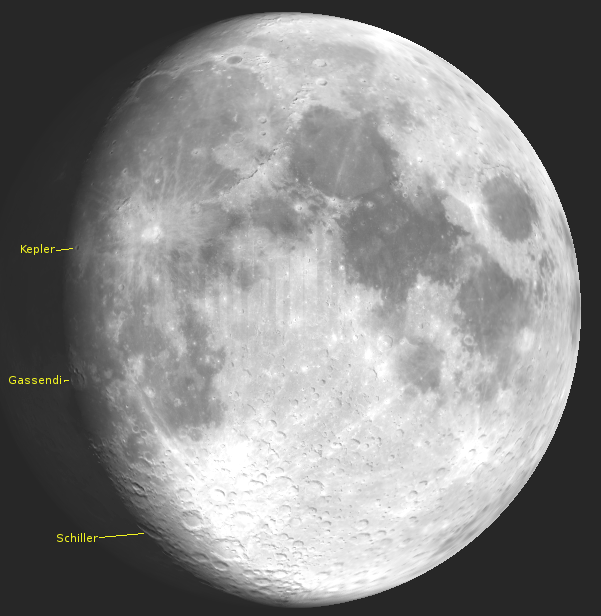
The bright gibbous moon highlighting three craters, Kepler, Gassendi, and Schiller. Created using the Virtual Moon Atlas.
Gassendi is named for Pierre Gassend, 17th French astronomer and pioneer in the use of a refractor telescope. Schiller is named for Julius Schiller a 17th century monk who came out with a Christian themed star atlas. These and other crater facts were obtained for the open source lunar program Virtual Moon Atlas.
10/24/2012 – Ephemeris – Whare are all the bright planets this week?
Ephemeris for Wednesday, October 24th. The sun will rise at 8:10. It’ll be up for 10 hours and 32 minutes, setting at 6:42. The moon, 3 days past first quarter, will set at 3:58 tomorrow morning.
Let’s see how many bright planets we can find this week. At 7:30 p.m. Mars can be seen low in the southwest moving away from the red star Antares, whose name means rival of Mars. Mars will set at 8:35. The planetary action will resume a few minutes later. Jupiter, will rise at 8:48 p.m. in the east northeast. It is located in the constellation of Taurus. It will transit or pass due south at 4:24 a.m. The last bright planet of the night is the morning star Venus which will rise at 5 a.m. also in the east. Venus is now below the hind end of Leo, and entering the constellation of Virgo. The planets Venus and Jupiter and the winter constellations are a great sight for early risers. You can enjoy for a few more weeks without danger of frost bite.
Times are for the Traverse City/Interlochen area of Michigan. They may be different for your location.
Addendum
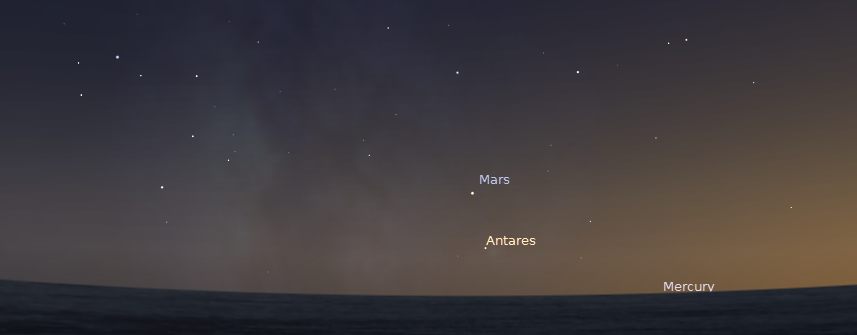
Mars, Antares, and the Teapot of Sagittarius low in the southwest at 7:30 p.m. on October 24, 2012. Created using Stellarium.
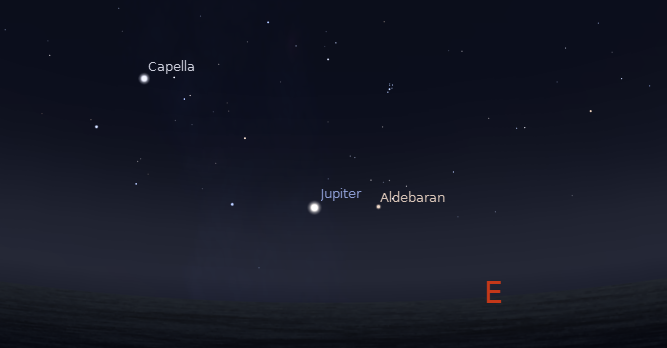
Jupiter in the east at 10 p.m. October 24, 2012. Created using Stellarium.
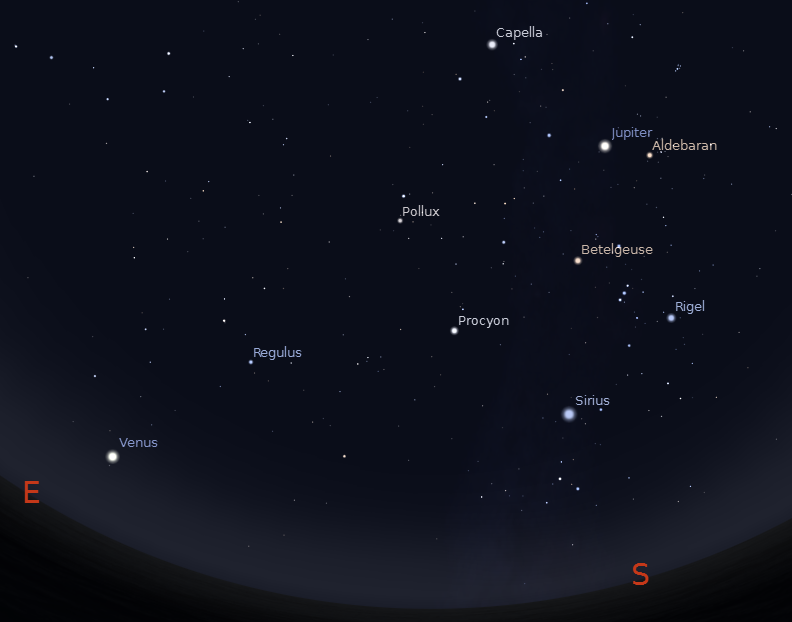
The morning skies with Jupiter and Venus at 6 a.m. on October 25, 2012. Created using Stellarium.
10/23/2012 – Ephemeris – The remarkable lunar crater Tycho
Ephemeris for Tuesday, October 23rd. The sun will rise at 8:08. It’ll be up for 10 hours and 35 minutes, setting at 6:44. The moon, 2 days past first quarter, will set at 2:52 tomorrow morning.
Tonight the moon’s advancing sunrise line will reveal a young crater near the bottom of the moon. That crater is Tycho. In binoculars or a telescope it’s features appear sharper, and its floor deeper than the surrounding craters. Its age is in the range of hundreds of thousands of years rather than billions. Tycho has an extensive ray system that extends thousands of miles across the face of the moon. That is best seen at full moon, and the rays are probably a huge number of craterlets. They are normally shadow filled but at full moon are fully illuminated accentuating the brightness of the rays. The crater was named for 16th Century Danish astronomer Tycho Brahe, the greatest observational astronomer before the invention of the telescope. [ His observations allowed Kepler to formulate his three laws of planetary motion.]
Times are for the Traverse City/Interlochen area of Michigan. They may be different for your location.
Addendum
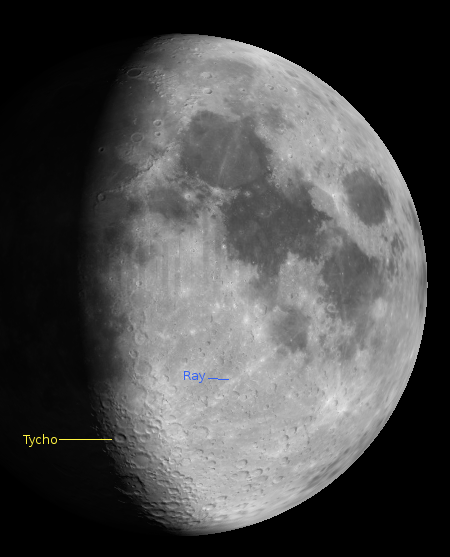
The crater Tycho and one of its rays at 9 p.m. on October 23 2012. Created using Virtual Moon Atlas.
10/22/2012 – Ephemeris – Three prominent craters on the moon tonight
Ephemeris for Monday, October 22nd. The sun will rise at 8:07. It’ll be up for 10 hours and 38 minutes, setting at 6:45. The moon, 1 day past first quarter, will set at 1:45 tomorrow morning.
Tonight’s slightly gibbous moon will reveal at its terminator a line of three craters just below the center of the moon. The one closest to the center of the moon, and the largest is Ptolemaeus, names for Claudius Ptolemy 2nd century astronomer. The next crater is Alphonsus named after Alphonse X, 13th century king of Castille, and responsible for improved astronomical tables. Alphonsus has been the site of transient reddish hazes that soggest to som of volcanis activity, but it’s never been proven. It was the target of the last Ranger spacecraft that crashed onto the moon taking pictures all the way down. The third crater is Arzackel , named after an 11th century Arabian astronomer.
Times are for the Traverse City/Interlochen area of Michigan. They may be different for your location.
Addendum
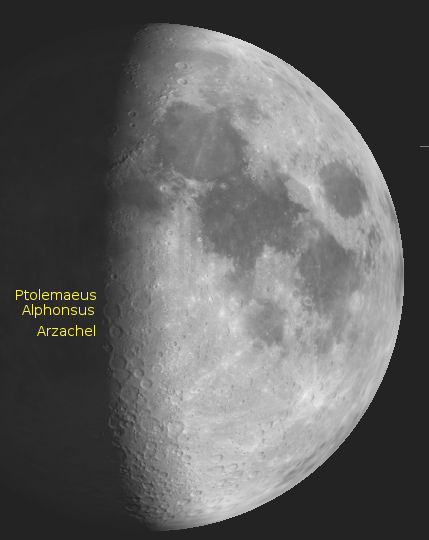
The moon at 10 p.m. on October 22, 2012. Created using Virtual Moon Atlas.
10/19/2012 – Ephemeris – Sky gazing opportunities in the Grand Traverse region.
Ephemeris for Friday, October 19th. The sun will rise at 8:03. It’ll be up for 10 hours and 46 minutes, setting at 6:50. The moon, 2 days before first quarter, will set at 10:20 this evening.
There are two chances for the public to observe the heavens this weekend. First is a Star Party at Northwestern Michigan College’s Rogers Observatory tomorrow night Saturday the 20th from 9 to 11 p.m.. The observatory is open rain or shine with a presentation, if its cloudy. Sunday the 21st the Grand Traverse Astronomical Society will hold its last Star Party of the year at Sleeping Bear Dunes National Lakeshore celebrating their 42nd anniversary. This event will run from 8 to 10 p.m. At the Pierce Stocking Scenic Drive at Stop 3, the Dunes Lookout. Parking for this event should be at Picnic Mountain just before stop 3. For both events we’ll have the first quarter moon, and wonders of the autumn and even summer skies.
Times are for the Traverse City/Interlochen area of Michigan. They may be different for your location.
10/18/2012 – Ephemeris – Autumn wonders for binoculars or small telescope: The Alpha Persei Association
Ephemeris for Thursday, October 18th. The sun will rise at 8:02. It’ll be up for 10 hours and 49 minutes, setting at 6:52. The moon, half way from new to first quarter, will set at 9:17 this evening.
When is a star cluster not a star cluster? When it’s an association. That is when it has begun to dissipate because the gravitational force of the group cannot hold it together. The central stars of the Big Dipper belong to The Ursa Major Association. Below the W shaped constellation of Cassiopeia in the northeast at 9 or 10 p.m. Is the constellation of Per-seus or Pers-e-us as it is usually pronounced. Its brightest star is Mirfak with a designation of Alpha Persei. There are some stars there to the naked eye, but with binoculars there are a great many stars just below naked eye visibility. This is called the Alpha Persei association. The star groups I’ve talked about this week are just some of the wonders visible in a simple pair of binoculars.
Times are for the Traverse City/Interlochen area of Michigan. They may be different for your location.
Addendum
The constellation Perseus. (Stellarium spells Alpha Persei Mirphak, not Mirfak. Star name spelling can be something variable.)
The constellation Perseus in the northeast at 10 p.m. on October 18, 2012. Created using Stellarium.
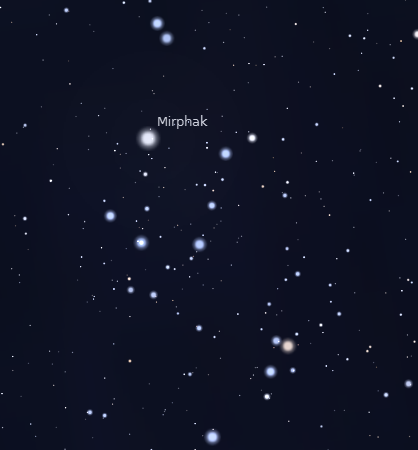
The Alpha Persei Association in a binocular view. Created using Stellarium.
 Bob Moler's Ephemeris Blog