Archive
11/16/2012 – Ephemeris – Capella the winter that doesn’t set (around here)
Ephemeris for Friday, November 16th. The sun will rise at 7:41. It’ll be up for 9 hours and 32 minutes, setting at 5:13. The moon, 3 days past new, will set at 8:11 this evening.
Midway up the sky in the east northeast at 9 p.m. You will find the bright star Capella. It is above and left of the bright planet Jupiter. Capella is located at one corner of a pentagon of stars that is the constellation Auriga the Charioteer. Capella represents a little she goat, while a slim triangle of stars are her kids. That triangle is known as the Kids. Capella is circumpolar for locations north of Ludington, meaning that this winter star doesn’t set, even in summer. Capella is a close binary star of stars with the same color as the sun, but much brighter. They orbit each other in 104 days. It looks like a single star in most telescopes. Spotting it low on the northern horizon at midnight in July is a reminder that winter will come soon enough.
Times are for the Traverse City/Interlochen area of Michigan. They may be different for your location.
Addendum
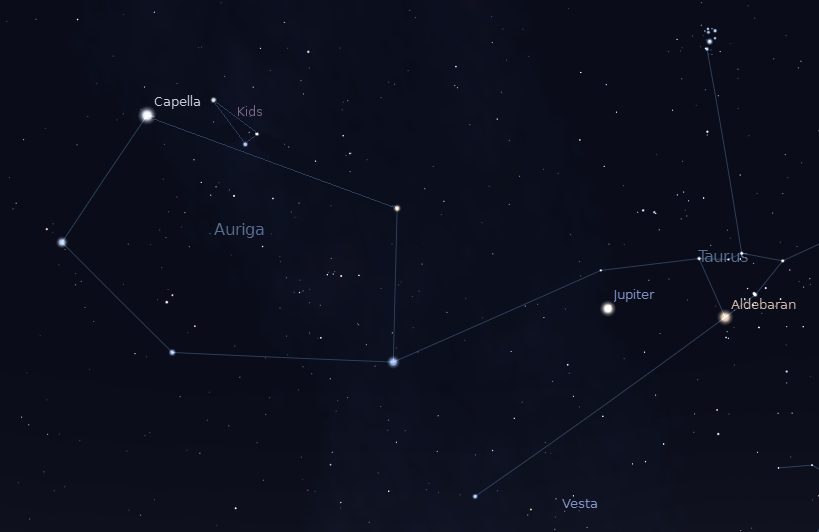
Capella in Auriga with the Kids at 9 p.m. on November 16, 2012. Created using Stellarium.
11/15/2012 – Ephemeris – Fomalhaut the lonely star has a companion planet
Ephemeris for Thursday, November 15th. The sun will rise at 7:39. It’ll be up for 9 hours and 34 minutes, setting at 5:14. The moon, 2 days past new, will set at 7:03 this evening.
The lonely bright star low in the south at 8 p.m. these evenings is Fomalhaut the harbinger of autumn in my book. Fomalhaut means fishes mouth and is located at the head of Piscis Austrinus, a very dim constellation. Fomalhaut is a young white star only 400 million years old with a disk of dust surrounding it. In an outer dust ring, 10 years ago the Hubble Space Telescope discovered a spot. Four years later astronomers discovered that the spot moved along the dust lane and announced the first direct discovery of an exoplanet. There’s been some controversy ever since, about is it really a planet or just a clump of material. It seems at this time that there is a planet there but it is shrouded by a cloud of dust, so that the planet cannot be detected.
Times are for the Traverse City/Interlochen area of Michigan. They may be different for your location.
Addendum
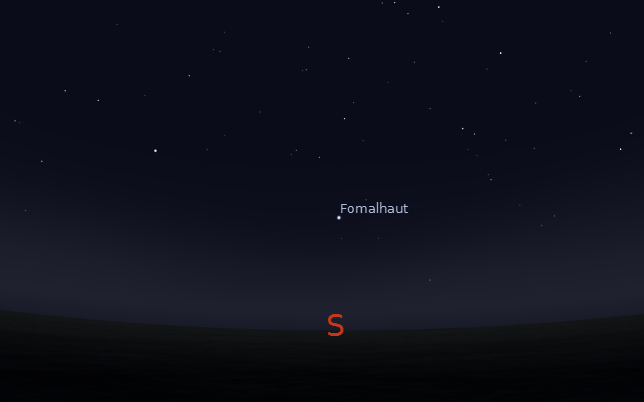
Fomalhaut in the south at 8 p.m. on November 15, 2012. Created using Stellarium.
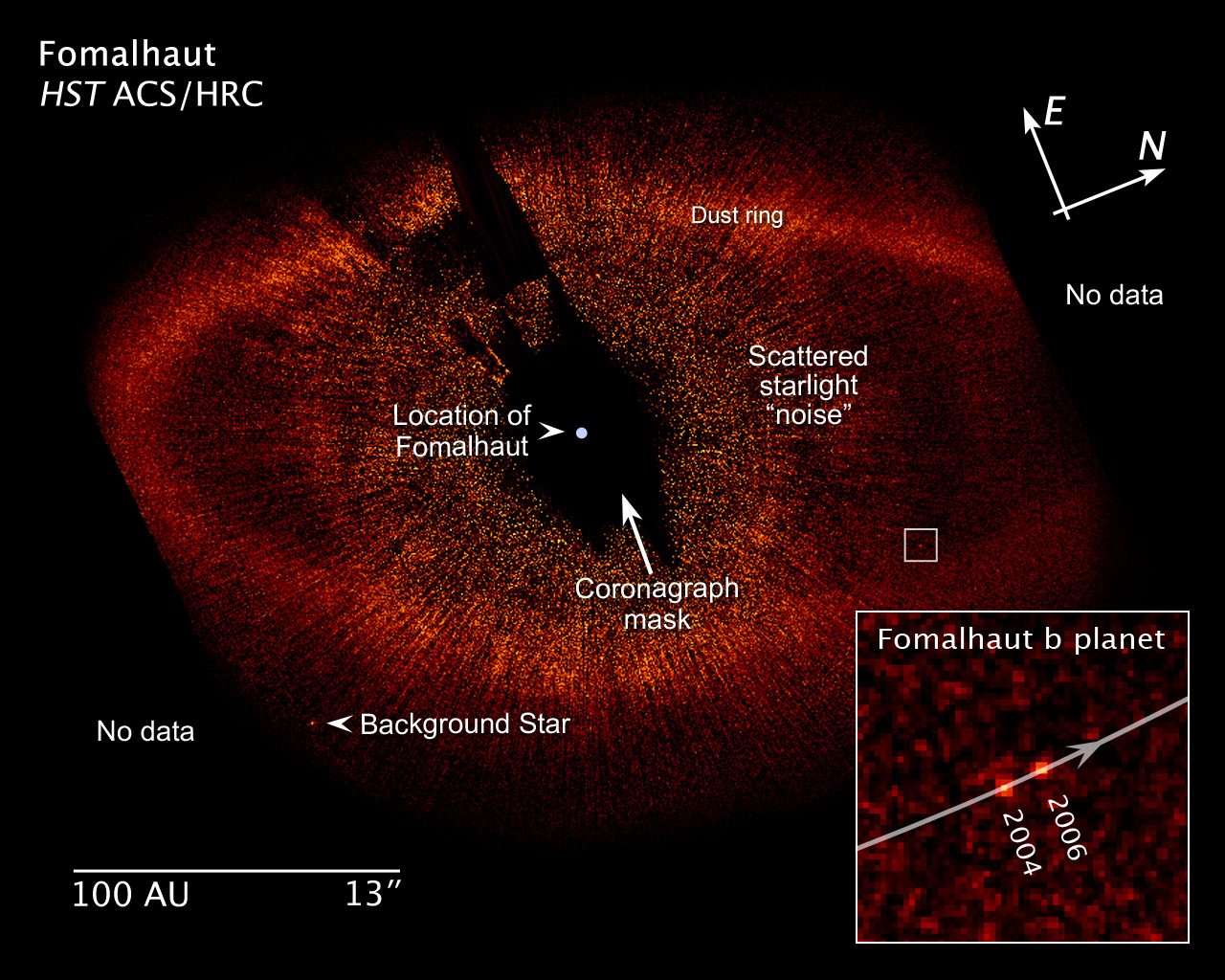
Fomalhaut and possible planet via the Hubble Space Telescope. Courtesy NASA
Click on above image to enlarge.
11/14/2012 – Ephemeris – Where are he bright planets this week.
Ephemeris for Wednesday, November 14th. The sun will rise at 7:38. It’ll be up for 9 hours and 36 minutes, setting at 5:15. The moon, 1 day past new, will set at 6:01 this evening.
Let’s check out the planets for this week. At 6:15 p.m. Mars can be seen low in the southwest. Mars, being the nearest planet outside the earth’s orbit takes its own sweet time leaving the evening sky. Mars will set at 7:14. The planetary action will have already picked up on the other side of the sky. Jupiter, will rise at 6:18 p.m. in the east northeast. It is located in the constellation of Taurus. It will transit or pass due south at 1:52 a.m. The morning planet Venus is the next planet to rise at 4:50 a.m. also in the east. Venus is now near the bright star Spica in the constellation of Virgo. Saturn can now be seen after it rises in the east south east at 5:58 a.m. as twilight brightens. It will be easier to spot next week.
Times are for the Traverse City/Interlochen area of Michigan. They may be different for your location.
Addendum
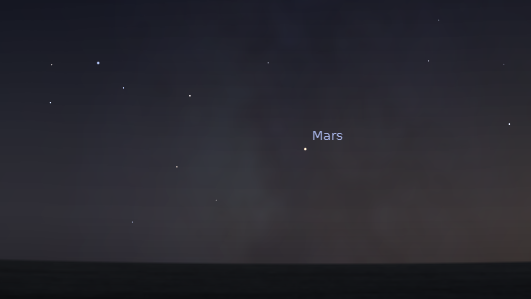
Mars low in the southwest at 6:15 p.m. on November 14, 2012. Created using Stellarium.
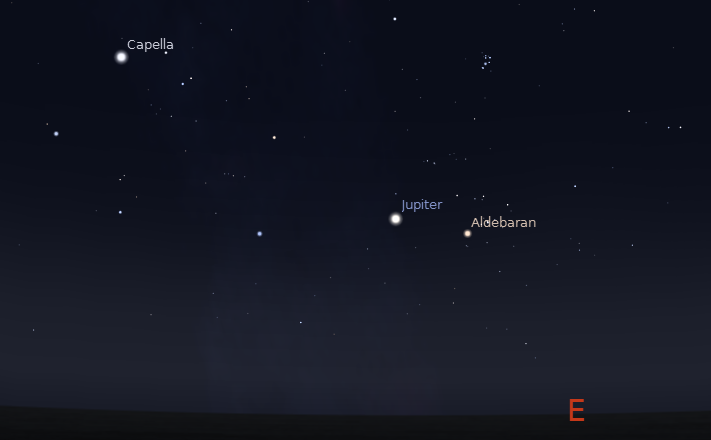
Jupiter low in the east at 8 p.m. on November 14, 2012. Created using Stellarium.
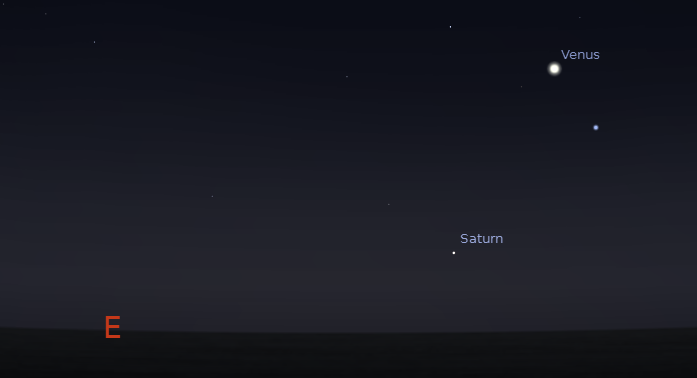
Venus and Saturn at 6:30 a.m. on November 15, 2012. Created using Stellarium.
11/13/2012 – Ephemeris – Total Solar Eclipse in the South Pacific
Ephemeris for Tuesday, November 13th. The sun will rise at 7:37. It’ll be up for 9 hours and 39 minutes, setting at 5:16. The moon is new today, and won’t be visible.
There will be a total solar eclipse today for the South Pacific Ocean. The path of totality crosses almost no land except in the two northernmost tips of Australia. Australia, New Guinea, New Zealand parts of Antarctica, Chile and Argentina will get a partial eclipse. The moon’s shadow crosses the earth from west to east, so in crossing the International Date Line it will start at sunrise on November 14th local time and end at sunset November 13th local time. The solar eclipse we’re waiting for is the total solar eclipse of August 21st 2017, now less than 5 years away. This will be at least partial for the contiguous 48 states with the path of totality crossing the central United States. Being in the path of totality that day is high on my bucket list.
Times are for the Traverse City/Interlochen area of Michigan. They may be different for your location.
Addendum
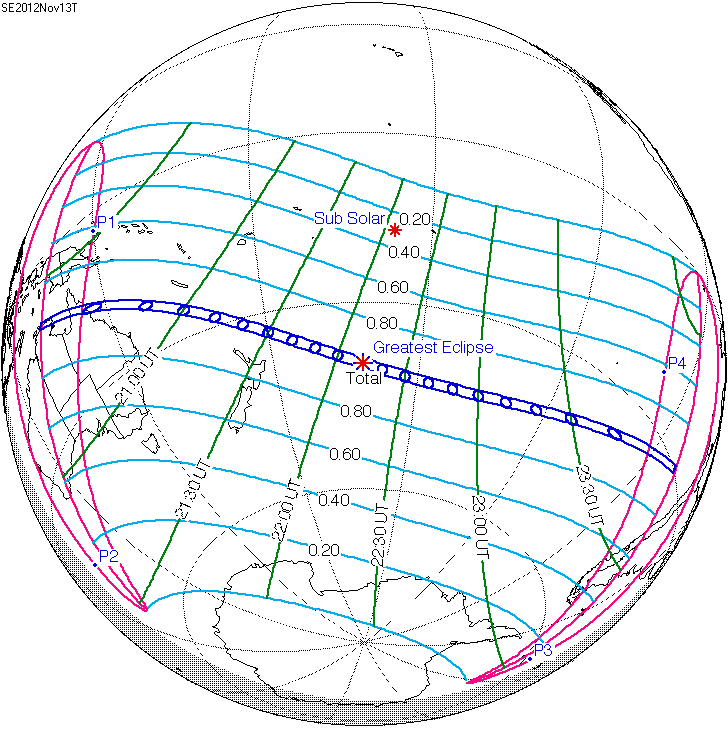
Diagram of the coverage of the November 13-14 total Solar Eclipse. Courtesy Fred Espanek, NASA.
Here’s an animation that brings the above chart to life.
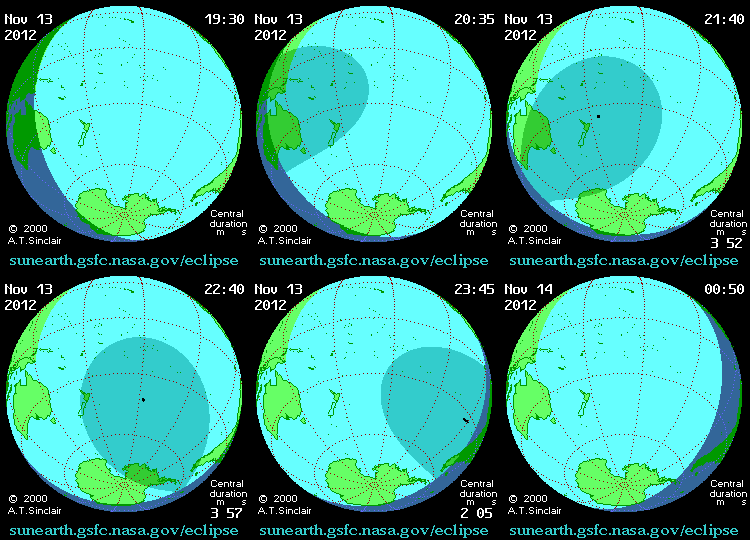
November 13-14 total solar eclipse animation. Courtesy NASA, A. T. Sinclair.
11/12/2012 – Ephemeris – The North Taurid Meteor Dhower
Ephemeris for Monday, November 12th. The sun will rise at 7:35. It’ll be up for 9 hours and 41 minutes, setting at 5:17. The moon, 1 day before new, will rise at 7:15 tomorrow morning.
This is the date of the peak of the Northern Taurid Meteor Shower. This shower has a long duration, from late October to early December. Taurus is up all night, so the meteors will be seen all night, but more numerous in the morning. There won’t be many of them, maybe 5 an hour, but they are very slow moving, only 29 kilometers per second or 18 miles per second, about half the speed of other meteors. It has more than its share of very bright meteors. These meteors are thought to have their origin with Comet Encke. Encke is the comet with the shortest period known, only 3.3 years. The peak will last several days, and there’s even an expectation of a swarm, a higher number or meteors, that might be visible during this period.
Times are for the Traverse City/Interlochen area of Michigan. They may be different for your location.
Addendum
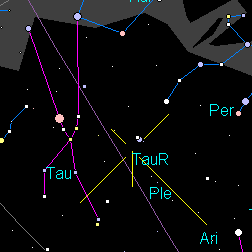
The Taurid Radiant.
11/09/2012 – Ephemeris – The constellations of the triangle and the ram
Ephemeris for Friday, November 9th. The sun will rise at 7:31. It’ll be up for 9 hours and 48 minutes, setting at 5:20. The moon, 3 days past last quarter, will rise at 3:29 tomorrow morning.
High in the south at 9 p.m. can be seen the Great Square of Pegasus. From the top left star of the square diverge two curved lines of stars that is Andromeda the chained princess. Just below and left of Andromeda is a slender triangle of stars, none particularly bright. It has a name you can easily see in the stars, Triangulum, the triangle. It has been known from antiquity, and early Christians saw it as the Mitre of Saint Peter or the Trinity. Another small constellation seen below Triangulum is the much better known constellation Aries the ram. It is the first constellation of the Zodiac, where the sun used to to enter on the first day of spring. Aries is a small hockey stick constellation, not that hard to spot.
Times are for the Traverse City/Interlochen area of Michigan. They may be different for your location.
Addendum
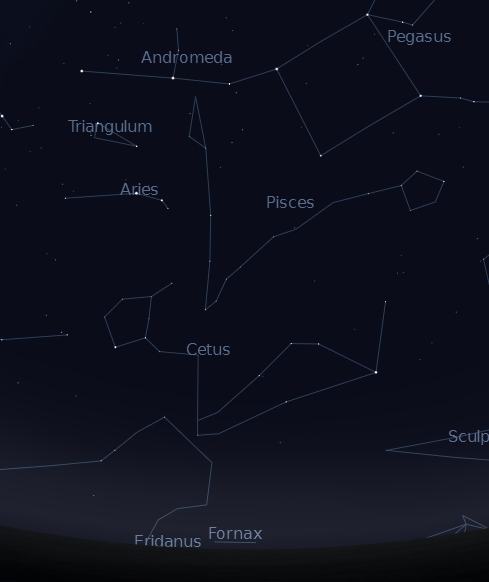
Cetus, Triangulum, Aries and surrounding constellations on November 8, 2012 at 9 p.m. Created using Stellarium.
11/08/2012 – Ephemeris – Is the constellation Cetus a whale of a sea monster?
Ephemeris for Thursday, November 8th. The sun will rise at 7:30. It’ll be up for 9 hours and 51 minutes, setting at 5:21. The moon, 2 days past last quarter, will rise at 2:18 tomorrow morning.
The identity of the constellation Cetus is a bit mixed up. Officially it is a whale, but in the story of the constellations above it, (Cassiopeia, Pegasus, Andromeda, Perseus and Cepheus) it is the monster sent to ravage the Ethiopian coast, and to whom the sacrifice of Andromeda was to stop. Either can be seen in the stars in the southeast at 9 p.m. It is a large constellation of dim stars below and left of the Great Square of Pegasus and Pisces. The whale can be seen diving, its tail of 5 stars in a squished pentagon, is seen to the upper left. If you see the stars differently and put the head of the of the sea monster where the tail of whale is the dreaded Cetus of the story appears. One of its stars is variable and may not be visible. It’s Mira, the wonderful.
Times are for the Traverse City/Interlochen area of Michigan. They may be different for your location.
Addendum
Cetus, Triangulum, Aries and surrounding constellations on November 8, 2012 at 9 p.m. Created using Stellarium.
11/07/2012 – Ephemeris – Where are the bright planets this week?
Ephemeris for Wednesday, November 7th. The sun will rise at 7:28. It’ll be up for 9 hours and 53 minutes, setting at 5:22. The moon, 1 day past last quarter, will rise at 1:11 tomorrow morning.
Let’s check out the planets for this week. At 6:15 p.m. Mars can be seen low in the southwest. Mars, being the nearest planet outside the earth’s orbit takes its own sweet time leaving the evening sky. Mars will set at 7:19. The planetary action will have already picked up on the other side of the sky. Jupiter, will rise at 6:48 p.m. in the east northeast. It is located in the constellation of Taurus. It will transit or pass due south at 2:23 a.m. The last bright planet of the night is the morning star Venus which will rise at 4:33 a.m. also in the east. Venus is now below the hind end of Leo, and actually in the constellation of Virgo. The planets Venus and Jupiter and the winter constellations are a great sight for early risers.
Times are for the Traverse City/Interlochen area of Michigan. They may be different for your location.
Addendum
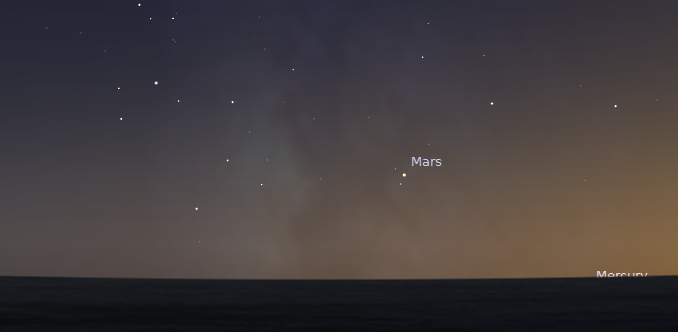
Mars low in the southwest at 6:15 p.m. on November 7, 2012. Created using Stellarium.
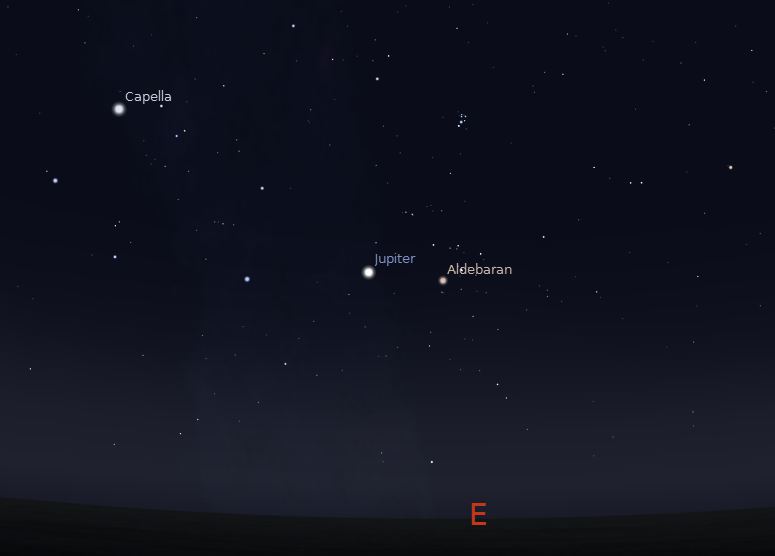
Jupiter rising at 9 p.m. on November 7, 2012. Created using Stellarium.
In the morning.
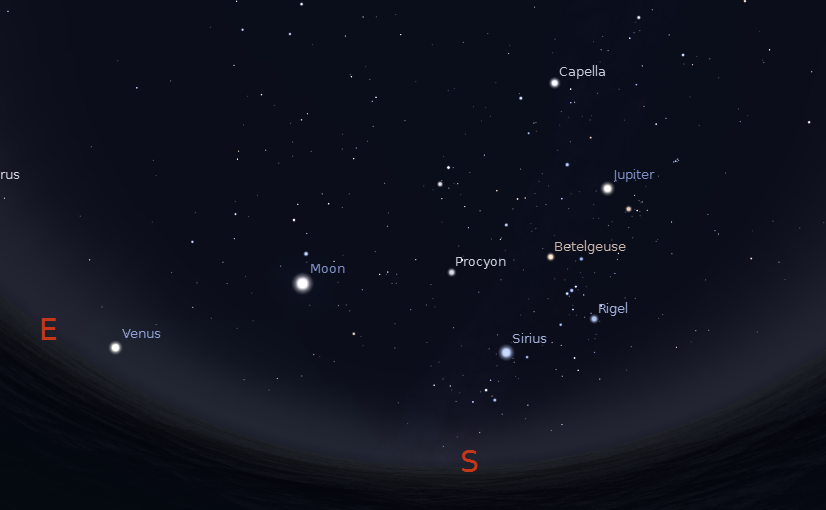
Jupiter and Venus with the winter stars at 5 a.m. November 8, 2012. Created using Stellarium.
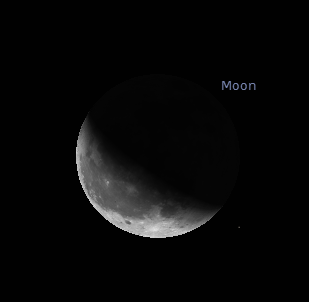
The waning crescent moon on November 8, 2012 at 5 a.m. Created using Stellarium.
11/06/2012 – Ephemeris – Pluto: an example of what happens when you don’t vote
Ephemeris for Election Day, Tuesday, November 6th. The sun will rise at 7:27. It’ll be up for 9 hours and 56 minutes, setting at 5:24. The moon, at last quarter today, will rise at 12:06 tomorrow morning.
Be sure and vote today. I have a tale of what happens when a low turn out leads for many to the wrong result. I’m referring to the vote at the International Astronomical Union meeting in 2006 that demoted Pluto to dwarf planet. It was the last day of the conference and many delegates had already left when the when the matter of defining what a planet was. A hastily formed proposal won the day. I haven’t the time to go into the definition, but Pluto didn’t fit it. Pluto, Eris the Kuiper belt object that caused the furor in the first place and the asteroid Ceres were given the titles dwarf planet because they are round. To add insult to injury Pluto was given an asteroid number 13430. That Pluto has 5 moons doesn’t change anything.
Times are for the Traverse City/Interlochen area of Michigan. They may be different for your location.
Addendum
Here’s the IAU definition of a planet:
(1) A “planet” is a celestial body that: (a) is in orbit around the Sun, (b) has sufficient mass for its self-gravity to overcome rigid body forces so that it assumes a hydrostatic equilibrium (nearly round) shape, and (c) has cleared the neighborhood around its orbit.
(2) A “dwarf planet” is a celestial body that: (a) is in orbit around the Sun, (b) has sufficient mass for its self-gravity to overcome rigid body forces so that it assumes a hydrostatic equilibrium (nearly round) shape2, (c) has not cleared the neighborhood around its orbit, and (d) is not a satellite.
(3) All other objects, except satellites, orbiting the Sun shall be referred to collectively as “Small Solar System Bodies”.
Note the mention of the sun in all three points. Thus this does not apply to exoplanets, those orbiting other stars. We are a long way from seeing and assessing all the bodies orbiting other stars, so it may be that every stellar system will have its own rules.
Oh by the way, I have come to agree with the IAU definition. Sorry, there are only 8 planets in our solar system.
11/05/2012 – Ephemeris – The zodiacal constellation of Aquarius
Ephemeris for Monday, November 5th. The sun will rise at 7:26. It’ll be up for 9 hours and 59 minutes, setting at 5:25. The moon, 1 day before last quarter, will rise at 11:02 this evening.
One of the constellations of the zodiac is in the south sky at 9 in the evening. It’s the constellation of Aquarius the water bearer. The image that is supposed to be depicted in the stars is that of a hapless fellow spilling a stone jar of water across the sky. Aquarius is fairly hard to spot because it is made of faint stars. One part of him, though, is easy to spot. That is the Water Jar, an asterism or informal constellation. It is a distinctive small nearly equilateral triangle of stars with another star in the center. Stars extending to the right from the water jar are that stream of water. The Water Jar is just below the top of the head of the upside down Pegasus the flying horse. The body of Aquarius is below, a misshapen deflated balloon of stars.
Times are for the Traverse City/Interlochen area of Michigan. They may be different for your location.
Addendum
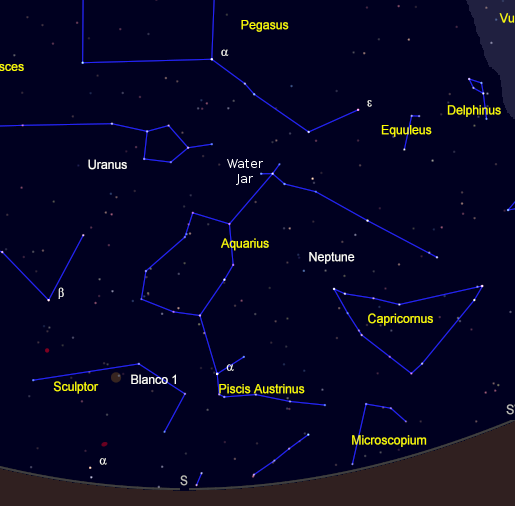
Aquarius and surrounding constellations 9 p.m. November 5, 2012. Created using Cart duCiel (Sky Charts)
 Bob Moler's Ephemeris Blog