Archive
01/17/2013 – Ephemeris – The blue super-giant star Rigel
Ephemeris for Thursday, January 17th. The sun will rise at 8:14. It’ll be up for 9 hours and 16 minutes, setting at 5:31. The moon, 1 day before first quarter, will set at 12:41 tomorrow morning.
Tuesday I talked about the star Betelgeuse the bright red star in the top left of Orion’s upright rectangle. Orion is seen in the south in the evening. The blue-white star in Orion’s opposite corner is usually brighter. It is Rigel whose longer Arabic name of which Rigel is the first part means Left Leg of the Giant. Rigel is a giant itself, actually a super giant star, which is more a measure of its mass than its size, that of 50 solar masses. Its surface temperature is more than twice as hot as the sun. It is 57 thousand times as bright as the sun and 50 times its diameter. Its distance is 860 light years. Those with telescopes might be able to spot a close companion star to Rigel, just at the edge of the bright arc light image of Rigel itself.
Addendum
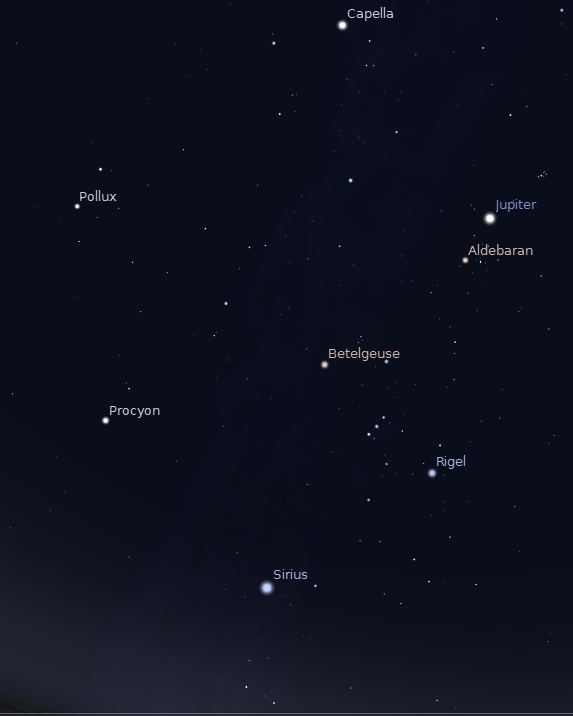
Rigel in the winter circle of bright winter stars plus Jupiter.this year. Created using Stellarium.
01/16/2013 – Ephemeris – Where are the bright planets this week?
Ephemeris for Wednesday, January 16th. The sun will rise at 8:15. It’ll be up for 9 hours and 14 minutes, setting at 5:30. The moon, 2 days before first quarter, will set at 11:37 this evening.
Let’s check out the planets for this week. Mars can be seen low in the southwest. It will set at 7:11 p.m, two minutes later than last week because Mars is moving northward. The sun will eventually catch up with it in mid April. Even before you can spot Mars, bright Jupiter will be visible in the southeast. Jupiter is located in the constellation of Taurus and moves from the southeast to the high south southwest during the evening. It will transit or pass due south at 9:15 p.m, and will set at 4:46 a.m. Jupiter is a wonderful sight in telescopes with its cloud bands and its moons which change positions each night. Saturn will be the next planet to rise at 2:20 a.m. in the east southeast. It’s located in eastern Virgo. Venus will rise at 7:15.
Times are for the Traverse City/Interlochen area of Michigan. They may be different for your location.
Addendum
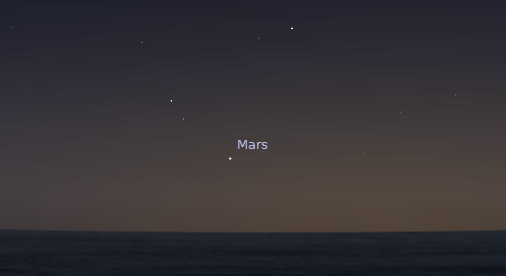
Mars, now becoming more visible as it moves northward is shown at 6:30 p.m. on January 16, 2013. Created using Stellarium.
Jupiter and the winter circle of bright winter stars at 9 p.m. January 16, 2013. Created using Stellarium.
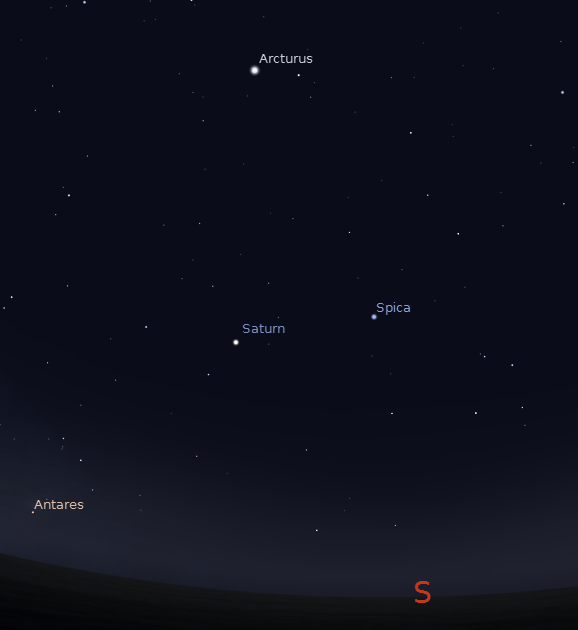
Saturn with the late spring and early summer stars at 6 a.m January 17, 2013.
01/15/2013 – Ephemeris – The red giant star with a funny name Betelgeuse (Beetle Juice), plus STEM Night tonight at Greenspire School
Ephemeris for Tuesday, January 15th. The sun will rise at 8:15. It’ll be up for 9 hours and 13 minutes, setting at 5:28. The moon, 3 days before first quarter, will set at 10:31 this evening.
The bright red star in constellation Orion’s shoulder is Betelgeuse, 643 light years away give or take 146 light years. Betelgeuse is a shortened form of an Arabic phrase that means “Armpit of the central one”. Orion is seen in the south in the evening. Even at its great distance it’s the star whose surface is easiest seen, after the sun of course. That’s because it’s so big. As somewhat larger around than the orbit of Jupiter, it turns out. Recent telescopic observations of Betelgeuse have shown plumes of gas surrounding the star. A star like Betelgeuse is so bloated that it can be described as a red hot vacuum, thus its edge or limb is much darker than its center. The sun has limb darkening too, but it is much less noticeable.
Tonight:

STEM (Science, Technology, Engineering, Mathematics) Night.
We’ll have Gary Carlisle and I will be there to view the moon and Jupiter if it’s clear, Make craters hands-on. I’ll be helping to make comets. Bring your gloves because comets are COLD! We’ll be representing the Grand Traverse Astronomical Society.
Times above are for the Traverse City/Interlochen area of Michigan. They may be different for your location.
Addendum
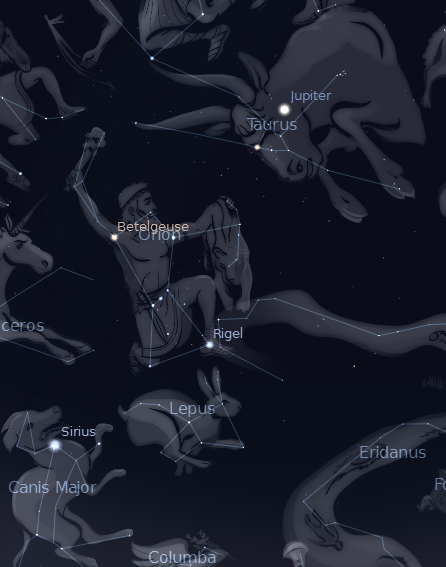
Orion facing Taurus letting Lepus escape with Jupiter in 2013. Check out Betelgeuse. Created using Stellarium.
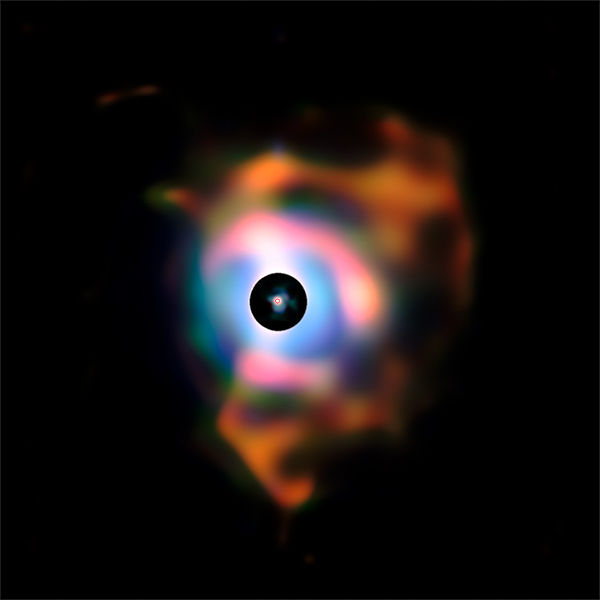
Betelgeuse and its nebula. From the European Southern Observatory’s Very Large Telescope.
01/14/2013 – Ephemeris – Lepus the hare, overlooked by Orion
Ephemeris for Monday, January 14th. The sun will rise at 8:16. It’ll be up for 9 hours and 11 minutes, setting at 5:27. The moon, 3 days past new, will set at 9:23 this evening.
Orion, the central winter constellation is seen in the southern sky this evening. He is a hunter, as artists depict him, he is preoccupied with the charge of Taurus the bull from the upper right. At Orion’s feet, and unnoticed by him is the small constellation of Lepus the hare. It’s very hard to see a rabbit in its eight dim stars: however, I can see a rabbit’s head ears and shoulders. A misshapen box is the head and face of this critter facing to the left. His ears extend upwards from the upper right star of the box, and the bend forward a bit. Two stars to the right of the box and a bit fart
Orion facing Taurus letting Lepus escape with Jupiter in 2013. Created using Stellarium.
her apart hint at the front part of the body. In Lepus telescopes can find M79, a distant globular star cluster, one of the few visible in the winter sky.
Times are for the Traverse City/Interlochen area of Michigan. They may be different for your location.
Addendum
01/11/2013 – Ephemeris – Sirius the Dog Star
Ephemeris for Friday, January 11th. The sun will rise at 8:17. It’ll be up for 9 hours and 6 minutes, setting at 5:23. The moon is new today, and won’t be visible.
The brightest star-like object in the evening sky is Jupiter high in the south around 9 p.m. The second brightest star-like object is Sirius, also known as the Dog Star. It also is the brightest night-time star in our skies period. Tonight at 9 p.m. it’s located low in the south southeastern sky. The Dog Star name comes from its position at the heart of the constellation Canis Major, the great dog of Orion the hunter. The three stars of Orion’s belt tilt to the southeast and point to Sirius. The name Sirius means ‘Dazzling One’, a reference to its great brilliance and twinkling. Its Egyptian name was Sothis, and its appearance in the dawn skies in late June signaled the flooding of the Nile, and the beginning of the Egyptian agricultural year.
Times are for the Traverse City/Interlochen area of Michigan. They may be different for your location.
Addendum
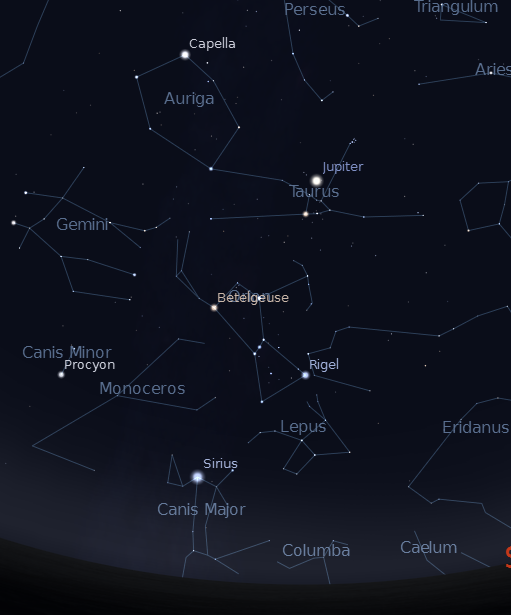
Sirius, Jupiter and the winter stars and constellations at 9 p.m. Created using Stellarium.
01/10/2013 – Ephemeris – The moon passes Venus this (early) morning
Ephemeris for Thursday, January 10th. The sun will rise at 8:17. It’ll be up for 9 hours and 4 minutes, setting at 5:22. The moon, 1 day before new, will rise at 7:48 tomorrow morning.
This morning the Venus and the thin crescent moon will appear together in the growing twilight. Venus has been our morning companion since the wonderful transit of Venus last June 5th. It will stay in the morning sky until it passes behind the sun on March 28th, after which it will slowly emerge into the evening sky once again. Unlike the transit, it will not pass directly behind the sun. Venus is inside the earth’s orbit of the sun, so moves faster than the earth. It’s year is 225 of our days. However we see Venus from the moving earth, so it takes about a year and 7 months for Venus to move around the sun from our point of view, So we have about 9 ½ months with Venus as our morning star and 9 ½ months as our evening star.
Times are for the Traverse City/Interlochen area of Michigan. They may be different for your location.
Addendum
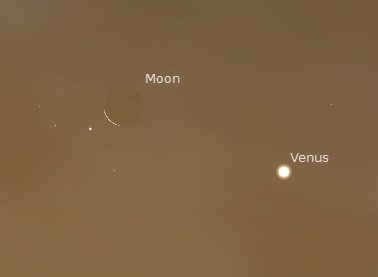
A closeup of Venus and the moon at 7:30 a.m. January 10, 2013. Created using Stellarium.
01/09/2013 – Ephemeris – Where are the bright planets this week?
Ephemeris for Wednesday, January 9th. The sun will rise at 8:18. It’ll be up for 9 hours and 3 minutes, setting at 5:21. The moon, 2 days before new, will rise at 6:56 tomorrow morning.
Let’s check out the planets for this week. Mars can be seen low in the southwest. It will set at 7:09 p.m, two minutes later than last week because sunset times are increasing and Mars is moving northward. The sun will eventually catch up with it. Even before you can spot Mars, bright Jupiter will be visible in the east. Jupiter is located in the constellation of Taurus and moves from the east to the high south during the evening. It will transit or pass due south at 9:44 p.m, and will set at 5:15 a.m. Jupiter is a wonderful sight in telescopes with its cloud bands and its moons which change positions each night. Saturn will be the next planet to rise at 2:45 a.m. in the east southeast. It’s located in eastern Virgo. Venus will rise at 7:03.
Times are for the Traverse City/Interlochen area of Michigan. They may be different for your location.
Addendum
Jupiter and the winter stars and constellations at 9 p.m. on January 9, 2013. Created using Stellarium.
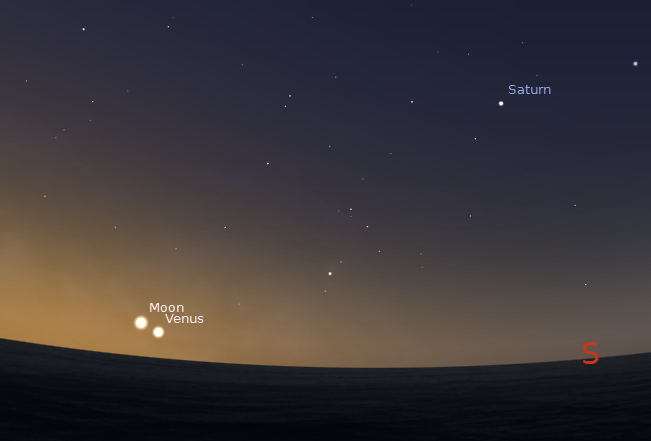
Saturn and Venus in morning twilight at 7:30 a.m. on January 10, 2013. Created using Stellarium.
A closeup of Venus and the moon at 7:30 a.m. January 10, 2013. Created using Stellarium.
In actuality the cusps of the crescent will extend to the moon’s poles. Planetarium programs generally have a problem with this on extremely thin crescents.
01/08/2013 – Ephemeris – The Great Orion Nebula
Ephemeris for Tuesday, January 8th. The sun will rise at 8:18. It’ll be up for 9 hours and 1 minute, setting at 5:20. The moon, 3 days before new, will rise at 5:56 tomorrow morning.
The closest star firming region to us is the Great Orion Nebula. It’s 1,344 light years away give or take 20 light years. A light year is about 6 trillion miles, if you’re counting. It’s located in the constellation Orion’s sword that hangs below his belt. It shines by emission and reflection of the light of a clutch of four stars at its heart, astronomers have called the Trapezium. Binoculars can be used to spot the nebula surrounding what looks like the middle star of the sword. The sword stars aren’t single stars like the belt but groups of stars. Anyway a telescope, using its lowest power will see a glow around those Trapezium stars. The glow will have a dark notch out of it, which is a dark cloud in front if it. Wisps of gas may also be seen.
Times are for the Traverse City/Interlochen area of Michigan. They may be different for your location.
Addendum
The Great Orion Nebula is also number 42 on Charles Messier’s list of objects to avoid when searching for comets. Amateur astronomers know it as M42, the show piece of the winter sky.
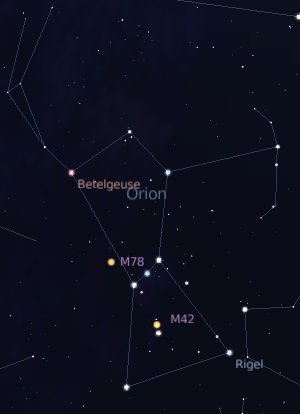
Orion via Stellarium.org
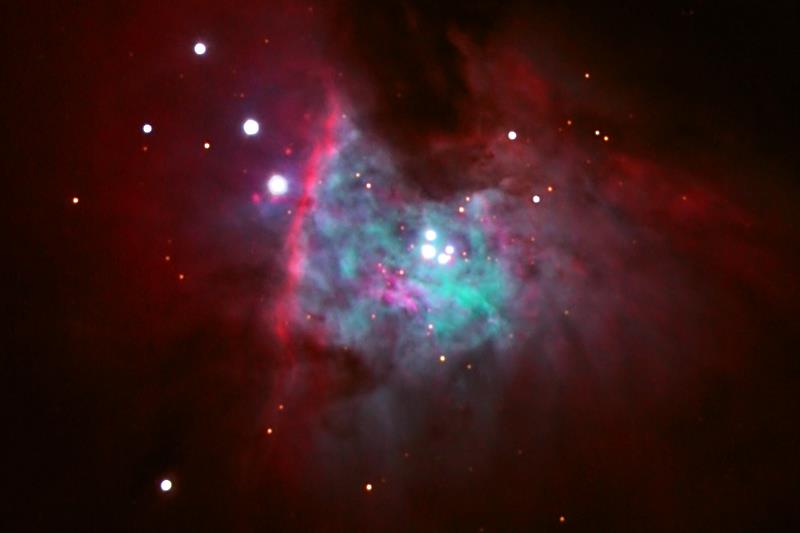
Inner part of the Great Orion Nebula (M42). Image by Scott Anttila.
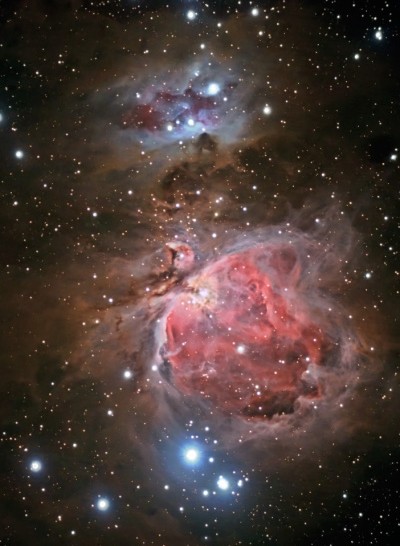
The Great Orion Nebula (M42) long exposure photograph by Scott Anttila. Includes all the sword stars.
01/07/2013 – Ephemeris – Saturn is near the moon this morning
Ephemeris for Monday, January 7th. The sun will rise at 8:18. It’ll be up for 9 hours and 0 minutes, setting at 5:19. The moon, 3 days past last quarter, will rise at 4:49 tomorrow morning.
This morning the planet Saturn will appear above and right of the crescent moon. They should be visible until a bit after seven a.m. The moon will be slipping eastward morning by morning, and by Thursday it will appear near the planet Venus. The moon’s movement around the earth with respect to the sun is called the synodic month, or a lunation. It is the period between one new moon to the next of about 29 and a half days. It is the basis for lunar calendars such as the Jewish and Islamic calendars. The moon’s crescent can be waxing or waning, growing fatter or thinner. It is now waning, and next week when we see the moon in the evening its phase will be waxing. The moon is just an illuminated ball in space.
Times are for the Traverse City/Interlochen area of Michigan. They may be different for your location.
Addendum
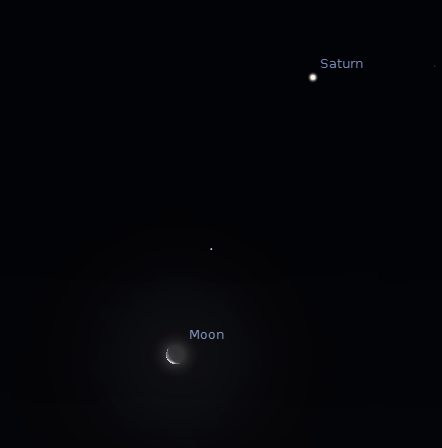
Saturn and the moon as seen at 6:30 a.m. on January 7, 2012. Created using Stellarium,
01/04/2013 – Ephemeris – Astronomical fun tonight
Ephemeris for Friday, January 4th. The sun will rise at 8:19. It’ll be up for 8 hours and 56 minutes, setting at 5:16. The moon, at last quarter today, will rise at 1:15 tomorrow morning.
Susan Kuschell, wife of the GTAS president will be present a talk at this evening’s meeting of the Grand Traverse Astronomical Society at Northwestern Michigan College’s Rogers Observatory starting at 8 p.m. Susan hasn’t revealed the topic of her talk. Could it be the travails of an astronomy widow? Actually Susan has been an active organizer in the community and is head of the children’s garden located behind the TC district Library, and has given invaluable assistance to the society in out funding and outreach efforts. Starting at 9 p.m. is our January star party at the observatory. Highlights, if its clear will be the planet Jupiter and the wonders of the winter sky including the Great Orion Nebula. All are welcome.
Times are for the Traverse City/Interlochen area of Michigan. They may be different for your location.
 Bob Moler's Ephemeris Blog