Archive
02/14/2013 – Ephemeris – NEAR neared the god of love 13 yaers ago today, Valentine’s Day
Ephemeris for St. Valentine’s Day, Thursday, February 14th. The sun will rise at 7:43. It’ll be up for 10 hours and 26 minutes, setting at 6:10. The moon, 3 days before first quarter, will set at 11:27 this evening.
On Valentine’s day 2000 a spacecraft named NEAR for Near Earth Asteroid Rendezvous slipped into orbit of the asteroid named after the Greek god of love Eros. It is a banana shaped asteroid. NEAR had failed in its first attempt to approach the asteroid, so the date was purely a coincidence of orbital mechanics. This was the first ever orbiting of a spacecraft about an asteroid. Eros proved to be a treasure trove of information. Eros is about 21 by 10 miles in size and roughly rotating end over end in a 5 hour period. At the end of a year long mission the satellite was commanded to land on the center part of Eros that was rotating the least. It survived the landing and operated for 16 days. The spacecraft has since been renamed NEAR-Shoemaker after the late Eugene Shoemaker.
Times are for the Traverse City/Interlochen area of Michigan. They may be different for your location.
Addendum
Eugene Shoemaker is famous in planetary circles of among other things Comet Shoemaker-Levy 9 fame (The comet that crashed into Jupiter in 1994).
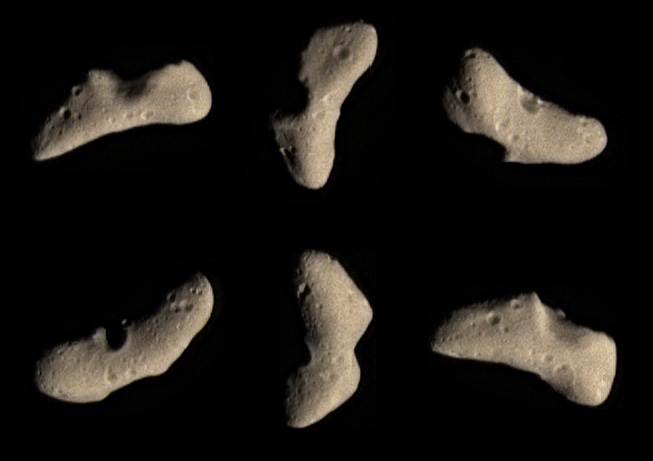
Six views of asteroid 433-Eros in February 2000. Images from NASA’s NEAR-Shoemaker spacecraft.
02/13/2013 – Ephemeris – Where are the bright planets this week?
Ephemeris for Ash Wednesday, Wednesday, February 13th. The sun will rise at 7:45. It’ll be up for 10 hours and 23 minutes, setting at 6:08. The moon, 3 days past new, will set at 10:23 this evening.
Let’s check out the planets for this week. Mercury can be seen low in the southwest. Mercury will set at 7:41 p.m. This is a good apparition of Mercury for us in the northern hemisphere. Binoculars will help you locate it low in the sky. Jupiter is located in the constellation of Taurus and moves from the high southeast to the high southwest during the evening. It will transit or pass due south at 7:25 p.m, and will set at 2:56 a.m. Jupiter is a wonderful sight in telescopes with its cloud bands and its moons which change positions each night. Saturn will be the next planet to rise at 12:34 a.m. in the east southeast. It’s located in eastern Virgo. Saturn will pass due south at 5:44 a.m. It will rise before midnight by the end of the month.
Times are for the Traverse City/Interlochen area of Michigan. They may be different for your location.
Addendum
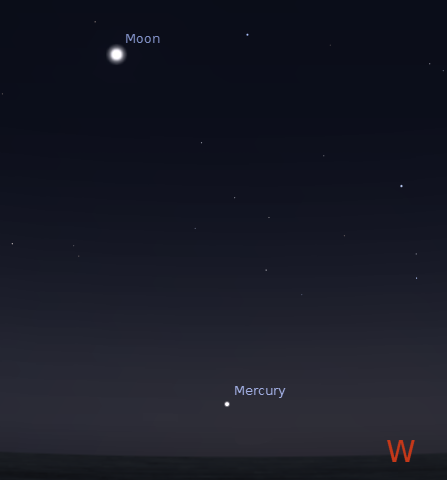
Mercury and the moon at 7:15 p.m. on February 13, 2013. Created using Stellarium.
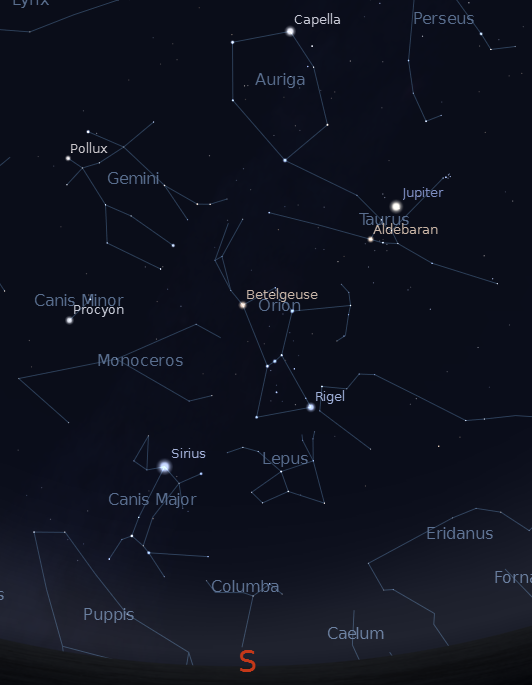
Jupiter and the winter constellations at 9 p.m. on February 13, 2013. Created using Stellarium.
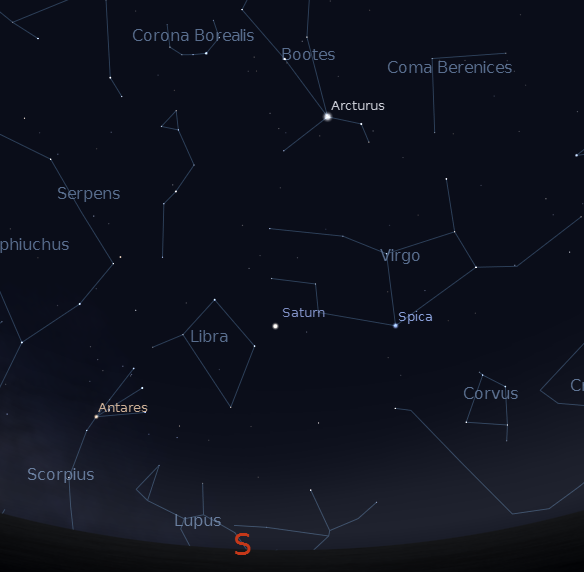
Saturn and the late spring and early summer constellations, as seen in the evening, but at 6 a.m. February 14, 2013.
02/12/2013 – Ephemeris – Astronomical basis for Lent and Easter
Ephemeris for Fat Tuesday, Tuesday, February 12th. The sun will rise at 7:46. It’ll be up for 10 hours and 20 minutes, setting at 6:07. The moon, 2 days past new, will set at 9:17 this evening.
The western ecclesiastical season of Lent starts tomorrow. It lasts 40 days excluding Sundays ending with the celebration of Easter on March 31st this year. It is a movable feast in that it’s on a different date each year following the first full moon of spring. It’s an attempt to follow the Jewish Passover, which starts on the 15th of the month of Nisan. Being a lunar calendar the 15th the generally the night of the full moon. And since the Last Supper was a Seder, the Christian church wanted to follow Passover as closely as possible using the Roman Solar based calendar. The western churches eventually adopted the Gregorian calendar to keep in sync with the seasons. The Eastern churches did not. Their Easter this year is on May 5th.
Times are for the Traverse City/Interlochen area of Michigan. They may be different for your location.
Addendum
The first day of spring is set by the churches as March 21st. In Michigan’s time zone spring now it always starts on March 20th, and will occasionally start on the 19th until 2103 after the Gregorian correction takes place in 2100. The Julian Calendar, instituted by Julius Caesar, was the official calendar for all the Christian world until 1582. The problem with the Julian Calendar is that the leap year every 4 years overcompensated for the seasonal or tropical year. The average year of 365 1/4 days turned out to be 11 minutes 14 seconds too long. By 1582 the actual vernal equinox or first day of spring had slipped back to March 10th.
Astronomers under Pope Gregory XIII proposed a change that was adopted by the Roman Catholic world. First remove 10 days from the calendar between October 4 and 15 1582. Then modify the leap year formula to keep the leap year on years divided by 4, except century years. Century years were ordinary 365 day years unless divisible by 400. This 1900 was an ordinary year, but 2000 was a leap year. The western protestant countries came around eventually. However the eastern churches still use the Julian calendar to set their feasts, thus Eastern Orthodox rarely coincides with western churches.
Note that the dating for Excel spreadsheets, starts the day count on January 1, 1900, except they thought that 1900 was a leap year.
2/11/2013 – Ephemeris – The moon will appear near Mercury tonight
Ephemeris for Monday, February 11th. The sun will rise at 7:48. It’ll be up for 10 hours and 17 minutes, setting at 6:05. The moon, 1 day past new, will set at 8:09 this evening.
Mercury will appear below the skinny crescent moon tonight shortly after sunset. The best time to spot them is about 6:45 p.m. looking very low to the west southwestern horizon. Binoculars as always are a real help in picking them out of the evening twilight. Mercury will appear about 6 degrees or 12 moon widths below the moon. They will be actually at their closest appearance this afternoon, and will have separated a bit before we will get to see them. As a rule of thumb, the moon will move its diameter against the stars in an hour’s time. Mercury’s got its thing going too. In 5 days it will be at greatest elongation or apparent angle of separation from the sun of about 18.1 degrees. At about the same time Mercury will actually pass its closest to the sun.
Times are for the Traverse City/Interlochen area of Michigan. They may be different for your location.
Addendum
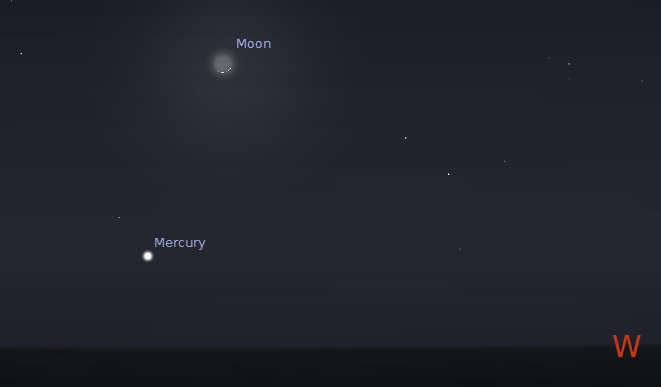
Mercury and the moon at 7:15 p.m. on February 11, 2013. Created using Stellarium. Note a one day old moon doesn’t show well in this view.
02/08/2013 – Ephemeris – Mercury will appear near Mars tonight.
Ephemeris for Friday, February 8th. The sun will rise at 7:52. It’ll be up for 10 hours and 9 minutes, setting at 6:01. The moon, 2 days before new, will rise at 7:01 tomorrow morning.
This evening after sunset Mercury and Mars will appear together, less the moon width’s apart. It will take a very low horizon to the southwest and pristine skies to spot these two. They should start to be visible in binoculars starting about 6:30. Both Mars and Mercury are on the far side of the sun. Mars is heading around behind the sun. It will be in conjunction with the sun on April 17th. For several weeks around that time the sun’s radio noise will interfere with communications with the Curiosity rover and the martian satellites that relay its signals, so it will remain motionless gathering weather and other data it can do in a static mode. Mercury will continue to move away from the sun from our point of view until the 16th of this month.
Times are for the Traverse City/Interlochen area of Michigan. They may be different for your location.
Addendum
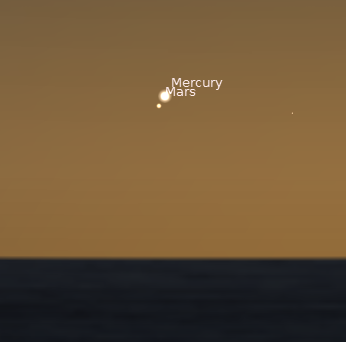
Mercury passing Mars at 6:45 p.m. on February 8, 2013. Created using Stellarium.
02/07/2013 – Ephemeris – The brother stars Castor and Pollux
Ephemeris for Thursday, February 7th. The sun will rise at 7:53. It’ll be up for 10 hours and 6 minutes, setting at 6:00. The moon, 3 days before new, will rise at 6:22 tomorrow morning.
At 9 p.m. the constellation of Gemini the twins will be seen high in the southeast. The namesake stars of the two lads are the two bright stars at the top of the constellation. Pollux the pugilist, or boxer, is the lower of the two, while Castor, the horseman, is the other star, or rather a six star system. In telescopes two close stars may be seen each is a spectroscopic binary, meaning the lines of two stars can be seen in the spectrum. A faint nearby spectroscopic binary also belong. Pollux, though a single star, does have at least one planet, one over twice the mass of Jupiter orbiting the star at a distance somewhat greater than Mars is from the sun. Pollux is 34 light years away while Castor is 50 light years away. Not too far away as stars go.
Times are for the Traverse City/Interlochen area of Michigan. They may be different for your location.
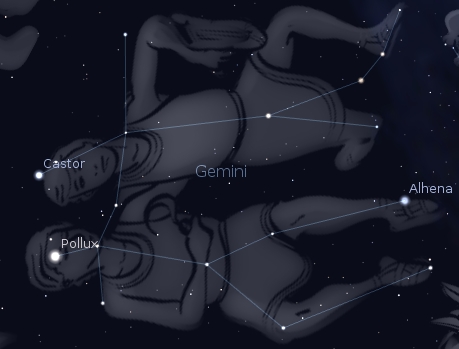
Gemini with Castor and Pollux. Created with Stellarium.
Addendum
02/06/2012 – Ephemeris – Where are the bright planets this week?
Ephemeris for Wednesday, February 6th. The sun will rise at 7:54. It’ll be up for 10 hours and 3 minutes, setting at 5:58. The moon, 3 days past last quarter, will rise at 5:36 tomorrow morning.
Let’s check out the planets for this week. Mars and Mercury can be seen low in the southwest. Mercury will set at 7:09, Mars 8 minutes later. Mercury will be the brighter of the two. They will be closest this Friday. I’ll talk more about that then. Jupiter is located in the constellation of Taurus and moves from the high southeast to the high southwest during the evening. It will transit or pass due south at 7:51 p.m, and will set at 3:22 a.m. Jupiter is a wonderful sight in telescopes with its cloud bands and its moons which change positions each night. Saturn will be the next planet to rise at 1:01 a.m. in the east southeast. It’s located in eastern Virgo. Saturn will pass due south at 6:11 a.m. It will rise before midnight by the end of the month.
Times are for the Traverse City/Interlochen area of Michigan. They may be different for your location.
Addendum
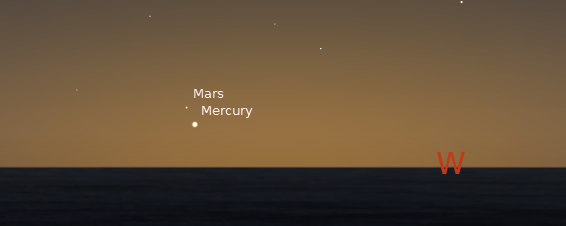
Mercury approaches Mars at 6:45 p.m. in the west on February 6, 2013. Created using Stellarium.
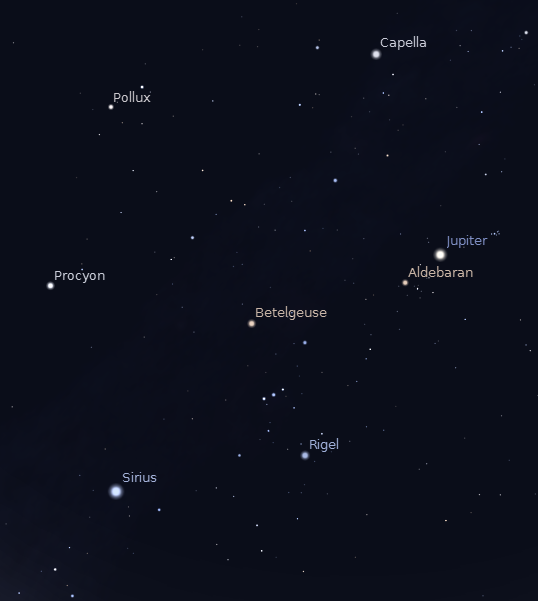
Jupiter with the winter stars at 9 p.m. on February 6, 2013. Created using Stellarium.
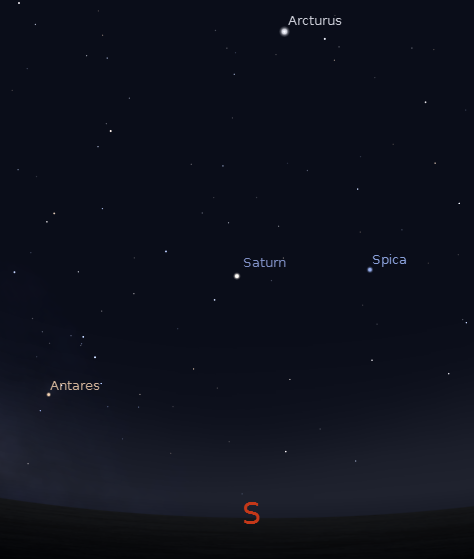
Previewing the Late spring stars with Saturn at 6 a.m. on February 7, 2013. Created using Stellarium.
02/05/2013 – Ephemeris – The bright stars Castor and Pollux of Gemini
Ephemeris for Tuesday, February 5th. The sun will rise at 7:56. It’ll be up for 10 hours and 1 minute, setting at 5:57. The moon, 2 days past last quarter, will rise at 4:42 tomorrow morning.
The constellation Gemini, the Twins is visible high in the southeast at 9 p.m. The namesake stars of the two lads, will be on the upper left edge of the constellation, diagonally aligned. Castor is to the upper right, while Pollux, a slightly brighter star is below left. Lines of stars from castor and Pollux to the lower right delineate the lads. In Greek mythology Castor and Pollux were twins, and half brothers, Castor was fathered by a mere mortal, while Pollux was fathered by Zeus in the famous Leda and the swan affair. The brothers, however were inseparable, and when Castor was killed during the quest for the Golden Fleece, Pollux pleaded with Zeus to let him die also. Zeus granted his wish, so both appear in the sky together forever.
Times are for the Traverse City/Interlochen area of Michigan. They may be different for your location.
Addendum
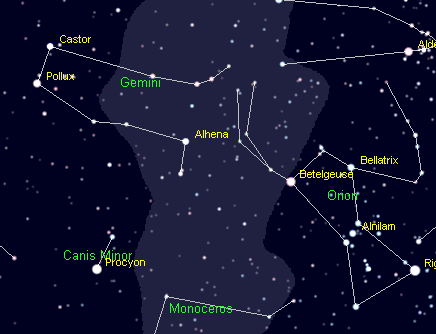
Gemini and Orion. Created using Cartes du Ciel
02/04/2013 – Ephemeris – The celestial unicorn
Ephemeris for Monday, February 4th. The sun will rise at 7:57. It’ll be up for 9 hours and 58 minutes, setting at 5:56. The moon, 1 day past last quarter, will rise at 3:41 tomorrow morning.
Among all the constellations in the sky of animals real and mythical, there is also a unicorn. It’s called Monoceros, and inhabits the southeastern sky at 9 p.m. bounded by Orion on the right, Canis Major, the great dog below and Canis Minor, the little dog to the left. Unfortunately for observers without optical aid Monoceros, though large, is devoid of any but the faintest stars. Maybe that’s why no one sees unicorns anymore. It has many faint stars because the Milky Way runs through it. To the telescope it is a feast of faint nebulae or clouds of gas and dust, the birth place of stars, including the red rose of the Rosette Nebula, and the strange and tiny Hubble’s Variable Nebula. It has a wealth of wonders below the surface so to speak.
Times are for the Traverse City/Interlochen area of Michigan. They may be different for your location.
Addendum
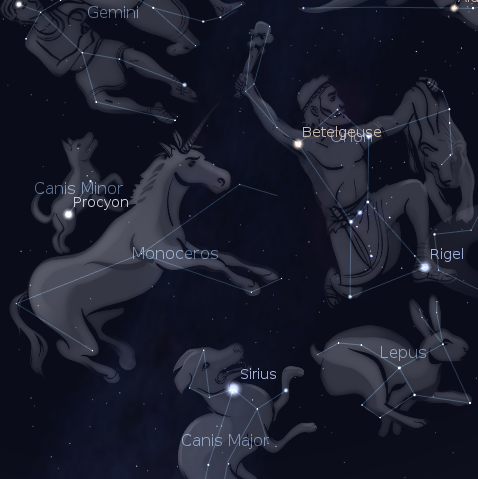
Moniceros the unicorn. Created using Stellarium.
Saturn will appear above the moon on the morning of February 3rd
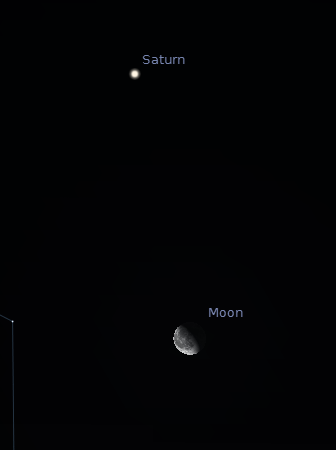
Here’s what you’ll see looking to the south at 4:55 a.m. EST. Created using Stellarium.
While you’re at it check out both with a telescopes. The two will hang out next to each other through the beginning of twilight.
 Bob Moler's Ephemeris Blog