Archive
05/16/2013 – Ephemeris – The moon’s elliptical orbit
Ephemeris for Thursday, May 16th. Today the sun will be up for 14 hours and 51 minutes, setting at 9:05. The moon, 2 days before first quarter, will set at 1:52 tomorrow morning. Tomorrow the sun will rise at 6:12.
Last week we had an annular eclipse of the sun. The moon didn’t fill up the face of the sun, leaving a ring or annulus. The moon, due to its innately elliptical orbit which is also affected by the sun, and to a much lesser extent the other planets, varies it’s low or perigee distance and its far or apogee distance each month. We saw apogee on Monday at 252,000 miles, perigee will be 223,000 miles on the 25th. That’s a pretty wide range of distances, but since there’s normally nothing to compare the moon’s size this variation in size is not noticeable until there’s a solar eclipse. The large appearance of the moon at its rising and setting is an optical illusion. The moon’s closer when overhead than when rising.
Times are for the Traverse City/Interlochen area of Michigan. They may be different for your location.
05/15/2013 – Ephemeris – Where are the bright planets this week?
Ephemeris for Wednesday, May 15th. Today the sun will be up for 14 hours and 49 minutes, setting at 9:03. The moon, 3 days before first quarter, will set at 1:21 tomorrow morning. Tomorrow the sun will rise at 6:13.
It’s time to check out the bright planets for this week. Venus is starting to make an appearance in the western sky after sunset, competing with the bright twilight glow. It will set in the west northwest at 10:08 p.m.. Jupiter is located in the constellation of Taurus, above the V shape of stars, the face of the bull and is in the west during the evening. It will set at 11:05 p.m. In the west northwest. Jupiter is still high enough as it gets dark to get a very good view of its cloud bands and satellites. Saturn will be low in the east southeast when it gets dark in the evening. It’s located in eastern Virgo, but is moving back a bit toward the bright star Spica to its right. Saturn will move past due south at 12:29 a.m., and set at 5:45 a.m.
Times are for the Traverse City/Interlochen area of Michigan. They may be different for your location.
Addendum
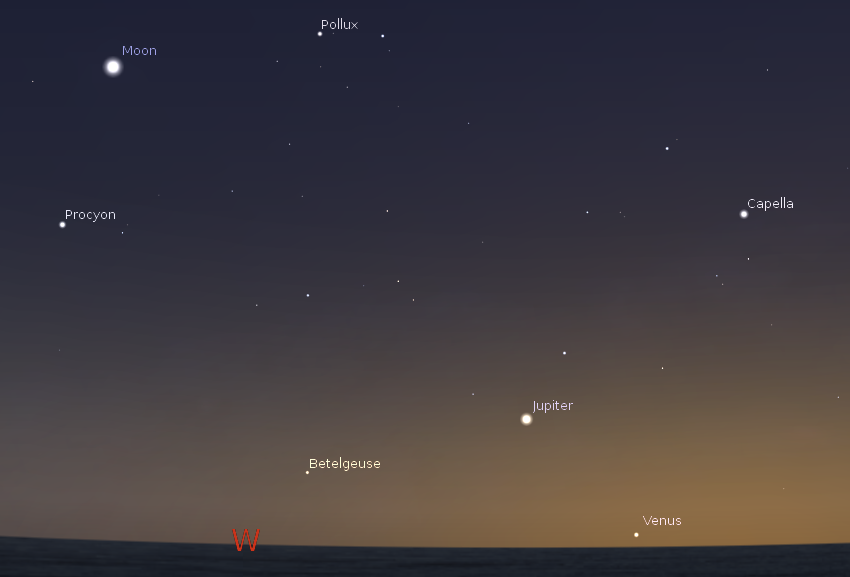
Jupiter and Venus with the fading stars of winter at 10 p.m. May 15, 2013. Created using Stellarium.
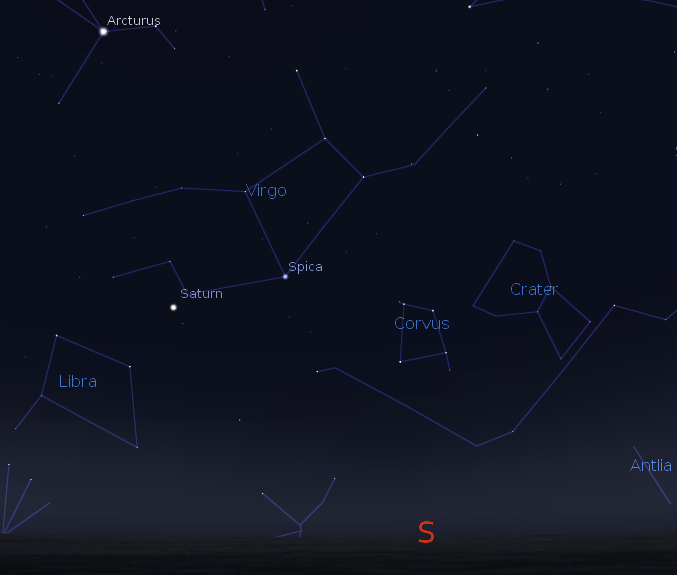
Saturn surrounded by the spring constellations at 10:30 p.m. May 15, 2013. Created using Stellarium.
05/14/2013 – She’ll be coming ’round the sun when she comes
AR 1748 is near the sun’s eastern limb. Already it has caused three radio blackouts. AR means active region, read sunspot group. It’s been kicking up quite a ruckus as it’s poised to rotate onto the earth facing side of the sun. this afternoon spaceweather.com‘s servers appear to be overloaded. I was able to get into the governments NOAA spaceweather website for the latest information.
We could be in for a week of so of northern lights. More later.
05/14/2013 – Ephemeris – How to find two bright spring stars.
Ephemeris for Tuesday, May 14th. Today the sun will be up for 14 hours and 47 minutes, setting at 9:02. The moon, 4 days before first quarter, will set at 12:48 tomorrow morning. Tomorrow the sun will rise at 6:14.
The Big Dipper, now pretty much overhead points to several stars and constellations. It’s handle points to two bright stars. First we follow the arc of the handle to the bright orange star Arcturus, the 4th brightest night time star. The reason I say night time is that the sun is a star also but by definition is not out at night. The arc to Arcturus is a how to find Arcturus and a clue to its name. Arcturus, high in the east southeast, lies at the base point of the kite shaped constellation of Boötes the herdsman. From Arcturus, straighten out the arc to a spike and one soon arrives at Spica a blue-white star in Virgo the virgin, now low in the southeast. Saturn is to its left this year. Spica is also sometimes pronounced “Speeka”.
Times are for the Traverse City/Interlochen area of Michigan. They may be different for your location.
Addendum
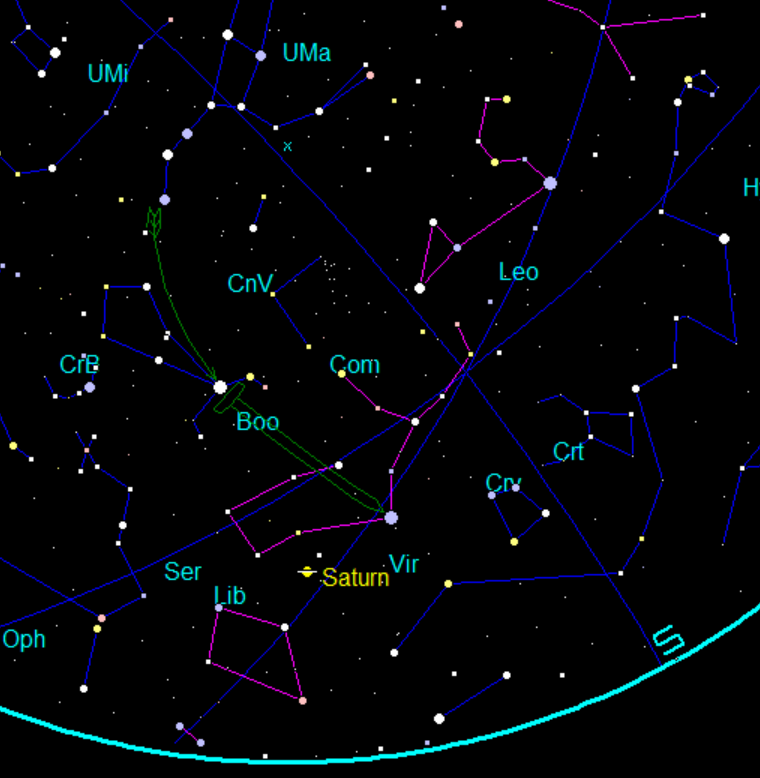
My program that shows the arc to Arcturus and spike to Spica.
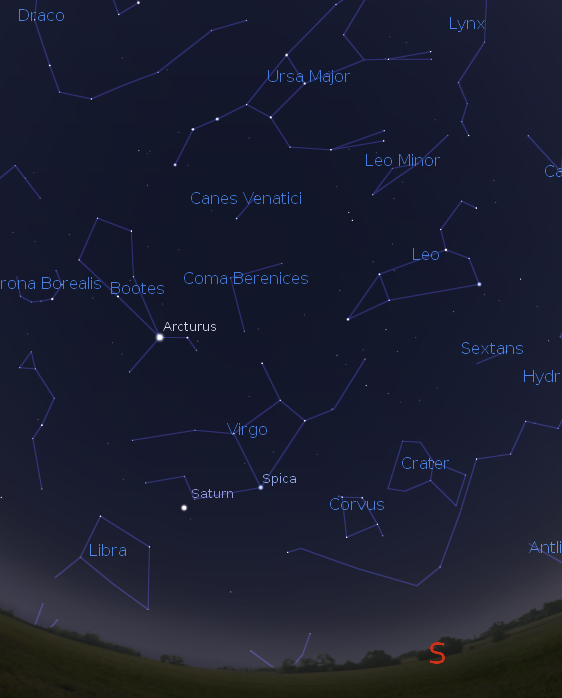
A more realistic view of the same part of the sky. Created using Stellarium.
05/13/2013 – Ephemeris – Evening viewing prospects for the planet Venus
Ephemeris for Monday, May 13th. Today the sun will be up for 14 hours and 45 minutes, setting at 9:01. The moon, 4 days past new, will set at 12:10 tomorrow morning. Tomorrow the sun will rise at 6:15.
For the rest of the year Venus will be in our evening sky. However it will not appear high in the west. It is making its appearance just when the path of the planets will begin to lie down south of the sun. The best time to see planets in the west after sunset is generally between December to June. The other six months they are best seen in the morning sky in the east. Since Venus lies between the earth and the sun, it never strays far from it. Right now Venus is emerging from behind the sun, and is nearly fully illuminated by the sun and far from us. The last two months of this year Venus will be close to us and exhibiting a crescent phase as it approaches and is about to pass between the earth and the sun.
05/10/2013 – Ephemeris – Star party featuring the sun tomorrow
Ephemeris for Tuesday, April 23rd. The sun rises at 6:44. It’ll be up for 13 hours May 10. The sun rises at 6:20. It’ll be up for 14 hours and 38 minutes, setting at 8:58. The moon, 1 day past new, will set at 9:48 this evening.
This month The Grand Traverse Astronomical Society trying a new type of star party at the Sleeping Bear Dunes National Lakeshore. This will be tomorrow from noon to 2 p.m. if it’s clear. That is the star of our star party will be the sun. We’ve done these at other venues and festivals, but this is the first time we’re doing it at the park. Telescopes will be set up at the park headquarters in Empire. In addition to white light filtered telescopes, the society will also have a spacial solar telescopes to view the sun’s atmosphere and any prominences visible. Prominences are large red clouds of hydrogen that can hang over the sun in loops are flung away by solar flares. The white light telescopes will show any sunspots that are on the sun’s face.
Times are for the Traverse City/Interlochen area of Michigan. They may be different for your location.
05/09/2013 – Ephemeris – There’s an annular eclipse in the Pacific Ocean today
Ephemeris for Thursday, May 9th. The sun rises at 6:21. It’ll be up for 14 hours and 35 minutes, setting at 8:57. The moon is new today, and won’t be visible.
Solar eclipse in Pacific. Later this afternoon our time there will be an annular eclipse of the sun. However it will only be visible from parts of the Pacific Ocean including Australia. Since the shadow crosses the International Date Line and the moon’s shadow moves west to east, it start in Australia on the morning of the 10th, and end far southeast of Hawai’i on evening of the 9th. An annular eclipse is one in which the moon is farther than average from the earth and cannot cover the whole face of the moon for observers on the earth. He moon’s farthest distance from the earth this month is called apogee at 252,000 miles next Monday. The lunar eclipse paired with this is a very slight penumbral eclipse on the 25th, too slight to be noticeable.
Times are for the Traverse City/Interlochen area of Michigan. They may be different for your location.
Addendum
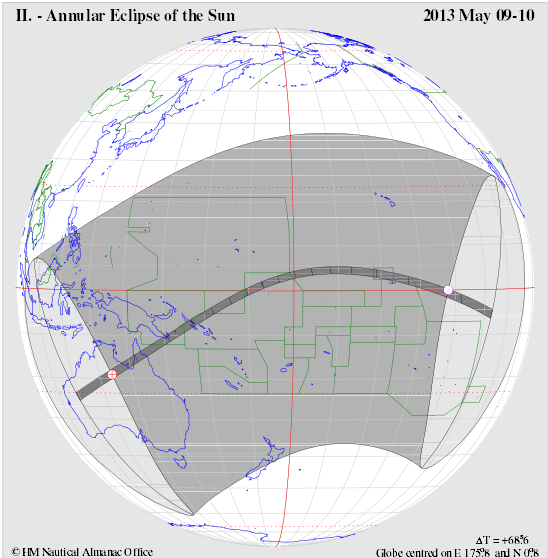
Annular eclipse path May 9-10, 2013.
From the Astronomical Almanac Online (USNO, HMNO).
The PDF version of the above image and eclipse times click here.
05/08/2013 – Ephemeris – Where are the bright planets tonight?
Ephemeris for Wednesday, May 8th. The sun rises at 6:22. It’ll be up for 14 hours and 33 minutes, setting at 8:55. The moon, 1 day before new, will rise at 6:06 tomorrow morning.
It’s time to check out the bright planets for this week. Venus is starting to make an appearance in the western twilit sky after sunset, competing with the bright twilight glow. It will set in the west northwest at 9:48. Jupiter is located in the constellation of Taurus, above the V shape of stars, the face of the bull and is in the west during the evening. It will set at 11:28 p. m. In the west northwest. Jupiter is still high enough as it gets dark to get a very good view of its cloud bands and satellites. Saturn will be low in the east southeast when it gets dark in the evening. It’s located in eastern Virgo, but is moving back a bit toward the bright star Spica to its right. Saturn will move past due south at 12:58 a.m., and set at 6:14 a.m.
Times are for the Traverse City/Interlochen area of Michigan. They may be different for your location.
Addendum
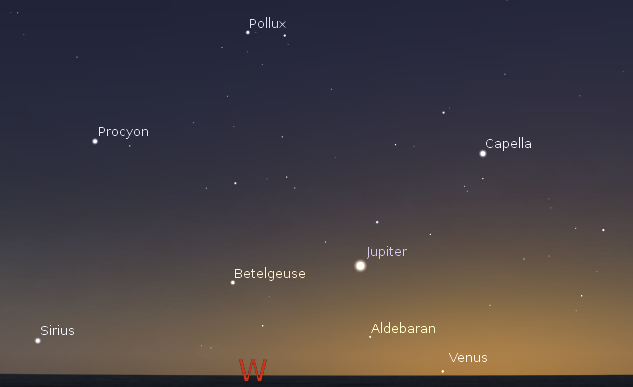
Venus, Jupiter and the fading stars of winter at 9:45 p.m. May 8, 2013. Created using Stellarium.
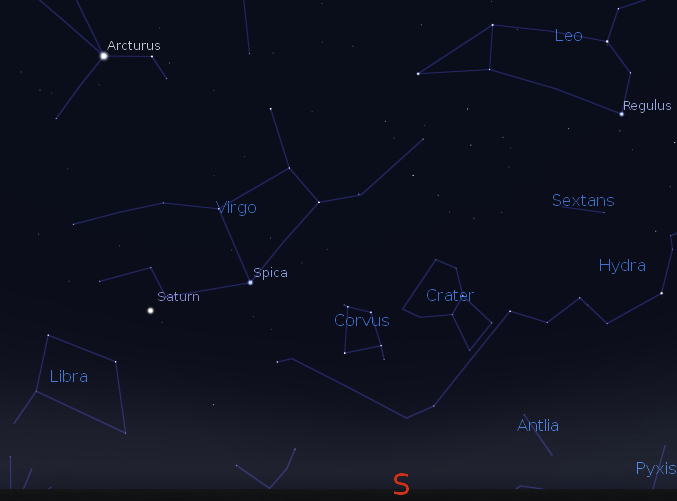
Saturn and the constellations of spring at 10:30 p.m. May 8, 2013. Created using Stellarium.
05/07/2013 – Ephemeris – Berenice’s celestial hairdo
Ephemeris for Tuesday, May 7th. The sun rises at 6:24. It’ll be up for 14 hours and 30 minutes, setting at 8:54. The moon, 2 days before new, will rise at 5:33 tomorrow morning.
High in the south southeast at 10 p.m. is a tiny and faint constellation of Coma Berenices, or Berenice’s hair. In it are lots of faint stars arrayed to look like several strands of hair. The whole group will fit in the field of a pair of binoculars, which will also show many more stars. The story behind it was that Berenice was the Queen of Egypt, whose husband was away at war. This was in the days when the Greeks ruled Egypt after Alexander conquered it. She offered her golden tresses to the gods for the king’s safe return. The hair, was placed in a temple. However the offering disappeared when the king returned. Ever since then the constellation of Coma Berenices has been seen to commemorate the queen’s sacrifice.
Times are for the Traverse City/Interlochen area of Michigan. They may be different for your location.
Addendum

Coma Berenices via Stellarium
 Bob Moler's Ephemeris Blog