Archive
07/31/2013 – Ephemeris – All 5 bright planets are visible now
Ephemeris for Wednesday, July 24th. The sun rises at 6:20. It’ll be up for 14 hours and 56 minutes, setting at 9:16. The moon, 2 days past full, will rise at 10:12 this evening.
Lets check out the planets visible now. Venus is now low in the west northwestern sky in evening twilight, Venus will set at 10:44 p.m. Holding forth in the southwest will be Saturn this evening, the brightest star-like object in the constellation Virgo appearing yellowish to the left of the extremely blue-white star Spica. Saturn is a wonderful sight in a telescope of 20 power or more. In telescopes Saturn’s large moon Titan can be easily seen. Saturn will set at 1:04 tomorrow morning. Jupiter and Mars will rise close together at 4:14 and 4:17 a.m. Respectively in the east northeast in morning twilight. The much dimmer Mars will appear to the lower left of the brighter Jupiter, and may take binoculars to locate.
Times are for the Traverse City/Interlochen area of Michigan. They may be different for your location.
Addendum
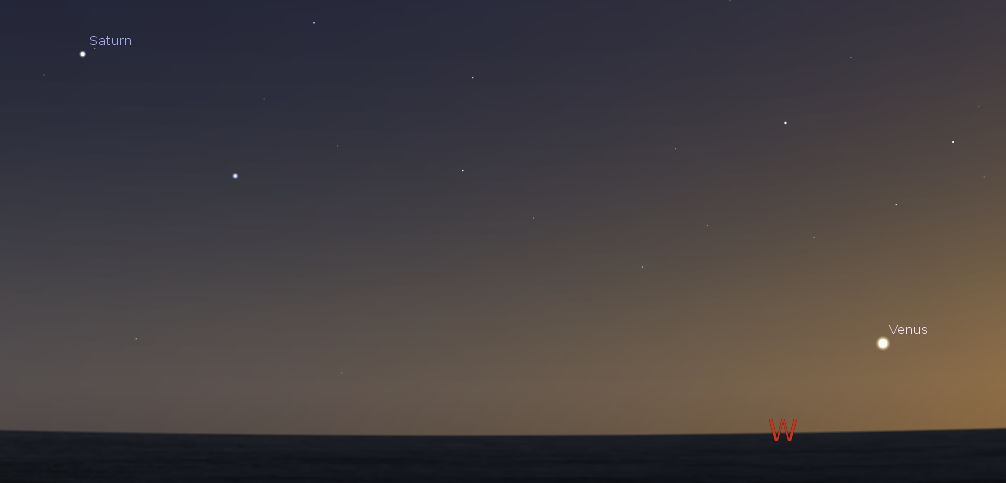
Venus and Saturn at 10 p.m. on July 31, 2013. Created using Stellarium
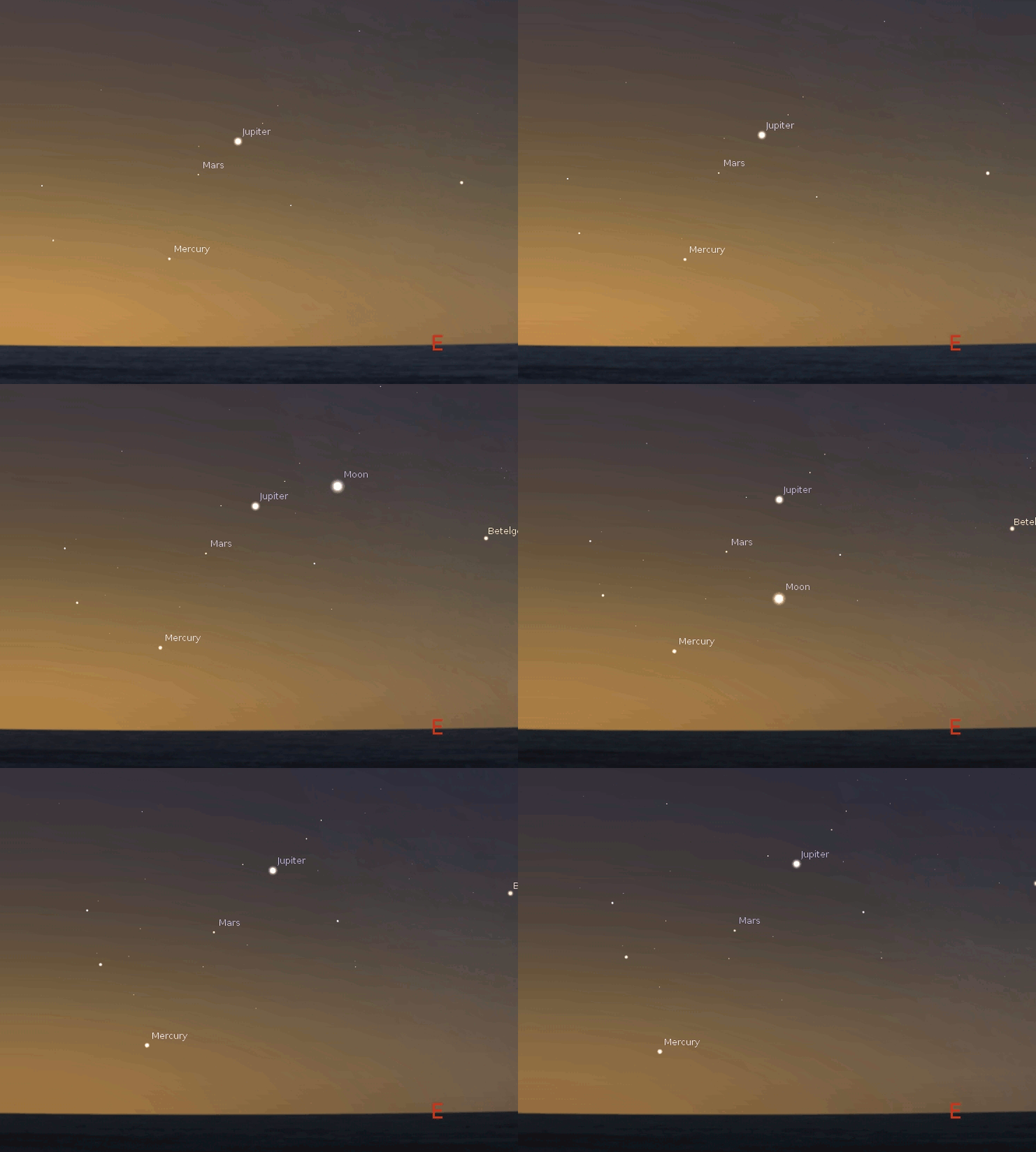
Animation of Mercury, Mars and Jupiter at one day intervals from July 31 to August 7, 2013 at 5:45 a.m. Created using Stellarium and the GIMP.
07/30/2013 – Ephemeris – Mercury appears in the morning
Ephemeris for Tuesday, July 30th. The sun rises at 6:27. It’ll be up for 14 hours and 43 minutes, setting at 9:10. The moon, 1 day past last quarter, will rise at 1:23 tomorrow morning.
Mercury is joining the morning planets Jupiter and Mars now. This morning is the time of its greatest elongation or separation from the sun of 20 degrees, but this planet will actually brighten as it starts its journey back around the sun. Mercury’s phase at greatest elongation is half illuminated. As it moves back around the sun the phase becomes fuller. To find Mercury it’s best to use binoculars. At around 5:30 look to the east northeast on a very low horizon. First locate Jupiter, the brightest and highest of the three. Then look below for reddish Mars. Once found, Mercury can be located by extending a line one and a half times further than Mars. These planets can be seen until 6 a.m. or a bit later.
Times are for the Traverse City/Interlochen area of Michigan. They may be different for your location.
Addendum
Animation of Mercury, Mars and Jupiter at one day intervals from July 31 to August 7, 2013 at 5:45 a.m. Created using Stellarium and the GIMP. Click to enlarge and animate.
07/29/2013 – Ephemeris – The constellation Aquila the eagle
Ephemeris for Monday, July 29th. The sun rises at 6:25. It’ll be up for 14 hours and 45 minutes, setting at 9:11. The moon, at last quarter today, will rise at 12:46 tomorrow morning.
Aquila the eagle is a constellation that lies in the Milky Way. It’s in the southeastern sky as it gets dark. Its brightest star, Altair is one of the stars of the Summer Triangle, a group of three bright stars seen now in the eastern sky in the evening. Altair, in the head of the eagle, is flanked by two slightly dimmer stars, the shoulders of the eagle. The eagle is flying northeastward through the Milky Way. Its wings are seen in the wing tip stars. A curved group of stars to the lower right of Altair is its tail. Within Aquila the Milky Way shows many dark clouds as part of the Great Rift that splits it here. The other summer bird is Cygnus the swan, above and left of Aquila, flying in the opposite direction, southward.
Times are for the Traverse City/Interlochen area of Michigan. They may be different for your location.
Addendum
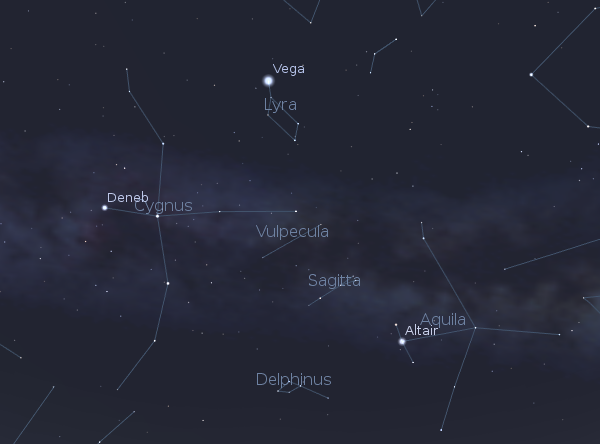
Aquila with the other constellations in the Summer Triangle. Created using Stellarium.
07/26/2013 – Ephemeris – South Delta Aquarid meteors at peak, but look for the Perseids
Ephemeris for Friday, July 26th. The sun rises at 6:22. It’ll be up for 14 hours and 51 minutes, setting at 9:14. The moon, 3 days before last quarter, will rise at 11:13 this evening.
We are now reaching the peak of the South Delta Aquarid meteor shower, which is hampered by the waning gibbous moon in the morning sky, where it’s visible. This is also the time to begin to look for the Perseid meteors that will reach peak next month on the morning of the 12th. The Perseids are an all night meteor shower because the radiant point, the point from which the meteors seem to come is far enough north so it never sets. The largest number of meteors appear when the radiant is highest in the sky, before dawn. However as soon as it gets dark the low position of the radiant in the northeast will result in fewer meteors but the streaks will be longer, as the meteoroids hit the atmosphere at a low angle.
Times are for the Traverse City/Interlochen area of Michigan. They may be different for your location.
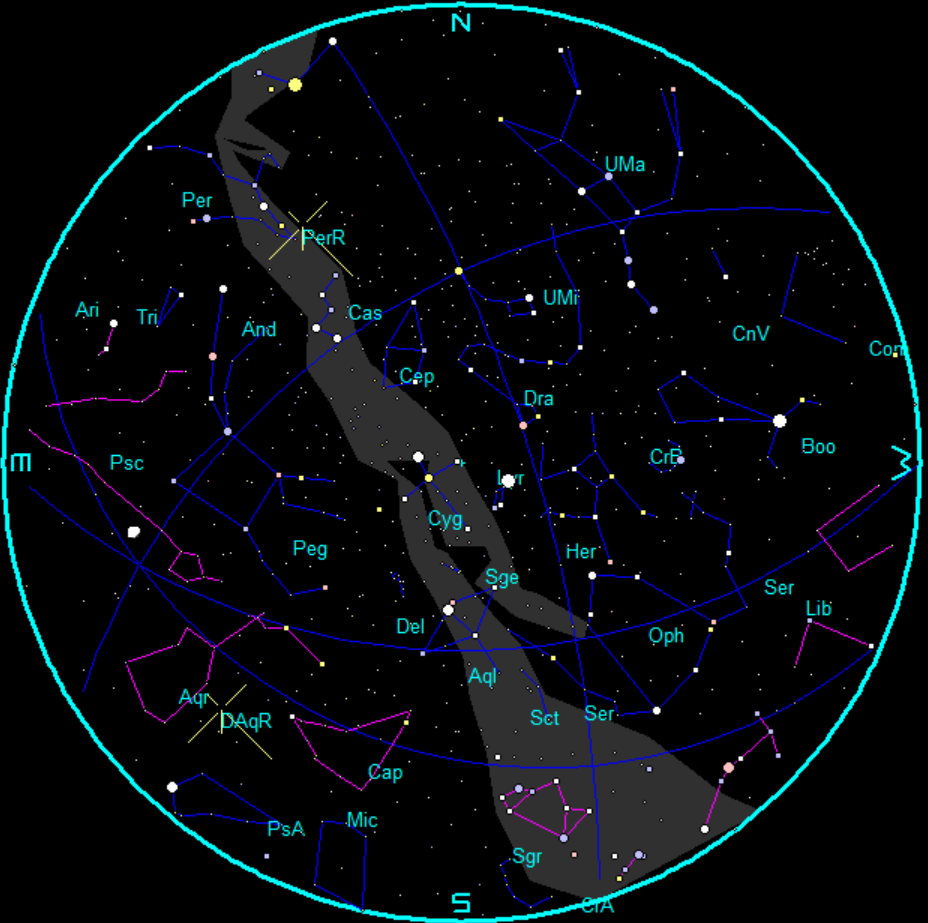
South Delta Aquarid meteor shower at peak and Persieds firing up at 1 a.m. July 27, 2013. PerR and DAqR are the radiants.
07/25/2013 – Ephemeris – Vega, the fifth brightest night-time star
Ephemeris for Thursday, July 25th. The sun rises at 6:21. It’ll be up for 14 hours and 54 minutes, setting at 9:15. The moon, 3 days past full, will rise at 10:43 this evening.
The star Vega, which is nearly overhead or the zenith is a special star for astronomers. It’s part of the small constellation of Lyra the harp, which includes the parallelogram of stars near it. Vega is kind of a standard calibration star. It is the 5th brightest night-time star with a brightness of 0 magnitude, although recent measurements place it at 0.03. Of the spectral types which denote the star’s color and surface temperature, Vega comes out to be pure white, with a surface temperature nearly twice the sun’s. It’s almost exactly 25 light years away, and so is one of the closer stars. It’s a tenth the sun’s age and 40 times the sun’s brightness. It has perhaps a Jupiter sized planet, and a Kuiper belt of Pluto like objects orbiting it.
Times are for the Traverse City/Interlochen area of Michigan. They may be different for your location.
Addendum
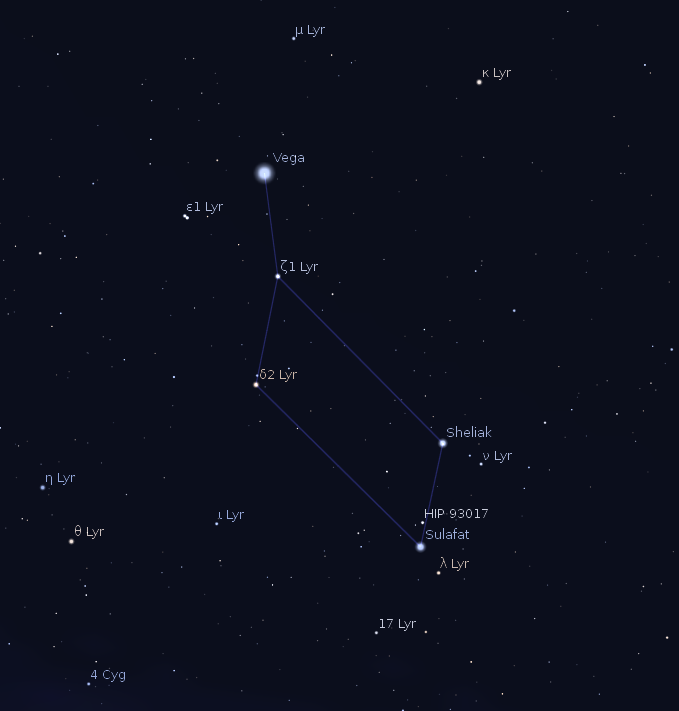
Magnified view of Lyra showing Vega. Created using Stellarium.
07/24/2013 – Ephemeris – Where are the bright planets in the sky this week?
Ephemeris for Wednesday, July 24th. The sun rises at 6:20. It’ll be up for 14 hours and 56 minutes, setting at 9:16. The moon, 2 days past full, will rise at 10:12 this evening.
Lets check out the planets visible now. Venus is now low in the west northwestern sky in evening twilight, Venus will set at 10:44 p.m. Holding forth in the southwest will be Saturn this evening, the brightest star-like object in the constellation Virgo appearing yellowish to the left of the extremely blue-white star Spica. Saturn is a wonderful sight in a telescope of 20 power or more. In telescopes Saturn’s large moon Titan can be easily seen. Saturn will set at 1:04 tomorrow morning. Jupiter and Mars will rise close together at 4:14 and 4:17 a.m. Respectively in the east northeast in morning twilight. The much dimmer Mars will appear to the lower left of the brighter Jupiter, and may take binoculars to locate.
Times are for the Traverse City/Interlochen area of Michigan. They may be different for your location.
Addendum
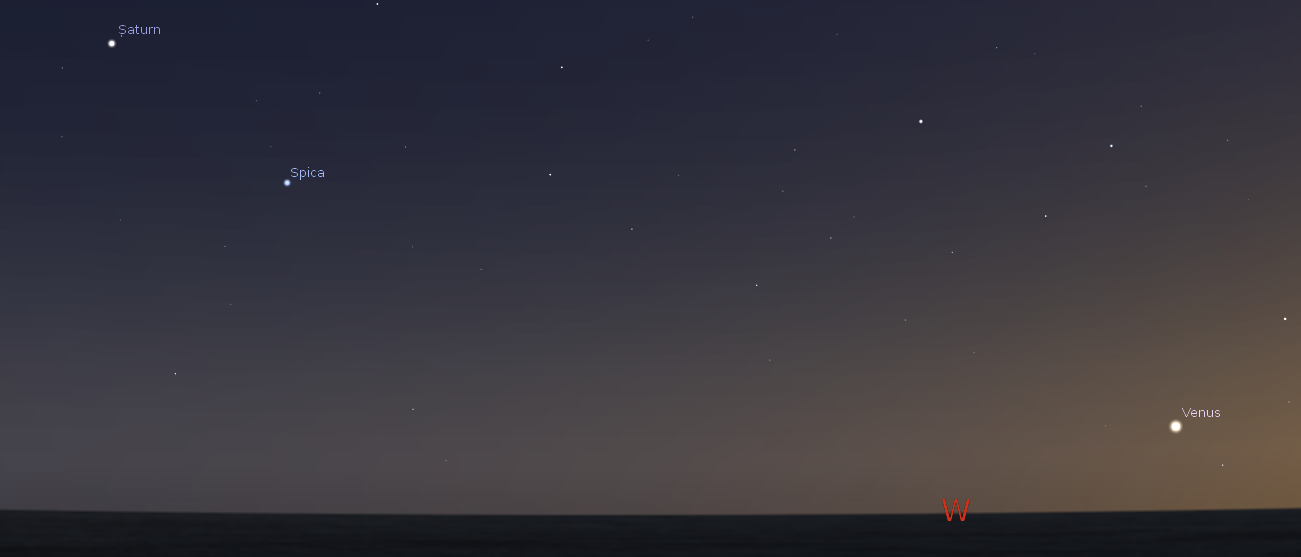
Venus and Saturn at 10:15 p.m. on July 24, 2013. Created using Stellarium. Click on Image to enlarge.
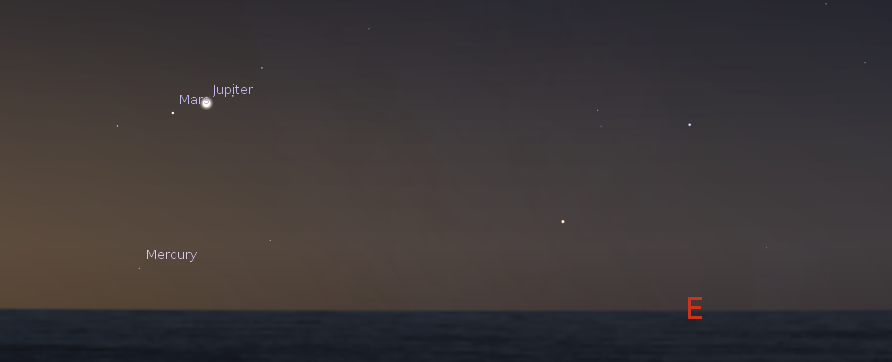
Jupiter, Mars and Mercury in morning twilight at 5:20 a.m. on July 25, 2013. I didn’t mention Mercury on the program because it’s very difficult to spot. Created using Stellarium.
07/23/2013 – Ephemeris – Grand Traverse Astronomical Society at the Lanphier Observatory tomorrow night
Ephemeris for Tuesday, July 23rd. The sun rises at 6:19. It’ll be up for 14 hours and 58 minutes, setting at 9:17. The moon, 1 day past full, will rise at 9:38 this evening.
The Lanphier Observatory of the Leelanau School is open this summer from 10 p.m. to midnight on Wednesday and Thursday evenings until Labor Day but only if it’s clear. The Leelanau School is located off M22 east of Glen Arbor. The observatory is located at the edge of the beach. Tomorrow night the Grand Traverse Astronomical Society will be hosting the viewing night at the Lanphier Observatory. Celestial wonders to be viewed will be Venus and Saturn, plus some of the brighter wonders of the night sky beyond the solar system. My informal connection with the Lanphier Observatory goes back to 1975 shortly after the Ephemeris program began. It was a gift to the school by then summer resident Charles Lanphier.
Times are for the Traverse City/Interlochen area of Michigan. They may be different for your location.
07/22/2013 – Ephemeris – The star Deneb, brighter than it looks
Ephemeris for Monday, July 22nd. Today the sun will be up for 15 hours, setting at 9:18. The moon, at full today, will rise at 9:00 this evening. Tomorrow the sun will rise at 6:19.
At 11 this evening the bright star Deneb in Cygnus the swan will be moderately high in the east northeast. Deneb is the dimmest star of the summer triangle. Of the other stars of the triangle, Vega is nearly overhead, and Altair to the south. While Deneb’s apparent magnitude, or brightness as seen from earth, makes it the dimmest of the three bright stars, Deneb’s vast distance of possibly 2,600 light years makes it 100 times the distance of Vega. If brought as close as Vega, Deneb would be several time brighter than Venus. For all this it is only 13-20 times the mass of the sun. It will have an extremely short life and it will explode, go supernova, in perhaps a few million years.
Times are for the Traverse City/Interlochen area of Michigan. They may be different for your location.
Addendum
Deneb with the other stars and constellations in the Summer Triangle. Created using Stellarium.
07/19/2013 – Ephemeris – Smile you’re on Candid Cassini Camera
Ephemeris for Friday, July 19th. Today the sun will be up for 15 hours and 6 minutes, setting at 9:21. The moon, 3 days before full, will set at 3:55 tomorrow morning. Tomorrow the sun will rise at 6:16.
Between 5:27 and 5:42 p.m. today go outside and look to the southeast and smile. An hour and a half later when the light arrives the Cassini spacecraft, hiding from the sun behind Saturn will take a series of photographs that will include the Earth in the background. All of us, the Earth included will fit into one pixel in Cassini’s camera. This is a reprise of the famous back-lit photograph of Saturn taken earlier in its mission. Closer to home members of the Grand Traverse Astronomical Society will be part of Kingsley Heritage Days Saturday and Sunday to view the sun if it’s clear. Also the society will host a star party at the NMC’s Rogers Observatory starting at 9 p.m. tomorrow night.
Times are for the Traverse City/Interlochen area of Michigan. They may be different for your location.
Addendum
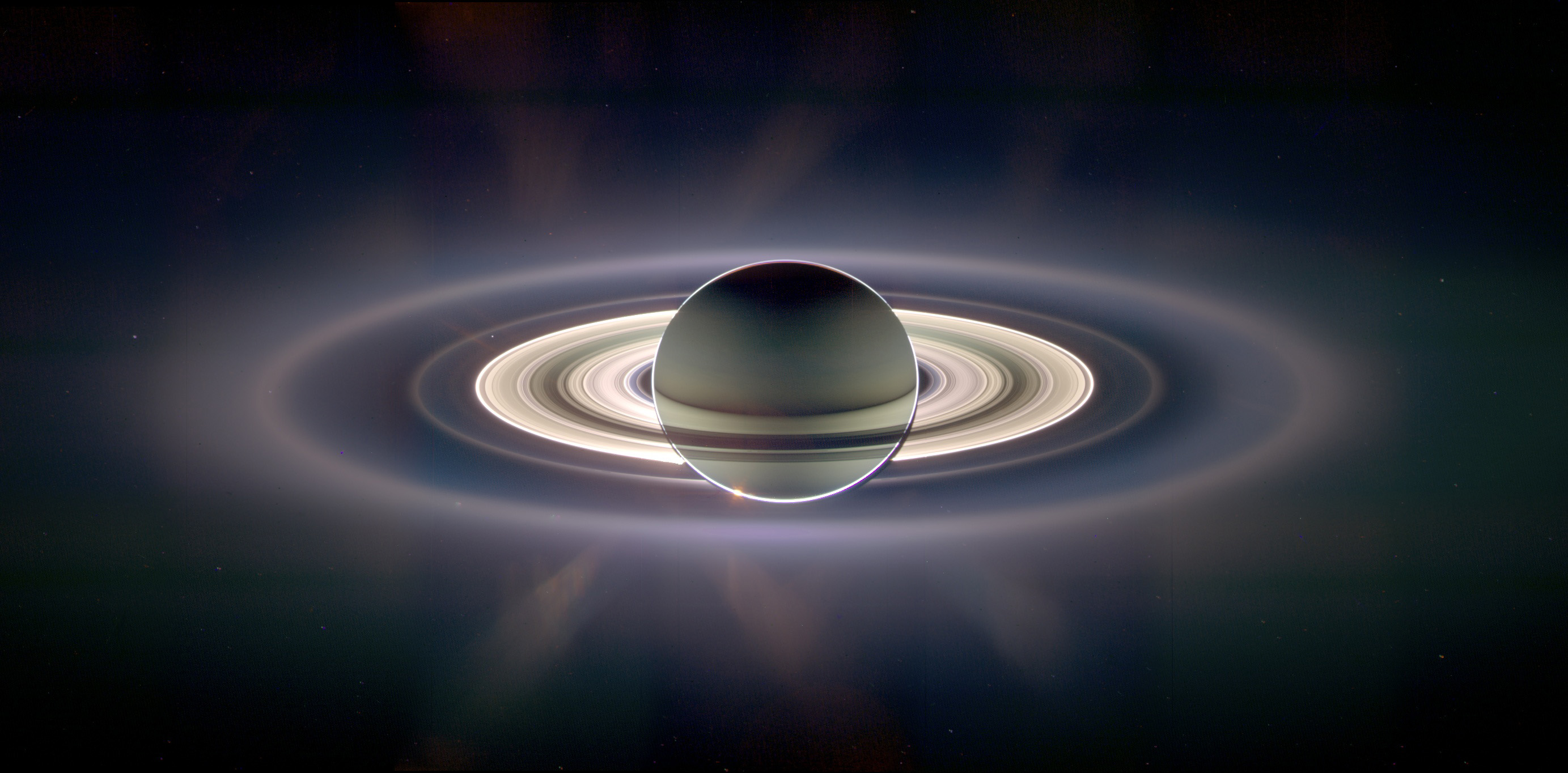
Saturn night side mosaic taken early in the mission. Note the pale blue dot at the 9:30 position outside the main rings and just inside the next fuzzy ring out. That’s Earth. Credit: NASA. Click on the image to enlarge.
07/18/2013 – Ephemeris – The bright star Altair
Ephemeris for Thursday, July 18th. Today the sun will be up for 15 hours and 7 minutes, setting at 9:22. The moon, 3 days past first quarter, will set at 2:56 tomorrow morning. Tomorrow the sun will rise at 6:15.
Of the three stars of the Summer Triangle Altair in the constellation Aquila the eagle is the farthest one south and the closest. Altair is at a distance of 16.8 light years away. One light year is nearly 6 trillion miles. Altair is 10 times the brightness of the sun. While it’s almost twice the sun’s diameter, it rotates once in only 9 hours, and has a decidedly squashed appearance when seen close up. There are techniques that can actually accomplish this. Our sun’s a slow poke, taking nearly a month to rotate once. In science fiction the Altair system was the scene for the classic film Forbidden Planet, one of the few science fiction classic films of the 1950s.
Times are for the Traverse City/Interlochen area of Michigan. They may be different for your location.
Addendum
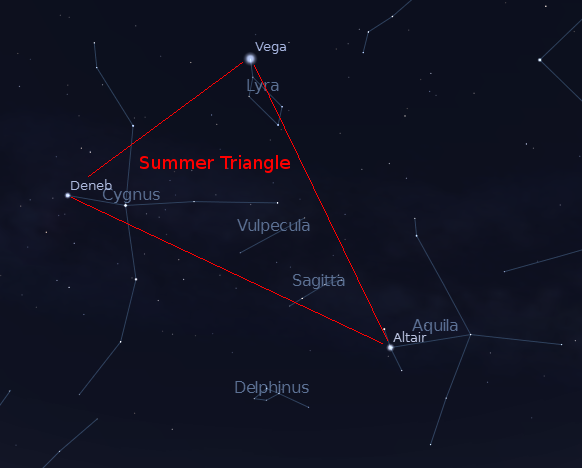
The Summer Triangle. Created using Stellarium and The Gimp.
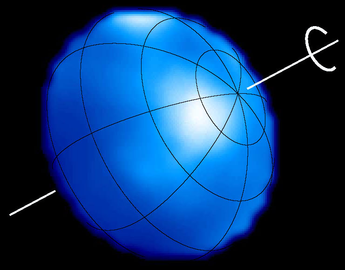
False-color image of the rapidly rotating star Altair, made with the MIRC imager on the CHARA array on Mt. Wilson.

United Planets Cruiser C57-D lands on Altair IV in the 1956 movie Forbidden Planet.
 Bob Moler's Ephemeris Blog