Archive
04/30/2014 – Ephemeris – It’s Wednesday, do you know where your planets are?
Ephemeris for Wednesday, April 30th. The sun rises at 6:34. It’ll be up for 14 hours and 11 minutes, setting at 8:45. The moon, 1 day past new, will set at 10:25 this evening.
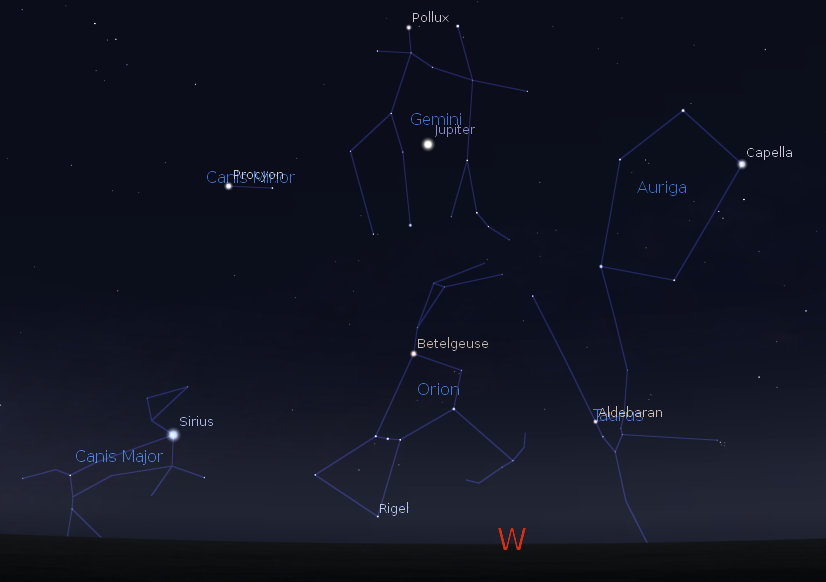
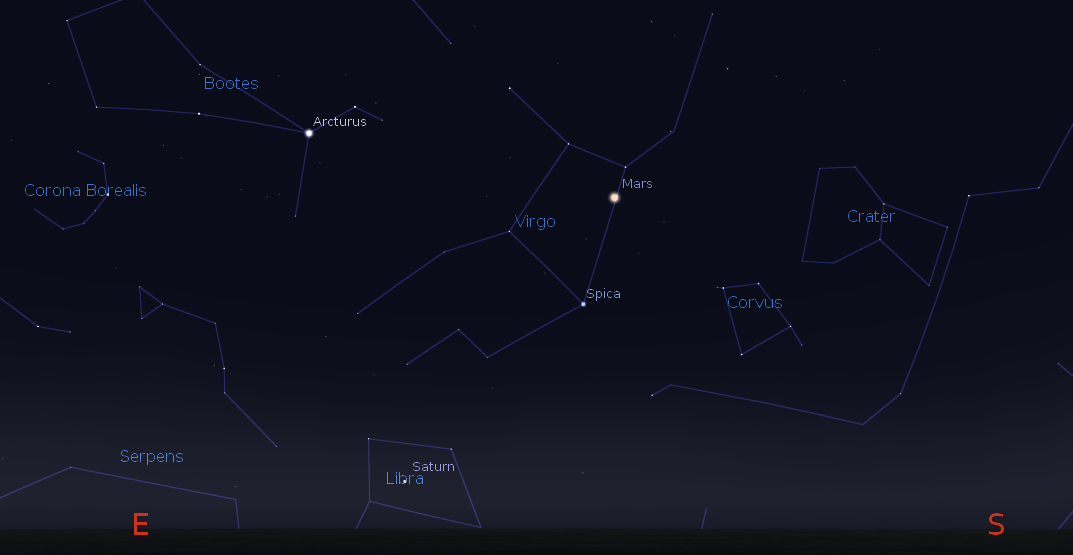
It’s Wednesday and once again time to locate the bright planets for this week. Brilliant Jupiter will be in the western sky as darkness falls tonight. It will set at 1:54 a.m. Reddish Mars is in Virgo and outshines the bright bluish star Spica below left of it as darkness falls. Mars is in the south-east as it gets dark. It will pass due south at 11:51 p.m. It’s 59.5 million miles away now, and moving away, and will set at 5:41 a.m. Saturn will rise at 9:24 p.m. It’s in the faint constellation of Libra the scales this year. It will pass due south at 2:23 a.m. The telescope will bring out Saturn’s beautiful rings, whose short dimensions now are as wide as the planet. Brilliant Venus will rise in the east at 5:05 a.m. and will stay pretty low to the horizon.
Times are for the Traverse City/Interlochen area of Michigan. They may be different for your location.
Addendum
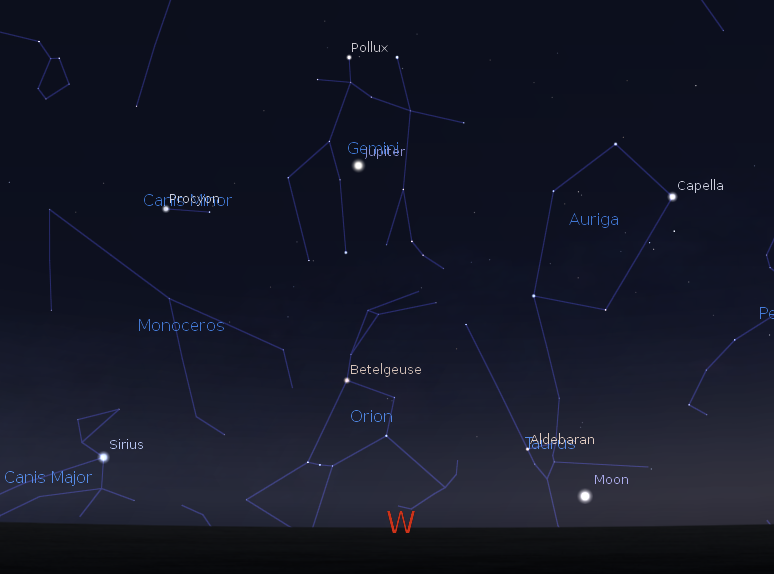
Jupiter, the Moon and the setting winter constellations in the west at 10 p.m. on April 30, 2014. Created using Stellarium.
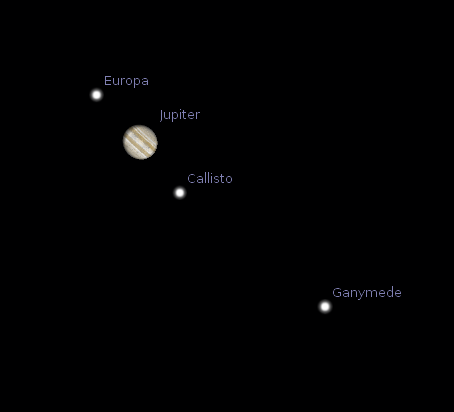
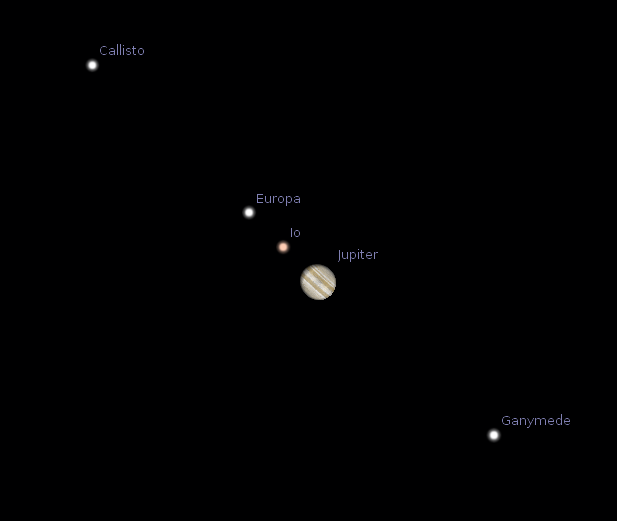
Jupiter and satellites through a telescope at 10 p.m. on April 30, 2014. The satellite Io is being occulted by Jupiter and will reappear at 11:56 p.m. (3:56 UT May 1, 2014). Created using Stellarium.
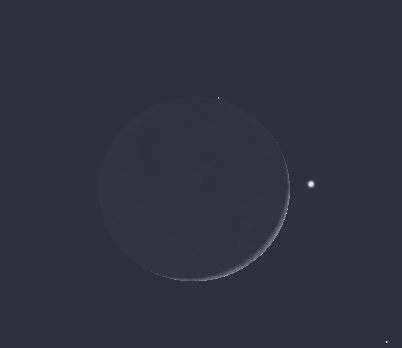
The crescent Moon at 10 p.m. on April 30, 2014. Created using Stellarium.
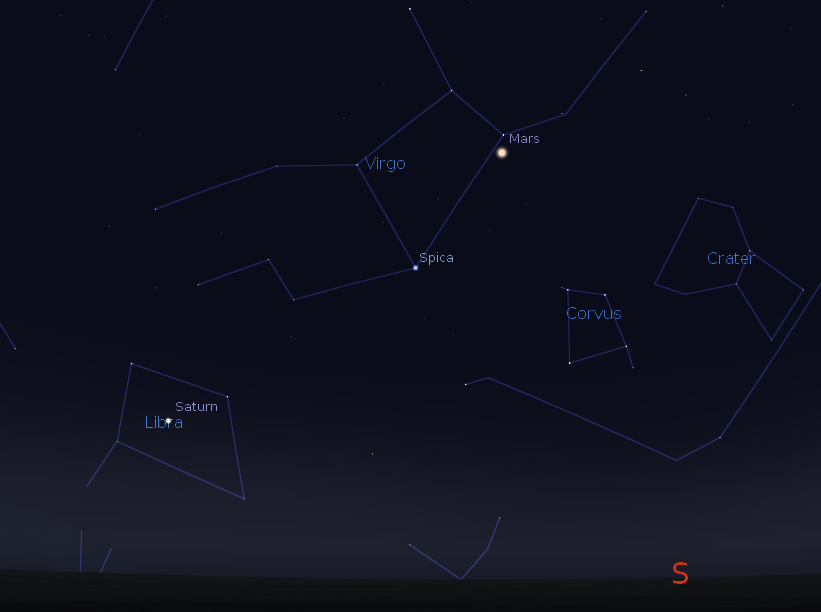
Mars, Saturn and some spring constellation at 11 p.m. April 30, 2014. Created using Stellarium.
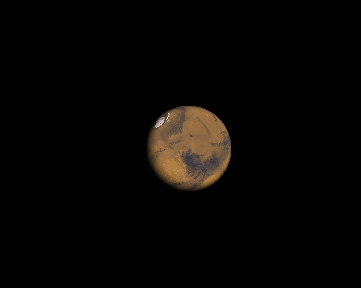
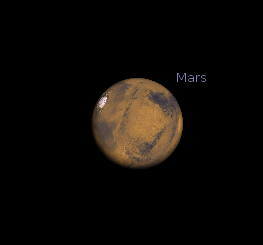
Telescopic view of Mars, 11 p.m. April 30, 2014. Created using Stellarium.
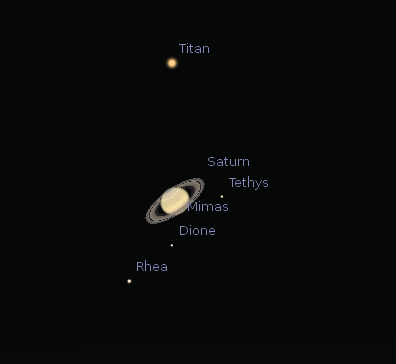
Telescopic view of Saturn and some of its moons at 11 p.m. April 30, 2014. Created using Stellarium.
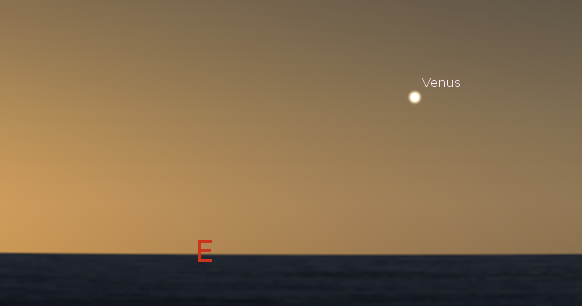
Venus in the twilight at 6 a.m. May 1, 2014. Created using Stellarium.
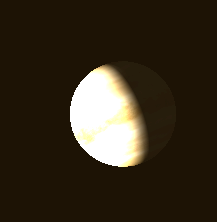
Telescopic view of Venus on May 1, 2014. Created using Stellarium.
04/29/2014 – Ephemeris – Today’s weird annular eclipse
Ephemeris for Tuesday, April 29th. The sun rises at 6:35. It’ll be up for 14 hours and 9 minutes, setting at 8:44. The moon is new today, and won’t be visible.
This event has already happened, and there was now way to be able to get to a spot too see its maximum effect. What I’m talking about was this morning’s weird annular eclipse of the sun. Australia saw the partial phase. An annular eclipse is one in which the moon is too far away to completely fill the face of the sun at maximum eclipse, leaving a bright ring of the uneclipsed sun around the moon. The path of annularity will just graze the earth over a spot in Antarctica. The center of this annular shadow called an antumbra, a new word I learned from descriptions of this eclipse, will just miss the earth. As far as I know no one had gone to the spot where the annular effect can be seen, so remote is its location. It kind of reminds one that the earth is a ball in space.
Times are for the Traverse City/Interlochen area of Michigan. They may be different for your location.
Addendum
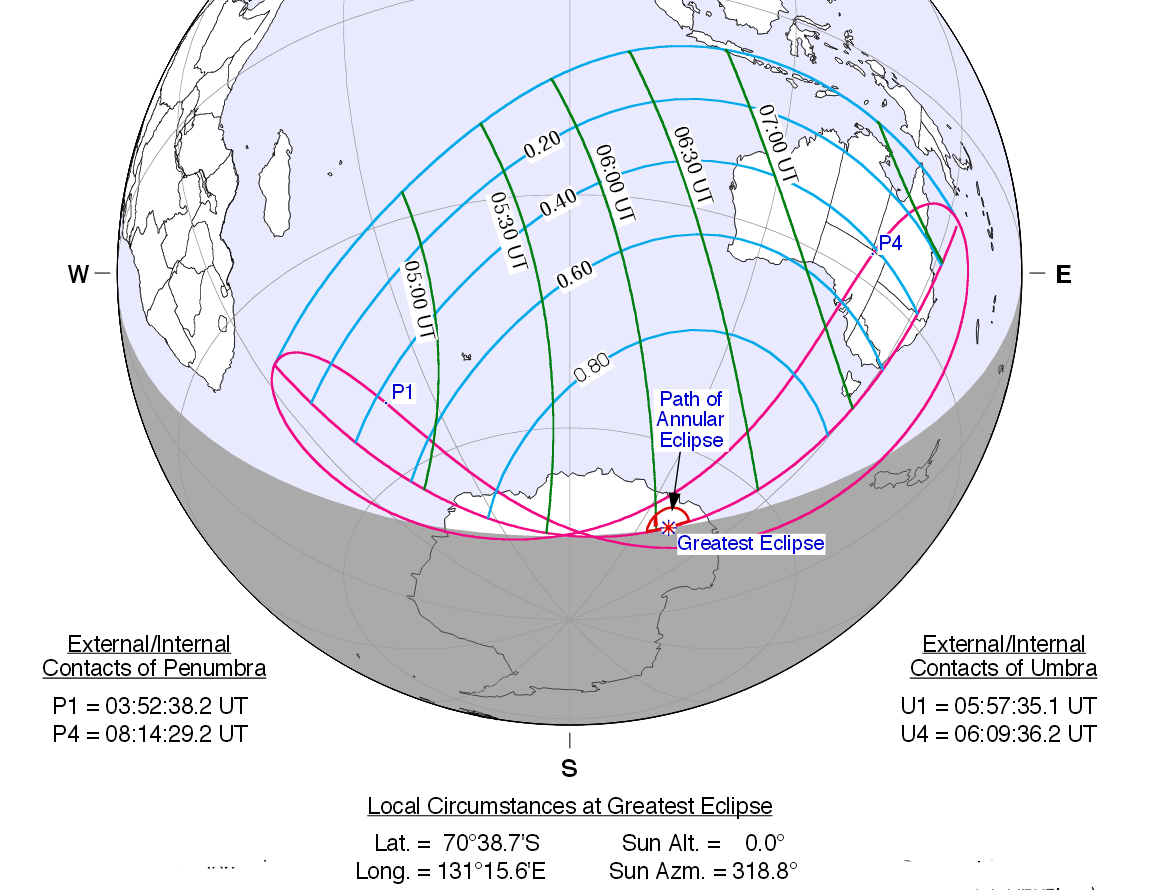
Area on the Earth where the eclipse can be seen. Credit: “Eclipses During 2014”, F. Espenak, Observer’s Handbook – 2014, Royal Astronomical Society of Canada, NASA eclipse website
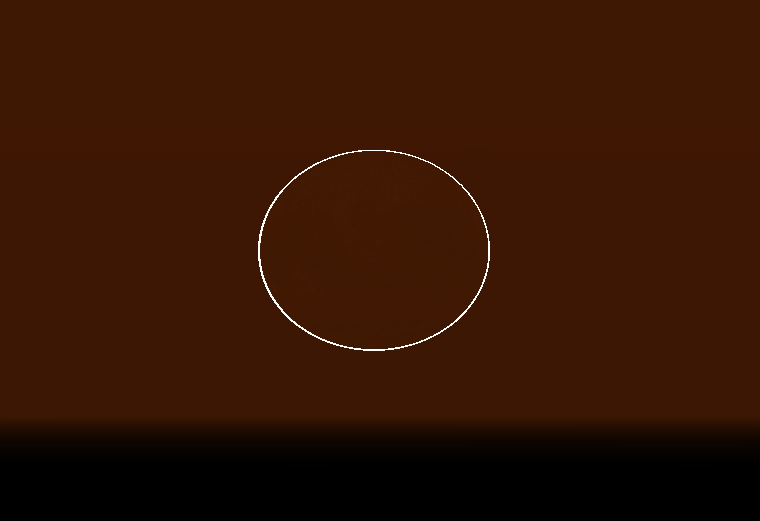
Annularity as simulated in Stellarium.
For more information on this eclipse check here: http://eclipse.gsfc.nasa.gov/OH/OH2014.html#SE2014Apr29A
04/28/2014 – Ephemeris – The legend of the constellation of Corvus the crow
Ephemeris for Monday, April 28th. The sun rises at 6:37. It’ll be up for 14 hours and 6 minutes, setting at 8:43. The moon, 1 day before new, will rise at 6:53 tomorrow morning.
The small constellation of Corvus the crow is located low in the south at 10:30 this evening. It’s made of 5 dim stars, but the pattern is a distinctive distorted box with two stars at the upper left marking that corner. To the right is a fainter constellation of a thick stemmed goblet called Crater. Both appear above the long constellation of Hydra the water snake who is slithering just above the southern horizon. In Greek mythology Corvus, then white, was the god Apollo’s pet. He once bid Corvus to take a cup and fetch him some water. Corvus however dallied and waited for a green fig to ripen. Corvus grabbed a snake and returned with a story on how the snake had delayed him. The angry Apollo turned the crow and all crows to this day black.
Times are for the Traverse City/Interlochen area of Michigan. They may be different for your location.
Addendum
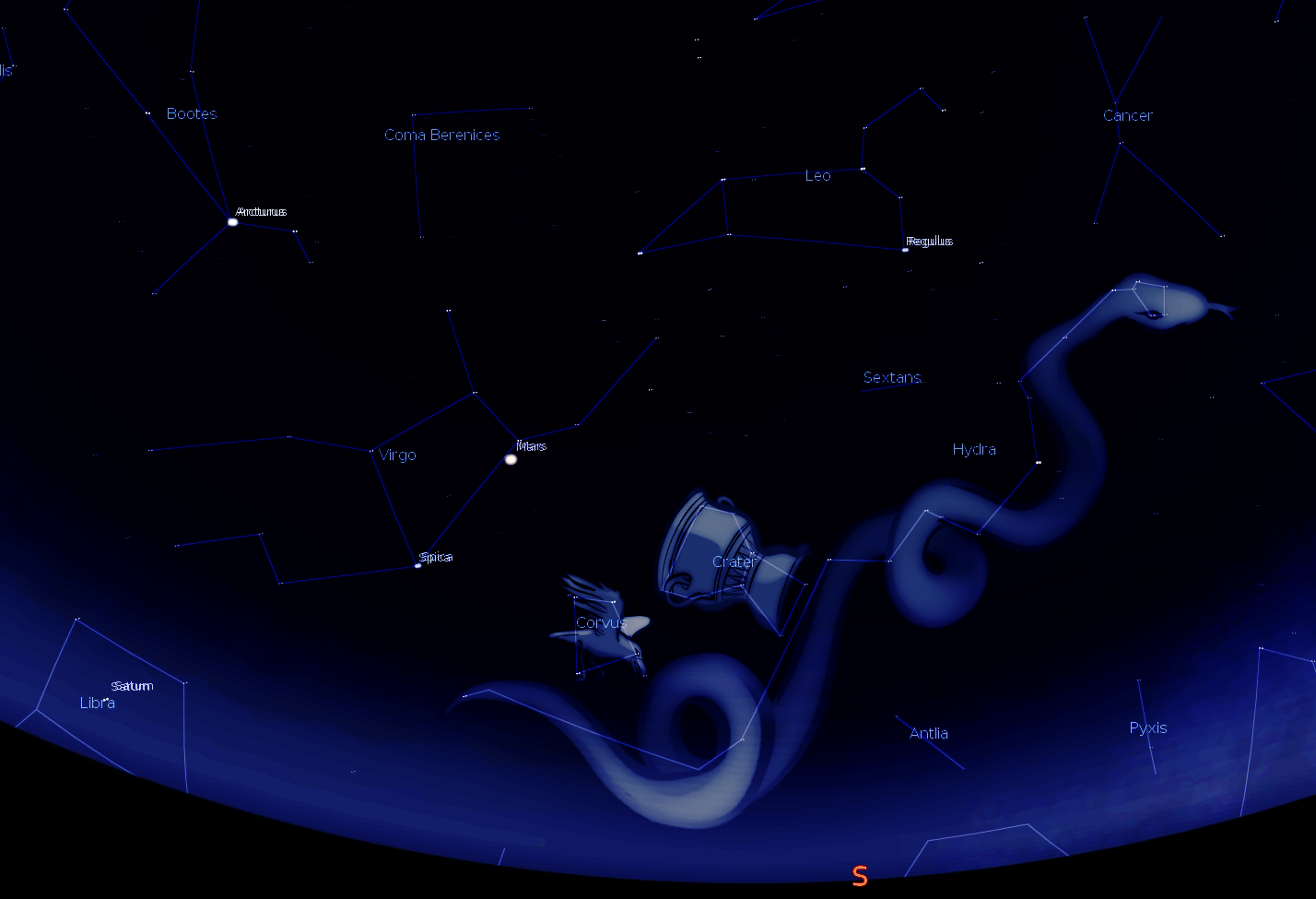
Corvus the crow, Crater the cup and Hydra the water snake along with the other spring constellations ay 10 p.m. April 28, 2014. Created using Stellarium.
04/25/2014 – Ephemeris – Star parties this weekend in the Grand Traverse area
Ephemeris for Arbor Day, Friday, April 25th. The sun rises at 6:41. It’ll be up for 13 hours and 57 minutes, setting at 8:39. The moon, 3 days past last quarter, will rise at 5:11 tomorrow morning.
The Grand Traverse Astronomical Society will be holding two events this weekend, starting tonight. Tonight’s Star Party will be held at the Sleeping Bear Dunes National Lakeshore’s Dune Climb parking lot. The event runs from 9 to 11 p.m. The event will be cancelled due to clouds. Check by calling the park if in doubt this afternoon. The second event will be a star party at Northwestern Michigan College’s Rogers observatory tomorrow night. That one runs also from 9 to 11 p.m. For that one rain or shine we will have scheduled a presentation on famous women astronomers presented by Becky Shaw. The observatory is located south of Traverse City, on Birmley road about a mile south of Hammond Road.
Times are for the Traverse City/Interlochen area of Michigan. They may be different for your location.
04/24/2014 – Ephemeris – Venus and the Moon in the morning
Ephemeris for Thursday, April 24th. The sun rises at 6:43. It’ll be up for 13 hours and 55 minutes, setting at 8:38. The moon, 2 days past last quarter, will rise at 4:39 tomorrow morning.
The planet Venus will be hanging with the moon for the next two mornings. Tomorrow morning the crescent Moon will appear to the right and above Venus. The planet will rise at 5:13, though it should be high enough to spot by 5:30 or 5:45 a.m. in the east. Saturday morning the crescent moon will be to the left of Venus. The moon will be passing Venus about 5 p.m. tomorrow afternoon. Parts of Asia will get a good look at that. We’ll get before and after shots of it. Viewing the moon and planets near the sun is easy or hard depending on the season. For the best views its generally late winter and spring evenings and late summer and autumn mornings. It’s the wrong time of year for easy Venus viewing.
Times are for the Traverse City/Interlochen area of Michigan. They may be different for your location.
Addendum
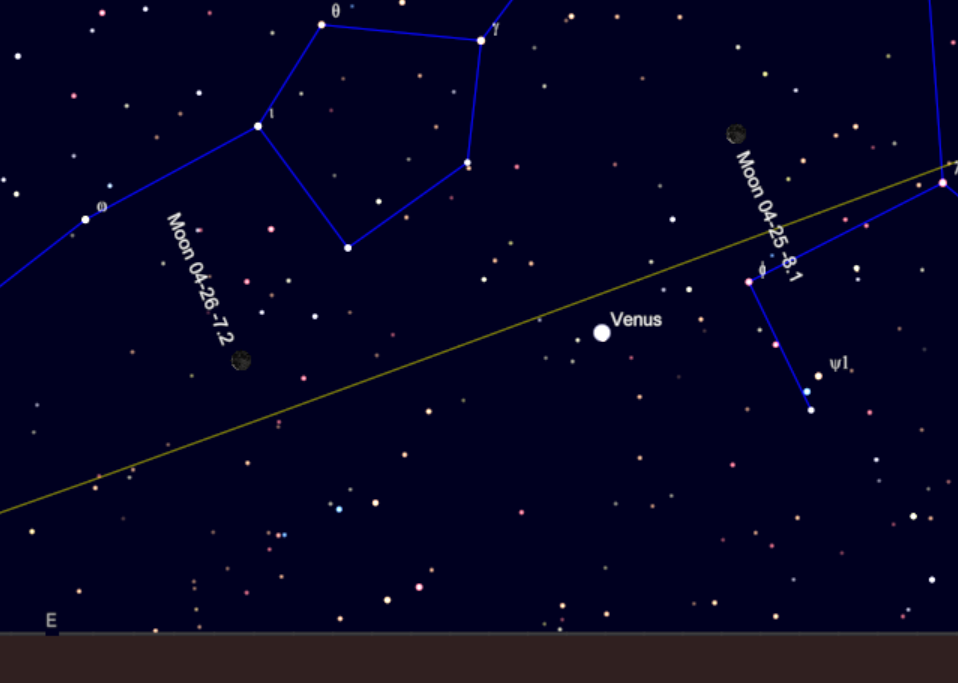
Venus and the Moon on two consecutive mornings 04/25/14 and 04/26/14 at 6 a.m. The yellow line is the ecliptic which is the path of the Sun in the sky. Created using Cartes du Ciel (Sky Charts).
04/23/2014 – Ephemeris – Where are those bright planets this week?
Ephemeris for Wednesday, April 23rd. The sun rises at 6:45. It’ll be up for 13 hours and 52 minutes, setting at 8:37. The moon, 1 day past last quarter, will rise at 4:06 tomorrow morning.
Wednesday is Bright Planets Day, or should I say classical planets day here on Ephemeris. Bright Jupiter will be in the western sky as darkness falls tonight. It will set at 2:17 a.m. Reddish Mars is in Virgo and outshines the bright bluish star Spica below it as darkness falls. Mars is up at sunset in the east. It will pass due south at 12:26 a.m. It’s 58.1 million miles (95.5 million kilometers) away now, and moving away. It will set at 6:14 a.m. Saturn will rise at 9:54 p.m. It’s in the faint constellation of Libra the scales this year. It will pass due south at 2:52 a.m. The telescope will bring out Saturn’s beautiful rings, whose short dimension now is as wide as the planet. Brilliant Venus will rise in the east at 5:14 a.m. and will stay pretty low to the horizon.
Times are for the Traverse City/Interlochen area of Michigan. They may be different for your location.
Addendum
Jupiter and the setting winter constellations in the west at 10 p.m. on April 23, 2014. Created using Stellarium.
Jupiter and satellites through a telescope at 10 p.m. on April 23, 2014. Created using Stellarium.
Mars, Saturn and some spring constellation at 10:30 p.m. April 23, 2014. Created using Stellarium.
Telescopic Mars. Actually Mars is much smaller in appearance than Jupiter. Interesting albedo features can be seen. For 10:30 pm. April 23, 2014. Created using Stellarium.
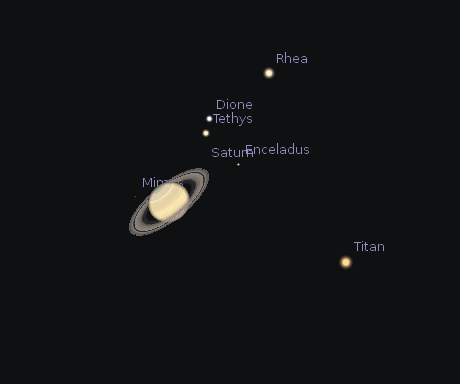
Telescopic Saturn at 11 p.m. April 23, 2014. You may want to wait a bit for it to rise some more for clearer views. Created using Stellarium.
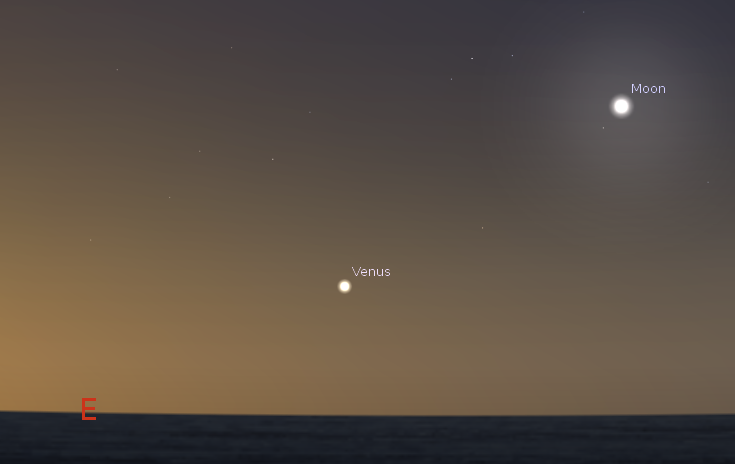
Venus and the Moon looking eastward at 6 a.m. on April 24, 2014. Created using Stellarium.
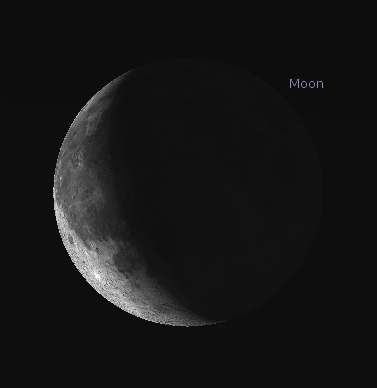
The moon as seen in binoculars at 6 a.m. on April 24, 2014. Created using Stellarium.
Venus through a telescope at 6 a.m. April 24, 2014. Note that none of these planetary images are to the same scale. Created using Stellarium.
04/22/2014 – Ephemeris – The Great Bear and the Fisher Star
Ephemeris for Earth Day, Tuesday, April 22nd. The sun rises at 6:46. It’ll be up for 13 hours and 49 minutes, setting at 8:36. The moon, at last quarter today, will rise at 3:31 tomorrow morning.
This evening the Big Dipper is practically overhead. The Europeans and some Native Americans say it as the hind end of a bear with dimmer stars making up the rest of the bear. The official constellation of which the Big dipper is a part is Ursa Major, the Great Bear. The native Americans were smart enough to depict the handle stars of the dipper as three hunters following the bear, rather than the bear’s unnaturally long tail. The Anishinabek Indians who settled around here saw instead of a bear a weasel like creature, who did have a long tail called Fisher or Fisher Star, who through a great adventure, with his other animal friends, brought summer and the rest of the seasons to the frozen earth.
Times are for the Traverse City/Interlochen area of Michigan. They may be different for your location.
Addendum
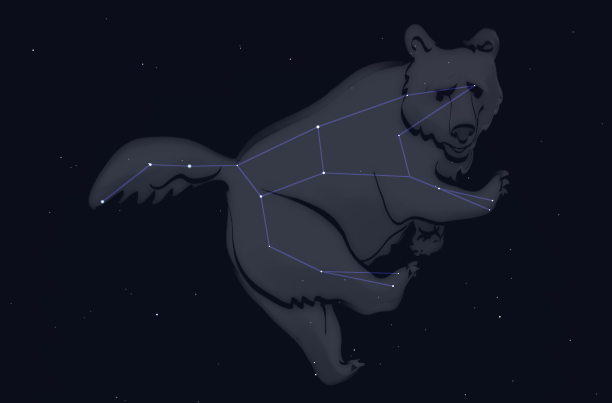
The Great Bear as the Europeans saw it. Created using Stellarium.
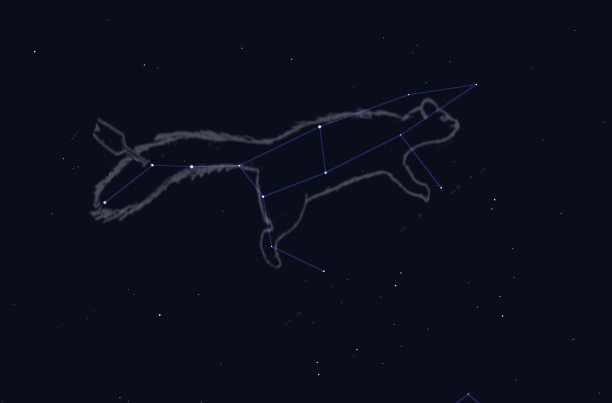
The Fisher Star. Created using Stellarium.
04/28/2014 – Ephemeris – The Lyrid meteor shower will reach peak tomorrow
Ephemeris for Monday, April 21st. The sun rises at 6:48. It’ll be up for 13 hours and 46 minutes, setting at 8:34. The moon, 1 day before last quarter, will rise at 2:52 tomorrow morning.
The second major meteor shower this year will reach its peak tomorrow afternoon (~18h UT). The best shot to see it will be tonight from about 10 to near 3 a.m. when the moon rises. The meteor shower is called the Lyrids, because they seem to come from near the constellation Lyra the harp and the bright star Vega. At 10 p.m. Vega is the brightest star low in the northeastern sky. By 3 a.m. Vega will be high in the east. The radiant of the meteors is to the west of Vega between Lyra and the dim constellation of Hercules. The most meteors will be visible just before the moon begins to brighten the sky before 3 a.m. Though a major shower the peak hourly rate is expected to be 18 meteors an hour. However we won’t quite get close to that rate.
Times are for the Traverse City/Interlochen area of Michigan. They may be different for your location.
Addendum
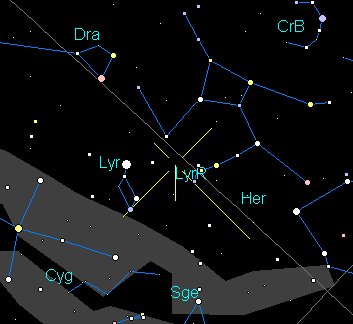
Lyrid meteor radiant. The bright star is Vega
The source of my information, the International Meteor Organization calendar can be downloaded from here.
David Dickinson’s post on this year’s Lyrid meteor shower on Universe Today is here.
04/18/2014 – Ephemeris – The constellation Coma Berenices
Ephemeris for Good Friday, Friday, April 18th. The sun rises at 6:53. It’ll be up for 13 hours and 37 minutes, setting at 8:31. The moon, 3 days past full, will rise at 12:21 tomorrow morning.
High in the southeast at 10 p.m. is a tiny and faint constellation of Coma Berenices, or Berenice’s hair. In it are lots of faint stars arrayed to look like several strands of hair. The whole group will fit in the field of a pair of binoculars, which will also show many more stars. The hank of hair was supposed to belong to Berenice, Queen of Egypt, of the 3rd century BCE. Coma Berenices is the second closest star cluster to us at only 250 light years away, after the Hyades, the face of Taurus the bull now setting in the west. It’s in an odd spot for a galactic star cluster, that’s supposed to lie in the plane of the Milky Way. It actually lies at the galactic pole. That’s an illusion because it’s so close to us. It’s still really in the plane of the Milky Way.
Times are for the Traverse City/Interlochen area of Michigan. They may be different for your location.
Addendum
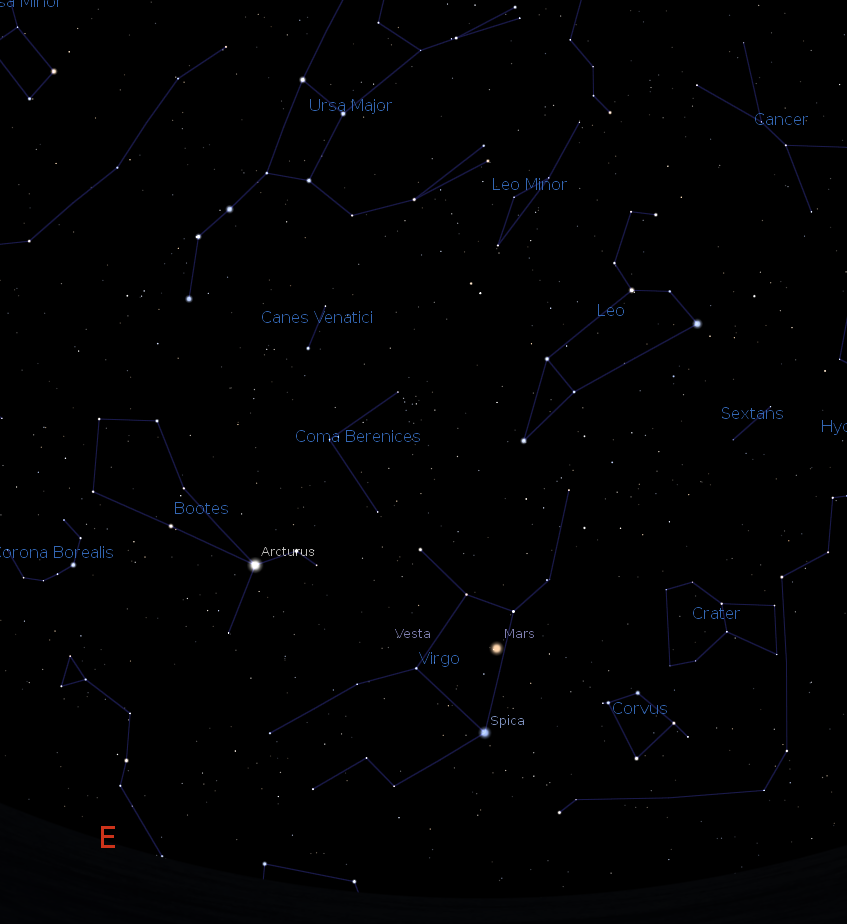
Coma Berenices finder chart for 10 p.m. April 18, 2014. Created using Stellarium.
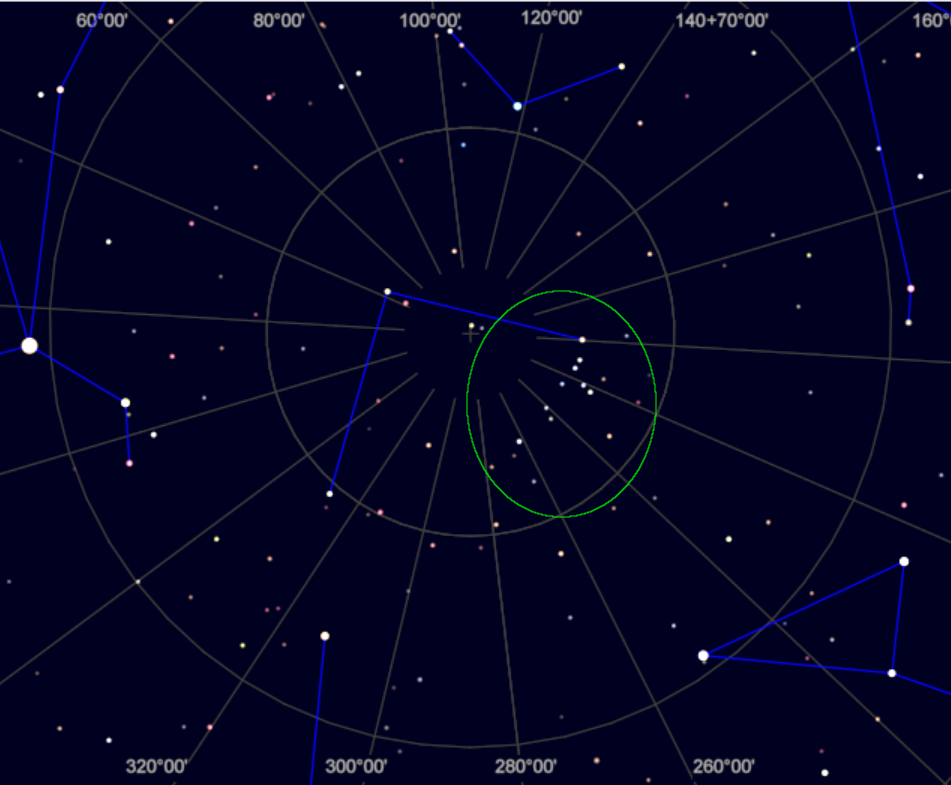
Coma Berenices and galactic coordinates showing how close to the galactic pole it is. Created using Cartes du Ciel
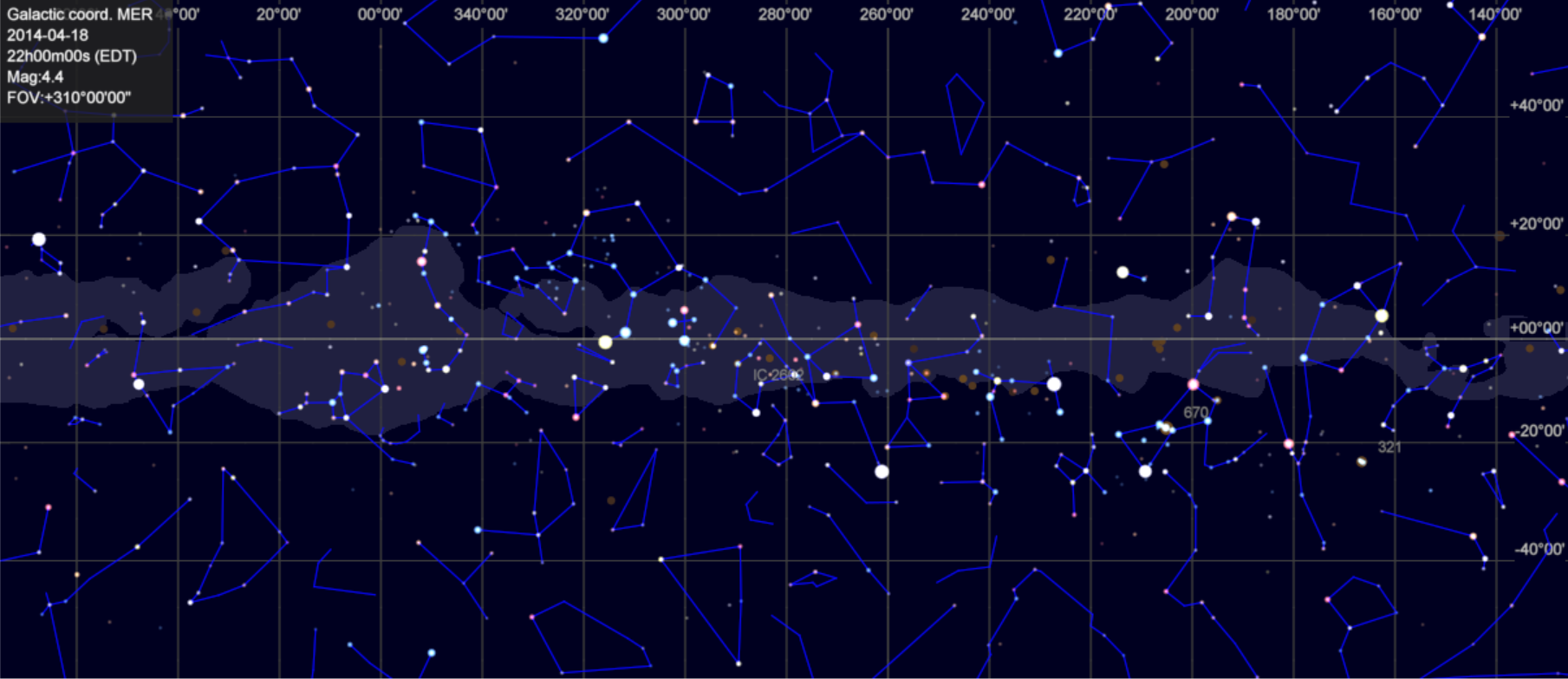
Mercator projection of the Milky Way and some bright open or galactic clusters (brown disks). See how the distribution hugs the milky band. Clusters farther away are either close to us or very old for open clusters. Created using Cartes du Ciel.
04/17/2014 – Ephemeris – Leo and the bright star Regulus
Ephemeris for Thursday, April 17th. The sun rises at 6:54. It’ll be up for 13 hours and 34 minutes, setting at 8:29. The moon, 2 days past full, will rise at 11:19 this evening.
High in the south at 10 p.m. is a pattern of stars that’s in the shape of a backward question mark. This informal star group or asterism, is also called the sickle. It is the head and mane of the official zodiacal constellation of Leo the lion. To the left is a triangle of stars is his hind end. The bright star at the bottom of the question mark, or end of the sickle’s handle is Regulus, the “Little King Star”, alluding to the lion’s status as the king of the jungle. Regulus is about 79 light years away and is a 4 star system that exists as two star pairs. The bright star Regulus itself and a companion too close to be imaged directly in telescopes, and a nearby pair of dim stars make up the system. The Moon often passes in front of Regulus, since it’s close its path.
Times are for the Traverse City/Interlochen area of Michigan. They may be different for your location.
Addendum
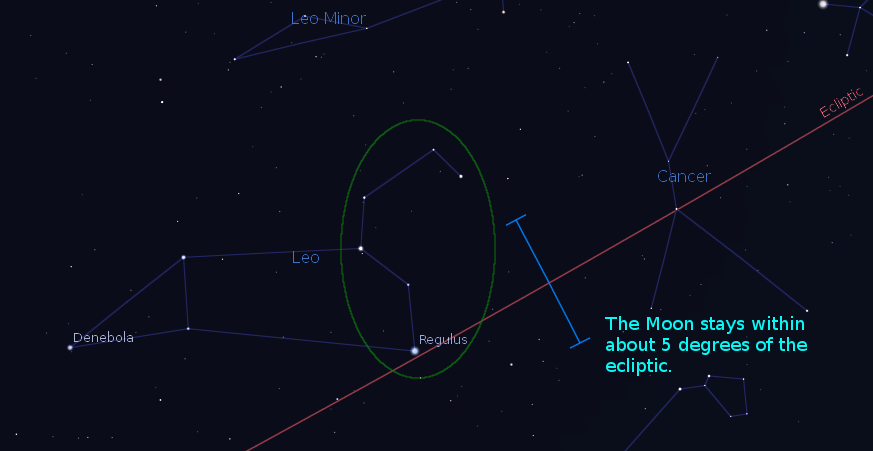
Leo’s sickle and backward question mark asterisms circled in green. Note that it is within the range of the moon’s orbit so it can be covered or occulted by the Moon. Created using Stellarium.
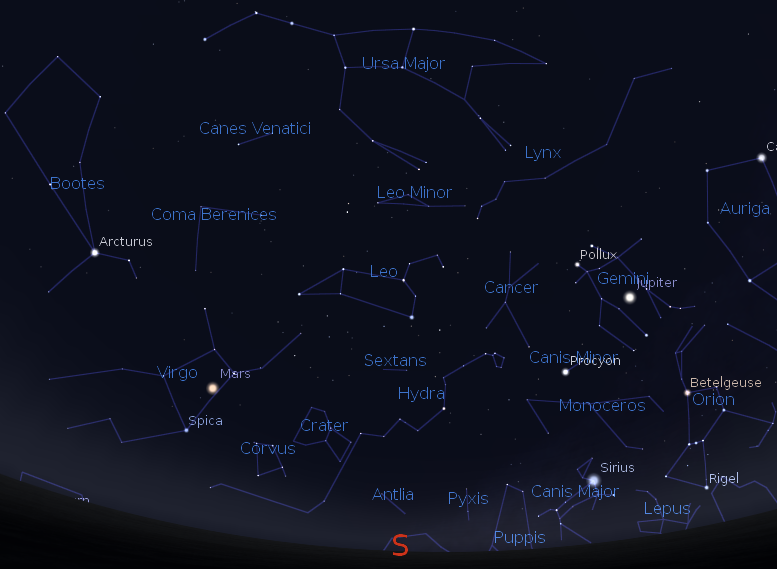
Leo finder chart for 10 p.m. April 17, 2014. Created using Stellarium.
 Bob Moler's Ephemeris Blog