Archive
06/16/2014 – Ephemeris – Dates of the earliest sunrise and latest sunset
Ephemeris for Monday, June 16th. Today the sun will be up for 15 hours and 33 minutes, setting at 9:29. The moon, half way from full to last quarter, will rise at 12:11 tomorrow morning. Tomorrow the sun will rise at 5:56.
Yesterday saw the earliest sunrise for the year. My sunrise times will start to show a change on Thursday. The day-to-day change in sunrise times are now a few seconds. The summer solstice, or longest day will be this Saturday, and the latest sunset won’t occur until next week Thursday. The reason these dates don’t coincide has to do with the tilt of the earth’s axis and the earth’s slightly elliptical path around the sun. Actually the disparity between these dates is more pronounced at the winter solstice when the Earth is closer to the sun and moving faster. Yup, the sun is farther away now than it was in December. Actually we’re moving slower now, so summer lasts a few days longer than winter.
Times are for the Traverse City/Interlochen area of Michigan. They may be different for your location.
06/13/2014 – Ephemeris – Saturn’s Rings and the Cassini Division
Ephemeris for Friday, June 13th. Today the sun will be up for 15 hours and 31 minutes, setting at 9:28. The moon, at full today, will rise at 9:54 this evening. Tomorrow the sun will rise at 5:56.
Saturn rings are the wonder of the solar system. While we know that Saturn isn’t the only planet with rings. Jupiter, Uranus, and Neptune have them plus at least one asteroid. Nowhere are they as grand as at Saturn. The rings actually outshine the planet. Now they are opening to their widest extent, and will continue to open a bit more until 2017, before closing again for 7 ½ years. Last Friday during the star party at Northwestern Michigan College’s Rogers Observatory, I was able to spot the break in the rings called Cassini’s Division. It’s caused by the orbital resonance of the moon Mimas and the ring particles at that distance from Saturn. Mimas orbits Saturn once to the ring particles at the division orbiting twice.
Times are for the Traverse City/Interlochen area of Michigan. They may be different for your location.
Addendum
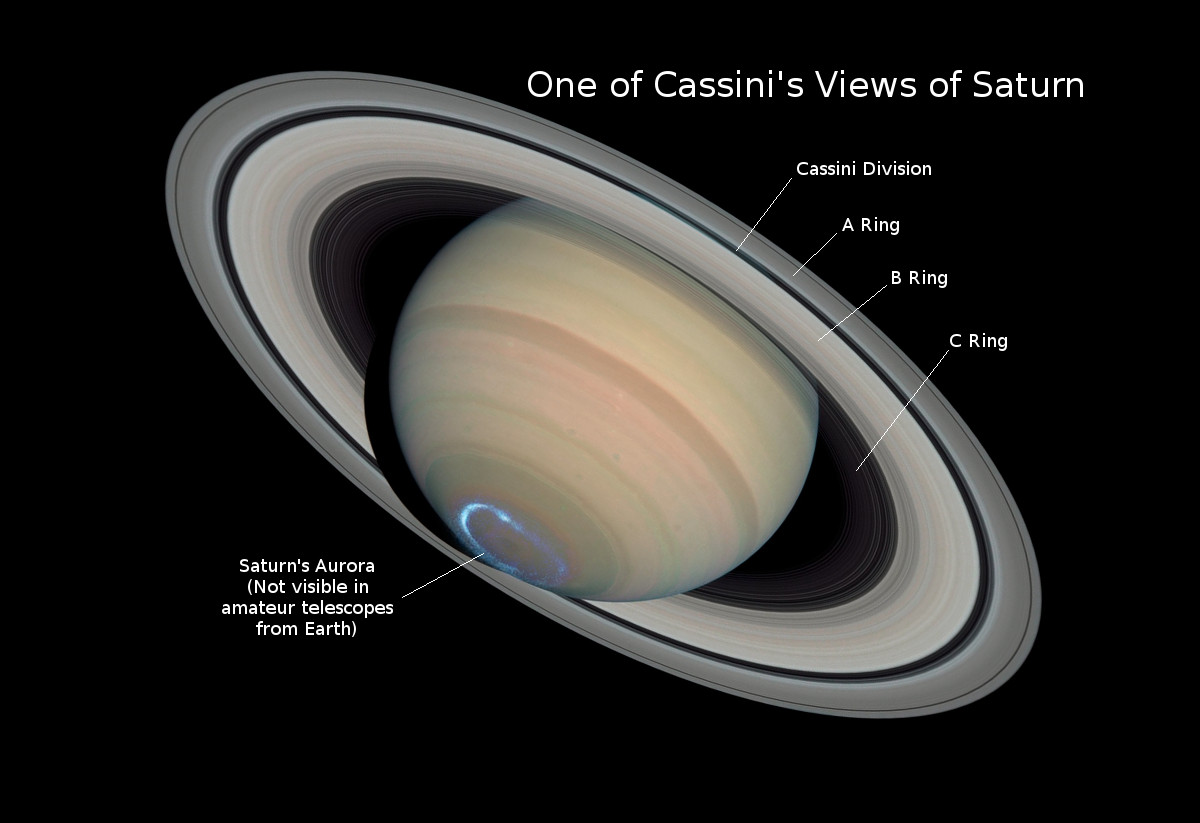
Saturn and rings from the Cassini spacecraft, plus the aurora oval in ultraviolet. Credit: NASA/JPL/Space Science Institute
06/12/2014 – Ephemeris – Jupiter is making up for lost time and is heading rapidly eastward
Ephemeris for Thursday, June 12th. Today the sun will be up for 15 hours and 31 minutes, setting at 9:28. The moon, 1 day before full, will set at 6:38 tomorrow morning. Tomorrow the sun will rise at 5:56.
The planet Jupiter which is the brilliant star-like object in the west is starting to pick up its eastward motion in the stars. Several months ago as the earth was passing Jupiter when it was rising in the east at sunset, it had stopped its eastward motion against the stars and headed westward. This retrograde motion was due to Earth in essence passing the slower moving Jupiter. Now that it’s on the other side of the sun Jupiter is making up for lost time because it and Earth are now moving in opposite directions. This I see in the week to week setting times of Jupiter. Stars rise and set 4 minutes earlier each night. For Jupiter its down to three minutes, meaning it’s moving eastward. When we see it again in December it will have blown past Cancer to Leo, but it will later backtrack into Cancer.
Times are for the Traverse City/Interlochen area of Michigan. They may be different for your location.
Addendum
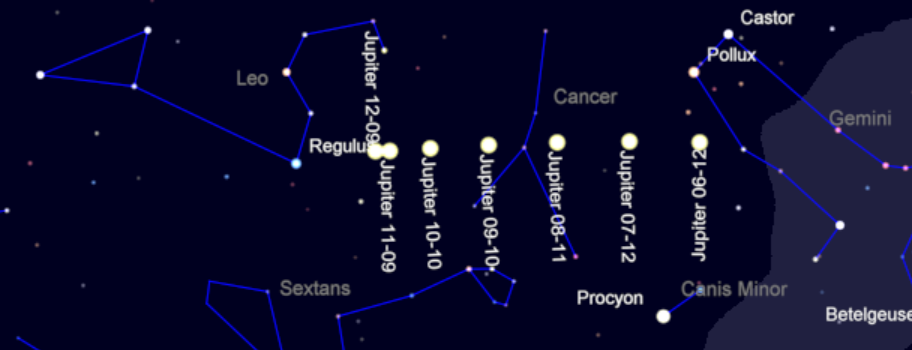
Jupiter’s apparent motion over the next 180 days. Note by December Jupiter will slow and will begin its retrograde loop as the Earth catches up with it again. Created using Cartes du Ciel (Sky Charts).
06/11/2014 – Ephemeris – It’s 11 p.m., do you know where your bright planets are?
Actually yes we do. Three are visible at 11 p.m., One, Mercury is MIA too close to the sun to be seen. And the 5th bright planet is a morning person planet. Uranus and Neptune are beyond the scope of this radio program. Well, on with the transcript:
Ephemeris for Wednesday, June 11th. Today the sun will be up for 15 hours and 30 minutes, setting at 9:27. The moon, 2 days before full, will set at 5:40 tomorrow morning. Tomorrow the sun will rise at 5:56.
It’s Wednesday and once again time to locate the bright planets for this week. We have lost Mercury to the bright twilight glow, and the fact that it’s getting dimmer as a crescent. Brilliant Jupiter will be in the western sky in Gemini as darkness falls tonight. It’s getting lower each night and will set at 11:36 p.m. tonight. Reddish Mars is in Virgo in the south-southwest as darkness falls. It’s 80 million miles (128 million km) away now, and moving away, and will set at 2:49 a.m. Saturn will be low in the southeast as darkness falls. It’s in the faint constellation of Libra the scales this year. It will pass due south at 11:26 p.m. Brilliant Venus will rise in the east at 4:14 a.m. in morning twilight.
Times are for the Traverse City/Interlochen area of Michigan. They may be different for your location.
Addendum
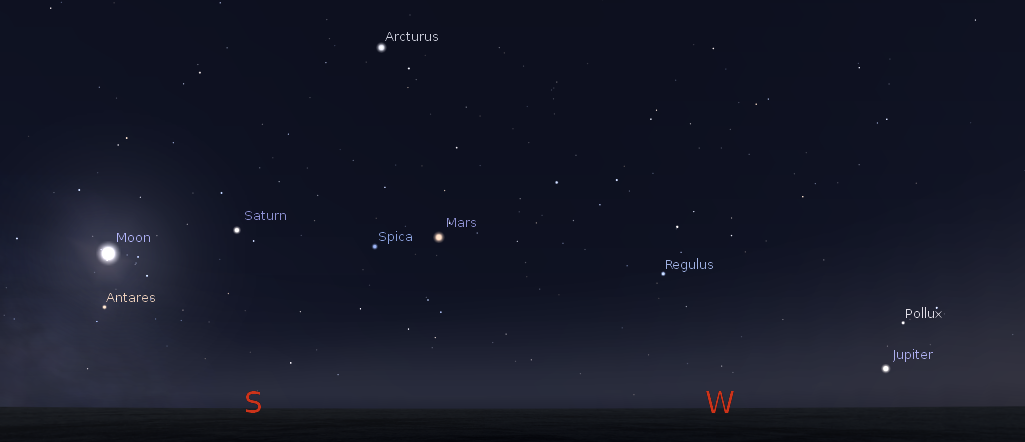
The evening planets at 11 p.m. on June 11, 2014. Created using Stellarium.
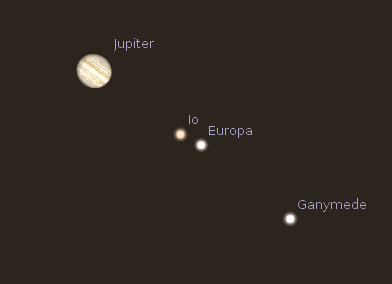
Jupiter and moons at 10 p.m., June 11, 2014 Callisto is in Jupiter’s shadow and wont emerge until 11:09 p.m. when Jupiter will be less than 5 degrees above the horizon in Michigan. Created using Stellarium.
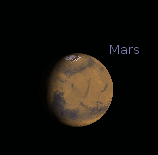
Mars through a telescope at 11 p.m., June 11, 2014. The large dark feature Syrtis Major is rotating onto the Earth side face of the planet from the left. Created using Stellarium.
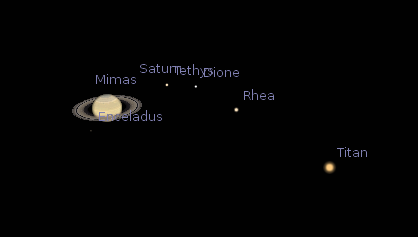
Saturn and some of its brighter moons at 11 p.m. June 11, 2014. The moon Titan can be seen in small telescopes, but larger scopes may be necessary to pick out the other satellites. Created using Stellarium.
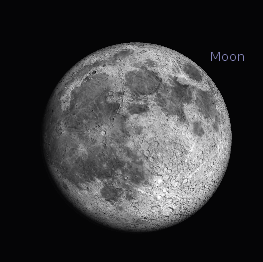
The Moon as seen in binoculars at 11 p.m., June 11, 2014. Created using Stellarium.
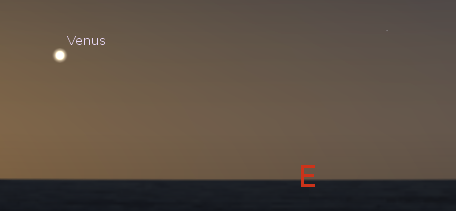
Venus in morning twilight at 5 a.m., June 12, 2014. Created using Stellarium.
A telescopic view of Venus as it would be seen at 5 a.m., June 12, 2014. Created using Stellarium.
06/10/2014 – Ephemeris – Our Moon and Saturn’s largest moon Titan
Ephemeris for Tuesday, June 10th. Today the sun will be up for 15 hours and 29 minutes, setting at 9:26. The moon, 3 days before full, will set at 4:51 tomorrow morning. Tomorrow the sun will rise at 5:57.
Tonight the planet Saturn will be near the bright gibbous Moon. One might need a bit of help locating it in the Moon’s glare. Saturn is to the right and slightly above the Moon. Saturn has a few moons of its own. The count’s up to 62, with another apparently forming from one of Saturn’s rings as monitored by the Cassini spacecraft now in orbit of Saturn. Cassini, which has about three years left in its mission, entered orbit of Saturn 10 years ago next month after a 7 year journey to get there. One of the most intensively studied moons is Titan, whose haze foiled the earlier Voyager spacecraft, Cassini and it’s Huygens lander have shown us earthly terrain and methane seas. Titan is easily seen in small telescopes near Saturn.
Addendum
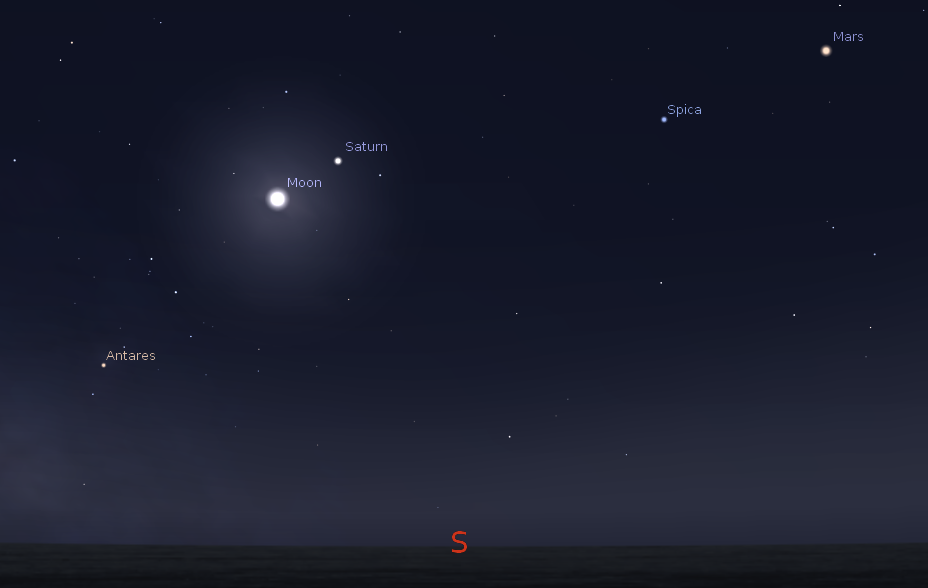
Saturn and the Moon tonight at 11 p.m., June 10, 2014. Created using Stellarium.
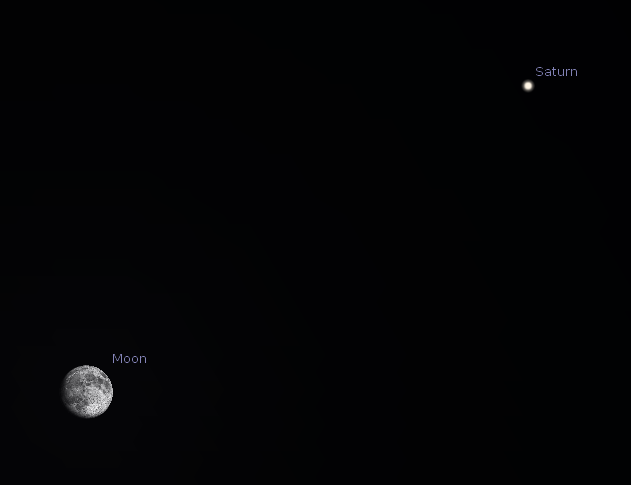
Just Saturn and the Moon showing the moon’s gibbous phase at 11 p.m. June 10, 2014. Created using Stellarium.
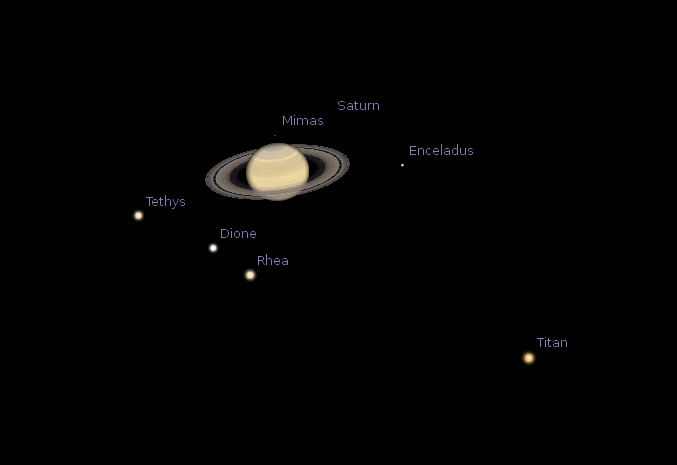
Saturn and its moons including Titan at 11 p.m. June 10, 2014. Created using Stellarium.
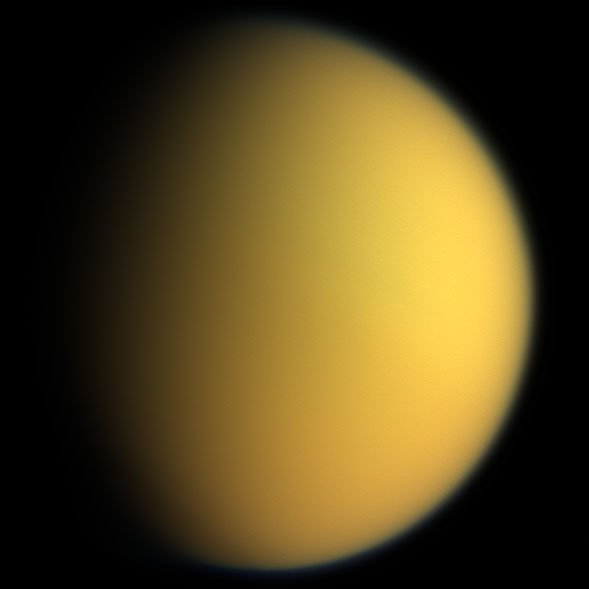
Titan, as Voyager would have seen it, but photographed by Cassini. Credit: NASA/JPL/Space Science Institute.
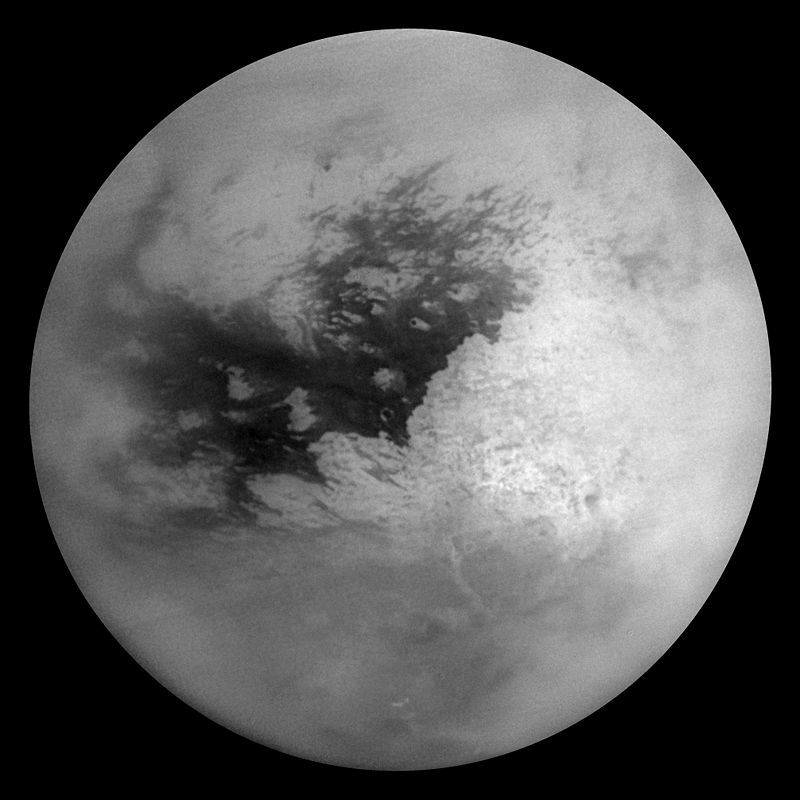
Titan as seen in the infrared by the Cassini spacecraft. Credit: NASA/JPL/Space Science Institute.
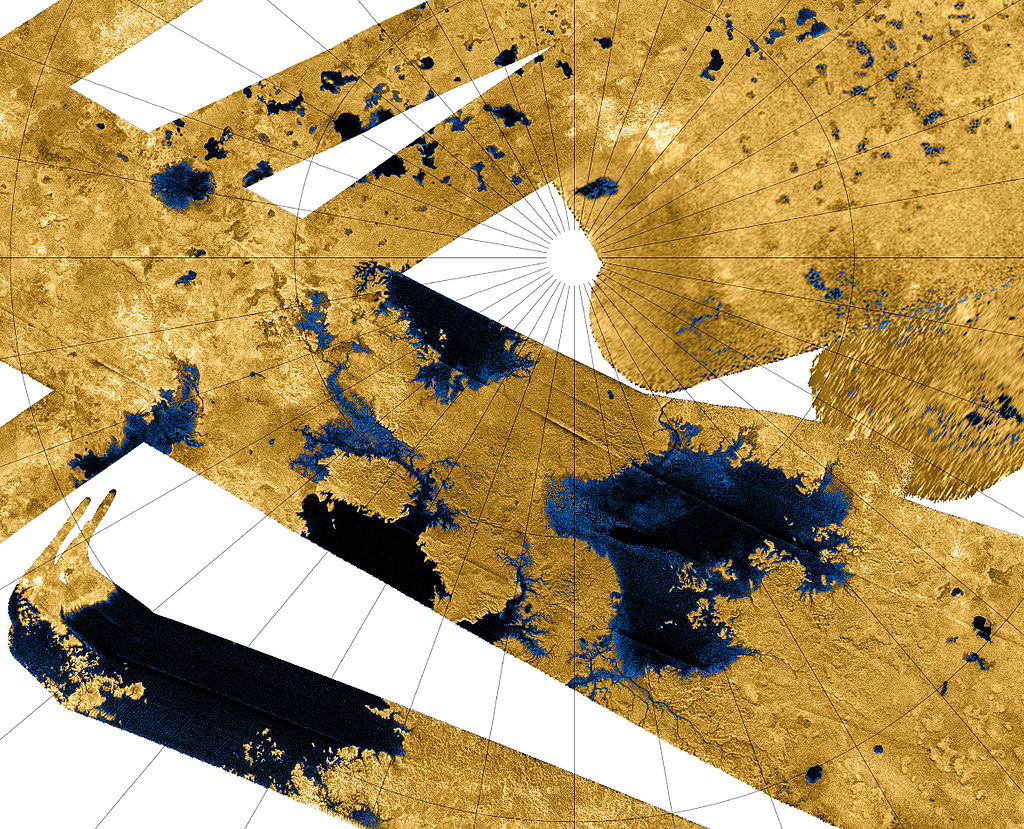
Seas and lakes at Titan’s north pole seen by radar from the Cassini spacecraft. Credit: NASA/JPL-Caltech/GSFC.

Image mosaic of Titan from the descending Huygens Lander. Credit: ESA/NASA/Univ. of Arizona.
06/09/2014 – Ephemeris – The brightest spot on the moon
Ephemeris for Monday, June 9th. Today the sun will be up for 15 hours and 28 minutes, setting at 9:26. The moon, half way from first quarter to full, will set at 4:09 tomorrow morning. Tomorrow the sun will rise at 5:57.
For all you Moon lovers out there we have a chance to study with telescopes the brightest spot on the Moon. It is at the upper left corner of the Moon and can easily be seen in binoculars. It’s the crater Aristarchus. However a telescope is what’s needed to see the crater in detail. Like the crater Alphonsus we looked at last Thursday, occasional hazes have been seen in this crater. Aristarchus isn’t really large, only 24 miles (40 km) in diameter. It is a young crater, which is why it’s bright. The asteroid that hit these penetrated the dark gray regolith into the lighter bedrock. Young in this case is somewhere younger than 1.1 billion years old. There’s an interesting valley near it called Schroter’s Valley.
Times are for the Traverse City/Interlochen area of Michigan. They may be different for your location.
Addendum
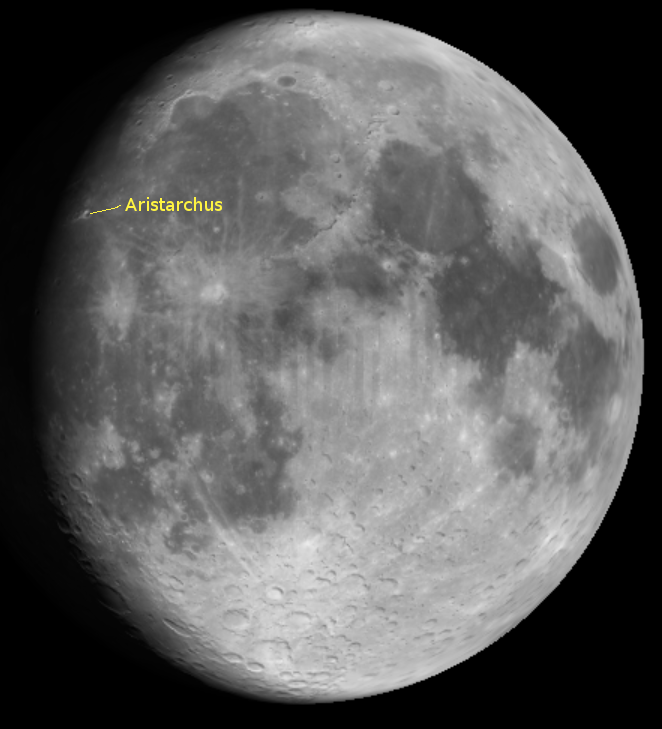
The crater Aristarchus at 11 p.m., June 9, 2014. It will brighten as we move to full moon. Created using Stellarium.
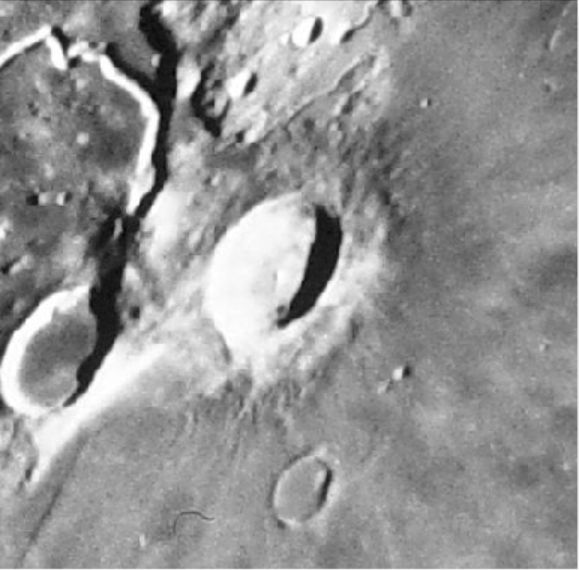
The crater Aristarchus. Credit: Lunar and Planetary Institute.
06/06/2014 – Ephemeris – Astronomy activities this weekend in the Grand Traverse Region
Ephemeris for Friday, June 6th. Today the sun will be up for 15 hours and 26 minutes, setting at 9:24. The moon, 1 day past first quarter, will set at 2:33 tomorrow morning. Tomorrow the sun will rise at 5:57.
The Grand Traverse Astronomical Society, or GTAS, has a busy weekend. At 8 p.m. the regular meeting at Northwestern Michigan College’s Rogers Observatory features Dr. David Penney with his presentation of “The Rare Earth”. At 9 p.m. at the observatory will be a star party until 11 p.m. On Saturday the GTAS will have their telescopes at The Sleeping Bear Dunes National Lakeshore Philip A. Hart Visitors Center in Empire for viewing the sun from 4 to 6 p.m. Then at 9 the GTAS will deploy their telescopes at the Dune Climb for an evening with the planets. The Dunes events will be contingent on the weather. Due to the lateness of the sunset it will be about 10 p.m. before any planets are spotted.
Times are for the Traverse City/Interlochen area of Michigan. They may be different for your location.
06/05/2014 – Ephemeris – A remarkable crater visible on the Moon tonight
Ephemeris for Thursday, June 5th. Today the sun will be up for 15 hours and 25 minutes, setting at 9:23. The moon, at first quarter today, will set at 2:05 tomorrow morning. Tomorrow the sun will rise at 5:58.
Near the Moon’s sunrise terminator at the southern half of our satellite are three large craters roughly arranged parallel to the terminator. The northernmost is the largest named Ptolemaeus. Just south of it is Alphonsus, and the third is Arzachel. Of the three Alphonsus is suspected of activity over the years. In 1956 Dinsmore Alter noticed a haze that obscured some of the cracks in the floor of Alphonsus and took photographs. The ultraviolet photos showed something, but his infrared photos did not. In 1959, Soviet astronomer Nicolai Kozyrev obtained spectra of a glow. In 1965 the last Ranger probe was sent to Alphonsus to see what there was to see, and apparently reported nothing unusual.
Times are for the Traverse City/Interlochen area of Michigan. They may be different for your location.
Addendum
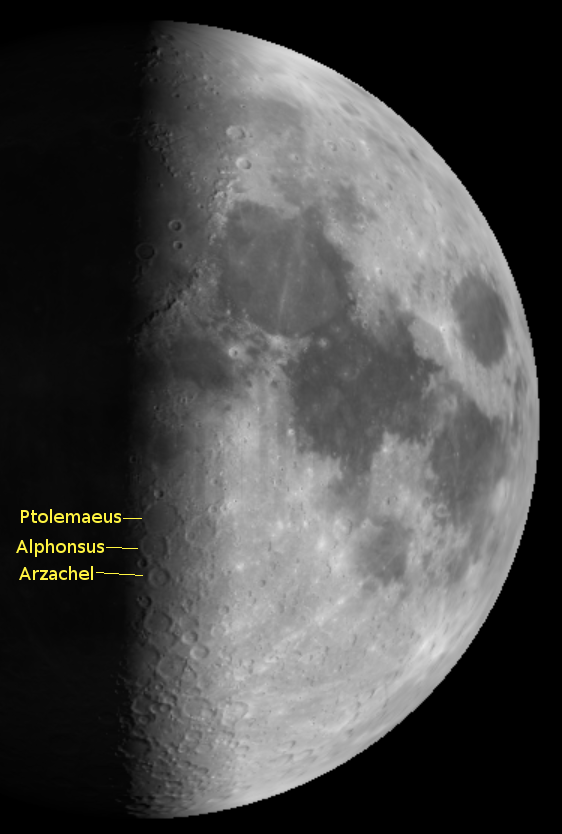
The Moon tonight, June 5, 2014. Created using Virtual Moon Atlas.
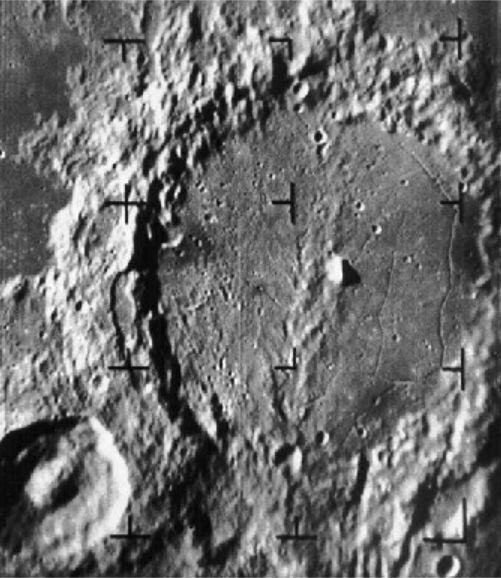
Ranger 9 Image of Alphonsus #1. Credit NASA.
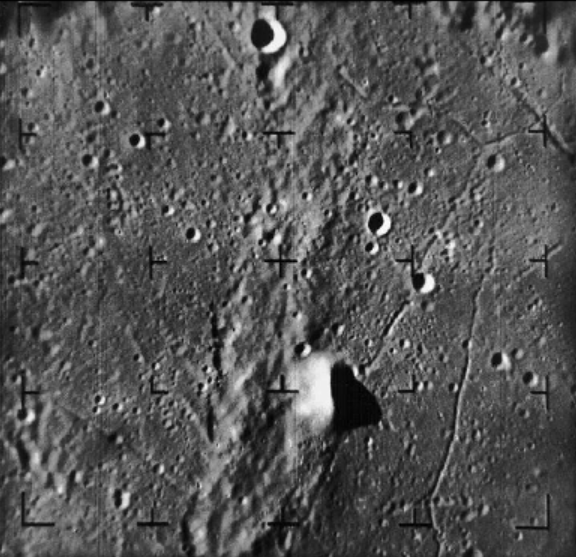
Ranger 9 Image of Alphonsus #2. Credit NASA.
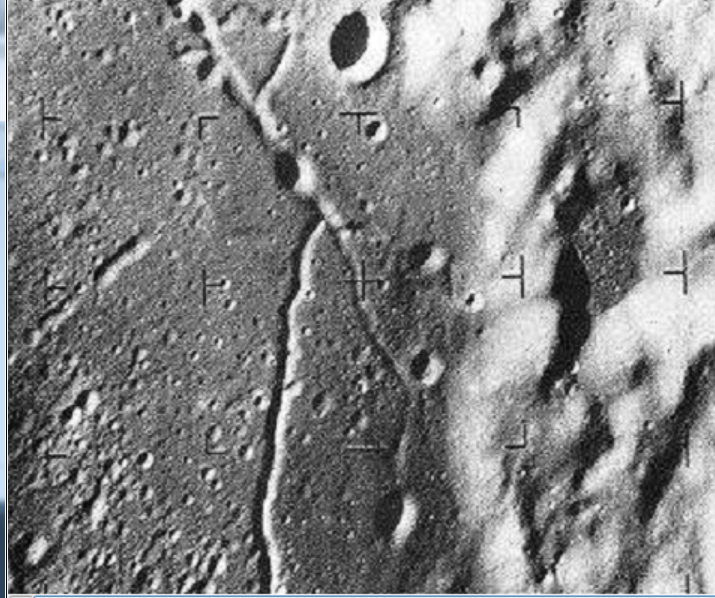
Ranger 9 Image of Alphonsus #3. Credit NASA.
06/04/2014 – Ephemeris – Last week for all 5 pre-telescopic planets to be visible for a while
Ephemeris for Wednesday, June 4th. Today the sun will be up for 15 hours and 23 minutes, setting at 9:22. The moon, 1 day before first quarter, will set at 1:39 tomorrow morning. Tomorrow the sun will rise at 5:58.
It’s Wednesday and once again time to locate the bright planets for this week. Mercury is showing up in the west shortly after sunset, It is getting dimmer (magnitude 1.6) as it is becoming a thin crescent. It will set at 10:47. Brilliant Jupiter will be in the western sky in Gemini as darkness falls tonight. It will set at 11:59 p.m. Reddish Mars is in Virgo in the south-southwest as darkness falls. It’s 76 million miles (122 million km) away now, and moving away, and will set at 3:14 a.m. Saturn will be low in the southeast as darkness falls. It’s in the faint constellation of Libra the scales this year. It will pass due south at 11:55 p.m. Brilliant Venus will rise in the east at 4:21 a.m. in morning twilight.
Times are for the Traverse City/Interlochen area of Michigan. They may be different for your location.
Addendum
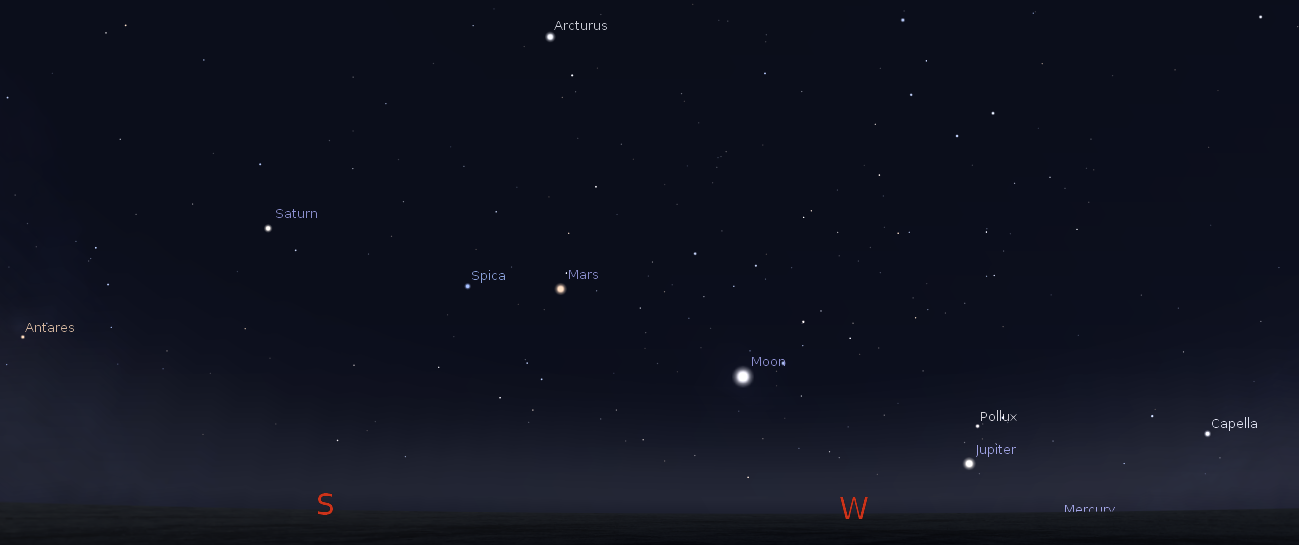
Jupiter, Mars, Saturn and the Moon seen at 11 p.m. June 4, 2014. Created using Stellarium.
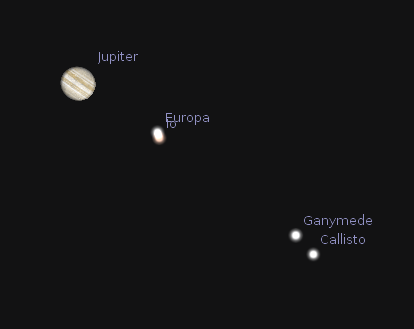
Jupiter and moons in a telescope at 11 p.m. June 4, 2014. Created using Stellarium.
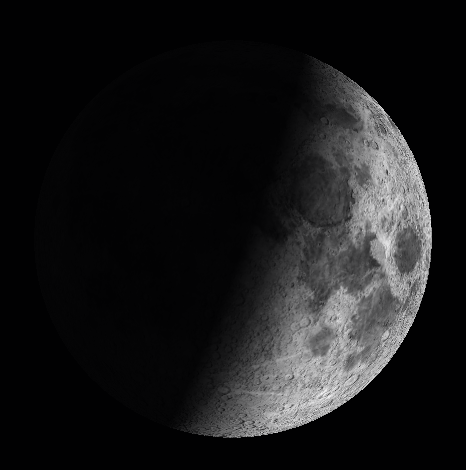
The Moon as it might appear in binoculars at 11 p.m. on June 4, 2014. Created using Stellarium.
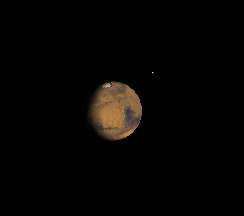
Mars, probably a bit better than it will appear in a small telescope at 11 p.m. June 4, 2014. Created using Stellarium.
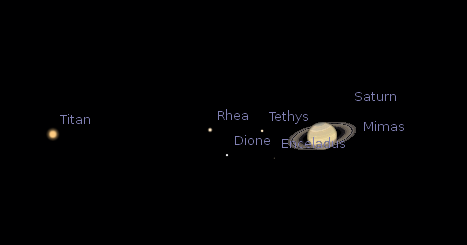
Saturn with some of its moons, not all of them will be visible in a small telescope, at 11 p.m. on June 4, 2014. Created using Stellarium.
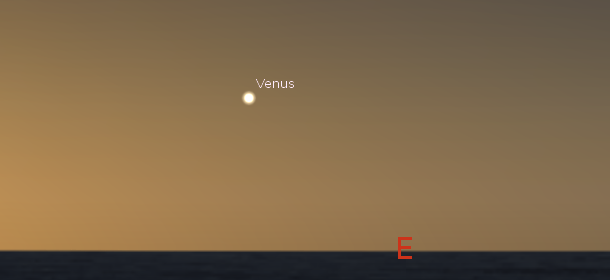
Venus in morning twilight in the east at 5:15, June 5, 2014. Created using Stellarium.
Venus showing its gibbous phase in a telescope at 5:15 a.m. on June 5, 2014. Created using Stellarium.
Want to check out what’s going on at the 224th American Astronomical Society meeting in Boston this week?
Twitter hashtag #aas224. You’ll get bits and pieces of what’s going on and lots of cool images.
 Bob Moler's Ephemeris Blog