Archive
Extra: 03/17/2015 – A geomagnetic storm is raging now
Looks like we’re in for aurorae A.K.A. northern lights tonight. There were displays of the aurora this morning over the northern tier of states according to spaceweather.com. It still could be going on tonight.
Tip ‘o the old observers cap to Don Flegel and Spaceweather.com.
03/17/2015 – Ephemeris – Jupiter’s cloud stripes
Ephemeris for St. Patrick’s Day, Tuesday, March 17th. The Sun will rise at 7:51. It’ll be up for 11 hours and 59 minutes, setting at 7:51. The Moon, 3 days before new, will rise at 6:37 tomorrow morning.
Jupiter is the one planet that we can see detail on with telescopes in the evening sky. Venus is so bright that it is hard to even see its gibbous phase. Actually the best way to see Venus is during the day with the blue sky around it. Jupiter is a big planet, 11 times the Earth’s diameter and 1,300 times it volume. Despite this it is only 318 times the Earth’s mass, so much of its mass is the atmosphere. It’s rotation rate is just under 10 hours at its equator. This drops with latitude, so its atmosphere is twisted into alternate belts and zones. The belts are dark brown while the zones are lighter. They move around the planet at different speeds causing storms that their boundaries. The Great Red Spot is a anticyclone in the south.
Times are for the Traverse City/Interlochen area of Michigan. They may be different for your location.
Addendum
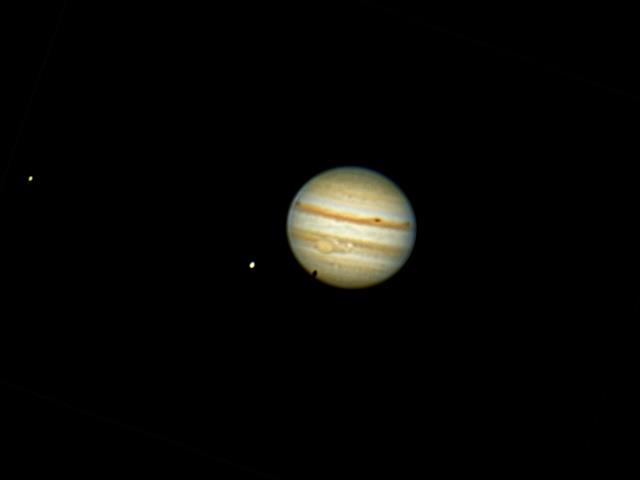
Jupiter by Scott Anttila November 14, 2011. With shadow on the planet and the Great Red Spot.
03/16/2015 – Ephemeris – The bright star Aldebaran
Ephemeris for Monday, March 16th. The Sun will rise at 7:53. It’ll be up for 11 hours and 56 minutes, setting at 7:49. The Moon, 3 days past last quarter, will rise at 5:57 tomorrow morning.
The constellation Orion, is in the south-southwest at 9 p.m. To the right of it, in the southwest is Taurus the bull. The bright orange star in Taurus is Aldebaran. Aldebaran appears at the upper left tip of a letter V group of stars that is the face of the bull. Aldebaran isn’t actually part of the group, called the Hyades star cluster. The cluster is about 151 light years away, while Aldebaran is 65. The star has an orange hue because its surface is cooler than the sun’s. However Aldebaran is 44 times larger in diameter, and shines 518 times brighter than the sun. The name Aldebaran means “Follower” because it follows the Pleiade star cluster through the skies. The Pleiades are to the right of Aldebaran.
Times are for the Traverse City/Interlochen area of Michigan. They may be different for your location.
Addendum
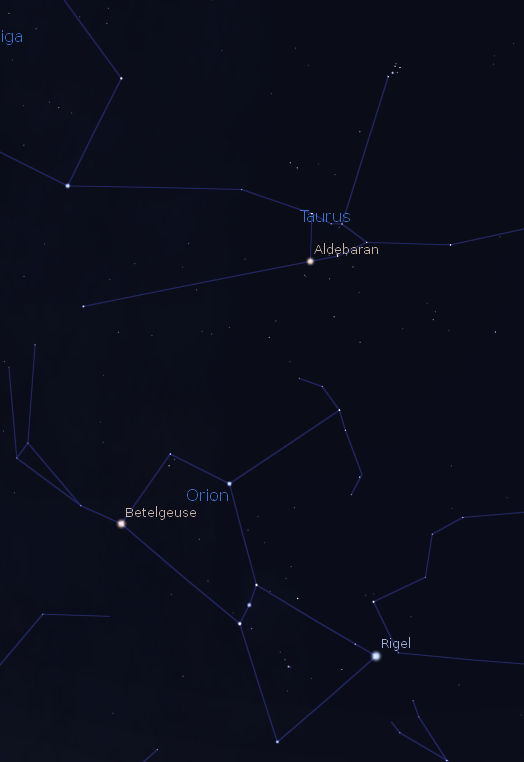
Aldebaran, the Hyades, of Taurus, Orion and the Pleiades. Created using Stellarium.
03/13/2015 – Ephemeris – Leo rising
Ephemeris for Friday, March 13th. The Sun will rise at 7:59. It’ll be up for 11 hours and 46 minutes, setting at 7:46. The Moon, at last quarter today, will rise at 3:35 tomorrow morning.
The constellation Leo the lion is now rising in the east at 9 pm. It’s below and left of the Big Dipper higher up in the east-northeast. Leo is marked by two sets of easily recognizable stars. The front of him is a backward question mark of stars, also known as the Sickle that mark his head and mane, along with the front part of his body. Regulus is the star at the bottom of that backwards question mark. It’s the Little King Star. Jupiter this year is above right if it. The hind end of him is a triangle of stars ending with another bright star, but not as bright as Regulus. It’s Denebola which means Lion’s tail. It is thought when the sun was in this constellation long ago that the lions were driven by the heat to quench their thirst in the Nile river. Ancients physicians thought medicines were poison when the sun was here too.
Times are for the Traverse City/Interlochen area of Michigan. They may be different for your location.
Addendum
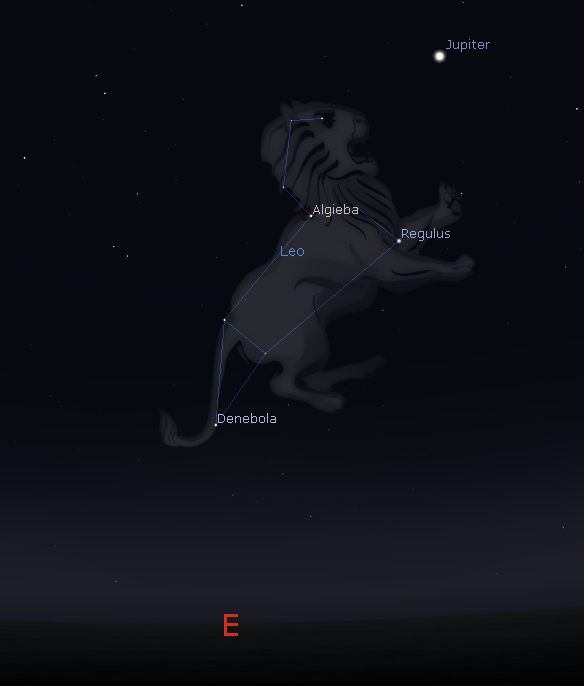
Leo rising in the east behind Jupiter at 9 p.m. on March 13, 2015. Created using Stellarium.
03/12/2015 – Ephemeris – Tonight’s a big night for Jovian satellite events
Ephemeris for Thursday, March 12th. The Sun will rise at 8:01. It’ll be up for 11 hours and 43 minutes, setting at 7:44. The Moon, 1 day before last quarter, will rise at 2:40 tomorrow morning.
Tonight will be a busy one in Jupiter’s system for those watching with telescopes. As it gets dark Jupiter’s moon Io will be in front of Jupiter and very difficult to spot. It’s shadow may be seen as a tiny inky black dot on the face of the planet. Io will move off the planet at 8:55 p.m., This will be followed by the shadow at 9:42 p.m. The fun isn’t over because the moon Europa will be appearing to approach Jupiter as Io leaves it. Europa will disappear behind Jupiter at 12:06 a.m. It will stay hidden until 4:32 a.m. Europe will clear the planet earlier, but will still be in Jupiter’s shadow until 4:32. When a moon’s in shadow, it is said to be eclipsed. When behind the planet it is occulted and when in front of Jupiter it is in transit.
Times are for the Traverse City/Interlochen area of Michigan. They may be different for your location.
Addendum
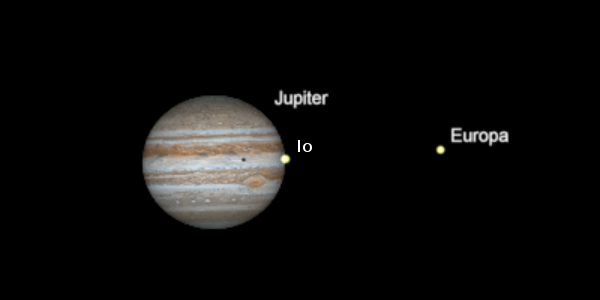
Io transit end at 8:55 p.m., March 12, 2015. Note Io’s shadow will leave the face of Jupiter at 9:32 p.m. Created using Cartes du Ciel (Sky Charts).
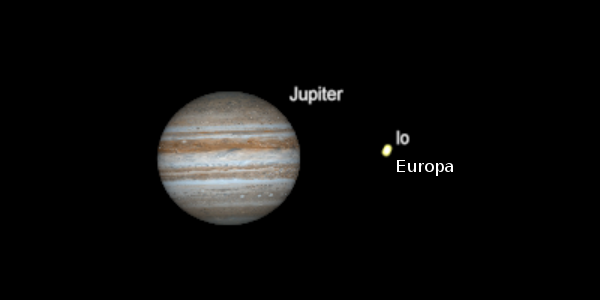
Io passes Europa about 10:20 p.m. March 12, 2015. Created using Cartes du Ciel (Sky Charts).
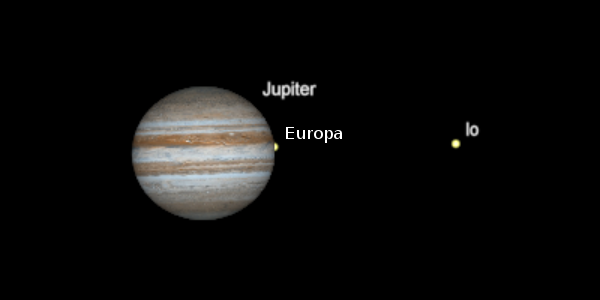
Europa’s occultation begins at 12:06 a.m., March 13, 2015. Created using Cartes du Ciel (Sky Charts).
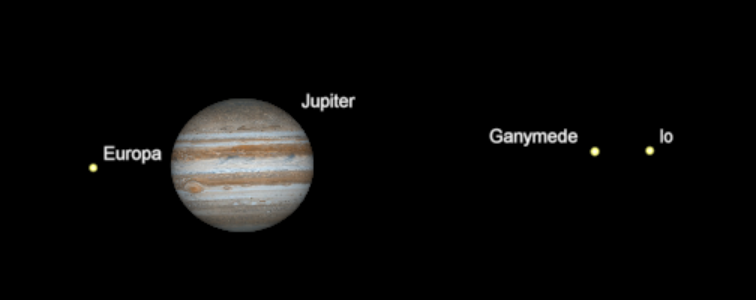
Europa emerges from eclipse by Jupiter’s shadow at 4:32 a.m., March 13, 2015. Note that Ganymede has entered the picture. It appeared to pass Io at about 3:30 a.m. Created using Cartes du Ciel (Sky Charts).
03/11/2015 – Ephemeris – On Wednesday we look at the bright planets
Ephemeris for Wednesday, March 11th. The Sun will rise at 8:02. It’ll be up for 11 hours and 40 minutes, setting at 7:43. The Moon, 2 days before last quarter, will rise at 1:42 tomorrow morning.
Lets take a look at the bright planets for this week. Brilliant Venus is in the west by 8:30 p.m. It will set at 10:31 p.m. Mars appears below and right of it. The Red Planet will set tonight at 9:47. Jupiter will appear In the southeastern sky in the evening. It will set at 6:41 a.m. It’s near the sickle-shaped head of Leo the lion, and it’s the brightest star-like object in the sky after Venus sets. In telescopes tonight the moon Io duck behind Jupiter at 9:29 early, but will pop into sunlight a bit away from the planet on the other side at 12:33 a.m. because it also will be hidden in Jupiter’s shadow. Early risers will be able to spot Saturn which will rise in the east-southeast at 1:54 a.m. It will appear below the Moon tomorrow morning.
Times are for the Traverse City/Interlochen area of Michigan. They may be different for your location.
Addendum
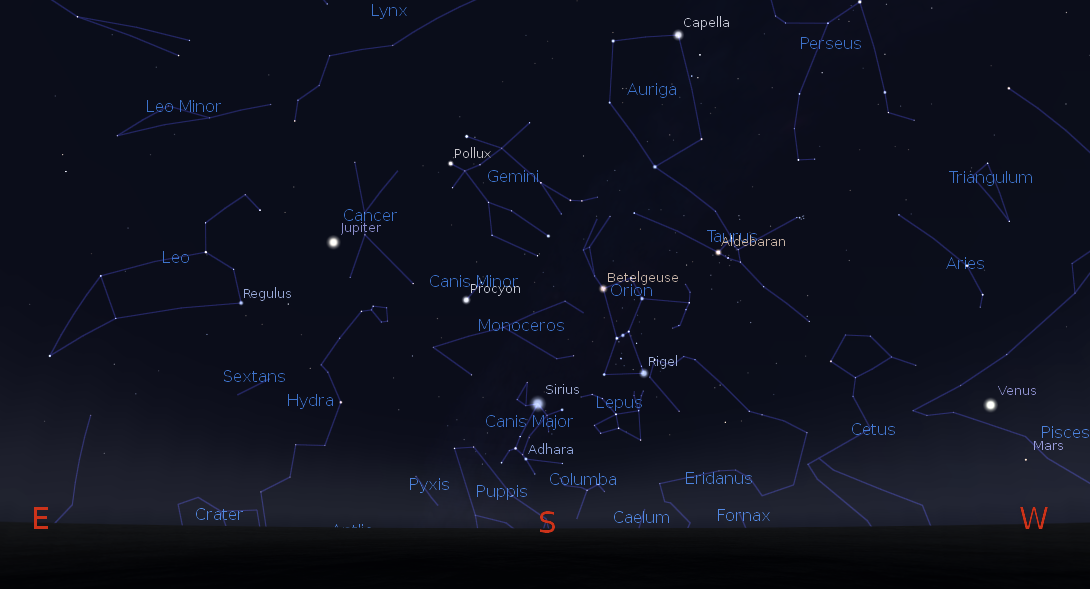
The evening planets Mars, Venus, and Jupiter with the winter constellations at 9 p.m. March 11, 2015. Created using Stellarium.
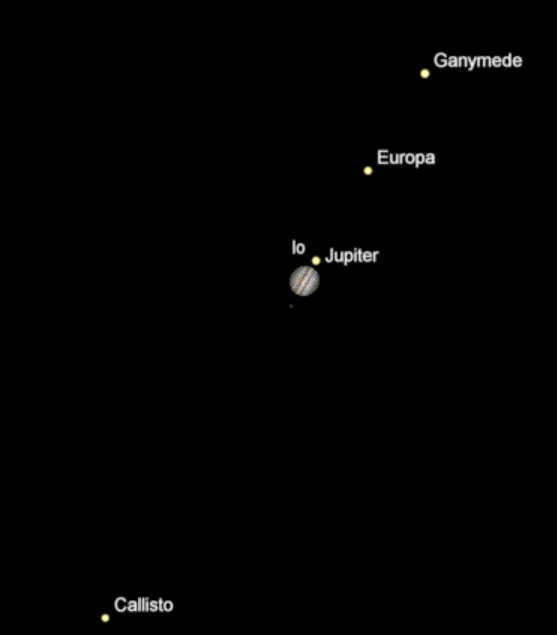
Jupiter and moons at 9 p.m. March 11, 2015, about 29 minutes before Io moves behind Jupiter. Created using Cartes du Ceil (Sky Charts).
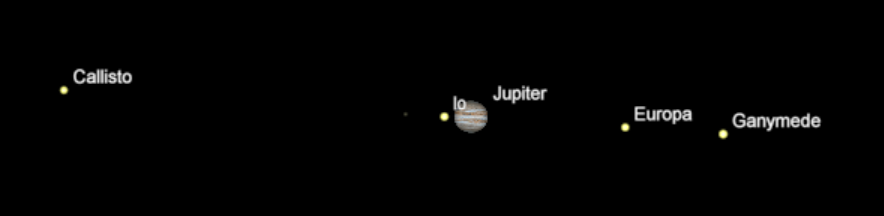
Jupiter and moons at 12:33 a.m. March 12, 2015, about when Io emerges into sunlight from Jupiter’s shadow. Created using Cartes du Ceil (Sky Charts).
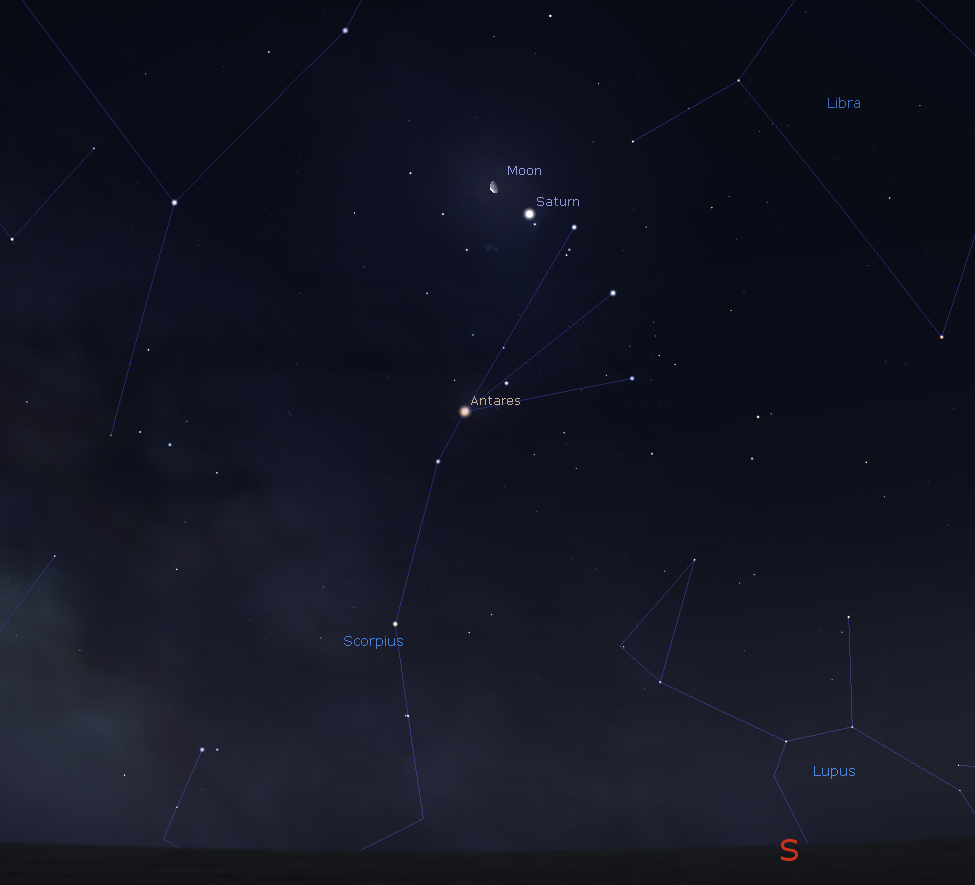
Saturn and the Moon in Scorpius in the south at 6 a.m. March 12, 2015. Created using Stellarium.
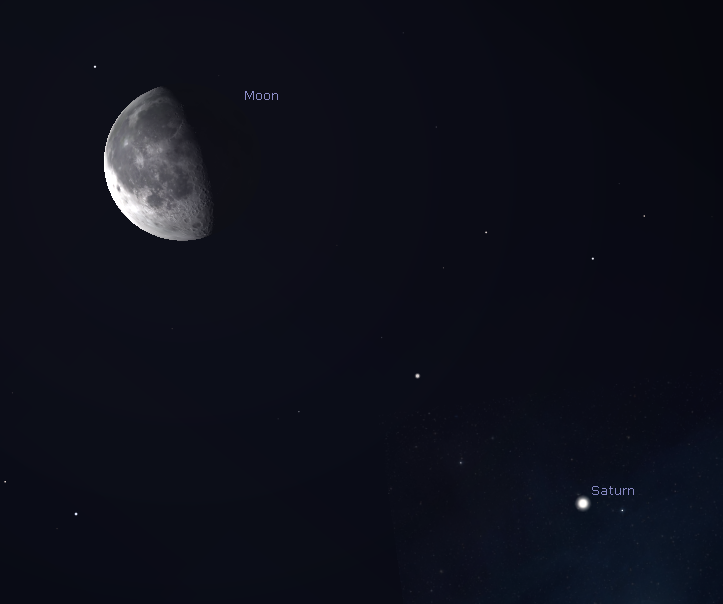
Closeup of Saturn and the Moon at 6 a.m. March 12, 2015. Created using Stellarium.
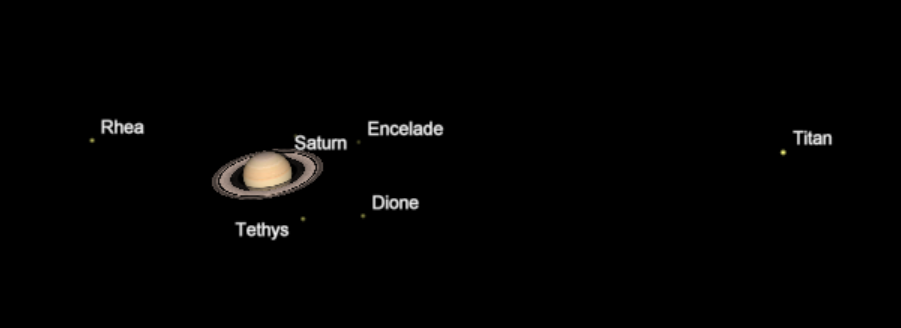
What Saturn and its moons might appear like in a telescope at 6 a.m., March 12, 2015. Small telescopes will show only the moon Titan. Created using Cartes du Ceil (Sky Charts).
03/10/2015 – Ephemeris – The Great Orion Nebula
Ephemeris for Tuesday, March 10th. The Sun will rise at 8:04. It’ll be up for 11 hours and 37 minutes, setting at 7:42. The Moon, 3 days before last quarter, will rise at 12:43 tomorrow morning.
The constellation of Orion the hunter, now in the south at 9 p.m., contains the most beautiful star forming region in the northern sky. It is the Great Orion Nebula. A nebula is simply a cloud. Back in the early days of telescopes it was anything that appeared fuzzy. Today it’s any cloud, whether of gas or dust, light or dark. The Great Orion Nebula is made up of gas, which is ionized and shines by fluorescence by the ultraviolet light of a clutch of four stars in its heart called the Trapezium. The nebula can be glimpsed with binoculars surrounding what looks like the center star of the vertical line of three stars that appears as the sword hanging from Orion’s belt. It’s the bright end of a large dark cloud that’s behind the bright stars of Orion.
Times are for the Traverse City/Interlochen area of Michigan. They may be different for your location.
Addendum
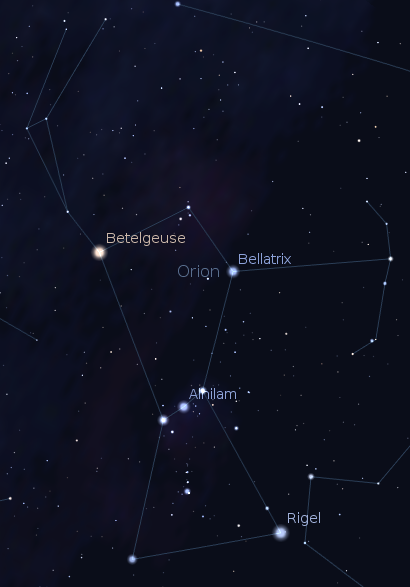
Orion upright and due south. Created using Stellarium.
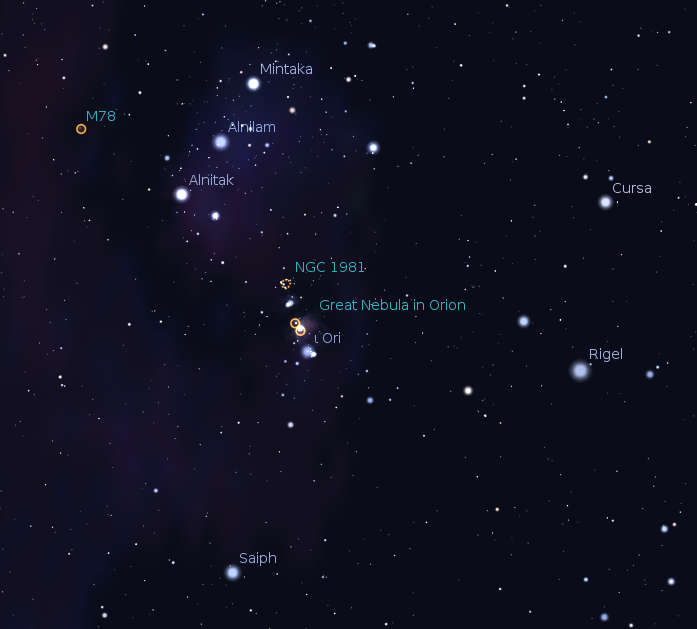
The lower part of Orion with the Great Orion Nebula. Created using Stellarium.
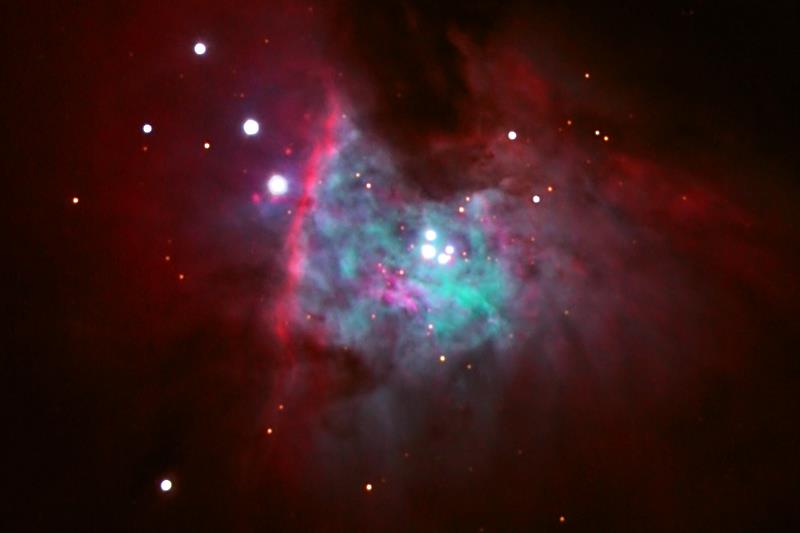
Inner part of the Great Orion Nebula with the Trapezium. Image by Scott Anttila
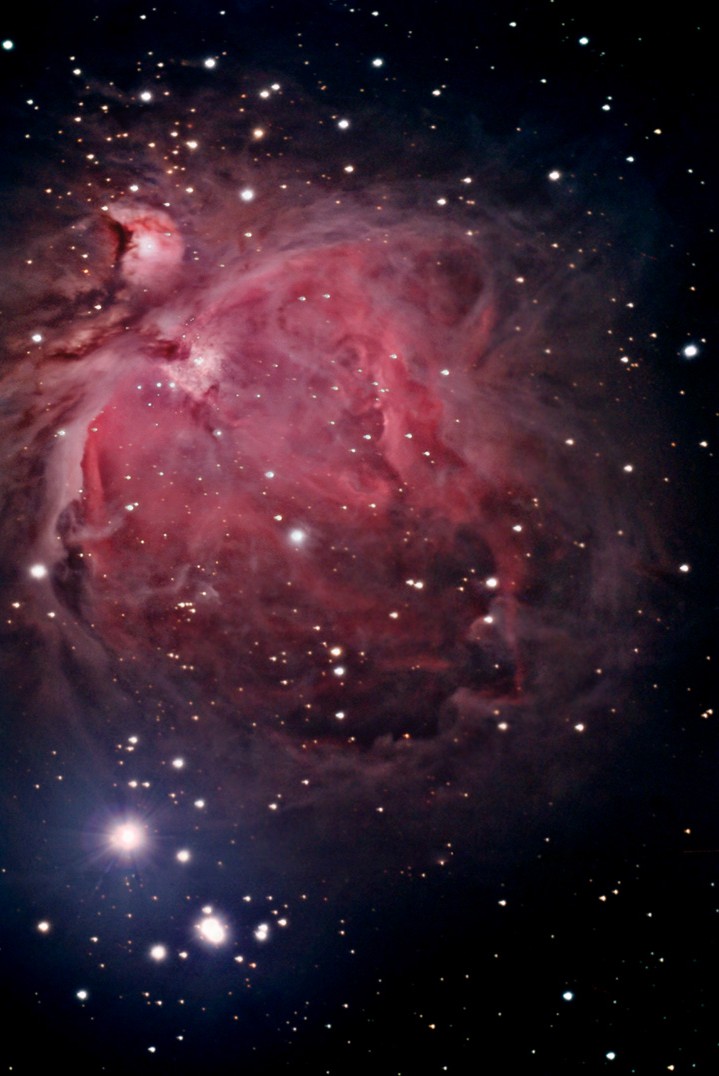
Great Orion Nebula by Scott Anttila
03/09/2015 – Ephemeris – The Big Dipper, a sign of spring
Ephemeris for Monday, March 9th. The Sun will rise at 8:06. It’ll be up for 11 hours and 34 minutes, setting at 7:40. The Moon, 4 days before last quarter, will rise at 11:43 this evening.
There’s a sign of spring appearing in the sky, rising high in the northeast. It’s the Big Dipper standing on its handle. In the native story of the Fisher Star, it’s the sign that it’s time for the maple sugar season. The Big Dipper is part of Ursa Major the great bear or a weasel-like creature called Fisher or Fisher Star. Draw a line through the bottom of the bowl of the dipper as if it leaks, and it will drip on the back of Leo the lion in the southeast. The handle of the Big Dipper will arc to Arcturus after 10 p.m. when that star rises. The most important guide that the Big Dipper provides is to point to Polaris, the north star. The two stars at the front of the bowl of the dipper point to Polaris, that alone of all the stars appears fixed in the north.
Times are for the Traverse City/Interlochen area of Michigan. They may be different for your location.
Addendum
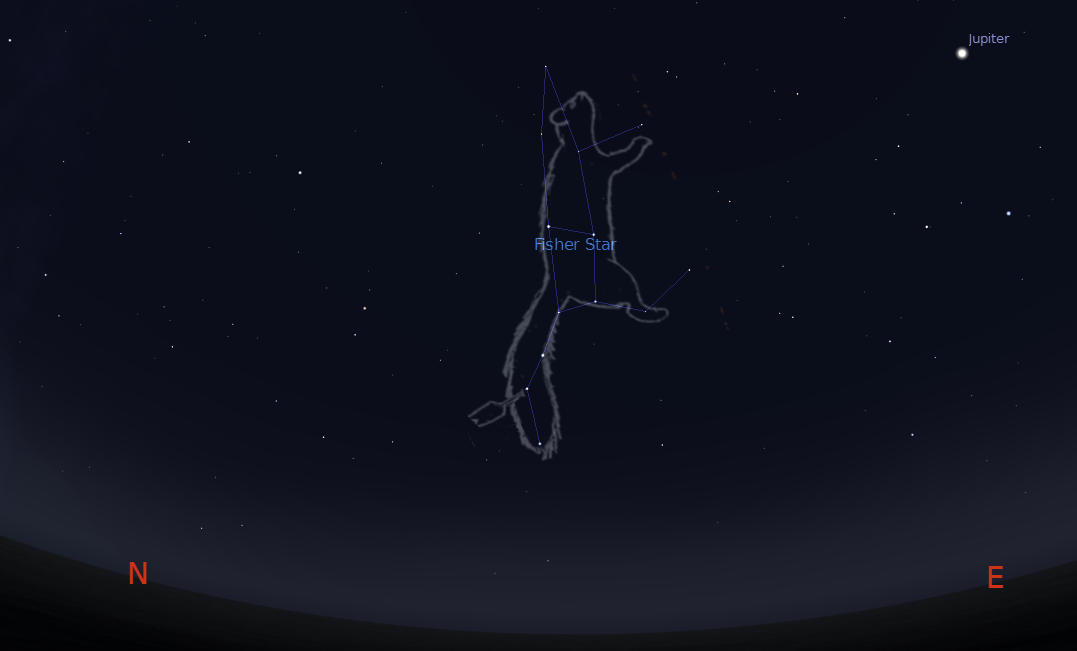
The Big Dipper, part of Ursa Major and also part of Fisher Star in the northeastern sky at 9 p.m. March 9, 2015
For the story of Fisher Star follow this link.
03/06/2015 – Ephemeris – Learn about this year’s adventures in exploring the soiar system tonight
Ephemeris for Friday, March 6th. The Sun will rise at 7:12. It’ll be up for 11 hours and 24 minutes, setting at 6:36. The Moon, 1 day past full, will rise at 7:47 this evening.
This evening yours truly will be giving a program at the monthly meeting of the Grand Traverse Astronomical Society at 8 p.m. at Northwestern Michigan College’s Rogers Observatory. It’s entitled Asteroids and Dwarf Planets and Comets, oh my! It’s about the three solar system bodies being visited this year by spacecraft from NASA and the European Space Agency. The asteroid is Ceres, which the Dawn spacecraft entered orbit of today. The dwarf planet is Pluto which is the target of a summer flyby by the New Horizon spacecraft. The comet is 67P/Churyumov–Gerasimenko orbited by ESA’s Rosetta spacecraft. There will be a star party at 9 p.m. following the meeting.
Times are for the Traverse City/Interlochen area of Michigan. They may be different for your location.
Addendum
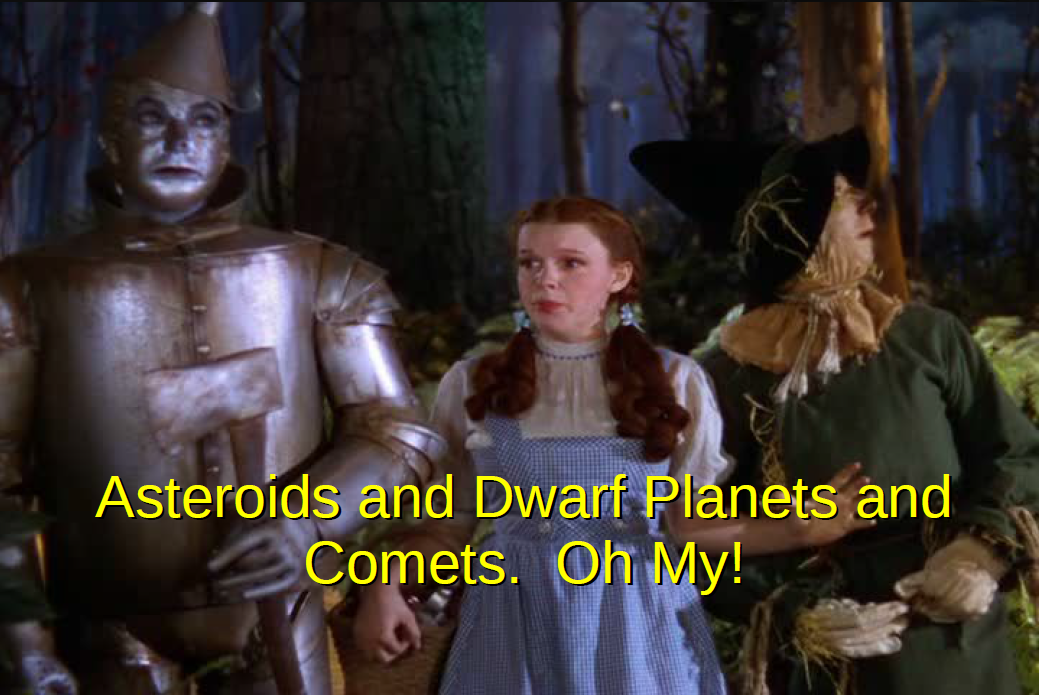
Apologies to MGM.
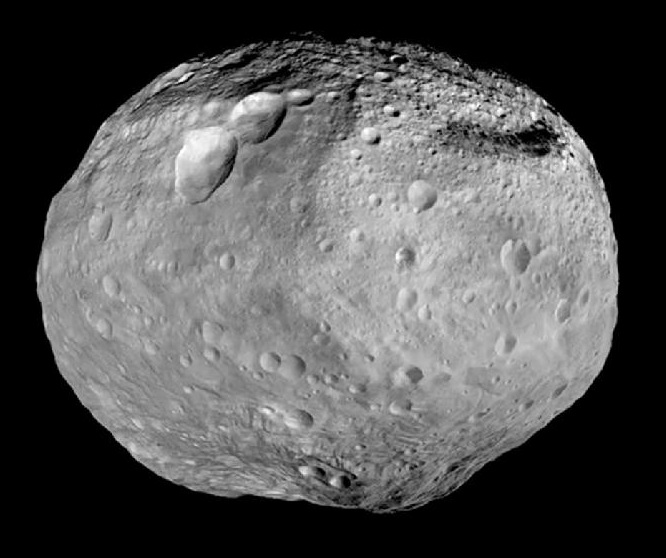
Looking back at Vesta as Dawn headed off to Ceres. Credit: NASA/JPL-Caltech/UCAL/MPS/DLR/IDA
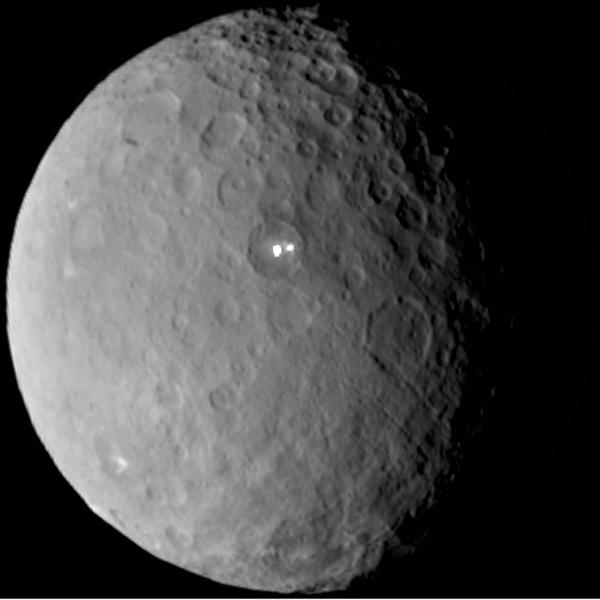
The bright spot is two. Picture taken February 19, 2015 from 29,000 miles (46,700 km). Credit: NASA/JPL-Caltech/UCLA/MPS/DLR/IDA.
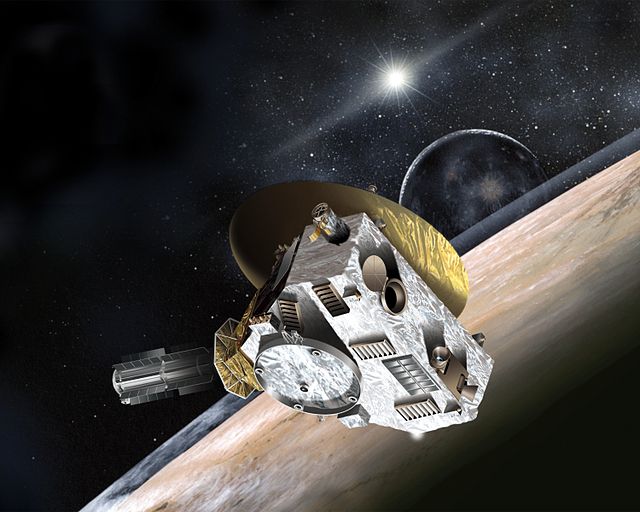
Artist conception of the New Horizons spacecraft at Pluto. Credit: NASA/Johns Hopkins University Applied Physics Laboratory/Southwest Research Institute
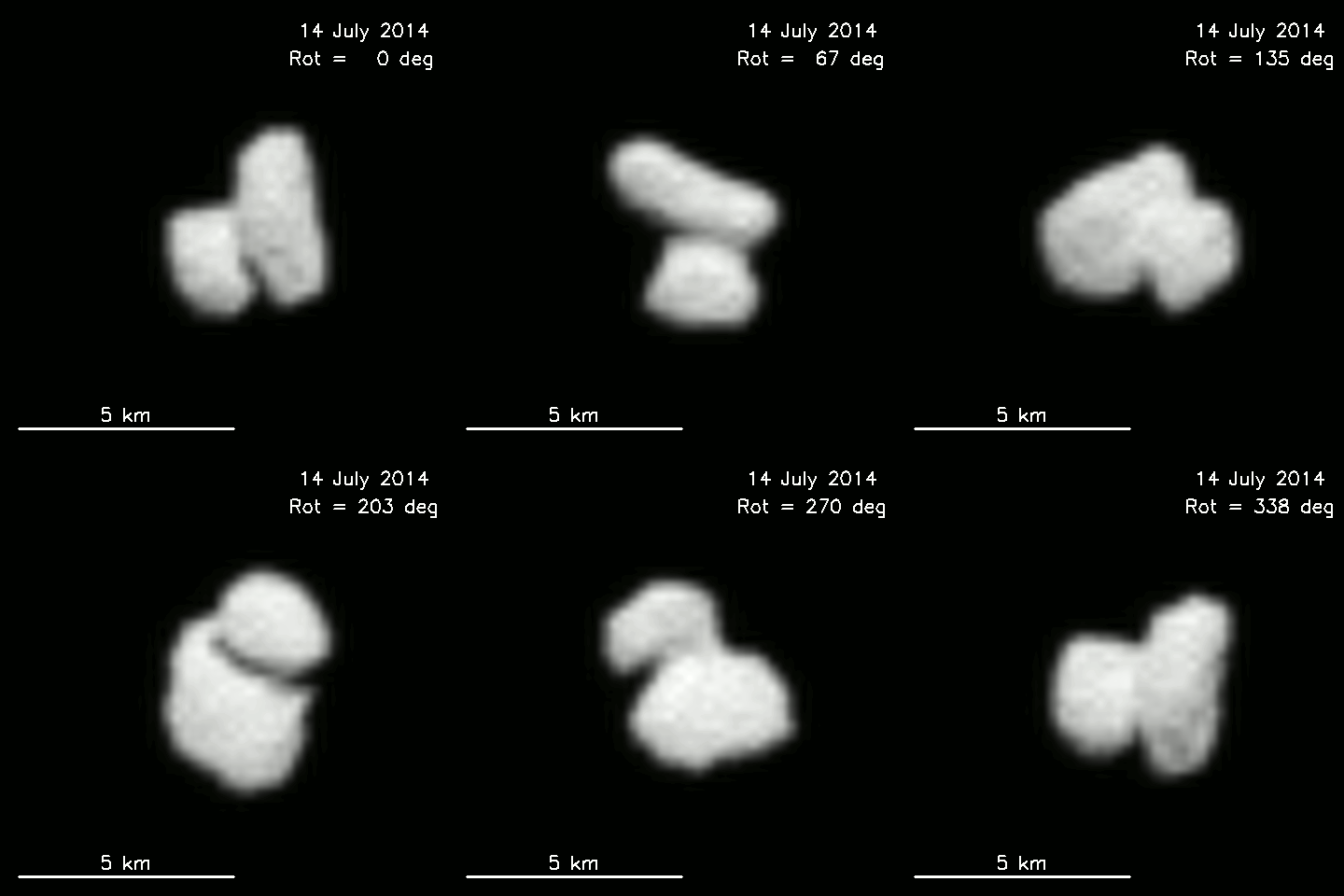
An animation of Comet 67p/Churyumov–Gerasimenko rotation on July 14, 2014. The 30 pixel wide image has been smoothed. The Rotation rate is 1 rotation every 12.4 hours. Credits: ESA/Rosetta/MPS for OSIRIS Team MPS/UPD/LAM/IAA/SSO/INTA/UPM/DASP/IDA
03/05/2015 – Ephemeris – Tonight’s moon is the smallest full moon of the year
Ephemeris for Thursday, March 5th. The Sun will rise at 7:13. It’ll be up for 11 hours and 21 minutes, setting at 6:35. The Moon, at full today, will rise at 6:48 this evening.
We’ve heard all about the supermoon, when the moon is at its closest. This is supposedly best seen when the full moon is rising. Of course the rising moon or sun, or the setting of these bodies look larger than normal due to an optical illusion. Well tonight’s full moon is the opposite. The Moon is at apogee, which is the farthest it gets in its orbit of the Earth. It’s 253 thousand miles (406 thousand km) from Earth. So the Moon should be, let me see, a mini-moon? So the Moon should appear small as it rises tonight. So if it’s clear tonight you might check out the moon. Does it appear as large as it usually does? Or does it appear smaller? The moon, being alone in the sky lacks anything else to compare its size to. It makes estimations difficult.
Times are for the Traverse City/Interlochen area of Michigan. They may be different for your location.
Addendum
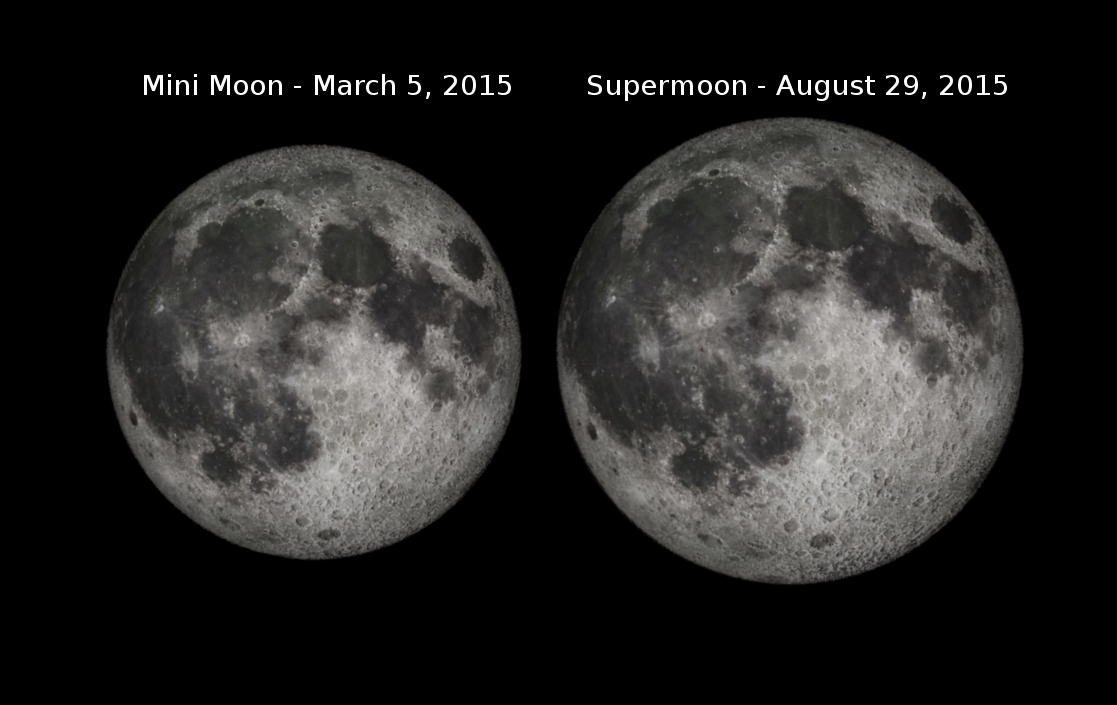
Here are the full mini and supermoons of the year. Created using Cartes du Ceil (Sky Charts)
 Bob Moler's Ephemeris Blog