Archive
4/16/2015 – Ephemeris – A constellation commemorating a real person
Ephemeris for Thursday, April 16th. The Sun rises at 6:57. It’ll be up for 13 hours and 31 minutes, setting at 8:28. The Moon, 2 days before new, will rise at 6:19 tomorrow morning.
Half way up the sky in the east-southeast at 10 p.m. is a tiny and faint constellation of Coma Berenices, or Berenice’s hair. In it are lots of faint stars arrayed to look like several strands of hair. The whole group will fit in the field of a pair of binoculars, which will also show many more stars. The story behind it was that Berenice was a real Queen of Egypt, whose husband was away at war. This was in the days when the Greeks ruled Egypt after Alexander conquered it. She offered her golden tresses to the gods for the king’s safe return. The hair, was placed in a temple. However the offering disappeared when the king returned. Ever since then the constellation of Coma Berenices has been seen to commemorate the queen’s sacrifice.
Times are for the Traverse City/Interlochen area of Michigan. They may be different for your location.
Addendum
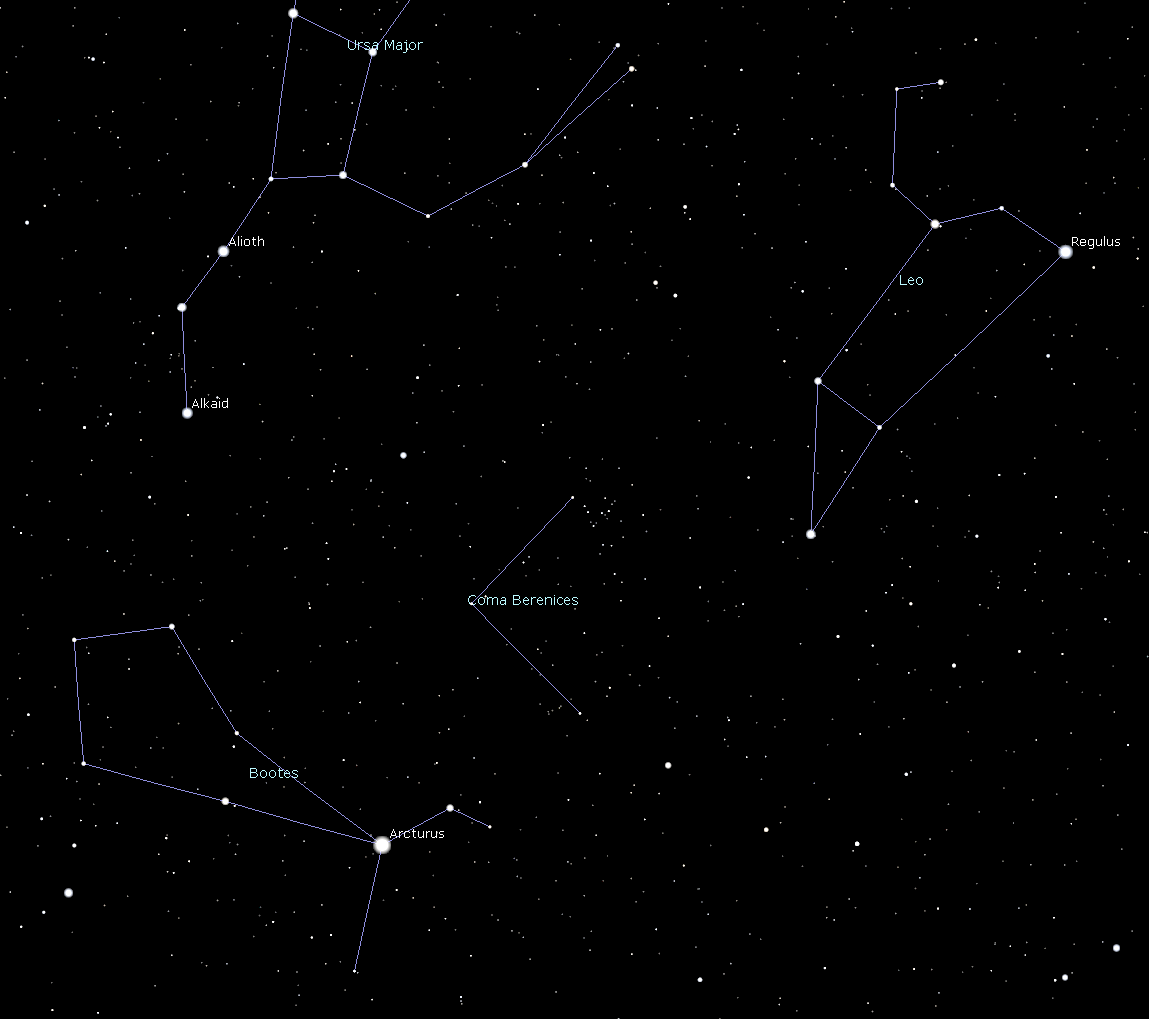
Coma Berenices and neighboring constellations at 10 p.m. on April 16, 2015. Note that only the upper right star of the upside down L shape actually belongs to the cluster. Created using Stellarium.
04/15/2015 – Ephemeris – Besides Tax Day, it’s planets day on Ephemeris
Wednesday, April 15th, Tax Day. The Sun rises at 6:58. It’ll be up for 13 hours and 28 minutes, setting at 8:27. The Moon, 3 days before new, will rise at 5:44 tomorrow morning.
Lets take a look at the bright planets for this week. Our brilliant evening star Venus is high in the west by 9 p.m. It will set at 12:06 a.m. Mars appears much lower and to the right of it. The Red Planet will set tonight at 9:48. Jupiter will appear high in the southern sky in the evening. It will set at 4:25 a.m. It’s near the sickle-shaped head of Leo the lion, and it’s the second brightest star-like object in the sky after Venus. All four moons will be visible in telescopes tonight, Europa will be on the western side of Jupiter casting it’s shadow on the planet in the evening. Saturn will rise in the east-southeast at 11:32 p.m. It will be low in the south at 5 to 6 a.m.
Times are for the Traverse City/Interlochen area of Michigan. They may be different for your location.
Note: Due to some incorrect calculations the Jupiter moon phenomena in the broadcast program was in error. This transcript corrects that.
Addendum
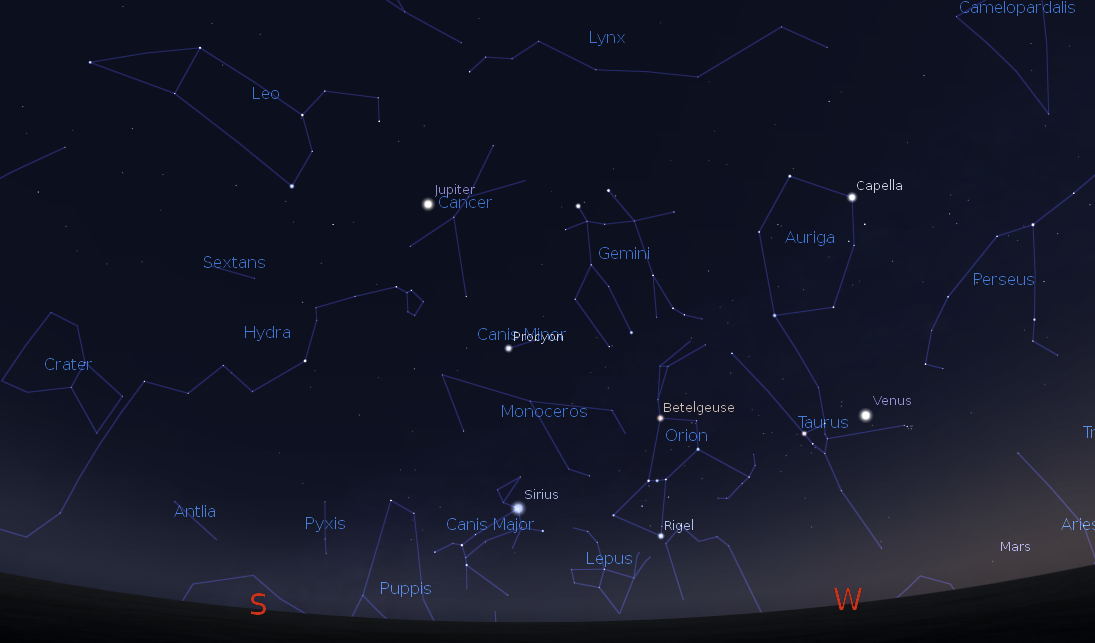
Jupiter, Venus and Mars and remaining winter constellations at 9:30 p.m. April 15, 2015. Created using Stellarium.
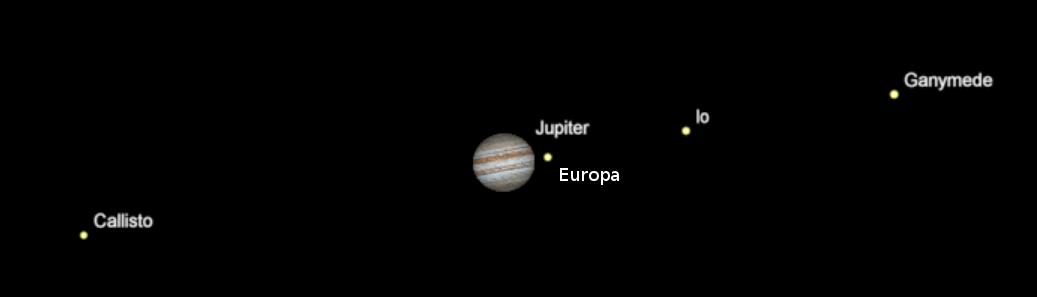
Jupiter and moons as they would appear in a telescope at 9:30 p.m. April 15, 2015. Created using Cartes du Ceil (Sky Charts).
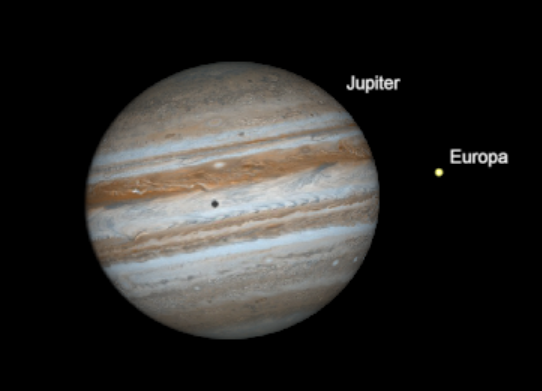
Closeup of Jupiter and Europa with its shadow cast on Jupiter at 9:30 p.m. April 15, 2015. Created using Cartes du Ceil (Sky Charts).
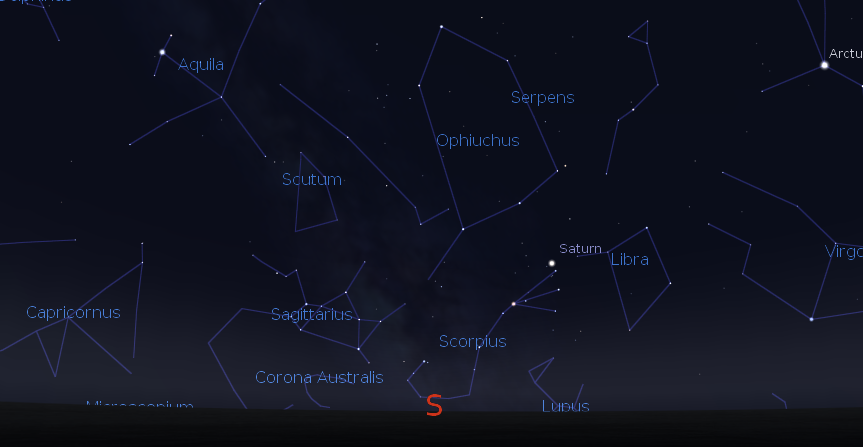
Saturn and the evening stars of summer at 5:30 a.m. April 16, 2015. Created using Stellarium.
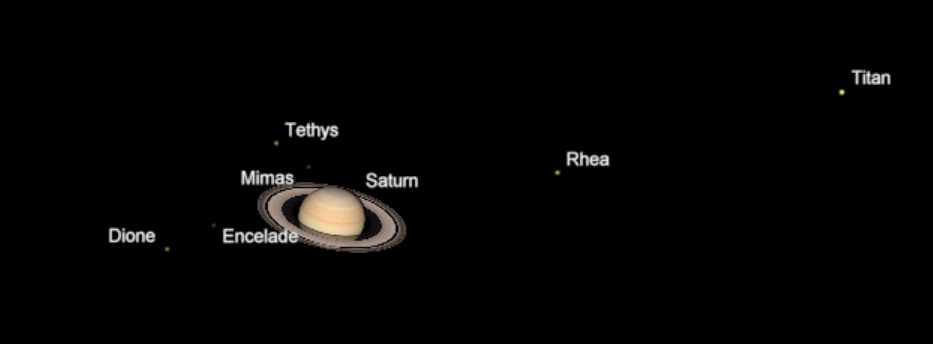
What Saturn and its moons might appear like in a telescope at 5:30 a.m., April 16, 2015. Small telescopes will show only the moon Titan. Created using Cartes du Ceil (Sky Charts).
04/14/2015 – Ephemeris – Arcas and Callisto
Ephemeris for Tuesday, April 14th. The Sun will rise at 7:00. It’ll be up for 13 hours and 25 minutes, setting at 8:26. The Moon, 3 days past last quarter, will rise at 5:08 tomorrow morning.
Rising in the eastern sky at 10 p.m. tonight is the kite shaped constellation of Boötes the herdsman. The bright star Arcturus is at the bottom of the kite, pointed to by the arc of the handle of the Big Dipper, overhead. In one story Boötes represents a young hunter named Arcas, son of Callisto, a beautiful young lady who had the misfortune of being loved by Zeus the chief Greek god. Zeus’ wife Hera, found out about it, and since she couldn’t punish Zeus, turned Callisto into an ugly bear. Arcas, unaware of why his mother disappeared in his youth was about to kill the bear when Zeus intervened and placed them both in the sky. Now Arcas as Boötes chases the Great Bear forever around the pole of the sky each night.
Times are for the Traverse City/Interlochen area of Michigan. They may be different for your location.
Addendum
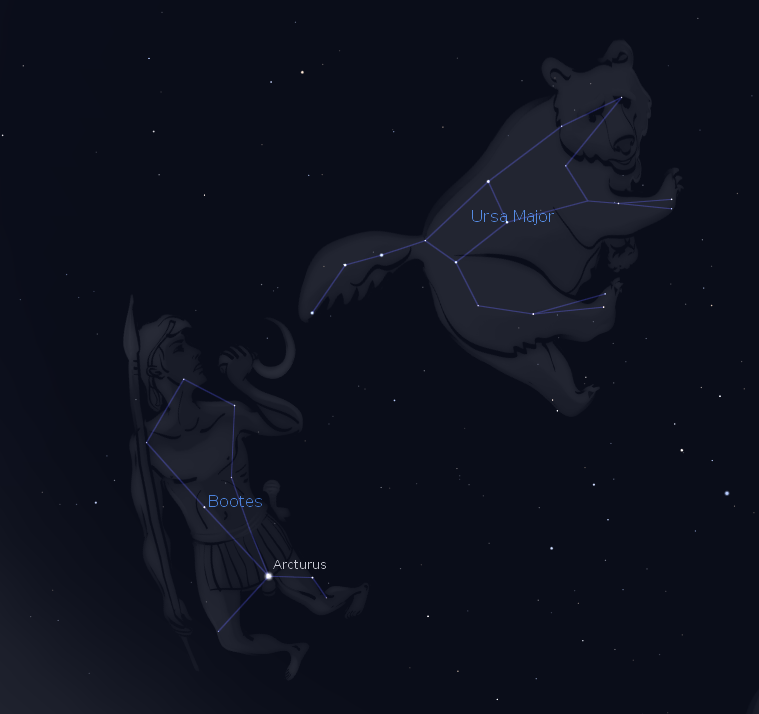
Bootes and Ursa Major aka Arcas chasing Callisto around the pole of the sky. Created using Stellarium.
öö
04/13/2015 – Ephemeris – The Big Dipper as seen from many lands
Ephemeris for Monday, April 13th. The Sun will rise at 7:02. It’ll be up for 13 hours and 22 minutes, setting at 8:25. The Moon, 2 days past last quarter, will rise at 4:31 tomorrow morning.
The Big Dipper will be high in the east, nearly overhead at 10 p.m. It is officially part of Ursa Major, the Great Bear. Other cultures have different representations for this star group. It’s the plough (plow), Charles’ Wain (Charlemagne’s Wagon), the Saucepan, or the Cleaver depending on the country. It performs an invaluable service in pointing out other stars and constellations, especially the star Polaris the north star. That star, which seems to hover over the north pole of the Earth can be found by using the two stars at the front of the bowl of the dipper to point to it. And at our latitude of around 45 degrees north, the Big Dipper is always in the sky. It is one of the circumpolar star groups that can be seen in any season.
Times are for the Traverse City/Interlochen area of Michigan. They may be different for your location.
Addendum
Right now in the spring the Big Dipper is nearly overhead pointing down to Polaris. I’ve turned these upside down so the images make more sense.
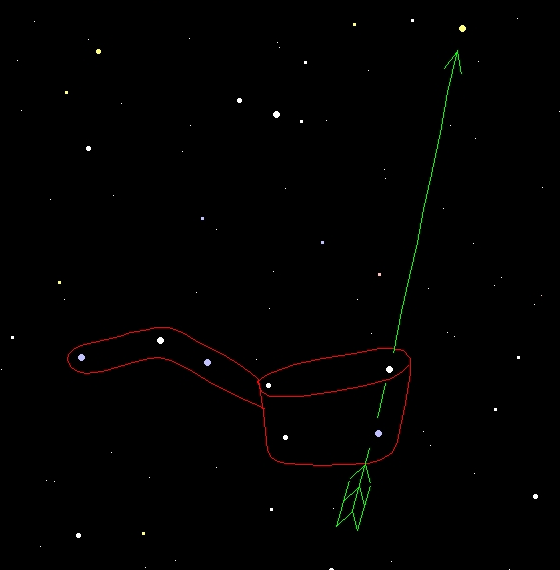
The Big Dipper or Sauce Pan. Credit: Bob Moler’s LookingUp program.
For runaway slaves fleeing northward at night it was their compass… “Follow the Drinking Gourd”
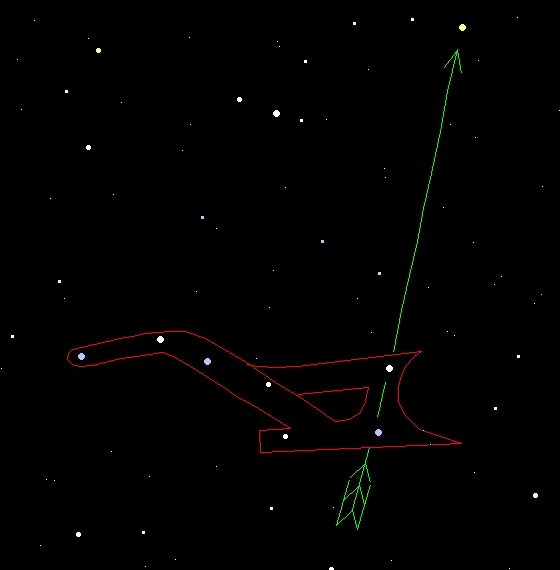
The Plough or plow in American. Credit: Bob Moler’s LookingUp program.
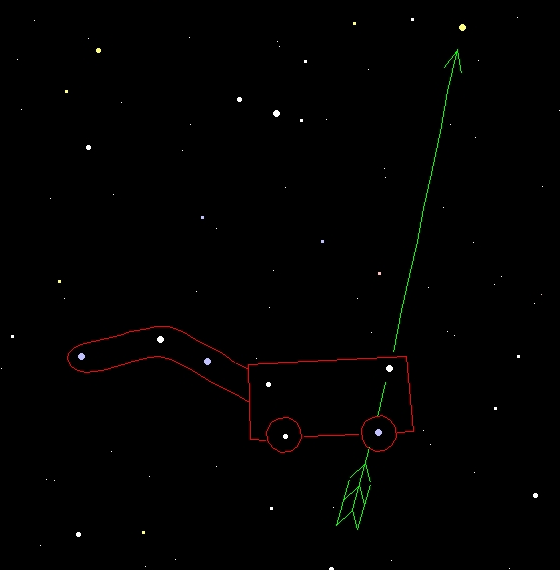
Charles’ Wain. Credit: Bob Moler’s LookingUp program.
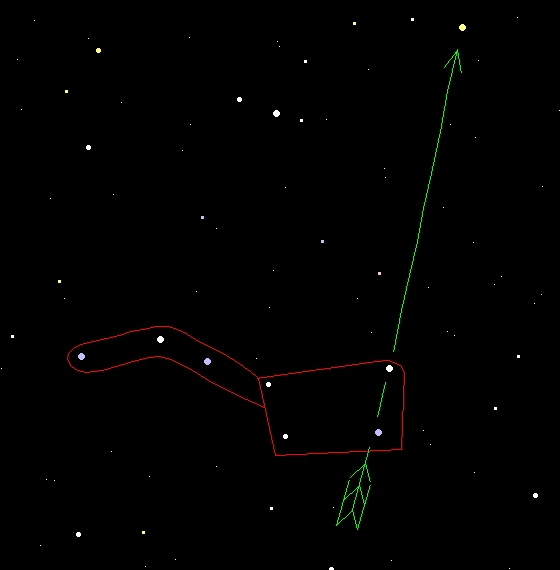
The Cleaver. Credit: Bob Moler’s LookingUp program.
Do you know any others?


04/10/2015 – Ephemeris – Venus will pass the Pleiades tomorrow evening
Ephemeris for Friday, April 10th. The Sun will rise at 7:07. It’ll be up for 13 hours and 13 minutes, setting at 8:21. The Moon, 1 day before last quarter, will rise at 2:22 tomorrow morning.
Tomorrow evening, that’s Saturday the 11th, Venus will pass the Pleiades. Venus will appear below and left of that famous Seven Sisters star cluster by about 5 moon widths, or about a quarter of the width of your fist held at arm’s length. Venus is moving rapidly eastward against the stars and will be approaching Jupiter for the next two and a half months. It will catch up with Jupiter and on June 30th it will be only half of a degree away, the width of the full moon. Jupiter look really bright when seen away from Venus, but to compare them close together, Jupiter can’t hold a candle to Venus. This also the part of the sky, in Leo that one of the planetary events between these two planets occurred that could have been part of the Star of Bethlehem.
Times are for the Traverse City/Interlochen area of Michigan. They may be different for your location.
Addendum
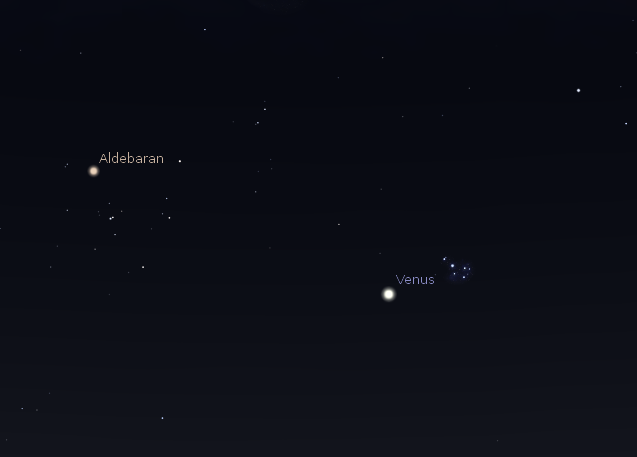
Venus passing the Pleiades at 10 p.m. on April 10, 2015. The Hyades, head of the constellation Taurus the bull, is to the left. Created using Stellarium.
04/09/2015 – Ephemeris – Two water creatures among the stars
Ephemeris for Thursday, April 9th. The Sun will rise at 7:09. It’ll be up for 13 hours and 10 minutes, setting at 8:20. The Moon, 2 days before last quarter, will rise at 1:30 tomorrow morning.
Hydra the water snake is the longest of the constellations. Its head is a group of five stars in a close group below a line between Leo the Lion and Gemini the twins in the southwest. This year it is below Jupiter. Its stars drop down and skirt the horizon underneath Corvus the crow, an interesting box-like constellation and Virgo and dip below the horizon in the southeast. It takes a low southern horizon to follow its body that far. It’s brightest star is Alphard. To the native peoples around here the sickle of Leo, the head of Hydra and stars down to Alphard made the Great Underwater Leopard, ready to snatch the foolish who ventured out on the thin ice and broke through this time of year.
Times are for the Traverse City/Interlochen area of Michigan. They may be different for your location.
Addendum
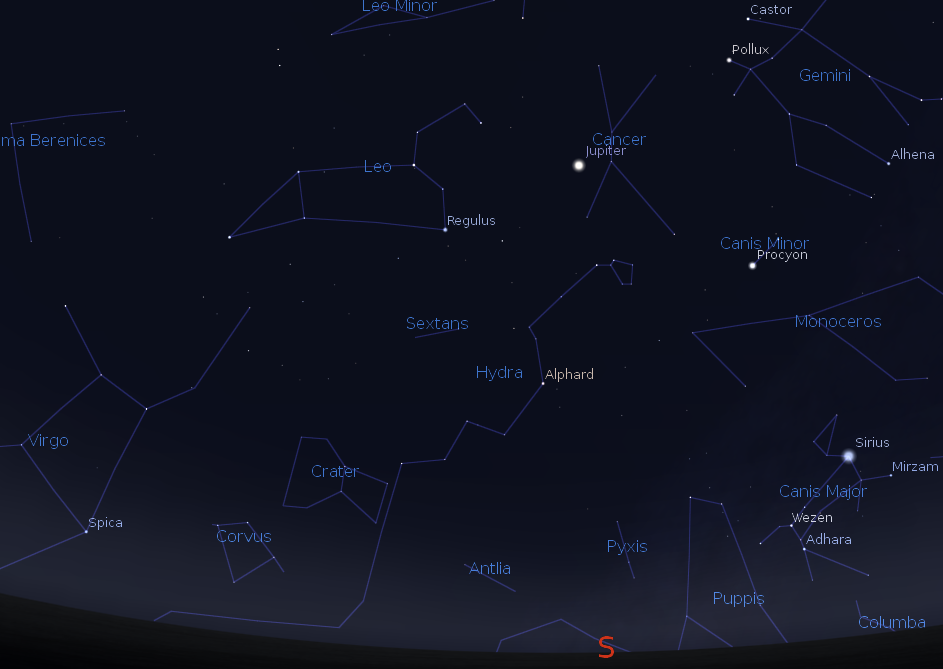
Hydra finder chart for 9:30 p.m. April 9, 2015. Created using Stellarium.
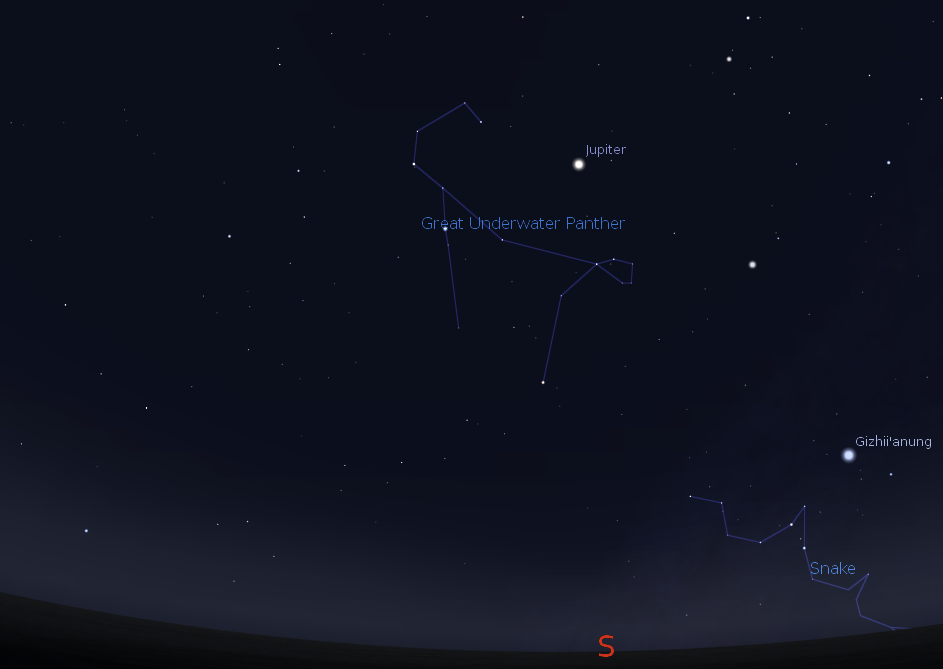
The Anishinaabek Great Underwater Panther. 9:30 p.m. April 9, 2015. Created using Stellarium. Constellation by Bob Moler, based on a video by Michael Wassegijig Price.
The video is here.
04/08/2015 – Ephemeris – It’s bright planet night on Ephemeris
Ephemeris for Wednesday, April 8th. The Sun will rise at 7:11. It’ll be up for 13 hours and 7 minutes, setting at 8:18. The Moon, 3 days before last quarter, will rise at 12:34 tomorrow morning.
Lets take a look at the bright planets for this week. Our brilliant evening star Venus is high in the west by 9 p.m. It will set at 11:43 p.m. Mars appears much lower and to the right of it. The Red Planet will set tonight at 9:48. Jupiter will appear high in the southeastern sky in the evening. It will set at 4:52 a.m. It’s near the sickle-shaped head of Leo the lion, and it’s the second brightest star-like object in the sky after Venus. Three of the four moons will be visible in telescopes tonight, Callisto is behind Jupiter and will reappear at 4:42 a.m., shortly before Jupiter sets. Early risers will be able to spot Saturn which will rise in the east-southeast at 12:01 a.m. It will be low in the south at 5 to 6 a.m.
Times are for the Traverse City/Interlochen area of Michigan. They may be different for your location.
Addendum
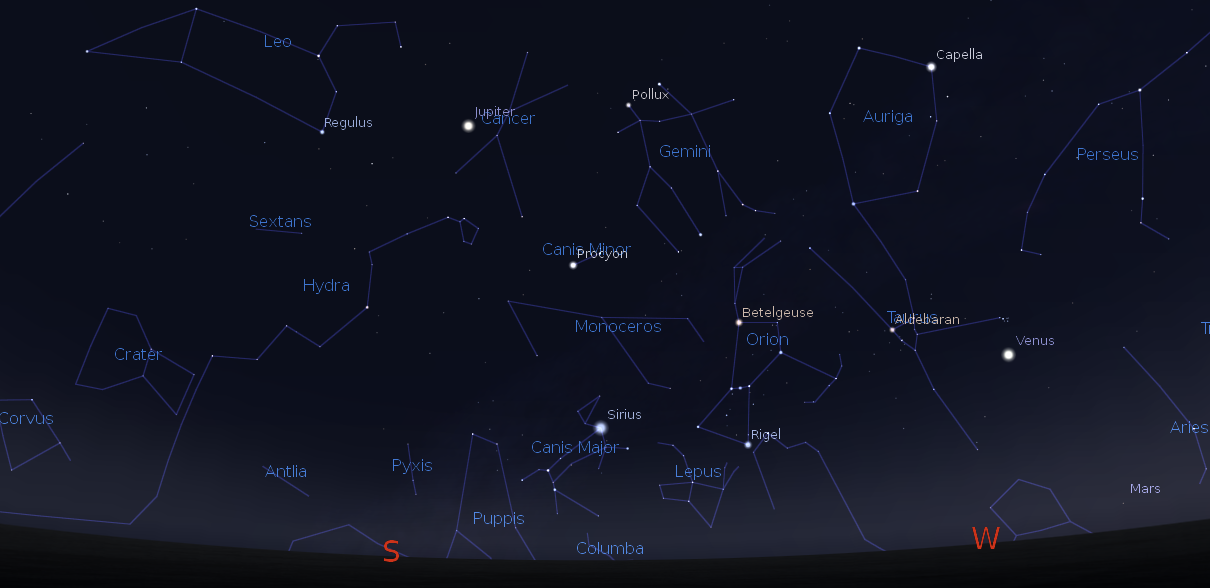
The Moon, Jupiter, Venus and Mars and remaining winter constellations at 9:30 p.m. April 8, 2015. Created using Stellarium.
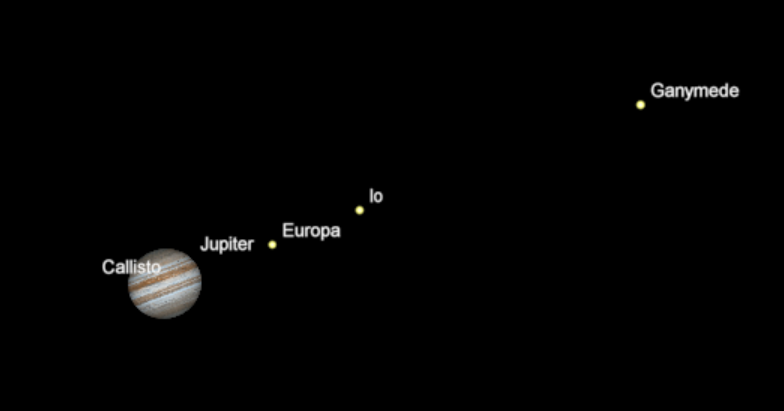
Jupiter and three of its moons. Callisto is tagged, but is behind the planet at 9:30 p.m. April 8, 2015. Created using Cartes du Ceil (Sky Charts).
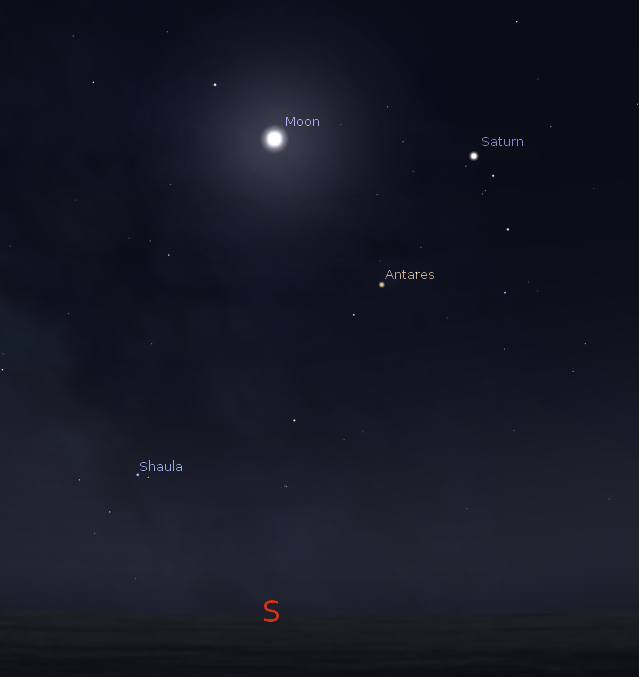
Saturn and the Moon above Scorpius at 5:30 a.m. April 9, 2015. Created using Stellarium.
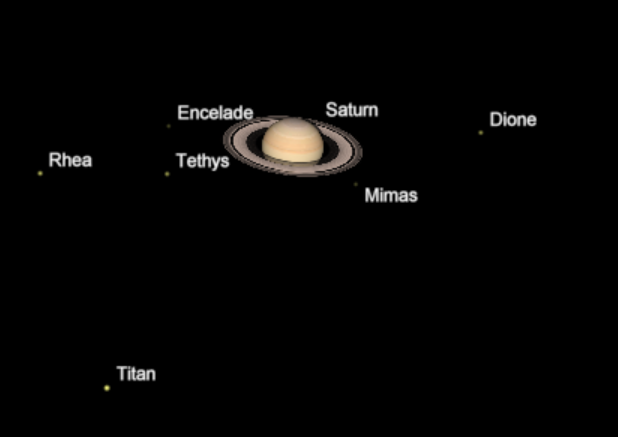
What Saturn and its moons might appear like in a telescope at 5:30 a.m., April 9, 2015. Small telescopes will show only the moon Titan. Created using Cartes du Ceil (Sky Charts).
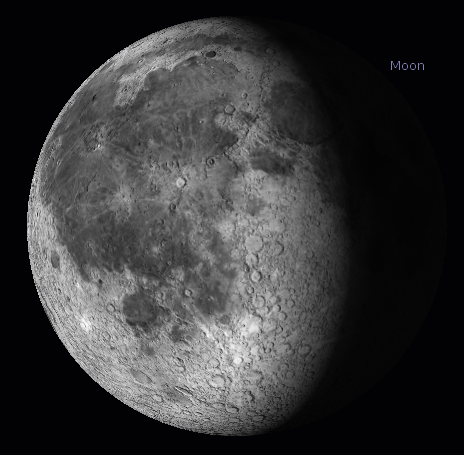
The Moon at 5:30 a.m. April 9, 2015. Created using Cartes du Ceil (Sky Charts).
04/07/2015 – Ephemeris – The Moon will pass Saturn tomorrow morning
Ephemeris for Tuesday, April 7th. The Sun will rise at 7:13. It’ll be up for 13 hours and 4 minutes, setting at 8:17. The Moon, 3 days past full, will rise at 11:36 this evening.
The planet Saturn is now rising shortly after midnight. However it is still best seen in the early morning. The Moon will be near Saturn when it rises and will get closer as the morning progresses. By 6 a.m. the Moon will be about four of its widths above and right of Saturn. The Moon will get its closest about 10 a.m., but by then it will be daylight and both will have set. Every week Saturn will rise, and set about a half hour earlier. That’s about an hour every two weeks, and two hours a month. This works for the stars and is pretty close for slow-moving planets like Jupiter and Saturn. So next month at this time Saturn will rise about 10 p.m., and in another month 9 p.m. By then it will be in the sky at sunset, and visible all night.
Times are for the Traverse City/Interlochen area of Michigan. They may be different for your location.
Addendum
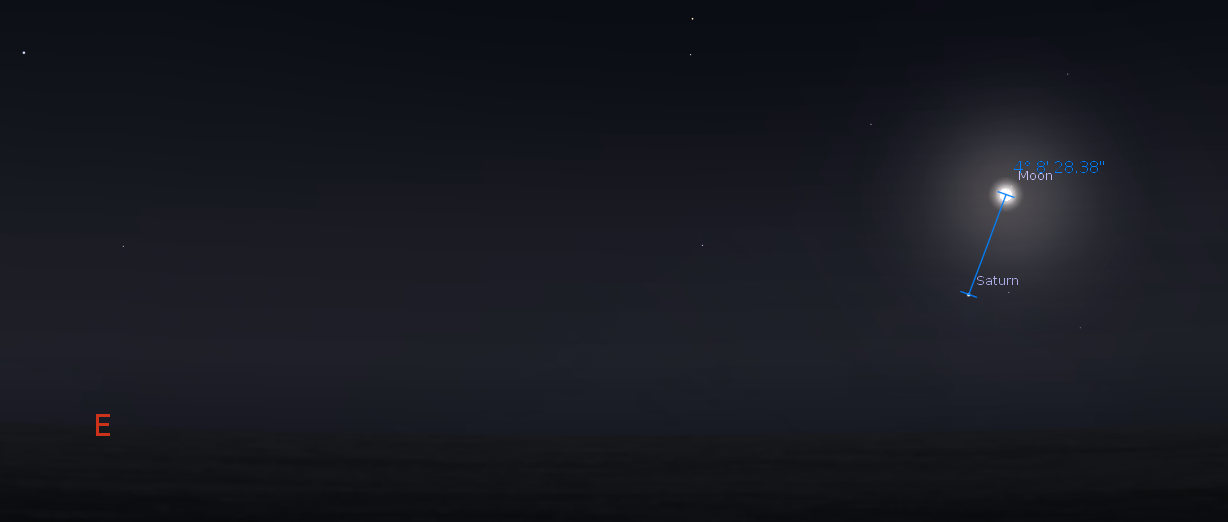
Saturn and the Moon shortly after rising. 12:44 a.m., April 8, 2015. Created using Stellarium.
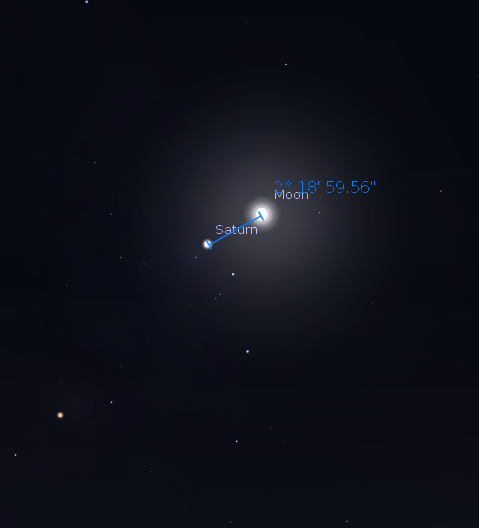
Saturn and the Moon shortly after twilight starts. 5:30 a.m., April 8, 2015. Created using Stellarium.
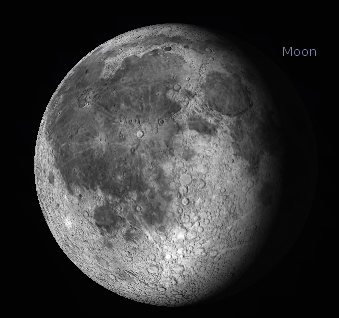
The Moon as it might appear in binoculars at 5:30 a.m. April 8, 2015. Created using Stellarium.
Some Rules of Thumb about the rotation of the earth and its revolution around the Sun.
These are approximate:
Stars rise or set 4 minutes earlier each night.
That’s about a half hour every week, and
It’s about 2 hours every month.
2 hours times 12 months = 24h hours, one rotation of the Earth
As far as viewing the stars and Constellations goes, that’s why we see the constellations in the same positions every year at the same time.
04/06/2015 – Ephemeris – Arcturus the 4th brightest star
Ephemeris for Monday, April 6th. The Sun will rise at 7:14. It’ll be up for 13 hours and 1 minute, setting at 8:16. The Moon, 2 days past full, will rise at 10:37 this evening.
One of the stars that stays up most of the year, except late autumn and most of winter is Arcturus. Now in the evening Arcturus is low in the east. It’s a bright star, officially the 4th brightest star in the night sky, and the 4th brightest star-like object in our night sky after Venus, Jupiter, and Sirius. Arcturus can be found by following the arc of the handle of the Big Dipper to it. Remember, follow the arc to Arcturus. Arcturus belongs to the kite shaped constellation of Boötes, which we’ll visit in greater detail when it’s higher in the sky. Arcturus is an interesting star. It’s 37 light years away, and moving quite rapidly at 75 miles per second (122km/s), mostly across the sky. Some astronomers think that it
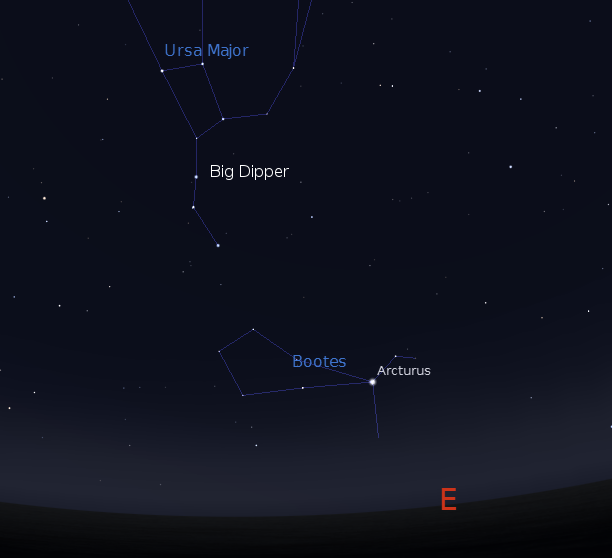
Arcturus off the handle of the Big Dipper at 9:30 p.m. April 6, 2015. Created using Stellarium.
may be part of a captured dwarf galaxy.
Times are for the Traverse City/Interlochen area of Michigan. They may be different for your location.
Addendum
04/04/2015 – Yay, it was finally clear for a lunar eclipse!
Well, of course the sky was clear for this eclipse. This is the third of a tetrad of lunar eclipses visible from the US. For this one we in Michigan are located too far east to see totality, although it was the first to be clear for. The image below shows that we just ran out of sky.
The last eclipse of the tetrad will be on the evening (for us) of September 27th 2015.
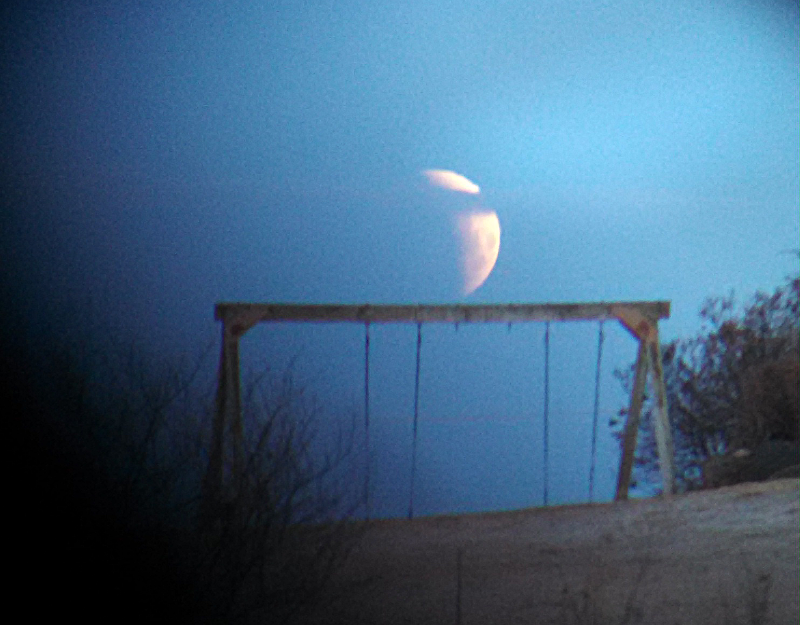
The partially eclipsed Moon setting through a thin cloud and the neighbor’s swing set at 7:09 EDT April 4, 2015. Taken with a Motorola Droid Razr phone through 10X50 binoculars. Credit: Bob Moler.
 Bob Moler's Ephemeris Blog