Archive
10/30/2015 – Ephemeris – The spookiest star
Ephemeris for Friday, October 30th. The Sun will rise at 8:17. It’ll be up for 10 hours and 16 minutes, setting at 6:34. The Moon, 3 days past full, will rise at 9:33 this evening.
Tomorrow night is the spookiest night of the year, so lets look at the spookiest star of all. It’s Algol, from Ghoul Star or Demon Star. The Chinese had a name for it that meant ‘piled up corpses’. It’s the second brightest star in the constellation Perseus the hero, rising in the northeast this evening. The star is located where artists have drawn the severed head of Medusa, whom he had slain. Medusa was so ugly that she turned all who gazed upon her to stone. Algol is her still glittering eye. Astronomers finally found out what was wrong with Algol. It does a slow 6 hour wink every two days 21 hours, because it is two stars that eclipse each other. It winked this morning and it will again centered on 11:45 p.m. Sunday night.
Times are for the Traverse City/Interlochen area of Michigan. They may be different for your location.
Addendum
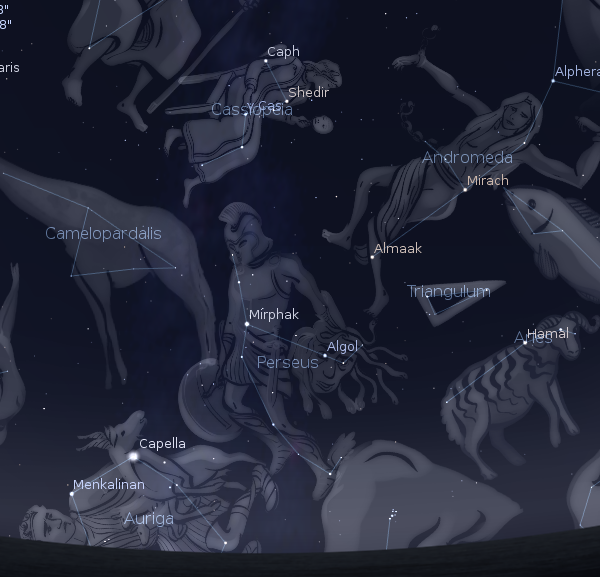
Algol at 7:30 p.m. on Halloween, in a modern portrayal. Created using Stellarium.
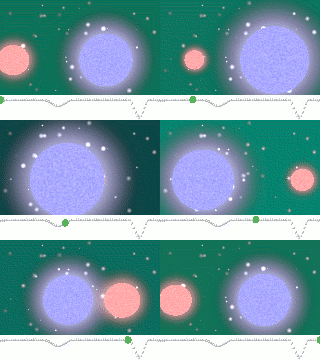
Animation of an eclipsing binary star like Algol. Credit: Wikimedia Commons h/t Earth and Sky
10/29/2015 – Ephemeris – The blue skies of Pluto
Ephemeris for Thursday, October 29th. The Sun will rise at 8:16. It’ll be up for 10 hours and 19 minutes, setting at 6:36. The Moon, 2 days past full, will rise at 8:40 this evening.
Images from the New Horizons spacecraft are streaming back slowly. It’s like trying to download a modern megapixel camera image using a thousand to two thousand bits per second telephone modem back in the ’90s. That’s why the images are dribbling out. They are released each Thursday or Friday. One of the last images was a colored image of the ring of atmosphere of Pluto backlit by the Sun, showing that the dwarf planet had a blue sky. The reason is still debated because there appear to be minute particles thought to be tholins in Pluto’s atmosphere. These would be colored brown or red. However they seen to preferentially scatter blue light like the nitrogen molecules in our atmosphere.
Times are for the Traverse City/Interlochen area of Michigan. They may be different for your location.
Addendum
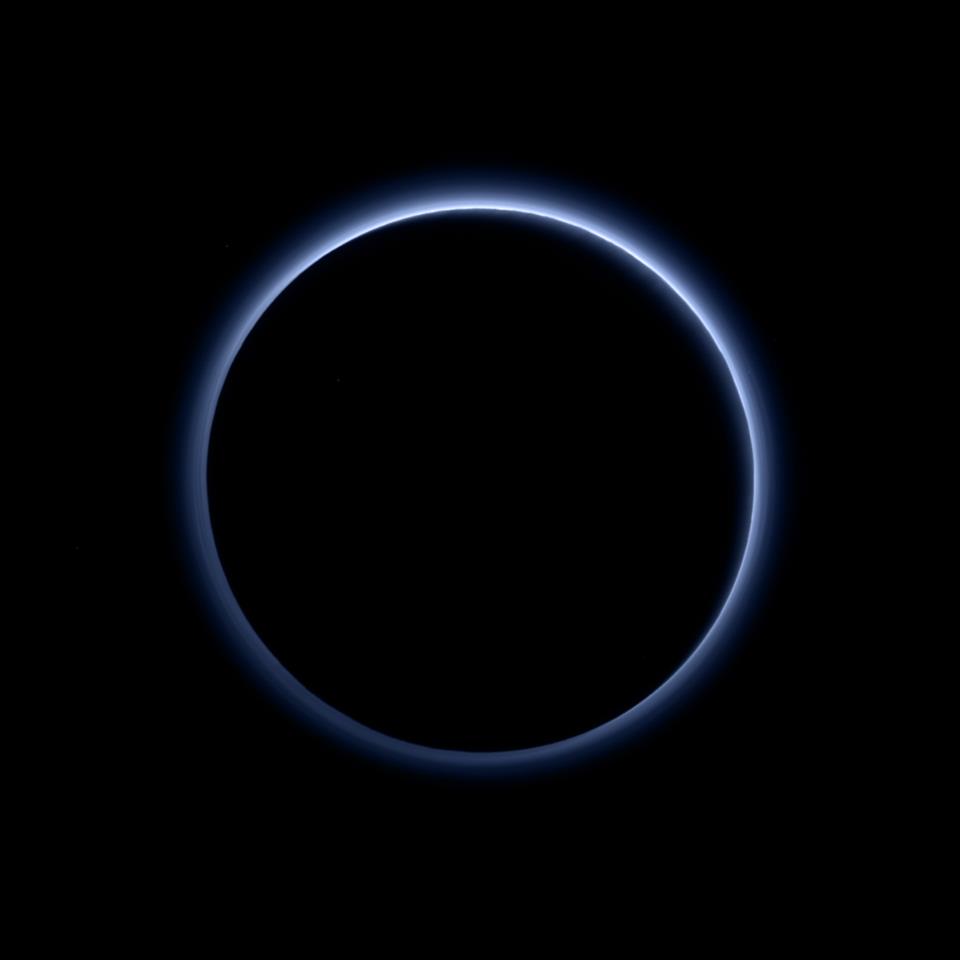
Pluto seen in silhouette, backlit by the Sun in color. Released October 10, 2015 by NASA/JHUAPL/SwRI
10/28/2015 – Ephemeris – The bright planets are gathered near the Sun in the evening and morning sky
Ephemeris for Wednesday, October 28th. The Sun will rise at 8:15. It’ll be up for 10 hours and 22 minutes, setting at 6:37. The Moon, 1 day past full, will rise at 7:52 this evening.
Let’s check out the whereabouts of the bright naked eye planets. The numbers of visible planets is getting a bit thin. The planet Saturn will be low in the west-southwest after sunset and will set at 8:06 p.m. It will be hard to find in evening twilight. In the morning sky the brilliant planet Venus will rise at 4:11 tomorrow morning. Jupiter will beat it above the horizon, rising at 3:33. Both will be quite high in the southeast by this program’s air time today. Jupiter will be just above Venus today and tomorrow morning. Mars will be below and to the left of these two. Mars will pass north of Venus next Tuesday. That will be a real contrast in brightness with Mars much fainter than Venus. Mercury has retreated back toward the Sun.
Times are for the Traverse City/Interlochen area of Michigan. They may be different for your location.
Addendum
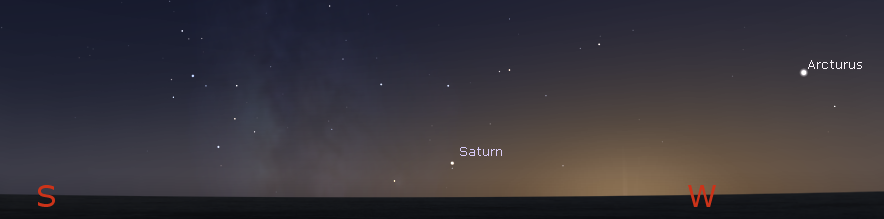
Saturn’s’ getting low in the twilight at 7:30 p.m. October 28, 2015. Created using Stellarium.
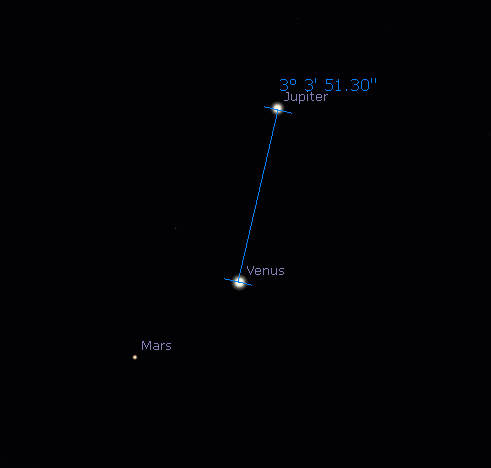
Venus with Jupiter 3 degrees above, with Mars below in the east-southeast at 7 a.m. October 29, 2015. Created using Stellarium.
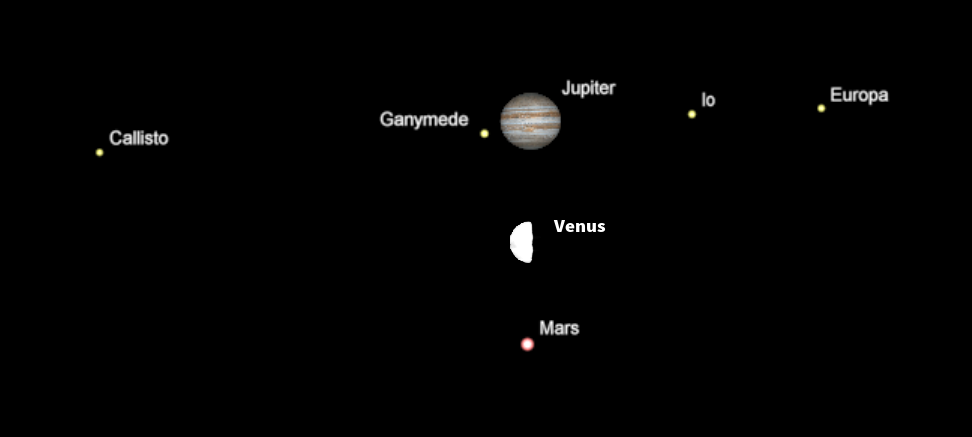
Apparent sizes of the morning planets Venus, Mars and Jupiter as seen through a telescope on October 29, 2015. Created using Cartes du Ciel (Sky Charts).
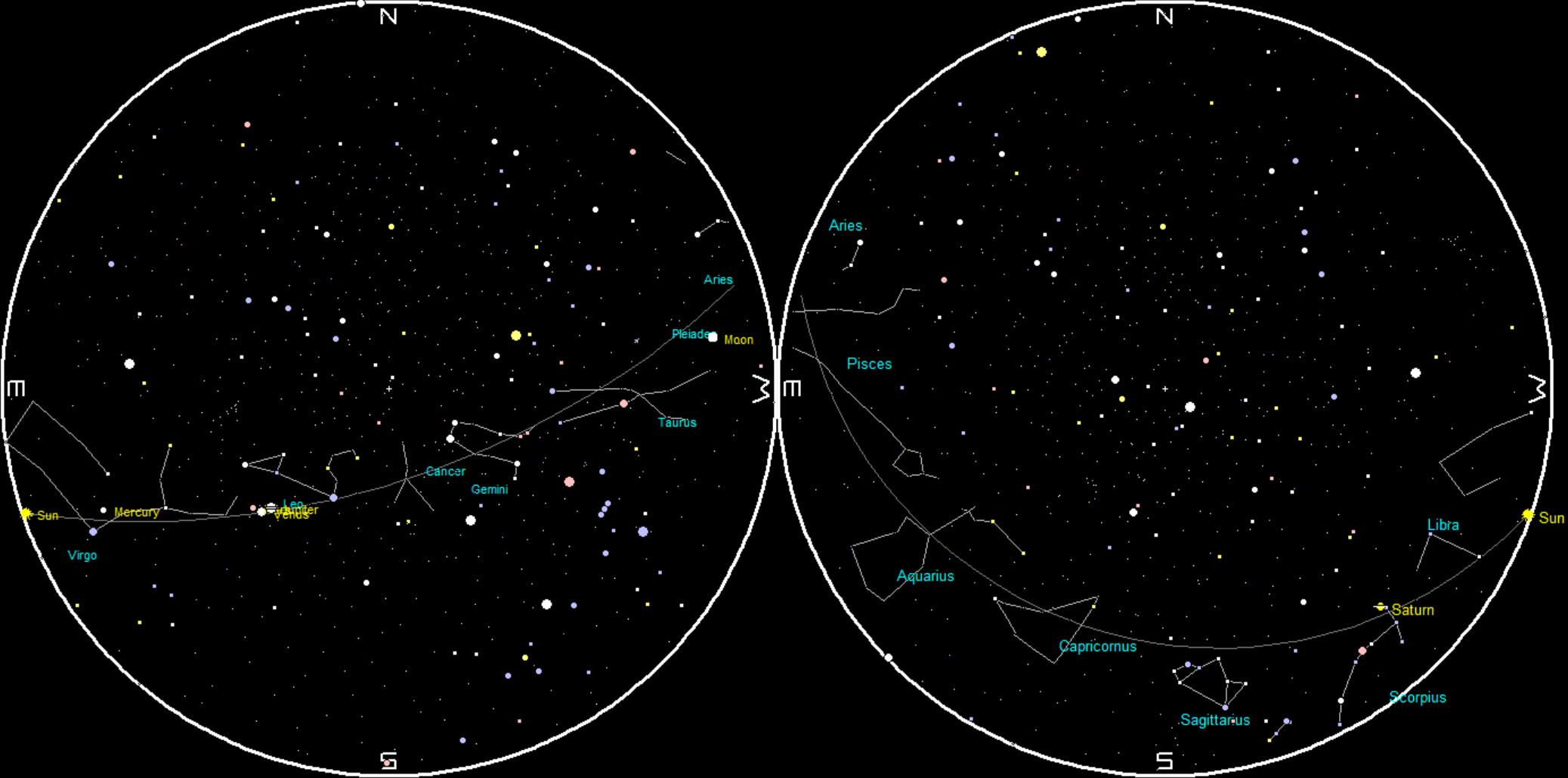
This is a chart showing the sunrise and sunset skies for October 28, 2015 showing the location of the planets and the Moon at that time. Created using my LookingUp program. Click on the image to enlarge.
10/27/2015 – Ephemeris – Hunter’s Moon
Ephemeris for Tuesday, October 27th. The Sun will rise at 8:13. It’ll be up for 10 hours and 25 minutes, setting at 6:39. The Moon, at full today, will rise at 7:09 this evening.
Tonight’s full moon is known as the Hunter’s Moon because it is the full moon after the harvest moon. The minute the Moon will be full will be at 7:05 this morning, about an hour before it sets. This was the time Native Americans and Europeans went out to secure the meat for the winter. And it also coincides with the time of year of our hunting seasons. So in that regard it fits nicely. The names of the full moons throughout the year generally mesh with the activities or weather conditions of that month. For instance December’s full moon is the Cold Moon or the Long Nights Moon. December has the longest nights. This list is taken from farmersalmanac.com, the website of the Old Framers Almanac, from which I’ve been getting folklore tidbits for years.
Times are for the Traverse City/Interlochen area of Michigan. They may be different for your location.
Addendum
Other sources for full moon names:
- Wikipedia
- EarthSky
- MoonConnection
- Or just search for: full moon names
10/26/2015 – Ephemeris – RIP Robert Farquhar interplanetary navigator extraordinaire
Ephemeris for Monday, October 26th. The Sun will rise at 8:12. It’ll be up for 10 hours and 28 minutes, setting at 6:40. The Moon, 1 day before full, will set at 8:10 tomorrow morning.
This morning Jupiter and Venus appear close together in the morning sky. They are said to be in conjunction. Also Venus is at its greatest separation from the Sun today. It will slowly begin to fall back toward the Sun. Last week Sunday Robert Farquhar died. He developed the technique of orbiting the L1 point between the Sun and the earth where the Earth nullifies the Sun’s gravity, so a spacecraft can stay there between the Earth and the Sun. He designed the trajectory for the ISEE-3 spacecraft that acted as an early warning for particles coming from the Sun. He also liberated it in 1982 and through a series of ingenious maneuvers worked it into a solar orbit that flew it through the tail of Comet Giacobini-Zinner.
Times are for the Traverse City/Interlochen area of Michigan. They may be different for your location.
Addendum
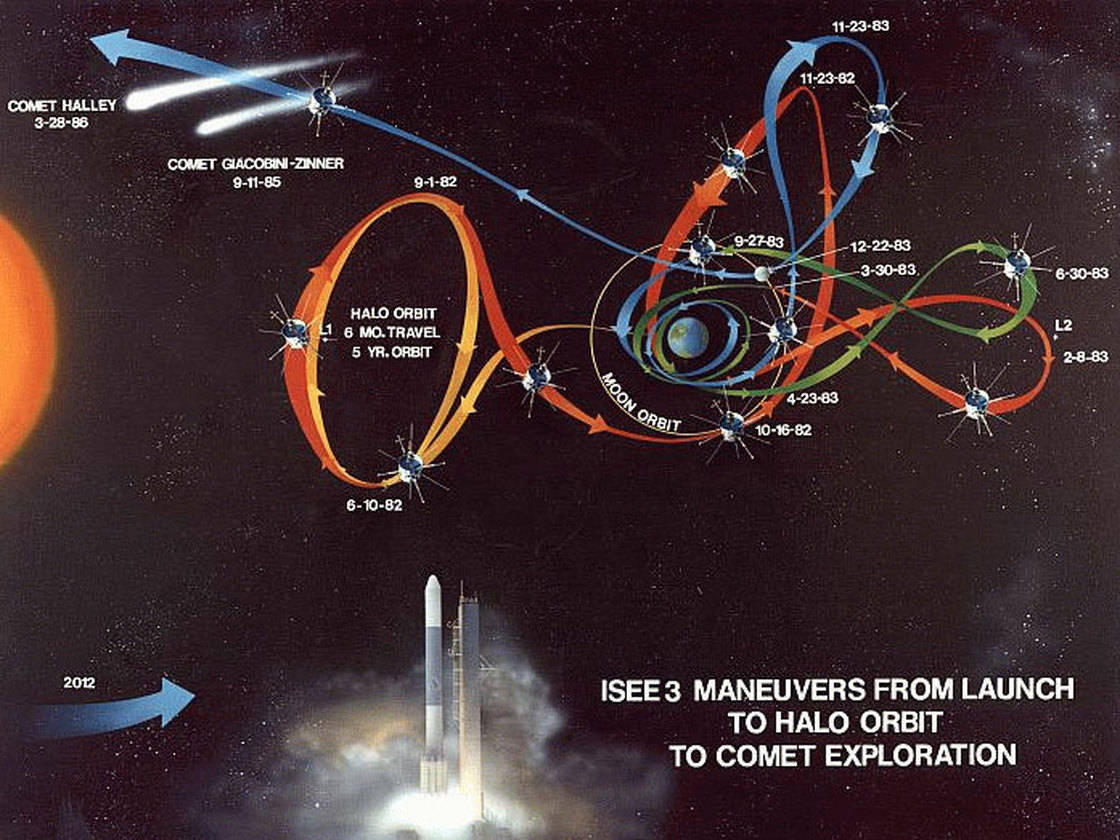
ISEE-3’s orbital path to the halo orbit at the Earth-Sun Lagrangian L1 point and out to cross the path of Comet Ziacobini-Zinner ahead of the fleet heading to Comet Halley. It was renamed ICE (International Comet Explorer). Credit: NASA/GSFC
Here’s a link to a page that recounts the quest to return the spacecraft to its L1 position by Farquhar and his band of “rouges” last year.
10/23/2015 – Ephemeris – Jupiter approaches Venus this weekend
Ephemeris for Friday, October 23rd. The Sun will rise at 8:08. It’ll be up for 10 hours and 36 minutes, setting at 6:45. The Moon, 3 days past first quarter, will set at 4:23 tomorrow morning.
Over the weekend the planets Venus and Jupiter will approach each other, until on Monday morning they will be a bit more than a degree apart, or twice the diameter of the Moon apart. Of course in reality Jupiter is far more distant than Venus. Jupiter is 563 million miles (906 million km) away, while Venus is only 63 million miles (101 million km) away, about a ninth of Jupiter’s distance. Also, on Monday Venus will be at its greatest western elongation from the Sun, that is its greatest angular separation from the Sun of 46 degrees. Venus, like Mercury, which went through its greatest western elongation last week have orbits of the Sun inside that of the Earth, so never stray far from it. Venus never rises or sets more than 3 hours from the Sun.
Times are for the Traverse City/Interlochen area of Michigan. They may be different for your location.
Addendum
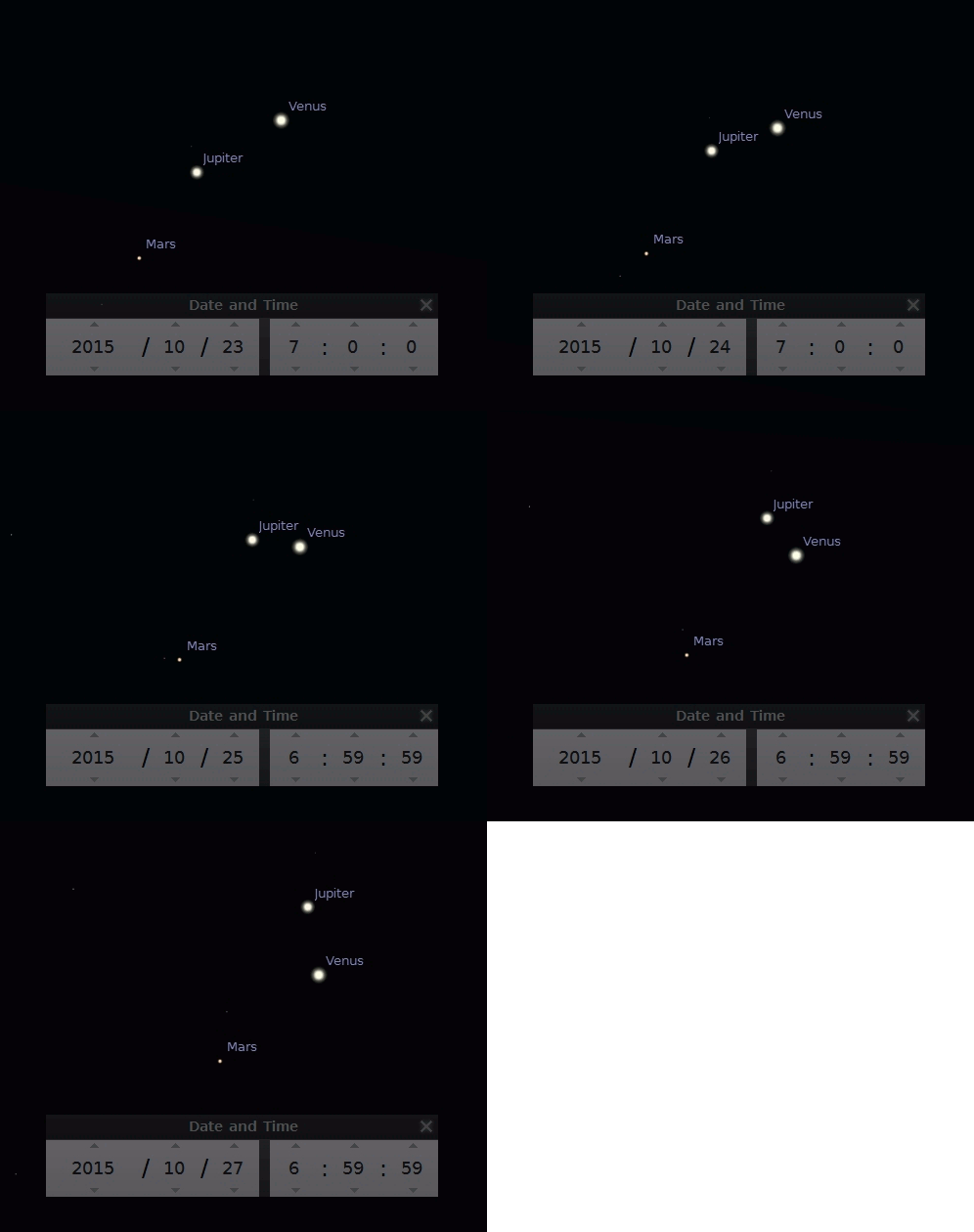
Jupiter passing Venus with Mars nearby in the east on the mornings of October 23, 24, 25, 26 and 27, 2015. Created using Stellarium and GIMP.
Check out my posts on the last two conjunctions of Jupiter and Venus in this series on August 18, 2014, and June 30, 2015. I discuss the possible connection to the Star of Bethlehem on my June 29th post.
10/22/2015 – Ephemeris – My favorite lunar feature
Ephemeris for Thursday, October 22nd. The Sun will rise at 8:07. It’ll be up for 10 hours and 39 minutes, setting at 6:46. The Moon, 2 days past first quarter, will set at 3:10 tomorrow morning.
The Moon tonight is revealing my favorite feature, Sinus Iridium or Bay of Rainbows. Unfortunately features on the Moon are not that colorful. The Bay of Rainbows is surrounded on three sides by a semicircular mountain range called the Jura Mountains which is actually a broken down crater wall. The Bay is a bay in Mare Imbrium, the Sea of Showers. It is the nomenclature of land forms on planets and moons that still have Latin names in astronomy. That and constellations. Of course the Bay of Rainbows and the Sea of Showers aren’t real bodies of water. These were the product of the imaginations of astronomers looking through their primitive telescopes, at a completely alien landscape.
Times are for the Traverse City/Interlochen area of Michigan. They may be different for your location.
Addendum
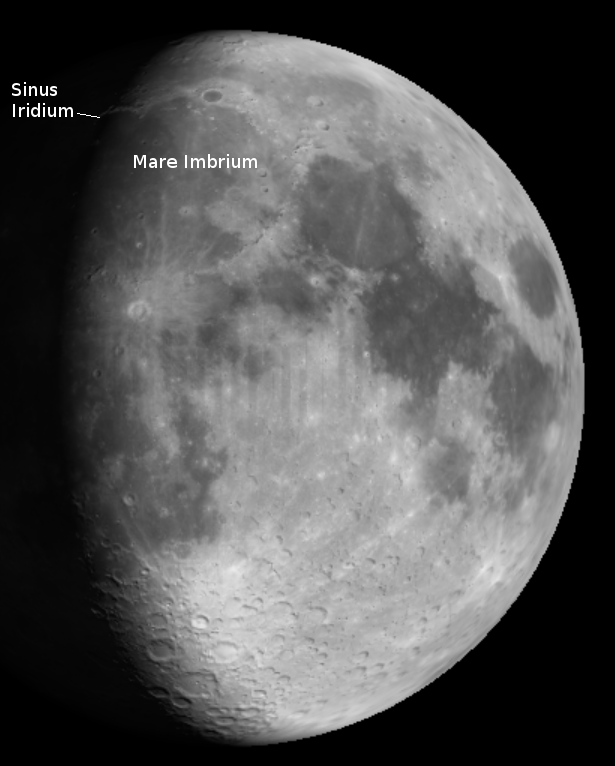
The Moon tonight with Sinus Iridium peeking out into the morning sunlight on the Moon, 9 p.m. October 2015. Created using Virtual Moon Atlas.
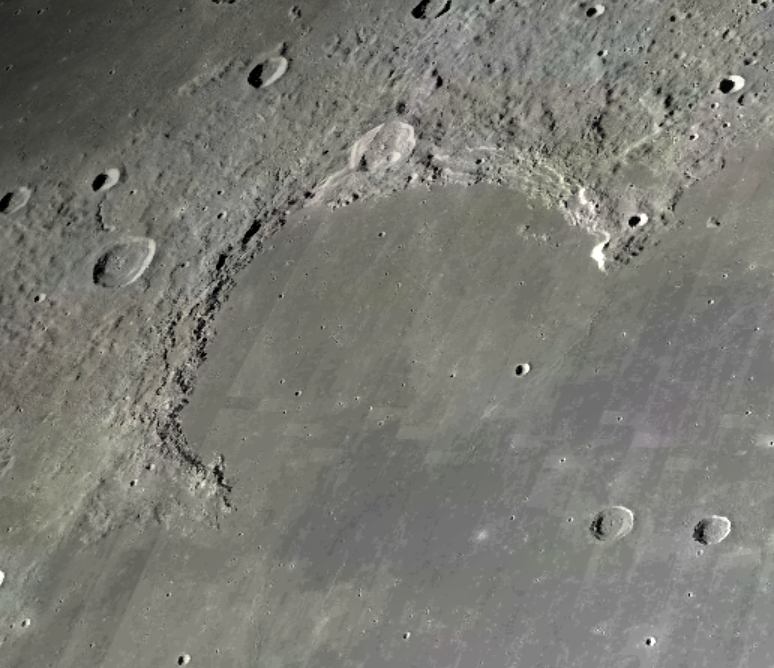
Sinus Iridium photographed by the Lunar Reconnaissance Orbiter as texture mapped on the globe of the Virtual Moon Atlas.
10/21/2015 – Ephemeris – The bright planets and an anniversary star party
Update 5:05 p.m.:
The star party at the Sleeping Bear Dunes has been canceled due to clouds.
Ephemeris for Wednesday, October 21st. The Sun will rise at 8:05. It’ll be up for 10 hours and 42 minutes, setting at 6:48. The Moon, 1 day past first quarter, will set at 2:00 tomorrow morning.
We’ve got a busy day. The planet Saturn will be low in the west-southwest after sunset and will set at 8:31 p.m. In the morning sky the brilliant planet Venus will rise at 4:05 and be quite high at this program’s air time. Jupiter will be just below and left of it. Mars will be below and left of Jupiter by a similar amount. Both rise within 20 minutes of Venus. Far below and left will be Mercury which will rise at 6:38. Tonight is the last star party of the year at the Sleeping Bear Dunes National Lakeshore. This is the lakeshore’s 45th anniversary. It will held starting at 8 p.m. at Pierce Stocking Drive Stop #3 the Dunes Overlook if it’s clear, Park at Picnic Mountain. The Moon will be the big attraction tonight. The Grand Traverse Astronomical Society has been holding star parties at the Sleeping Bear Dunes since the park’s 40th anniversary in 2010.
Times are for the Traverse City/Interlochen area of Michigan. They may be different for your location.
Addendum
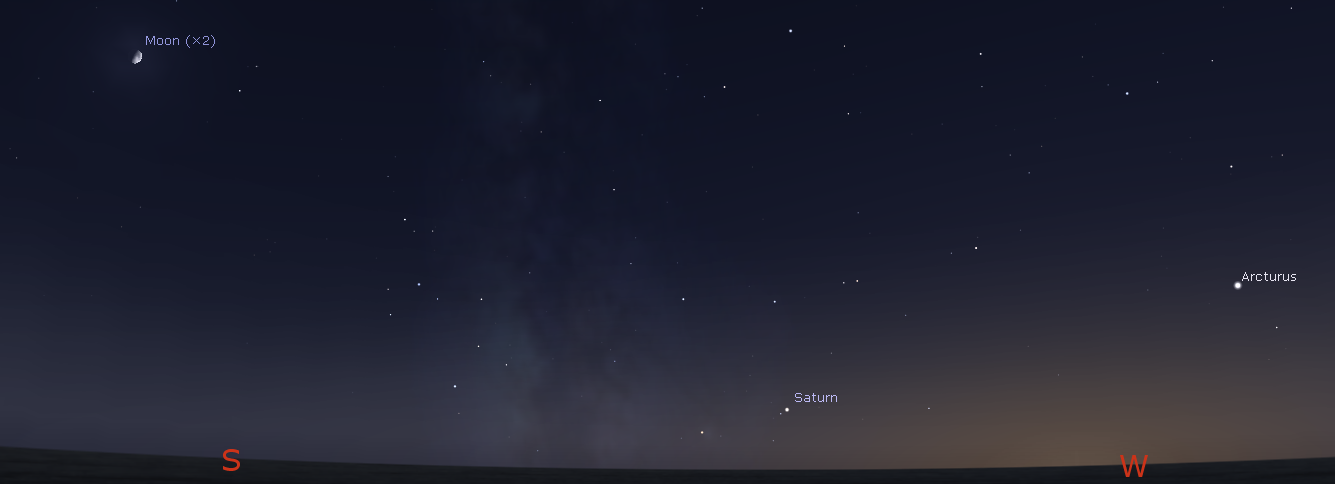
Saturn and the Moon (at twice normal size) at 7:30 p.m. October 21, 2015. Created using Stellarium.
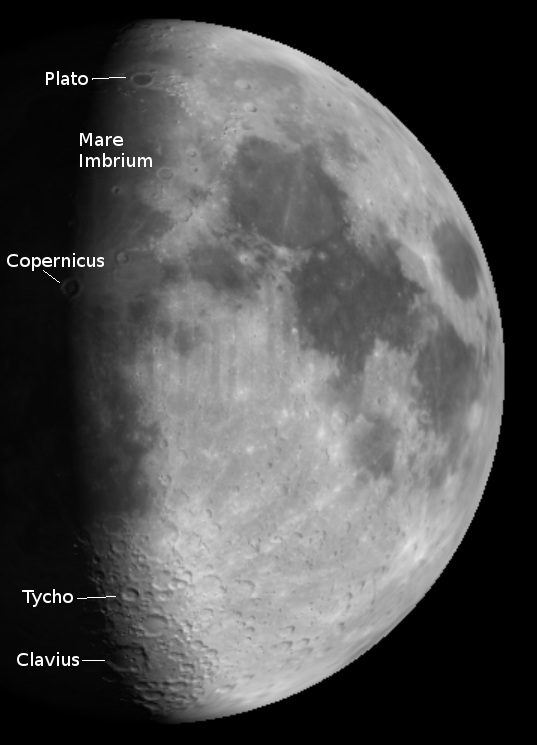
The telescopic Moon tonight, October 21, 2015, for the star party at Sleeping Bear Dunes. Created using Virtual Moon Atlas.
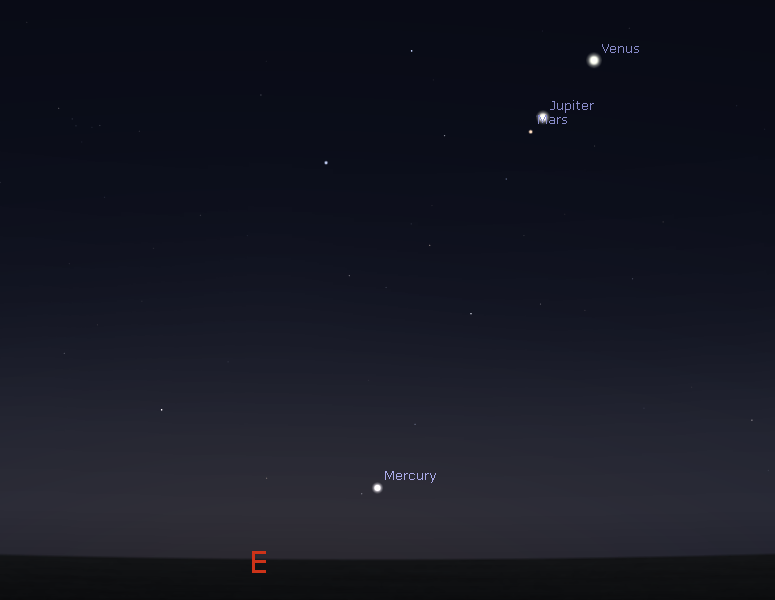
The morning planets at 7 a.m., October 22, 2015. Created using Stellarium.
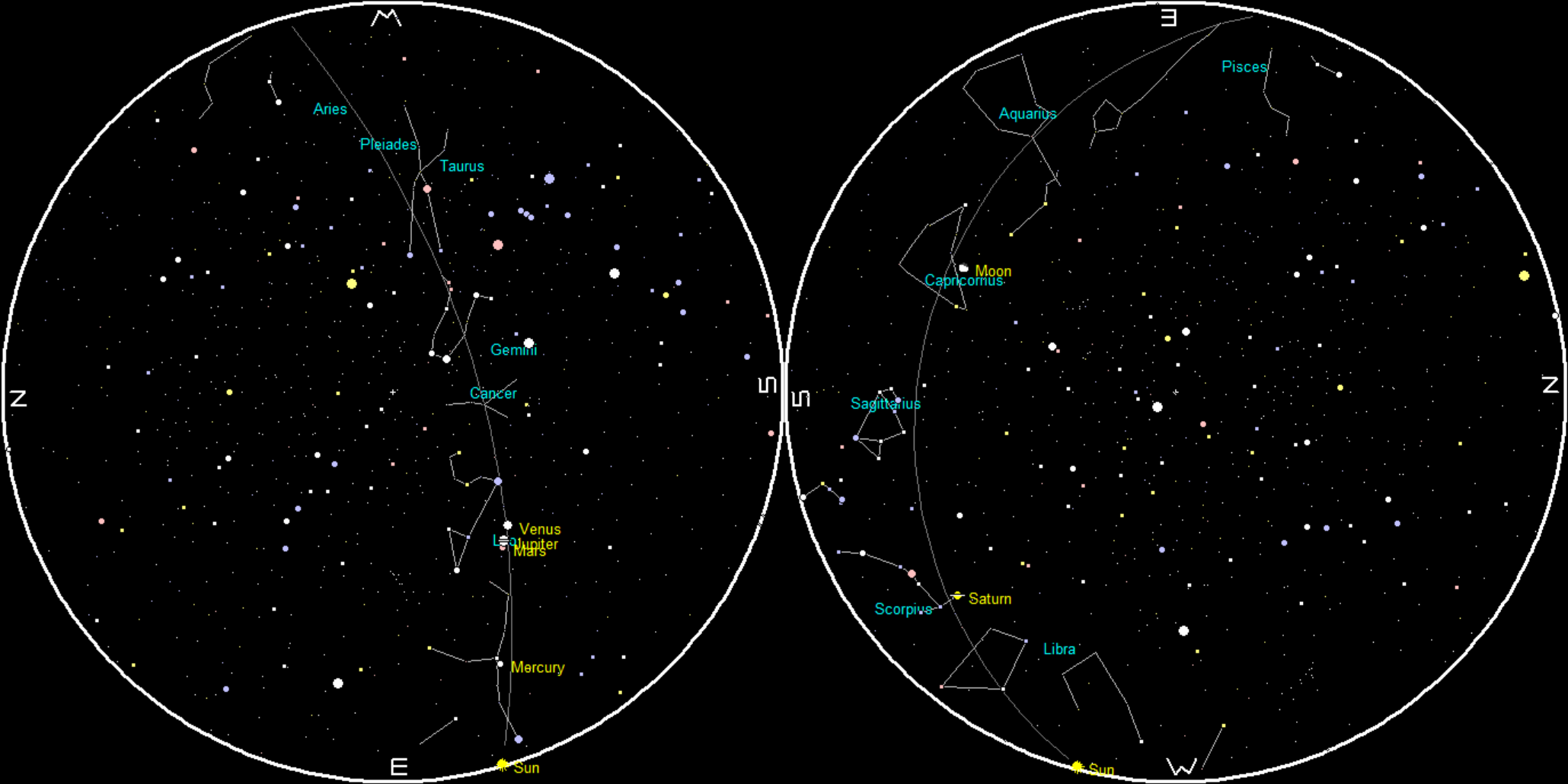
This is a chart showing the sunrise and sunset skies for October 21, 2015 showing the location of the planets and the Moon at that time. The charts are rotated 90 degrees to more clearly show the traffic jam of the morning planets. Created using my LookingUp program. Click on the image to enlarge.
10/20/2015 – Ephemeris – Halley’s Comet returns… in bits and pieces
Ephemeris for Tuesday, October 20th. The Sun will rise at 8:04. It’ll be up for 10 hours and 45 minutes, setting at 6:50. The Moon, at first quarter today, will set at 12:53 tomorrow morning.
Halley’s Comet is back! Well sorta. In the form of the Orionid meteor shower. Bits of Halley’s Comet from previous passes by the Earth’s orbit make their twice yearly show in our skies as these bits collide with the Earth’s atmosphere. Halley’s orbit passes close to the earth’s orbit at points where the Earth is around May 6th and again near October 21st. Light dust get blown back into the tail of the comet. Heavier particles, still affected by the pressure of sunlight and the gravitational pull of the Sun and planets end up roughly following the comet’s orbit. Tonight night after the Moon sets should be the best time to see them. They will seem to come from a spot above Orion and below Gemini.
Times are for the Traverse City/Interlochen area of Michigan. They may be different for your location.
Addendum
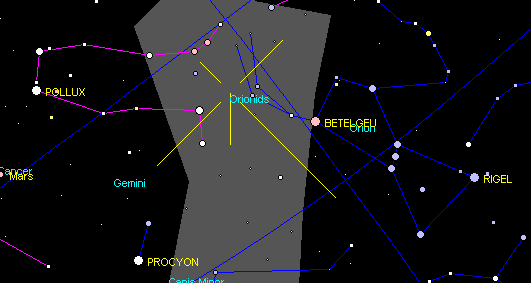
Orionid Radiant
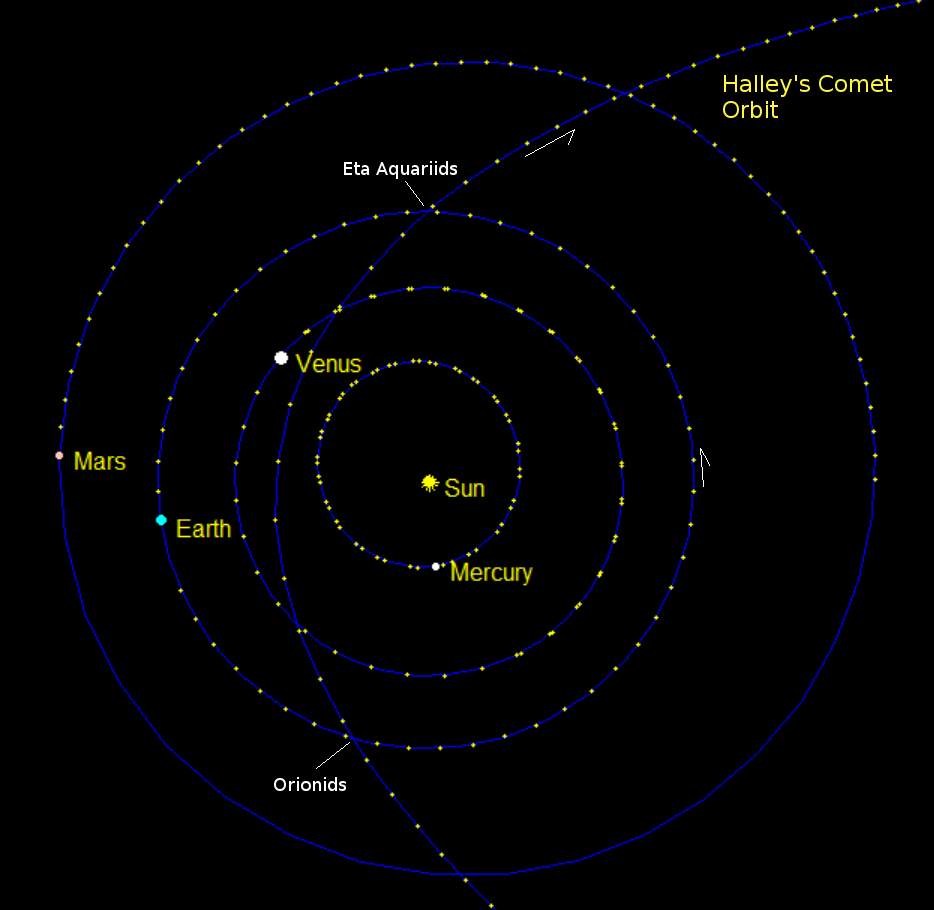
We get two meteor showers from Halley’s Comet. The Orionids, when Halley is approaching the inner solar system, and the Eta Aquariids when it’s leaving. Credit my LookingUp program.
10/19/2015 – Ephemeris – Where did the Moon come from?
Ephemeris for Monday, October 19th. The Sun will rise at 8:03. It’ll be up for 10 hours and 48 minutes, setting at 6:51. The Moon, 1 day before first quarter, will set at 11:51 this evening.
Only two planets in the solar system have moons at least a quarter the size of the planet they orbit: The Earth and Pluto. The Moon is a bit more than a quarter the Earths diameter while Pluto’s moon Charon is half its size. Probably in the early days of the solar system, some four and a half billion years ago collisions were rather common. It is thought by many planetary scientists that a Mars sized protoplanet collided with the proto-earth with a glancing blow to rip off much of the Earth’s crust, thrust it into orbit where it coalesced into the Moon. It seems that Pluto’s Charon may have been formed much the same way. Some thing the varying axial tilts of the planets may have been caused the same way by smaller objects.
Times are for the Traverse City/Interlochen area of Michigan. They may be different for your location.
Addendum
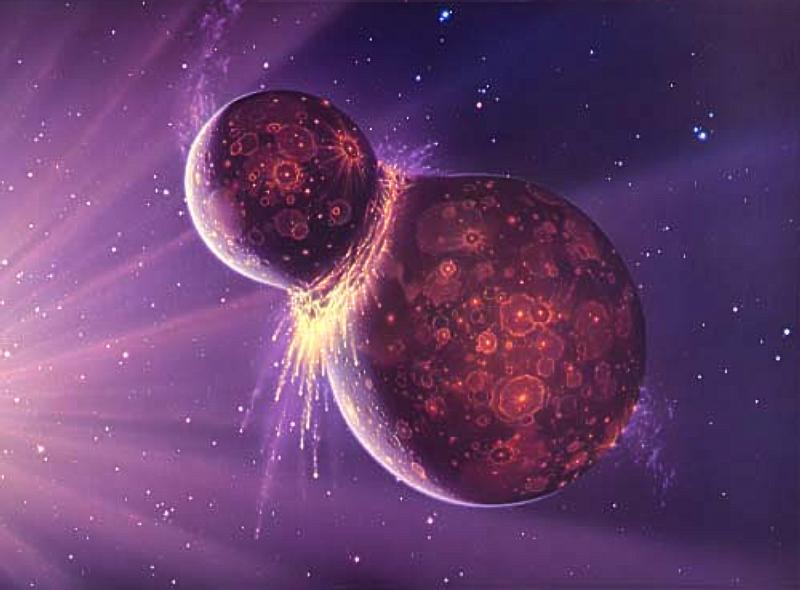
The hypothetical collision of a Mars sized body with the young Earth. Credit: Joe Tucciarone via NASA
Breaking News
Robert Farquhar the man behind the ISEE-3 spacecraft, the first to hang out at the Earth-Sun L1 point between the Earth and the Sun back in 1978 passed away yesterday. In 1982 he “stole” the spacecraft and through an amazing number of maneuvers using very little fuel managed to send it through the tail of Comet Gicobini-Zinner ahead of the fleet of spacecraft then aimed at Halley’s Comet. Last year when the then renamed spacecraft ICE approached the Earth, he hatched a plan to return the spacecraft to its L1 position. Unfortunately apparently there was not enough fuel pressure to complete the burns necessary for the task. I’ll have a program on Robert Farquhar next Monday.
 Bob Moler's Ephemeris Blog