Archive
12/17/2015 – Ephemeris – The bright star Aldebaran the “follower”
Ephemeris for Thursday, December 17th. The Sun will rise at 8:14. It’ll be up for 8 hours and 48 minutes, setting at 5:03. The Moon, 1 day before first quarter, will set at 12:07 tomorrow morning.
The central constellation of winter Orion, will be rising the east-southeast at 9 p.m. Above it is Taurus the bull. The bright orange star in Taurus is Aldebaran. Aldebaran appears at the lower left tip of a letter V group of stars that is the face of the bull. Aldebaran isn’t actually part of the group, called the Hyades star cluster. The cluster is about 151 light years away, while Aldebaran is 65. The star has an orange hue because its surface is cooler than the sun’s. However Aldebaran is 44 times larger in diameter, and shines 425 times brighter than the sun, if you include the infrared which our eyes can’t detect, or 150 times brighter in visible light. The name Aldebaran means “Follower” because it follows the Pleiades star cluster above through the night.
Times are for the Traverse City/Interlochen area of Michigan. They may be different for your location.
Addendum
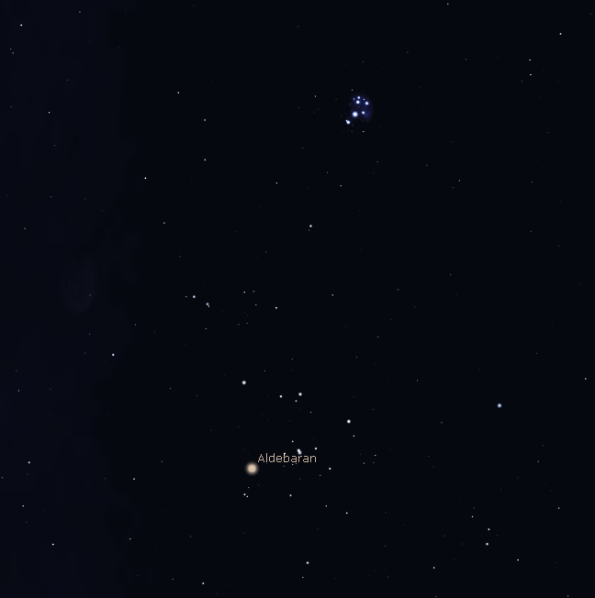
Aldebaran, the Hyades and Pleiades star clusters. Created using Stellarium.
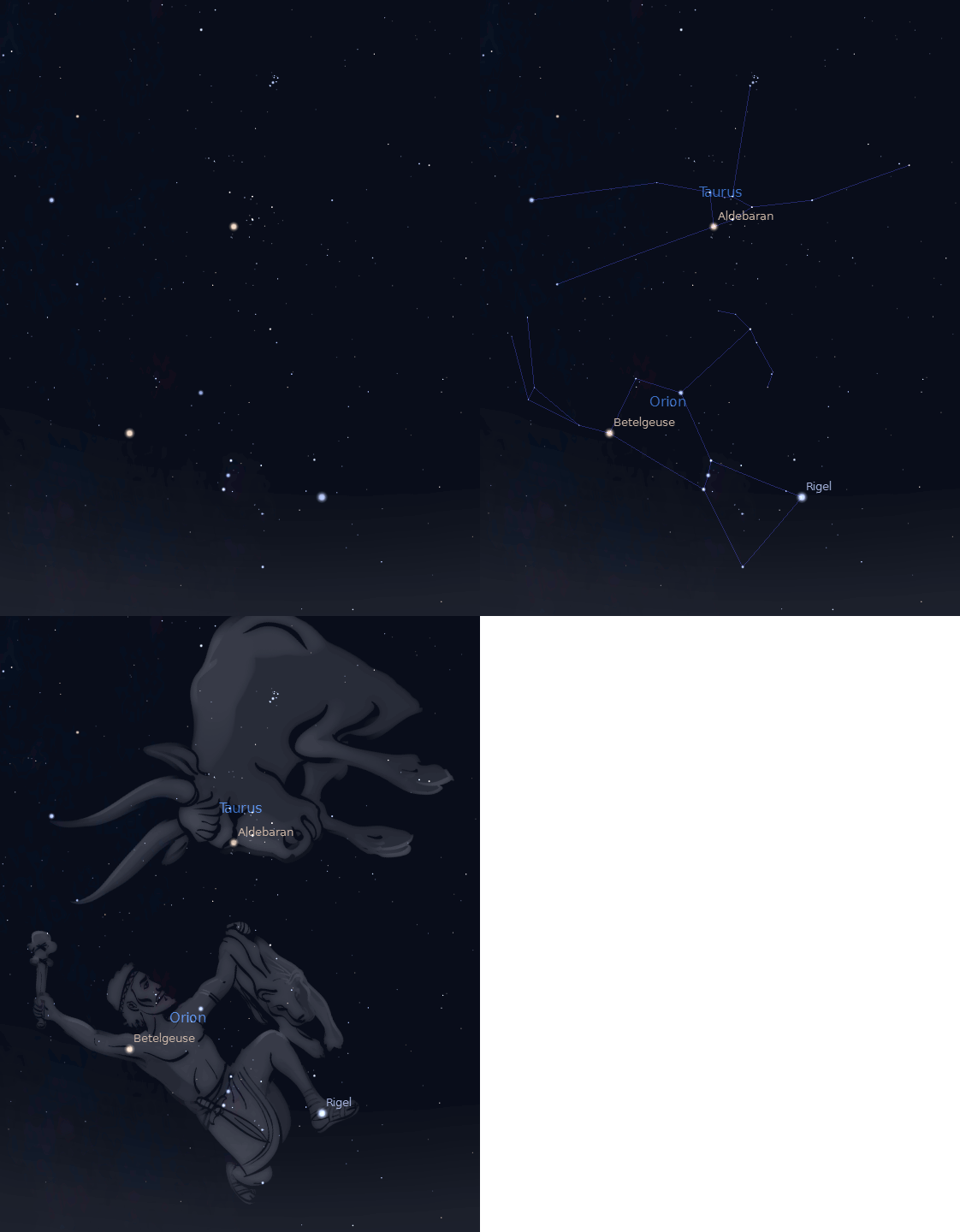
Three views of Taurus the bull and Orion the hunter for 9 p.m. on December 8, 2015. Created using Stellarium and GIMP.
12/16/2015 – Ephemeris – The planet action is still in the morning
Ephemeris for Wednesday, December 16th. The Sun will rise at 8:13. It’ll be up for 8 hours and 49 minutes, setting at 5:02. The Moon, 2 days before first quarter, will set at 10:57 this evening.
Let’s check out the whereabouts of the bright naked eye planets. Mercury is becoming marginally visible very low in the southwest before it sets at 6 p.m. In the morning sky there are three bright planets. Jupiter will be the first to rise, at 12:15 a.m. in the east. Mars will rise next at 2:39 a.m. also in the east, followed by Venus at 4:41 a.m. in the east-southeast. Mars lies in line between Venus below and Jupiter above, almost halfway between the two. Don’t confuse Mars with the star Spica which is brighter and right below it. Saturn will rise at 6:54 a.m. in the east-southeast. Comet Catalina is a telescopic object about one and a half the width of a fist held at arm’s length above Venus and the same amount left of Mars.
Times are for the Traverse City/Interlochen area of Michigan. They may be different for your location.
Addendum
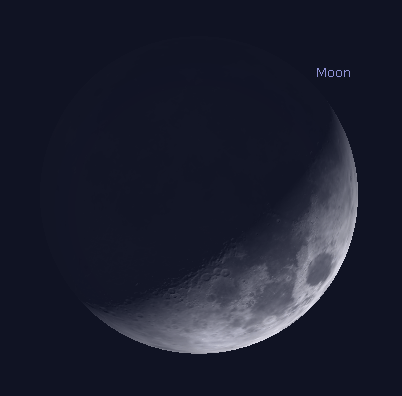
The moon as it might look in binoculars at 8 p.m., December 16, 2015. Created using Stellarium.
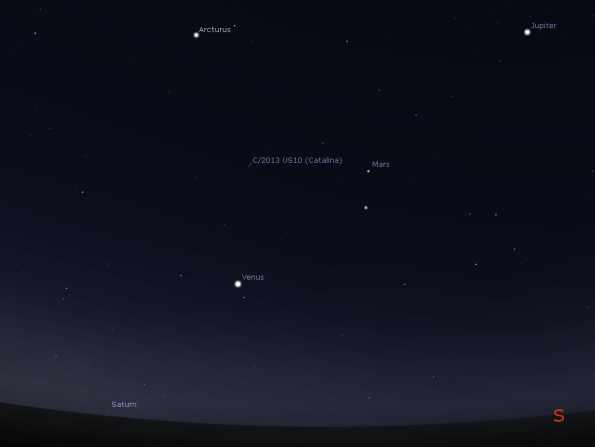
The Morning planets at 7 a.m., December 17, 2015. Created using Stellarium.
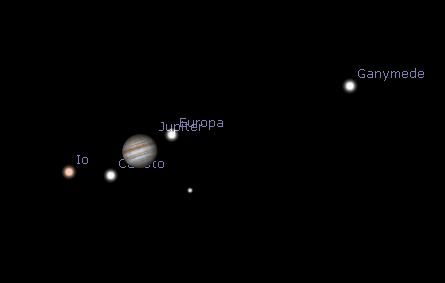
Jupiter and moons in a telescope at 7 a.m. December 17, 2015. Created using Stellarium.
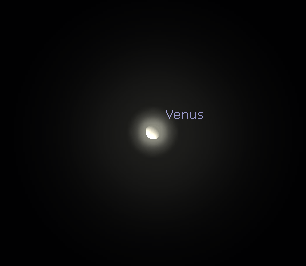
Venus as seen in a telescope as seen at the same magnification as Jupiter above, at 7 a,m. December 17, 2015. Created using Stellarium.
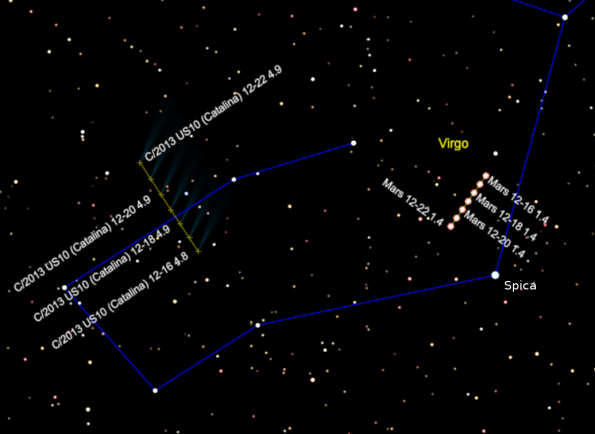
Comet Catalina and Mars for the next week. Note the magnitudes for the comet are about 1 magnitude too bright. It will take binoculars or a small telescope to spot the comet which will not show a tail visually. Created using Cartes du Ciel (Sky Charts).
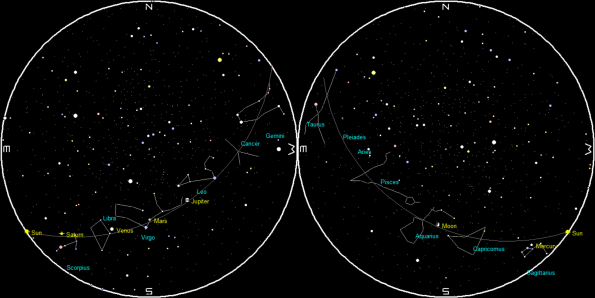
This is a chart showing the sunrise and sunset skies for December 16, 2015 showing the location of the planets and the Moon at that time. Created using my LookingUp program. Click on the image to enlarge.
12/15/2015 – Ephemeris – Procyon the star that’s “Before the dog”
Ephemeris for Tuesday, December 15th. The Sun will rise at 8:13. It’ll be up for 8 hours and 49 minutes, setting at 5:02. The Moon, 3 days before first quarter, will set at 9:48 this evening.
Visible low in the east at 9:30 p.m. appears the star Procyon to its lower left is Sirius the brightest night-time star. Procyon is the bright star in the constellation Canis Minor, or lesser dog. I can find only one other star in Canis Minor. Perhaps it’s a hot dog. If Sirius, in Canis major is the Dog Star then Procyon should be the Little Dog Star. However Procyon is an interesting name. It means “Before the dog”, which is an allusion to the fact that Procyon, though east of Sirius actually rises before it. This is due to Procyon’s more northerly position. This effect doesn’t work south of the equator, however. Sirius will rise at about 9 tonight. Procyon is a star much like Sirius but is 32% farther away. It’s 11.4 to Sirius’ 8.6 light years away.
Times are for the Traverse City/Interlochen area of Michigan. They may be different for your location.
Addendum
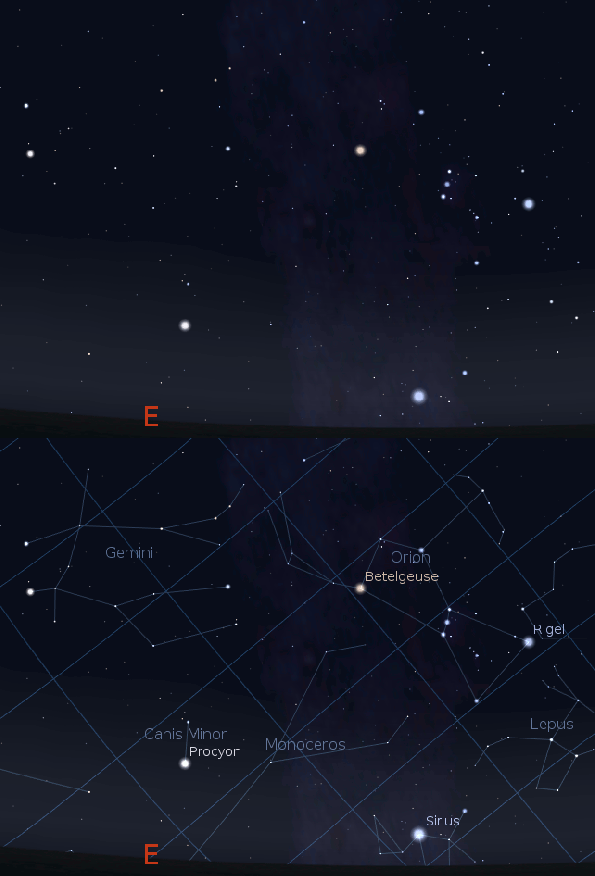
Procyon, Sirius and the stars of winter. Created using Stellarium
In the above chart, beside the constellation lines, we have the grid of right ascension, from lower left to upper right; and declination, from upper left to lower right. right ascension lines are like longitude on the Earth, while declination lines are latitude lines. They are tipped because I don’t live at either the equator or one of the poles. As the Earth rotates the Sun, stars and planets slide westward in the direction of the declination lines. Note that Sirius is closer to the horizon than Procyon. Also that Sirius is west of the 7 hour right ascension line. (Take my word for it.) Procyon is east of that line, thus Sirius is west of Procyon.
Other cool things can be seen in the chart. Note the declination line that touches the horizon at the east compass point and runs just above Orion’s belt. It is 0º declination, or the celestial equator. It extends to the west compass point on the western horizon. The Sun on the equinoxes will rise due east and set due west. The 6 hour right ascension line runs past Betelgeuse in Orion. At 23½º north declination, near Castor’s big toe in Gemini is where the Sun appears on the first day of summer, the summer solstice.
P.S. It was cloudy and rainy the last two days. Didn’t see a Geminid meteor again this year, keeping my record intact.
12/14/2015 – Ephemeris – The Geminids reach peak today – See ’em morning or evening
Ephemeris for Monday, December 14th. The Sun will rise at 8:12. It’ll be up for 8 hours and 50 minutes, setting at 5:02. The Moon, 3 days past new, will set at 8:42 this evening.
The Geminid meteor shower is ongoing right now. The peak is expected to be near 1 p.m. today. So the numbers seen this morning while it’s still dark should be about the same as will be seen this evening. Not peak numbers, but it should be a good show nonetheless if it’s clear tonight. The radiant is in the constellation of Gemini above Orion. The source of this shower is an asteroid rather than a comet. It may be a burnt out comet which lost all its frozen gasses. It has a definite highly elliptical orbit of a comet and comes very close to the Sun, where one of the STEREO Sun monitoring spacecraft saw it ejecting a cloud of dust. It may be classed as a rock comet for that reason, blurring the line between comets and asteroids.
Times are for the Traverse City/Interlochen area of Michigan. They may be different for your location.
Addendum
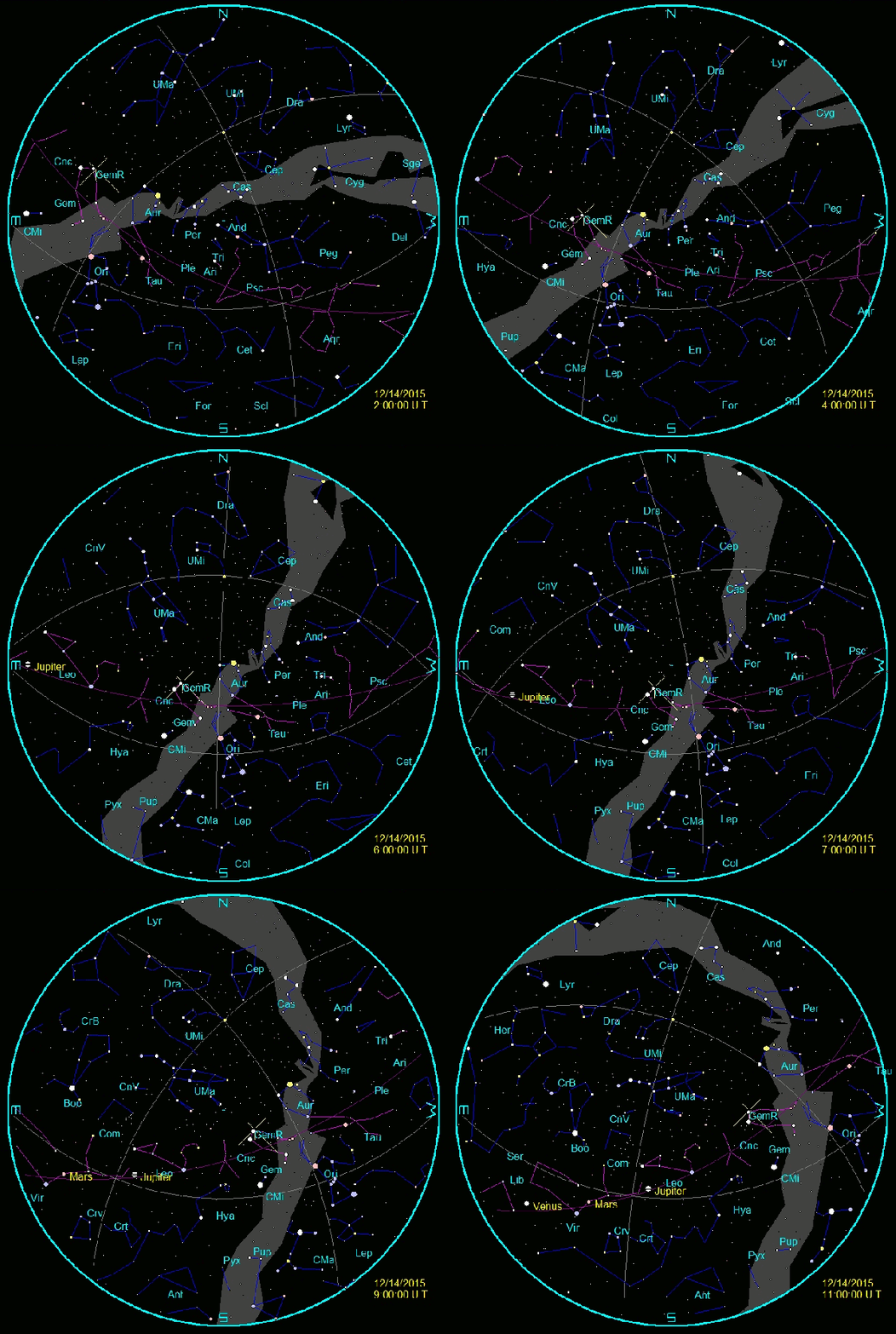
All Sky view one hour intervals for The Geminid meteor shower the night of December 13-14, 2015.. Note the radiant “GemR”. Created with my LookingUp program and GIMP.
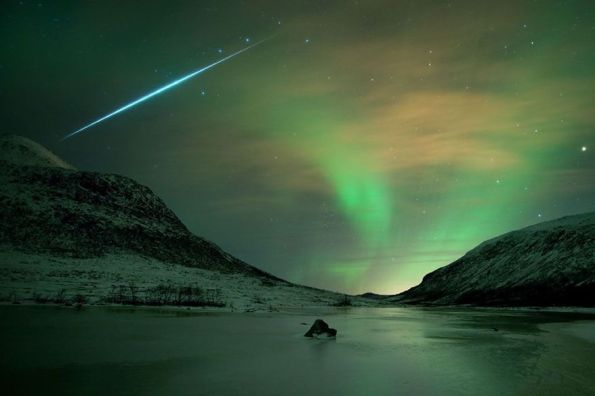
A Geminid and the aurora borealis from Norway. Found this in a NASA blog (link below) uncredited). However I was able to find the credit: Image Credit & Copyright: Bjørnar G. Hansen.
The image above was also an Astronomy Picture of the Day. Here’s a link to the NASA blog dated December 9, 2015 about live tweeting the Geminids.
12/11/2015 – Ephemeris – The Geminid meteor shower will be cranking up this weekend
Ephemeris for Friday, December 11th. The Sun will rise at 8:09. It’ll be up for 8 hours and 52 minutes, setting at 5:02. The Moon is new today, and won’t be visible.
Over the weekend and through Monday night the Geminid Meteor shower will be seen. This shower is actually the bet of the year, with higher hourly counts of meteors than the more famous Perseid meteor shower of August. Around here the cold weather and the more than even chance that it will be cloudy have kept this astronomer from having seen even one. Maybe this year. The Geminids can be seen all night because the radiant point is in the northern sky, well north of the celestial equator at least. At 9 p.m. the constellation Gemini rises sideways with the namesake of the twins, the stars Castor and Pollux vertically aligned in the east with Castor on top. The closest to the peak numbers will be seen Monday early morning and Monday night.
Times are for the Traverse City/Interlochen area of Michigan. They may be different for your location.
Addendum
All Sky view one hour intervals for The Geminid meteor shower the night of December 13-14, 2015.. Note the radiant “GemR”. Created with my LookingUp program and GIMP.
Note the times are in Universal time conversion to local time.
 UT     EST
  2     9 p.m.
  3    10 p.m.
  4    11 p.m.
  5    12 m.
  6     1 a.m.
  7     2 a.m.
  8     3 a.m.
  9     4 a.m.
 10     5 a.m.
 11     6 a.m.
For locations other than EST Eastern Standard time (UT – 5 hours), just use EST as your local time. The latitude is set for near 45º north.
12/10/2015 – Ephemeris – What’s a charioteer doing holding goats?
Ephemeris for Thursday, December 10th. The Sun will rise at 8:08. It’ll be up for 8 hours and 53 minutes, setting at 5:02. The Moon, 1 day before new, will rise at 7:59 tomorrow morning.
Rising now more than half way up the sky in the east at 9 p.m. will be the bright star Capella and its pentagonal constellation Auriga the Charioteer. Auriga appears to be hunched down sideways in the sky in his chariot carrying 4 goats. Capella is the mother goat, and a slim triangle of stars near her are her kids. Perhaps the kids in the chariot were such a distraction that he crashed. So maybe the gods placed them in the sky as a warning. In fact that triangle is an asterism widely known as the Kids. The Milky Way runs through Auriga and it is the home of several star clusters that appear as fuzzy spots in binoculars. Capella for us in northern Michigan never sets. It is a winter star that can be seen year round. It’s disconcerting to spot it scraping the northern horizon in July.
Times are for the Traverse City/Interlochen area of Michigan. They may be different for your location.
Addendum
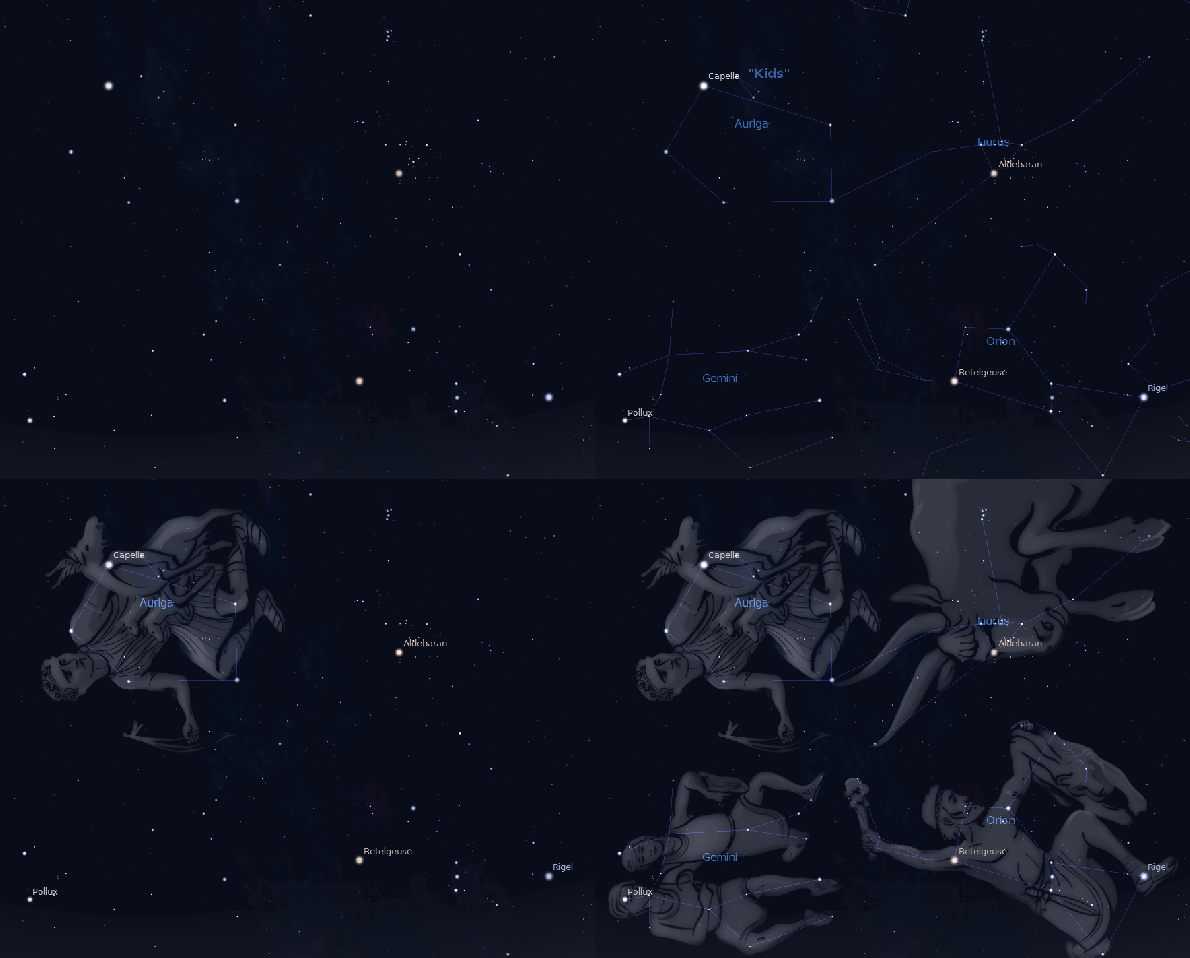
Auriga and neighboring constellations for 9 p.m. December 10, 2015. Created using Stellarium and GIMP.
12/09/2015 – Ephemeris – The planet action is in the morning sky
Ephemeris for Wednesday, December 9th. The Sun will rise at 8:07. It’ll be up for 8 hours and 54 minutes, setting at 5:02. We’re at the time of the earliest sunset. The Moon, 2 days before new, will rise at 7:02 tomorrow morning.
Let’s check out the whereabouts of the bright naked eye planets. Saturn and Mercury are too close to the direction of the Sun to be seen now. In the morning sky there are three bright planets. Jupiter will be the first to rise, at 12:39 a.m. in the east. Mars will rise next at 2:47 a.m. in the east, followed by Venus at 4:28 a.m. also in the east. Mars lies in line between Venus below and Jupiter above, almost halfway between the two. Don’t confuse Mars with the star Spica which is brighter and closer to Venus. Comet Catalina will be about half the width of a fist held at arm’s length above and left of Venus and will slowly be moving farther above Venus as the days go by.
Times are for the Traverse City/Interlochen area of Michigan. They may be different for your location.
Addendum
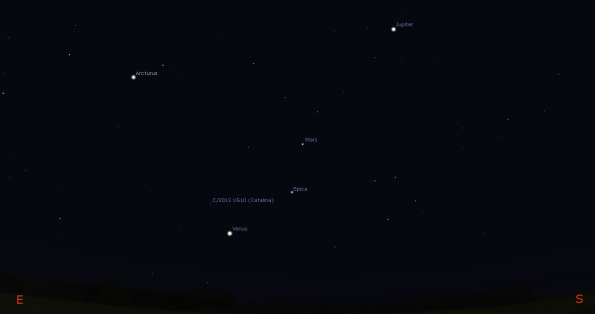
Jupiter, Mars and Venus appear with Comet Catalina in the southeast at 6 a.m., December 10, 2015. Comet Catalina is much fainter than shown and only sports a tail in photographs. Created using Stellarium.
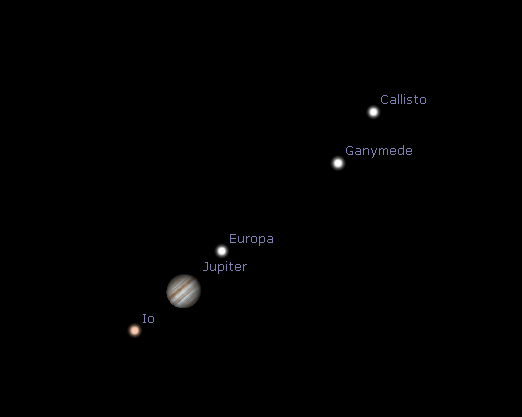
Jupiter and moons in a telescope at 6 a.m. December 10, 2015. Created using Stellarium.
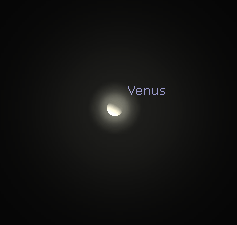
Venus as seen in a telescope as seen at the same magnification as Jupiter above, at 6 a,m. December 10, 2015. Created using Stellarium.
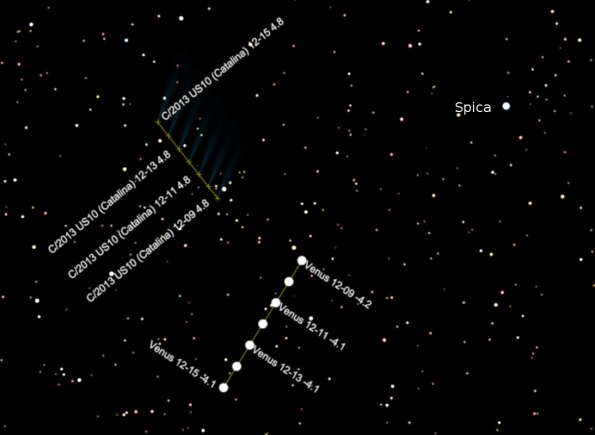
Comet Catalina and Venus for the next week. Note the magnitudes for the comet are about 2 magnitude too bright. It will take binoculars or a small telescope to spot the comet which will not show a tail visually. Created using Cartes du Ciel (Sky Charts).
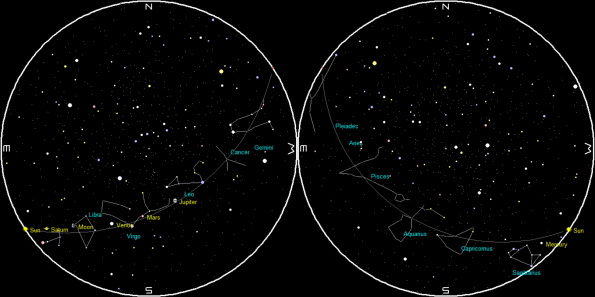
This is a chart showing the sunrise and sunset skies for December 9, 2015 showing the location of the planets and the Moon at that time. Created using my LookingUp program. Click on the image to enlarge.
12/08/2015 – Ephemeris – The hard charging Taurus the bull
Ephemeris for Tuesday, December 8th. The Sun will rise at 8:07. It’ll be up for 8 hours and 55 minutes, setting at 5:02. The Moon, 3 days before new, will rise at 6:03 tomorrow morning.
Low in the east at 9 p.m. is the constellation of Orion the giant hunter . Above him is Taurus the bull. His face is a letter V shape of stars lying on its side with the bright orange-red star Aldebaran at the bottom left tip of the V as its angry blood-shot eye. Orion is depicted in the sky facing with club in one hand and a shield in the other the approaching and in some depictions charging Taurus. The V of stars is a star cluster called the Hyades. The Pleiades are in his shoulder above. Taurus in Greek mythology was the guise the god Zeus when he carried off the maiden Europa. Europa’s still with him, sort of, as the intriguing satellite orbiting Zeus’ Roman equivalent Jupiter. In fact the moons around the planet Jupiter are generally named for Jupiter’s lovers and friends. His wife is missing from the entourage, and will be until the NASA spacecraft Juno reaches Jupiter next year.
Times are for the Traverse City/Interlochen area of Michigan. They may be different for your location.
Addendum
Three views of Taurus the bull and Orion the hunter for 9 p.m. on December 8, 2015. Created using Stellarium and GIMP.
12/07/2015 – Ephemeris – Today the Moon will pass in front of the planet Venus
Ephemeris for Monday, December 7th. The Sun will rise at 8:06. It’ll be up for 8 hours and 56 minutes, setting at 5:02. The Moon, half way from last quarter to new, will rise at 5:04 tomorrow morning.
The Moon will pass in front of Venus between about 12:20 p.m. and 1:27 p.m. for the Interlochen, Traverse City Area. Times will vary as much as 5 minutes over the IPR listening area. Some sort of telescopic aid is needed to see Venus and the crescent Moon in daylight. The crescent Moon is quite faint, though Venus should be easier to spot because it’s brighter. I have a special post on my blog dated Saturday December 5th.. It’s titled Venus Occultation December 7, 2015 from Northern Michigan with all the details. My blog is bobmoler.wordpress.com, or do an Internet search for Bob Moler, That’s Moler spelled M-O-L-E-R, no extra letters. And hope for clear skies.
Times are for the Traverse City/Interlochen area of Michigan. They may be different for your location.
Addendum
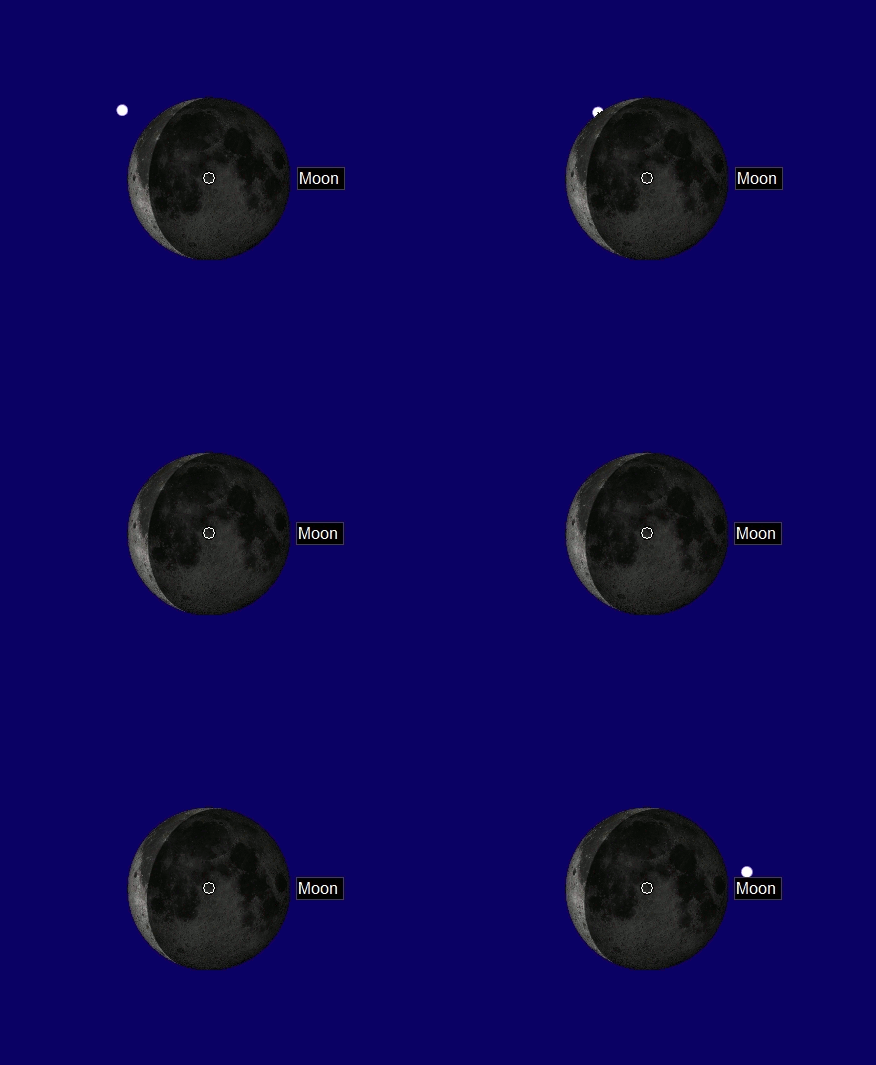
Animation of the occultation. Created using Cartes du Ciel (Sky Charts) and GIMP.
Venus Occultation December 7, 2015 from Northern Michigan
What is an occultation? An occultation is when one nearer celestial body covers or hides another, more distant body. The word occultation comes from occult which simply means hidden. No black magic is involved.
The occultation of Venus will occur on December 7, from 12:21 p.m. to 1:27 p.m. for the Grand Traverse Area, give or take a few minutes either way. The exact time depends on your location. This event would be a great sight if it occurred in the early morning skies before sunrise. Unfortunately it’s centered on 1 p.m. Venus and the Moon are visible in the daytime with a telescope and even binoculars, but are difficult to find. The Moon and Venus do make a beautiful sight in the morning in the 5 to 7 a.m. hours.
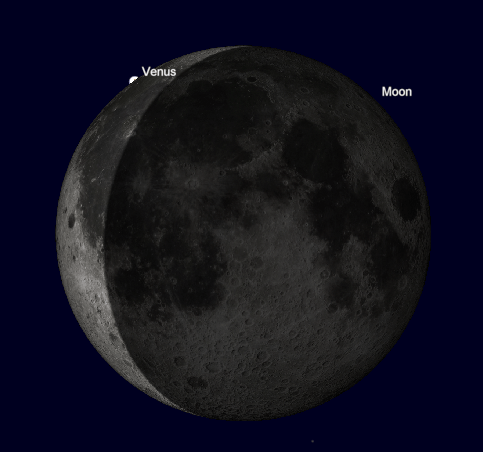
Disappearance of Venus at 12:20 p.m. Created using Cartes du Ciel (Sky Charts).
The trick to viewing this event is even finding the Moon or Venus. One could set up a telescope with tracking ability to track Venus throughout the morning. Unless you have a telescope Go To mount and can track the Moon, track Venus instead. The Moon moves about its own diameter with respect to the stars in an hour, so it will have to be constantly adjusted to keep pointed at the Moon. Actually Venus has a higher surface brightness than the Moon, so it should be easier to track, especially if the sky is hazy and the Moon isn’t visible.
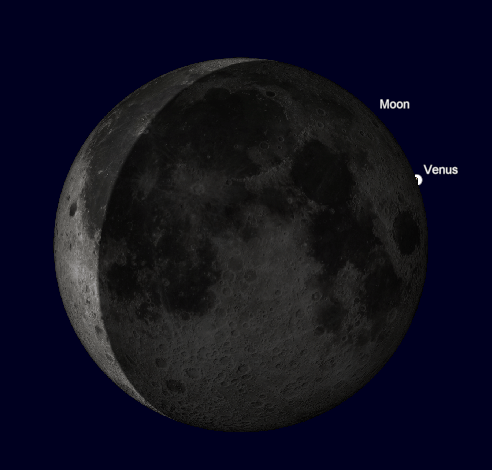
Disappearance of Venus at 1:27 p.m. Created using Cartes du Ciel (Sky Charts).
Unlike a stellar occultation Venus will disappear over several seconds. A telescope capable to seeing Venus’ gibbous phase will see the bright edge of the Moon actually pass in front it. Venus will emerge from the Moon’s dark side which will be invisible. So Venus will slowly reappear next to the crescent Moon. Hoping for clear skies, and good luck.
If you are not located near Traverse City, you can use my technique to estimate the occultation times. I used Cartes du Ciel the free software found on the Internet at http://www.ap-i.net/skychart/en/start. Make sure that the program is set for topocentric positions under Setup/Solar System. And you have entered your position under Setup/Observatory. You can find your location in Google Earth.
You can also use Stellarium (http://stellarium.org). Just make sure the Moon is normal sized.
In both programs you can lock the Moon or Aldebaran in the center of the screen Pick a time in advance of the occultation and using the set time window walk the star towards the Moon, mark the time. Then walk the star out from the Moon and record the reappearance time. That’s it.
This should work with other planetarium programs too.
Animation of the occultation. Created using Cartes du Ciel (Sky Charts) and GIMP.
For better accuracy go to the International Occultation Timing Association (IOTA) website. Download and install their Occult4 program for Windows computers. Follow the instructions. When I ran the program for my location, the location I use for Interlochen/Traverse City (Since I live approximately half-way between the two). I got results within a half-minute of the IOTA Occult4 program results. So the approximation method using planetarium programs is valid.
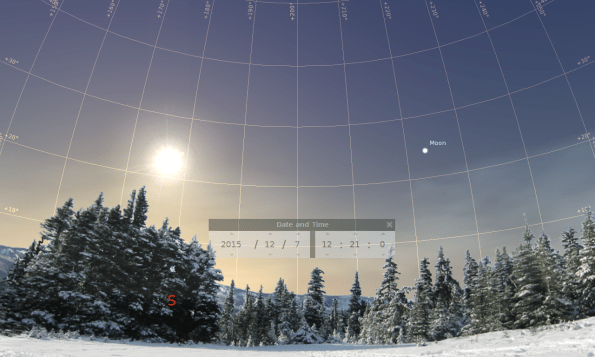
Sun and Moon’s positions at the start of the occultation from northern Michigan. Note the Moon and Venus will be invisible to the naked eye. Created using Stellarium.
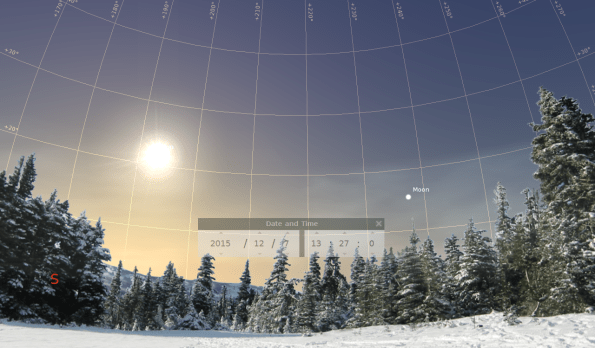
Sun and Moon’s positions at the end of the occultation from northern Michigan. Note the Moon and Venus will be invisible to the naked eye. Created using Stellarium.
When I made up the above images I really thought there would be snow on the ground by now. But what little we had has come and gone.
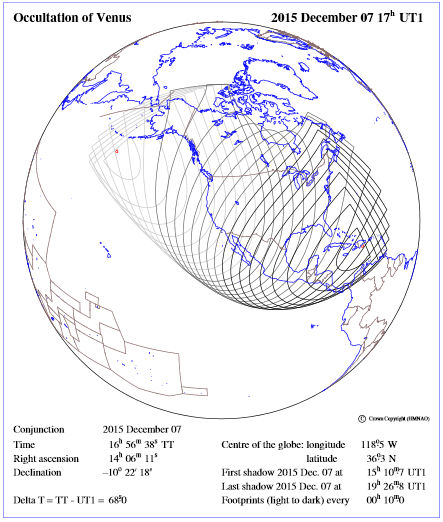
Occultation of Venus Visibility Map for North America. Credit: Astronomical Almanac Online -U.S. Nautical Almanac Office, United States Naval Observatory (USNO), in the United States and Her Majesty’s Nautical Almanac Office (HMNAO), United Kingdom Hydrographic Office (UKHO), in the United Kingdom.
 Bob Moler's Ephemeris Blog