Archive
01/29/2016 – Ephemeris – The rabbit that got away
Ephemeris for Friday, January 29th. The Sun will rise at 8:05. It’ll be up for 9 hours and 40 minutes, setting at 5:46. The Moon, 2 days before last quarter, will rise at 11:40 this evening.
Orion, the central winter constellation is seen in the south at 9 p.m. He is a hunter, but he’s preoccupied with the charge of Taurus the bull from the upper right. At Orion’s feet, and unnoticed by him is the small constellation of Lepus the hare. It’s very hard to see a rabbit in its eight dim stars: however, I do see a rabbit’s head ears and shoulders. A misshapen box is the head and face of this critter facing to the left. His ears extend upwards from the upper right star of the box, and the bend forward a bit. Two stars to the right of the box and a bit farther apart hint at the front part of the body. In Lepus telescopes can find M79, a distant globular star cluster, one of the few of these compact clusters visible in the winter sky.
Times are for the Traverse City/Interlochen area of Michigan. They may be different for your location.
Addendum

An animation showing the stars, constellations and artwork of Lepus, Orion and Taurus. Created using Stellarium and GIMP.
As you can see, the image above of Lepus isn’t how I imagine the hare as I mentioned in the text.
01/28/2016 – Ephemeris – This post has gone to the dogs
Ephemeris for Thursday, January 28th. The Sun will rise at 8:06. It’ll be up for 9 hours and 38 minutes, setting at 5:45. The Moon, 3 days before last quarter, will rise at 10:42 this evening.
The great winter constellation or star group Orion the Hunter, is located in the southern sky at 9:30 p.m. His elongated rectangle of a torso is vertical. In the center of the rectangle are three stars in a line that make his belt. As a hunter, especially one of old, he has two hunting dogs. The larger, Canis Major can be found by following the three belt stars of Orion down and to the left. There lies the brilliant star called Sirius, also known as the Dog Star. It’s in the heart of a stick figure dog facing Orion that appears to be begging. The smaller dog can be found by extending a line through Orion’s shoulder stars to the left. We find a bright star called Procyon. It and one other star make up the hot-dog shaped constellation of Canis Minor, the little dog.
Times are for the Traverse City/Interlochen area of Michigan. They may be different for your location.
Addendum
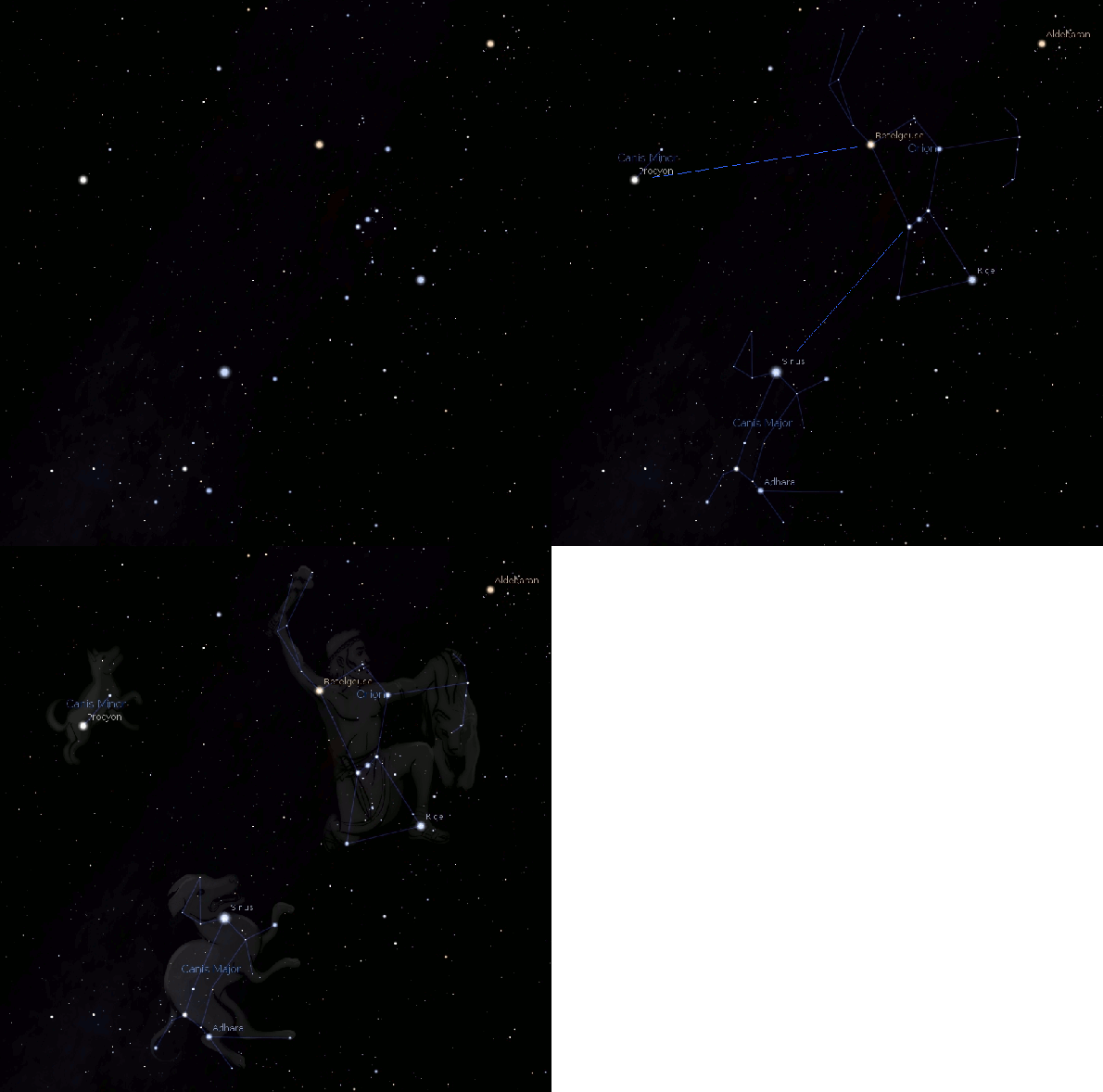
Orion and his hunting dogs revealed in animation. Created with Stellarium and GIMP.
01/27/2016 – Ephemeris – The Moon rises near Jupiter tonight
Ephemeris for Wednesday, January 27th. The Sun will rise at 8:07. It’ll be up for 9 hours and 36 minutes, setting at 5:43. The Moon, half way from full to last quarter, will rise at 9:43 this evening.
Let’s check out the whereabouts of the bright naked eye planets. All the classical planets visible from antiquity are officially now in the morning sky. However Jupiter actually will rise at 9:30 p.m., in the east. The Moon will be right below it tonight. Jupiter’s still a morning planet since it’s not up at sunset. Mars will rise next at 1:54 a.m. in the east-southeast. It’s below and left of the bright star Spica. Saturn will rise at 4:30 a.m. in the east-southeast. Venus will rise at 6:11 a.m. again in the east-southeast. Mercury is not favorably placed for northern hemispheric observers now. Comet Catalina is up all night and is a binocular object crossing the line from the pointer stars in the Big Dipper and the North Star Polaris tonight.
Times are for the Traverse City/Interlochen area of Michigan. They may be different for your location.
Addendum
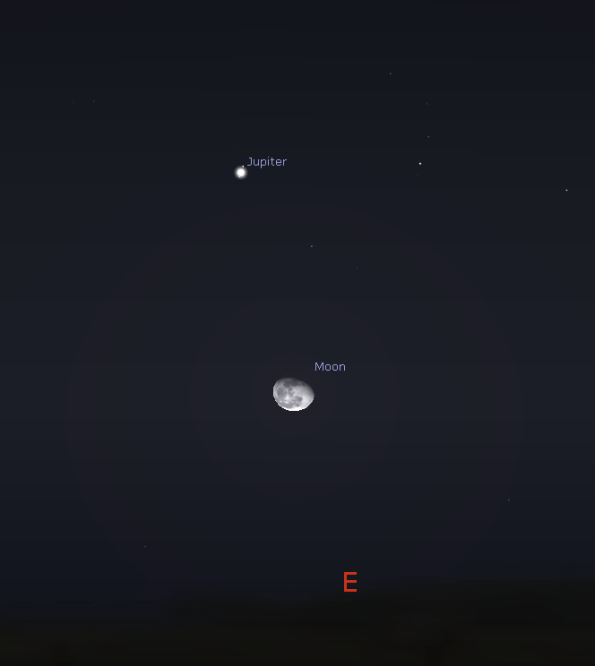
Jupiter and the Moon at 10 p.m. January 27, 2016. Created using Stellarium.
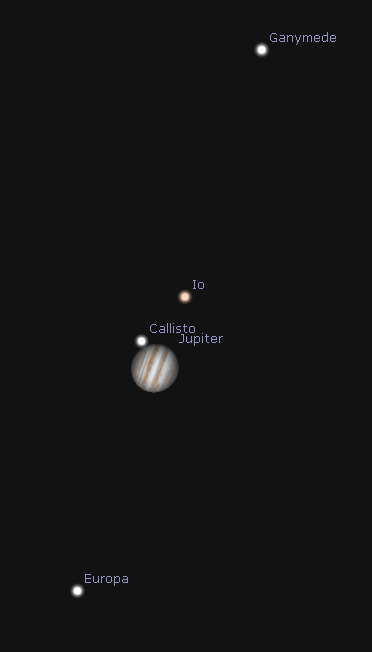
Jupiter and moons as they would appear in a telescope at 10 p.m. January 27, 2016. Created using Stellarium.
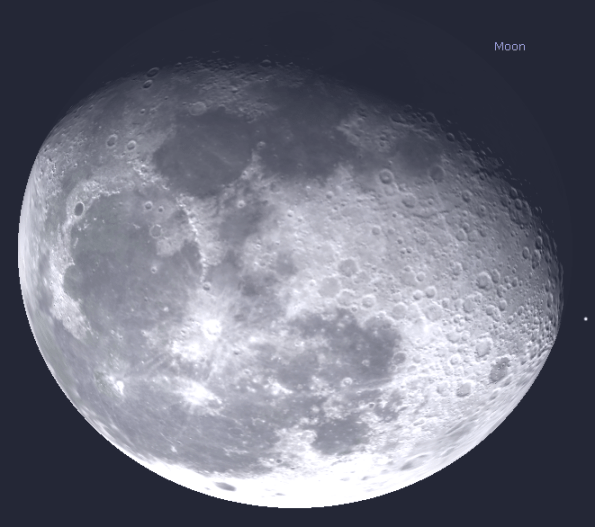
The Moon rising. Note the distortion of the atmospheric refraction squishes the Moon vertically being only a quarter-hour after it rose. 10 p.m., January 27, 2016. Created using Stellarium.
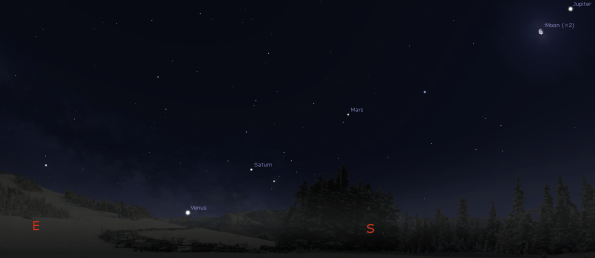
The morning planets and the Moon at 6:45 a.m., January 28, 2016. Created using Stellarium.
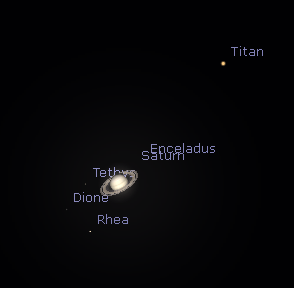
Saturn and its moons in a telescope on the morning of January 28, 2016. Created using Stellarium.
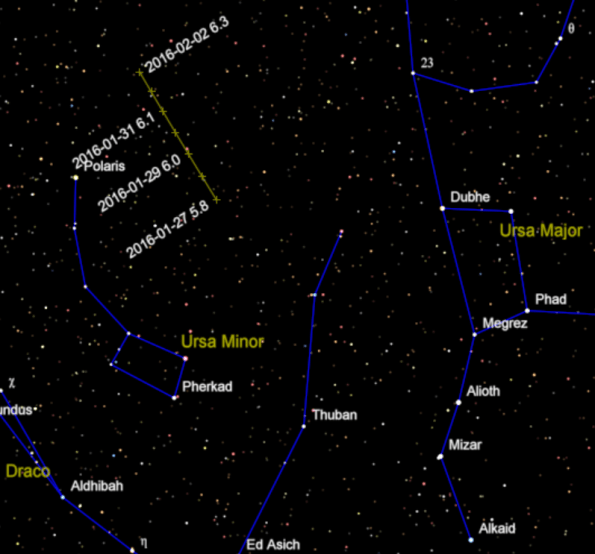
Comet Catalina’s path for the next week. Note the magnitudes for the comet are about correct. It will take binoculars or a small telescope to spot the comet which will not show a tail visually. Created using Stellarium.
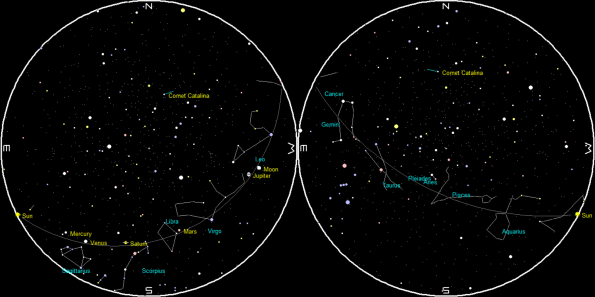
This is a chart showing the sunrise and sunset skies for January 27, 2016 showing the location of the planets, the Moon and Comet Catalina at that time. Created using my LookingUp program.
Some of these images above are shown smaller than actual size. Image expansion lately hasn’t worked. If you are using Firefox, right-click on the image, and then click on View Image.
01/26/2016 – Ephemeris – Planet X
Ephemeris for Tuesday, January 26th. The Sun will rise at 8:08. It’ll be up for 9 hours and 33 minutes, setting at 5:42. The Moon, 3 days past full, will rise at 8:44 this evening.
Last week Dr. Mike Brown and Konstantin Batygin announced that they have good cause to suspect that there is a Neptune sized planet lurking in the outer Kuiper Belt, perhaps 1,000 AU or a 1,000 times the Earth’s distance from the sun. In miles that comes to a possible distance of 100 billion miles from the sun. The evidence is the odd similarity of the orbits of six Kuiper belt objects, including the best known Sedna, whose closest points of their orbits to the Sun, called perihelia are remarkably close together. Planet X is not a name, but a placeholder for something unknown, like X in an equation, which will be replaced by a real designation if found and confirmed. So no, Planet X has not been found, but as Sherlock Holmes would say: the game is afoot.
Times are for the Traverse City/Interlochen area of Michigan. They may be different for your location.
Addendum
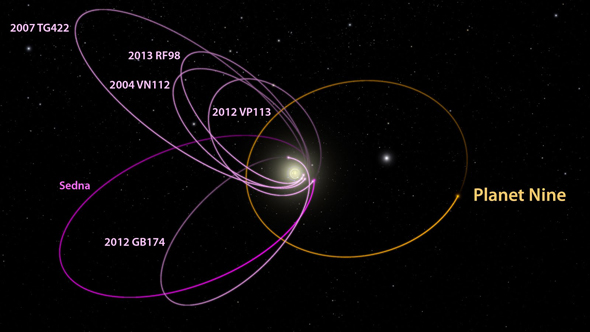
The obit off to the right is the suspected orbit of the unknown body dubbed Planet X or Planet 9. Credit: Mike Brown and Konstantin Batygin.
Links to explore this further from reliable sources are: Universe Today, The Planetary Society, and Phil Plait’s Bad Astronomy.
01/25/2016 – Ephemeris – Sirius the Dog Star
Ephemeris for Monday, January 25th. The Sun will rise at 8:09. It’ll be up for 9 hours and 31 minutes, setting at 5:41. The Moon, 2 days past full, will rise at 7:43 this evening.
While we’re waiting for the bright Moon to leave the evening sky, let’s look at another bright star. This one is the brightest of all, Sirius the Dog Star. The Dog Star name comes from its position at the heart of the constellation Canis Major, the great dog of Orion the hunter. The three stars of Orion’s belt tilt to the southeast and point to Sirius. The name Sirius means ‘Dazzling One’, a reference to its great brilliance and twinkling. The Romans thought Sirius added its heat to that of the Sun in summer to bring on the scorching Dog Days of July and August. Its ancient Egyptian name was Sothis, and its first appearance in the morning twilight in late June signaled the flooding of the Nile, and the beginning of the Egyptian agricultural year.
Times are for the Traverse City/Interlochen area of Michigan. They may be different for your location.
Addendum
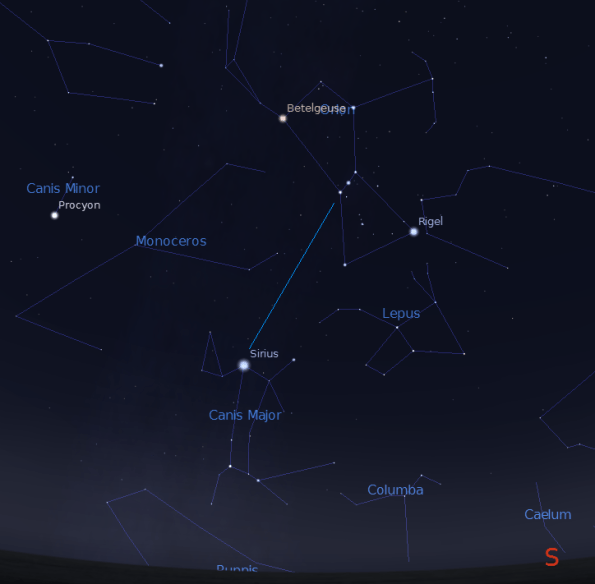
Orion’s Belt points to Sirius. Created using Stellarium.
01/22/2016 – Ephemeris – Getting sunrise and sunset times for your location
Ephemeris for Friday, January 22nd. The Sun will rise at 8:12. It’ll be up for 9 hours and 24 minutes, setting at 5:36. The Moon, 1 day before full, will set at 7:31 tomorrow morning.
With the bright moon, blocking all but the brightest stars, it’s a good time to do some housekeeping. When I started this program 40 ½ years ago Interlochen Public Radio (IPR) had only one transmitter and a single antenna pattern. It was simply WIAA then. The sunrise and sunset times worked well for that. However since then with transmitters from Manistee to the Straits I cannot hope to cover it all with a single set of times. The differences in the times also vary with the seasons. To get help on the Internet go to my monthly site ephemeris.bjmoler.org and click on Calendars. There are calendars for Ludington, Cadillac, Interlochen/Traverse City, Petoskey and Mackinaw City. Select a month to view or printout a whole year, or use the email link to request a sunrise, sunset, and Moon calendar for your town. There’s also a link to get sunrise and sunset times for anywhere in the world
Times are for the Traverse City/Interlochen area of Michigan. They may be different for your location.
Addendum
As an aside. I wrote the program to compute the calendars back in the ’80s. It produces calendars in three formats, of which I still use two: comma separated values, and HTML. The HTML output is what is used for the calendar pages. The comma separated value files are input into a database which is used to create for me the first paragraph of the transcript. For the blog posting I omit “This is Bob Moler with…” as redundant. The program also produces database tables of the planets from which I base the Wednesday planet program rise, set and sometimes transit times.
The actual Ephemeris audio programs are also found on the ephemeris.bjmoler.org under the audio link. A whole week of programs are available.
01/21/2016 – Ephemeris – Rigel, Orion’s other bright star
Ephemeris for Thursday, January 21st. The Sun will rise at 8:12. It’ll be up for 9 hours and 22 minutes, setting at 5:35. The Moon, 2 days before full, will set at 6:44 tomorrow morning.
The bright star at the bottom right corner of the big upright rectangle that is the giant hunter Orion’s body in the south-southeast is Rigel. It is a white star with a bluish tinge. It compares in brightness with Betelgeuse at the opposite end of Orion’s rectangle, though it’s usually a bit brighter. The mismatch in color makes brightness comparisons difficult. Rigel is about 860 light years away, It’s 20 times the mass of the Sun, 120 thousand the times brighter than the Sun, and a diameter about the size of the orbit of Mercury. It’s age is thought to be about 8 million years. It has a visual companion star that can be seen in amateur telescopes. It’s not that dim, but suffers by being close to the arc light brightness of Rigel.
Times are for the Traverse City/Interlochen area of Michigan. They may be different for your location.
Addendum
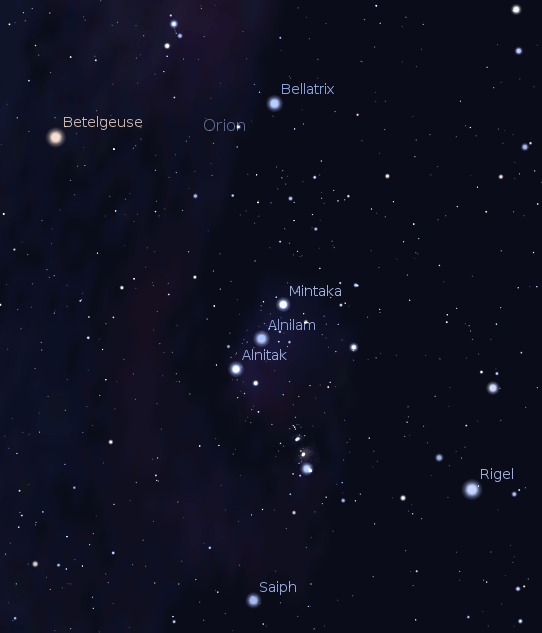
Torso of Orion centered on his belt. Created using Stellarium.
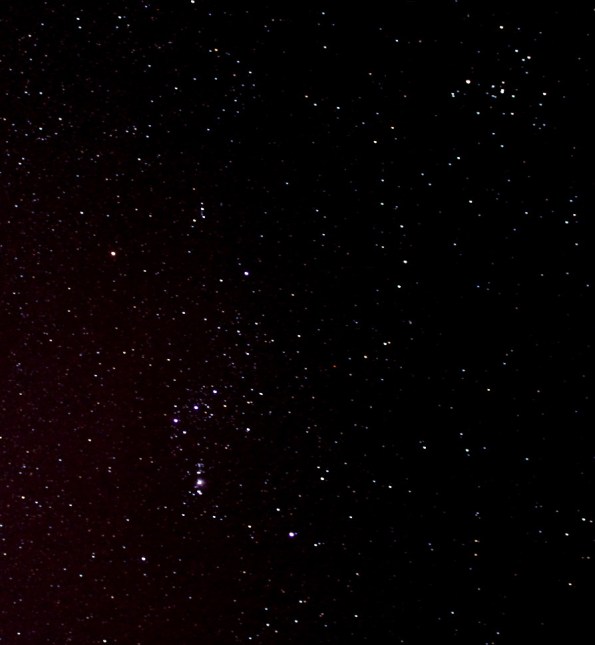
Orion and the head of Taurus photograph by myself January 4, 2016 at 11:30 p.m. It’s a stack of untracked 20 exposures.
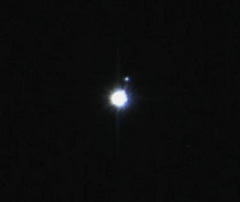
Rigel with its companion star as photographed through a telescope. No attribution. Source: http://washedoutastronomy.com/content/urban-orion?page=1
01/20/2016 – Ephemeris – The planet action is in the morning sky
Update: This is the proper text for today
Ephemeris for Wednesday, January 20th. The Sun will rise at 8:13. It’ll be up for 9 hours and 20 minutes, setting at 5:34. The Moon, 3 days before full, will set at 5:51 tomorrow morning.
Let’s check out the whereabouts of the bright naked eye planets. All the classical planets visible from antiquity are now in the morning sky. However Mercury is too close to the Sun, and may remain too low in the sky to spot when it’s farther from the Sun. Jupiter will be the first to rise, actually at 10 p.m., in the east. It’s still a morning planet since it’s not up at sunset. Mars will rise next at 2:03 a.m. in the east-southeast. It’s below and left of the bright star Spica. Saturn will rise at 4:55 a.m. in the east-southeast. Venus will rise at 6 a.m. again in the east-southeast. Comet Catalina is a binocular object between the bowls of the Big and Little Dippers. It’s heading across the tail of Draco the dragon.
Times are for the Traverse City/Interlochen area of Michigan. They may be different for your location.
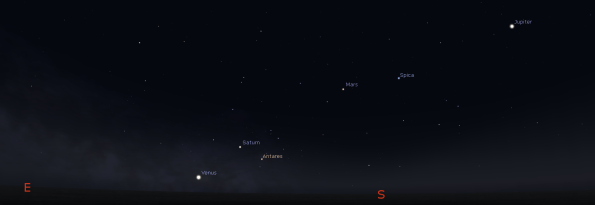
Here of the morning planets. From right to left, Jupiter, Mars, Saturn and Venus. Time: 6:30 a.m., January 21, 2016. Created using Stellarium.
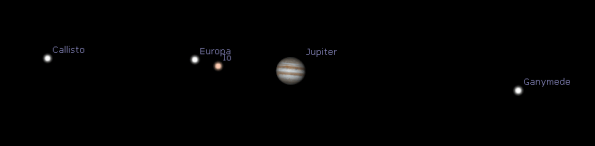
Jupiter and its 4 Galilean moons at 6:30 a.m., January 21, 2016. Created using Stellarium.
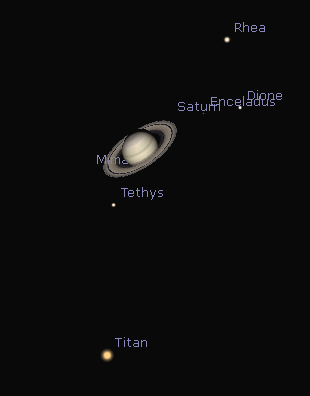
Saturn and its moons at a greater magnification as for Jupiter above at 6:30 a.m., January 21, 2016. Small telescopes will show only the moon Titan. Created using Stellarium.
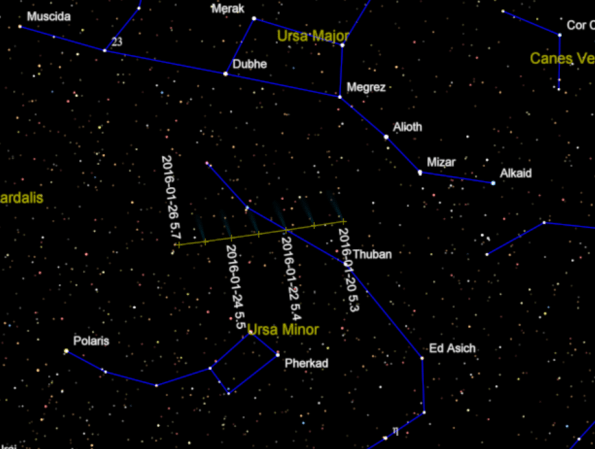
Comet Catalina’s path for the next week. Note the magnitudes for the comet are about correct. It will take binoculars or a small telescope to spot the comet which will not show a tail visually. Created using Stellarium.
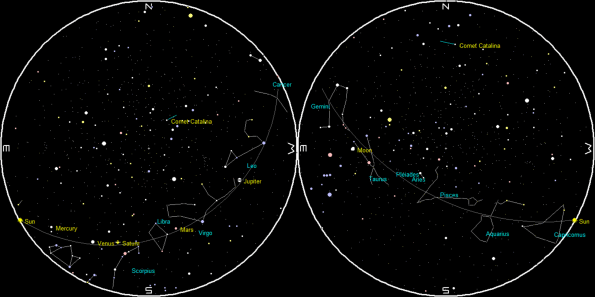
This is a chart showing the sunrise and sunset skies for January 20, 2016 showing the location of the planets, the Moon and Comet Catalina at that time. Created using my LookingUp program.
The top and bottom images above are shown smaller than actual size. Image expansion lately hasn’t worked. If you are using Firefox, right-click on the image, and then click on View Image.
01/19/2016 – Ephemeris – The Moon will cover Aldebaran tonight!
Ephemeris for Tuesday, January 19th. The Sun will rise at 8:14. It’ll be up for 9 hours and 18 minutes, setting at 5:32. The Moon, 3 days past first quarter, will set at 4:51 tomorrow morning. | Tonight the Moon will pass in front of or occult the bright star Aldebaran, the bright star in Taurus the bull. The bright Moon will making spotting Aldebaran difficult without binoculars, or better yet, a telescope. Aldebaran will wink out at the Moon’s dark eastern or left edge around 9:06 p.m. The exact time depends on your location. It’s within a minute or 2 for the IPR listening area. Aldebaran will be uncovered by the Moon around 10:25 p.m. at the bright lower right edge of the Moon. Today’s posting on bobmoler.wordpress,com will have much more information on the event, and how to calculate times for other locations along the path of the occultation (see below). This is the best of the four Aldebaran occultations visible this year.
Times are for the Traverse City/Interlochen area of Michigan. They may be different for your location.
Addendum
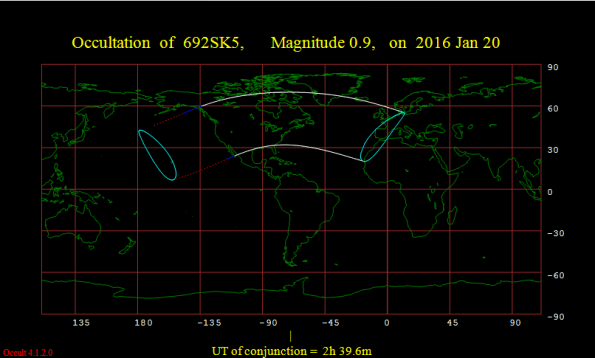
Occultation visibility map for January 19, 2016 EST (January 20 UT). Credit IOTA/Occult4 program. Looks like the followers of this blog in the UK will get a piece of this one too.
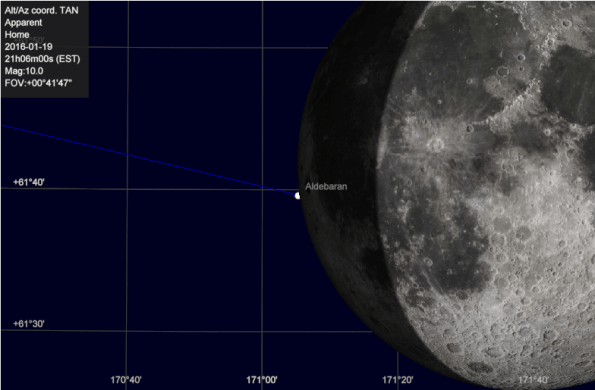
Aldebaran will disappear at the Moon’s dark leading edge at about 9:06 p.m. January 19, 2016. Created using Cartes du Ciel (Sky Charts).
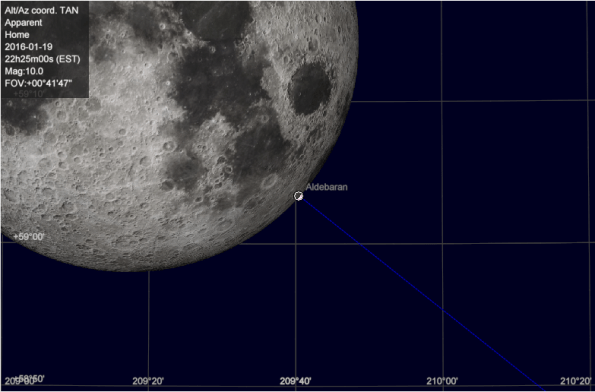
Aldebaran will reappear at the Moon’s bright trailing edge at about 10:25 p.m. January 19, 2016. Created using Cartes du Ciel (Sky Charts).
Estimating timings for your location
I used Cartes du Ciel the free software that I have a link to on the right. Make sure that the program is set for topocentric positions under Setup/Solar System. And you have entered your position under Setup/Observatory. You can find your location in Google Earth.
You can also use Stellarium. Just make sure the Moon is normal sized.
In both programs you can lock the Moon or Aldebaran in the center of the screen Pick a time in advance of the occultation and using the set time window walk the star towards the Moon, mark the time. Then walk the star out from the Moon and record the reappearance time. That’s it.
This should work with other planetarium programs too.
01/18/2015 – Ephemeris – Betelgeuse, a dying star
Ephemeris for Martin Luther King Day, Monday, January 18th. The Sun will rise at 8:15. It’ll be up for 9 hours and 16 minutes, setting at 5:31. The Moon, 2 days past first quarter, will set at 3:47 tomorrow morning.
Now that the Moon is getting brighter and making the fainter tars in the constellations harder to find, let’s look at the bright stars of Winter. Today, let’s look at Betelgeuse the reddish star in Orion the hunter’s shoulder. Lets get the basic facts out first. Betelgeuse is a red giant star 90 thousand to 150 thousand times brighter than the Sun and 7 to 20 times the Sun’s mass. It’s around a thousand times the diameter of the Sun, making it about the diameter of the orbit of Jupiter. It’s about 650 light years away, but that’s a bit uncertain. It is shedding gasses at a prestigious rate. Though only 7 million years old, it may explode as a supernova in the next million years. And yes, we’re far enough away.
Times are for the Traverse City/Interlochen area of Michigan. They may be different for your location.
Addendum
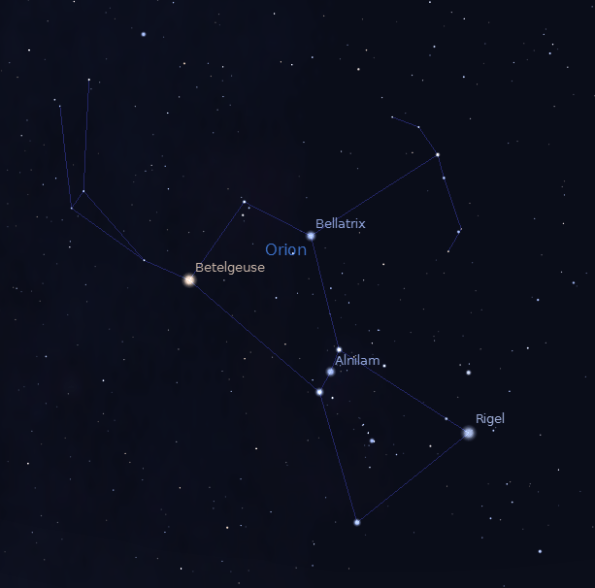
Some of Orion’s named stars, including Betelgeuse. Orion at 8 p.m. Created using Stellarium.
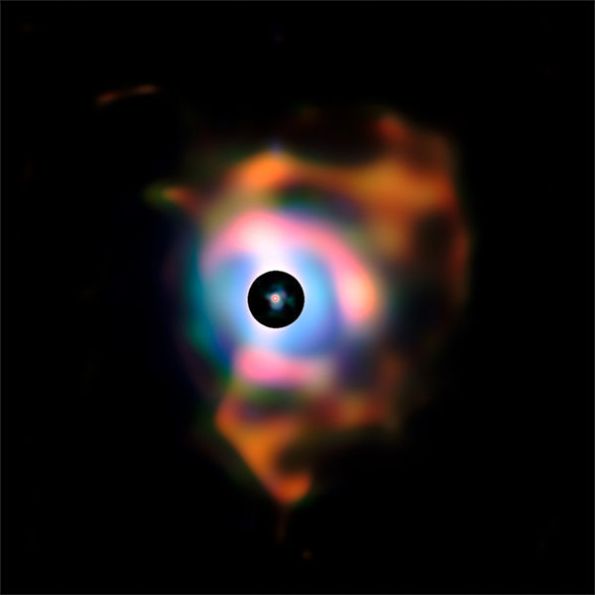
Betelgeuse and its nebula. From ESO’s Very Large Telescope.
 Bob Moler's Ephemeris Blog