Archive
01/15/2016 – Ephemeris – The Comet Catalina is closest to the Earth this weekend
Ephemeris for Friday, January 15th. The Sun will rise at 8:16. It’ll be up for 9 hours and 11 minutes, setting at 5:27. The Moon, 1 day before first quarter, will set at 12:19 tomorrow morning.
Comet Catalina is near its brightest now that it’s closest to the Earth, or will be Sunday at about 67 million miles (108 million km), about three-quarters the distance to the Sun. It is also circumpolar, staying up all night for the entire IPR listening area. That’s not as big a deal as it sounds because the Moon won’t set till after midnight and it’s getting brighter as it moves to become full in a couple of weeks. So the best views are still in the morning for the next week. The comet can be spotted in binoculars as a fuzzy spot. The comet is now nearest the star Mizar in the bend of the Big Dipper’s handle. It’s slowly moving to split the distance between the Big and Little Dippers between now and the end of the month. Good comet hunting!
Times are for the Traverse City/Interlochen area of Michigan. They may be different for your location.
Addendum
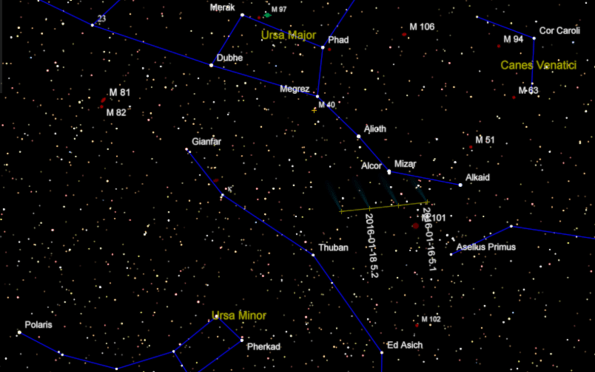
Comet Catalina closest weekend to the Earth. Comet positions are for 4 a.m. January 16 to 19, 2016. Created using Cartes du Ciel (Sky Charts).
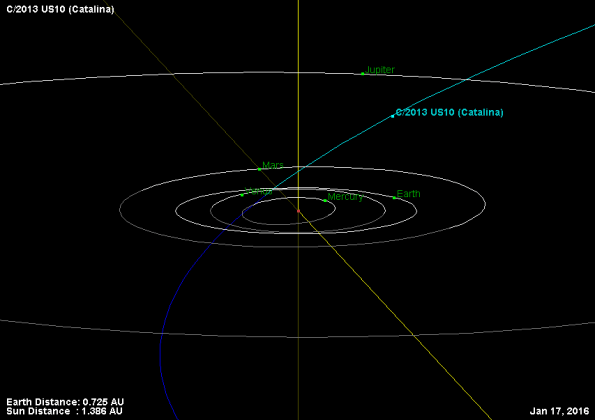
Comet C/2013 US10 (Catalina) at its closest approach to the Earth on January 17, 2016 of 0.725 AU, 67 million miles or 108 million kilometers. Credit NASA/JPL.
01/14/2016 – Ephemeris – Mercury joins the rest of the bright morning planets
Ephemeris for Thursday, January 14th. The Sun will rise at 8:17. It’ll be up for 9 hours and 9 minutes, setting at 5:26. The Moon, 2 days before first quarter, will set at 11:08 this evening.
After 9:03 this morning all the bright planets, known from antiquity, will be in the morning sky. To be a morning planet one must be in the sky at sunrise. And even though Jupiter rises before midnight, it is still in the sky at sunrise. It will leave the morning sky and enter the evening sky February 6th when it moves in opposition with the Sun and rises at sunset. Mercury is joining the morning planets by passing inferior conjunction with the Sun this morning, however this is not a good time of year to spot it in the morning. In the later part of February, we may have a shot at spotting it. However folks in the southern hemisphere will have better luck at spotting it, because it too is in the southern part of the sky.
Times are for the Traverse City/Interlochen area of Michigan. They may be different for your location.
Addendum
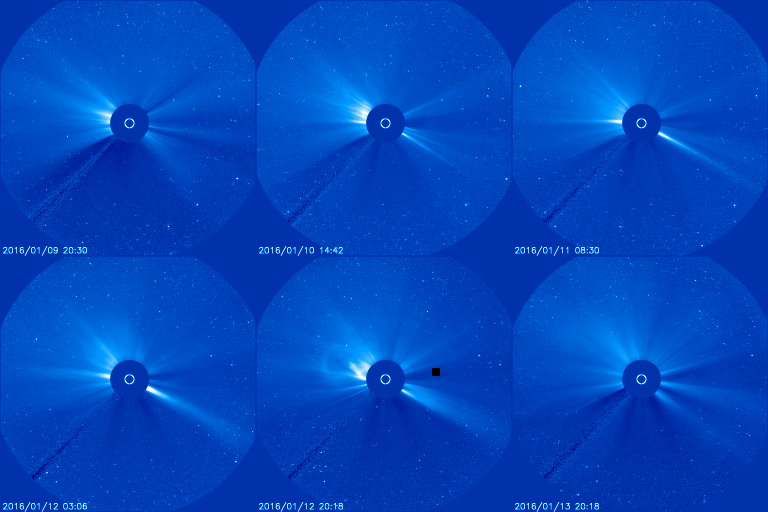
Solar and Heliospheric Observatory (SOHO) LASCO C3 coronograph animated GIF of a three day period 1/10 to 1/13/2016 image of the Sun. Mercury will enter the picture above center on the left on 1/11. Mercury is not very bright due to the fact that the Sun is illuminating it on the other side. We’re seeing mostly the unlit side. Credit ESA/NASA.
01/13/2016 – Ephemeris – Four bright planets are in the morning sky but one more is hiding
Ephemeris for Wednesday, January 13th. The Sun will rise at 8:17. It’ll be up for 9 hours and 7 minutes, setting at 5:25. The Moon, 3 days before first quarter, will set at 9:57 this evening.
Let’s check out the whereabouts of the bright naked eye planets. Mercury is now only one day from inferior conjunction, passing between the Earth and the Sun. The next inferior conjunction after this, May 9th Mercury will pass across the face of the Sun. In the morning sky there are four bright planets. Jupiter will be the first to rise, actually at 10:28 p.m., in the east. Mars will rise next at 2:11 a.m. in the east-southeast. It’s left of the bright star Spica. Saturn will rise at 5:19 a.m. Venus will rise at 5:47 a.m. again in the east-southeast, following Saturn. Comet Catalina is a binocular object near the star at the end of the handle of the Big Dipper named Alkaid. It’s heading to go between the Big and Little Dippers this week.
Times are for the Traverse City/Interlochen area of Michigan. They may be different for your location.
Addendum
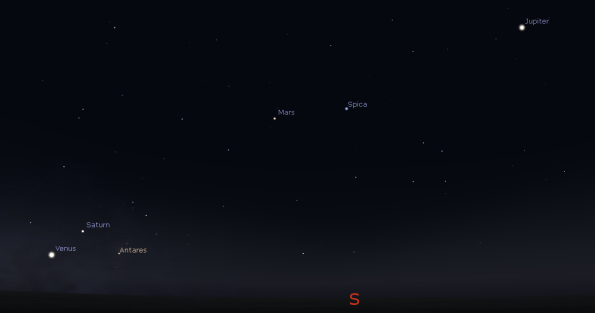
Here of the morning planets. From right to left, Jupiter, Mars, Saturn and Venus. Time: 6:30 a.m., January 14, 2016. Created using Stellarium.

Jupiter and its 4 Galilean moons at 6:30 a.m., January 14, 2016. Created using Cartes du Ciel (Sky Charts).
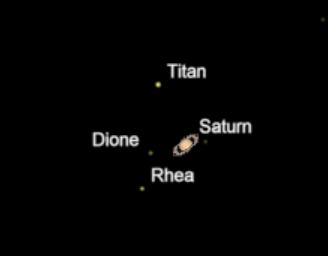
Saturn and its moons through a telescope at 6:30 a.m., January 14, 2016. Small telescopes will show only the moon Titan. Created using Cartes du Ciel (Sky Charts).
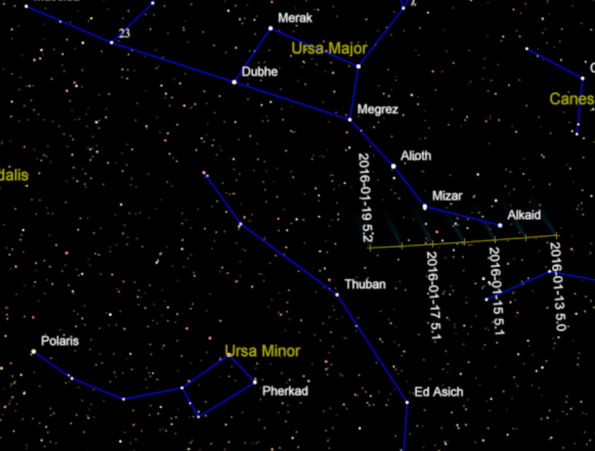
Comet Catalina’s path for the next week. Note the magnitudes for the comet are about correct. It will take binoculars or a small telescope to spot the comet which will not show a tail visually. Created using Cartes du Ciel (Sky Charts).
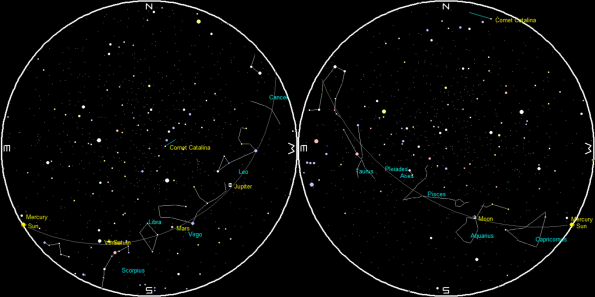
This is a chart showing the sunrise and sunset skies for January 13, 2016 showing the location of the planets, the Moon and Comet Catalina at that time. Created using my LookingUp program.
Several of the images above are shown smaller than actual size. Image expansion lately hasn’t worked. If you are using Firefox, right-click on the image, and then click on View Image.
01/12/2016 – Ephemeris – Down a lazy river to Achernar
Ephemeris for Tuesday, January 12th. The Sun will rise at 8:18. It’ll be up for 9 hours and 5 minutes, setting at 5:24. The Moon, 3 days past new, will set at 8:46 this evening.
There’s a long and sinuous constellation that’s part of the winter sky. It is Eridanus, which depicts a river. The river starts near the lower right corner of Orion, near the bright star Rigel and flows to the right then down near the southern horizon, then it meanders below the horizon. One has to travel to the far southern United States or even farther south to see the southern terminus of the river, the bright star Achernar. Writers over the ages have seen here the Nile and the earth circling river Ocean of the flat earth days. In fiction Star Trek’s Mr. Spock supposedly came from a planet called Vulcan orbiting a star in Eridanus, sometimes identified as 40 Eridani, a dim triple star system 16.5 light years away.
Times are for the Traverse City/Interlochen area of Michigan. They may be different for your location.
Addendum
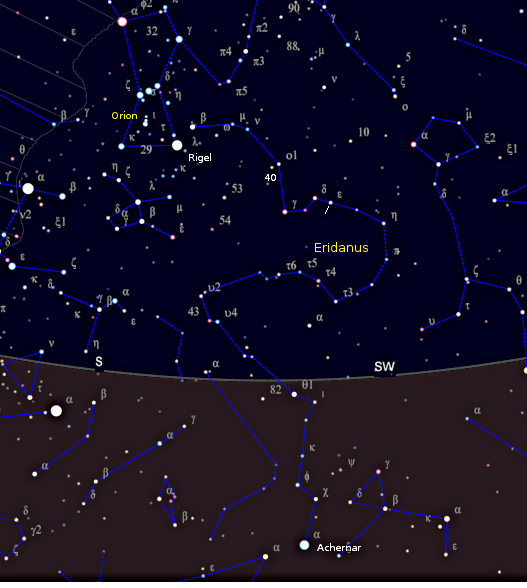
Eridanus with possible homes for Mr. Spock indicated. Created using Cartes du Ciel (Sky Charts).
In the chart above I’ve displayed that Bayer Greek letter designations and the Flamsteed numerical designations for the stars. There’s actually two candidate stars for Spock’s home world Vulcan. Epsilon (ε) is one. I’ve even mentioned it in prior posts. It’s 10.5 light years away. The star itself is 82% the mass of the Sun. It also has one and possibly two planets. The problem is that the star is young, lass than a billion years old. Any planet in the habitable zone of that star would be approximately the same state of development as the Earth 3 1/2 billion years ago.
The second star is 40 Eridani or Omicron 2 (ο2). The star is not labeled on the chart. It’s just above the “40” I marked on the chart. It is a triple star system that’s about 16.5 light years away. The brightest star is 84% the mass of the Sun, cooler, and about half as bright. The nearest of the companion stars comes almost as close as the orbit of Neptune to the primary star. The other one is much farther away. Though no planets have been found, a planet in the habitable zone would have a stable orbit. This star system is about a billion years older than the Sun, so it would be an ideal place to have an advanced civilization. Though the exact location of Vulcan has never been mentioned in any of the Star Trek series or movies, even Gene Roddenberry, the series creator has seemed to accept 40 Eridani as the location for Vulcan.
01/11/2016 – Ephemeris – Gemini, the half-brothers that are twins
Ephemeris for Monday, January 11th. The Sun will rise at 8:18. It’ll be up for 9 hours and 4 minutes, setting at 5:22. The Moon, 2 days past new, will set at 7:36 this evening.
Before the Moon brightens the evening sky, lets look at another of the winter constellations. The constellation Gemini, the Twins is visible high in the east-southeast, above and left of Orion the hunter at 9 p.m. The namesake stars of the two lads, will be at the left end of Gemini, vertically aligned. Castor is on top, while Pollux is below. From them come two lines of stars extending toward Orion that outline the two. In Greek mythology the lads were half brothers, Castor was fathered by a mere mortal, while Pollux was fathered by Zeus in the famous Leda and the swan affair, but were born together. When Castor was killed during the quest for the Golden Fleece, Pollux pleaded with Zeus to let him die also, so both appear together in the sky forever.
Times are for the Traverse City/Interlochen area of Michigan. They may be different for your location.
Addendum
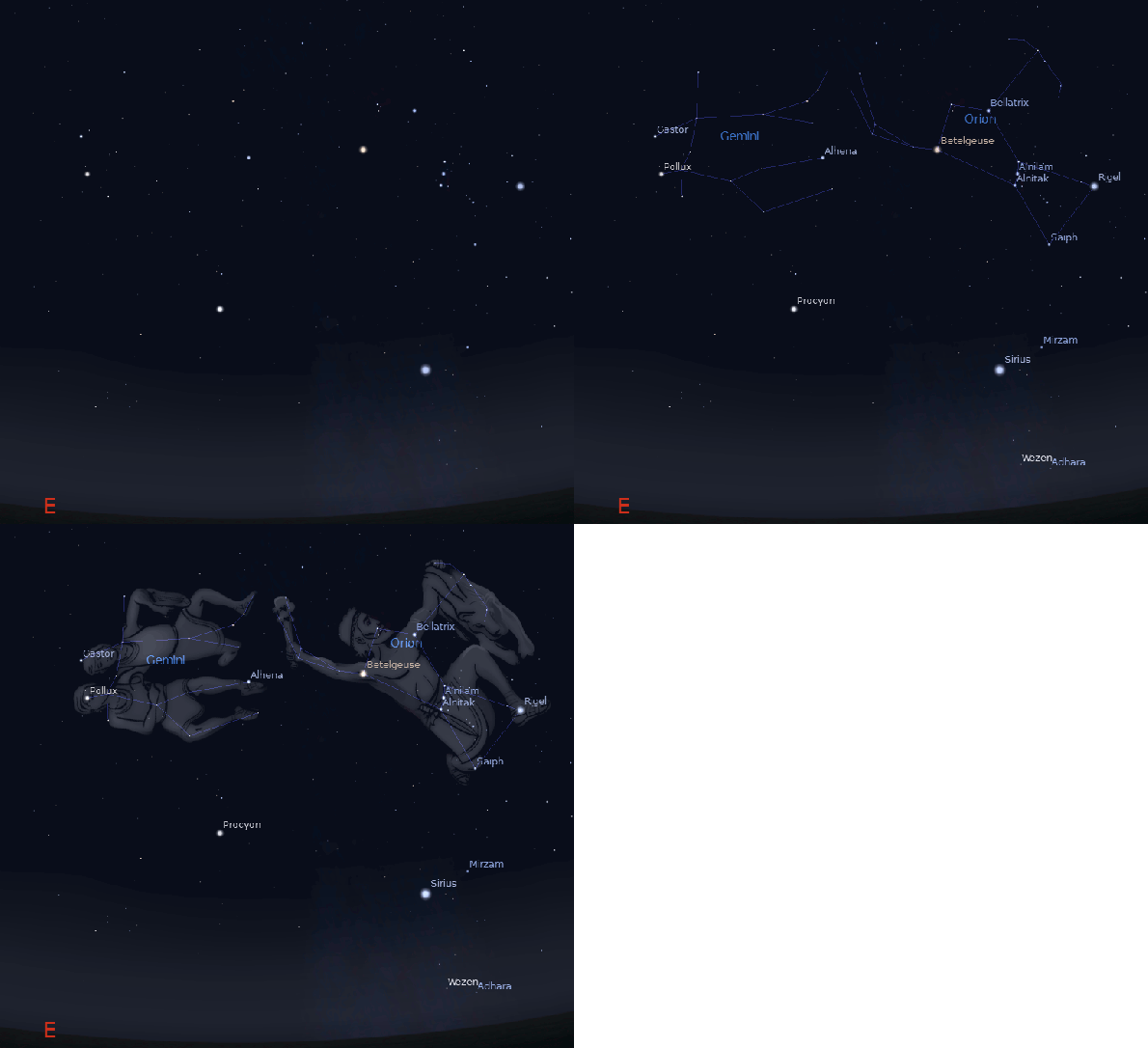
Gemini revealed by animation. Created using Stellarium and GIMP.
01/08/2016 – Ephemeris – A telescope clinic tonight and Venus and Saturn get cozy tomorrow morning
Ephemeris for Friday, January 8th. The Sun will rise at 8:19. It’ll be up for 9 hours even, setting at 5:19. The Moon, 1 day before new, will rise at 7:35 tomorrow morning.
If you’ve received a telescope for Christmas and are having trouble setting it up, or have an unused one in a closet somewhere, bring them to Northwestern Michigan College’s Rogers Observatory tonight at 8 p.m. The Grand Traverse Astronomical Society will be holding their annual telescope clinic to help you understand and use your telescope. The clinic will extend through the period that will be set aside for a star party if it’s clear. Tomorrow morning the planets Venus and Saturn will appear close together low on the southeastern horizon. They should be high enough to spot by 6 a.m. and will be visible in the brightening twilight til about quarter to eight a.m. Dimmer Saturn will be about 2/3rds of a Moon width to the right of Venus.
Times are for the Traverse City/Interlochen area of Michigan. They may be different for your location.
Addendum
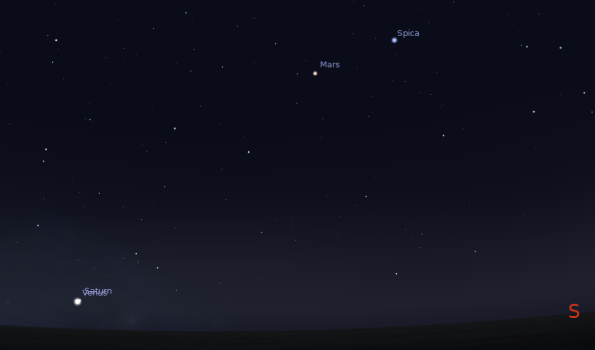
Mars with Venus and Saturn close together. at 6 a.m. January 9, 2016. Created using Stellarium.
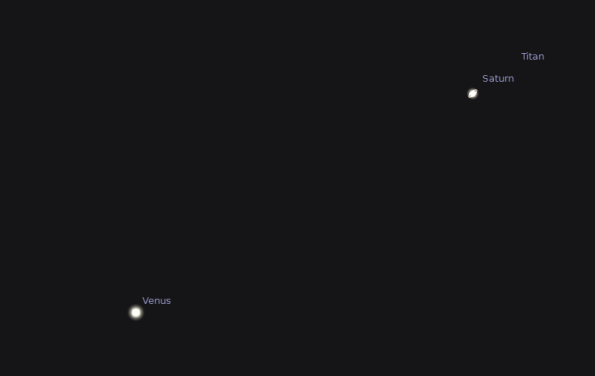
Low power telescope view of Venus and Saturn at 6 a.m. January 9, 2016. At this time the planets are about 20 minutes of arc apart, about 2/3rds the width of the Moon apart. Created using Stellarium.
The actual conjunction of these two planets will occur at 2:42 a.m. (7:42 Hrs UT). Folks in the UK and Europe will spot these two planets even closer together.
01/07/2016 – Ephemeris – The Orion entourage
Ephemeris for Thursday, January 7th. The Sun will rise at 8:19. It’ll be up for 8 hours and 59 minutes, setting at 5:18. The Moon, 2 days before new, will rise at 6:42 tomorrow morning.
The whole Orion entourage is now visible in the southeast at 9 p.m. Orion the hunter with stars at his shoulders and knees and has a belt of three stars in a straight line. He has one arm upraised holding a club from the reddish star Betelgeuse and in the other arm he’s holding a lion skin shield fending off an attack from Taurus the bull above and right of him. Following the belt stars to the lower left we come to the brightest night-time star Sirius the Dog Star in the heart of Canis Major, his great hunting dog. Making a nearly equilateral triangle with Sirius and Betelgeuse is Procyon the little dog star in Canis Minor, Orion’s other small hunting dog. Hunched at the distracted Orion’s feet is the small constellation of Lepus the hare.
Times are for the Traverse City/Interlochen area of Michigan. They may be different for your location.
Addendum
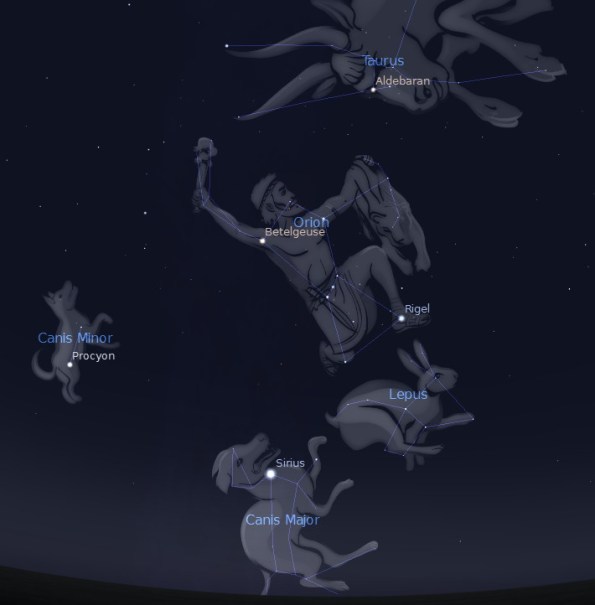
The Orion Entourage as seen at 9 p.m. January 7, 2016. Created using Stellarium
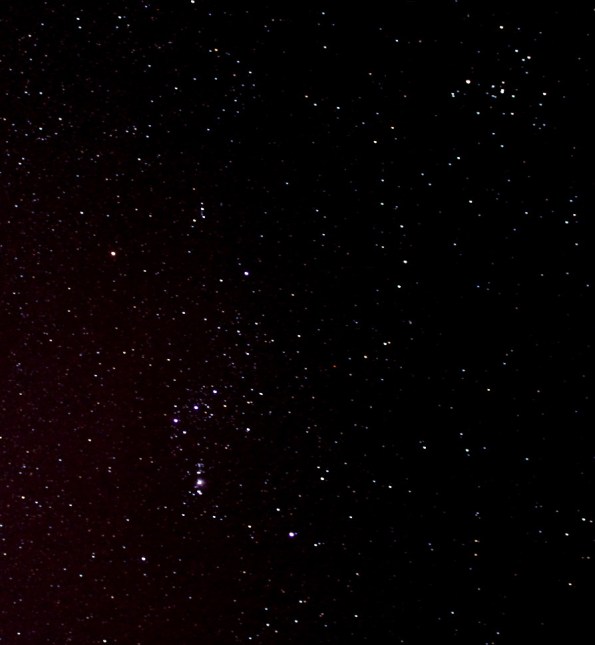
Orion and the head of Taurus photograph by myself January 4, 2016 at 11:30 p.m. It’s a stack of 5 untracked 20 second exposures.
Limiting magnitude is about 8, so you’re seeing stars you’d see with binoculars. The glow off to the left s from Traverse City, the center of which is 6 miles away to my northeast. I’m looking south here to get out of the glow, so Orion is more upright. I didn’t quite make it. My southwest through northwest is the darkest.
As you can probably guess I’ve got a new camera for my birthday/Christmas, a Canon EOS Rebel T5, and I’m investigating its astrophotographic capabilities. So expect some more “new” actual photographs on these posts.
01/06/2016 – Ephemeris – The bright planet action is in the morning
Jan 6. This is Bob Moler with Ephemeris for Wednesday, January 6th. The Sun will rise at 8:19. It’ll be up for 8 hours and 57 minutes, setting at 5:17. The Moon, 3 days before new, will rise at 5:46 tomorrow morning.
Let’s check out the whereabouts of the bright naked eye planets. Mercury is now too close to the Sun in the evening sky, and is only 8 days from inferior conjunction with the Sun. The next inferior conjunction after this, May 9th Mercury will pass in front of the Sun. In the morning sky there are four bright planets. Jupiter will be the first to rise, actually at 10:56 p.m., in the east. Mars will rise next at 2:20 a.m. also in the east-southeast. It’s left of the bright star Spica. Venus will rise at 5:30 a.m. also in the east-southeast. Saturn will rise at 5:47 a.m. following Venus. Comet Catalina is a binocular object about a third of the way from the bright star Arcturus, and the star at the end of the handle of the Big Dipper named Alkaid.
Times are for the Traverse City/Interlochen area of Michigan. They may be different for your location.
Addendum
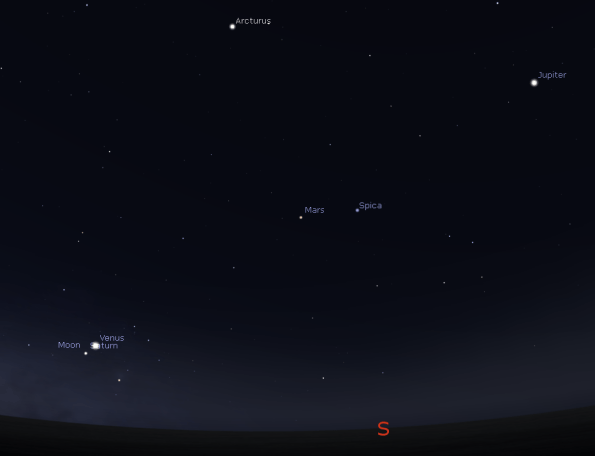
Here of the morning planets. From right to left, Jupiter, Mars and the traffic jam of Venus, Saturn and the Moon. Time: 7 a.m., January 7, 2016. Created using Stellarium.
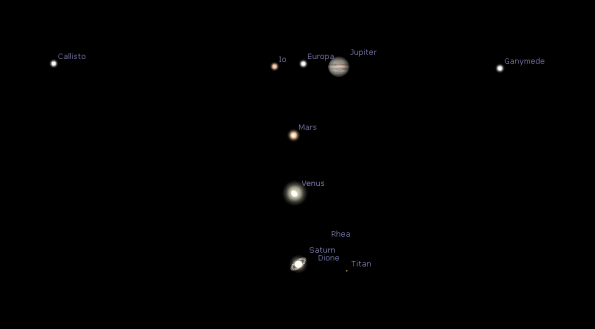
The planets to, mostly, the same scale of apparent sizes. Venus is the size of the small gibbous center of the overexposed glow. Mars is smaller than it’s image, about half the size of Venus. Created using Stellarium.
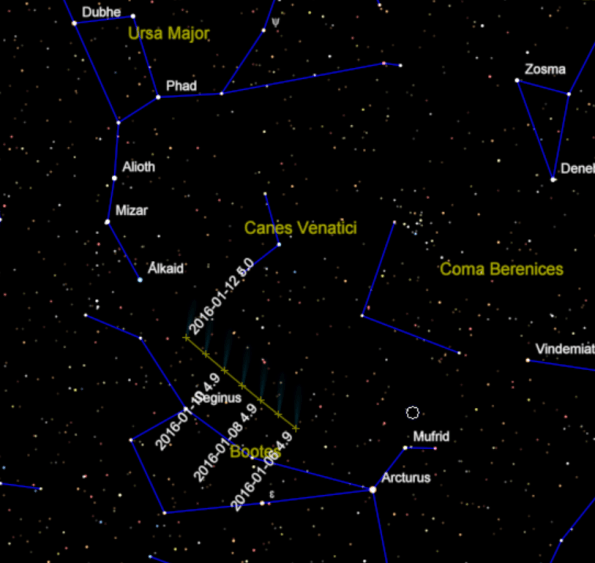
Comet Catalina’s path for the next week. Note the magnitudes for the comet are about 1 magnitude too bright. It will take binoculars or a small telescope to spot the comet which will not show a tail visually. Created using Cartes du Ciel (Sky Charts).
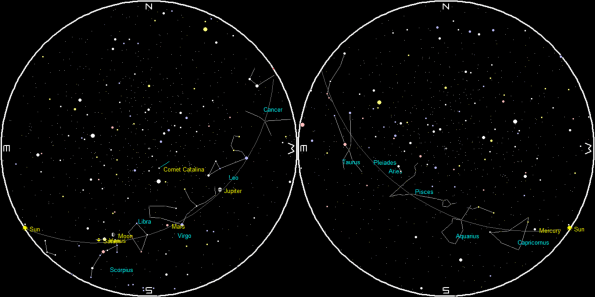
This is a chart showing the sunrise and sunset skies for January 6, 2016 showing the location of the planets, the Moon and Comet Catalina at that time. Created using my LookingUp program.
Several of the images above are shown smaller than actual size. Image expansion lately hasn’t worked. If you are using Firefox, right-click on the image, and then click on View Image.
01/05/2016 – Ephemeris – The crescent moon is passing the morning planets
Ephemeris for Tuesday, January 5th. The Sun will rise at 8:20. It’ll be up for 8 hours and 56 minutes, setting at 5:16. The Moon, 3 days past last quarter, will rise at 4:48 tomorrow morning.
This morning the crescent Moon will be in the morning sky about half way between Venus below and Mars above. Reddish Mars is to the left of the bright blue-white star Spica nearly in the south at 7 a.m. Jupiter is way high in the south-southwest by then. Venus is approaching Saturn, and they will apparently cross paths this Saturday. By tomorrow morning the Moon will be much closer to Venus, with our Morning Star about 5 degrees, or 10 Moon diameters below and left of the thin crescent Moon, which should be exhibiting earthshine by then. By Thursday the Moon will be about the same distance to the left of Venus. The line that can be drawn through planets, along the Zodiac, is lying down as the Sun is slowly heading northward.
Times are for the Traverse City/Interlochen area of Michigan. They may be different for your location.
Addendum
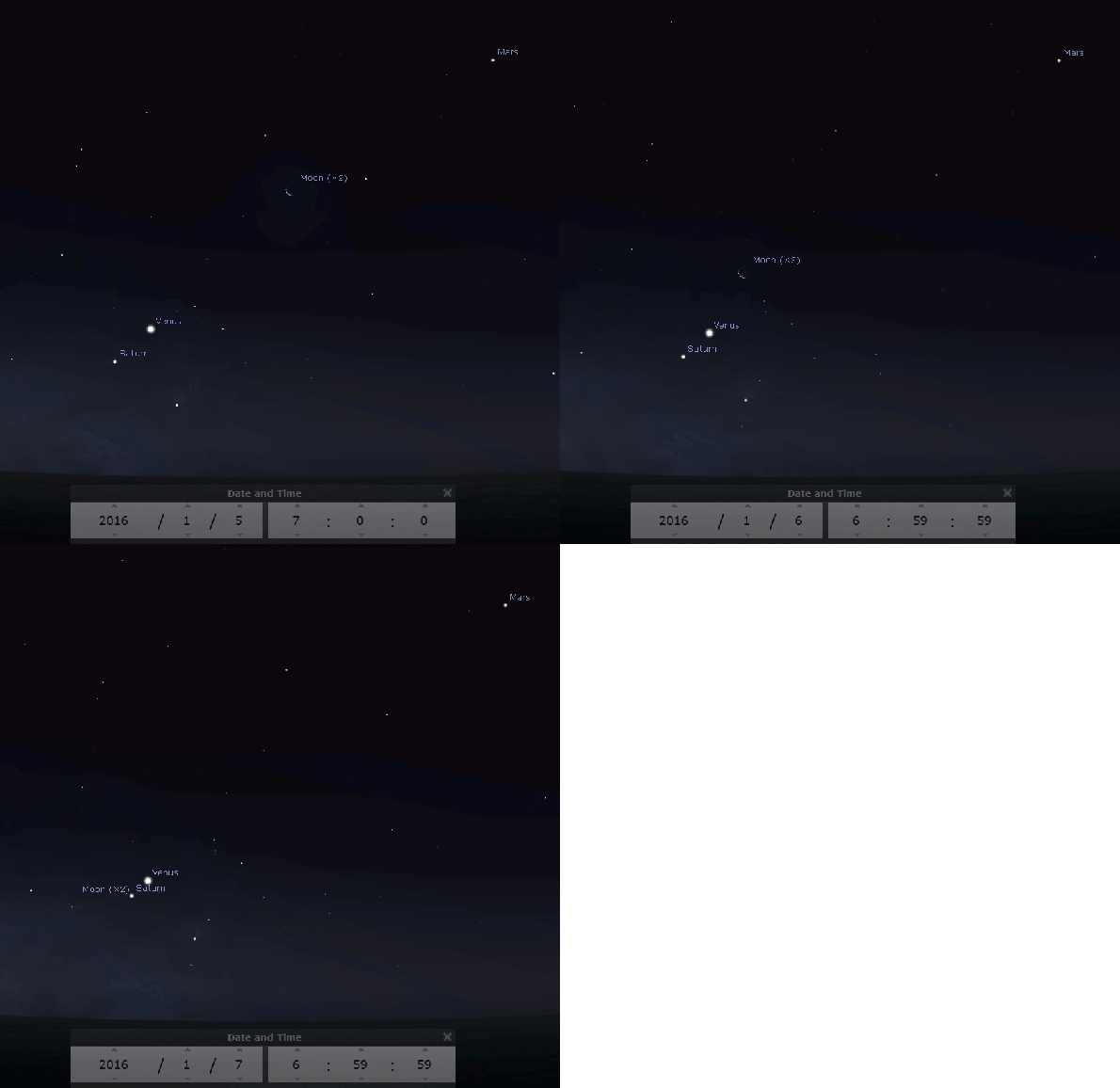
The travels of the crescent Moon by Venus and Saturn. Positions shown for 7 a.m. on consecutive mornings: January 5-7, 2016. The moon is shown twice its size for clarity. Created using Stellarium and GIMP.
01/04/2016 – Ephemeris – Some named stars in Orion and how to remember them
Ephemeris for Monday, January 4th. The Sun will rise at 8:20. It’ll be up for 8 hours and 55 minutes, setting at 5:15. The Moon, 2 days past last quarter, will rise at 3:49 tomorrow morning
Now that the Moon has fled let’s turn to the dark skies of winter and the magnificent constellation of Orion the hunter. At 9 p.m. he’s not yet completely upright in the southeast at 9 p.m. His seven bright stars make him easy to spot, starting with his belt of three stars in a straight line angling down to the left. It is inside a rectangle framing his shoulders and knees, leaning now to the left. The bright reddish star at the upper left corner is Betelgeuse, which according to a certain movie one shouldn’t say three-time in a row. The other shoulder star is a name familiar to Harry Potter fans, Bellatrix, though there’s nothing Lestrange about it. The lower right star is the bright blue-white Rigel. All in all a very impressive constellation.
Times are for the Traverse City/Interlochen area of Michigan. They may be different for your location.
Addendum
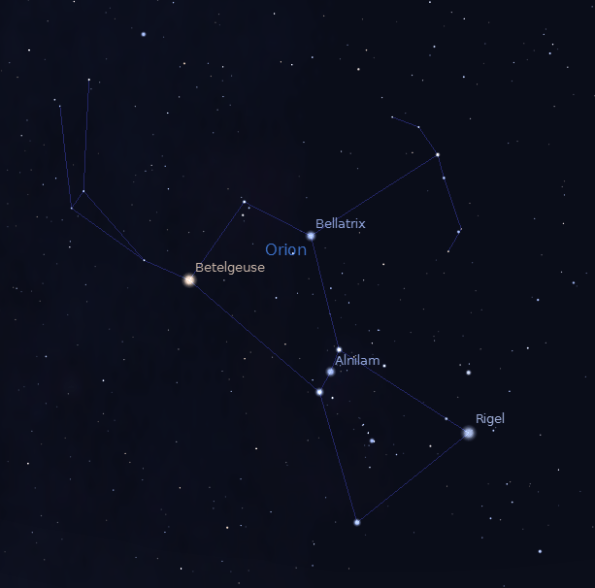
Some of Orion’s star names. Orion at 9 p.m. January 4, 2016. Created using Stellarium.
 Bob Moler's Ephemeris Blog