Archive
04/29/2016 – Ephemeris – Let’s preview the merry skies of May
Ephemeris for Arbor Day, Friday, April 29th. The Sun rises at 6:34. It’ll be up for 14 hours and 10 minutes, setting at 8:45. The Moon, at last quarter today, will rise at 3:01 tomorrow morning.
Sunday starts the month when the promise of spring is finally fulfilled. Daylight hours in the Interlochen/Traverse City area will increase from 14 hours and 16 minutes Sunday to 15 hours 20 minutes on the 31st. The altitude, or angle, of the Sun above the southern horizon at local noon will ascend from 60 degrees Sunday to 67 degrees at month’s end. The altitude of the sun in the Straits area will be a degree lower than that but your daylight will be a few minutes longer. The big event of May will be the transit of the tiny planet Mercury across the face of the Sun on May 9th. I’ll have more on that next week. Also Mars will be in opposition from the Sun on the 22nd which due to its elliptical orbit will actually be closest to us 8 days later on the 30th at 46.779 million miles (75.284 million km).
Times are for the Traverse City/Interlochen area of Michigan. They may be different for your location.
Addendum
May Star Chart
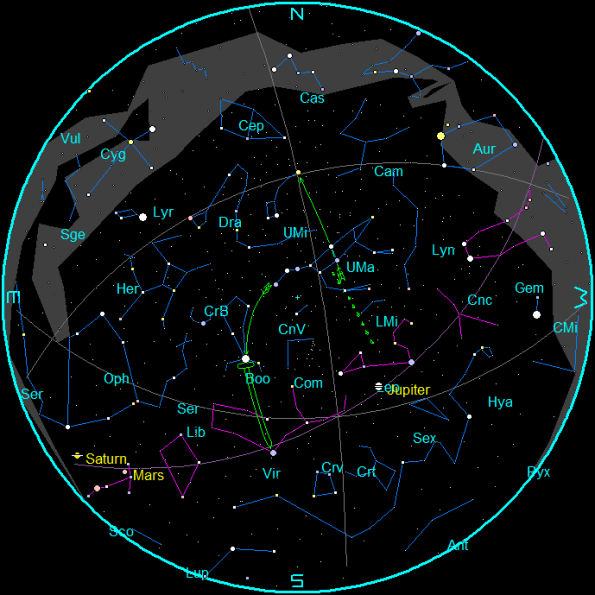
Star Chart for May 2016. Created using my LookingUp program. To enlarge in Firefox Right-click on image then click View Image.
The planets and stars are plotted for the 15th at 11 p.m. EDT. That is chart time. Note, Traverse City is located approximately 45 minutes behind our time meridian. (An hour 45 minutes behind our daylight saving time meridian.) To duplicate the star positions on a planisphere you may have to set it to 1:45 earlier than the current time.
Evening nautical twilight ends at 10:00 p.m. EDT on the 1st, increasing to 10:43 p.m. EDT on the 31st.
Morning nautical twilight starts at 5:20 a.m. EDT on the 1st, and decreasing to 4:38 a.m. EDT on the 31st.
Add a half hour to the chart time every week before the 15th and subtract a half hour for every week after the 15th. Before the 13th also subtract an hour for Standard Time.
For a list of constellation names to go with the abbreviations click here.
- Pointer stars at the front of the bowl of the Big Dipper point to Polaris the North Star
- A leaky Big Dipper drips on Leo
- Follow the arc of the handle of the Big Dipper to the star Arcturus
- Extend the ac to a spike to point to Spica
Calendar of Planetary Events
Credit: Sky Events Calendar by Fred Espenak and Sumit Dutta (NASA’s GSFC)
To generate your own calendar go to http://eclipse.gsfc.nasa.gov/SKYCAL/SKYCAL.html
Times are Eastern Time. Some additions made to aid clarity.
    Date   Time      Event
May 01 Su            Venus: 9.8° W
    02 Mo  9:27 p.m. Moon Descending Node
    04 We  2:45 p.m. Eta Aquarid Shower: ZHR = 60
    06 Fr 12:14 a.m. Moon Perigee: 357800 km
    06 Fr  3:30 p.m. New Moon
    08 Su  4:21 a.m. Moon-Aldebaran: 0.5° S
    09 Mo  7:12 a.m. Mercury transit begins
    09 Mo 10:57 a.m. Mercury mid-transit
    09 Mo  2:42 p.m. Mercury transit ends
    09 Mo  5:54 p.m. Moon North Dec.: 18.4° N
    13 Fr  1:02 p.m. First Quarter
    14 Sa  3:06 a.m. Moon-Regulus: 2.5° N
    15 Su  5:30 a.m. Moon-Jupiter: 2.2° N
    15 Su  4:39 p.m. Moon Ascending Node
    18 We  6:06 p.m. Moon Apogee: 405900 km
    21 Sa  5:15 p.m. Full Moon
    22 Su  7:15 a.m. Mars Opposition
    22 Su  5:59 a.m. Moon-Saturn: 3.5° S
    24 Tu  7:16 a.m. Moon South Dec.: 18.5° S
    29 Su  8:12 a.m. Last Quarter
    30 Mo 12:45 a.m. Moon Descending Node
    30 Mo  5:36 p.m. Mars closest to the Earth 0.50321 AU
Jun 01 We            Venus: 1.5° W
Transit of Mercury
May 9, 2016 7:12 a.m. (11:21 UT) to 2:42 p.m. (18:42 UT)
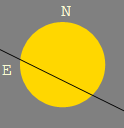
The track of Mercury across the face of the Sun. Mercury will travel from upper left to lower right. Mercury will not be visible until it impinges upon the disk of the Sun. Credit IOTA’s program Occult4.

The map showing where the transit is visible in whole or in part. If using Firefox enlarge the map by right clicking on it and select View Image.
04/28/2016 – Ephemeris – The adventures of Corvus, Apollo’s pet crow
Ephemeris for Thursday, April 28th. The Sun rises at 6:36. It’ll be up for 14 hours and 8 minutes, setting at 8:44. The Moon, 1 day before last quarter, will rise at 2:20 tomorrow morning.
The small constellation of Corvus the crow is located low in the south at 11 this evening. It’s made of 5 dim stars, but the pattern is a distinctive distorted box with two stars at the upper left marking that corner. To the right is a fainter constellation of a thick stemmed goblet called Crater. Both appear above the long constellation of Hydra the water snake who is slithering just above the southern horizon.. In Greek mythology Corvus, then white, was the god Apollo’s pet. Apollo once bid Corvus to take a cup and fetch him some water. Corvus however dallied and waited for a green fig to ripen. Corvus grabbed a snake and returned with a story as to how the snake had delayed him. The angry Apollo turned the crow and all crows to this day black.
Times are for the Traverse City/Interlochen area of Michigan. They may be different for your location.
Addendum
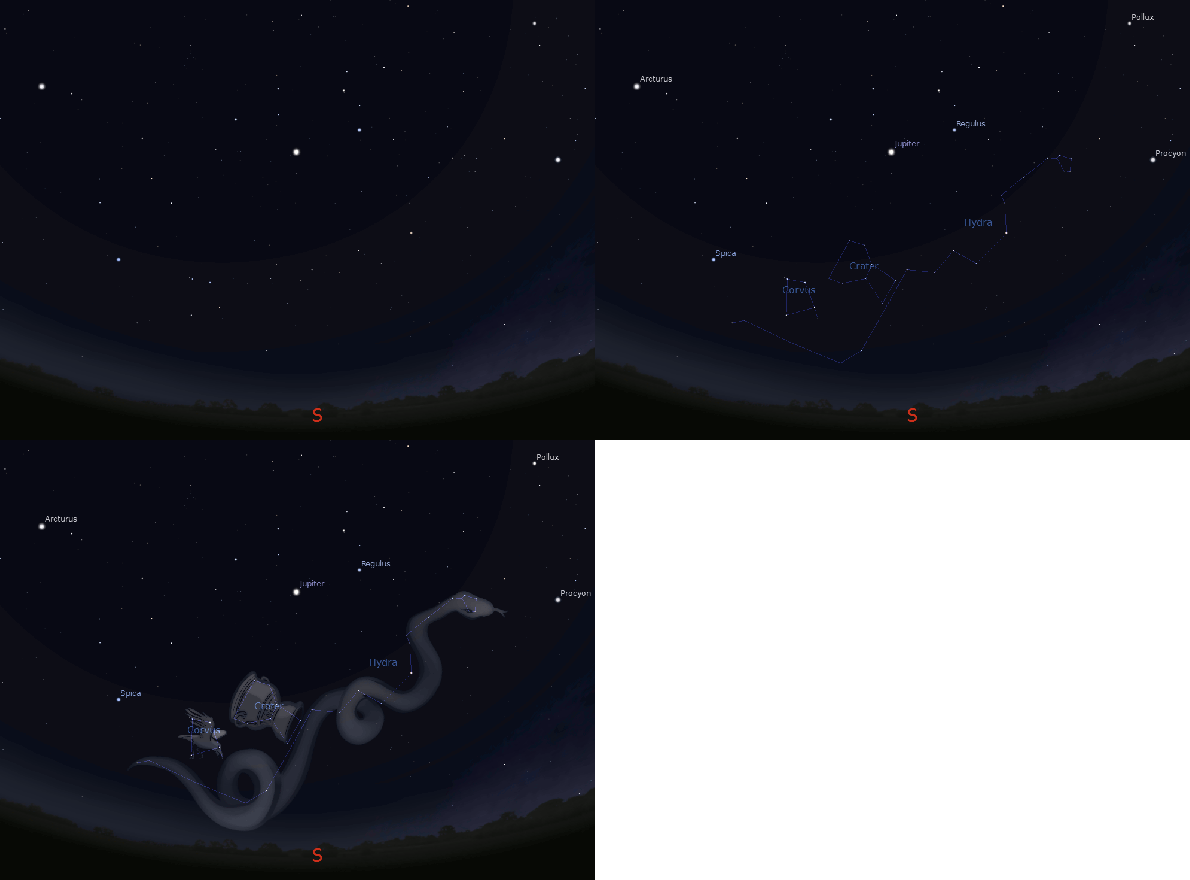
Corvus the crow, Crater the cup and Hydra the water snake along with Jupiter and the other spring stars at 10 p.m. April 28, 2016. Created using Stellarium.
04/27/2016 – Ephemeris – Mars is closing in on its rival, but backs off for now
Ephemeris for Wednesday, April 27th. The Sun rises at 6:38. It’ll be up for 14 hours and 5 minutes, setting at 8:43. The Moon, 2 days before last quarter, will rise at 1:36 tomorrow morning.
Let’s see what the bright naked eye planets are up to. Mercury is in the west-northwest, very low to the horizon, setting at 10:12 p.m. Mercury is really fading now. Jupiter is in the southeast in the early evening, and will pass due south at 10:17 p.m., and will set at 4:51 a.m. It’s below the stars of Leo this year. Binoculars can make out some of Jupiter’s moons, but a telescope is required to see all four bright moons and Jupiter’s cloud features. Mars will rise at 11:11 p.m. in the east-southeast. It’s now almost bu not quite directly north of its look-a-like star Antares, whose name means Rival of Mars. Saturn will rise at 11:40 p.m. in the east-southeast. It’s just left of Mars. Its rings are a telescopic treat. Venus is invisibly close to the Sun now.
Times are for the Traverse City/Interlochen area of Michigan. They may be different for your location.
Addendum
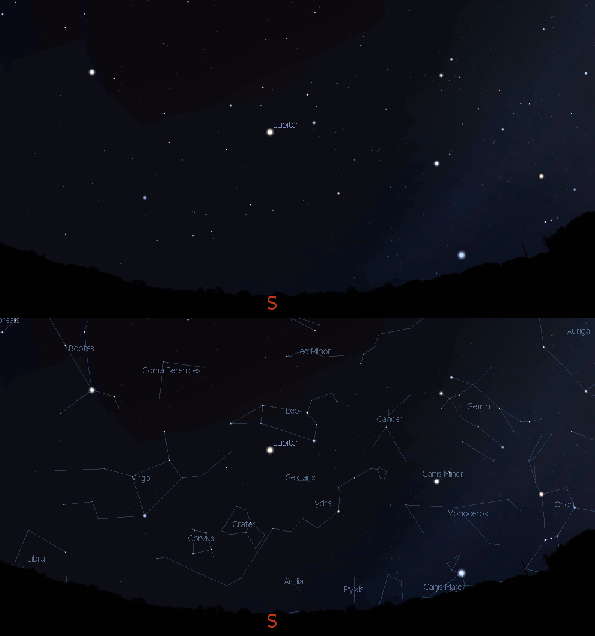
Jupiter and the spring stars animation. Set for 10 p.m. April 27, 2016. Created using Stellarium.
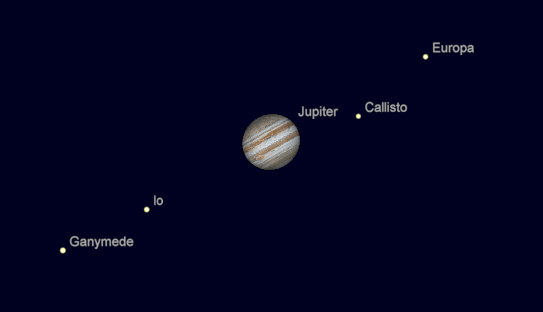
Jupiter and its moons as they might be seen in a telescope at 10 p.m., April 27, 2016. Jupiter’s apparent diameter is 41.2″ According to the Project Pluto web site the Great Red spot will cross Jupiter’s central meridian at 9:16 p.m., a half hour after sunset. If so, the position of the spot in this chart is incorrect. Created with Cartes du Ciel (Sky Charts).
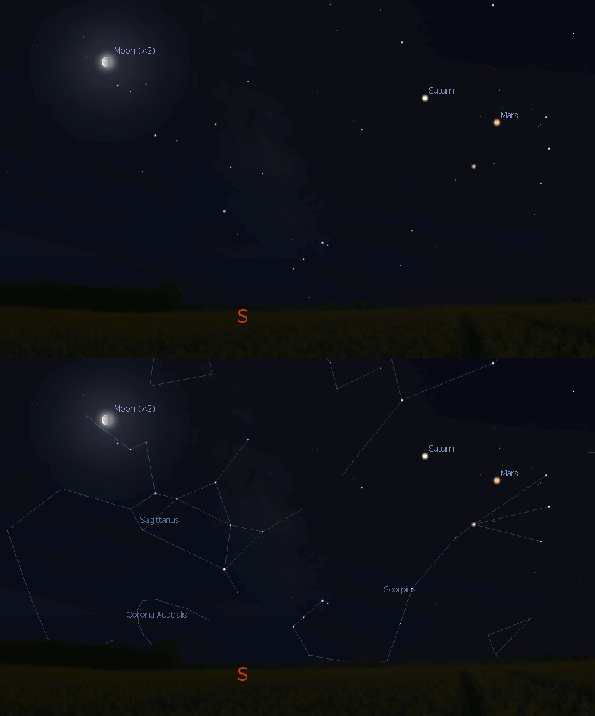
Mars, Saturn and the Moon at 5:30 a.m. April 28, 2016. Created using Stellarium.
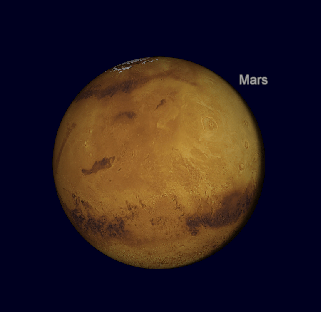
Mars as it might be seen in a large telescope with high power at 5:30 a.m., April 28 2016. Mars apparent diameter is 15.7″. The central meridian will be 169.90 degrees. Created using Cartes du Ciel (Sky Charts).
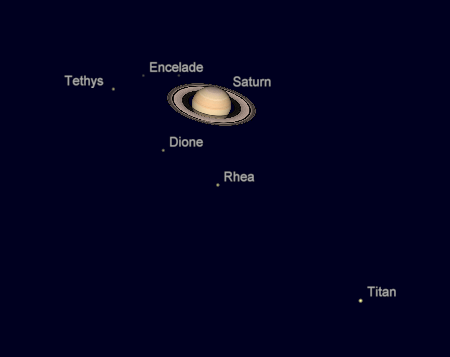
Saturn and its moons at 5:30 a.m., April 28, 2016. The apparent diameter of the planet will be 18.1″. The rings span 42.1″, a bit larger than the apparent diameter of Jupiter. Created using Cartes du Ciel (Sky Charts).
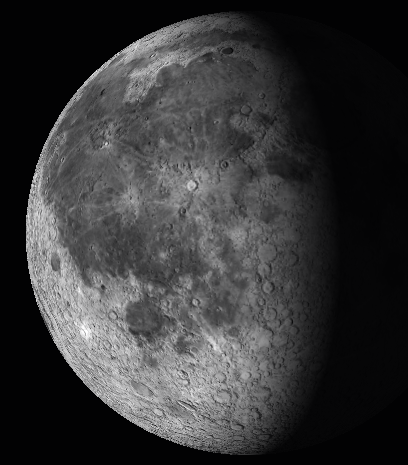
The Moon as it might appear in binoculars at 5:30 a.m. on April 28, 2016. Created using Stellarium.
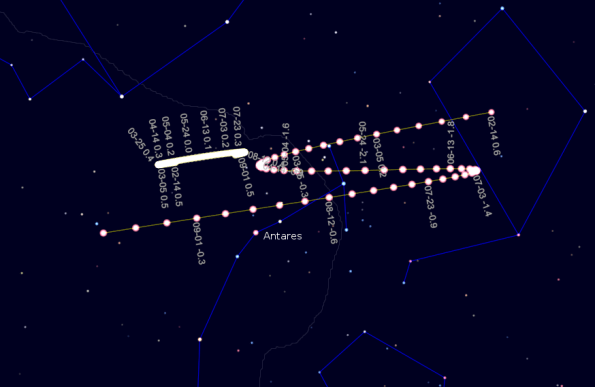
The retrograde tracks of Mars and Saturn as we pass both planets this year. The tracks start on February 14, 2016 and run to September 13, 2016 plotted at 4 day intervals and labeled every 20 days. I noticed when producing the Mars, Saturn & Moon plot above that Mars was not due north of Antares on the 27th. Mars actually became stationary and started it’s retrograde loop a few days ago before it got that far. However when Mars doubles back, it will have a much closer pass of Antares on August 27th. Saturn’s plots are so close together that they appear as a fat line. Created using Cartes du Ciel (Sky Charts).
Retrograde motion of the planets are caused when the Earth is either passing a superior planet (Mars, Jupiter, Saturn, etc.), or when being passed by an inferior planet (Venus and Mercury). It was a big problem with the old Earth center solar system, before Copernicus and Kepler.
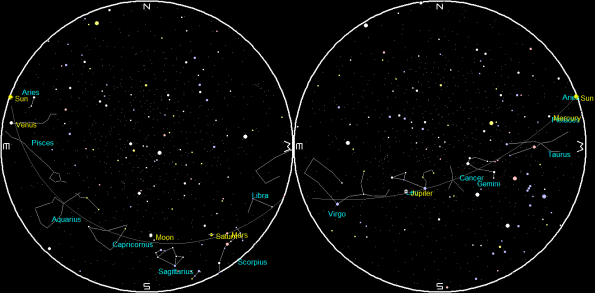
Planets at sunrise and sunset of a single night starting with sunset on the right on April 27, 2016. The night ends on the left with sunrise on April 28. If you are using Firefox right-click on the image and select View Image to enlarge the image. That goes for all the large images.
04/26/2016 – Ephemeris – Arcturus, just passing through
Ephemeris for Tuesday, April 26th. The Sun rises at 6:39. It’ll be up for 14 hours and 2 minutes, setting at 8:42. The Moon, 3 days before last quarter, will rise at 12:48 tomorrow morning.
Arcturus is an orange-colored giant star, 37 light years away. We see it high in the east and pointed to by following the arc of the handle of the Big Dipper. Arcturus is a rapidly moving star. It’s velocity is about 76 miles per second (122 km/s). It’s almost at its nearest to the Sun now. In the next 2,000 years it will move about one degree, twice the width of the Moon toward Spica. Arcturus may be part of a dwarf galaxy being assimilated by the Milky Way which may account to its odd motion. Arcturus is thought to be close to 8% more massive than the Sun and about 6 to 8 ½ billion years old. It has entered its red giant stage after running out of hydrogen in its core. It may be a glimpse of what the sun will look like in 5 billion years.
Times are for the Traverse City/Interlochen area of Michigan. They may be different for your location.
Addendum
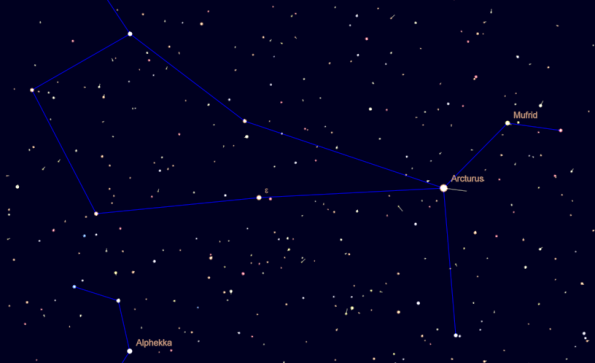
The constellation Bootes and the 4th brightest star in the night sky. The thin line extending to the right from Arcturus is the distance it will travel in the next 2,000 years. That line is nearly one degree ling, or 2 Mon diameters. Created using Cartes du Ciel (Sky Charts)
04/25/2016 – Ephemeris – Arcas and Callisto
Ephemeris for Monday, April 25th. The Sun rises at 6:41. It’ll be up for 13 hours and 59 minutes, setting at 8:40. The Moon, 3 days past full, will rise at 11:56 this evening.
Appearing mid way up the sky in the east at 10 p.m. is the kite shaped constellation of Boötes the herdsman. The bright star Arcturus is at the bottom of the kite, pointed to by the arc of the handle of the Big Dipper, above it. In one story Boötes represents a young hunter named Arcas, son of Callisto, a beautiful young lady who had the misfortune of being loved by Zeus the chief of the Greek gods. Zeus’ wife Hera, found out about the affair, and since she couldn’t punish Zeus, turned the poor woman into an ugly bear. Arcas, unaware of the events surrounding his mother’s disappearance was about to kill the bear when Zeus intervened and placed them both in the sky to save her. To this day Boötes continues to chase the great bear Ursa Major around the sky each night.
Times are for the Traverse City/Interlochen area of Michigan. They may be different for your location.
Addendum
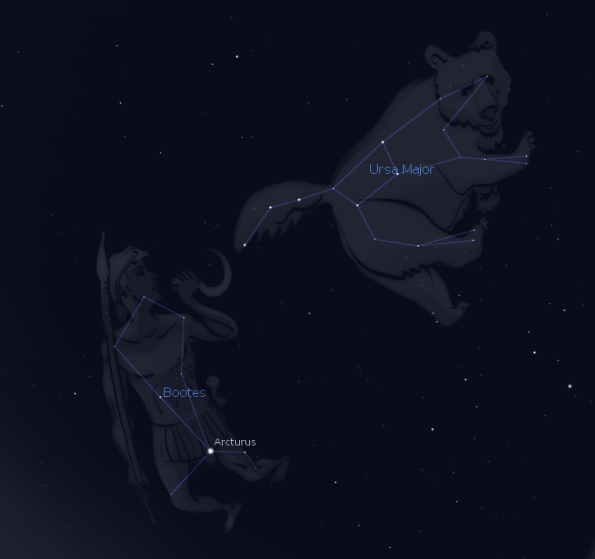
Bootes and Ursa Major aka Arcas chasing Callisto around the pole of the sky. Created using Stellarium.

Arcas about to slay the bear by the 17th century artist Baur. Source: University of Virginia Electronic Text Center
04/22/2016 – Ephemeris – Hitting on Jupiter
Ephemeris for Earth Day, Friday, April 22nd. The Sun rises at 6:45. It’ll be up for 13 hours and 51 minutes, setting at 8:37. The Moon, at full today, will rise at 9:08 this evening.
The first time anyone had spotted anything hitting Jupiter was in 1994, when over 20 pieces of Comet Shoemaker-Levy 9 hit the planet over an exciting week in July. Jupiter gets hit maybe once a year by a small asteroid making a flash or a scar visible from the Earth. Except for Shoemaker-Levy 9, all the rest of the impacts have been discovered by amateur astronomers who create videos of Jupiter through their modest, by professional standards, telescopes. Generally the reason for the videos is to stack the images to produce super detailed images of the planet, like my friend Scott Anttila, whose images I occasional post with these program transcripts on my blog bobmoler.wordpress.com. Amateurs have even discovered exoplanets.
Times are for the Traverse City/Interlochen area of Michigan. They may be different for your location.
Addendum
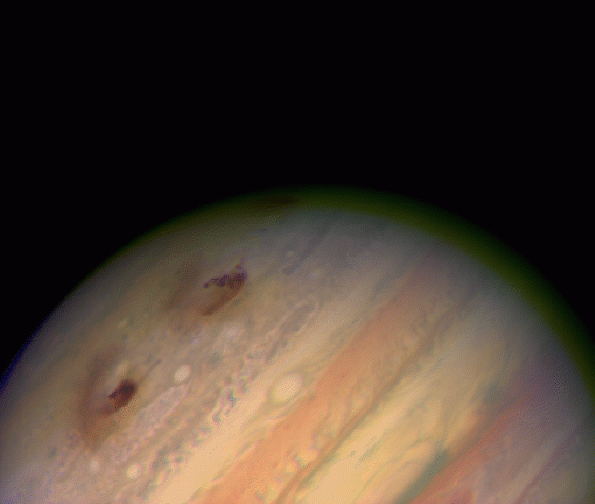
Two of the impact sites of the over 20 bits of Comet Shoemaker-Levy 9 photographed on July 18, 1994. Credit NASA/ESA Hubble Space Telescope.
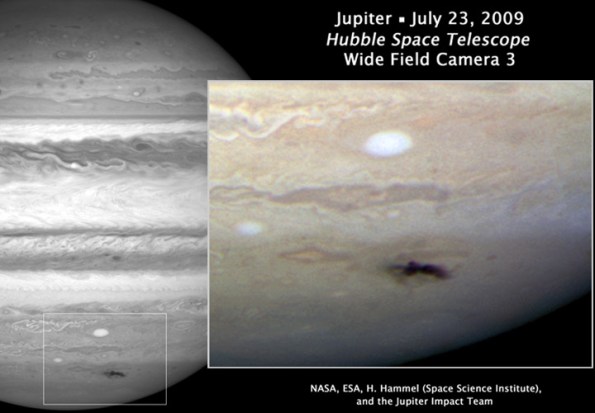
Blemish from an impact discovered by amateur astronomer Anthony Wesley on July 17, 2009. Credit NASA/ESA Hubble Space Telescope.
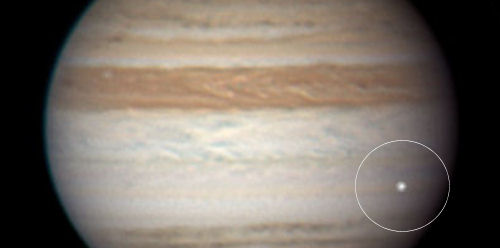
Impact June 3, 2010 photographed by Anthony Wesley. Credit Anthony Wesley.
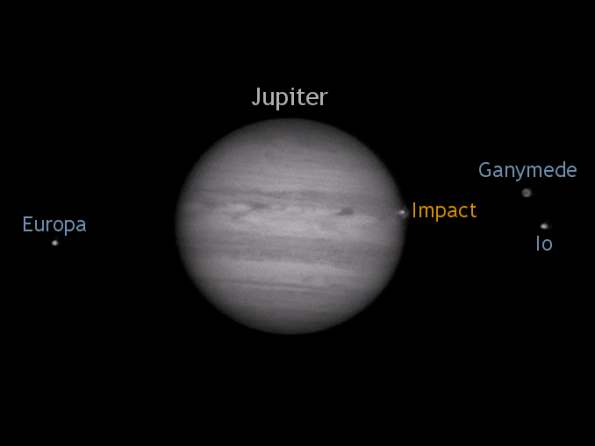
Processed image by John McKeon of the impact of March 17, 2017. The impact was first noticed by Gerrit Kernbauer. Both were amateur astronomers.
Universe Today and more information and videos of the most recent event.
04/21/2016 – Ephemeris – Up up and a way my beautiful balloon*
Ephemeris for Thursday, April 21st. The Sun rises at 6:47. It’ll be up for 13 hours and 48 minutes, setting at 8:36. The Moon, 1 day before full, will set at 7:16 tomorrow morning.
The successful launch of the SpaceX Falcon 9 spacecraft and the Dragon module marked the returned SpaceX to supplying the International Space Station after its failure last June. Besides the great achievement of landing the first stage of the Falcon on a barge, it delivered the Bigelow Aerospace BEAM inflatable module to the ISS. It’s already been attached to the station and will be inflated next month. Bigelow already has two inflatable satellites in orbit: Genesis I and II launched in 2006 and 2007 and though retired, are still in orbit. Inflatable spacecraft offer maximum volume for minimum weight. If the tests on the space station prove the concept, the Mars manned spacecraft may feature an inflatable living module.
Times are for the Traverse City/Interlochen area of Michigan. They may be different for your location.
*Apologies to the 5th Dimension and Bigelow Aerospace.
Addendum
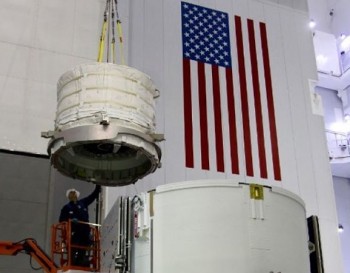
The BEAM module being loaded in the Dragon Trunk. Credit NASA / SpaceX.
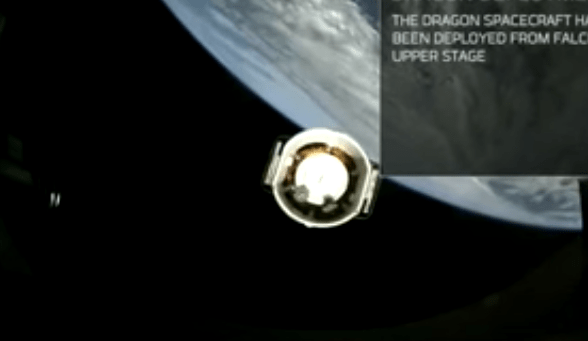
Dragon separating from the Falcon second stage with the BEAM module seen in the Dragon trunk. From a SpaceX/NASA video.
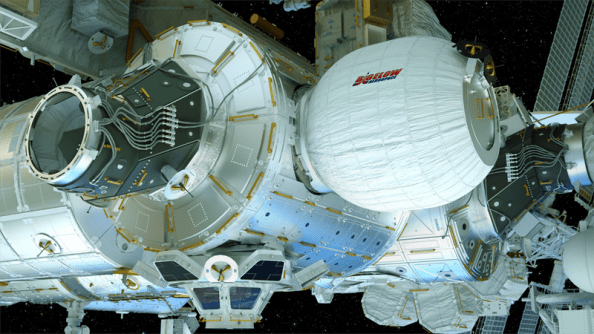
What the BEAM module will look like when attached to the ISS and inflated. Credit NASA.
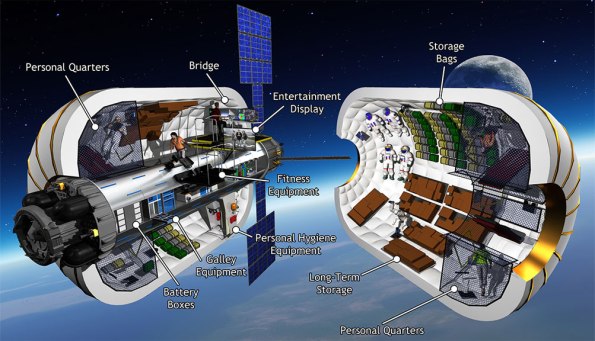
Cutaway view of the Bigelow Aerospace B330 Expandable Space Habitat. They are contracting with United Launch Alliance to send it into orbit. It will have 330 cubic meters of volume. Credit Bigelow Aerospace.
04/20/2016 – Ephemeris – Two bright planets in the evening, and two in the morning
Ephemeris for Wednesday, April 20th. The Sun rises at 6:49. It’ll be up for 13 hours and 45 minutes, setting at 8:34. The Moon, 2 days before full, will set at 6:47 tomorrow morning.
Let’s see what the bright naked eye planets are up to. Mercury is in the west-northwest, very low to the horizon, setting at 10:26 p.m. Mercury is fading now. Jupiter is in the southeast in the evening, and will pass due south at 10:46 p.m., and will set at 5:19 a.m. It’s below the stars of Leo this year. Binoculars can make out some of Jupiter’s moons, but a telescope is required to see all four bright moons and Jupiter’s cloud features. Mars will rise at 11:40 p.m. in the east-southeast. It’s above Scorpius but is actually in western Ophiuchus now. Saturn will rise at 12:09 a.m. in the east-southeast. It’s just left of Mars. Its rings are a telescopic treat. Venus will rise at 6:28 a.m. and not visible in the bright twilight.
Times are for the Traverse City/Interlochen area of Michigan. They may be different for your location.
Addendum
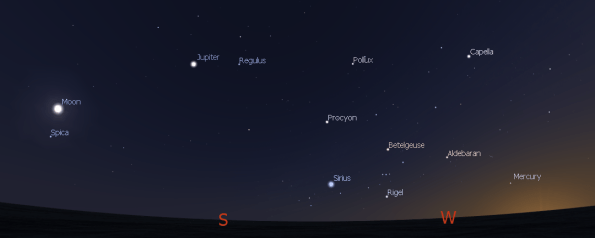
Mercury, Jupiter, the Moon and bright stars visible at 9:30 p.m. April 20, 2016.. Created using Stellarium.
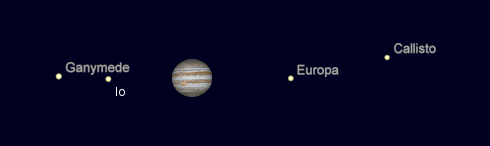
Jupiter and its moons as they might be seen through a telescope at 9:30 p.m. April 20, 2016. It’s 42.0″ in diameter. Created using Cartes du Ciel (Sky Charts).
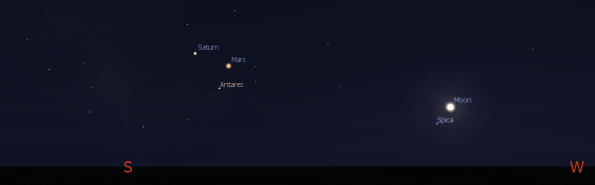
The Moon, Mars and Saturn and the bright stars at 5:30 a.m. April 21, 2016. Created using Stellarium.
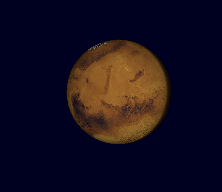
Mars as it might be seen in a large telescope with high power at 5:30 a.m., April 21 2016. Mars apparent diameter is 14.6″. The central meridian will be 233.11 degrees. Syrtis Major is at the extreme left of the planet. Created using Cartes du Ciel (Sky Charts).
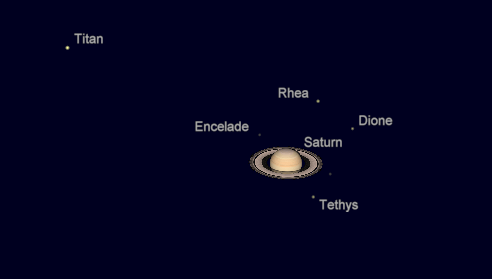
Saturn and its moons at 5:30 a.m., April 21, 2016. The apparent diameter of the planet is 17.9″. The rings span 41.7″, almost the apparent diameter of Jupiter. Created using Cartes du Ciel (Sky Charts).
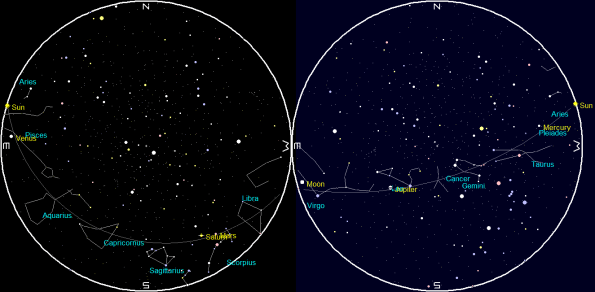
Planets at Sunrise and Sunset on April 20, 2016. If you are using Firefox right-click on the image and select View Image to enlarge the image.
04/19/2016 – Ephemeris – Sending postcards to Alpha Centauri
Ephemeris for Tuesday, April 19th. The Sun rises at 6:50. It’ll be up for 13 hours and 42 minutes, setting at 8:33. The Moon, 3 days before full, will set at 6:19 tomorrow morning.
Here’s an idea.., How about sending postcards to Alpha Centauri. That’s the idea backed by Yuri Milner, Russian Billionaire and Mark Zuckerburg, Facebook Millionaire and supported by Steven Hawking, the most famous physicist of our age. Thousands of small computers on cards with a small solar sail would be pushed by Earth bound lasers to 20% the speed of light to the Alpha Centauri star system, the closest to our own which is 4.3 light years away. At 20% the speed of light these craft would take a bit over 20 years to reach their target. As they passed through they would photograph the system looking for planets. The results would be transmitted to Earth at the speed of light, in 4.3 years. It seems fantastic.
Times are for the Traverse City/Interlochen area of Michigan. They may be different for your location.
Addendum
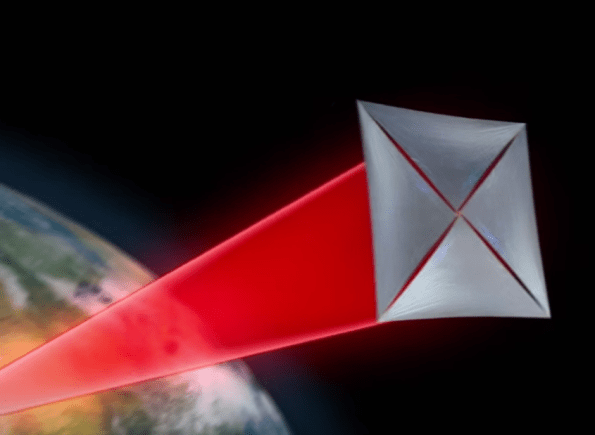
From a YouTube video showing how these tiny spacecraft will be launched.
The video is located at: https://youtu.be/wMkWGN1G6Kg
Video of the announcement: https://youtu.be/0cVQwDdYF4w
04/18/2016 – Ephemeris – A lunar crater that celebrates the first known proponent of a Sun centered solar system
Ephemeris for Monday, April 18th. The Sun rises at 6:52. It’ll be up for 13 hours and 39 minutes, setting at 8:32. The Moon, 4 days before full, will set at 5:52 tomorrow morning.
The Moon slipped past Jupiter at 1:30 this morning so this evening the planet is to the right of the Moon. The brightest spot on the Moon will appear to the upper left of it tonight in binoculars or a small telescope. It is the crater Aristarchus, named after the Greek philosopher who first proposed a Sun centered solar system in the 3rd century BC. Nobody else bought the idea until 19 centuries later. The crater Aristarchus is a relatively new crater, which on the Moon means it was formed probably less than 1.1 billion years ago, after most cratering had subsided. Mysteriously there have been reports over the years from amateur astronomers and even professionals of seeing transient bright spots or glows emanating from the crater.
Times are for the Traverse City/Interlochen area of Michigan. They may be different for your location.
Addendum
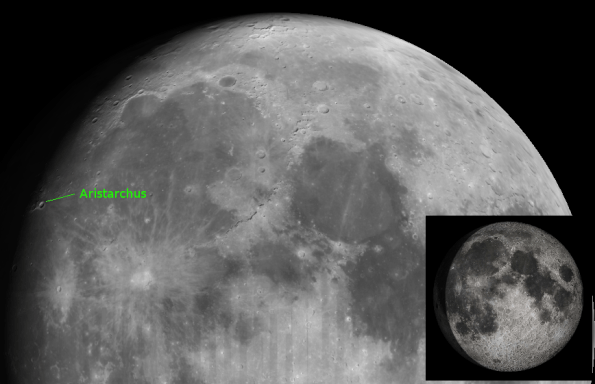
The sun rose on Aristarchus at the upper left side fo the Moon . Image from 10 p.m. April 18, 2016.
 Bob Moler's Ephemeris Blog