Archive
09/16/2016 – Ephemeris – The Harvest Moon is slightly eclipsed for everyone but the Americas
Ephemeris for Friday, September 16th. The Sun will rise at 7:23. It’ll be up for 12 hours and 27 minutes, setting at 7:50. The Moon, at full today, will rise at 7:59 this evening.
Tonight’s full Moon is the Harvest Moon, the nearest full Moon to the autumnal equinox. For the next few nights the Moon will rise later each night by much less than the average 50 minutes later each night effectively lengthening twilight for those gathering in crops. Also this afternoon there will be a penumbral lunar eclipse visible, well not here in Michigan… because the Moon won’t be up. Actually just about the whole world except North America and most of South America will be able to see the eclipse. A penumbral eclipse is what I call a 5 o’clock shadow eclipse. You wouldn’t know it unless someone pointed it out to you, when the Moon dips into the Earth’s outer shadow and the sunlight falling part of it is diminished by a little bit.
Times are for the Traverse City/Interlochen area of Michigan. They may be different for your location.
Addendum
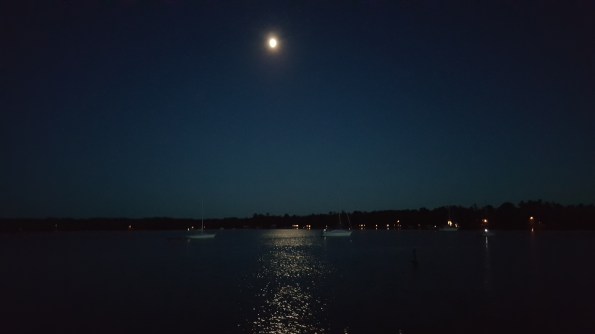
The not so full Moon of Monday night and its reflection on the waters of Suttons Bay after the schooner Inland Seas docked after an evening sail. Credit: the author.
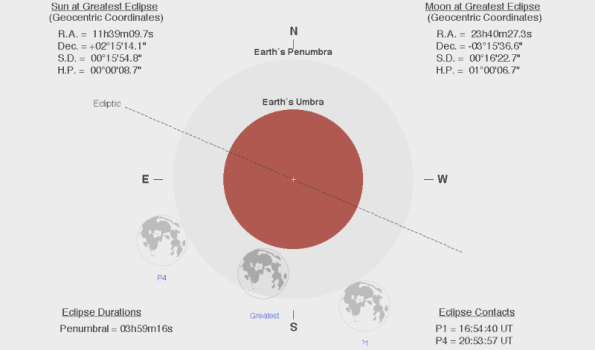
The penumbral eclipse of the Moon centered on 2:25 p.m. Eastern time, 18:54 UT, for an hour and a half before and after. Only near the middle of the eclipse will anything be visible of the effect. I find that wearing sunglasses reduces the brightness of the moon and enhances the penumbral shadow. Credit: NASA/GSFC/ Fred Espenak.
For the full-page pdf of the above click here: http://eclipse.gsfc.nasa.gov/LEplot/LEplot2001/LE2016Sep16N.pdf
09/15/2016 – Ephemeris – SpaceX has an explosion in its Falcon 9 second stage
Ephemeris for Thursday, September 15th. The Sun will rise at 7:22. It’ll be up for 12 hours and 30 minutes, setting at 7:52. The Moon, 1 day before full, will set at 7:01 tomorrow morning.
The rocket company SpaceX had one of its Falcon 9 Rockets explode as it was being fueled for a test firing to check out its booster engines on September first. The second stage, which was being loaded with fuel exploded. Even if a tank had been ruptured, there should be no ignition source to cause the explosion. Unfortunately the satellite, AMOS-6 a communications satellite destined for geosynchronous orbit, was already mounted on the rocket, and can be seen falling off the rocket just after the explosion. This is the second failure of a Falcon 9. In June of last year a helium tank inside the liquid oxygen tank in the second stage broke loose and ruptured the tank, while still being boosted by the first stage. It took a few seconds after the rupture before the fuel ignited causing the explosion that ended the mission. SpaceX has issued a request for videos or anything that might shed light on the latter accident.
Times are for the Traverse City/Interlochen area of Michigan. They may be different for your location.
Addendum
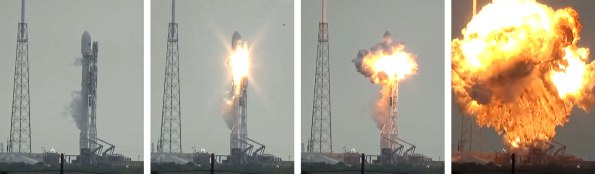
A sequence of photographs of the Falcon 9 explosion. Credit: US Launch Report.
09/14/2016 – Ephemeris – Then there were four… Evening planets that is.
Ephemeris for Wednesday, September 14th. The Sun will rise at 7:21. It’ll be up for 12 hours and 33 minutes, setting at 7:54. The Moon, 2 days before full, will set at 5:49 tomorrow morning.
Tonight we have only four of the bright classical planets in the evening sky. Mercury crossed into the morning sky Monday, Jupiter will follow shortly. Jupiter is impossible to spot being very close to the direction of the Sun. We are left with Venus, Saturn and Mars. Venus is briefly visible after sunset, low in the west. It will set at 8:52 p.m., following the Sun’s earlier setting times. Mars, Saturn and the star Antares start the evening in the southwestern sky in a triangle, with Saturn on top, Mars below and to the left, and Antares below Saturn and right of and below Mars. Saturn, spectacular in telescopes with its rings, will set at 11:18 p.m. And Mars, moving rapidly to the east against the stars will set at 11:39 p.m.
Times are for the Traverse City/Interlochen area of Michigan. They may be different for your location.
Addendum
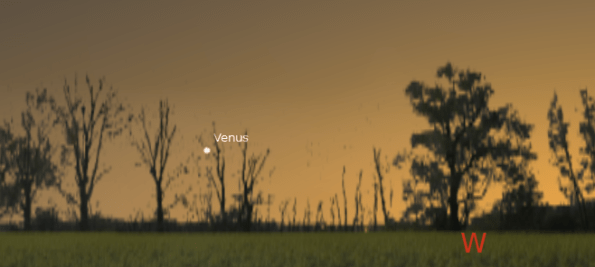
Looking very low in the west at 8:14 p.m., 20 minutes after sunset, September 14, 2016. Created using Stellarium.
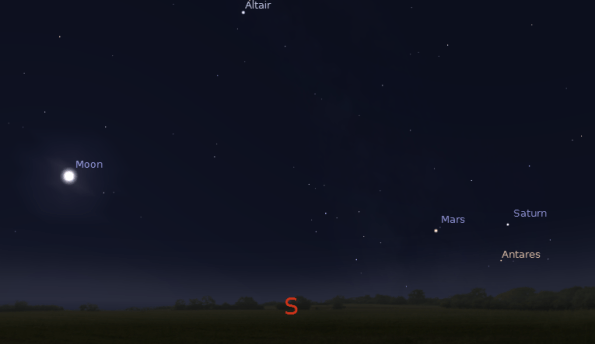
The Moon and the lengthening Mars-Saturn-Antares triangle at 9:30 p.m., September 14, 2016. Created using Stellarium.
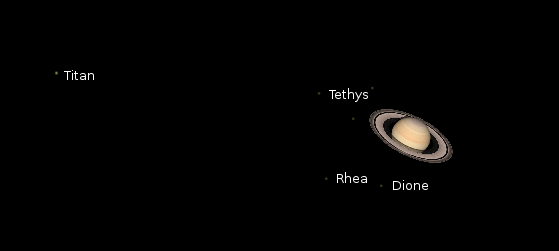
Saturn and some of its moons at 9:30 p.m. September 14, 2016. Created using Cartes du Ciel (Sky Charts).
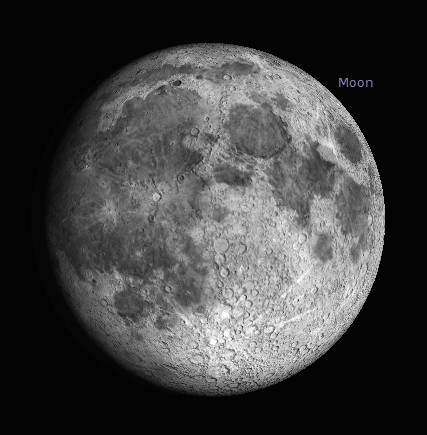
The Moon tonight as it might be seen in binoculars at 9:30 p.m. September 14, 2016. Created using Stellarium.
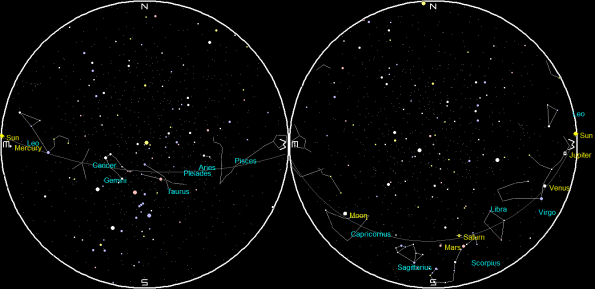
Planets and Moon at sunset and sunrise of a single night starting with sunset on the right on September 14, 2016. The night ends on the left with sunrise on September 14. Mercury has escaped to the morning sky. If you are using Firefox right-click on the image and select View Image to enlarge the image. That goes for all the large images. Created using my LookingUp program.
09/13/2016 – Ephemeris
Ephemeris for Tuesday, September 13th. The Sun will rise at 7:19. It’ll be up for 12 hours and 36 minutes, setting at 7:56. The Moon, 3 days before full, will set at 4:40 tomorrow morning.
Last Thursday evening an Atlas V rocket lifted off with NASA’s only interplanetary mission this year. The spacecraft called by one of NASA’s tortured acronyms OSIRIS-Rex is on its way to the asteroid Bennu, which was discovered in 1999, and named by a 3rd grader in a contest. Bennu is an Egyptian deity resembling a heron and also resembling the spacecraft. OSIRIS-Rex will take two years to reach the small asteroid, orbit it for two years mapping it in great detail and will approach to retrieve a sample. It will take 3 years to return the sample to the Earth in 2023. Bennu is interesting because it contains organic compounds from the origin of the solar system and because of the tiny chance it could hit the Earth in 200 years or so.
Times are for the Traverse City/Interlochen area of Michigan. They may be different for your location.
Addendum
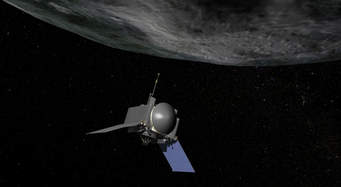
The OSIRIS-REx spacecraft with its sampler boom extended.
09/12/2016 – Ephemeris – Mercury passes inferior conjunction with the Sun today
Ephemeris for Monday, September 12th. The Sun will rise at 7:18. It’ll be up for 12 hours and 39 minutes, setting at 7:58. The Moon, 3 days past first quarter, will set at 3:34 tomorrow morning.
Today the Planet Mercury will pass inferior conjunction, that is move between the Earth and the Sun. Unlike last inferior conjunction, when it passed directly in front of the Sun on May 9th. This time it will pass below the Sun. The term inferior means it is between the Earth and the Sun. A superior conjunction is when Mercury passes the back side of the Sun. Mercury will be moving into the morning side of the sky, and toward the end of the month it will be much easier to spot than it was last month when it was low in the west. On autumn mornings the ecliptic, the path of the Sun and planets, sticks up, close to vertical, while in the evenings it lies close to the horizon, which is also why Venus sets so soon after the Sun now.
Times are for the Traverse City/Interlochen area of Michigan. They may be different for your location.
Addendum
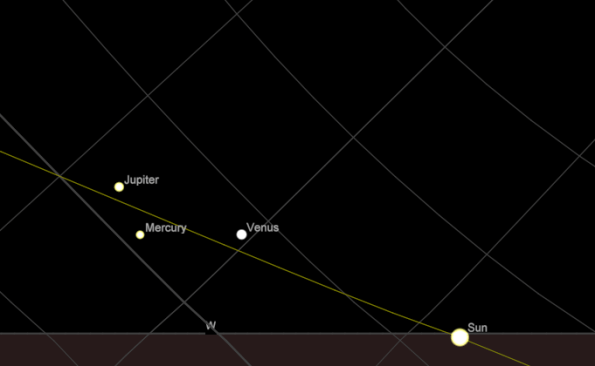
Mercury last August 16 at greatest eastern elongation. Note how low Mercury is to the horizon at sunset. Created using Cartes du Ciel (Sky Charts).
Note in the charts above and below the line passing through the Sun, and the one the planets hang around is the ecliptic, the projection of the Earth’s orbit on the celestial sphere. The grid line running through the west compass point at the horizon is the celestial equator. I’m allowing us to see below the horizon. As planets rise, move across the sky and set they will appear to move parallel to the celestial equator.
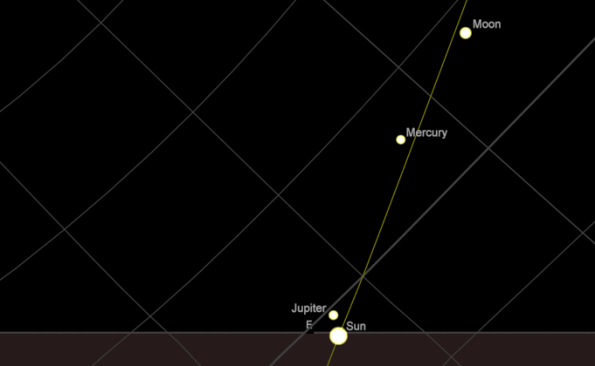
Mercury this coming September 28 at greatest western elongation. Note how high Mercury is to the horizon at sunrise. Created using Cartes du Ciel (Sky Charts).
Note too that Mercury appears farther from the Sun on August 16th than at September 28th. And it is. On August 16th Mercury appears 27.4 degrees from the Sun. On September 28th, it’s only 17.8 degrees. That’s a big advantage for observers in the southern hemisphere. The best times to see an eastern elongation of Mercury is on winter and spring evenings, and the best times to see a western elongation of Mercury is on summer and autumn mornings. Since the seasons are reversed from the northern hemisphere to the southern hemisphere. Our not so good August 16th elongation of Mercury was a really good one for folks south of the equator. We’ll return the favor September 28th. But the best southern hemisphere greatest elongations are always greater in the separation of Mercury from the Sun than northern ones because Mercury has a markedly elliptical orbit.
09/09/2016 – Ephemeris – There’s a star party tomorrow at the NMC Rogers Observatory
Ephemeris for Friday, September 9th. The Sun will rise at 7:15. It’ll be up for 12 hours and 48 minutes, setting at 8:03. The Moon, at first quarter today, will set at 12:50 tomorrow morning.
For the sixth weekend in a row the Grand Traverse Astronomical Society will host an observing event. Just one this weekend. It will be a star party at Northwestern Michigan College’s Rogers Observatory tomorrow night, Saturday night the 10th from 9 to 11 p.m. The observatory’s and GTAS members telescopes will be used to view the Moon and the planets Saturn and Mars. Some of the brighter deep-sky objects of the summer sky will also be visible. There will be an alternate program available if it’s cloudy. Last weekend’s star party , out at the Sleeping Bear Dunes was a perfectly clear night with and nearly 1800 folks showed up to view the wonders of the Milky Way. The society and the park thank all who attended.
Times are for the Traverse City/Interlochen area of Michigan. They may be different for your location.
09/08/2016 – Ephemeris – The Moon tonight: Two mountain ranges
Ephemeris for Thursday, September 8th. The Sun will rise at 7:14. It’ll be up for 12 hours and 51 minutes, setting at 8:05. The Moon, 1 day before first quarter, will set at 12:07 tomorrow morning.
The planet Saturn will appear below the nearly first quarter Moon tonight. The southern part of the Moon shows lots of craters in a pair of binoculars or small telescope. The area is called the lunar highlands. Most of the northern part of the Moon contains the lunar seas or maria. There is some interesting terrain there for the small telescope, including the mountain range the Alps to the North and the Apennines south of them. Lunar mountain ranges are named after Earthly ones. The two ranges are part of the broken ramparts around Mare Imbrium, the large Sea of Showers. In it are a few large craters that were created by impacts since the sea itself was created by a huge asteroid impact over 3.8 billion years ago.
Times are for the Traverse City/Interlochen area of Michigan. They may be different for your location.
Addendum
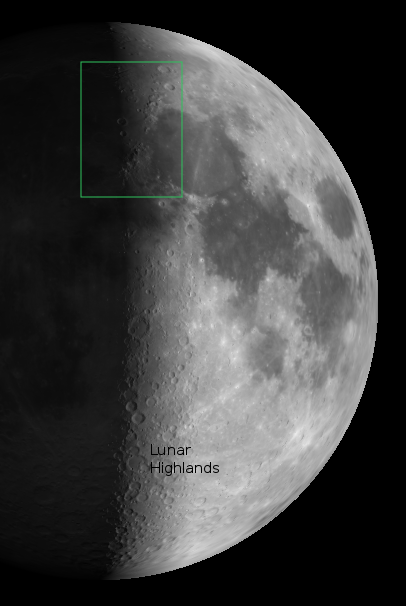
The Moon tonight at 9 p.m. September 8, 2016. Created using Stellarium.
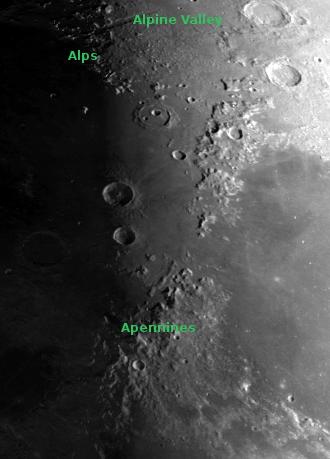
A closer look at the emerging mountains on the Moon at 9 p.m. September 8, 2016. Created using Stellarium.
More of these mountains will be revealed in coming nights.
09/07/2016 – Ephemeris – Then there was one in the west and two in the southwest
Ephemeris for Wednesday, September 7th. The Sun will rise at 7:12. It’ll be up for 12 hours and 54 minutes, setting at 8:07. The Moon, 2 days before first quarter, will set at 11:29 this evening.
Tonight we still have all the bright classical planets in the evening sky, barely. Venus, Mercury, Jupiter are very low in the west, but only Venus is briefly visible after sunset. It will set at 9:03 p.m. Later this month Mercury and Jupiter will pass the Sun to become visible in the morning sky. Venus alone will remain in the evening sky, slowly pulling away from the Sun. Mars, Saturn and the star Antares start the evening in the southwestern sky in a triangle, with Saturn on top, Mars below and to the left, and Antares below and right of Mars. Saturn, spectacular in telescopes with its rings, will set at 11:45 p.m. And Mars, moving rapidly to the east against the stars will set at 11:50 p.m.
Times are for the Traverse City/Interlochen area of Michigan. They may be different for your location.
Addendum
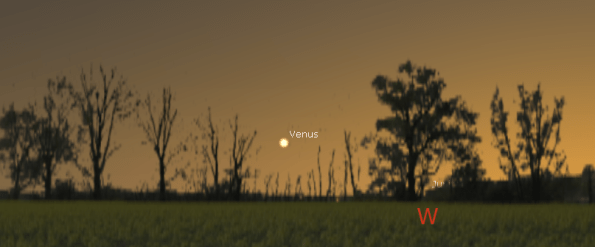
Looking very low in the west at 8:30 p.m., 20 minutes after sunset, September 7, 2016. Created using Stellarium.
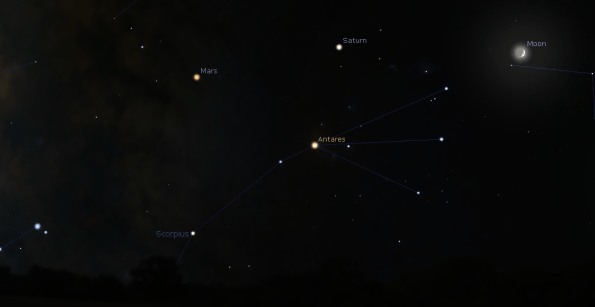
The Moon and the Mars-Saturn-Antares triangle at 9:30 p.m., September 7, 2016. Created using Stellarium.
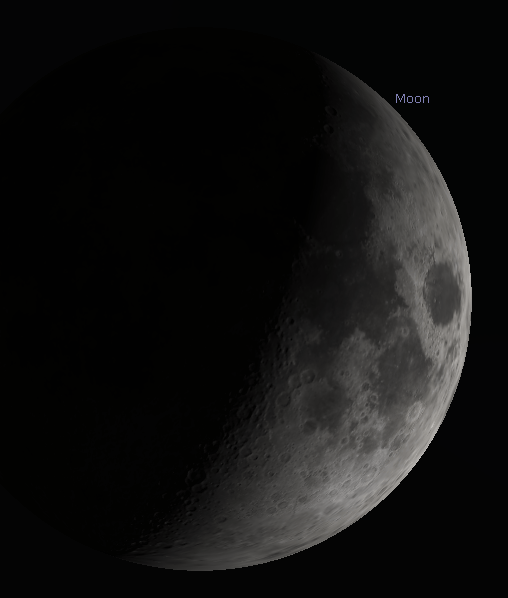
The Moon tonight as it might be seen in binoculars at 9:30 p.m. September 7, 2016. Created using Stellarium.
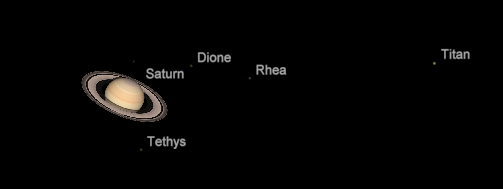
Saturn and some of its moons at 9:30 p.m. September 7, 2016. Created using Cartes du Ciel (Sky Charts).
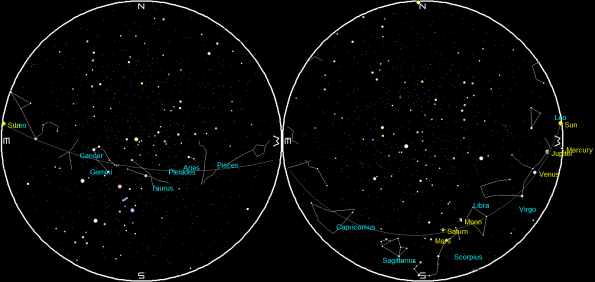
Planets and Moon at sunset and sunrise of a single night starting with sunset on the right on September 7, 2016. The night ends on the left with sunrise on September 8. Actually all the naked eye planets are in the evening sky. If you are using Firefox right-click on the image and select View Image to enlarge the image. That goes for all the large images. Created using my LookingUp program.
09/06/2016 – Ephemeris – The prominent lunar crater Theophilus
Ephemeris for Tuesday, September 6th. The Sun will rise at 7:11. It’ll be up for 12 hours and 57 minutes, setting at 8:09. The Moon, 3 days before first quarter, will set at 10:55 this evening.
The Moon’s terminator, the sunrise line, is half-way across the Sea of Tranquility on our satellite’s equator. Below that is a distinctive crater just coming into light. It’s prominent enough to spot in binoculars. It’s name is Theophilus. The name is familiar with those familiar with the New Testament of the Bible, as the person that the Gospel of Luke and Acts of the Apostles is addressed to. However that isn’t who the crater is named for, but for the Patriarch of Alexandria of the late 4th century. The two other large craters south of Theophilus that will be visible tomorrow are named for two other Orthodox saints of Alexandria. They were named by Giovanni Riccioli a 17th century astronomer and priest, who named many other craters.
Times are for the Traverse City/Interlochen area of Michigan. They may be different for your location.
Addendum
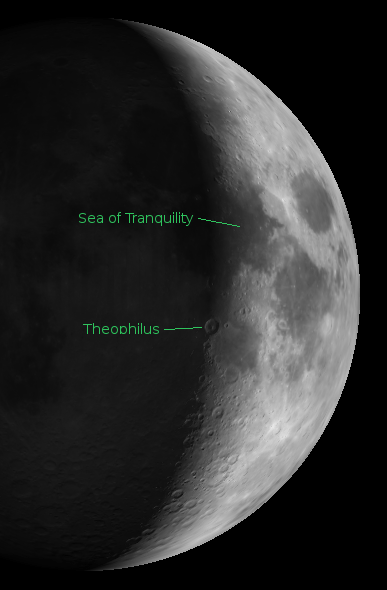
The Moon at 9 p.m. September 6, 2016 showing the crater Theophilus. Created using the Virtual Moon Atlas.
When Theophilus is on the terminator as it is tonight the Sun may touch the crater rim and the central peaks, while the crater floor is still in shadow. It’s a cool sight.
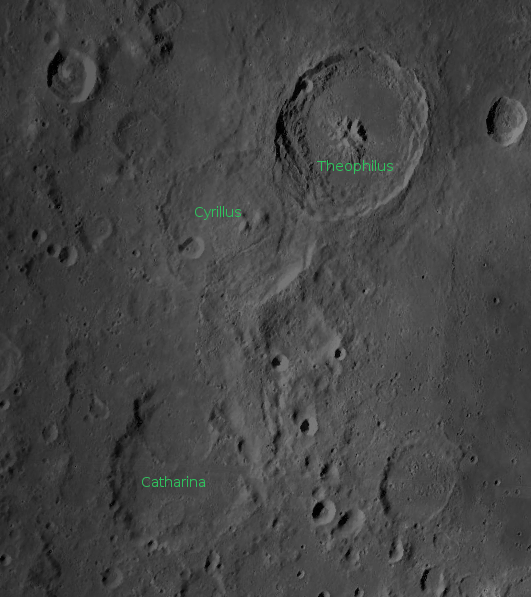
Three Alexandrian saints, Theophilus, Cyrillus, and Catharina (St Catherine) immortalized on the Moon. Created using the Lunar Reconnaissance Orbiter texture on the Virtual Moon Atlas.
Note that Cyrillus has very low crater walls and is hard to see unless the sun angle is low near lunar sunrise of sunset.
09/05/2016 – Ephemeris – Anticipating summer’s end
Ephemeris for Labor Day, Monday, September 5th. The Sun will rise at 7:10. It’ll be up for 13 hours and 0 minutes, setting at 8:11. The Moon, half way from new to first quarter, will set at 10:24 this evening.
Even though we have 17 more days officially, of summer, according to the actual seasons, today seems like it, the end of summer. Summer seems to be defined or confined to between the time that the kids get out of school, to Labor Day, after which the kids go back to school. Schools in other locales have been back for almost two weeks now. As far as the summer sky goes, the summer Milky Way will stick around until October, until we lose the Teapot of Sagittarius over the southwestern horizon. The Summer Triangle of bright summer stars, won’t leave the sky until December, as they move ever westward. However in the east the autumn stars are even now rising, pushing the Milky Way to the west.
Times are for the Traverse City/Interlochen area of Michigan. They may be different for your location.
Addendum
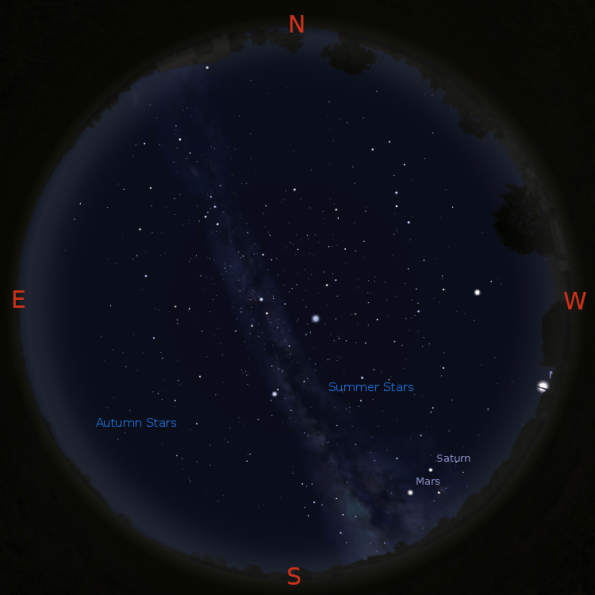
The transitional skies of 10 p.m. tonight 9/5/2016. Created using Stellarium.
 Bob Moler's Ephemeris Blog