Archive
12/19/2016 – Ephemeris – OK kids, do I have to turn this chariot around
Ephemeris for Monday, December 19th. The Sun will rise at 8:16. It’ll be up for 8 hours and 48 minutes, setting at 5:04. The Moon, 1 day before last quarter, will rise at 11:44 this evening.
The constellation Auriga the charioteer is half way up the sky in the east at 8 p.m. It is a pentagon of stars, with the brilliant star Capella at one of its corners. Capella represents a she goat he’s carrying. A narrow triangle of stars nearby Capella are her kids, an informal constellation or asterism. Within and near that pentagon, binoculars and telescopes will find several star clusters, groups of hundreds of stars born in the clump we still see them in. These star clusters will appear as fuzzy spots in binoculars. One called M38 is near the center of the pentagon. Another, M36 is below it. Still another star cluster, M37, is farther below still. The M designations come from Charles Messier who two centuries ago ran into them while looking for comets.
Times are for the Traverse City/Interlochen area of Michigan. They may be different for your location.
Addendum
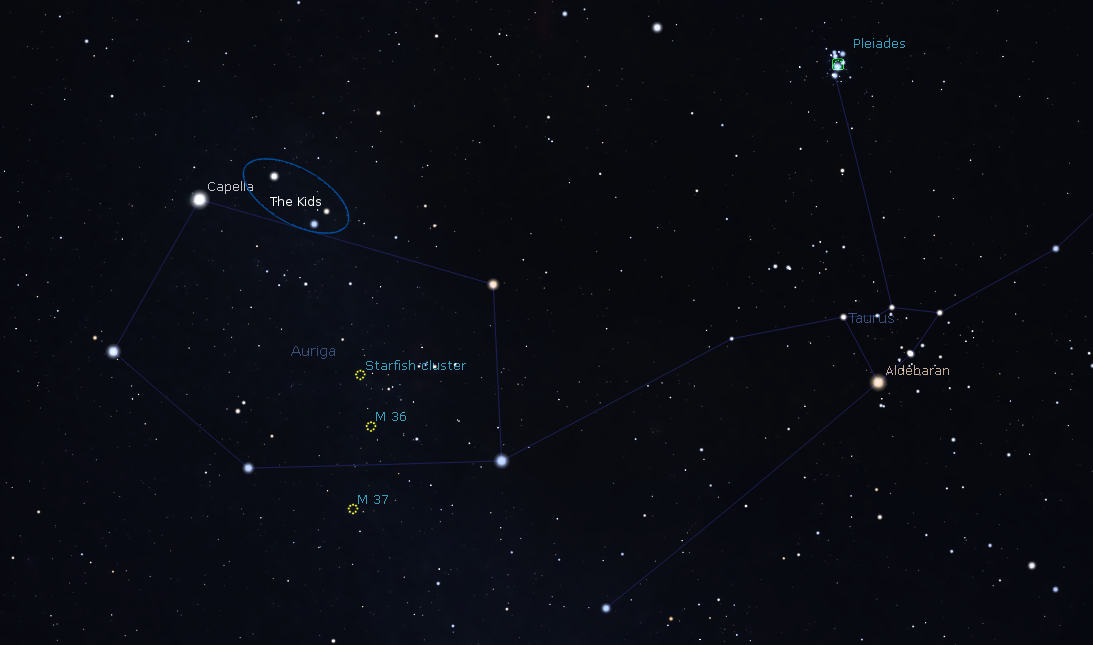
Auriga the charioteer with Capella and the Kids at 8 p.m. December 19, 2016. The object named the Starfish Cluster is M38. To the right is Taurus the bull with the Hyades, his face and above the Pleiades in his shoulder. Created using Stellarium and edited with GIMP. Click on the image to enlarge.
12/16/2016 – Ephemeris – The Pleiades in the mythology of many cultures
Ephemeris for Friday, December 16th. The Sun will rise at 8:14. It’ll be up for 8 hours and 48 minutes, setting at 5:03. The Moon, 3 days past full, will rise at 8:28 this evening.
Let’s look at how some other cultures saw the Pleiades. To the Anishinabek native peoples around here the Pleiades is the “Hole in the Sky” or the seven stones that are heated for the sweat lodge ceremony. To the Kiowa* these were sister stars that had been whisked into the sky from the top of Devils Tower in Wyoming where they were threatened by a huge bear. In Norse mythology these were the goddess Freya’s hens. The name we know them by has rather misty origins. Some think the Greek name is from the mother of the seven sisters, Pleione. The Greek word for sail is similar to Pleiades, and some suggested that the appearance of the Pleiades in the morning sky signaled the best sailing weather in the Mediterranean region.
Times are for the Traverse City/Interlochen area of Michigan. They may be different for your location.
* I originally reported it as Lakota on the program, and earlier as the Sioux.
Addendum
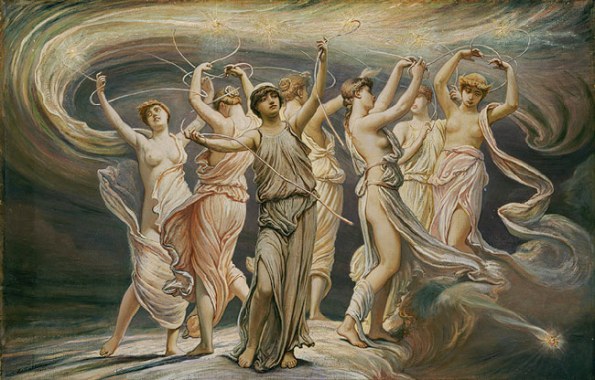
The Greek Pleiades a painting by Elihu Vedder in the Metropolitan Museum of Art, New York City. Public Domain.
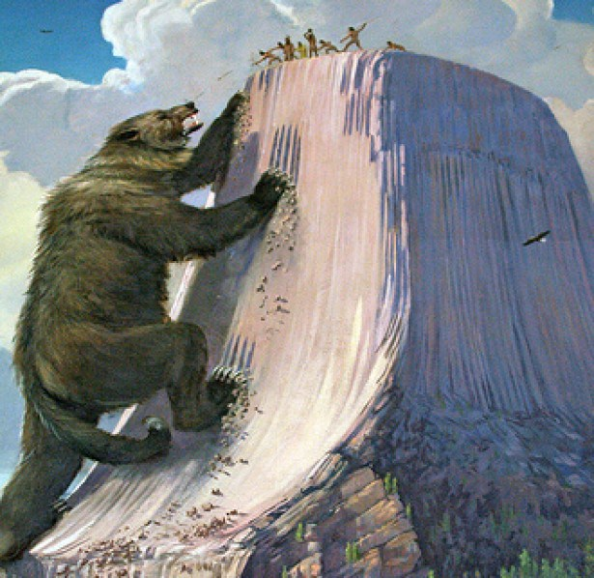
Seven maidens being attacked by a giant bear, having fled to the top of Devil’s Tower in Wyoming. Painting by Herbert Collins, www.nps.gov/deto
12/15/2015 – Ephemeris – The Seven Sisters of the Pleiades
Ephemeris for Thursday, December 15th. The Sun will rise at 8:13. It’ll be up for 8 hours and 49 minutes, setting at 5:02. The Moon, 2 days past full, will rise at 7:21 this evening.
While I’ve mentioned the Pleiades with regard to its neighboring stars and constellations several times this autumn I haven’t looked at this beautiful star cluster itself. The Pleiades appears as a group of six or seven stars visible to the naked eye, of over a hundred stars, and is also known as the Seven Sisters. Some also mistake it for the Little Dipper, due to the little bowl shape in the center of the cluster. I call it the “tiny dipper”. The real Little Dipper is now hanging off Polaris in the north. There are a lot of stories about the Pleiades from many different cultures. From the Greek and Roman cultures we get our best known stories of them, that the seven sisters were the daughters of the god Atlas and Pleione. The 9 brightest stars bear the names of the sisters and their parents.
Times are for the Traverse City/Interlochen area of Michigan. They may be different for your location.
Addendum
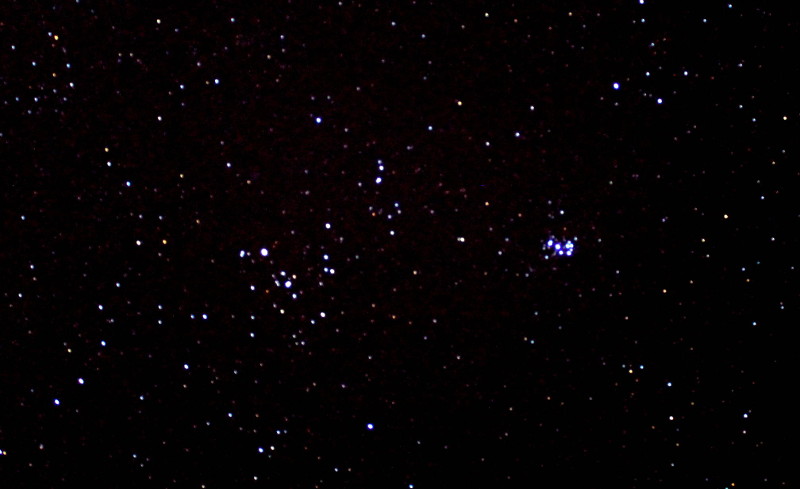
The Pleiades (right) and the Hyades, the face of Taurus the bull (left) in this photograph I took 11:23 p.m. January 4, 2016.
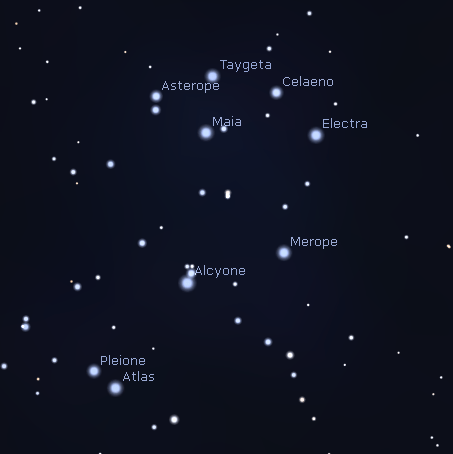
The named stars of the Pleiades. This is also showing more stars than can be seen with the naked eye. This is the number of stars that can be seen in binoculars, which is the best way to observe them. Most telescopes offer too much magnification to fit all the stars in. A thirty power wide angle eyepiece can just fit all the stars in. Created using Stellarium. Note that this view is the orientation of the cluster at 8p.m. tonight.
12/14/2016 – Ephemeris – Mercury is seen briefly with the evening planets
Ephemeris for Wednesday, December 14th. The Sun will rise at 8:12. It’ll be up for 8 hours and 49 minutes, setting at 5:02. The Moon, 1 day past full, will rise at 6:17 this evening.
In the east-southeast before 7:30 these mornings. Jupiter can be glimpsed in the morning twilight. Jupiter will rise tomorrow at 2:39 a.m. We are approaching Jupiter as it appears to move away from the Sun. We will pass it on April 7th next year. Mercury, Venus and Mars are in the evening sky. At 6 p.m. these planets will be seen in the southwest and low in the sky. Mercury will require a very low horizon, Venus will be the higher and the brightest of the three, Mars will be higher to the left. Mercury will set at 6:24 p.m., Venus will set at 8:30. Mars will set at 10:11. Mars’ setting time hasn’t changed much in the last month and a half. Venus is slowly heading northward for the rest of it’s evening appearance, and is moving higher in the sky.
Times are for the Traverse City/Interlochen area of Michigan. They may be different for your location.
Addendum
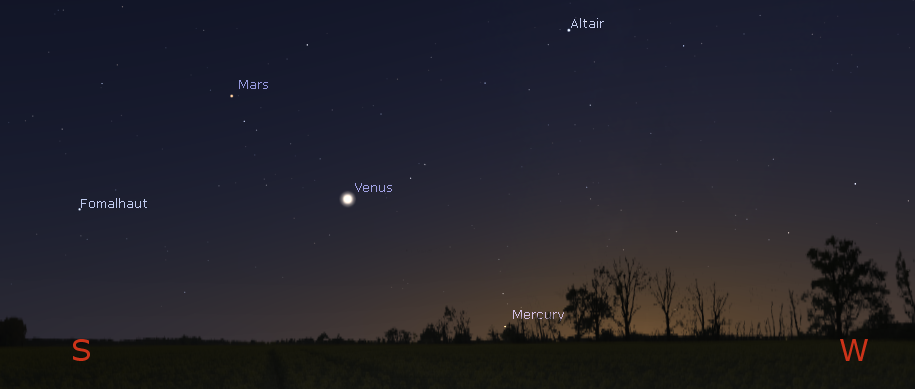
Venus, Mars and Mercury in the trees at 6 p.m., December 14, 2016. This is approximately one hour after sunset. Click on image to enlarge. Created using Stellarium.
Mercury might be spotted a half hour earlier a bit higher with binoculars.
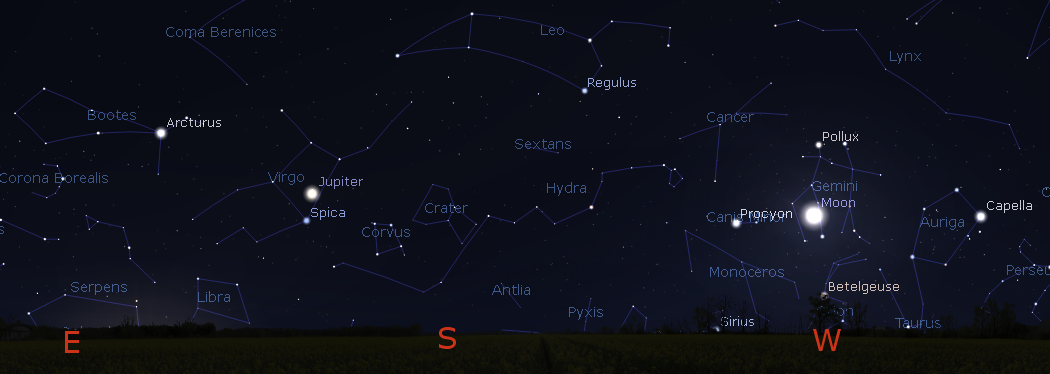
Jupiter the Moon and a preview of the southern spring constellations at 6:30 a.m. December 15, 2016. Click on image to enlarge. Created using Stellarium.
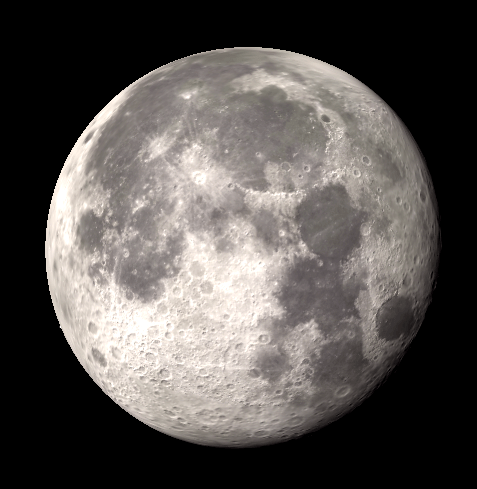
The Moon at 6:30 a.m. December 15, 2016. Created using Stellarium.
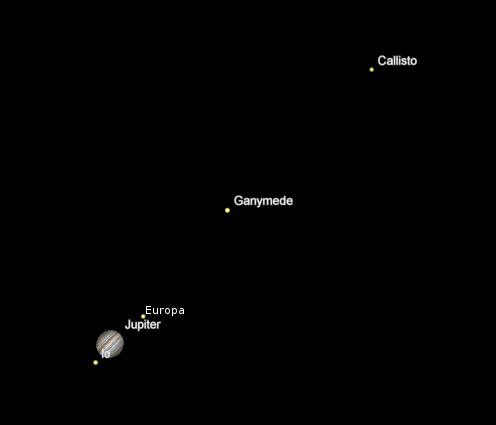
Jupiter and moons at 6:30 a.m. December 15, 2016. Io appeared from behind Jupiter at 5:42 a.m. (10:42 UT). Image created using Cartes du Ciel (Sky Charts).
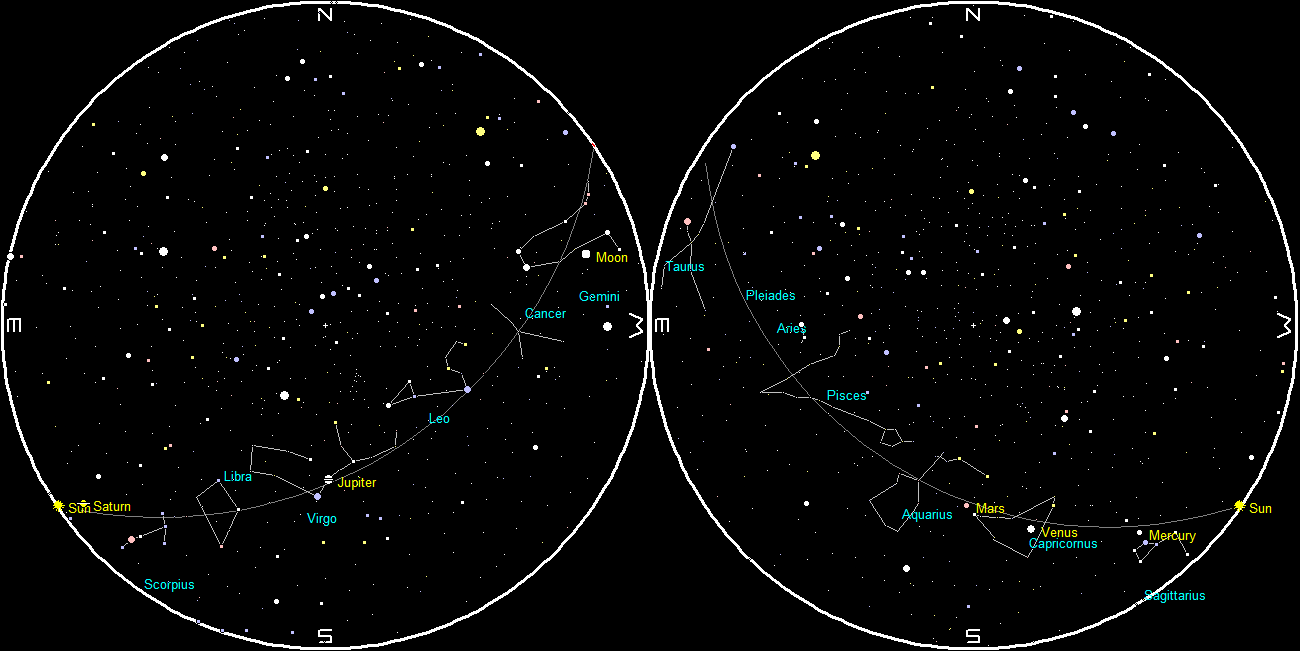
Planets and Moon at sunset and sunrise of a single night starting with sunset on the right on December 14, 2016. The night ends on the left with sunrise on December 15. Click on image to enlarge. Created using my LookingUp program.
12/13/2016 – Ephemeris – The Geminid meteor shower will reach its peak tonight
Ephemeris for Tuesday, December 13th. The Sun will rise at 8:12. It’ll be up for 8 hours and 50 minutes, setting at 5:02. The Moon, at full today, will rise at 5:18 this evening.
The great meteor shower of December will reach its peak 7 p.m. The shower is called the Geminids because they seem to come from the constellation of Gemini the twins. Unlike most meteor showers which have their highest numbers just before dawn, the normal highest numbers of meteors, when the radiant point is highest in the sky is between 2 and 3 a.m. The radiant point, near the star Castor, the higher of the twin’s namesake stars will rise before 8 p.m. tonight. In the last few years the Geminids have bested the Perseid shower of August for numbers of meteors. The Geminids are caused by bits of rock that orbit the sun in a rather small but elongated orbit. Unfortunately this year the Moon is full, so all but the brightest meteors will be drowned out by moonlight.
Times are for the Traverse City/Interlochen area of Michigan. They may be different for your location.
Addendum
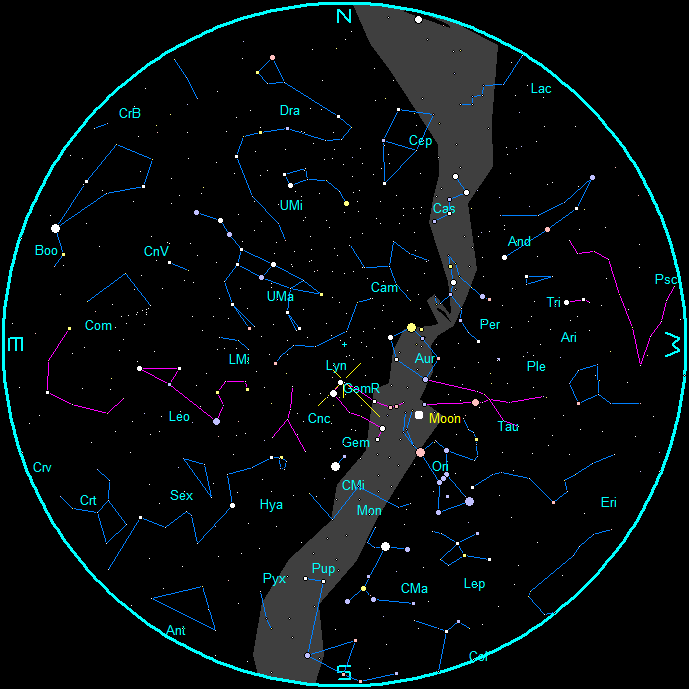
The entire sky at the time the radiant (GemR) is at its highest. That’s actually 2:37 a.m. December 14th, 2016. The radiant’s altitude is 78º. Also shown is the Moon’s position. Created using my LookingUp program. Click on the image to enlarge.
12/12/2016 – Ephemeris – The Moon will cover the eye of the bull tonight
Ephemeris for Monday, December 12th. The Sun will rise at 8:11. It’ll be up for 8 hours and 51 minutes, setting at 5:02. The Moon, 1 day before full, will set at 7:21 tomorrow morning.
Late tonight the nearly full moon will pass in front of the bright star Aldebaran. This will be a difficult event to spot due to the brightness of the Moon. It will take a telescope at least to spot Aldebaran, the bright star the is the bloodshot eye in the face of Taurus the bull. It might help to spot Aldebaran an hour or two early, while it’s some distance left of the Moon. Aldebaran will disappear at the Moon’s left edge, while its a tiny distance from the bright edge of the Moon at around 10:54 p.m. Aldebaran will reappear at about 12:09 a.m. Make sure to start observing several minutes early since these are low precision times, plus your location affects the times. These times are most accurate in the Western Lower Peninsula of Michigan.
Times are for the Traverse City/Interlochen area of Michigan. They may be different for your location.
Addendum
The Moon moves from west to east, so the occultation events will happen earlier to the west and later to the east. Planetarium programs can be used to simulate the position of the Moon and stars and can be used to estimate the occultation start and end times. To be accurate your location longitude and latitude must be entered in the program.
The times I developed are from the free program Cartes du Ciel and are within a minute of that provided by the more accurate program Occult4, which can be downloaded for free at the site below. Planetarium programs are close enough, however. Occult4 is somewhat difficult to use.
If you’re out keep a look out for some bright Geminid Meteors. Their shower will reach its peak tomorrow night.
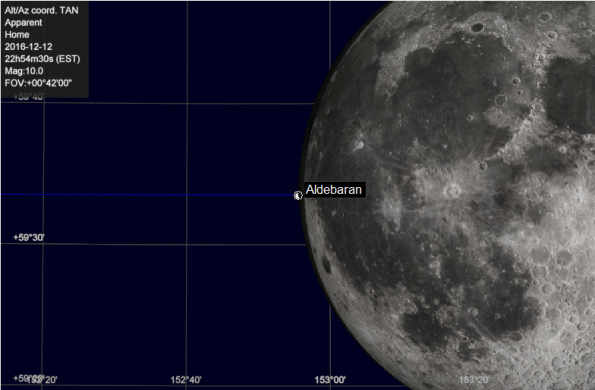
Start of the occultation at 11:54 p.m EST December 12, 2016. The grid is altitude and azimuth. Created using Cartes du Ciel.
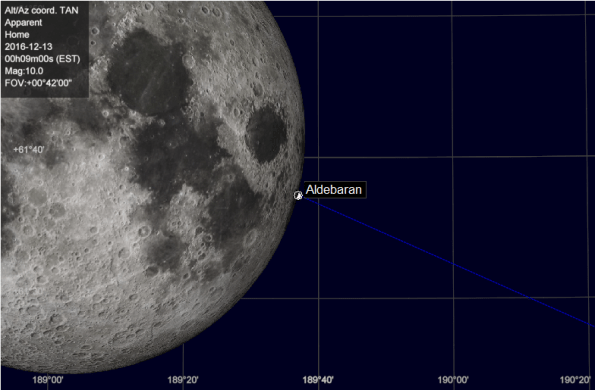
End of the occultation at 12:09 a.m EST December 13, 2016. The grid is altitude and azimuth. Created using Cartes du Ciel.
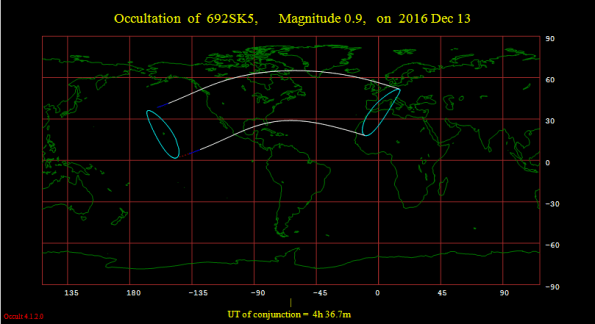
Path of the occultation. Locations between the bright boundaries would see the occultation at night. Created by the software program Occult4 by the International Occultation Timing Association.
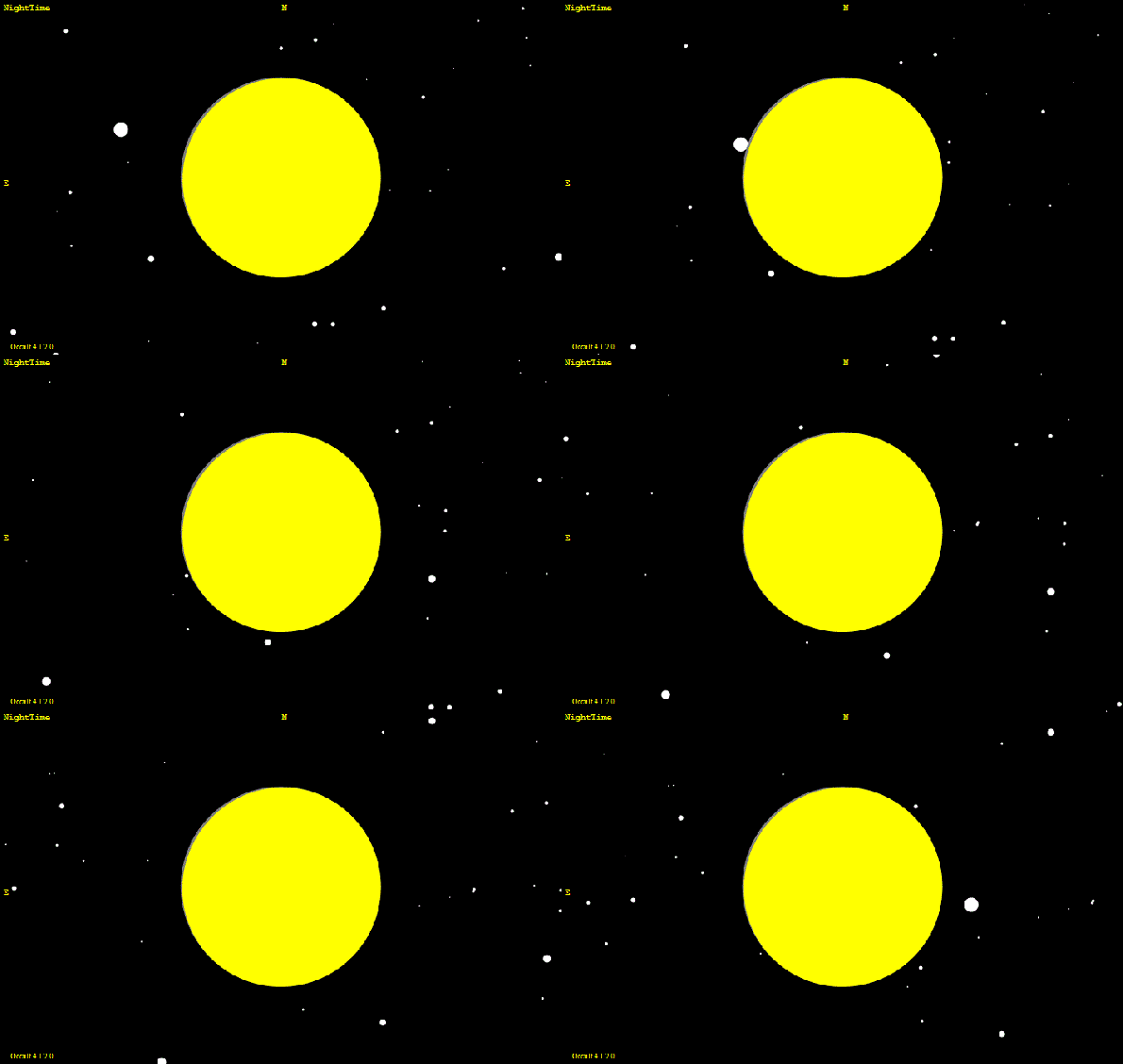
An animation created by Occult4 of the occultation of Aldebaran and some of the dimmer stars of the Hyades.
Eclipse and occultation information and software can be accessed at http://occultations.org/ the website of IOTA, the International Occultation Timing association.
12/09/2016 – Ephemeris – The earliest sunset
Ephemeris for Friday, December 9th. The Sun will rise at 8:08. It’ll be up for 8 hours and 53 minutes, setting at 5:02. The Moon, 2 days past first quarter, will set at 3:39 tomorrow morning.
In twelve days we will have the shortest day in terms of daylight hours. But the change isn’t uniformly distributed in the morning and evening. Tonight and tomorrow evening we will have the earliest sunsets Sunset times have been within the same minute for the last few days and will continue for the next few. The latest sunrise will occur on January second. The reason is that the Sun is traveling faster eastward than average, so the Earth’s rotation takes a little longer each day to catch up with it. Near the solstice the Sun is at a higher latitude, where the longitude lines are closer together, also the Earth is nearing its closest to the Sun, so moves faster its orbit adding to the effect. The effect exists in June but isn’t as noticeable.
Times are for the Traverse City/Interlochen area of Michigan. They may be different for your location.
Addendum
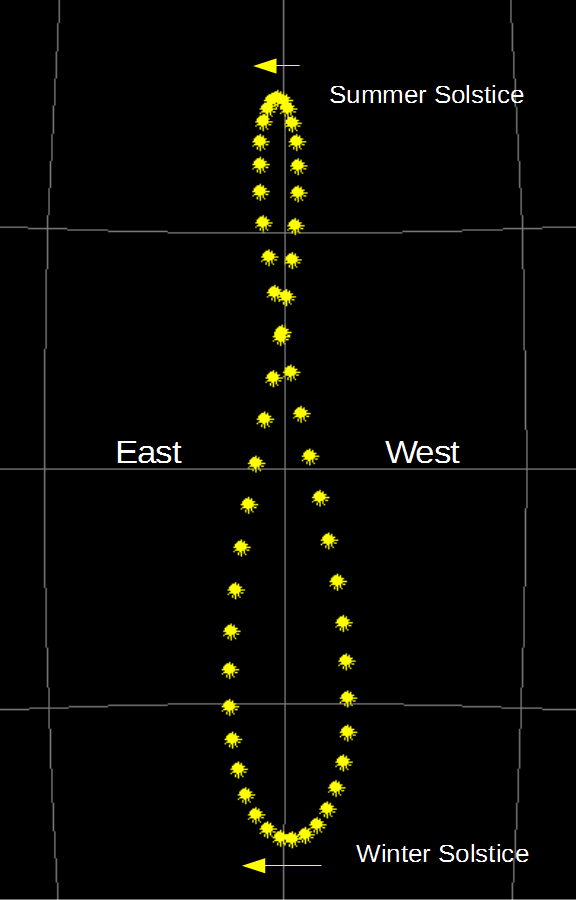
This figure 8 is called an analemma. One can find it on old globes in the Pacific Ocean. Explanation below. Created using my LookingUp program by plotting the Sun at 7 day intervals at local noon for a year.
At the bottom of the analemma is where the Sun is near the winter solstice when it is moving its fastest eastward. At the top, near the summer solstice the Sun is moving faster than average, but not as fast as it is now. The Earth will be nearest the Sun on January 4th, a point called perihelion. Aphelion next year, when the Earth is farthest from the Sun, will be July 3rd next year.
Godspeed John Glenn
With these words from the Capcom John Glenn was launched into the clear Florida sky on February 20, 1962, the first American to orbit the Earth. I cut my college classes to witness the launch on TV that day. He and Alan Shepard were the astronauts of firsts in the Mercury program and my special heroes. With Glenn’s passing all the Mercury astronauts now belong to history.
Godspeed John Glenn and Rest in peace.
12/08/2016 – Ephemeris – Aldebaran, the follower
Ephemeris for Thursday, December 8th. The Sun will rise at 8:07. It’ll be up for 8 hours and 54 minutes, setting at 5:02. The Moon, 1 day past first quarter, will set at 2:26 tomorrow morning.
The central constellation of winter, Orion, is low in the east-southeast at 9 p.m. Above it is Taurus the bull. The bright orange star in Taurus is Aldebaran. Aldebaran appears at the bottom left tip of a letter V group of stars lying on its side that is the face of the bull. Aldebaran isn’t actually part of the group, called the Hyades star cluster. The cluster is about 151 light years away, while Aldebaran is a bit less than half that. The star has an orange hue because its surface is cooler than the Sun’s. However Aldebaran is 44 times larger in diameter, and shines 350 times brighter than the Sun. Next Monday night the 12th, the Moon will pass in front of Aldebaran in an event called an occultation I’ll have more information on it then. The name Aldebaran means The Follower, since it follows the Pleiades across the sky as the Earth rotates.
Times are for the Traverse City/Interlochen area of Michigan. They may be different for your location.
Addendum
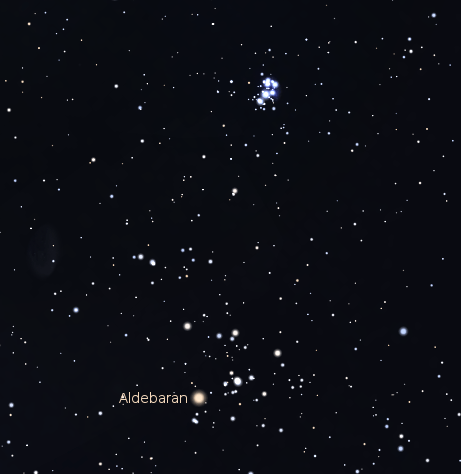
Aldebaran in the ‘V’ shape of the Hyades (The face of Taurus the bull) with the Pleiades above. Created using Stellarium.
12/07/2016 – Ephemeris – Where are the bright planets
Ephemeris for Wednesday, December 7th*. The Sun will rise at 8:06. It’ll be up for 8 hours and 55 minutes, setting at 5:02. The Moon, at first quarter today, will set at 1:16 tomorrow morning.
In the east-southeast before 7:30 these mornings. Jupiter can be glimpsed in the morning twilight. Jupiter will rise tomorrow at 3:01 a.m. We are approaching Jupiter as it appears to move away from the Sun. We will pass it on April 7th next year. Venus and Mars are in the evening sky. At 6 p.m. these planets will be seen in the southwest and low in the sky. Venus will be the lower and brighter of the two, Mars will be higher to the left. Venus will set at 8:14. Mars will hang on a bit longer and will set at 10:10. Mars’ setting time hasn’t changed much in the last month and a half. It’s losing to the Sun by only a little bit each day. Venus is slowly heading northward for the rest of it’s evening appearance, and is moving higher in the sky.
Times are for the Traverse City/Interlochen area of Michigan. They may be different for your location.
* 75th anniversary of the attack on Pearl Harbor. I was only 3 days old at the time, so had nothing to do with it.
Addendum
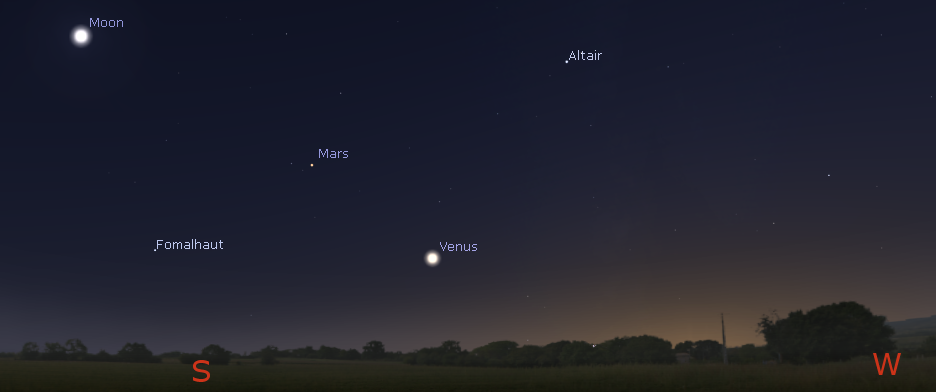
Venus, Mars and the Moon at 6 p.m., December 7, 2016. This is approximately one hour after sunset. Click on image to enlarge. Created using Stellarium.
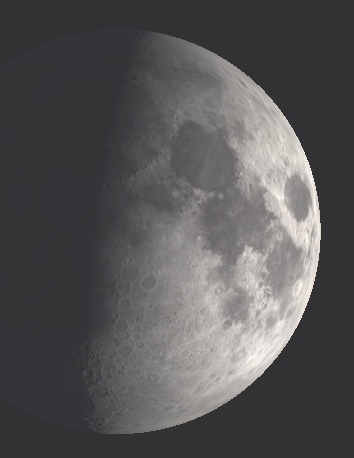
A closeup of the Moon at 6 p.m., December 7, 2016. Created using Stellarium.
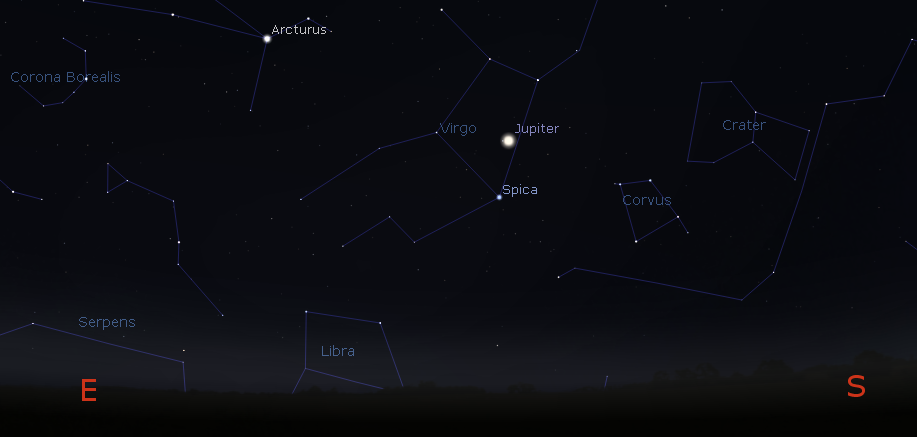
Jupiter and a preview of spring constellations at 6:30 a.m. December 8, 2016. Click on image to enlarge. Created using Stellarium.
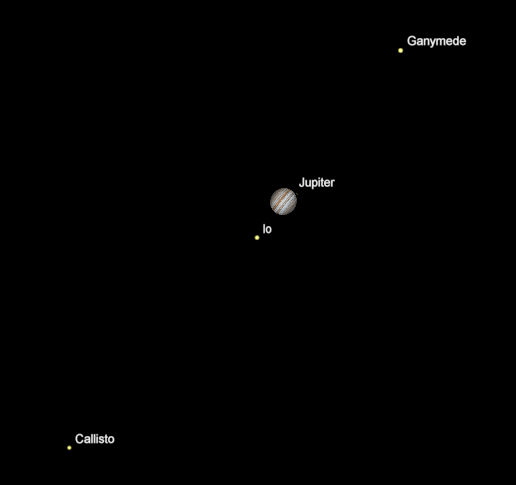
Jupiter and moons at 6:30 a.m. December 8, 2016. Europa is in Jupiter’s shadow at this time. It will disappear in its shadow at 4:46 a.m. (9:46 UT). Image created using Cartes du Ciel. Note that Europa was on the image, but was removed. Stellarium had it right, but I prefer Cartes’ rendering.
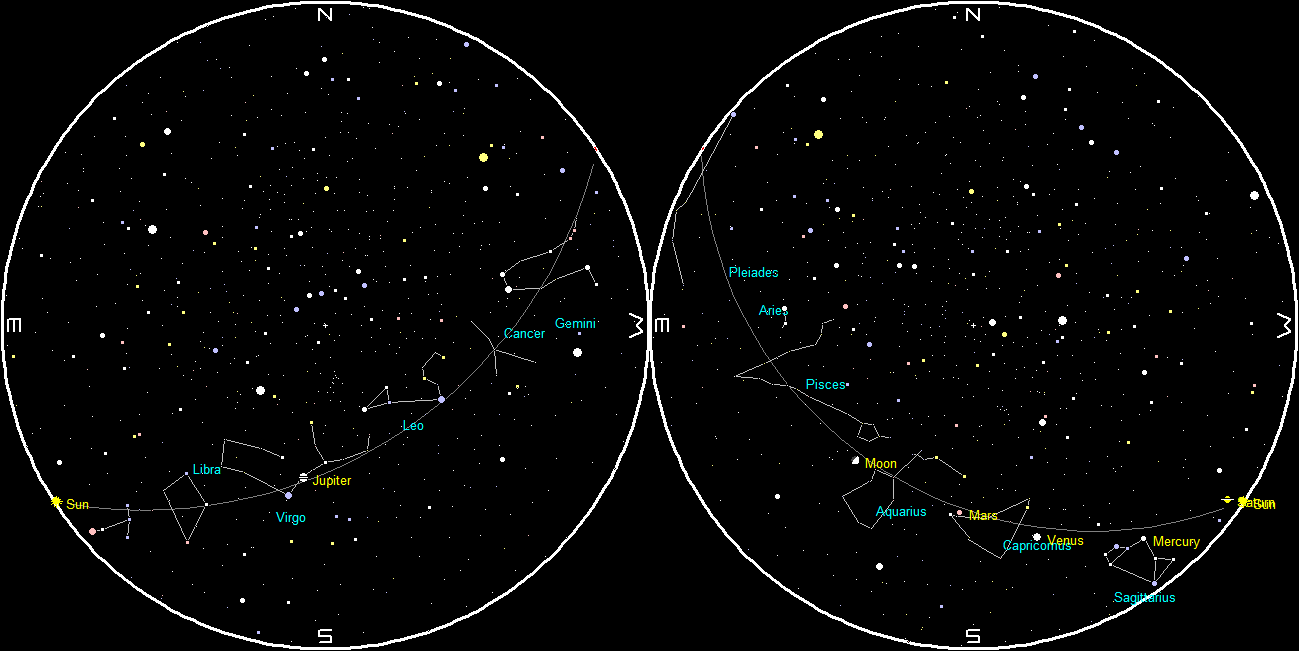
Planets and Moon at sunset and sunrise of a single night starting with sunset on the right on December 7, 2016. The night ends on the left with sunrise on December 8. Click on image to enlarge. Created using my LookingUp program.
Note that Saturn is practically plotted on top of the Sun. It will be in conjunction with the Sun on the 10th. After that it will enter the morning sky.
 Bob Moler's Ephemeris Blog