Archive
03/30/2018 – Ephemeris – Previewing April skies
Ephemeris for Good Friday, Friday, March 30th. The Sun will rise at 7:27. It’ll be up for 12 hours and 40 minutes, setting at 8:07. The Moon, 1 day before full, will set at 7:50 tomorrow morning.
The 4th month of the year begins on Sunday. Daylight hours in the Interlochen/Traverse City area and will increase from 12 hours and 46 minutes Sunday to 14 hours 12 minutes on April 30th. The altitude, or angle, of the Sun above the southern horizon at local noon will be 50 degrees Sunday and will ascend to 60 degrees on April 30th. The altitude of the Sun in the Straits area will be a degree lower. The actual time of local apparent noon when the sun passes due south, will be about 1:43 p.m. The Lyrid meteor shower will reach it’s peak on the early afternoon of the 22nd. So the early morning hours between 3 and 5 a.m. are the best time to see it when the Moon has set and the radiant is high in the sky.
Addendum
April Evening Sky Chart
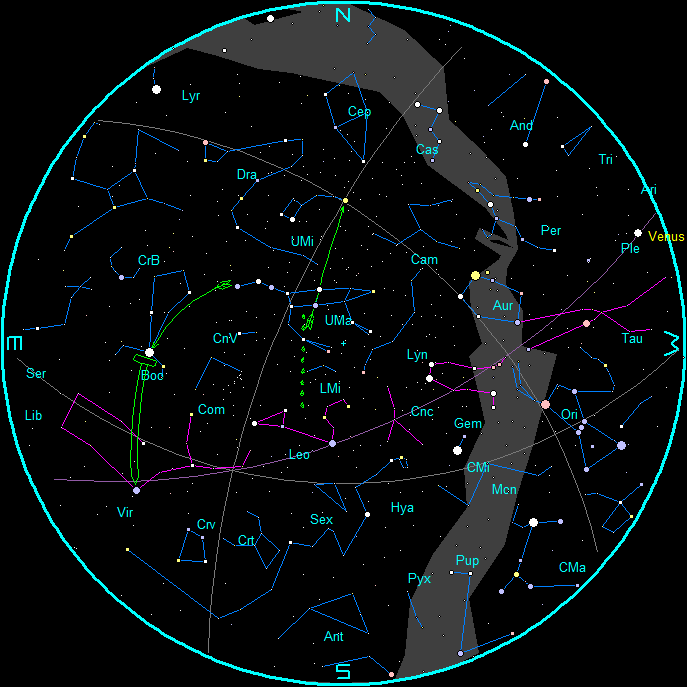
Star Chart for April 2018 (10 p.m. EDT April 15, 2018). Created using my LookingUp program. Click on image to enlarge.
The planets and stars are plotted for the 15th at 9 p.m. EDT in the evening and 5 a.m. for the morning chart. These are the chart times. Note that Traverse City is located approximately 45 minutes behind our time meridian. (An hour 45 minutes behind our daylight saving time meridian during EDT and 45 minutes behind our daylight standard time meridian. during EST). To duplicate the star positions on a planisphere you may have to set it to 1 hour 45 minutes (Daylight Time) or 45 minutes (Standard Time) earlier than the current time.
Note the chart times of 10 p.m. and 5 a.m. are for the 15th. For each week before the 15th add ½ hour (28 minutes if you’re picky). Watch out for the time change. For each week after the 15th subtract ½ hour. The planet positions are updated each Wednesday on this blog. For planet positions on dates other than the 15th, check the Wednesday planet posts on this blog.
April Morning Star Chart
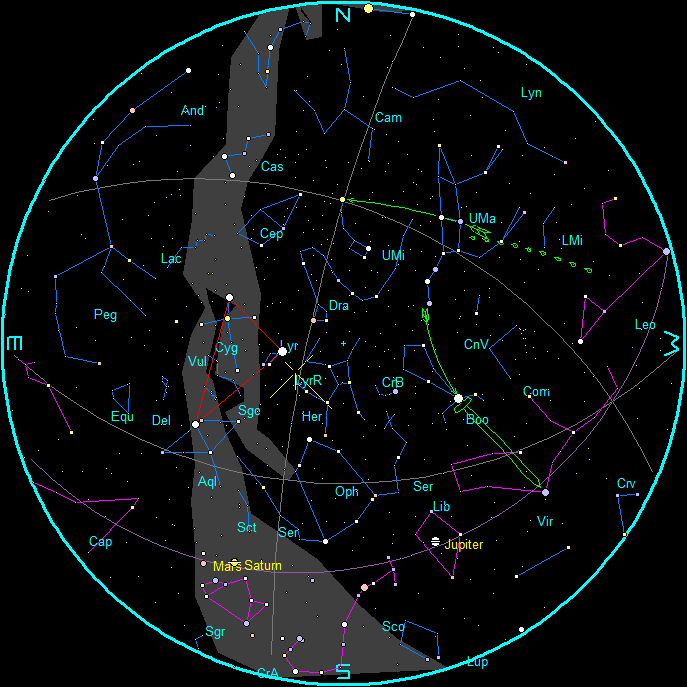
Star Chart for April 2018 mornings based on 5 a.m. April 15th. Created using my LookingUp program. Click on image to enlarge.
For a list of constellation names to go with the abbreviations click here.
Star chart annotations
- Pointer stars at the front of the bowl of the Big Dipper point to Polaris the North Star.
- Leaky Big Dipper drips on Leo.
- Follow the arc of the handle of the Big Dipper to the star Arcturus and
- Continue with a spike to Spica.
- The Summer Triangle is in red.
- LyrR is the Lyrid meteor shower radiant. The Lyrid meteor shower will reach its peak for us on the morning of the 22nd. The actual peak time is variable for this shower and can occur as early as 6 a.m. to as late as 5 p.m. Also the peak numbers of meteors are variable. Best time to observe without the Moon is between 3 a.m. and the start of twilight.
Twilight
Evening nautical twilight ends at 9:17 p.m. EDT on the 1st, increasing to 10:00 p.m. EDT on the 30th.
Evening astronomical twilight ends at 9:54 p.m. EDT on the 1st, increasing to 10:44 p.m. EDT on the 30th.
Morning astronomical twilight starts at 5:47 a.m. EDT on the 1st, and decreasing to 4:43 a.m. EDT on the 30th.
Morning nautical twilight starts at 6:23 a.m. EDT on the 1st, and decreasing to 5:27 a.m. EDT on the 30th.
NASA Calendar of Planetary Events
    Date    Time    Event
Apr 01  Su          Venus: 19.9° E
    01  Su  1:47 pm Mercury Inferior Conj.
    02  Mo  3:02 pm Mars-Saturn: 1.3° N
    03  Tu 10:14 am Moon-Jupiter: 4.2° S
    07  Sa  8:50 am Moon-Saturn: 2.1° S
    07  Sa 10:37 am Moon South Dec.: 20.3° S
    07  Sa  2:15 pm Moon-Mars: 3.5° S
    08  Su  1:32 am Moon Apogee: 404100 km
    08  Su  3:18 am Last Quarter
    10  Tu  4:09 am Moon Descending Node
    15  Su  9:57 pm New Moon
    17  Tu  3:29 pm Moon-Venus: 5.5° N
    18  We 10:35 am Uranus Conjunction
    19  Th 12:45 am Moon-Aldebaran: 1.1° S
    20  Fr 10:44 am Moon Perigee: 368700 km
    21  Sa  3:38 am Moon North Dec.: 20.4° N
    22  Su  1:49 pm Lyrid Shower: ZHR = 20
    22  Su  5:46 pm First Quarter
    23  Mo  2:17 am Moon-Beehive: 2° N
    23  Mo  8:19 am Moon Ascending Node
    24  Tu 12:47 pm Venus-Pleiades: 3.5° S
    24  Tu  3:39 pm Moon-Regulus: 1.2° S
    29  Su  1:59 pm Mercury Elongation: 27° W
    29  Su  8:58 pm Full Moon
    30  Mo  1:16 pm Moon-Jupiter: 4.1° S
May 01  Tu          Venus: 27.2° E
Sky Events Calendar by Fred Espenak and Sumit Dutta (NASA’s GSFC),
http://eclipse.gsfc.nasa.gov/SKYCAL/SKYCAL.html
If you go to the above site you can print out a list like the above for the entire year
or calendar pages for your time zone.
Sun and Moon Rising and Setting Events
     LU                  Ephemeris of Sky Events for Interlochen/TC
     April, 2018    Local time zone: EDT
     +-----------------------------------------------------------------------+
     | DATE |  SUN     SUN  DAYLIGHT|   TWILIGHT*    |MOON  RISE OR    ILLUM |
     |      |  RISE    SET    HOURS |  END    START  |PHASE SET** TIME FRACTN|
     +=======================================================================+
     |Sun  1| 07:23a  08:10p  12:46 | 09:15p  06:19a |      Rise 09:35p   97%|
     |Mon  2| 07:21a  08:11p  12:49 | 09:16p  06:17a |      Rise 10:40p   93%|
     |Tue  3| 07:19a  08:12p  12:53 | 09:18p  06:15a |      Rise 11:44p   87%|
     |Wed  4| 07:18a  08:14p  12:56 | 09:19p  06:13a |      Rise 12:44a   80%|
     |Thu  5| 07:16a  08:15p  12:59 | 09:20p  06:11a |      Rise 01:41a   71%|
     |Fri  6| 07:14a  08:16p  13:02 | 09:22p  06:09a |      Rise 02:33a   62%|
     |Sat  7| 07:12a  08:17p  13:05 | 09:23p  06:07a |      Rise 03:20a   53%|
     +------+-----------------------+----------------+-----------------------+
     |Sun  8| 07:10a  08:19p  13:08 | 09:25p  06:05a |L Qtr Rise 04:03a   43%|
     |Mon  9| 07:09a  08:20p  13:11 | 09:26p  06:03a |      Rise 04:40a   34%|
     |Tue 10| 07:07a  08:21p  13:14 | 09:28p  06:01a |      Rise 05:14a   25%|
     |Wed 11| 07:05a  08:22p  13:17 | 09:29p  05:59a |      Rise 05:45a   17%|
     |Thu 12| 07:03a  08:24p  13:20 | 09:31p  05:57a |      Rise 06:14a   11%|
     |Fri 13| 07:01a  08:25p  13:23 | 09:32p  05:55a |      Rise 06:42a    5%|
     |Sat 14| 07:00a  08:26p  13:26 | 09:34p  05:53a |      Rise 07:10a    2%|
     +------+-----------------------+----------------+-----------------------+
     |Sun 15| 06:58a  08:27p  13:29 | 09:35p  05:51a |New   Set  08:05p    0%|
     |Mon 16| 06:56a  08:29p  13:32 | 09:37p  05:49a |      Set  09:16p    1%|
     |Tue 17| 06:55a  08:30p  13:35 | 09:38p  05:47a |      Set  10:27p    5%|
     |Wed 18| 06:53a  08:31p  13:38 | 09:40p  05:45a |      Set  11:38p   11%|
     |Thu 19| 06:51a  08:32p  13:41 | 09:41p  05:43a |      Set  12:47a   19%|
     |Fri 20| 06:50a  08:34p  13:44 | 09:43p  05:41a |      Set  01:50a   29%|
     |Sat 21| 06:48a  08:35p  13:47 | 09:44p  05:39a |      Set  02:46a   40%|
     +------+-----------------------+----------------+-----------------------+
     |Sun 22| 06:46a  08:36p  13:49 | 09:46p  05:37a |F Qtr Set  03:34a   51%|
     |Mon 23| 06:45a  08:37p  13:52 | 09:47p  05:35a |      Set  04:15a   62%|
     |Tue 24| 06:43a  08:39p  13:55 | 09:49p  05:33a |      Set  04:51a   73%|
     |Wed 25| 06:41a  08:40p  13:58 | 09:50p  05:31a |      Set  05:22a   82%|
     |Thu 26| 06:40a  08:41p  14:01 | 09:52p  05:29a |      Set  05:52a   90%|
     |Fri 27| 06:38a  08:42p  14:04 | 09:53p  05:28a |      Set  06:20a   95%|
     |Sat 28| 06:37a  08:44p  14:06 | 09:55p  05:26a |      Set  06:48a   99%|
     +------+-----------------------+----------------+-----------------------+
     |Sun 29| 06:35a  08:45p  14:09 | 09:57p  05:24a |Full  Rise 08:25p  100%|
     |Mon 30| 06:34a  08:46p  14:12 | 09:58p  05:22a |      Rise 09:30p   99%|
     +-----------------------------------------------------------------------+
     * Nautical Twilight
     ** Moonrise or moonset, whichever occurs between sunset and sunrise
The times given are for the Traverse City/Interlochen area of Michigan. They may be different for your location.
03/29/2018 – Ephemeris – The Easter date is set by the first full moon of spring and a developing conjunction
Ephemeris for Thursday, March 29th. The Sun will rise at 7:29. It’ll be up for 12 hours and 37 minutes, setting at 8:06. The Moon, 2 days before full, will set at 7:21 tomorrow morning.
This Sunday, April 1st will be Easter for western churches. Because it falls on the first Sunday after the first full moon since March 21st. The Full Moon is Saturday the 31st. It happens that Passover begins at sundown the 31st. Orthodox churches will celebrate Easter on April 8th, a week later. It’s going to be a somewhat busy weekend in the sky also. Sunday Mercury will pass from the evening sky to the morning sky in an event called an inferior conjunction of the Sun. It is not visible, but folks in the southern hemisphere will easily spot Mercury late in April. In the morning sky Mars will pass below Saturn between the mornings of the 2nd and 3rd. They are close to the same brightness, but Mars is distinctly redder.
The times given are for the Traverse City/Interlochen area of Michigan. They may be different for your location.
Addendum
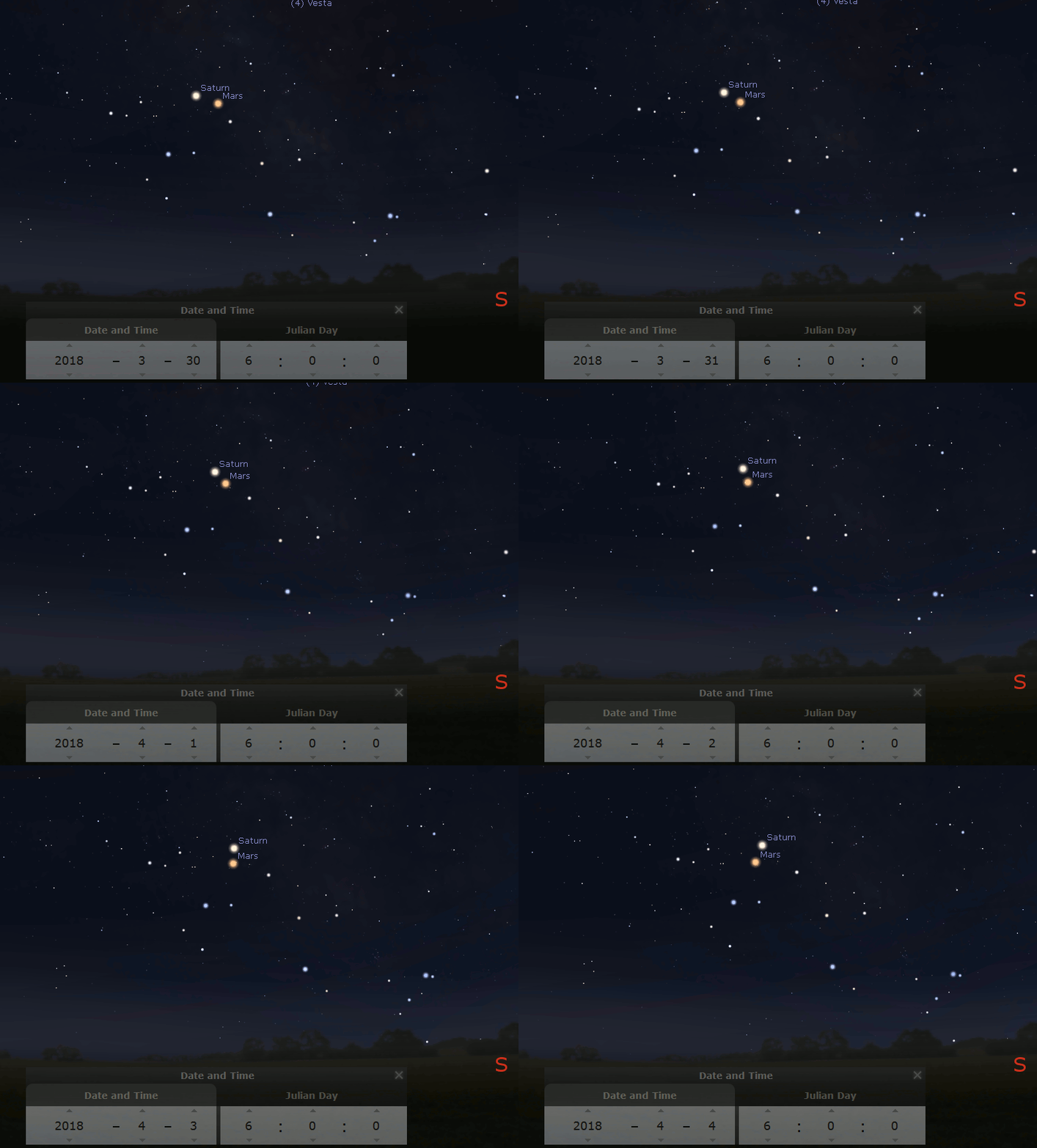
Conjunction animation of Mars passing Saturn at daily intervals at 6 a.m. for March 30 to April 4, 2018. This will occur above the Teapot asterism of the constellation of Sagittarius. Created using Stellarium ans GIMP.
03/28/2018 – Ephemeris – Four bright planets are visible
Ephemeris for Wednesday, March 28th. The Sun will rise at 7:31. It’ll be up for 12 hours and 34 minutes, setting at 8:05. The Moon, 3 days before full, will set at 6:49 tomorrow morning.
Let’s take our weekly look at the bright planets. We’re down to 4 the naked eye planets are visible now. One is in the evening sky. Venus will be visible low in the Western twilight from about 8:30 p.m. until before it sets at 9:43. Mercury is heading between the Earth and the Sun, not directly but will enter the morning sky Sunday. It’s morning appearance later next month will not be a good one for us in the northern hemisphere. Late this evening Jupiter will rise at 11:46. Mars will rise at 3:23 a.m. Saturn will end the procession, rising 3 minutes later. At 6 tomorrow morning these three planets will be strung across the southern sky. Bright Jupiter will be in the south-southwest, dimmer Mars will be in the south-southeast, just right of and a bit below Saturn.
The times given are for the Traverse City/Interlochen area of Michigan. They may be different for your location.
Addendum
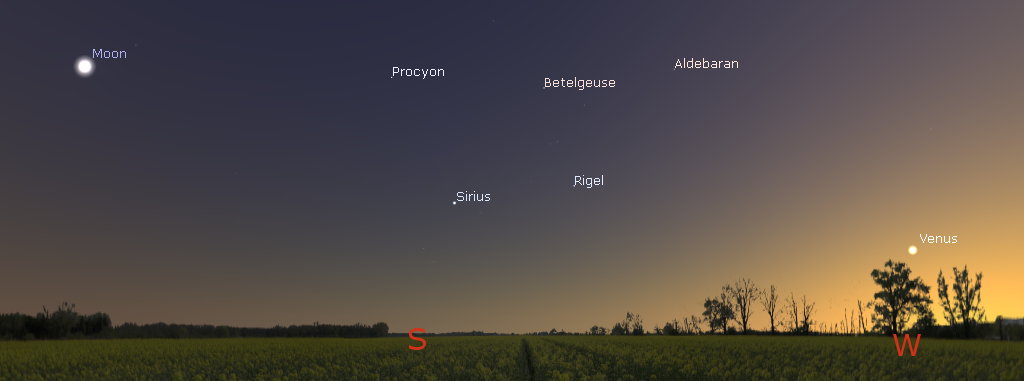
Venus, the bright winter stars and the Moon at 8:30 p.m. tonight March 28, 2018. Click on the image to enlarge. Created using Stellarium.
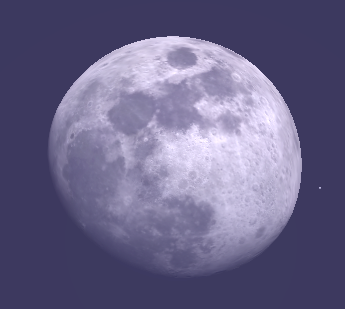
The Gibbous Moon tonight at 8:30 p.m., March 28, 2018. Created using Stellarium.
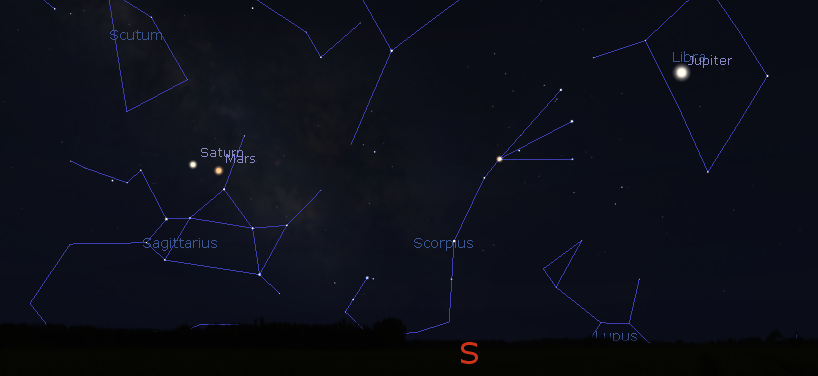
The morning planets and constellations at 6 a.m. March 29, 2018. Click on the image to enlarge. Created using Stellarium
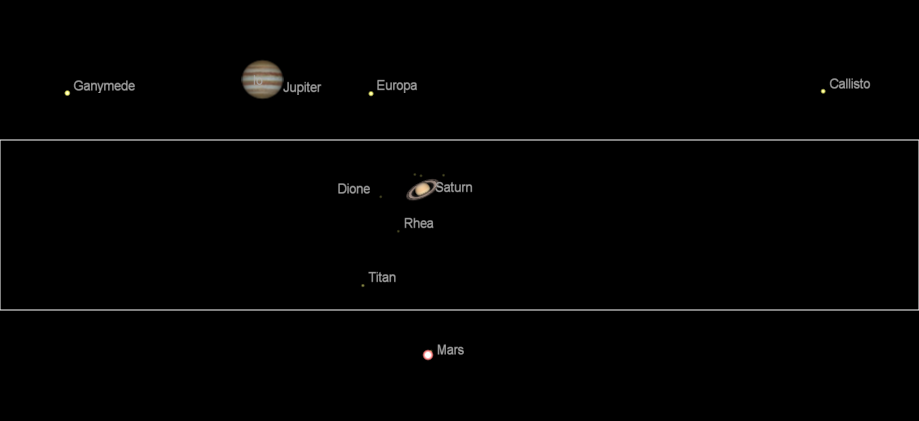
The morning planets as seen by a telescope using the same magnification for all at 6 a.m. March 29, 2018. At 6 a.m. Jupiter’s moon Io is behind the planet. See the table below for Io events in the morning. Click on the image to enlarge. Created using Cartes du Ciel (Sky Charts).
Moon  Event            Date        Time      Local Time
Io:   Eclipse start:   29 Mar 2018  7:10 UT  3:10 a.m. EDT
Io:   Occultation end: 29 Mar 2018 10:11 UT  6:11 a.m. EDT
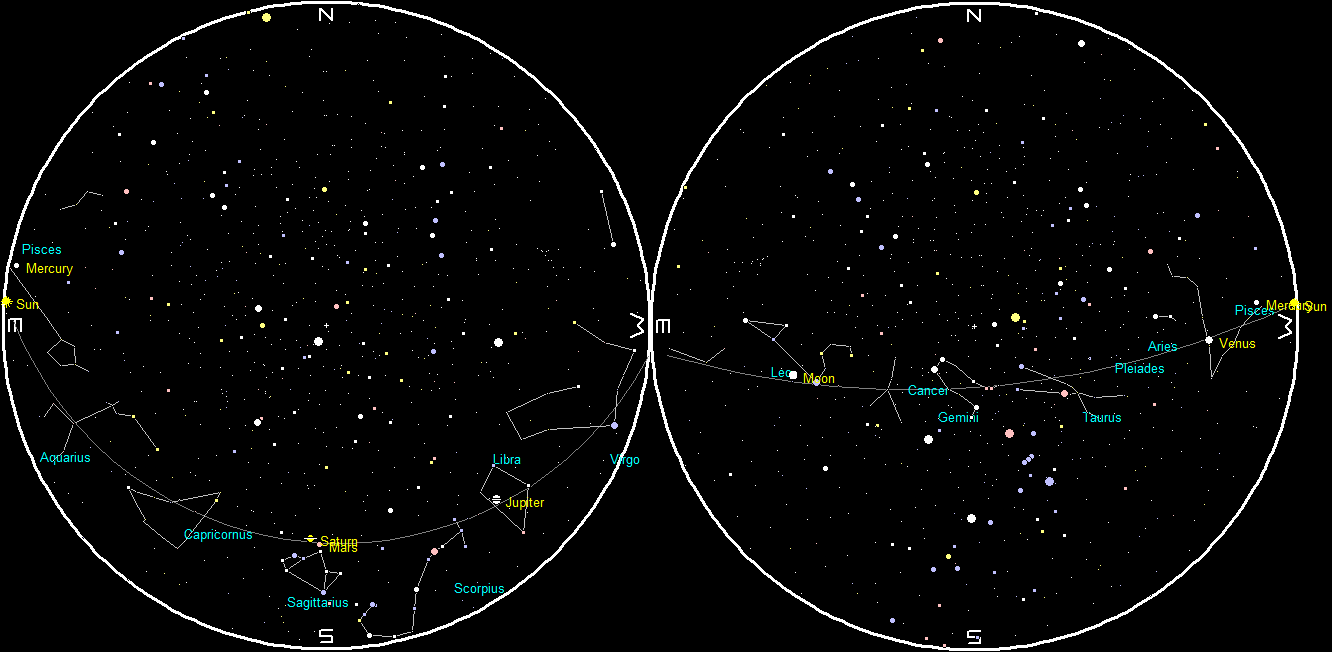
Planets and the Moon at sunset and sunrise of a single night starting with sunset on the right on March 28, 2018. The night ends on the left with sunrise on the 29th. Click on the image to enlarge. Created using my LookingUp program.
03/27/2018 – Ephemeris – Chinese first space lab will reenter the Earth’s atmosphere in a few days
Ephemeris for Tuesday, March 27th. The Sun will rise at 7:32. It’ll be up for 12 hours and 31 minutes, setting at 8:04. The Moon, 3 days past first quarter, will set at 6:14 tomorrow morning.
The first Chinese space lab Tiangong-1 is estimated to reenter the atmosphere and mostly burn up in the latter days of this week or early next week. There may be parts that will survive the fiery entry into the Earth’s atmosphere. The space lab was launched in 2011, and has been visited by one robotic and two crewed spacecraft. However the Chinese lost control of it in 2016 and cannot control it’s reentry location. It was launched with an inclination of 42.8 degrees, so it flies between 42.8 north and south latitudes, so it won’t land on anybody in the IPR listening area. When NASA’s Skylab space station made an uncontrolled entry in 1979, a piece fell in Australia. They sued the United States $400 for littering according to Space.com.
The times given are for the Traverse City/Interlochen area of Michigan. They may be different for your location.
Addendum

The Tiangong-1 space lab. Source: Space.com, Chinese space agency photo.
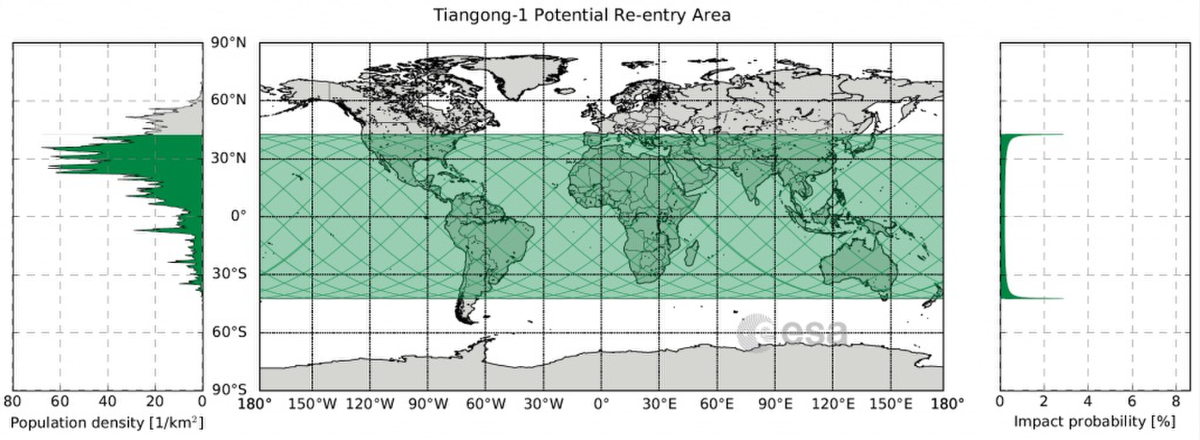
Tiangong-1 Potential Re-entry area. Click on image to enlarge. Source Space.com, European Space Agency data.
03/26/2018 – Ephemeris – The Moon will slide below the Beehive star cluster tonight
Ephemeris for Monday, March 26th. The Sun will rise at 7:34. It’ll be up for 12 hours and 28 minutes, setting at 8:02. The Moon, 2 days past first quarter, will set at 5:34 tomorrow morning.
Tonight the gibbous Moon will be seen among the stars of Cancer the crab. It will just about completely drown Cancer’s dim stars out. That is no exception to one of the famous group of stars in Cancer, the Beehive star cluster. It is going to take binoculars or a small telescope to spot them. The star cluster will be at the 11 o’clock position from the Moon. When looking for the cluster try to keep the Moon out of your field of view. The cluster is about 4 moon-widths away, so aim high and slowly aim those binoculars down. There will be other times in the next few months to catch the Moon near the Beehive, when the Moon will be a not so overwhelming crescent as the cluster moves westward in the evening sky with the rest of the stars.
The times given are for the Traverse City/Interlochen area of Michigan. They may be different for your location.
Addendum
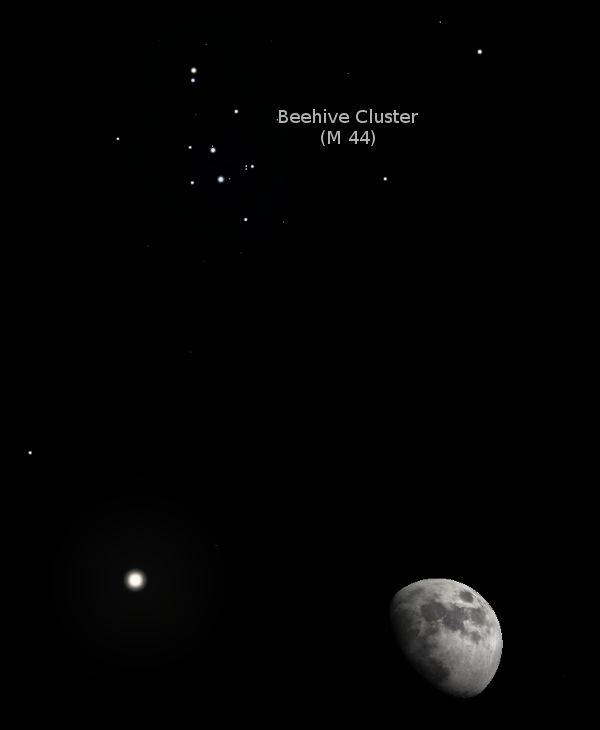
The Moon and the Beehive Star Cluster tonight at 9 p.m. March 26, 2018. The star cluster will be very difficult to spot. Created using Stellarium, however I had to boost the brightness of the stars and eliminate the atmosphere control to darken the sky enough to see the cluster. Good luck!
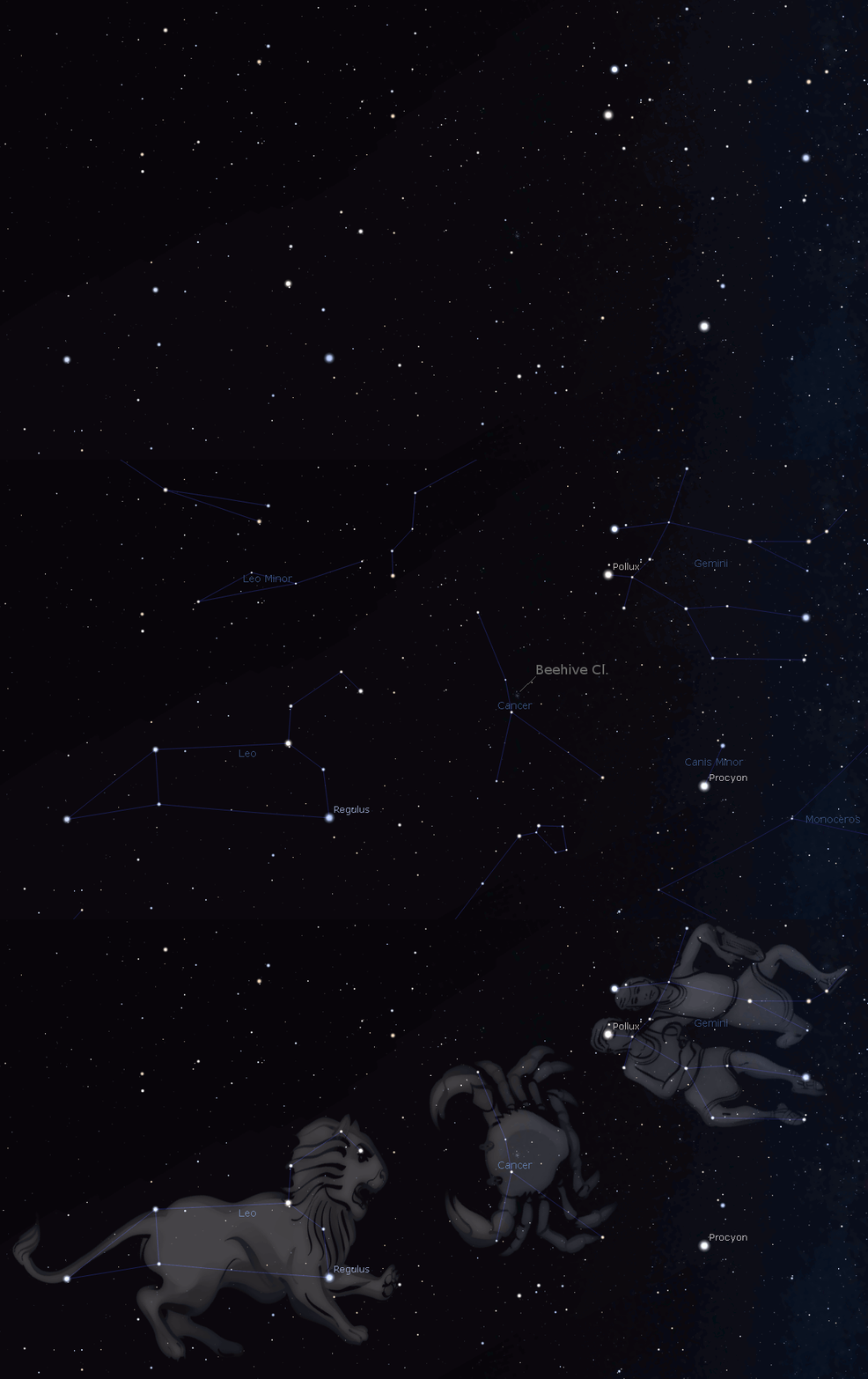
Cancer the crab finder chart for a dark night. Note the beehive cluster, also known to amateur astronomers as M44, along with other catalog names. Prior to the invention of the telescope this cluster was known as Praesepe which means “Manger”. Created using Stellarium and GIMP.
03/23/2018 – Ephemeris – After a crazy week sail on the Sea of Serenity
Ephemeris for Friday, March 23rd. The Sun will rise at 7:40. It’ll be up for 12 hours and 18 minutes, setting at 7:59. The Moon, 1 day before first quarter, will set at 2:53 tomorrow morning.
This evening the Moon will be at nearly first quarter and the terminator will be at the edge of the Sea of Serenity or Mare Serenitatis, with the morning Sun shining on its ramparts. Through binoculars or the naked eye the scallop shell shaped sea will be visible at the upper right part of the moon, the man in the moon’s left eye as he is facing us. In telescopes the moon will be inverted and even also reversed, so Serenity could appear in any other quadrant depending on what your telescope does to the image. There are two large craters above or north of Serenity if looking at them with a non-inverting telescope. The nearest to Serenity is Eudoxus, and the farther one is Aristoteles, named after Aristotle.
The times given are for the Traverse City/Interlochen area of Michigan. They may be different for your location.
Addendum
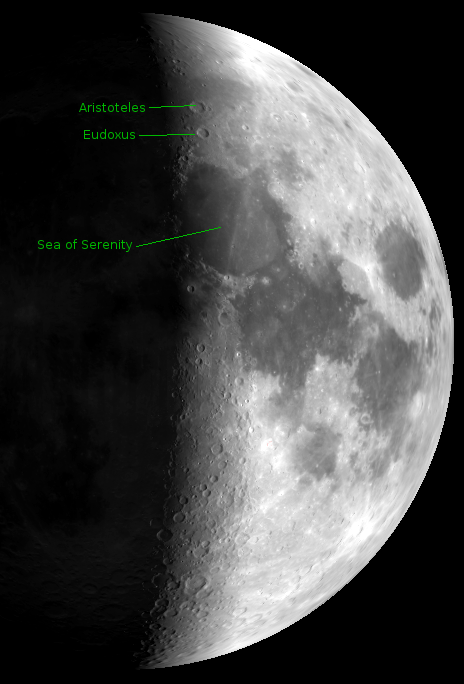
Tonight’s Moon with the Sea of Serenity and two isolated large craters. 9 p.m., March 23, 2018. Created using Virtual Moon Atlas.
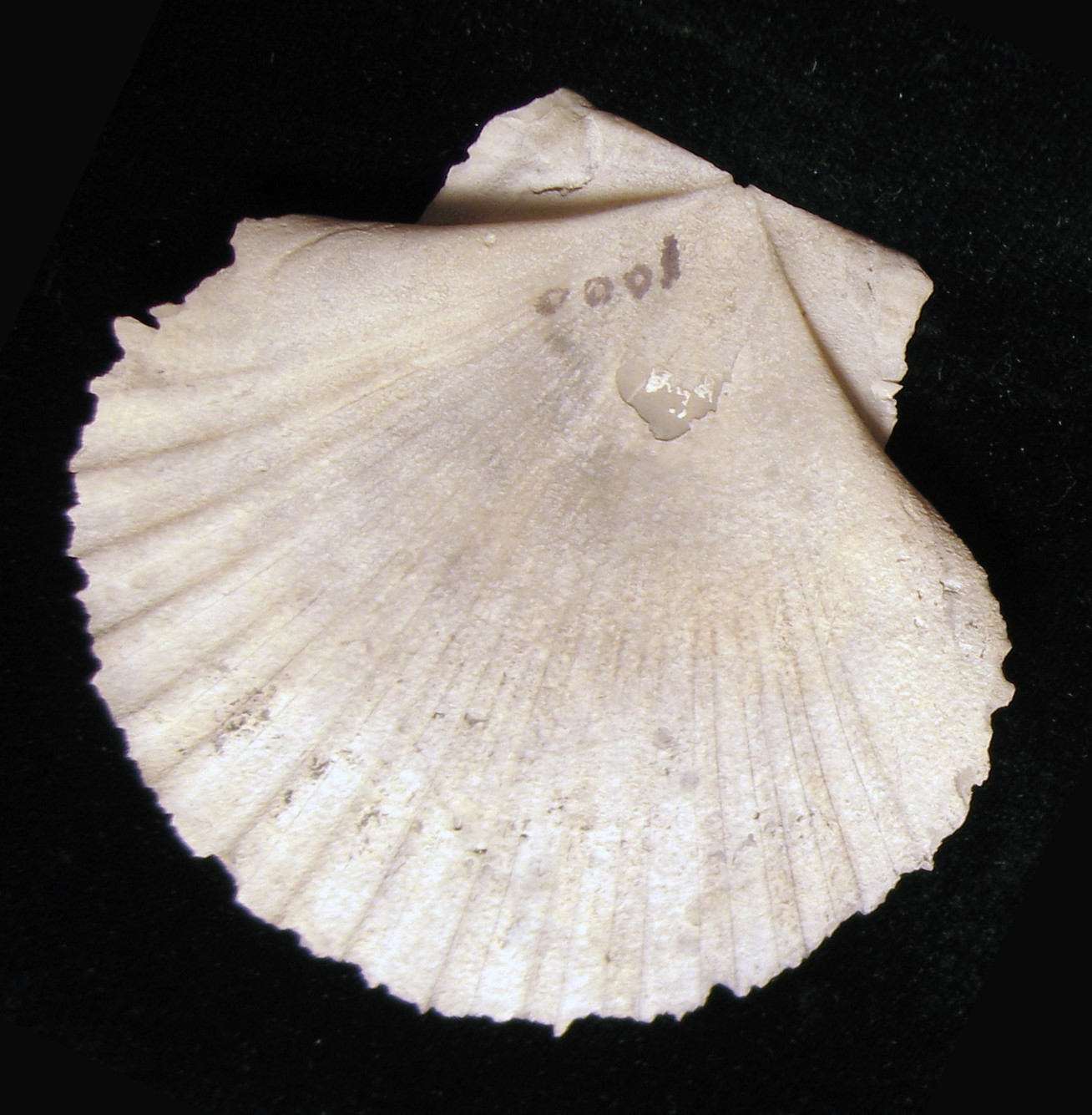
Image of a scallop shell rotated to match the Sea of Serenity. Credit Wikipedia user Kevmin. (Creative Commons)
03/22/2018 – Ephemeris – The bright star Aldebaran will appear below the Moon tonight
Ephemeris for Thursday, March 22nd. The Sun will rise at 7:42. It’ll be up for 12 hours and 15 minutes, setting at 7:57. The Moon, 2 days before first quarter, will set at 1:48 tomorrow morning.
The bright star Aldebaran will appear below the Moon tonight. Over the past two years we’ve seen the Moon cover Aldebaran in an event called an occultation on several occasions. There will be a similar occultation tonight for the far northern part of the Earth. Though the series of Aldebaran occultations won’t end until September this year, we won’t see any of them. The Next season of monthly Aldebaran occultations for the Earth won’t start until 2033. It will last a bit more than 2 years. We’ll see our share of those occultations then. Other bright, first magnitude, stars that can be occulted by the Moon are Pollux in Gemini, Regulus in Leo, Spica in Virgo and Antares in Scorpius.
The times given are for the Traverse City/Interlochen area of Michigan. They may be different for your location.
Addendum
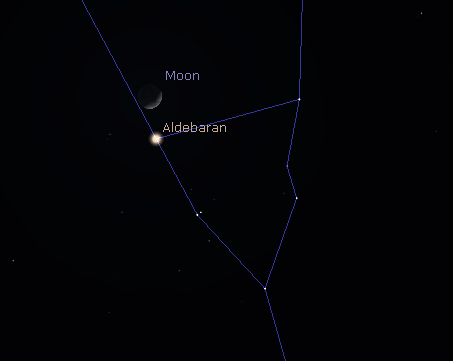
The star Aldebaran, the bloodshot eye of Taurus the bull at 9 p.m. tonight, March 22, 2018 to be seen below the crescent Moon. The rest of the face of Taurus, the V-shaped stars of the star cluster called the Hyades will be visible in binoculars. Created using Stellarium. The Moon will be brighter than Aldebaran, not the opposite as seen here.
03/21/2018 – Ephemeris – The bright planets this week
Ephemeris for Wednesday, March 21st. The Sun will rise at 7:44. It’ll be up for 12 hours and 12 minutes, setting at 7:56. The Moon, 3 days before first quarter, will set at 12:39 tomorrow morning.
Let’s take our weekly look at the bright planets. All 5 of the naked eye planets are visible now. Two of them are in the evening sky, but very close to the Sun. Venus will be visible low in the Western twilight from about 8:10 p.m. until before it sets at 9:26. Mercury is much dimmer but at the same height and to the right of Venus, tonight by about 8 Moon widths. Mercury is dimming rapidly. In the morning Jupiter will rise at 12:20. Mars will rise at 3:33. Saturn will end the procession, rising at 3:53 a.m. At 7 tomorrow morning these three planets will be strung across the southern sky. Bright Jupiter will be in the southwest, dimmer Mars will be in the south. Saturn will be in the south-southeast.
The times given are for the Traverse City/Interlochen area of Michigan. They may be different for your location.
Addendum
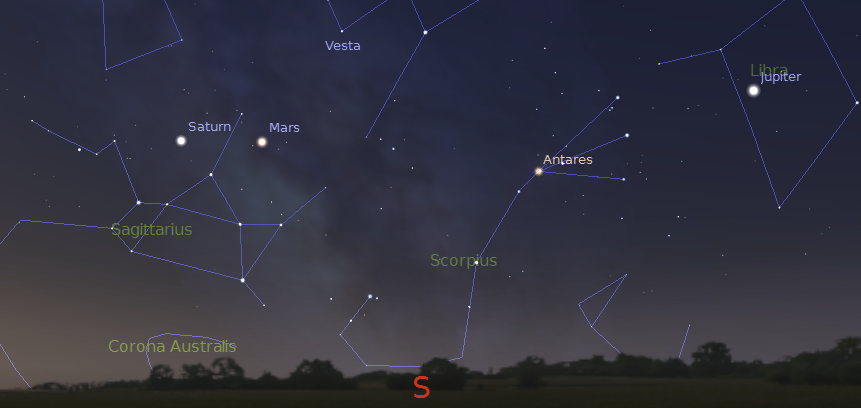
The morning planets of Jupiter, Mars and Saturn seen at 7 a.m. EDT this morning March 21, 2018. Click on image to enlarge. Created using Stellarium.
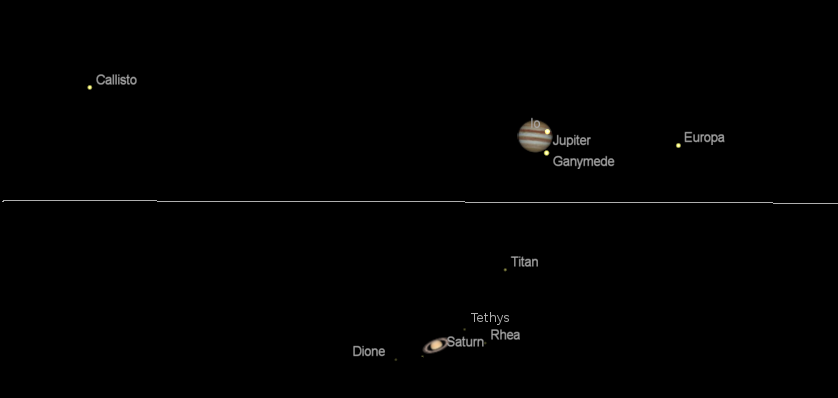
Jupiter and Saturn with their brighter satellites this morning at 7 a.m. March 21, 2018. They are displayed at the same scale. Saturn in about twice as far as Jupiter. Its disk is a bit smaller than Jupiter’s so it appears about half as large. The extent of the rings appear to be about the same as Jupiter’s diameter. Created using Cartes du Ciel (Sky Charts).
Jovian satellite events this morning
Satellite Event              Date       Universal  Local Time
Ganymede: Eclipse start:     21 Mar 2018  7:30 UT  3:30 am EDT
Io      : Shadow start:      21 Mar 2018  8:08 UT  4:08 am EDT
Io      : Transit start:     21 Mar 2018  9:09 UT  5:09 am EDT
Ganymede: Eclipse end :      21 Mar 2018  9:15 UT  5:15 am EDT
Io      : Shadow end :       21 Mar 2018 10:18 UT  6:18 am EDT
Io      : Transit end :      21 Mar 2018 11:17 UT  7:17 am EDT
Ganymede: Occultation start: 21 Mar 2018 11:50 UT  Not visible
Ganymede: Occultation end :  21 Mar 2018 12:54 UT  Not visible
An eclipse is when the moon passes through Jupiter’s shadow.
An occultation is when the moon is hidden behind the planet.
Shadow denotes the projection of a satellite’s shadow on the face of Jupiter.
Transit is the passage of a satellite across the face of Jupiter. It becomes hard to find against the.
Timings are from https://www.projectpluto.com.
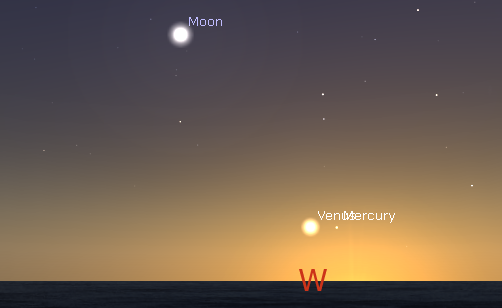
Venus and Mercury, low in the west at 8:30 p.m., March 21, 2018. Created using Stellarium.
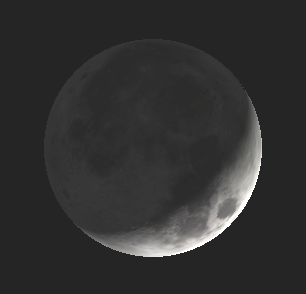
The waxing crescent Moon as it might be seen in binoculars at 9 p.m. tonight. March 21, 2018. Created using Stellarium.
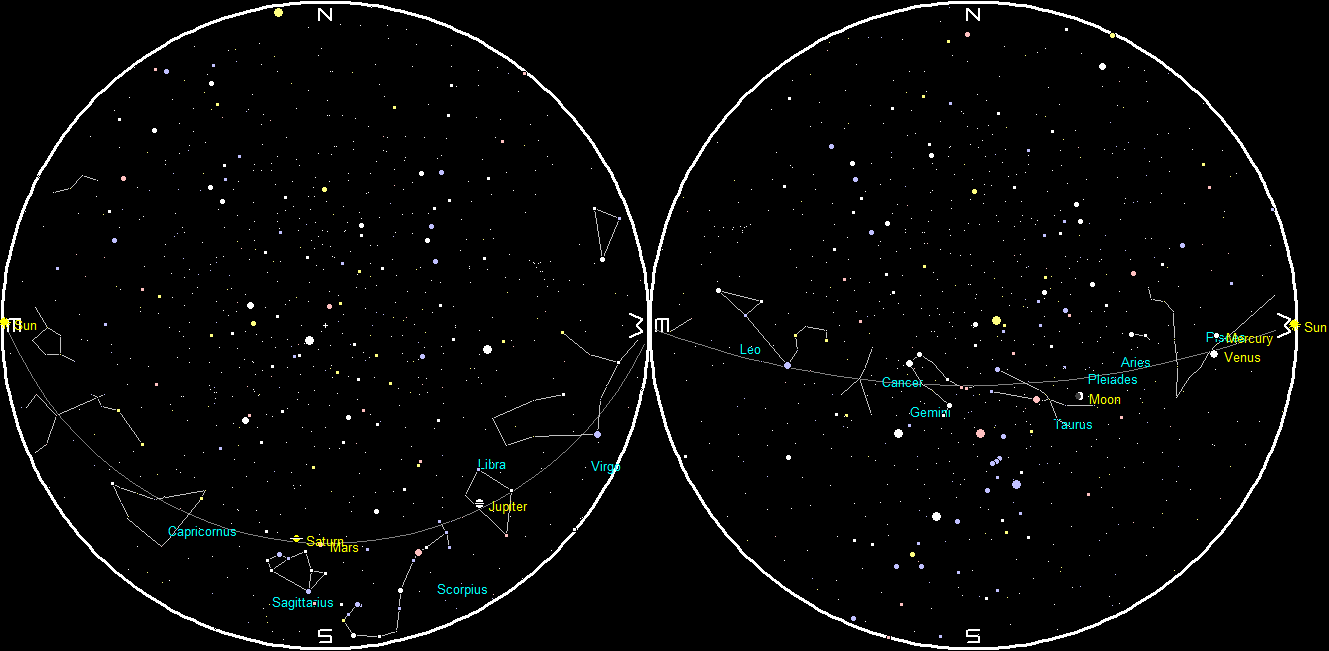
Planets and the Moon at sunset and sunrise of a single night starting with sunset on the right on March 21, 2018. The night ends on the left with sunrise on the 22nd. Click on the image to enlarge. Created using my LookingUp program.
03/20/2018 – Ephemeris – Spring begins later today!
Ephemeris for Tuesday, March 20th. The Sun will rise at 7:45. It’ll be up for 12 hours and 9 minutes, setting at 7:55. The Moon, 3 days past new, will set at 11:30 this evening.
At 12:15 p.m. the season of spring will begin. It may or may not feel it in our neck of the woods, but astronomically at that time the Sun will appear to cross a point in the sky called the vernal equinox. Equinox means equal night, when the Sun is up for 12 hours, and set for 12 hours. It does, if you don’t look too close, and in the old days clock weren’t that accurate anyway. The vernal equinox is the point in the sky where the Sun crosses the celestial equator, which is above the Earth’s equator heading north. The North Pole will begin 6 months of daylight, while the rest of the northern hemisphere will bask in more than 12 hours of sunlight a day. The reverse is true in the southern hemisphere where autumn will start.
The times given are for the Traverse City/Interlochen area of Michigan. They may be different for your location.
Addendum
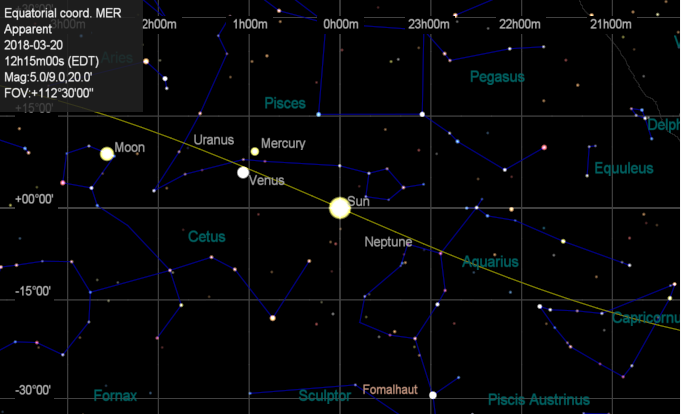
The Sun at the vernal equinox point in the sky at 12:15 p.m. EDT (16:15 UT) March 20, 2018. That point is the starting point in measurements on the celestial sphere. 0 hours right ascension, 0 degrees declination. The yellow line is the ecliptic, the plane of the Earth’s orbit and the apparent path of the Sun, whivh moves about one degree per day from lower right to upper left. Created using Cartes du Ciel (Sky Charts).
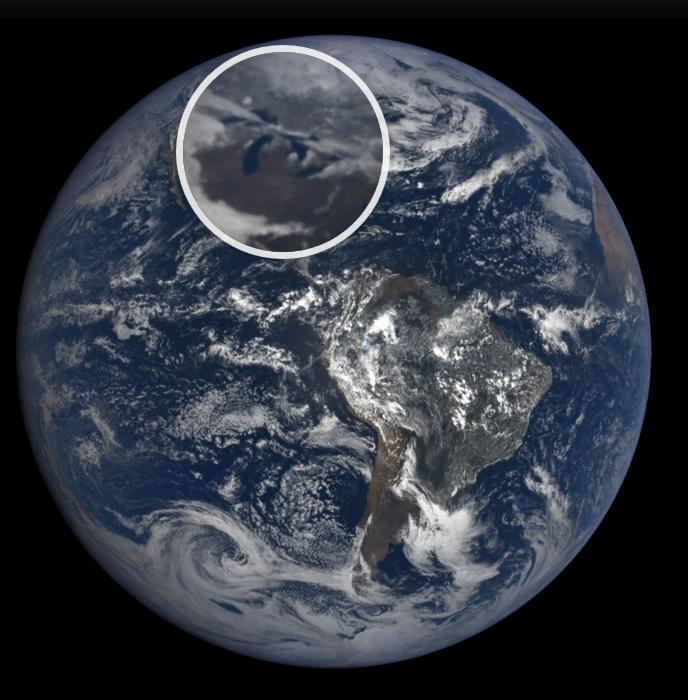
The Earth from 2 days before the vernal equinox, with the north pole not quite in sunlight. I’ve added a magnifying spot showing Michigan. The white stuff fringing the upper part of the Michigan mitten is snow. It was a rare clear day Saturday when this image was taken. Credit NOAA/NASA/DSCOVR satellite/EPIC camera.
The DSCOVR satellite was 914,903 miles (1,472,394 km) sunward of the Earth at the time of the image. The satellite is in a halo orbit of the Lagrangian L1 point between the Earth and the Sun.
03/19/2018 – Ephemeris – The dim zodiacal constellation of Cancer the crab
Ephemeris for Monday, March 19th. The Sun will rise at 7:47. It’ll be up for 12 hours and 6 minutes, setting at 7:54. The Moon, 2 days past new, will set at 10:21 this evening.
At 10 this evening, the faint constellation, and member of the Zodiac, Cancer the crab is located in the south half way between the bright stars Castor and Pollux of the constellation Gemini, high in the south and the bright star Regulus in Leo the lion in the southeast. Cancer is very dim, looking like an upside-down Y or even a K if all its stars can be made out. In the center of Cancer is a fuzzy spot to the unaided eye. In binoculars or a low power telescope this fuzzy spot becomes a cluster of stars. It is the Beehive cluster. At 577 light years away, according to the latest measurements, it is one of the closest star clusters. A week from tonight the Moon will pass below this cluster, by about 4 of its diameters.
The times given are for the Traverse City/Interlochen area of Michigan. They may be different for your location.
Addendum
Cancer the crab finder chart. Note the beehive cluster, also known to amateur astronomers as M44, along with other catalog names. Prior to the invention of the telescope this cluster was known as Praesepe which means “Manger”. Created using Stellarium and GIMP.
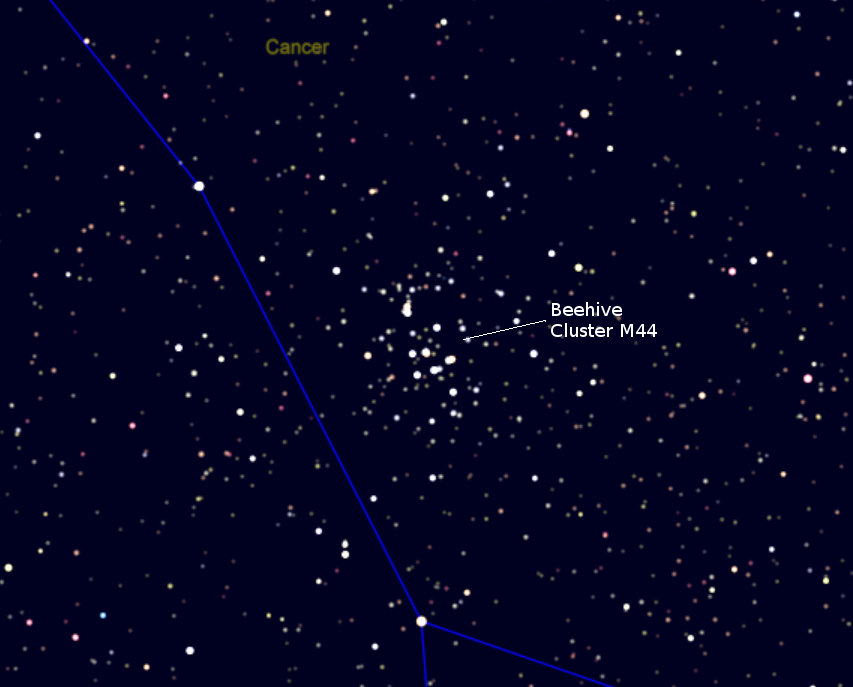
The Beehive star cluster, M44. Its ancient name was the Praesepe or manger when glimpsed by the naked eye. Created using Cartes du Ciel (Skycharts)
 Bob Moler's Ephemeris Blog