Archive
07/04/2018 – Ephemeris – The bright planets for the week of Independence Day
Ephemeris for Independence Day, Wednesday, July 4th. Today the Sun will be up for 15 hours and 28 minutes, setting at 9:31, and it will rise tomorrow at 6:03. The Moon, 2 days before last quarter, will rise at 1:13 tomorrow morning.
It’s Wednesday again and time to look for and at the bright planets. Four of them are in the evening sky. The brilliant beacon of Venus will be visible in the western twilight from about 9:50 p.m. until it sets at 11:42 p.m. Mercury is far below and right of it, setting at 10:57 p.m. Jupiter will be in the south as it gets dark. Jupiter is only outshone by Venus and the Moon, though Mars will outshine it next month at its closest. Jupiter will set at 2:37 a.m. Binoculars will show it to be bigger than star-like in size. Saturn will start the evening low in the southeast will stay relatively low, above the Teapot of Sagittarius and will set at 5:39 a.m.. Mars will rise at 11:17 p.m. and is now outshining Saturn.
The times given are for the Traverse City/Interlochen area of Michigan. They may be different for your location.
Addendum
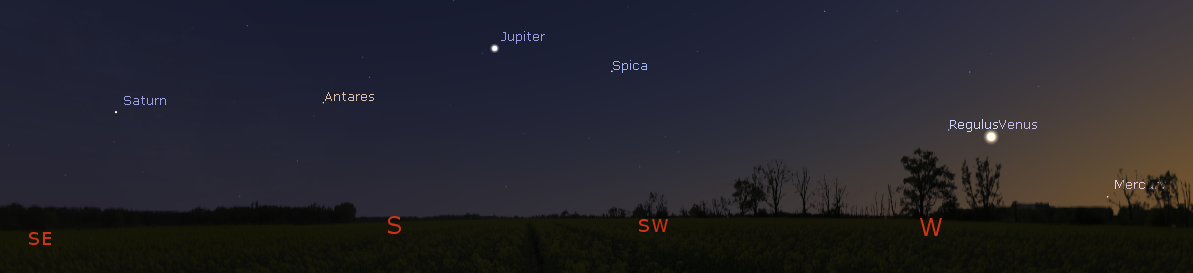
All the evening planets for July 4, 2018 at 10:30 p.m. Click on the image to enlarge. Created using Stellarium.
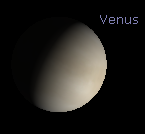
Telescopic appearance of Venus on July, 4, 2018. A moon filter helps cut down the glare to be able to more easily see the phase. Created using Stellarium.
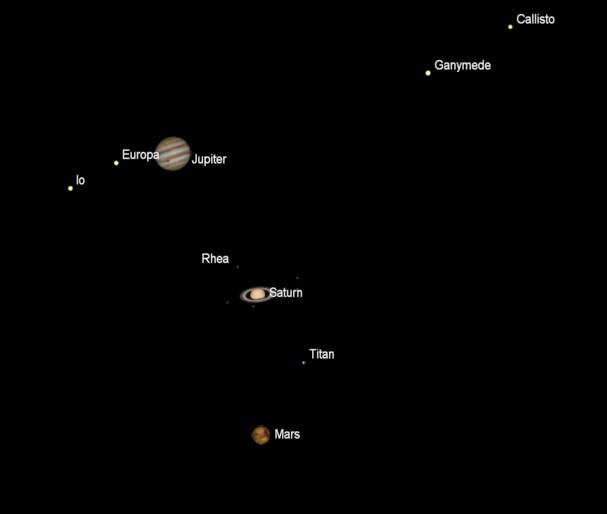
Telescopic views of Jupiter and Saturn at 10:30 p.m. on July 4, and Mars at 12 midnight on July 5, 2018 at the same magnification. Created using Cartes du Ciel (Sky Charts).
Europa’s transit of the face of Jupiter starts at 1:55 a.m. July 5th. The Great Red Spot will cross the central meridian of Jupiter at 11:19 p.m.
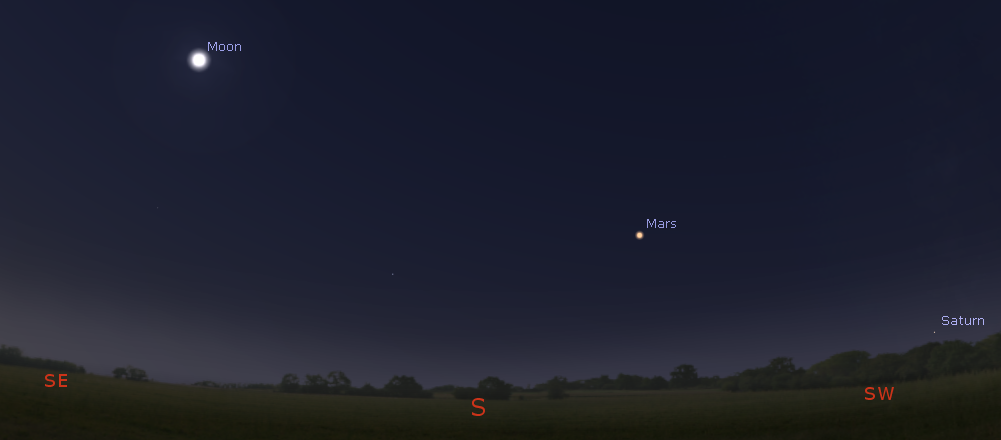
Mars Saturn and the Moon at 5 a.m. July 5, 2018. Click on the image to enlarge. Created using Stellarium.
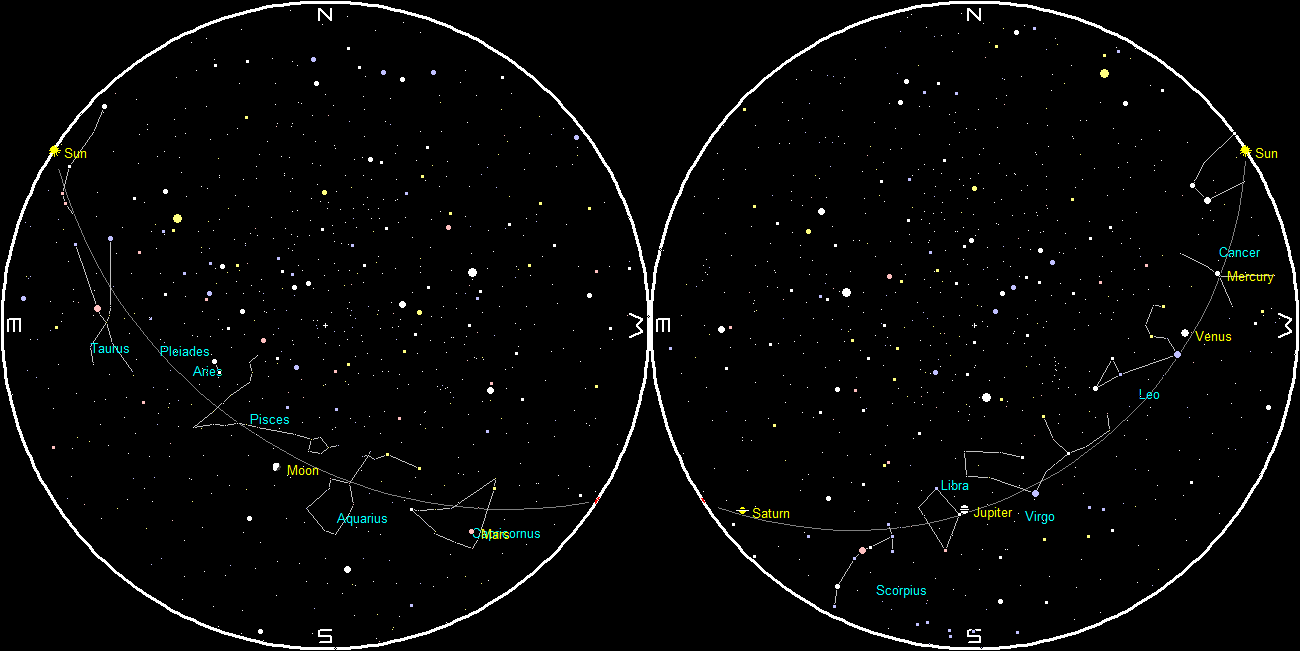
Planets and the Moon at sunset and sunrise of a single night starting with sunset on the right on July 4, 2018. The night ends on the left with sunrise on the 5th. Click on the image to enlarge. Created using my LookingUp program.
07/03/2018 – Ephemeris – Antares the sparkler star
Ephemeris for Tuesday, July 3rd. Today the Sun will be up for 15 hours and 29 minutes, setting at 9:31, and it will rise tomorrow at 6:02. The Moon, 3 days before last quarter, will rise at 12:47 tomorrow morning.
There’s going to be a lot of fireworks tomorrow night to celebrate Independence Day, and I may be watching some after the local Beach Bums baseball game. There’s at least one star that is a great sparkler any summer evening. That’s Antares in Scorpius the scorpion low in the south tonight. We in Michigan always see Antares low in the south. It’s a bright red giant star which twinkles mightily, and since it’s low in the sky spits and sputters all kinds of colors due to our atmosphere’s turbulence, and the fact that we’re looking through so much of it at Antares. The more magnification one uses with binoculars or a telescope the greater the sparkler effect. It is even called in sometimes as a UFO.
The times given are for the Traverse City/Interlochen area of Michigan. They may be different for your location.
Addendum
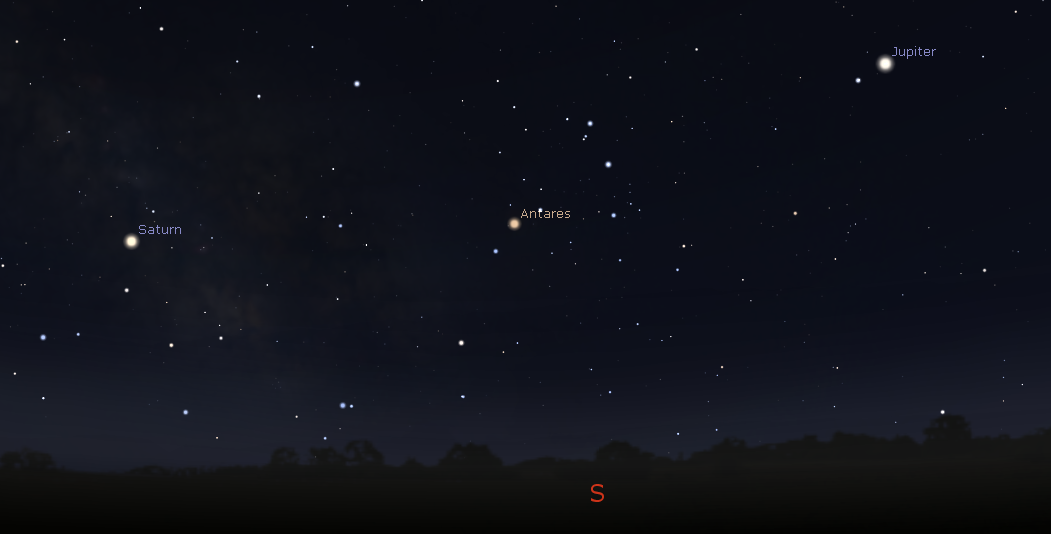
Antares finder chart for 11 p.m., July 3, 2018. Created using Stellarium.
07/02/2018 – Ephemeris – The starry triangle of summer
Ephemeris for Monday, July 2nd. Today the Sun will be up for 15 hours and 30 minutes, setting at 9:31, and it will rise tomorrow at 6:02. The Moon, half way from full to last quarter, will rise at 12:19 tomorrow morning.
Now that it’s summer it’s time to look for the Summer Triangle in the sky. It’s seen rising in the east as it gets dark. Highest of the three bright stars is Vega in the constellation Lyra the harp, whose body is seen in a narrow parallelogram nearby. The second star of the triangle is Deneb lower and left of Vega, It appears dimmer than Vega because it is by far the most distant of the three. The third star of the Summer Triangle is seen farther below and a right of Vega. It is Altair in Aquila the eagle, and the closest. Altair is 16.5 light years away, Vega is 27 light years while Deneb actually one of the brighter stars known, is 1500 or more light years away. It’s distance is not well known.
The times given are for the Traverse City/Interlochen area of Michigan. They may be different for your location.
Addendum
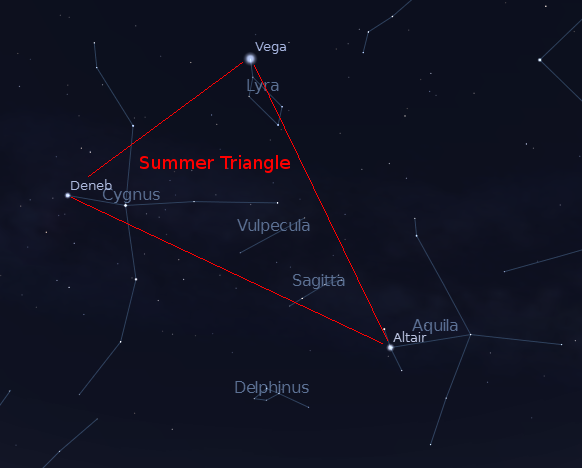
The Summer Triangle. Created using Stellarium.
 Bob Moler's Ephemeris Blog