Archive
09/14/2018 – Ephemeris – Local astronomy activities Saturday the 15th
Note: I’m a bit late with this post due to unscheduled star party last night for Greenspire School at Leelanau Outdoor Center near Pyramid Point. Then I had a sail this morning for Inland Seas. I came home absolutely pooped out. Anyway the events described except for the first paragraph below are for tomorrow.
Ephemeris for Friday, September 14th. The Sun will rise at 7:20. It’ll be up for 12 hours and 34 minutes, setting at 7:55. The Moon, 2 days before first quarter, will set at 11:00 this evening.
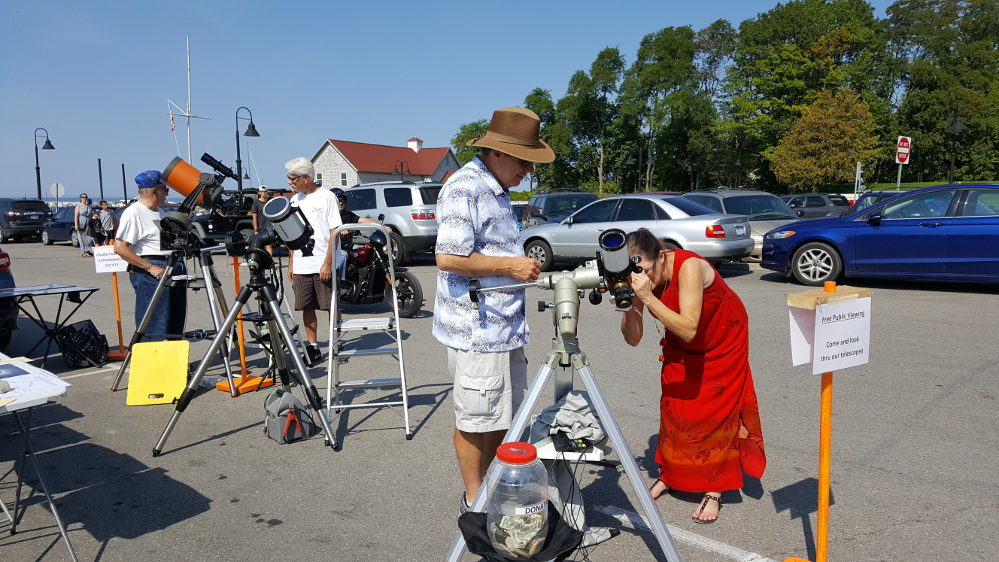
There are two local astronomical events tomorrow. The Leland Heritage Celebration will take place from 10 a.m. to 4 p.m. at Fishtown in Leland. The Grand Traverse Astronomical Society will be there to show the Sun through member’s telescopes, maybe spot the Moon and the planet Venus plus give out NASA items for the kids. We’ll exhibit pictures gained from last year’s total solar eclipse. Then starting at 9 p.m. the crew will be at Northwestern Michigan College’s Rogers Observatory for a star party, viewing Mars, Saturn, Jupiter and the Moon, plus some brighter objects beyond the solar system. Rain will affect the Leland event. The observatory is located on south of Traverse City on Birmley Road between Keystone and Garfield roads.
The times given are for the Traverse City/Interlochen area of Michigan. They may be different for your location.
Addendum
09/13/2018 – Ephemeris – The Man in the Moon’s eye
Ephemeris for Thursday, September 13th. The Sun will rise at 7:19. It’ll be up for 12 hours and 37 minutes, setting at 7:57. The Moon, 3 days before first quarter, will set at 10:27 this evening.
The Moon tonight is a 4 day old moon, and appears near the planet Jupiter. Day one is its first appearance in the evening after disappearing from the morning sky. The ancients called it the new moon, but astronomers treat the conjunction of the Moon and the Sun as the new moon. In this program I note the days before or after the nearest quarter phase, as a better representation of the actual appearance of the Moon’s phase. The Moon will be a beautiful crescent tonight. Binoculars will reveal a dark area just above the fattest part of the crescent. It serves as one of the Man in the Moon’s eyes. Its official name is Mare Crisium, or Sea of Crises. Most of the Moon’s seas are connected, or appear to be. This one is definitely not.
The times given are for the Traverse City/Interlochen area of Michigan. They may be different for your location.
Addendum
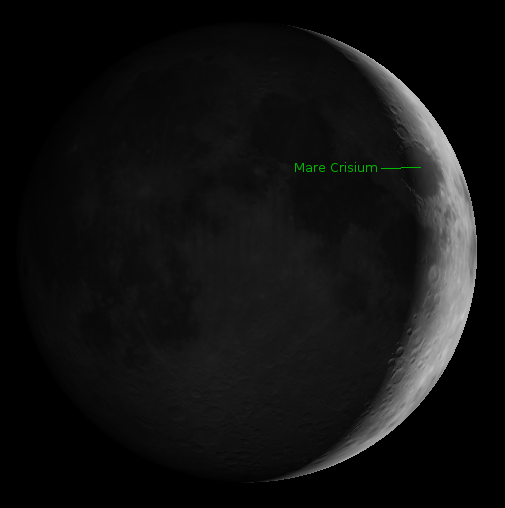
The 4 day old Moon showing Mare Crisium, the Sea of Crises. 9 p.m. September 13, 2018. Created using Virtual Moon Atlas.
09/12/2018 – Ephemeris – Wednesday is bright planet day on Ephemeris
Ephemeris for Wednesday, September 12th. The Sun will rise at 7:18. It’ll be up for 12 hours and 40 minutes, setting at 7:59. The Moon, 3 days past new, will set at 9:56 this evening.
It’s Wednesday again and time to look at the bright planets. Four of them are visible in the evening sky. The brilliant Venus will be visible in the western twilight from about 8:20 p.m. until it sets at 9:03 p.m. Jupiter will be in the southwest as it gets dark. It is only outshone by Venus, and the Moon, and is again brighter than Mars. Jupiter will set at 10:16 p.m. Saturn will start the evening low in the southern sky and will stay relatively low, above the Teapot of Sagittarius. It will be due south at 8:28 p.m. and will set at 12:51 a.m. Mars will be low in the south-southeast as the skies darken tonight. and is now 46.4 million miles (74.6 million km) away. Mars will be due south at 10:29 p.m., and it will set at 2:43 a.m.
The times given are for the Traverse City/Interlochen area of Michigan. They may be different for your location.
Addendum
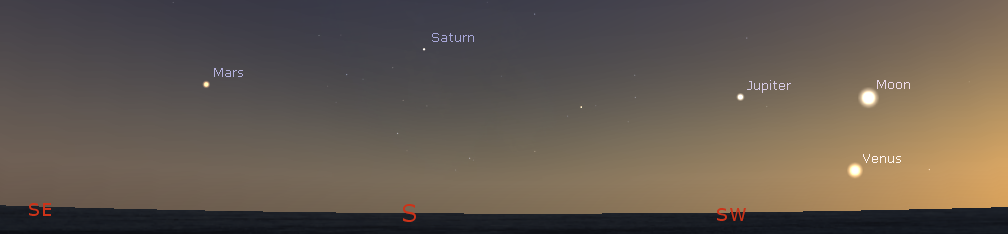
The evening planets at 8:30 p.m. September 12, 2018. Click on image to enlarge. Created using Stellarium.
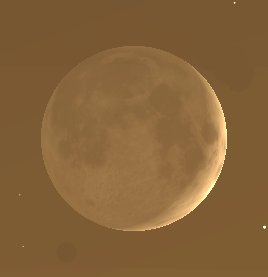
The crescent Moon as it should appear tonight in binoculars. Created using Stellarium.
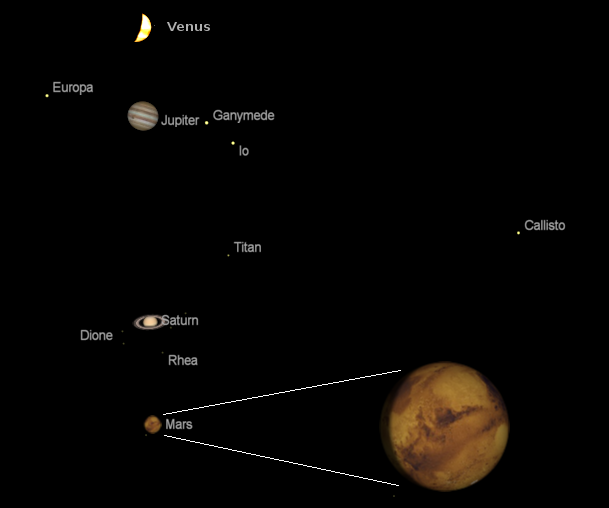
Venus, Jupiter, Saturn and Mars with the same magnification at 8:30 p.m. September 12, 2018. Yes, your eyes don’t deceive you, Venus is larger than Jupiter. Venus is 34.9 ” (seconds of arc) in diameter, while Jupiter is 33.8″. Venus is approaching us, while Jupiter is being left behind by the Earth. Mars is also shown enlarged. The global dust storm is abating, so the albedo features are beginning to be seen. Created using Cartes du Ciel (Sky Charts).
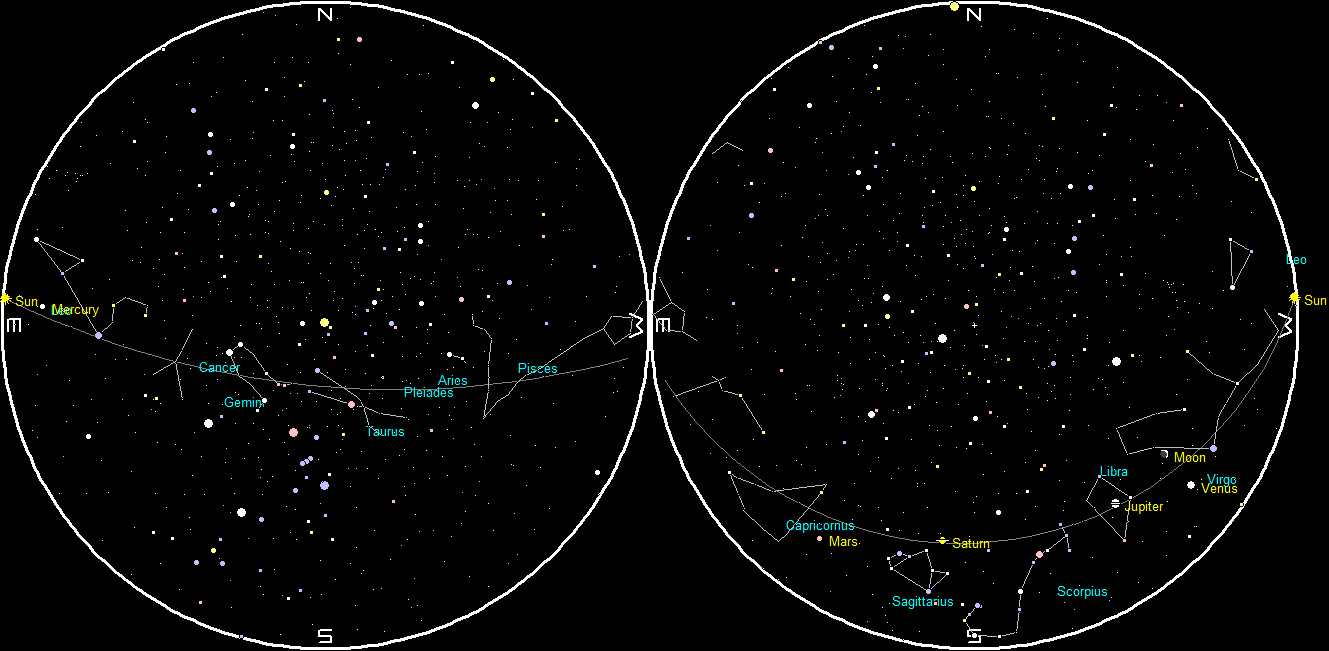
Planets and the Moon at sunset and sunrise of a single night starting with sunset on the right on September 12, 2018. The night ends on the left with sunrise on the 13th. Click on the image to enlarge. Created using my LookingUp program.
09/11/2018 – Ephemeris – Earth shine on the Moon
Ephemeris for Tuesday, September 11th. The Sun will rise at 7:16. It’ll be up for 12 hours and 43 minutes, setting at 8:00. The Moon, 2 days past new, will set at 9:27 this evening.
At around 8:30 this evening Venus will be in the southwest only 9 degrees above the horizon, about the width of a fist held at arm’s length. While viewing Venus the Moon will be to the right and above our evening star. It will be a thin sliver of a crescent and in the twilight there will be the suggestion that there is more than the thin sliver of the Moon visible. Binoculars will confirm that the entire disk of the Moon will be visible. The effect is called earth shine. The nearly full Earth is illuminating the Moon to a much greater degree than the full Moon illuminates the Earth. The Earth is about 4 times the Moons diameter and its surface is about twice as bright and the Moon’s. The ancients called it: “The old Moon in the new Moon’s arms.”
The times given are for the Traverse City/Interlochen area of Michigan. They may be different for your location.
Addendum
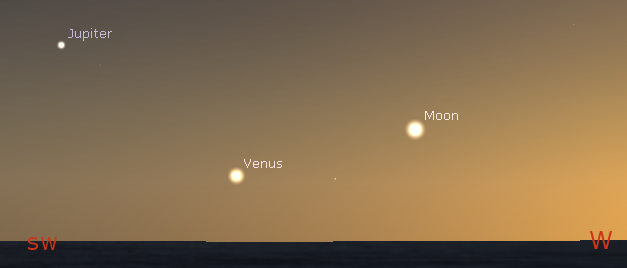
Venus, the Moon and Jupiter at 8:30 p.m. September 11, 2018. Created using Stellarium.

An overly colored Moon to bring out Earth shine on thye evening of September 11, 2018. Created by Stellarium. Overly processed in GIMP.
09/10/2018 -Ephemeris – The Coathanger in the sky
Ephemeris for Monday, September 10th. The Sun will rise at 7:15. It’ll be up for 12 hours and 47 minutes, setting at 8:02. The Moon, 1 day past new, will set at 8:57 this evening.
Just about every amateur astronomer knows a little asterism or informal constellation called the Coathanger. It’s stars are mostly below naked eye visibility, but it is a great sight in binoculars. It’s located along a line from Altair in Aquila the eagle to Vega in Lyra the harp. These are two star of the Summer Triangle. It is also just west of, or right of, the constellation Sagitta the arrow. It consists of six stars in just about a perfectly straight line with four stars in a tight group south of them making the hook. In telescope finders which invert the image the Coathanger appears right-side-up. Arab astronomer Al Sufi discovered it and described it in 964 AD. It has the catalog designation of Collinder 399. It is also known as Brocchi’s Cluster.
The times given are for the Traverse City/Interlochen area of Michigan. They may be different for your location.
Addendum
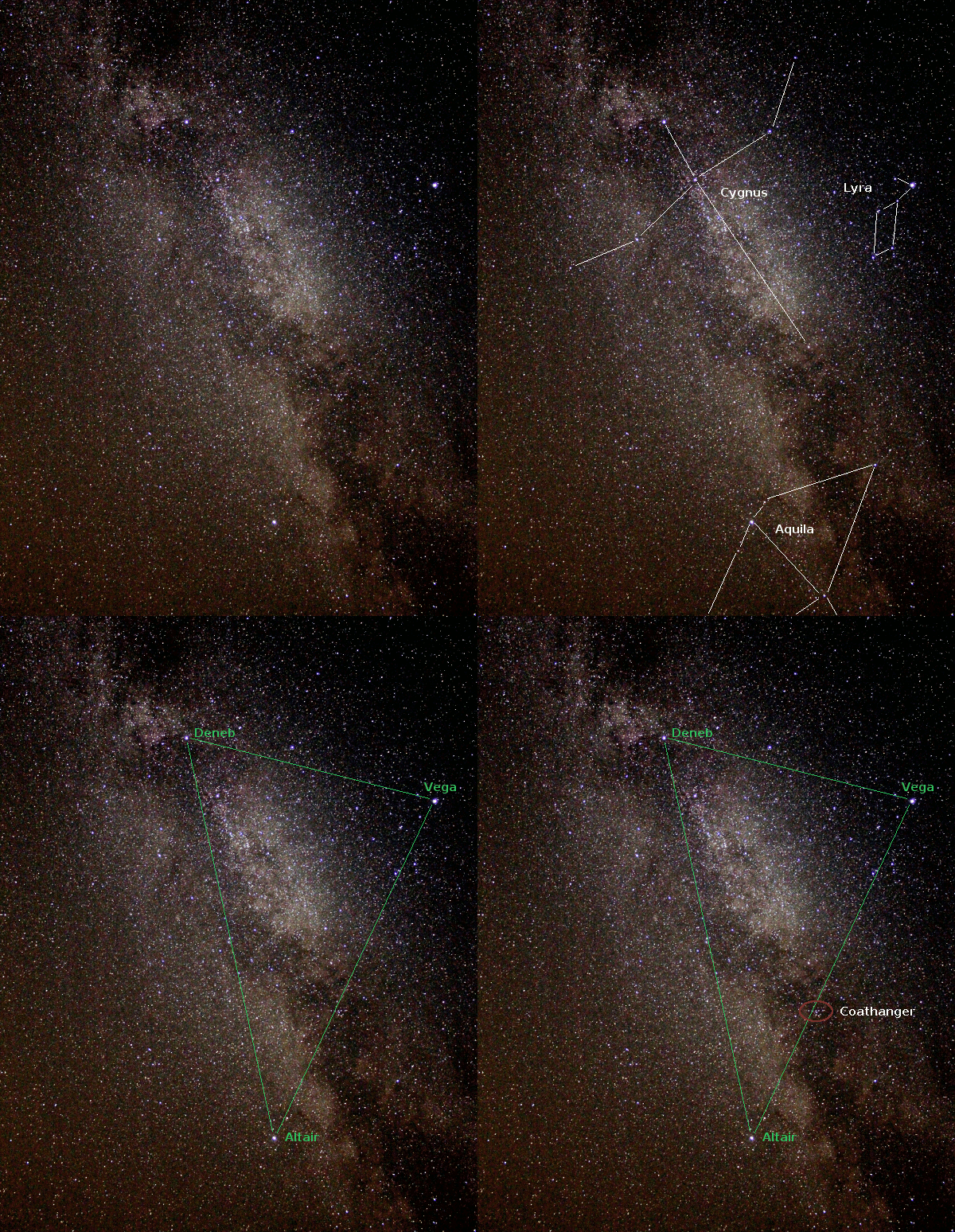
How to find the Coathanger. Look for the Summer Triangle. On the line from Altair to Vega the Coathanger can be found. Star imaged by Bob Moler.
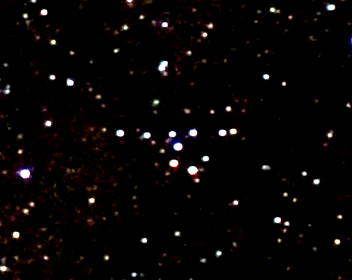
Binocular view of the Coathanger. From the original resolution of the above photograph.
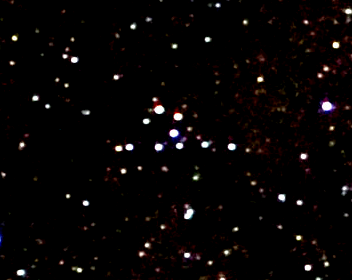
Telescope finder view of the Coathanger. Telescope finders usually invert the image, so it looks like a proper coat hanger.
09/07/2018 – Ephemeris – Two astronomy events in the Grand Traverse region this weekend
Ephemeris for Friday, September 7th. The Sun will rise at 7:12. It’ll be up for 12 hours and 56 minutes, setting at 8:08. The Moon, 2 days before new, will rise at 5:35 tomorrow morning.
This evening the Grand Traverse Astronomical Society will hold its monthly meeting at the Northwestern Michigan College’s Rogers Observatory at 8 p.m. with a program featuring Dr. David Penney and his talk Large Impacts on the Earth. After watching the impacts of Comet Shoemaker-Levy 9 into Jupiter in 1994 the public and space agencies began to take the possibility of an asteroid or comet impact on the Earth seriously. Dr. Penney will talk about evidence of such impacts on the Earth in the past. After the talk, at 9 p.m. there will be a star party to view the heavens including Saturn and Mars and wonders of the Milky Way. The observatory is located south of Traverse City, on Birmley Road between Garfield and Keystone roads.
The times given are for the Traverse City/Interlochen area of Michigan. They may be different for your location.
Addendum
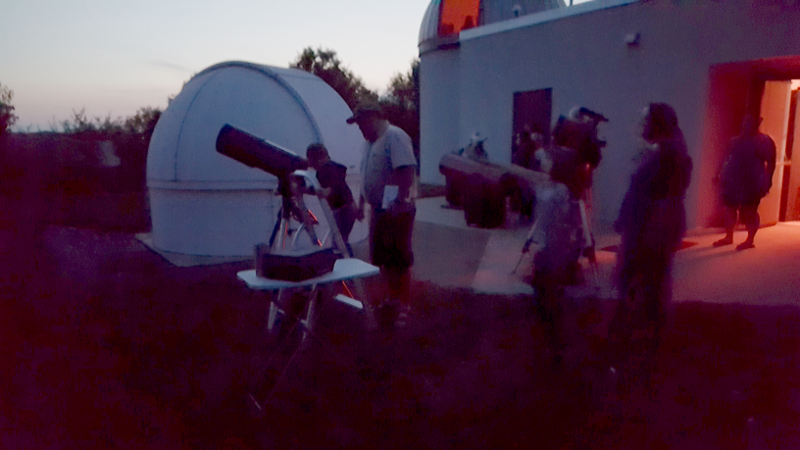
Telescopes set up by members of the Grand Traverse Astronomical Society at the back of Northwestern Michigan College’s Joseph H. Rogers Observatory on August 3, 2018. Credit mine.
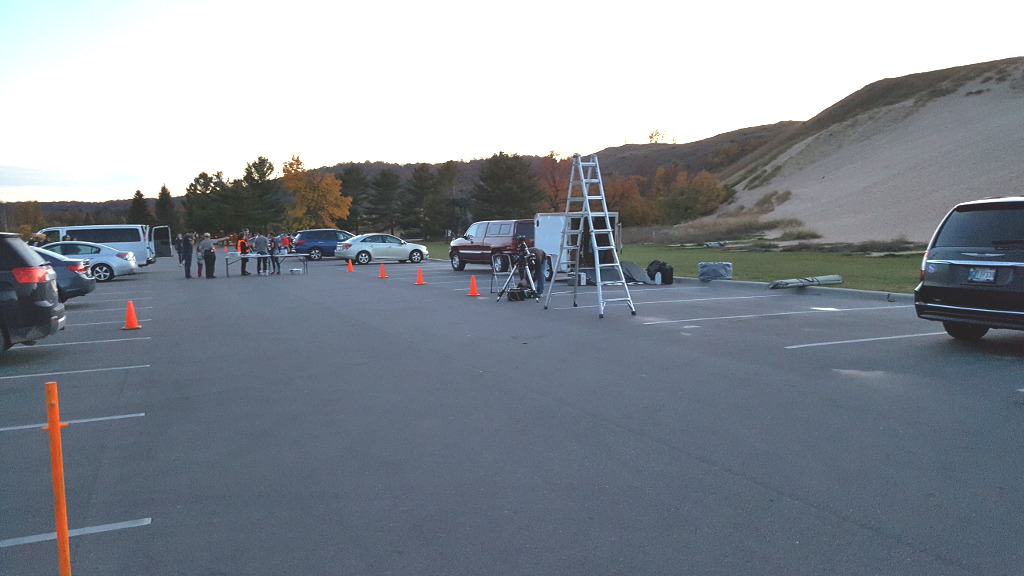
This in the beginning of setup for the October 21, 2917 star party at the dune climb. Taken early while there was enough light. The dune blocks up to 12 degrees from the southwest to northwest, but the rest of the horizon is quite low.
09/06/2018 – Ephemeris – The constellations of Delphinus and Sagitta
Ephemeris for Thursday, September 6th. The Sun will rise at 7:11. It’ll be up for 12 hours and 59 minutes, setting at 8:10. The Moon, 3 days before new, will rise at 4:19 tomorrow morning.
Located below the eastern edge of the Summer Triangle of three of the brightest stars in the sky, which is nearly overhead in our sky at 10 p.m., is the tiny constellation of Delphinus the dolphin. Delphinus’ 6 stars in a small parallelogram with a tail, really does look like a dolphin leaping out of the water. The parallelogram itself has the name Job’s Coffin. The origin of this asterism or informal constellation is unknown. Of the dolphin itself: the ancient Greeks appreciated this aquatic mammal as we do, and told stories of dolphins rescuing shipwrecked sailors. There’s another tiny constellation to the right of Delphinus, Sagitta the arrow a small thin group of 5 stars, which represents Cupid’s dart.
The times given are for the Traverse City/Interlochen area of Michigan. They may be different for your location.
Addendum
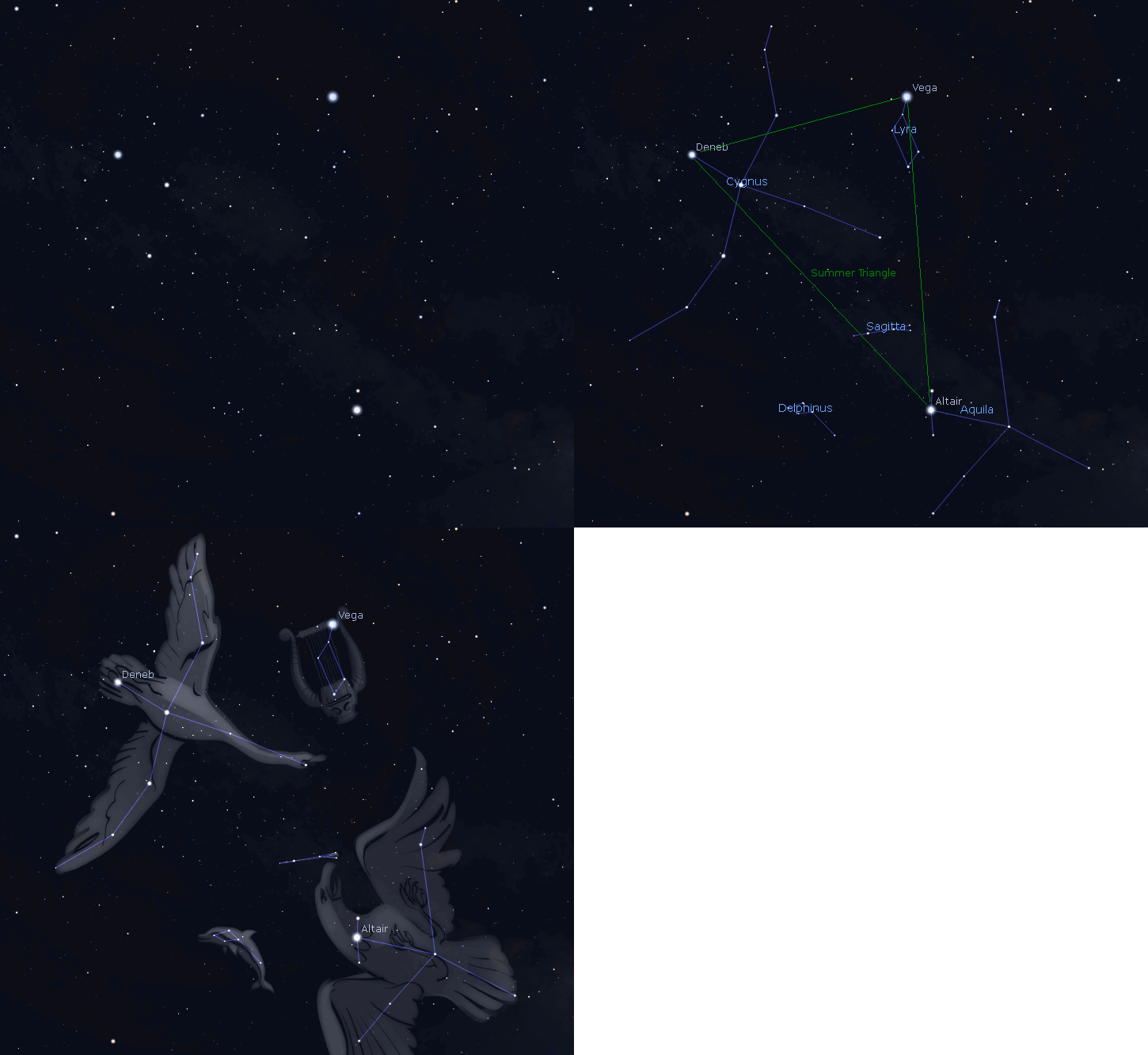
Delphinus and Sagitta finder animation. Click on image to enlarge. Created using Stellarium and GIMP.
09/05/2018 – Ephemeris – It’s Wednesday and time to look at the bright planets
Ephemeris for Wednesday, September 5th. The Sun will rise at 7:09. It’ll be up for 13 hours and 2 minutes, setting at 8:12. The Moon, 3 days past last quarter, will rise at 3:08 tomorrow morning.
It’s Wednesday again and time to look at the bright planets. Four of them are visible in the evening sky. The brilliant Venus will be visible in the western twilight from about 8:30 p.m. until it sets at 9:24 p.m. Jupiter will be in the southwest as it gets dark. It is only outshone by Venus, and the Moon, and is the same brightness as Mars. Jupiter will set at 10:40 p.m. Saturn will start the evening low in the southern sky and will stay relatively low, above the Teapot of Sagittarius. It will be due south at 8:54 p.m. and will set at 1:19 a.m.. Mars will be low in the southeast as the skies darken tonight. and is now 43.6 million miles (70.2 million km) away. Mars will be due south at 10:52 p.m., and it will set at 3:02 a.m. Mercury will rise in the east-northeast at 5:58 a.m. and be visible until about 6:50 tomorrow morning.
The times given are for the Traverse City/Interlochen area of Michigan. They may be different for your location.
Addendum
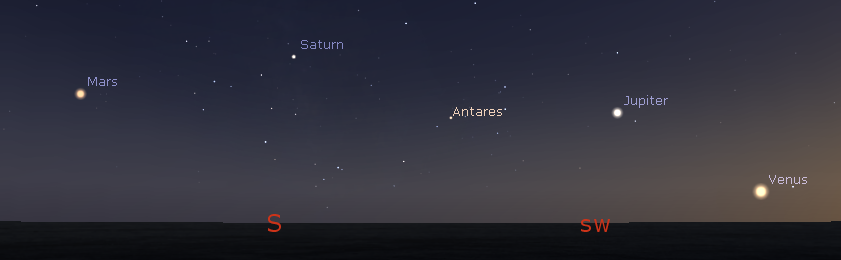
The evening planets at 9 p.m. September 5, 2018. Click on image to enlarge. Created using Stellarium.
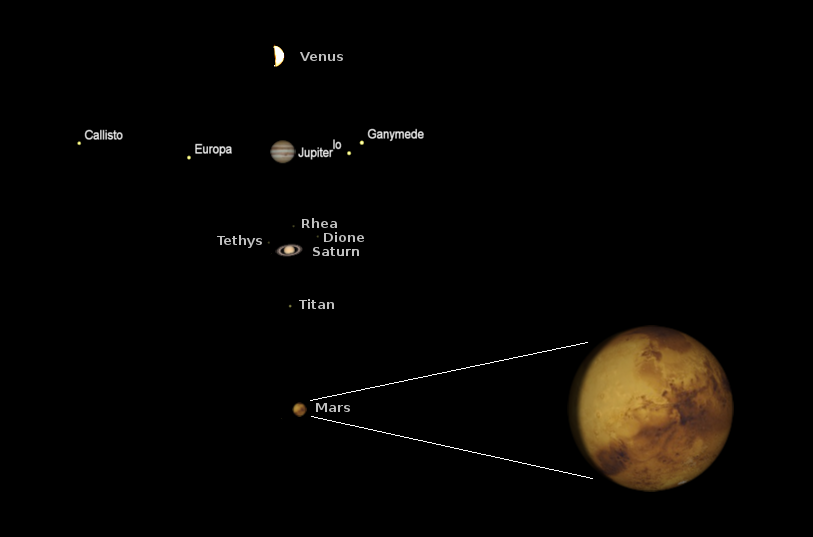
Venus, Jupiter, Saturn and Mars with the same magnification at 9 p.m. September 5, 2018. Mars is also shown enlarged. The global dust storm is abating, so the albedo features are beginning to be seen. Created using Cartes du Ciel (Sky Charts).
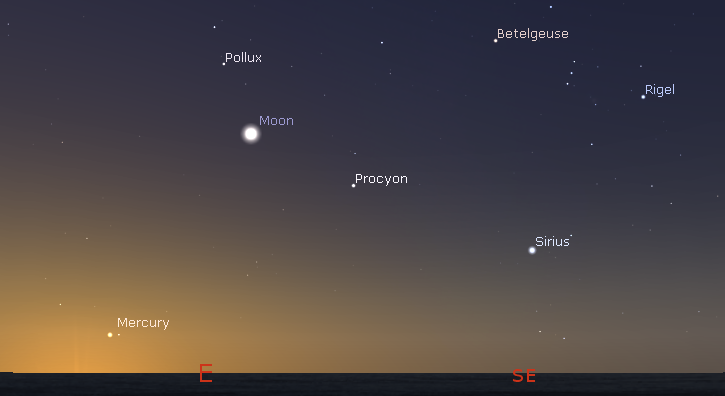
Mercury and Moon in the morning at 6:30 a.m. September 6, 2018. Click on image to enlarge. Created using Stellarium.
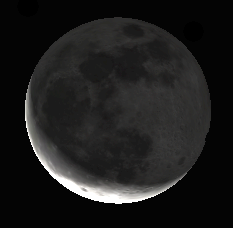
The crescent Moon as it should appear tomorrow morning. Created using Stellarium.
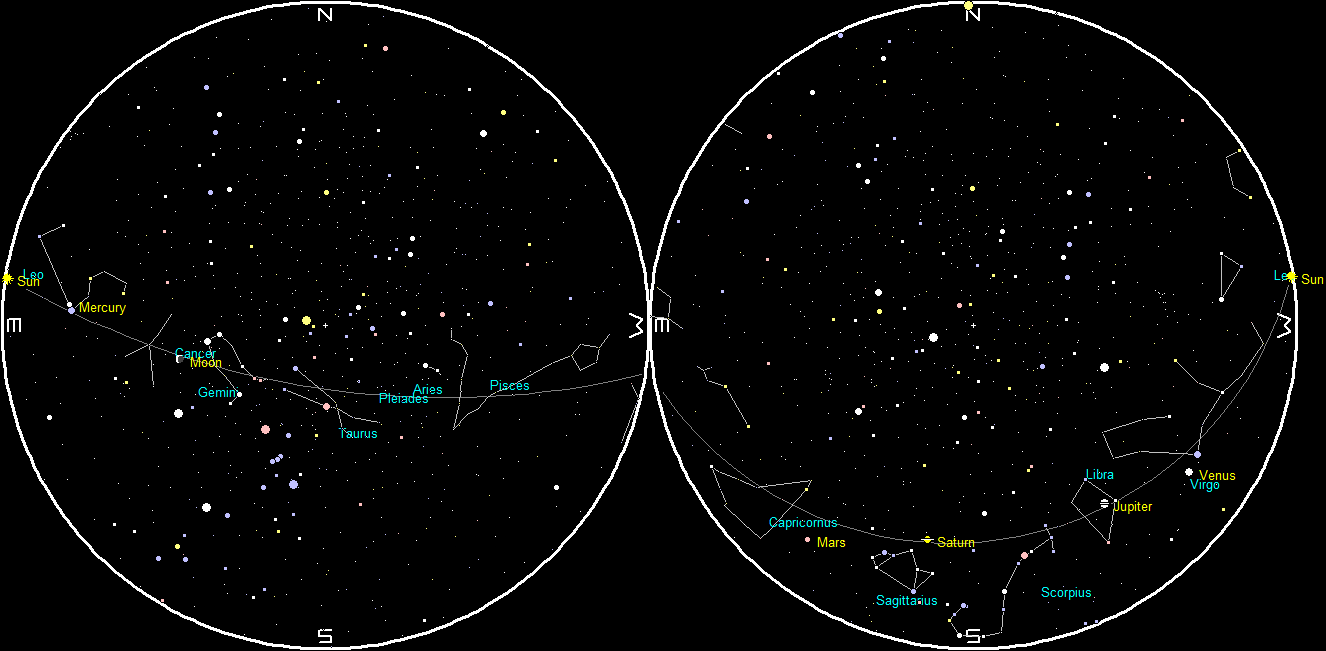
Planets and the Moon at sunset and sunrise of a single night starting with sunset on the right on September 5, 2018. The night ends on the left with sunrise on the 6th. Click on the image to enlarge. Created using my LookingUp program.
09/04/2018 – Ephemeris – The Great Rift
Ephemeris for Tuesday, September 4th. The Sun will rise at 7:08. It’ll be up for 13 hours and 5 minutes, setting at 8:13. The Moon, 2 days past last quarter, will rise at 2:03 tomorrow morning.
High overhead the Milky Way is seen passing through the Summer Triangle of three bright stars. Here we find the Milky Way splits into two sections. The split starts in the constellation of Cygnus the Swan or Northern Cross very high in the east. The western part of the Milky Way ends southwest of the Aquila the eagle. This dark dividing feature is called the Great Rift. Despite the lack of stars seen there, it doesn’t mean that there are fewer stars there than in the brighter patches of the Milky Way. The rift is a great dark cloud that obscures the light of the stars behind it. Sometimes binoculars can be used to find the edges of the clouds of the rift, as stars numbers drop off suddenly. This is especially easily seen in Aquila.
The times given are for the Traverse City/Interlochen area of Michigan. They may be different for your location.
Addendum
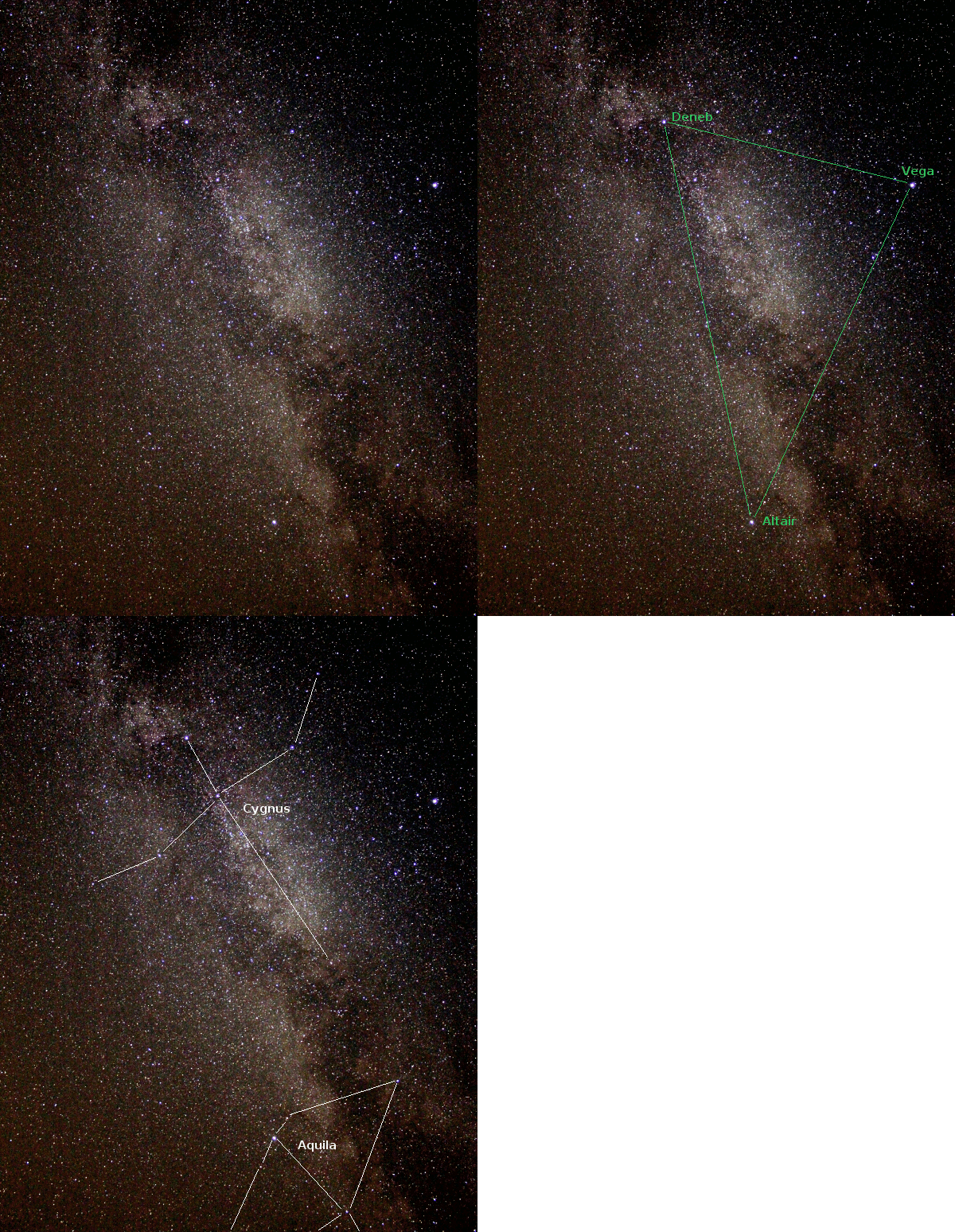
The Great Rift finder animation as seen in the Summer Triangle, also showing the constellations of Cygnus the swan and the northern part of Aquila the eagle. This image a stack of 5 30 second exposures taken the morning of the Perseid meteor shower the is year in a vain attempt to capture some meteors.
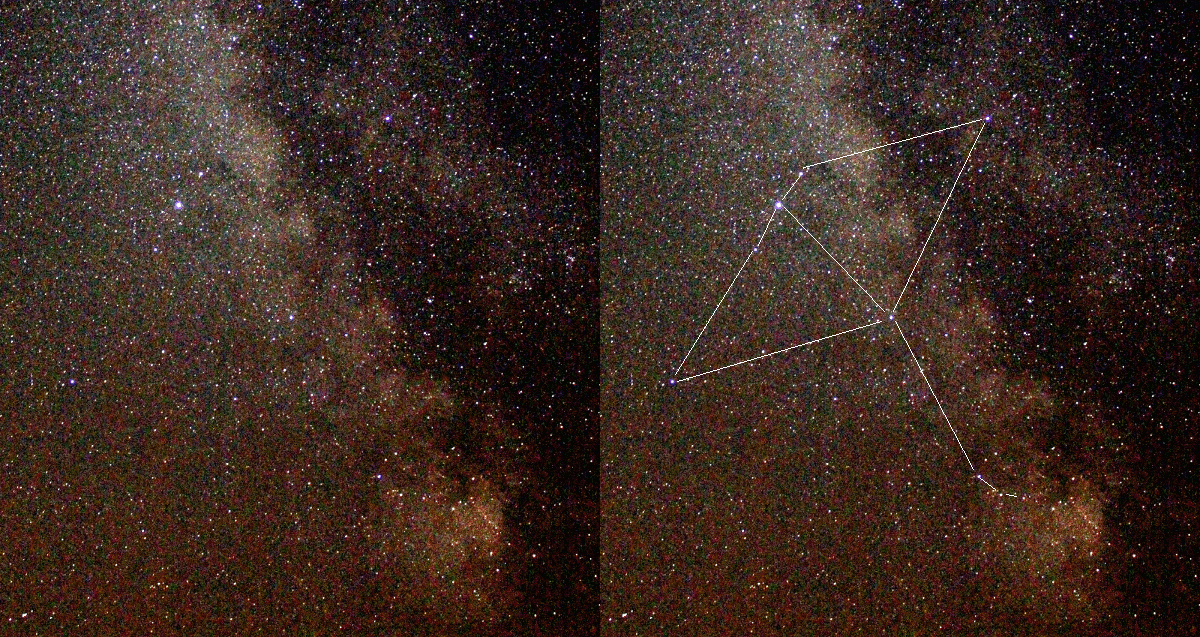
Annotated and animated photograph taken of Aquila August 13, 2018 during the Perseid meteor shower. Alas, no Perseids in this photograph. Taken by me and processed using Registax and GIMP.
09/03/2018 – Ephemeris – Looking for Sagittarius, Centaur or Teapot
Ephemeris for Labor Day, Monday, September 3rd. The Sun will rise at 7:07. It’ll be up for 13 hours and 8 minutes, setting at 8:15. The Moon, 1 day past last quarter, will rise at 1:08 tomorrow morning.
The Milky Way runs from northeast to south through the heavens at 10 p.m. The Milky Way is brighter and broader just above the horizon in the south. In that glow in the south is a star pattern that looks like a stout little teapot, with a bright stream of the Milky Way rising from the spout, which faces the west. This pattern of stars is the major part of the constellation called Sagittarius. This year the planet Saturn appears right above it. According to Greek mythology Sagittarius is a centaur with a bow and arrow poised to shoot Scorpius the scorpion setting in the southwest. This centaur is Chiron, the most learned of the breed, centaurs usually being a rowdy bunch. The center of the pin wheel of our Milky Way galaxy lies hidden beyond the stars above the spout of the teapot.
The times given are for the Traverse City/Interlochen area of Michigan. They may be different for your location.
Addendum
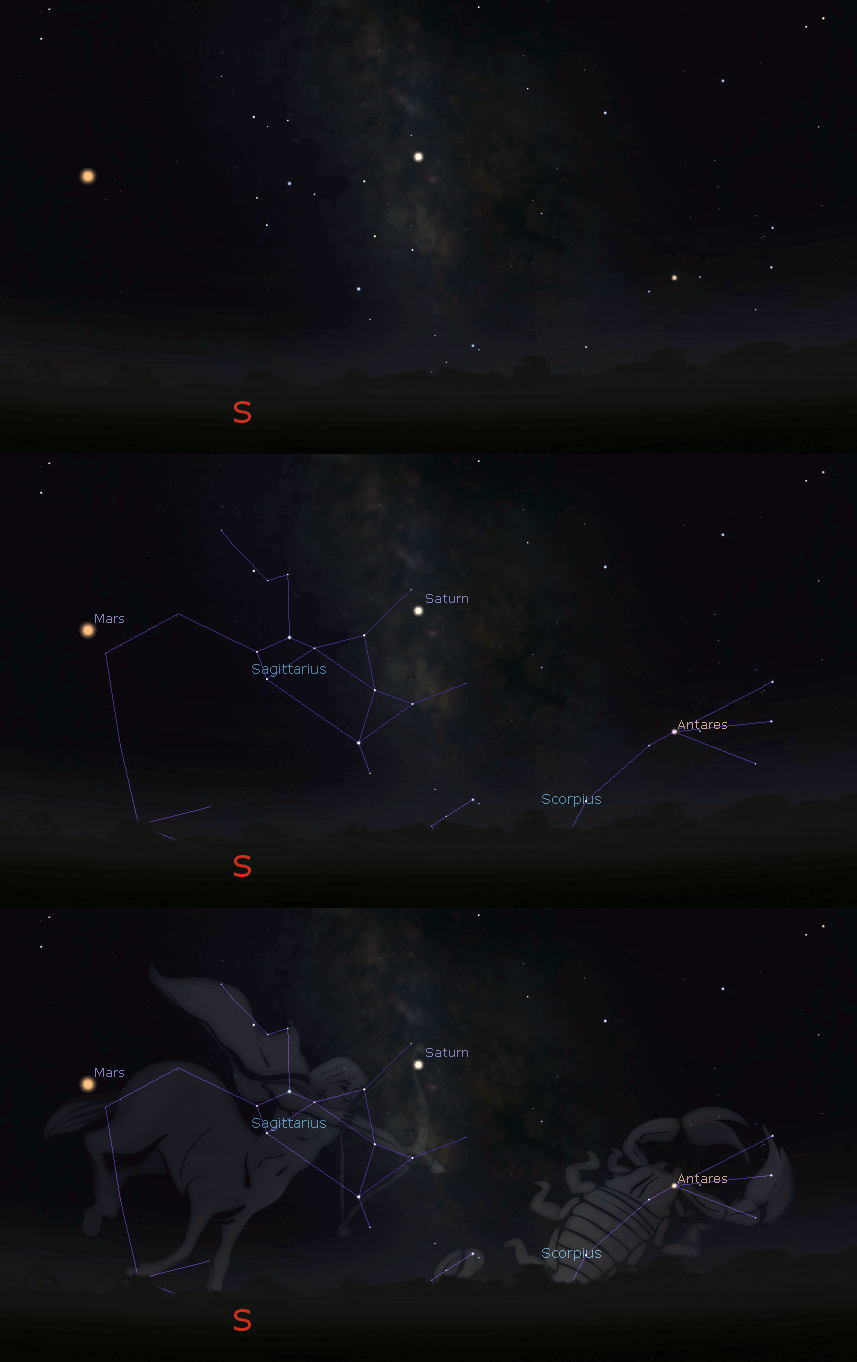
Sagittarius Finder animation for 10 p.m. September 3, 2018. Created using Stellarium and GIMP.

