Archive
04/30/2020 – Ephemeris – See bits of Halley’s Comet in the morning crashing into the Earth’s atmosphere
This is Bob Moler with Ephemeris for Thursday, April 30th. Today the Sun will be up for 14 hours and 13 minutes, setting at 8:47, and it will rise tomorrow at 6:32. The Moon, at first quarter today, will set at 3:47 tomorrow morning.
Do you remember seeing Halley’s Comet back in 1986? The actual pronunciation is “Hawley’s”, according to Sir Edmund’s contemporary Samuel Pepys. The reason I asked is whether you saw it in 1986 or are young enough to live long enough to see it in 41 years, we all have a twice yearly chance to see bits of Halley’s Comet, shed in previous returns through the inner solar system and strewn along its orbit, burn up in Earth’s atmosphere as the Eta Aquariid meteor shower going on now, or the Orionids in late October. The time to see the meteor shower is in the early morning after the Moon sets. That’s after 3:47 a.m. tomorrow morning and 4:22 Saturday morning. Astronomical twilight starts about 4:40 a.m. It will probably be 5 a.m. before it really interferes. With the meteors all over the sky, coming from the southeast.
The event times given are for the Traverse City/Interlochen area of Michigan. They may be different for your location.
Addendum
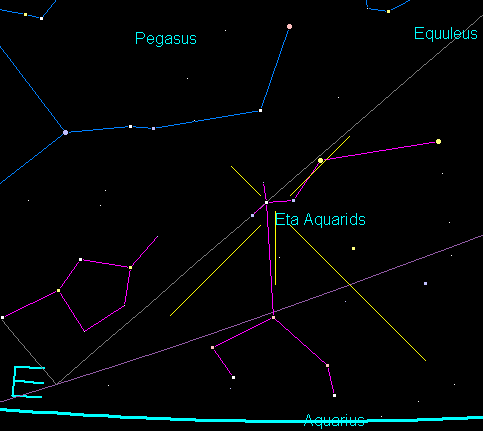
The Eta Aquariid radiant at the peak of the shower. The radiant moves slowly to the east with time. Credit: my LookingUp program.
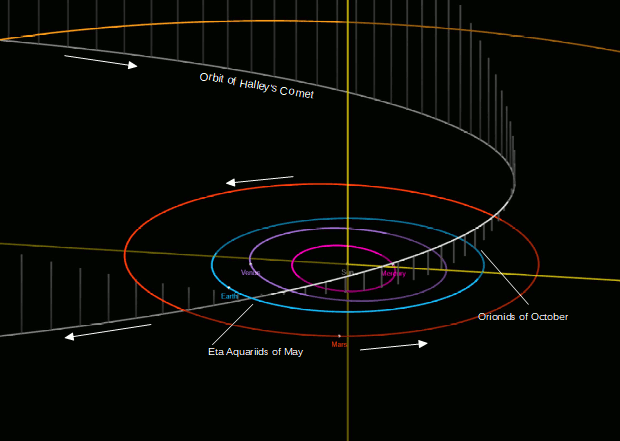
Halley’s Comet orbit with the orbits of the inner planets showing the points at which the debris from the comet intersect with the Earth’s orbit causing meteor showers. Diagram credit JPL Small-Body Database Browser with my annotations.
04/29/2020 – Ephemeris – Let’s look at the naked-eye planets for this week
This is Ephemeris for Wednesday, April 29th. Today the Sun will be up for 14 hours and 11 minutes, setting at 8:45, and it will rise tomorrow at 6:33. The Moon, 1 day before first quarter, will set at 3:07 tomorrow morning.
Let’s look at the naked-eye planets for this week. Venus is our evening star shining brightly in the west. It will set at 12:29 a.m. It’s a couple of days past its greatest brilliancy, and only 41 million miles away. In the morning sky there are three planets fairly close together in the south-southeast. Bright Jupiter will rise first at 2:29 a.m. Followed by Saturn at 2:44 a.m. Mars, stretching its lead left of Saturn, will rise an hour after Saturn. It’s now down to 114 million miles (184 million km) away, as the Earth slowly overtakes it at the rate of about 5 million miles (8 million km) a week. Mars will be closest to us in October. It’s not as close as it was 2 years ago, but closer than it will get for the next 15 years.
The event times given are for the Traverse City/Interlochen area of Michigan. They may be different for your location.
Addendum
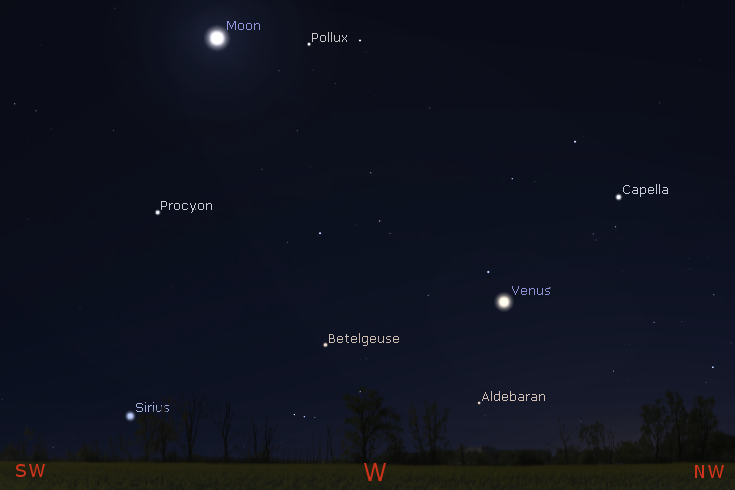
Venus and the fat crescent Moon tonight at 10 p.m. April 29, 2020. Click on the image to enlarge. Created using Stellarium.
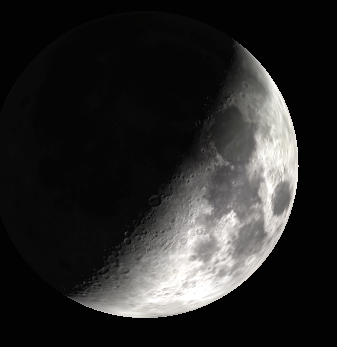
The Moon as it might appear in binoculars tonight April 29, 2020. Created using Stellarium,
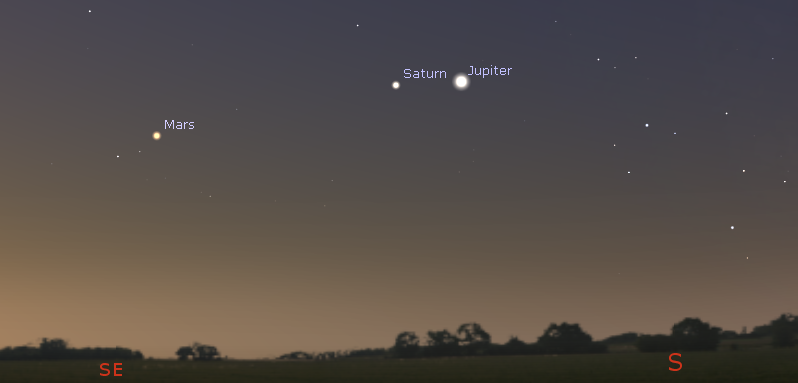
Morning planets in twilight at 6 a.m. tomorrow morning, April 30, 2020. Click on the image to enlarge. Created using Stellarium.
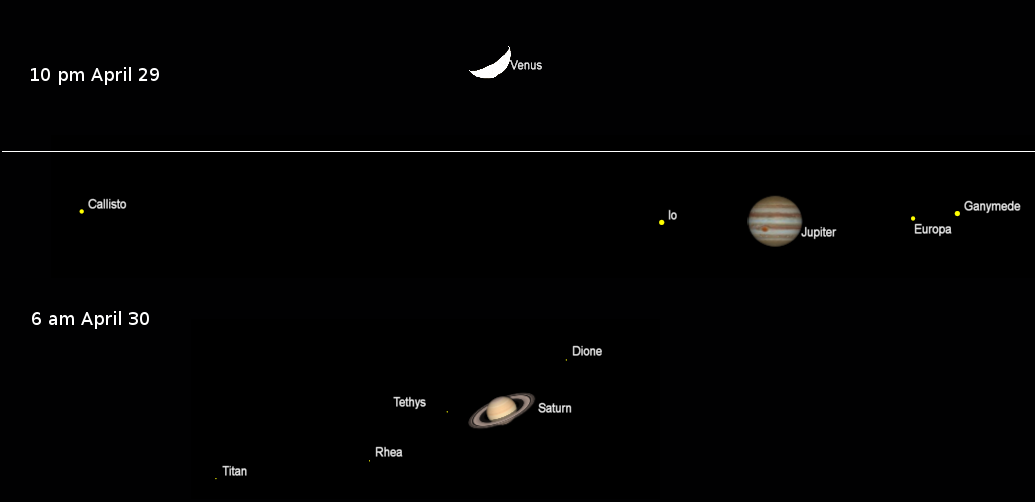
The planets as seen in a telescope with the same magnification. Venus in the evening and Jupiter and Saturn in the morning on the night of April 29/30, 2020. Apparent diameters: Venus, 40.58″; Jupiter, 40.62″; Saturn, 16.92″, rings, 39.42″. Mars at 7.59″ won’t be added until it reaches 10″. The ” symbol means seconds of arc (1/3600th of a degree.) Created using Cartes du Ciel (Sky Charts).
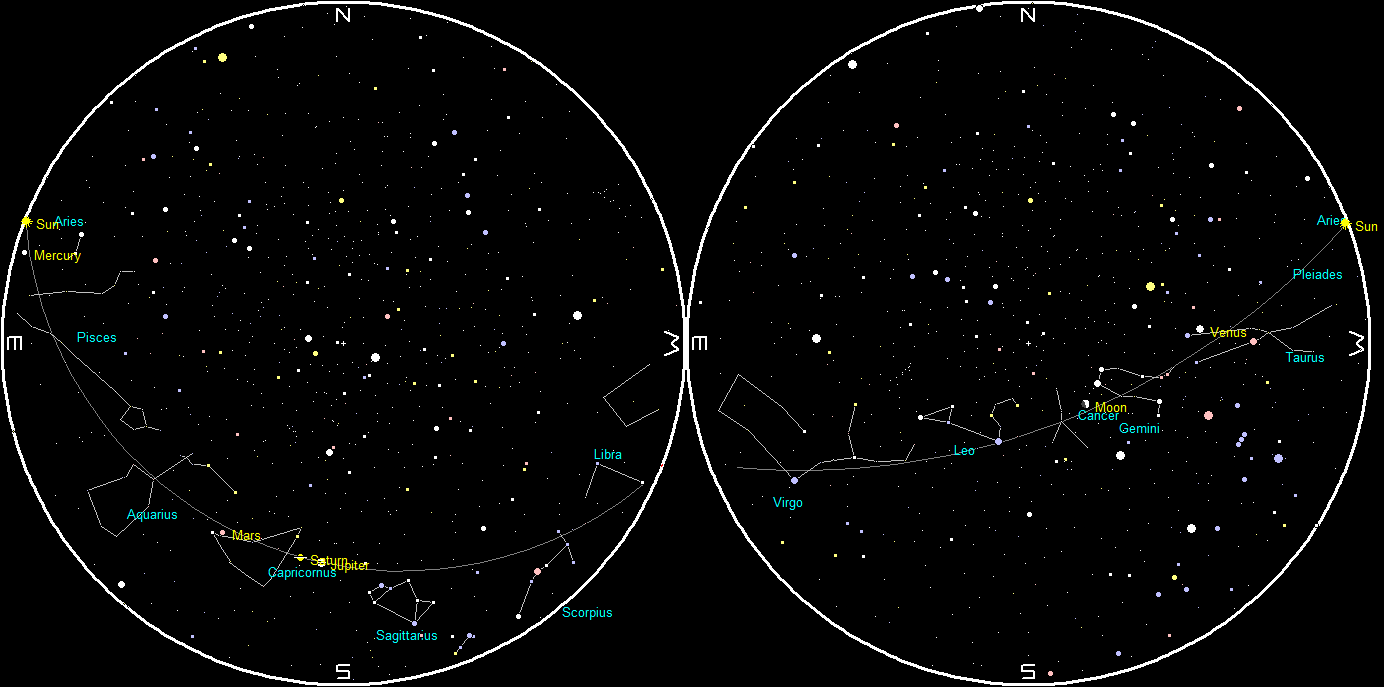
Planets and the Moon at sunset and sunrise of a single night starting with sunset on the right on April 29, 2020. The night ends on the left with sunrise on the 30th. The closeness of Jupiter and Saturn in the morning sky unfortunately overlays planets and labels. Click on the image to enlarge. Created using my LookingUp program.
04/28/2020 – Ephemeris – My life with the pandemic so far (A rare personal program)
This is Bob Moler with Ephemeris for Tuesday, April 28th. Today the Sun will be up for 14 hours and 8 minutes, setting at 8:44, and it will rise tomorrow at 6:34. The Moon, 2 days before first quarter, will set at 2:20 tomorrow morning.
The stay at home order from the Governor issued last week to stay home until at least May 15th was not a surprise to me. I’m at the vulnerable age group… old. Most of what I do is done at home anyway, though will I miss being an instructor for the Inland Seas Educational Association. I am usually on the schooner Manitou in the spring. My stroke in January would have precluded me sailing this spring anyway even if there was no virus to shut things down. Maybe this fall? I’m getting my garden ready. What’s an astronomer doing with all this earth bound stuff? Well it just happens that the Earth’s a planet too. I tend to think of it as spaceship Earth, hurtling around the Sun at 67,000 miles per hour (107,000 kph).
The event times given are for the Traverse City/Interlochen area of Michigan. They may be different for your location.
04/27/2020 – Ephemeris – Sunrise at Theophilus
This is Ephemeris for Monday, April 27th. Today the Sun will be up for 14 hours and 5 minutes, setting at 8:43, and it will rise tomorrow at 6:36. The Moon, 3 days before first quarter, will set at 1:26 tomorrow morning.
If my Moon charting software is correct this is the one evening out of the month when the central peak of the crater Theophilus catches the first rays of the rising Sun, while the crater floor is in shadow. It kind of looks like a bulls eye. It can be spotted with binoculars on the inside of the crescent, on the terminator, the sunrise line about half way between the ends of the crescent. Theophilus is 61 miles (101 km) in diameter. A telescope of any size with 30 to 50 power magnification will really bring out the detail. More magnification may be warranted, but if the bigger image becomes fuzzy, back off the power. It may be the diameter of your telescope due to the wave nature of light or the atmosphere you’re looking through that’s causing the problem.
The event times given are for the Traverse City/Interlochen area of Michigan. They may be different for your location.
Addendum
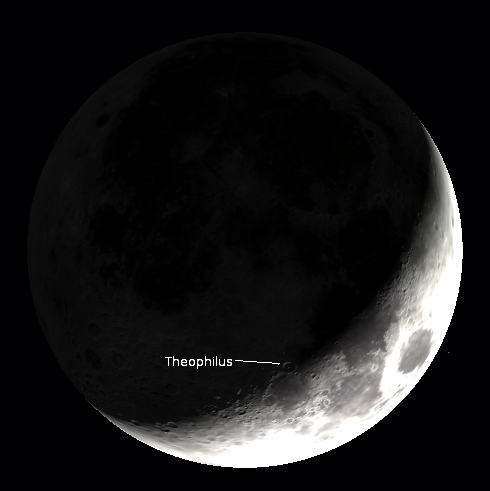
The Moon as it should appear at 10 p.m. tonight April 27, 2020 EDT (2:00 UT the 28th UT) with Theophilus on the terminator. Created with Stellarium.
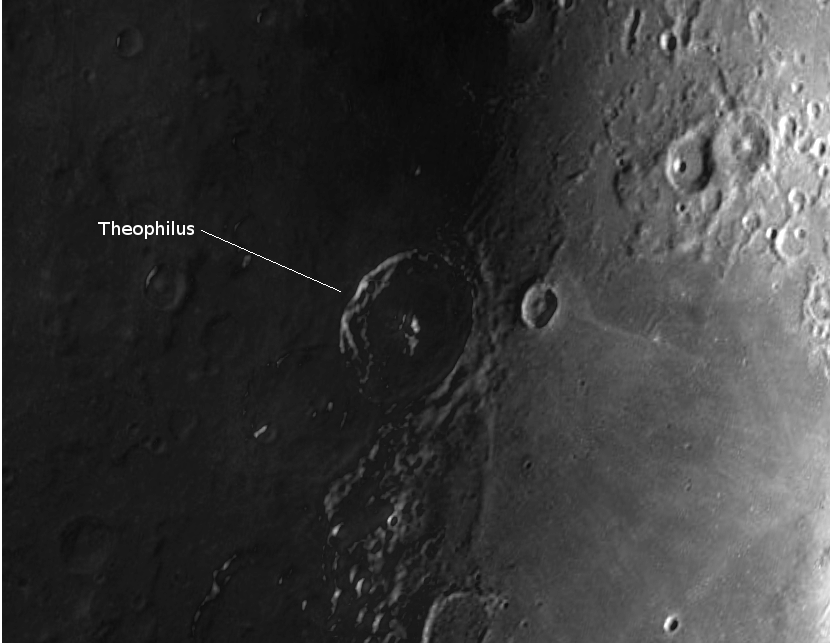
Theophilus at sunrise with the Sun illuminating the central peak and the far crater wall. Theophilus’ diameter is 61 miles or 101 kilometers in diameter. The crater walls rise 13 ,3000 feet or 4,400 meters above the crater floor, and the central mountain with four peaks rises 4,600 feet or 1,400 meters above the crater floor. Image and information from Virtual Moon Atlas. This image needs to be rotated clockwise about 45 degrees to match the image above.
04/24/2020 – Ephemeris – The Big Dipper can be used to point to other stars and constellations
This is Bob Moler with Ephemeris for Arbor Day, Friday, April 24th. Today the Sun will be up for 13 hours and 57 minutes, setting at 8:39, and it will rise tomorrow at 6:41. The Moon, 2 days past new, will set at 10:21 this evening.
The Big Dipper can be used to point to other stars and constellations. Right now the Big Dipper is nearly overhead. The front bowl stars point to Polaris, the North Star which never seems to move in the sky. The handle can be used to find two stars. First follow the arc of the handle away from the bowl to find the fourth brightest night-time star Arcturus in the base of the kite shaped constellation of Boötes. Straighten the arc to a spike and continue to the south and you will come to the bright blue-white star Spica in Virgo the virgin. You can remember these stars with the phrase “Follow the arc of the handle to Arcturus and then spike to Spica” or if you prefer the alternate pronunciation of the latter star “Speak to Speeka”.
The event times given are for the Traverse City/Interlochen area of Michigan. They may be different for your location.
Addendum
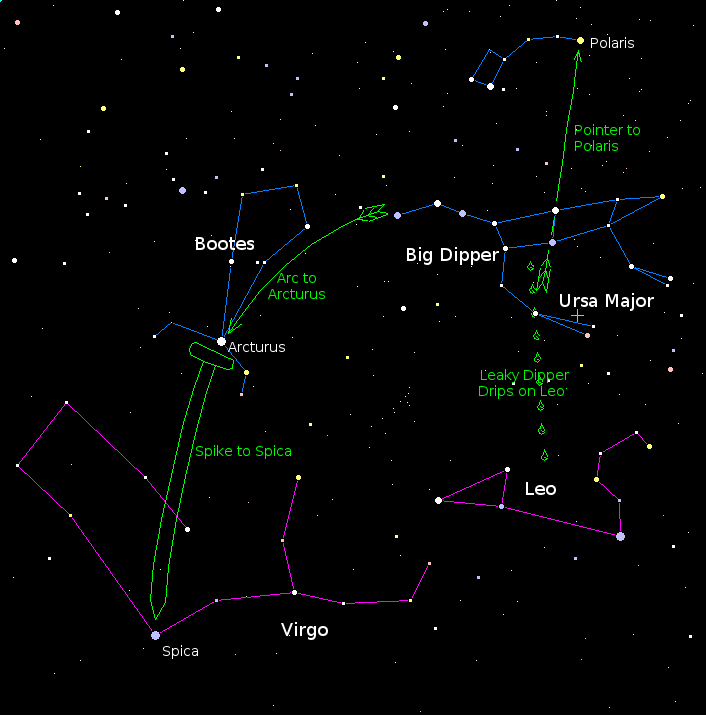
Finding stars and constellations using the Big Dipper. Click on the image to enlarge. Created using my LookingUp program for Windows.
04/23/2020 – Ephemeris – New Comet SWAN
This is Ephemeris for Thursday, April 23rd. Today the Sun will be up for 13 hours and 54 minutes, setting at 8:38, and it will rise tomorrow at 6:42. The Moon, 1 day past new, will set at 9:18 this evening.
Let’s get a preview of the newly discovered Comet SWAN. It was discovered using the Solar Wind Anisotropies or SWAN camera on the SOHO spacecraft hanging out a million miles (1.5 million km) sunward of the Earth. The SWAN instrument is the only one on the spacecraft not pointed at the Sun. Its to study where the solar wind interacts with the interstellar medium of hydrogen. The comet must have been producing an extraordinary amount of hydrogen to be noticed, so the comet may have had an outburst, and it may fade to its normally dim self after a while. That means it may not be naked-eye by the middle of next month. Assuming this was no outburst, the comet will make its naked-eye debut low in the northwest near the end of twilight in late May. I’ll have updates as we go.
The event times given are for the Traverse City/Interlochen area of Michigan. They may be different for your location.
Addendum
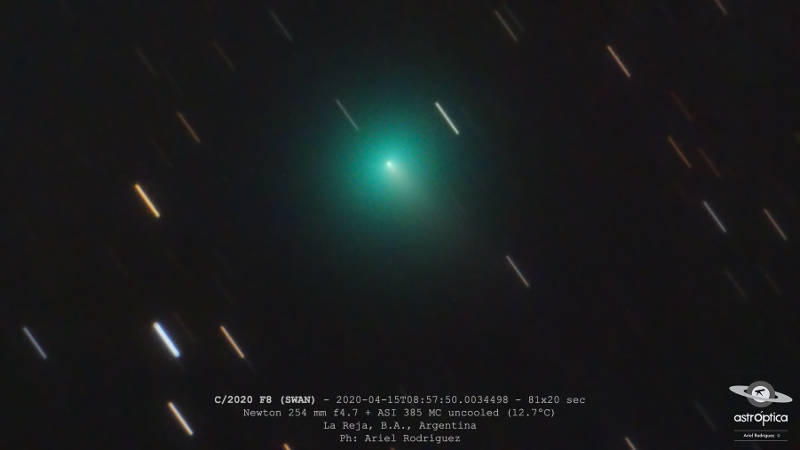
Comet C/2020 F8 (SWAN) photographed by Ariel Rodriguez, La Reja, Argentina. Click on the image to enlarge. Retrieved from Seiichi Yoshida’s web site. See link below.
04/22/2020 – Ephemeris – Our weekly look at the naked-eye planets
This is Ephemeris for Earth Day, Wednesday, April 22nd. Today the Sun will be up for 13 hours and 51 minutes, setting at 8:37, and it will rise tomorrow at 6:44. The Moon is new today, and won’t be visible.
Let’s look at the naked-eye planets for this week. Venus is our evening star shining brightly in the west. It will set at 12:35 a.m. The rest of the planet action is in the morning sky where there are three planets fairly close together in the south-southeast. Bright Jupiter will rise first at 2:55 a.m. Followed by Saturn at 3:11 a.m. Mars, stretching its lead left of Saturn, will rise at 4 a.m. It’s now down to 120 million miles (193 million km) away, as the Earth slowly overtakes it at the rate of about 5 million miles (8 million km) a week. Mars will be closest to us in October at about 39 million miles (62 million km). That’s not as close as it was 2 years ago, but closer than it will get for the next 15 years.
The event times given are for the Traverse City/Interlochen area of Michigan. They may be different for your location.
Addendum
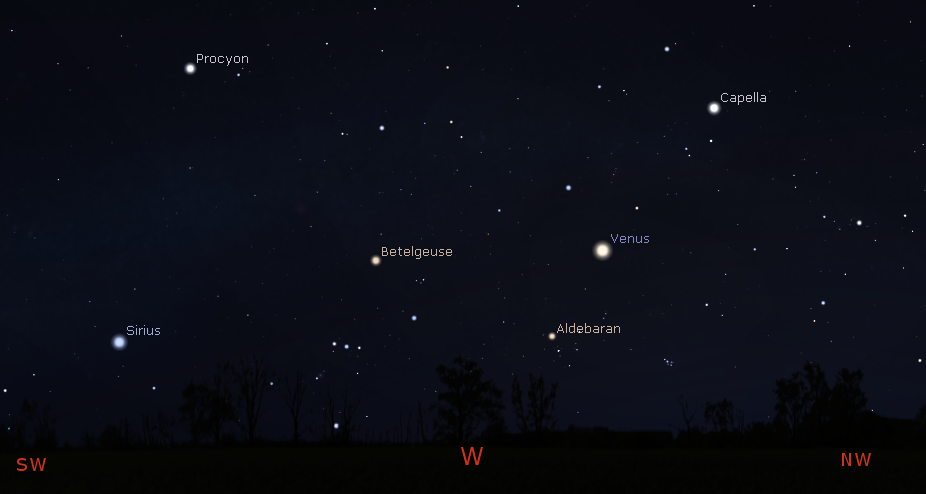
Venus in the west-northwest at 10 p.m. tonight, April 22, 2020. Click on the image to enlarge. Created using Stellarium.
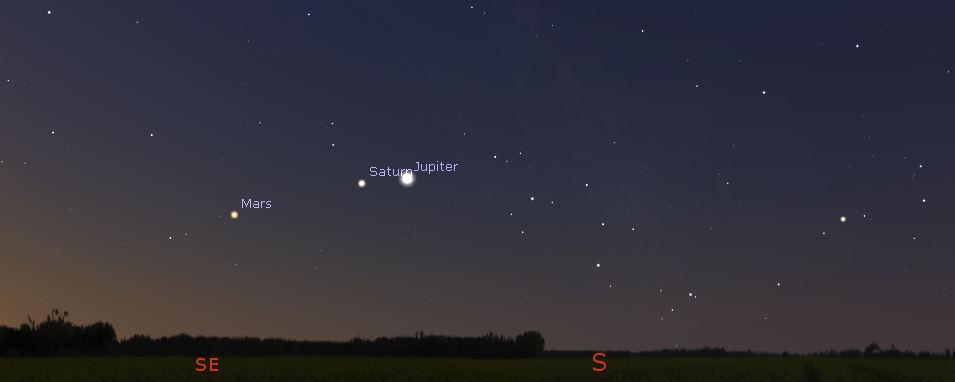
The Morning planets and the southern summer stars at 6 a.m. tomorrow April 23, 2020. Click on the image to enlarge. Created using Stellarium.
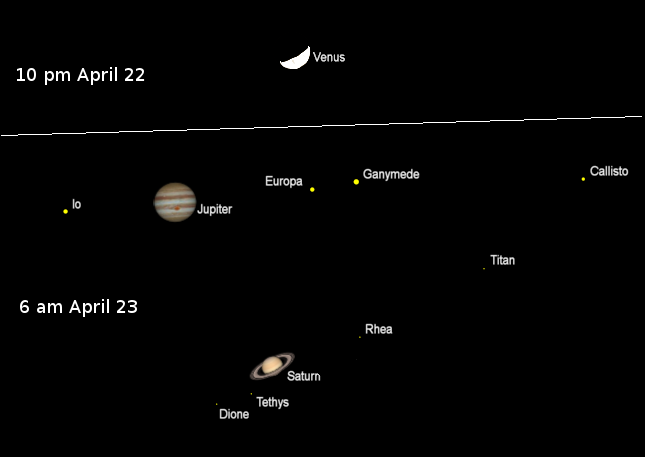
The planets as seen in a telescope with the same magnification. Venus in the evening and Jupiter and Saturn in the morning on the night of April 22/23, 2020. Apparent diameters: Venus, 34.36″; Jupiter, 39.72″; Saturn, 16.73″, rings, 38.96″. Mars at 7.28″ won’t be added until it reaches 10″. The ” symbol means seconds of arc (1/3600th of a degree.) Created using Cartes du Ciel (Sky Charts).
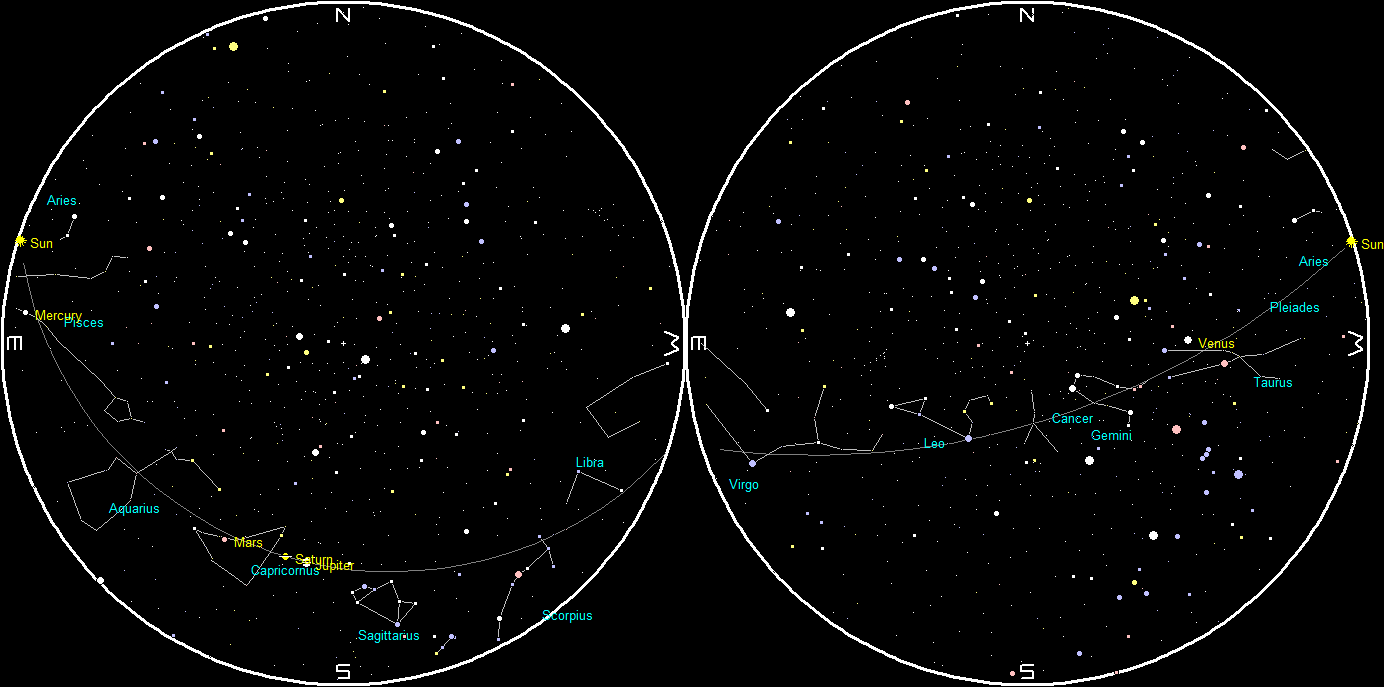
Planets and the Moon at sunset and sunrise of a single night starting with sunset on the right on April 22, 2020. The night ends on the left with sunrise on the 23rd. The closeness of Jupiter and Saturn in the morning sky unfortunately overlays planets and labels. Click on the image to enlarge. Created using my LookingUp program.
04/21/2020 – Ephemeris – The Lyrid Meteor Shower will reach its peak after midnight tonight
This is Ephemeris for Tuesday, April 21st. Today the Sun will be up for 13 hours and 48 minutes, setting at 8:36, and it will rise tomorrow at 6:45. The Moon, 1 day before new, will rise at 6:58 tomorrow morning.
The Lyrid meteor shower will reach its peak tomorrow morning at around 2 a.m. The Moon will be new tomorrow so it won’t interfere. The radiant point, from which the meteor seem to come is between the constellation Lyra the harp for which they are named with its bright star Vega and Hercules. The numbers of meteors seen in an hour could be between 12 and 20. The Lyrids are caused by the debris left when a comet last seen in 1861, crossed Earth’s orbit as Comet Thacher. Speaking of comets, a new comet named SWAN was discovered a month ago. It was detected by with the Solar Wind An-iso-tropies camera or SWAN aboard the Solar and Heliospheric Observatory or (SOHO) spacecraft. We’ll follow Comet SWAN as it approaches the Sun next month.
The event times given are for the Traverse City/Interlochen area of Michigan. They may be different for your location.
Addendum
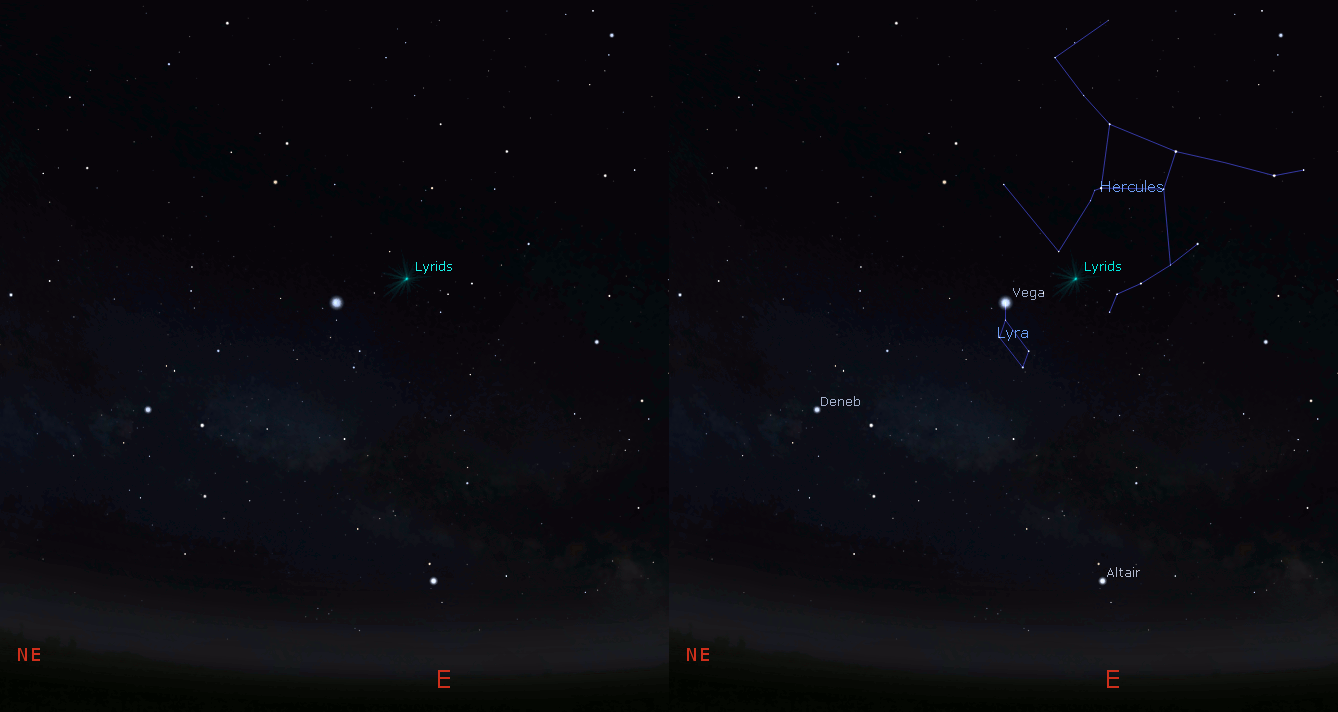
An animation Looking east at 2 a.m. April 22, 2020 toward Lyra, and Hercules with the Lyrid meteor radiant. The named stars are the stars of the Summer Triangle. Click on the image to enlarge. The meteors will appear all over the sky, but Lyrid meteors can be back traced to the radiant point. Created using Stellarium and GIMP.
04/20/2020 – Ephemeris – The Little King Star
This is Ephemeris for Monday, April 20th. Today the Sun will be up for 13 hours and 45 minutes, setting at 8:34, and it will rise tomorrow at 6:47. The Moon, 2 days before new, will rise at 6:37 tomorrow morning.
The brightest star in the constellation Leo, which is high in the south these evenings is Regulus, whose name means “Little King”. It is appropriate due to its position in the heart of the king of beasts Leo the lion. Regulus is dead last in brightness of the 21 first magnitude stars, the brightest night-time stars. Even so, it is much brighter than the Sun. It is 79 light years away. The Sun would require a telescope to be spotted at that distance. Regulus appears to be a quadruple star system. The bright star itself is really two stars with a bright star orbited by a much dimmer star every 40 days. There are two dimmer stars much further out that share Regulus’ motion through space. There are an infinite variety of star system arrangements in the galaxy and beyond.
The event times given are for the Traverse City/Interlochen area of Michigan. They may be different for your location.
Addendum
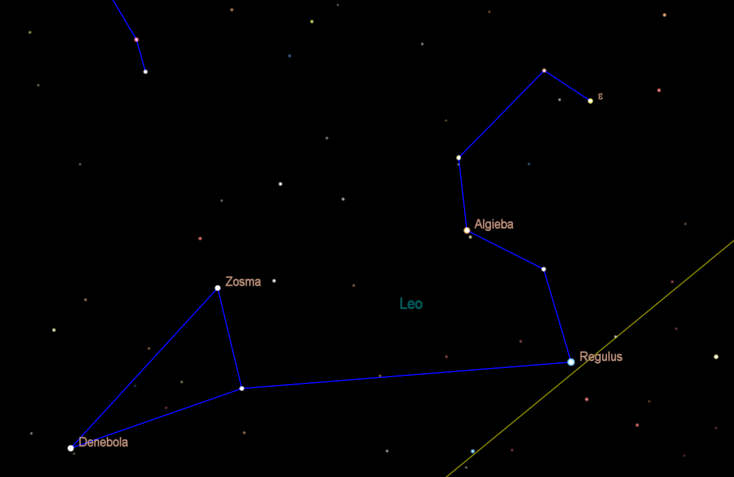
The naked eye stars of Leo, including Regulus at 9:30 p.m. April 20, 2020. Note that Algieba is a binary star that can be seen in small telescopes. The yellow line that passes Regulus is the ecliptic the apparent path of the Sun. The Moon and planets also hang out near that line. Created using Cartes du Ciel (Sky Charts).
04/17/2020 – Ephemeris – More on Comet ATLAS
One of the problems that can happen when you record programs several days before they are aired is that events can get ahead of you. Comet ATLAS is disintegrating and won’t get any brighter than it already is. This program was written after I read reports that the comet had faded but the full ramifications of the fading were not known.
This is Bob Moler with Ephemeris for Friday, April 17th. Today the Sun will be up for 13 hours and 36 minutes, setting at 8:31, and it will rise tomorrow at 6:52. The Moon, 3 days past last quarter, will rise at 5:32 tomorrow morning.
Lets talk more about Comet C/2019 Y4 (ATLAS). For this program I talk about celestial sights visible to the naked-eye or are easily found in binoculars. Each program script is posted on this blog usually with images and charts. The blog postings are generally illustrated. Anyway, it seems that Comet ATLAS is breaking up. With the Neil Sedaka’s 1960 song “Breakin up is hard to do” to the contrary, for comets breaking up is quite easy. They are porous assemblages of bits of dust, pebbles and frozen gasses. It is already most likely a chip off the old block.. er comet. It follows the same orbit as the Great Comet of 1844. Both of these could be parts of an even larger comet passing the Sun 6 or maybe even 12 thousand years ago.
The event times given are for the Traverse City/Interlochen area of Michigan. They may be different for your location.
Addendum
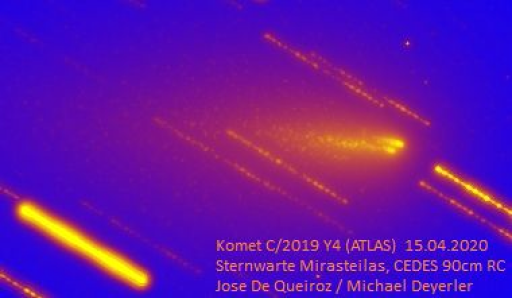
Comet ATLAS C/2019 Y4 showing two nuclei on April 15, 2020. Credit: Jose De Queiroz and Michael Deyerler from Switzerland’s public Mirasteilas Observatory. Copied from Spaceweather.com. The streaks are stars as the telescope was tracking the comet during the exposure.
An even newer discovered comet may make it to naked-eye visibility late next month, if it holds together. I’ll talk about Comet C/2020 F8 (SWAN) next Tuesday.
 Bob Moler's Ephemeris Blog