Archive
07/17/2020 – Ephemeris – Viewing Comet C/2020 F3 (NEOWISE) this weekend
This is Ephemeris for Friday, July 17th. Today the Sun will be up for 15 hours and 9 minutes, setting at 9:23, and it will rise tomorrow at 6:14. The Moon, 3 days before new, will rise at 4:01 tomorrow morning.
With Comet NEOWISE visible low in the northwest around 11 pm, one might wonder just what a comet is. Comets in general scared the crap out of the peoples of Eurasia. Comets gate crashed the perfect order of the cosmos they had thought up and supposedly caused all sorts of mayhem. As far as I’m concerned this comet is the one bright spot so far this year. A comet is mostly nothing. NEOWISE has a solid nucleus which is perhaps 3 miles (5 km) in diameter and a tail of many million of miles (km) long. If that nucleus was rock instead of frozen gasses, water and pebbles one would need a good sized telescope to spot it. Instead the gasses evaporate creating a giant head that rivals Jupiter in size and a tail all considered pretty good vacuum by earthly standards.
The event times given are for the Traverse City/Interlochen area of Michigan. They may be different for your location.
Addendum
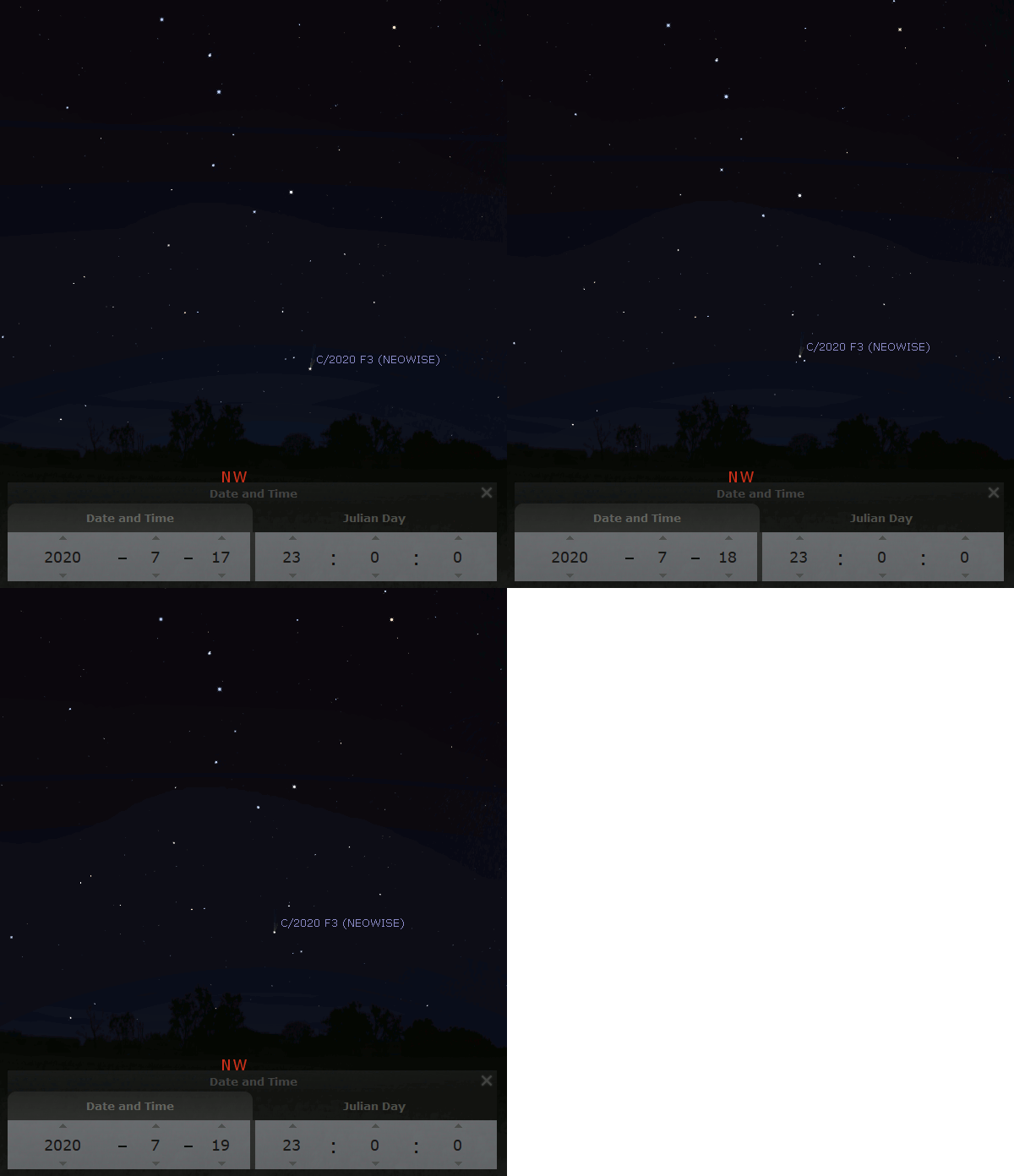
An animation showing the position of Comet NEOWISE at 11 pm (or approximately an hour and a half after sunset if you’re not from Northern Michigan) for Friday, Saturday and Sunday evenings July 17-19, 2020. Created using Stellarium.
Update
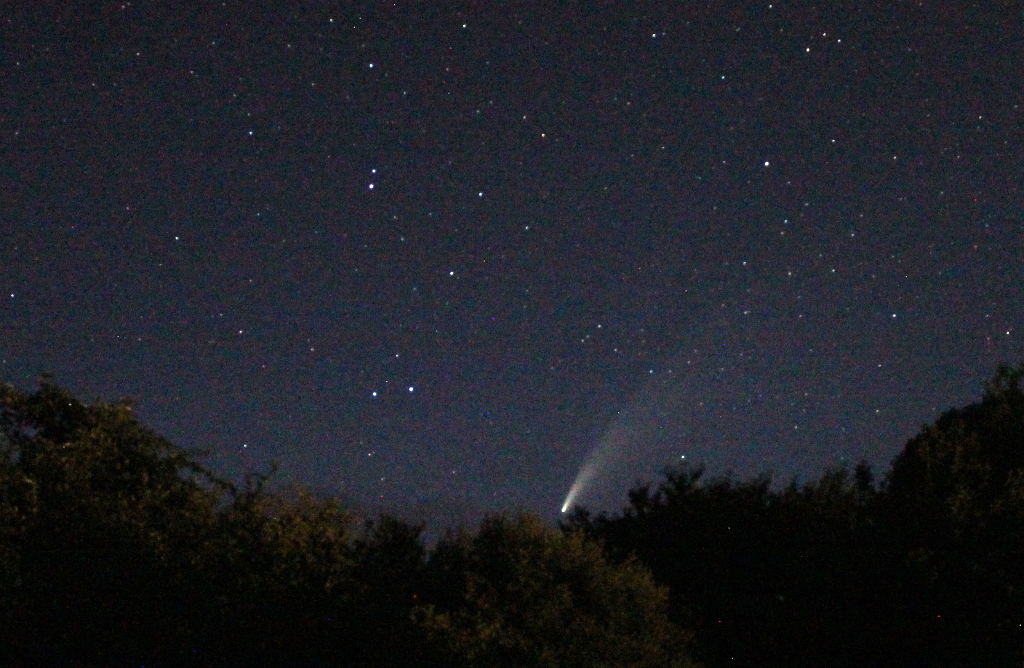
Comet NEOWISE from backyard over tall shrubbery 11:18 pm July 16, 2020. I didn’t have time to focus properly which actually accentuates the stars.
07/16/2020 – Ephemeris – Comet NEOWISE’ orbit and path in our skies
This is Ephemeris for Thursday, July 16th. Today the Sun will be up for 15 hours and 11 minutes, setting at 9:24, and it will rise tomorrow at 6:13. The Moon, half way from last quarter to new, will rise at 3:20 tomorrow morning.
Comet NEOWISE is now visible in the northwest at about 11:00 pm. It doesn’t fare too well in twilight. The tail will be near vertical but tilted a bit to the right. The comet’s orbit is tilted about 40 degrees to the Earth’s orbital plane and it is traveling opposite the traffic flow of the planets and asteroids of the solar system. It came from the south and is reaching its northern most position before heading back to the south. It is actually circumpolar now, meaning it is far enough north in our sky so it doesn’t set for those of us in the Grand Traverse region for another 6 days. Its low point will be just scraping the northern horizon. It is still visible in the morning in the northeast, but the evening time is now the best time to view it.
The event times given are for the Traverse City/Interlochen area of Michigan. They may be different for your location.
Addendum
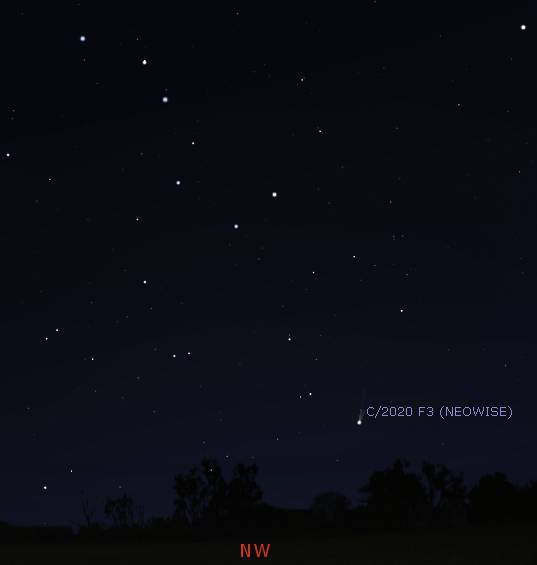
Comet 2020 F3 NEOWISE at 11 pm July 16, 2020, approximately an hour and a half after sunset. Created using Stellarium.
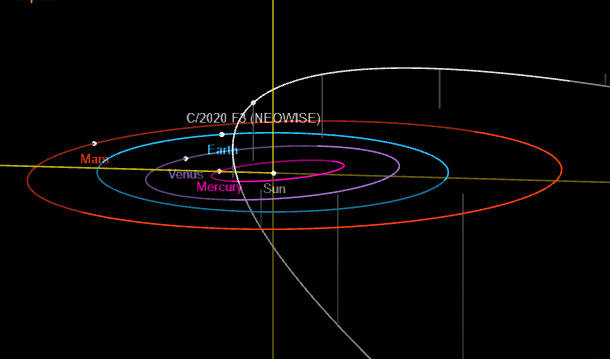
C/2020 F3 (NEOWISE) orbit. Comet position at July 16 at 8 pm EDT: Earth distance 0.765 au, Sun distance 0.479 au. Credit JPL Small-Body Browser
07/15/2020 – Ephemeris – Let’s look at a comet and the naked-eye planets for this week
This is Ephemeris for Wednesday, July 15th. Today the Sun will be up for 15 hours and 13 minutes, setting at 9:25, and it will rise tomorrow at 6:12. The Moon, 3 days past last quarter, will rise at 2:47 tomorrow morning.
Let’s look at a comet and naked-eye planets for this week. Jupiter now rises before sunset and now is an official evening planet. It’s seen low in the southeast in the evening. To the left of it will be Saturn. The next planet up will be Mars which will rise at 12:41 am. Its now down to 67.8 million miles (109.2 million km) away, as the Earth slowly overtakes it at the rate of about 3.7 million miles (6 million km) a week. Venus will rise at 3:33 am in the east-northeast as our Morning Star. Newly discovered Comet NEOWISE is now visible in the evening sky A good time to start looking would be about 10:45 pm toward the northwest. The comet is trending brighter than early predictions and sports a wide tail. The comet gets its name from the NASA Satellite and mission to detect near Earth objects or NEOs in the infrared.
The event times given are for the Traverse City/Interlochen area of Michigan. They may be different for your location.
Addendum
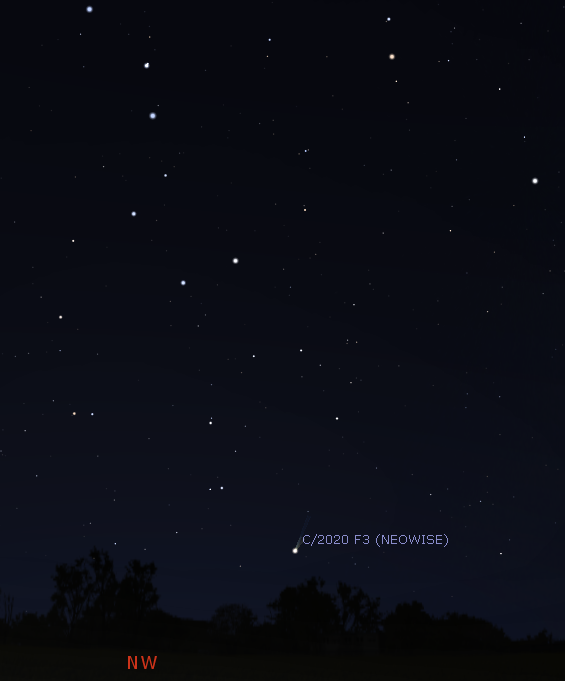
Comet NEOWISE in the evening tonight July 15, 2020 at 11 pm. The comet’s head or coma is shown somewhat brighter than it actually appears. What shows up first is the streak oa the tail. 11 pm here in western Michigan is equivalent to about an hour and a half after sunset. Created using Stellarium.
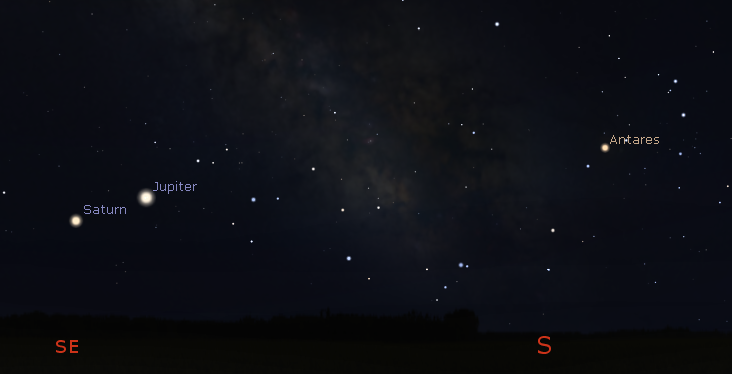
Saturn and Jupiter in the evening tonight at 11 pm July 15, 2020. Also shown are the stars of the Teapot of Sagittarius and Scorpius to the right. Click on the image to enlarge. Created using Stellarium.
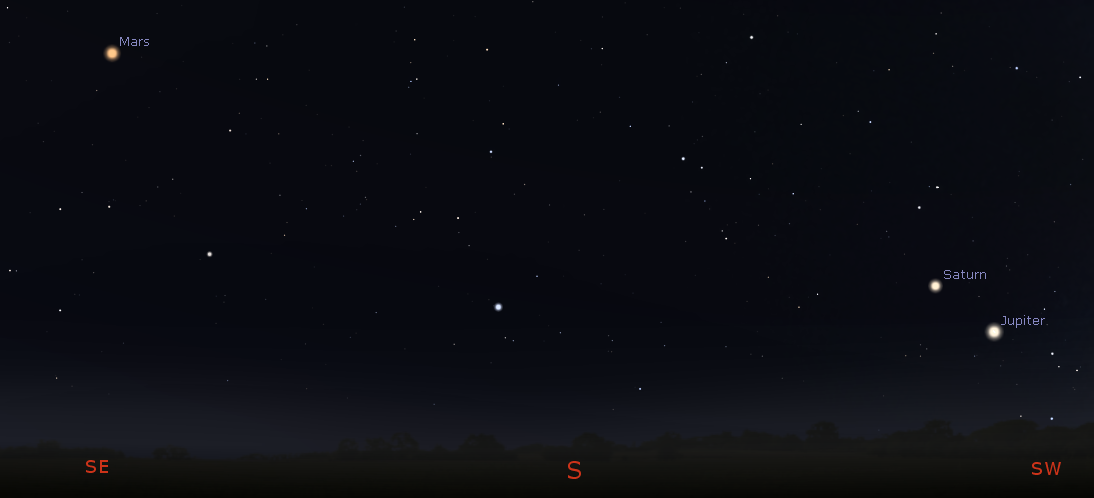
Mars, Saturn and Jupiter at 4:30 tomorrow morning July 16, 2020. Click on the image to enlarge. Created using Stellarium.
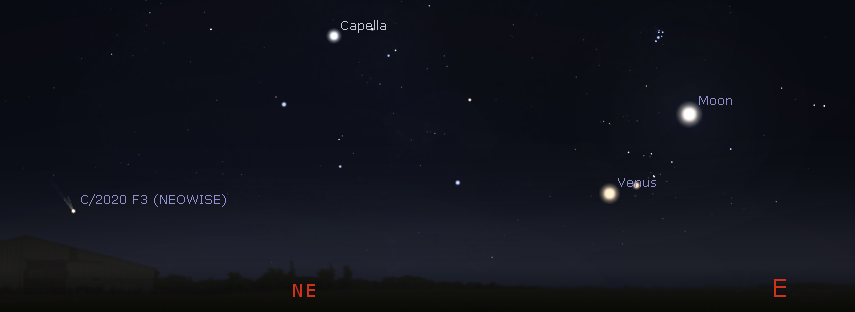
Venus, the Moon and the comet in the morning at 4:30 am or about an hour, 45 minutes before sunrise. Click on the image to enlarge. Created using Stellarium.
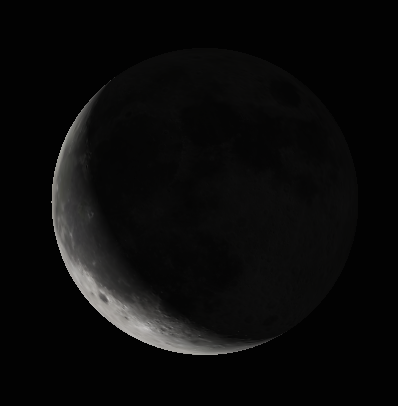
Binocular Moon tomorrow morning at 4:30 a.m. July 16, 2020. The large dark gray area centered on the 9 o’clock position that dominates the crescent is Oceanus Procellarum (Ocean of Storms). The dark floored crater near the limb at the 8 o’clock position is Grimaldi. Created using Stellarium.
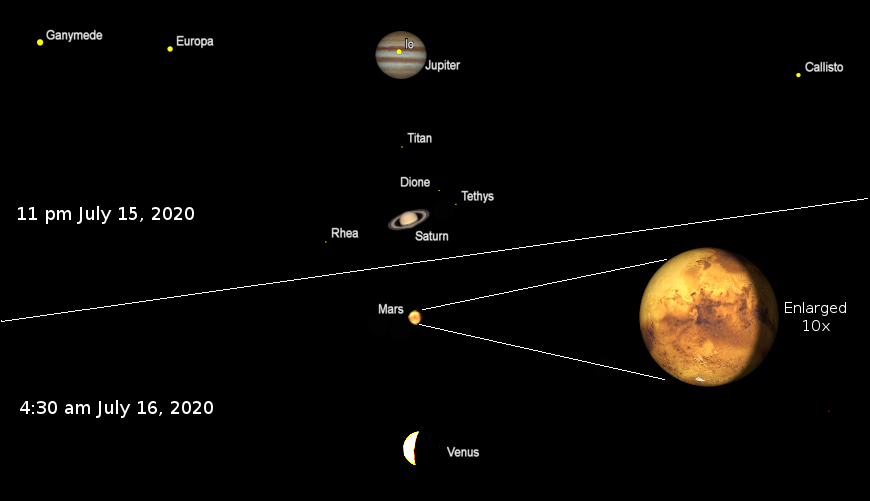
The planets as seen in a telescope (north up) with the same magnification tonight and tomorrow July 15/16, 2020. Apparent diameters: Jupiter, 47.63″; Saturn, 18.47″, rings, 43.02″, Mars, 12.87″, and Venus 33.81″. At 11 pm the moon Io is transiting the face of Jupiter. I’ve ever been able to spot a moon in transit, though I can sometimes see the shadow cast on the planet. By 4:30 am Io will appear next to Jupiter on the same side as Callisto. Mars also displays an enlargement showing surface detail. The ” symbol means seconds of arc (1/3600th of a degree.) Created using Cartes du Ciel (Sky Charts).
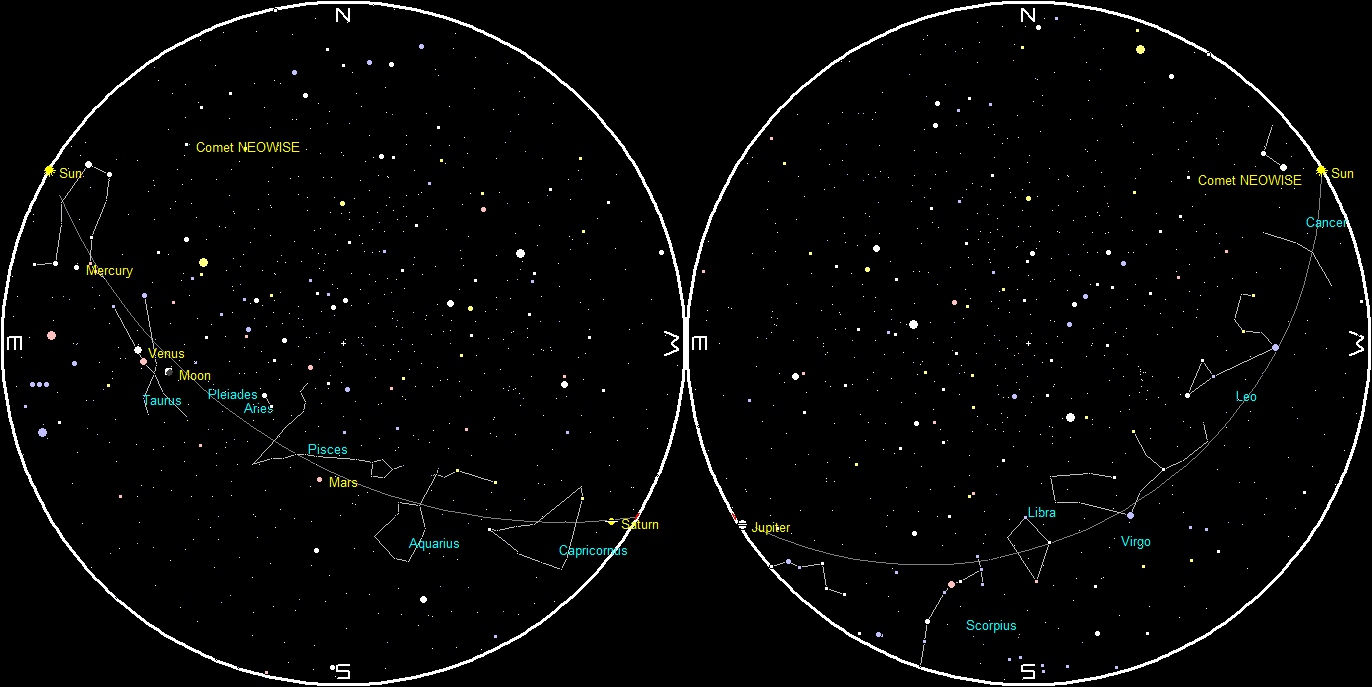
Planets, a comet, and the Moon at sunset and sunrise of a single night starting with sunset on the right on July 15, 2020. The night ends on the left with sunrise on the 16th. Jupiter made it into the evening sky yesterday when it passed opposition. Saturn will do the same on the 20th. Click on the image to enlarge. Created using my LookingUp program.
07/14/2020 – Ephemeris – Comet NEOWISE is now visible in the evening sky
This is Ephemeris for Tuesday, July 14th. Today the Sun will be up for 15 hours and 14 minutes, setting at 9:25, and it will rise tomorrow at 6:11. The Moon, 2 days past last quarter, will rise at 2:19 tomorrow morning.
Comet C/2020 F3 also known as NEOWISE a NASA acronym was discovered in late March by the Wide-Field Infrared Survey Explorer or WISE spacecraft on its add-on mission. It was looking for Near Earth Objects or NEOs, hence the name NEOWISE. The comet passed its closest to the Sun on July 3rd and is now outbound on its nearly 7,000 year orbit. It’s now visible in the evening sky seen generally below the Big Dipper in the northwestern sky but much closer to the horizon as soon as it gets sufficiently dark. Binoculars will help you locate the comet which should be of naked-eye brightness for the rest of the month, though it will be fading all the way, though it now appears brighter than predicted. Also photographs make the comet appear brighter than it is to the eye.
The event times given are for the Traverse City/Interlochen area of Michigan. They may be different for your location.
Addendum

My photograph of Comet NEOWISE at 4:40 am Sunday morning July 12, 2020 over the west arm of Grand Traverse Bay south of the Discovery Pier off M22. (For non-Michigander astronomers M22 is not the globular star cluster in Sagittarius, but a very scenic Michigan state road.) Click on the image to enlarge.
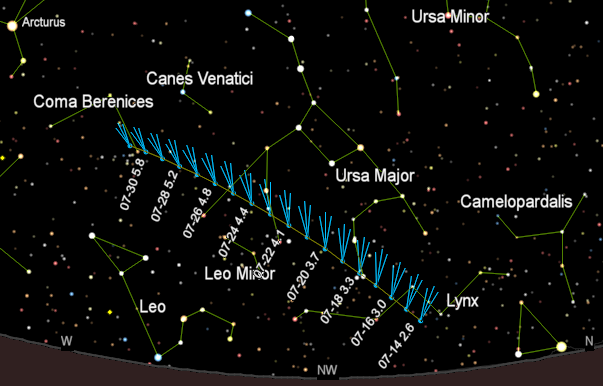
Comet NEOWISE in the evening for July 14, 2020 to July 31, 2020. The horizon is for July 14th at 11 p.m. Click on the image to enlarge. Created using Cartes du Ciel (Sky Chart).
07/13/2020 – Ephemeris – The constellation of Ajijaak, the crane
This is Bob Moler with Ephemeris for Monday, July 13th. Today the Sun will be up for 15 hours and 16 minutes, setting at 9:26, and it will rise tomorrow at 6:11. The Moon, 1 day past last quarter, will rise at 1:55 tomorrow morning.
Friday I looked at the constellation of Cygnus the swan and the informal constellation or asterism made from most of its stars the Northern Cross. Cygnus is the official International Astronomical Union constellation name. However the indigenous Anishinaabe people of our area had another bird in mind when seeing these stars, which are now fairly high in the east in the evening: Ajijaak, (pronounced a-ji-jock) a Sand Hill crane. While the swan is flying, neck outstretched to the south through the Milky Way, the crane is flying northward with its long legs trailing behind. The bright star Deneb is at his head. Where I live I see more cranes than swans these days and hear their creaking-door-like calls, and see a pair from time to time in a field south of where I live.
The event times given are for the Traverse City/Interlochen area of Michigan. They may be different for your location.
Addendum
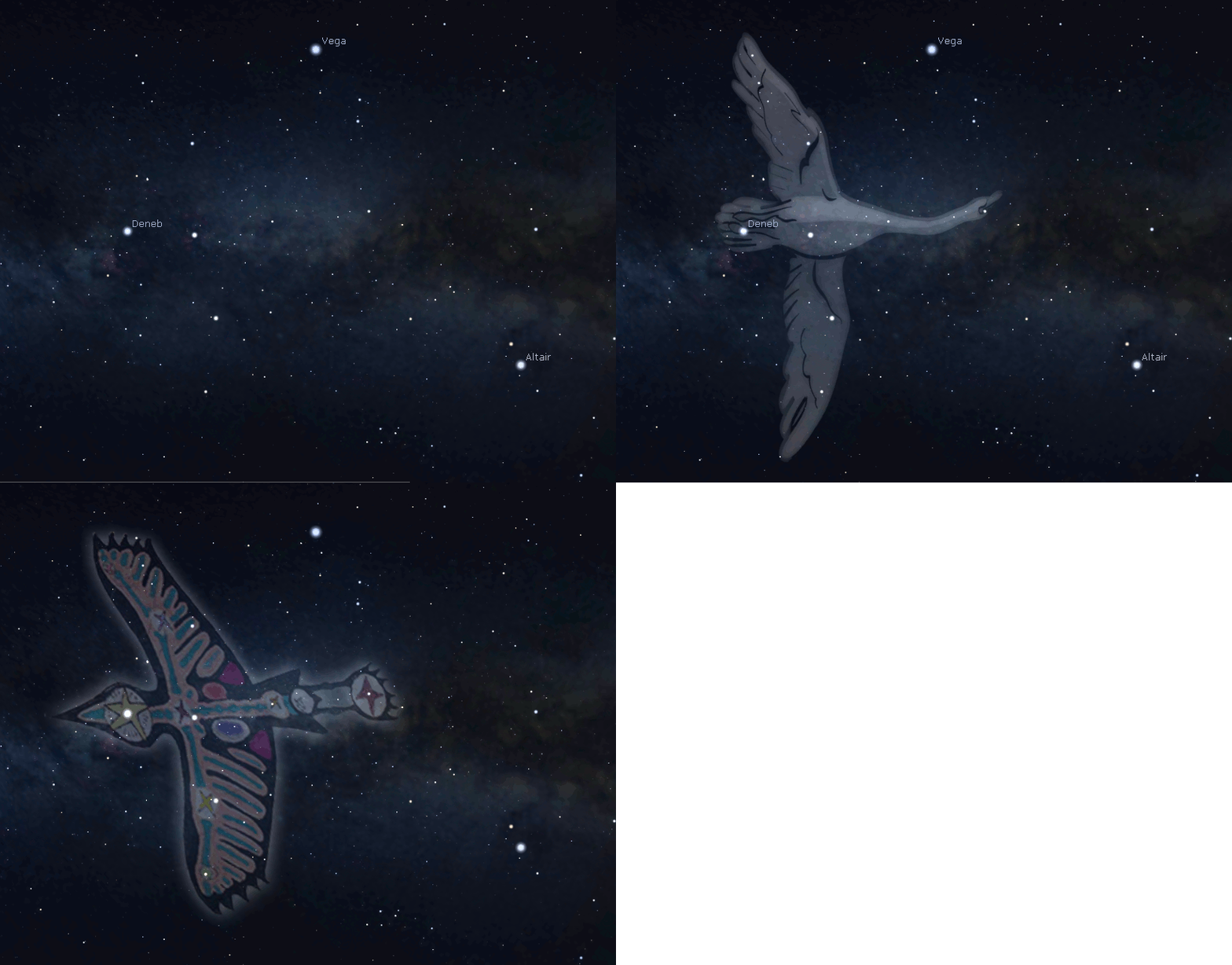
The IAU Cygnus the swan and the Anishinaabe Ajijaak the crane constellations demonstrated via an animated GIF image. Note the bright star of the Summer Triangle. Click on the Image to enlarge it. Created using Stellarium (both star lore images are embedded in Stellarium). The Anishinaabe image is from Ojibwe Giizhig Anung Masinaaigan – Ojibiwe Sky Star Map created by A. Lee, W. Wilson, and C. Gawboy.
07/10/2020 – Ephemeris – The constellation Cygnus the swan
This is Bob Moler with Ephemeris for Friday, July 10th. Today the Sun will be up for 15 hours and 20 minutes, setting at 9:28, and it will rise tomorrow at 6:08. The Moon, 2 days before last quarter, will rise at 12:52 tomorrow morning.
Fairly high in the east at 11 p.m. Is the constellation of Cygnus the swan, flying south through the Milky Way. It is also called the Northern Cross. At the left, the tail of the swan or the head of the cross is the bright star Deneb, one of the stars of the Summer Triangle. The next star right is Sadr the intersection of the body and the wings of the swan seen in flight, or the intersection of the two pieces of the cross. There are two or three stars farther to the right that delineate the swan’s long neck or upright of the cross, that ends with the star Alberio in the beak of the swan or foot of the cross. The crosspiece of the cross extends to the stars on either side of the intersection star Sadr, while the swan’s wings extend to a couple more stars each.
The event times given are for the Traverse City/Interlochen area of Michigan. They may be different for your location.
Addendum
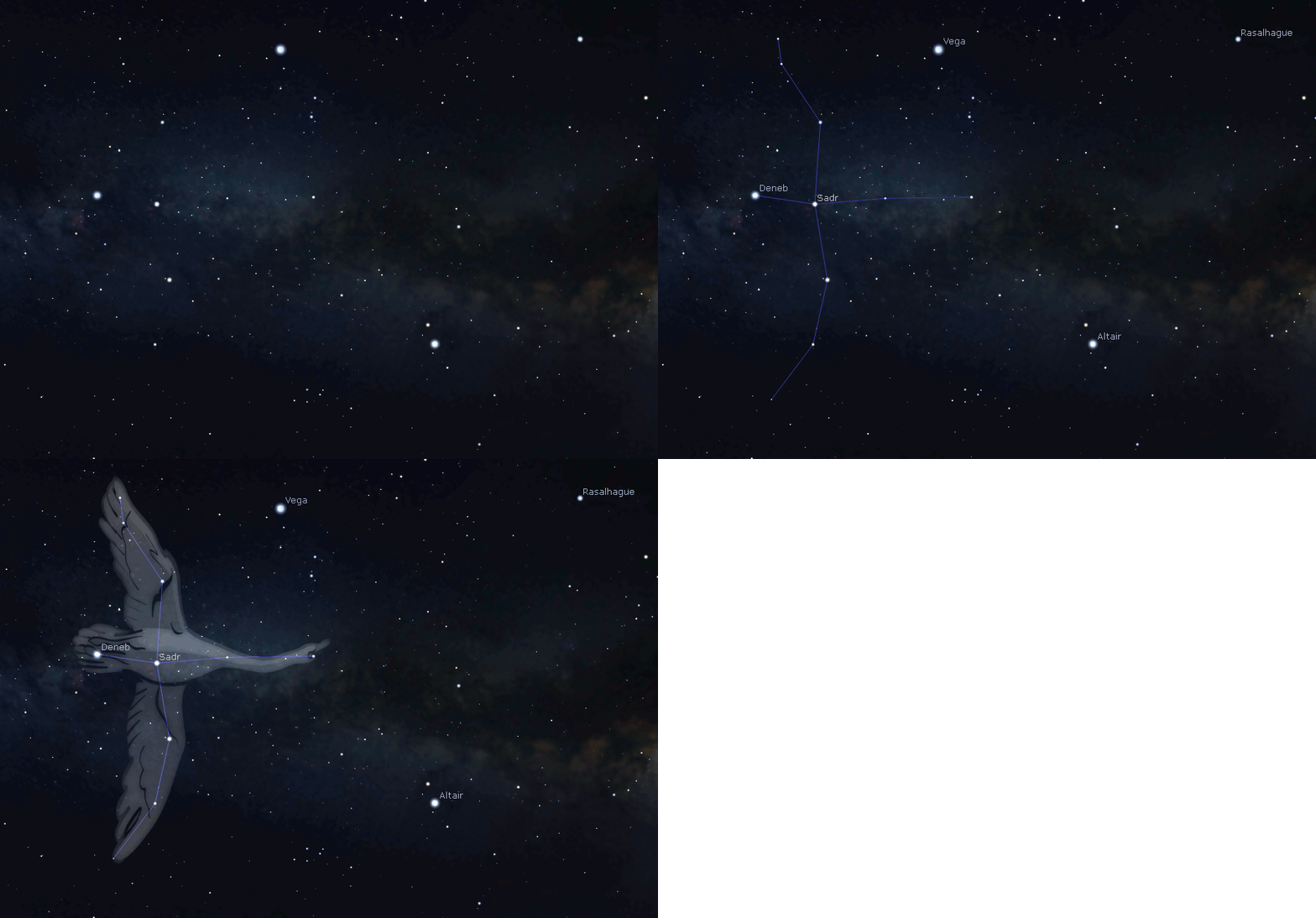
Animated Cygnus finder chart. Included also are, beside Deneb, the other stars of the Summer Triangle: Vega and Altair and their constellations Lyra the harp and Aquila. See if you can find them. Click on the image to enlarge it. Created using Stellarium.
07/09/2020 – Ephemeris – The constellation of Lyra the harp
Jul 9. This is Bob Moler with Ephemeris for Thursday, July 9th. Today the Sun will be up for 15 hours and 22 minutes, setting at 9:29, and it will rise tomorrow at 6:07. The Moon, 3 days before last quarter, will rise at 12:30 tomorrow morning.
High in the east at 11 p.m. can be found a bright star just above a small, narrow, but very distinctive parallelogram of stars. They are the stars of the constellation Lyra the harp. The bright star is Vega the 5th brightest night-time star. To the Romans the star Vega represented a falling eagle or vulture. Apparently they never made the distinction between the two. It is a pure white star and serves as a calibration star for color and brightness. The harp, according to Greek mythology, was invented by the god Hermes. The form of the harp in the sky, is as he had invented it: by stretching strings across a tortoise-shell. Hermes gave it to his half-brother Apollo, who in turn gave it to the legendary musician Orpheus.
The event times given are for the Traverse City/Interlochen area of Michigan. They may be different for your location.
Addendum
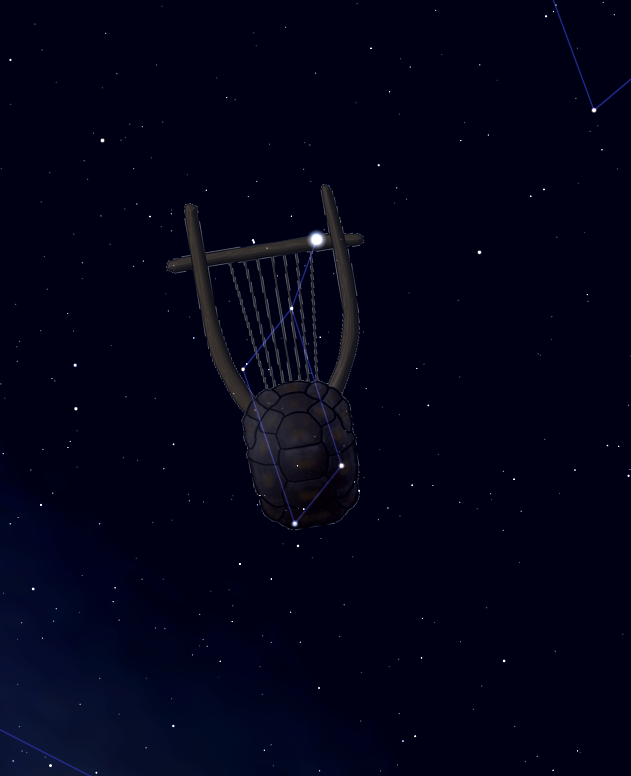
Lyra as a tortoise shell harp. Created using Stellarium and free clip art.
07/08/2020 – Ephemeris – Let’s look at the naked-eye planets and a comet for this week
This is Bob Moler with Ephemeris for Wednesday, July 8th. Today the Sun will be up for 15 hours and 23 minutes, setting at 9:29, and it will rise tomorrow at 6:06. The Moon, 3 days past full, will rise at 12:05 tomorrow morning.
Let’s look at the naked-eye planets and a comet for this week. Jupiter now rises at 9:41 pm in the east-southeast. Saturn will rise 22 minutes later at 10:03 pm right behind Jupiter. Mars, is stretching its lead left of Saturn and will rise at 1 am in the east. Its now down to 71 and a half million miles (115.2 million km) away, as the Earth slowly overtakes it at the rate of about 3.9 million miles (6.2 million km) a week. Venus will rise at 3:47 am in the east-northeast as our Morning Star. Newly discovered Comet NEOWISE will rise at 3:16 am and be visible in the northeast before the twilit sky brightens too much. The comet gets its name from the NASA Satellite and mission to detect near Earth objects or NEOs in the infrared.
The event times given are for the Traverse City/Interlochen area of Michigan. They may be different for your location.
Addendum
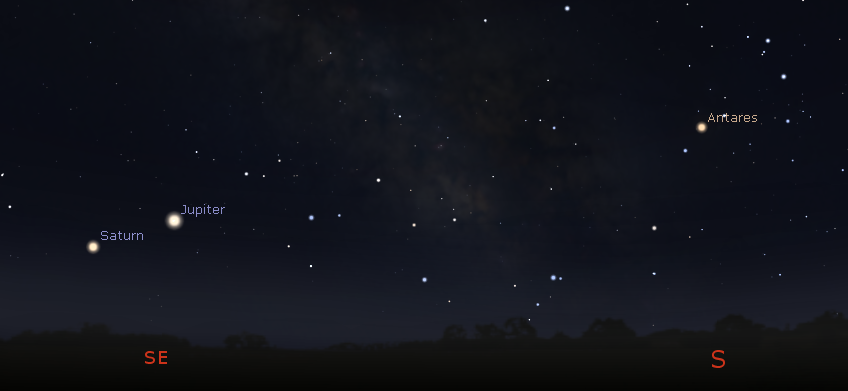
Saturn and Jupiter planets plus two southern constellations to the right of them at 11 pm tonight July 8, 2020. Just right of Jupiter is Sagittarius that looks more like a teapot than a centaur with a bow and arrow. Further right is Scorpius the scorpion. Click on the image to enlarge. Created using Stellarium.
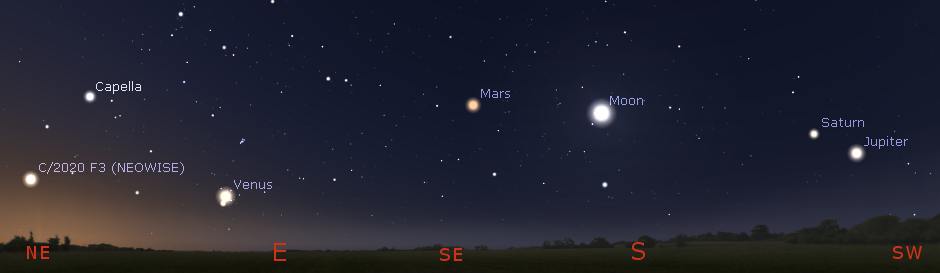
Planets, the Moon and a comet visible at 5 am tomorrow morning July 9, 2020. Venus appears just above the star Aldebaran. Comet NEOWISE’ tail is visible, but not at this scale, and it is shown as being too bright. Click on the image to enlarge. Created using Stellarium.
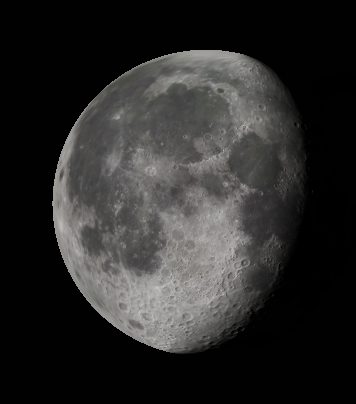
The Moon as it might appear tomorrow morning at 5 a.m. July 9, 2020. Created using Stellarium.
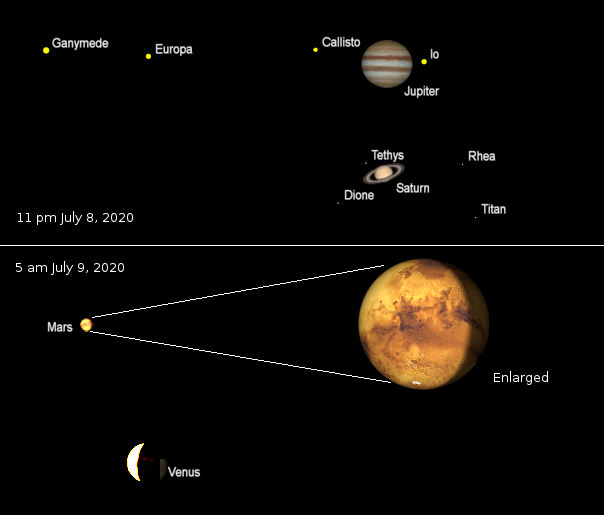
The planets as seen in a telescope (north up) with the same magnification tonight and tomorrow July 8/9, 2020. Apparent diameters: Jupiter, 47.57″; Saturn, 18.43″, rings, 42.94″, Mars, 12.19″, and Venus 37.66″. Mars also displays an enlargement showing surface detail. The ” symbol means seconds of arc (1/3600th of a degree.) Created using Cartes du Ciel (Sky Charts).
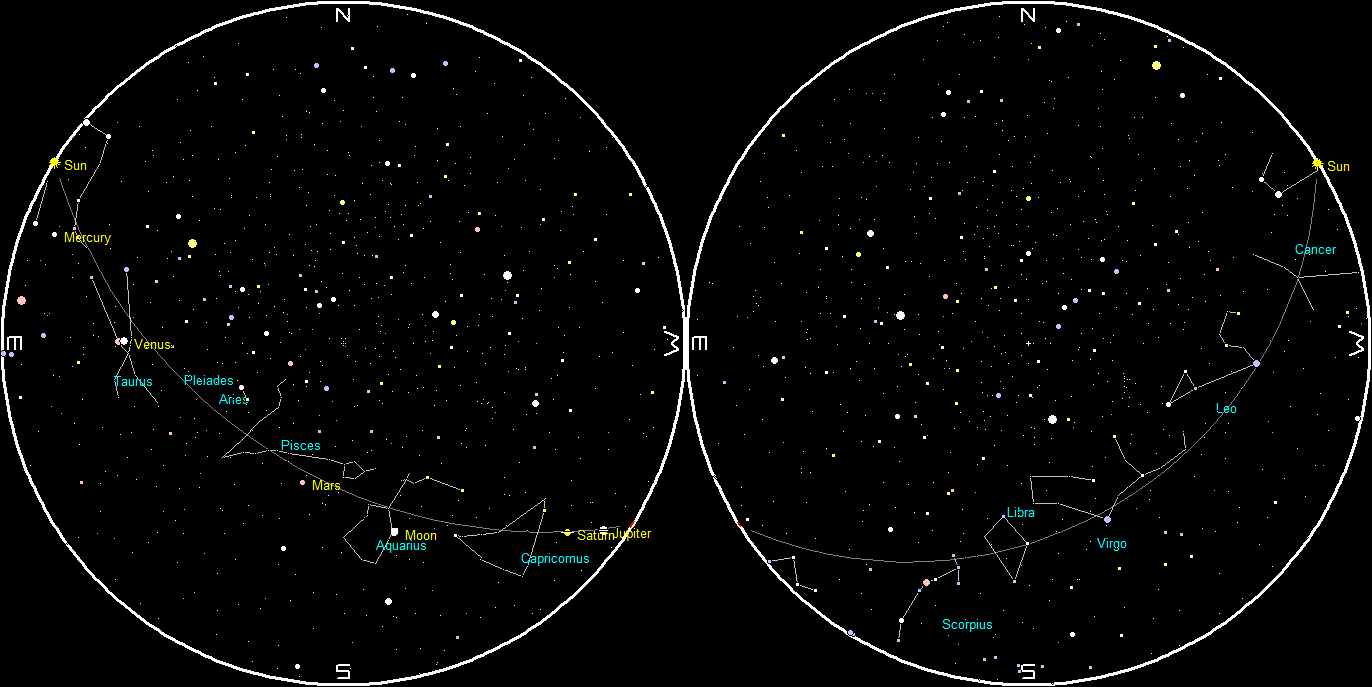
Planets and the Moon at sunset and sunrise of a single night starting with sunset on the right on July 8, 2020. The night ends on the left with sunrise on the 9th. The closeness of Jupiter and Saturn in the morning sky unfortunately overlays planets and labels. Click on the image to enlarge. Created using my LookingUp program.
07/07/2020 – Ephemeris – New Comet NEOWISE (C/2020 F3) is visible in the morning
This is Ephemeris for Tuesday, July 7th. Today the Sun will be up for 15 hours and 24 minutes, setting at 9:29, and it will rise tomorrow at 6:06. The Moon, 2 days past full, will rise at 11:37 this evening.
Comet C/2020 F3 (NEOWISE) is visible in the morning now, and quite bright. At 5 am in twilight it will be very low in the northeast tomorrow morning, below the bright star Capella. I’ve seen a photograph of it showing a tail. Over the next week it will be moving northward along the horizon at 5 am and fading as it goes. Then it will become visible in the evening sky next week. It is best seen in binoculars, though it can be spotted with the naked eye. One needs a low northeastern horizon. That’s the problem with comets: they’re brightest when close to the Sun, and can be seen best only when the Sun isn’t up. So that leaves morning or evening twilight, unless they are a huge comet like Hale-Bopp of 23 years ago that doesn’t get close to the Sun.
The event times given are for the Traverse City/Interlochen area of Michigan. They may be different for your location.
Addendum
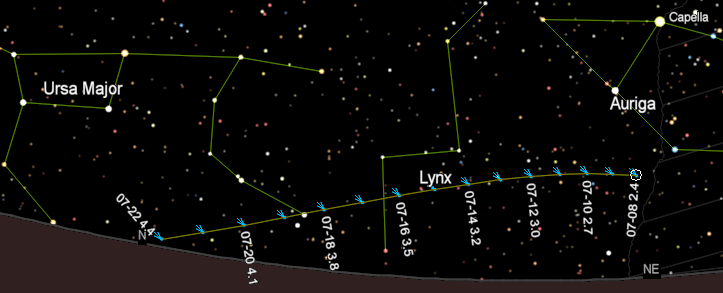
Comet NEOWISE starting at 5 am February 8, 2020. Every second date has month-day and predicted magnitude. The sky will be a bit higher each morning. Created using Cartes du Ciel (Sky Charts)
07/06/2020 – Ephemeris – The southernmost star of the Summer Triangle, Altair
This is Bob Moler with Ephemeris for Monday, July 6th. Today the Sun will be up for 15 hours and 25 minutes, setting at 9:30, and it will rise tomorrow at 6:05. The Moon, 1 day past full, will rise at 11:02 this evening.
The southernmost star of the Summer Triangle is Altair, high in the east-southeast. The other two stars of the triangle are Vega nearly overhead in the east, and Deneb high in the east-northeast. Altair is the closest of the three at a distance of 16.7 light years away. One light year is nearly 6 trillion miles. Altair is 10 times the brightness of the Sun. If seen at Altair’s distance, the Sun would only be as bright as one of the two stars that flank it. What is rather different about Altair is its rapid rotation. While it’s almost twice the sun’s diameter, it rotates once in about 9 hours, The CHARA Interferometer at Mt. Wilson has actually imaged its squashed disk in the infrared. Our Sun’s a slow poke, taking nearly a month to rotate once.
The event times given are for the Traverse City/Interlochen area of Michigan. They may be different for your location.
Addendum
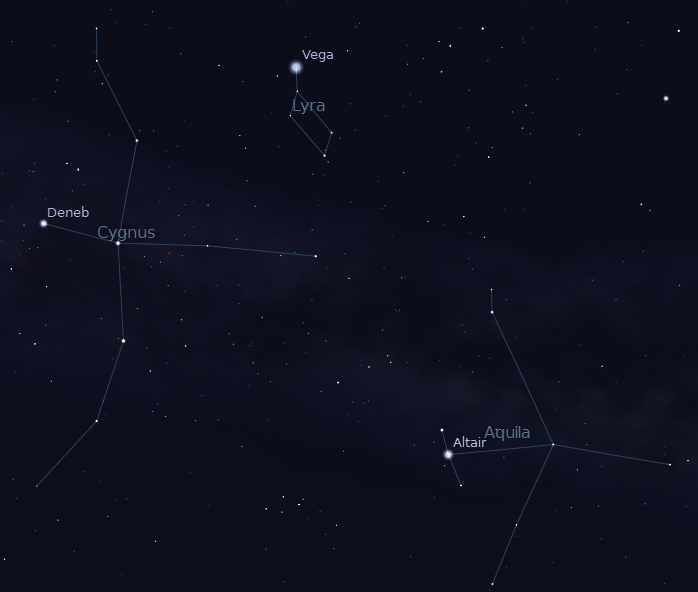
Summer Triangle. Created using Stellarium.
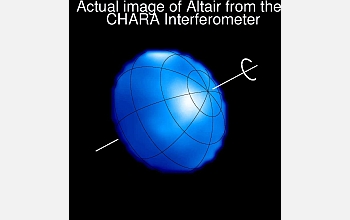
Lines added to show the rotation axis. Credit: Zina Deretsky, National Science Foundation.
 Bob Moler's Ephemeris Blog