Archive
02/12/2021 – Ephemeris – Monoceros the unicorn
This is Ephemeris for Darwin Day, Friday, February 12th. Today the Sun will be up for 10 hours and 20 minutes, setting at 6:07, and it will rise tomorrow at 7:45. The Moon, 1 day past new, will set at 7:07 this evening.
Among all the constellations in the sky of animals real and mythical, there is also a unicorn. It’s called Monoceros, and inhabits the southeastern sky at 8 p.m. mostly bounded by Orion on the right, Canis Major, the great dog below and Canis Minor, the little dog to the left and above. Unfortunately for observers without a telescope Monoceros, is devoid of any but the faintest stars. Maybe that’s why no one sees unicorns anymore. It has many faint stars because the Milky Way runs through it. To the telescope it is a feast of faint nebulae or clouds of gas and dust, the birthplace of stars, including the red rose of the Rosette Nebula, and Hagrid’s Dragon Cluster (NGC 2301). It also contains a beautiful telescopic triple star system, Beta (β) Monocerotis.
The event times given are for the Traverse City/Interlochen area of Michigan. They may be different for your location.
Addendum
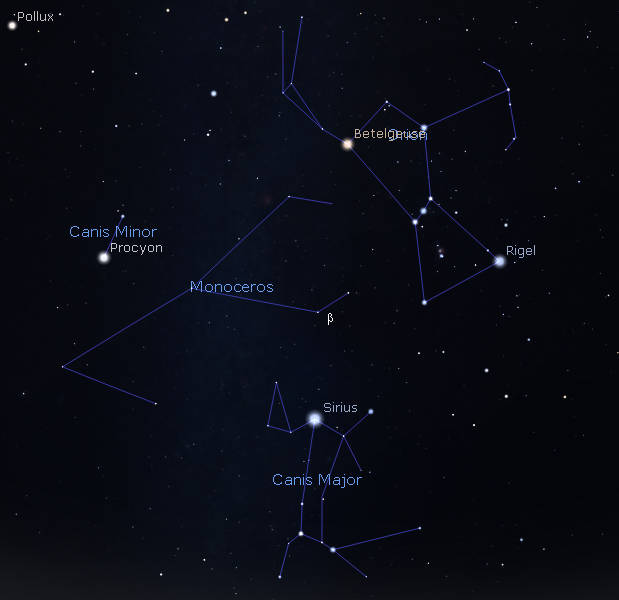
Monoceros finder chart showing neighboring constellations for about 8 pm in mid-February. Created using Stellarium.
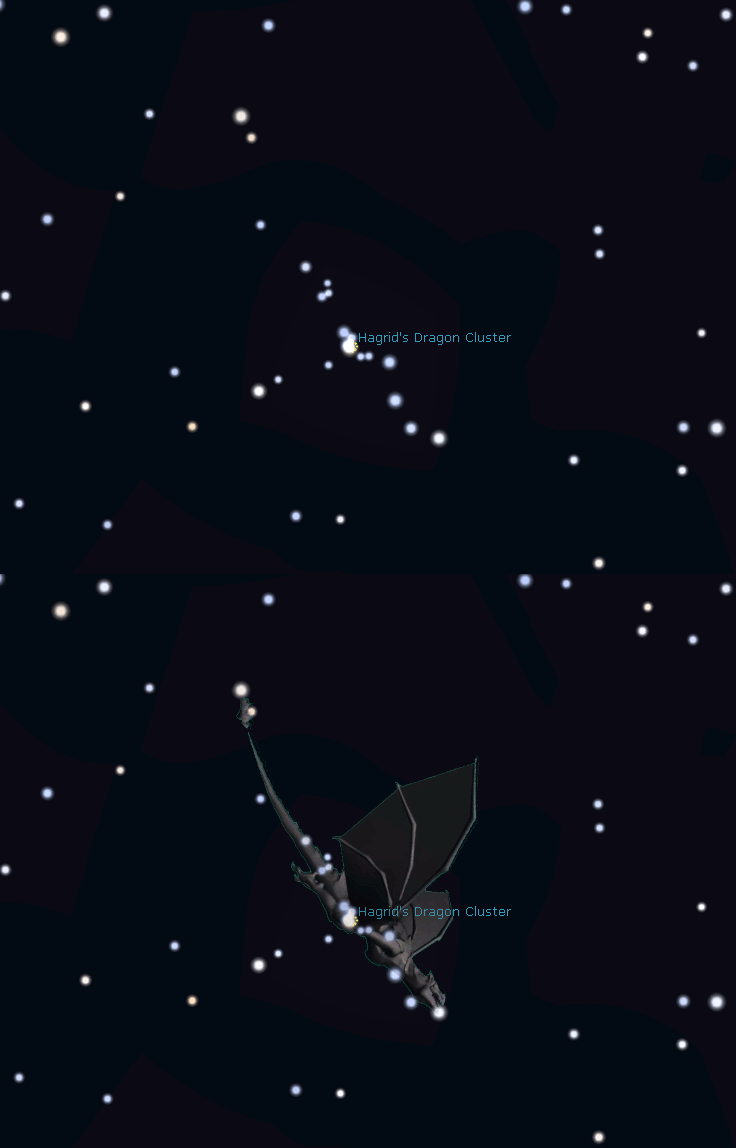
The brighter stars of NGC 2301 (Hagrid’s Dragon Cluster, AKA Great Bird Cluster and Copeland’s Golden Worm). It’s also in two other catalogs: Cr 119 and Mel 54. Created using Stellarium and GIMP. Dragon from “Dragon Flying Cycle” on YouTube by Simon Hussey.
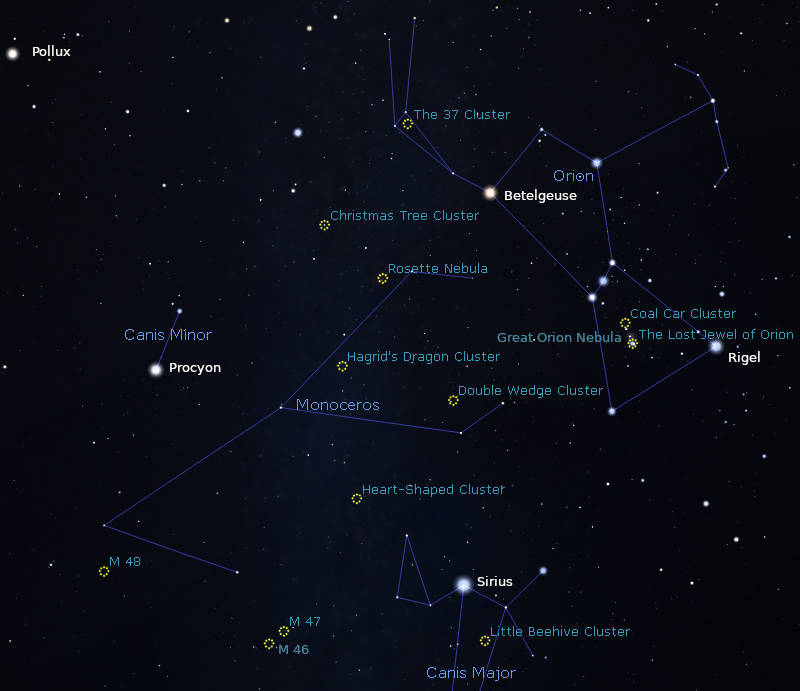
Deep Sky Objects in and around Monoceros. Click on the image to enlarge. Created using Stellarium.
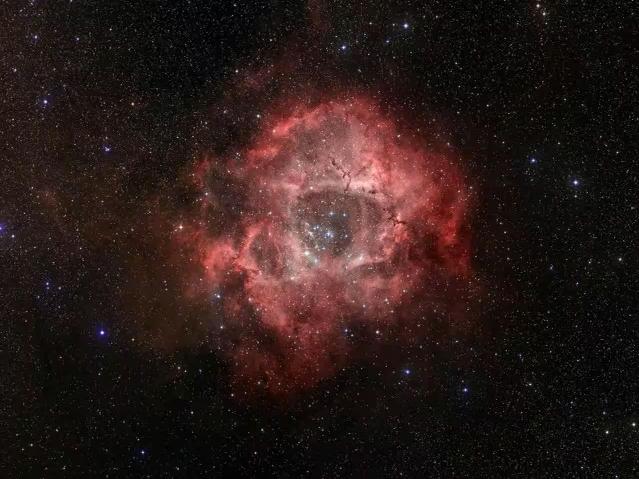
Rosette Nebula in the infrared from the Spitzer Space Telescope. The star cluster in the center is visible in a telescope, but the nebula is strictly photographic. Credit: NASA/JPL/Caltech.
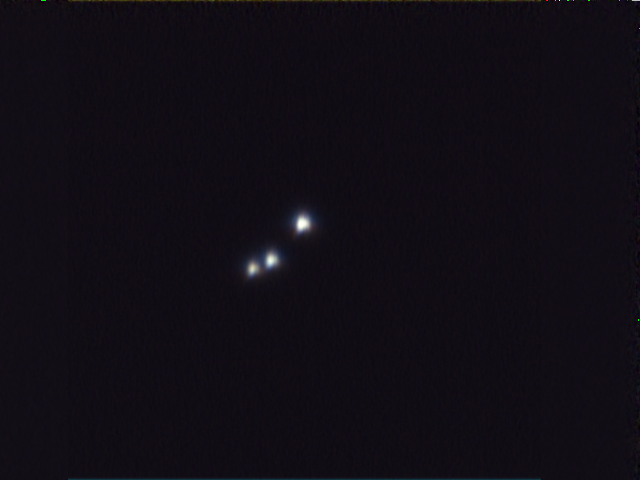
Telescopic Beta Monocerotis. William Hershel, discoverer of Uranus, said that it was “One of the most beautiful sights in the heavens.” Credit: F. Ringwald, Fresno State.
02/11/2021 – Ephemeris – The Winter Triangle
This is Ephemeris for Thursday, February 11th. Today the Sun will be up for 10 hours and 17 minutes, setting at 6:06, and it will rise tomorrow at 7:47. The Moon is new today, and won’t be visible.
I usually talk about the Winter Circle of bright stars, but some other astronomers talk about the Winter Triangle. The stars involved are Betelgeuse in the hunter Orion, Sirius in Canis Major, Orion’s large hunting dog, and Procyon in Canis Minor, his other small hunting dog. These three stars enclose a rather blank piece of sky with the faint Milky Way running through it and the almost invisible constellation of Monoceros the unicorn. The Summer Triangle has three bright stars with no other close competition. The Winter Triangle has four other bright stars near it. Any three of these would make a nice triangle. One of these constellations Canis Minor is tiny, with Procyon and one other star. It makes me think of a dachshund, or maybe, if I’m hungry, a hot dog.
The event times given are for the Traverse City/Interlochen area of Michigan. They may be different for your location.
Addendum
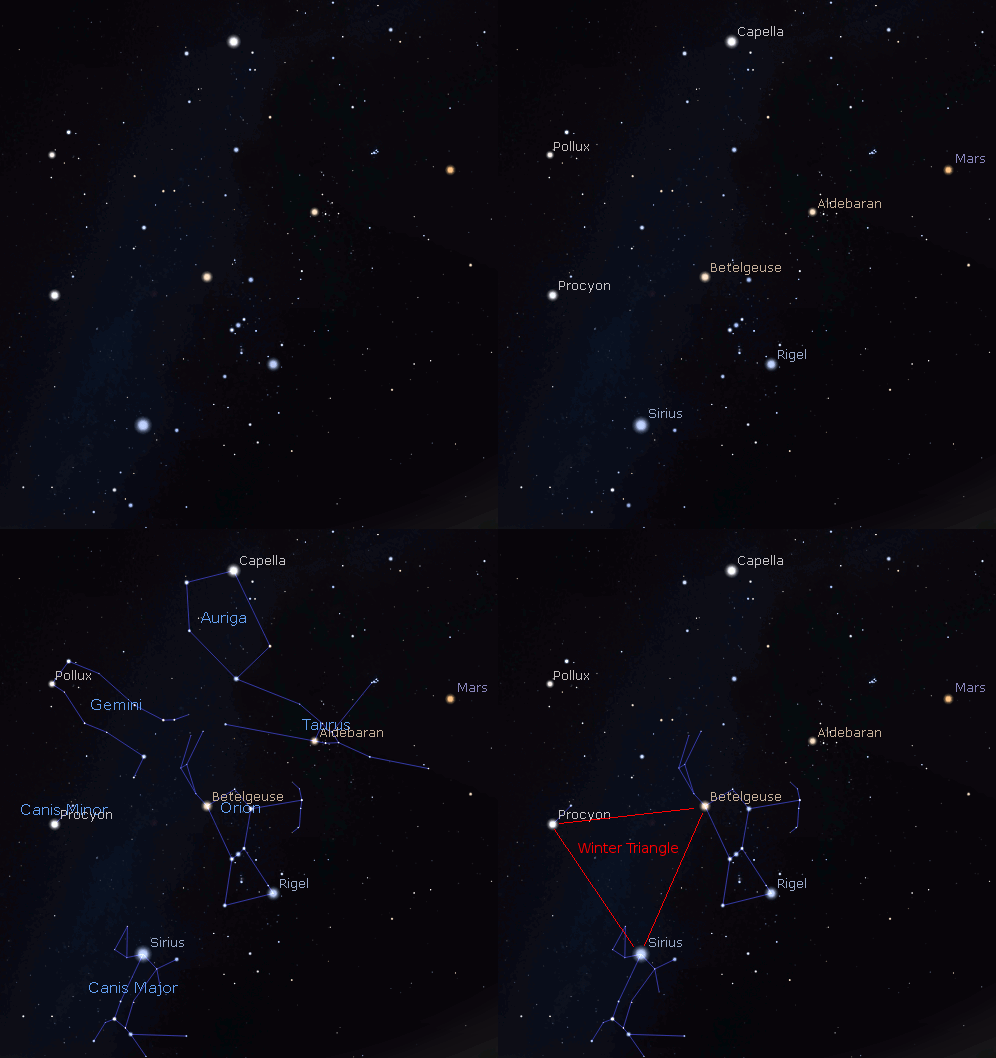
Winter Triangle finder animation. It shows the star field, named first magnitude stars, then their constellations, then the Winter Triangle and constellations of the three stars. Click on the image to enlarge. Created using Stellarium and GIMP.
02/10/2021 – Ephemeris – Let’s have a lookout for the naked-eye planets for this week
This is Ephemeris for Wednesday, February 10th. Today the Sun will be up for 10 hours and 14 minutes, setting at 6:04, and it will rise tomorrow at 7:48. The Moon, 1 day before new, will rise at 8:11 tomorrow morning.
Let’s have a lookout for the naked-eye planets for this week. It’s slim pickings for the bright naked-eye planets, known from antiquity, in our skies now. Only Mars can be spotted. The rest of them are hanging out in the direction of the Sun and won’t be seen until spring in the morning sky. Mars can be found high in the southwest at 8 pm. Mars is increasing its speed eastward through the constellation of Aries the ram, which it’s two thirds the way through, and will set at 1:38 am. Of the outer planets Mars is the fastest, being the nearest to the Sun, so unlike Jupiter, Saturn and the stars which rise and set about four minutes earlier each night, Mars sets about a minute earlier each night now.
The event times given are for the Traverse City/Interlochen area of Michigan. They may be different for your location.
Addendum
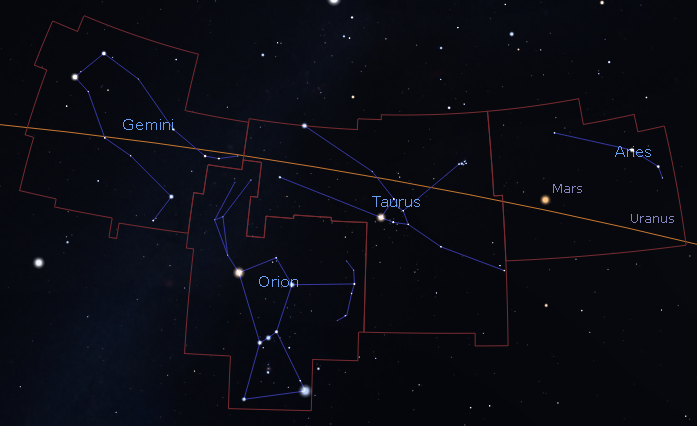
Mars with zodiacal constellations along its future path with Orion as a prominent marker. The orange line is the ecliptic, the path of the Sun in the sky, and near which the planets can be found. Along with the constellation lines in blue are the official astronomical constellation boundaries in red. Click on the image to enlarge. Created using Stellarium.
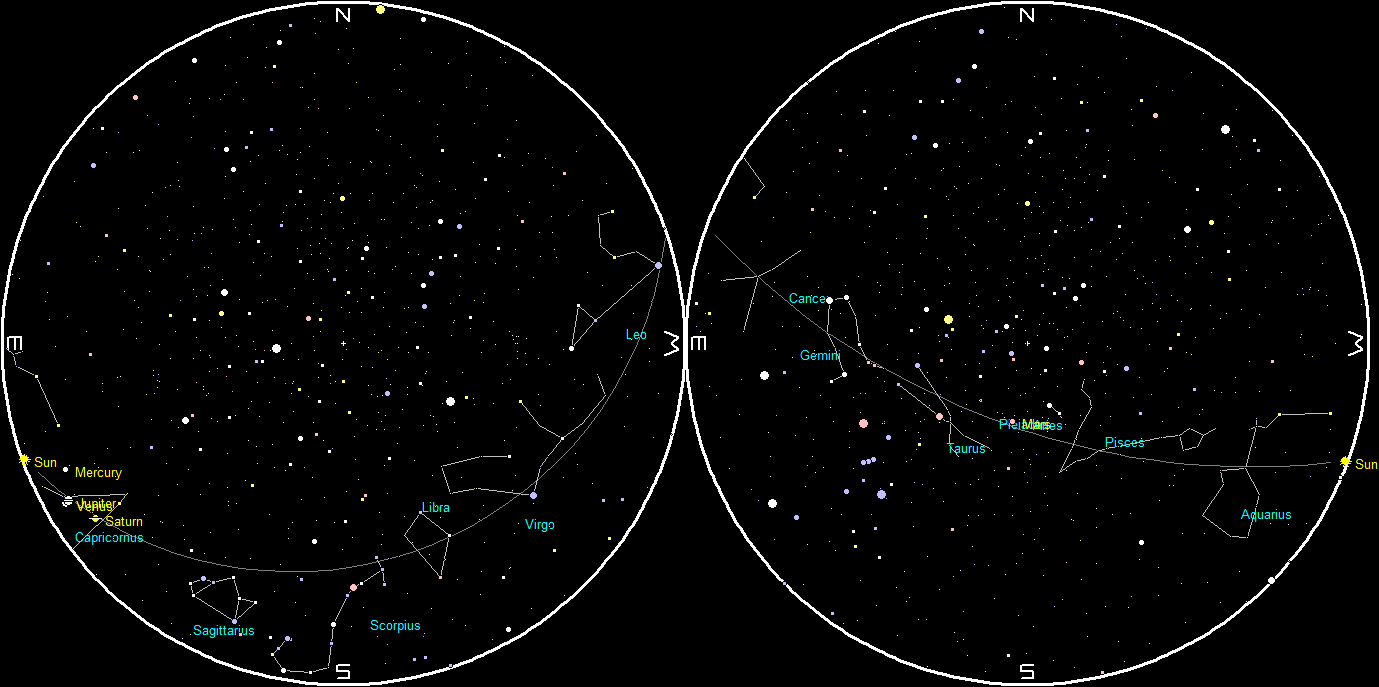
Planets and the Moon at sunset and sunrise of a single night starting with sunset on the right on February 10, 2021. The night ends on the left with sunrise on the 11th. There is a planet traffic jam in the morning and the labels for Jupiter and Venus overlap. Unfortunately these planets rise too soon before the Sun to be seen for us up north. Click on the image to enlarge. Created using my LookingUp program.
02/09/2021 – Ephemeris – Happy Mars New Year
This is Ephemeris for Tuesday, February 9th. Today the Sun will be up for 10 hours and 11 minutes, setting at 6:03, and it will rise tomorrow at 7:49. The Moon, 2 days before new, will rise at 7:35 tomorrow morning.
Thanks to Dr. Phil Plait’s Bad Astronomy Blog I found out that last Sunday was Mars’ New Year’s Day for year 36*. I didn’t know they were counting them. Year 1 started on the first day of spring for Mars’ Northern Hemisphere, April 11th 1955. Like for most calendars the year numbering wasn’t created until later, from a scientific paper published in 2000 which followed the seasonal changes on Mars and had to put them in Mars years to make sense, rather than Earth years. I approve. As a teenager with my first telescope I eagerly awaited Mars’ especially close approach in 1956. By the Mars calendar that was in martian year 1. Back then our ignorance of Mars was profound. But a decade later the Mariner 4 spacecraft flew past Mars taking the first closeup pictures.
The event times given are for the Traverse City/Interlochen area of Michigan. They may be different for your location.
* For some reason I said it was year 38 in the broadcast.
Addendum
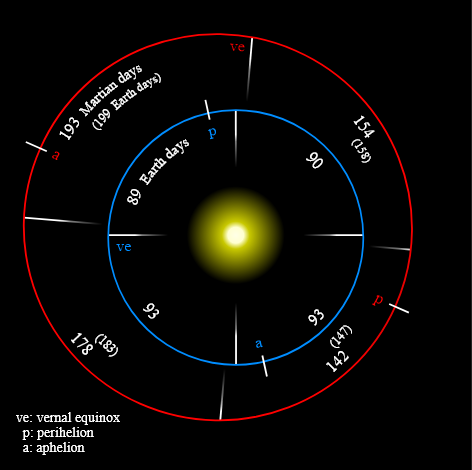
Earth and Mars orbits and seasons compared as seen from the north. Planet motion is counterclockwise. Vernal equinox is the position of the planet for the Northern Hemisphere spring Source: Wikipedia user Areong.
Additional links:
https://www.syfy.com/syfywire/happy-martian-new-year
https://en.wikipedia.org/wiki/Timekeeping_on_Mars
https://www.planetary.org/articles/mars-calendar
02/08/2021 – Ephemeris – A look at Gemini the twins
This is Ephemeris for Monday, February 8th. Today the Sun will be up for 10 hours and 9 minutes, setting at 6:01, and it will rise tomorrow at 7:51. The Moon, 3 days before new, will rise at 6:49 tomorrow morning.
Let’s look at another of the winter constellations, and a member of the Zodiac. The constellation of Gemini the Twins is visible high in the southeast, above and left of Orion the hunter at 9 p.m. The namesake stars of the two lads, will be at the left end of Gemini, are nearly overhead and vertically aligned. Castor is on top, while the slightly brighter Pollux is below. From them come two lines of stars that outline the two extending toward Orion. In Greek mythology the lads were half brothers, Castor was fathered by a mere mortal, while Pollux was fathered by Zeus, but were born together as twins. When Castor was killed during the quest for the Golden Fleece, Pollux pleaded with Zeus to let him die also, so Zeus placed them together in the sky, so they could be together forever.
The event times given are for the Traverse City/Interlochen area of Michigan. They may be different for your location.
Addendum
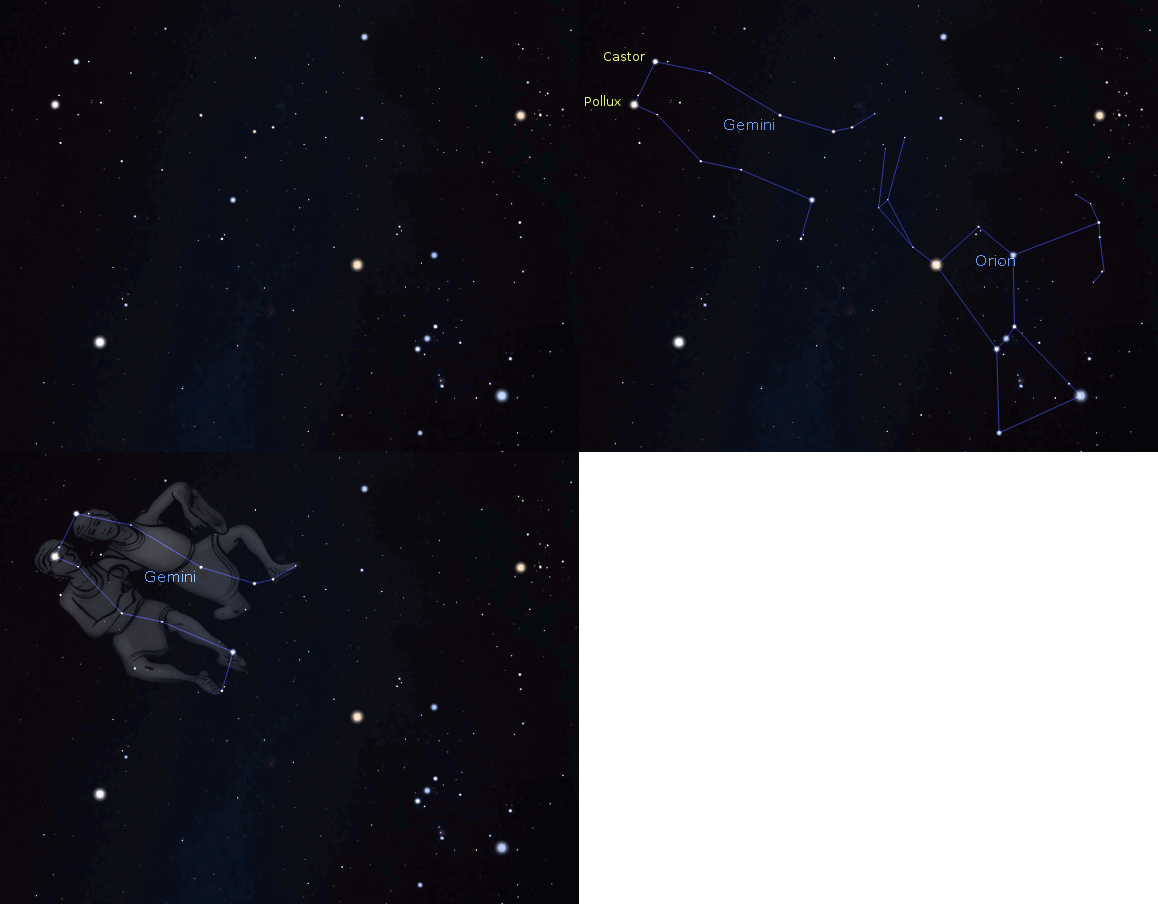
Gemini finder animation for early February at 9 pm (about 3 hours after sunset). Created using Stellarium and GIMP.
02/04/2021 – Ephemeris – Finding Orion’s larger hunting dog
This is Bob Moler with Ephemeris for Thursday, February 4th. Today the Sun will be up for 9 hours and 58 minutes, setting at 5:56, and it will rise tomorrow at 7:56. The Moon, at last quarter today, will rise at 2:19 tomorrow morning.
The great winter constellation or star group Orion the hunter, is located in the southern sky at 9 p.m. His elongated rectangle of a torso is vertical. In the center of the rectangle are three stars in a line that make his belt. As a hunter, especially one of old, he has two hunting dogs. The larger, Canis Major can be found by following the three belt stars of Orion down and to the left. They point to Sirius, the brightest night-time star, also known as the Dog Star. It’s in the heart of a stick figure dog low in the southeast facing Orion that appears to be begging. There’s a fine star cluster, called Messier, or M 41, at the 5 o’clock position from Sirius. It’s easily visible in binoculars or a small telescope.
The event times given are for the Traverse City/Interlochen area of Michigan. They may be different for your location.
Addendum
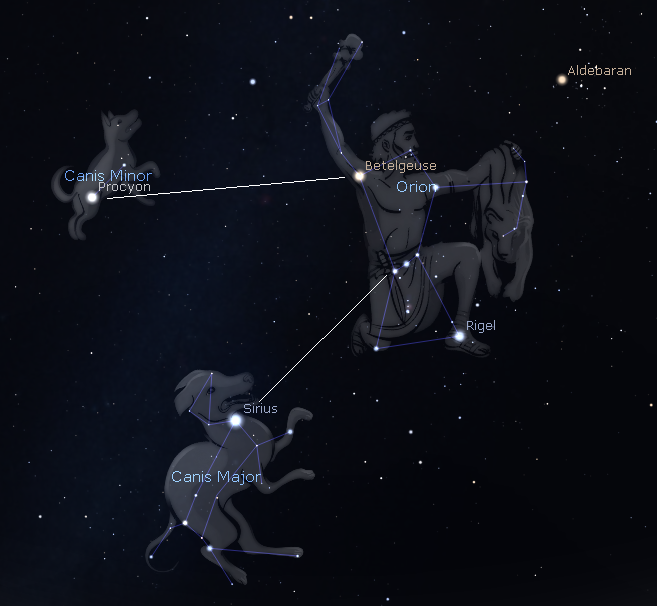
Orion and his hunting dogs with pointers as seen February. I didn’t have time in the program to mention Canis Minor, the little dog. I expect to cover it in the future, or you can search for Canis Minor in the search box above. Created using Stellarium.
I did not have time to talk about Canis Minor in this program due to the inclusion of M 41. I plan to cover Canis Minor soon. I have in the past. Search for Canis Minor in the search box above.
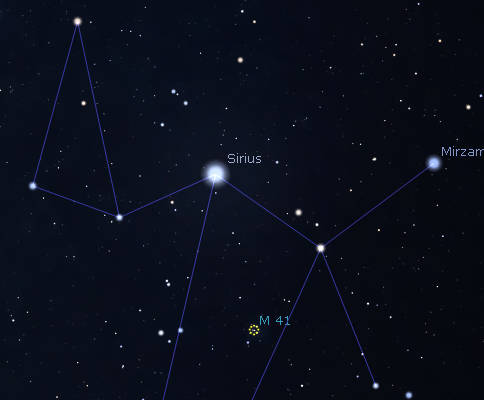
Star cluster M 41 finder chart. Created using Stellarium.
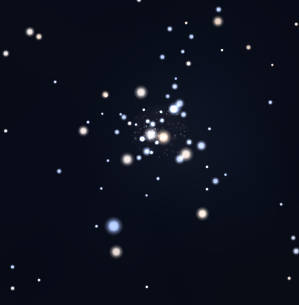
M 41 up close. Image courtesy of Tim Hunter and James McGaha, Grasslands Observatory at http://www.3towers.com
02/03/2021 – Ephemeris – Let’s have a lookout for the naked-eye planets
This is Ephemeris for Wednesday, February 3rd. Today the Sun will be up for 9 hours and 55 minutes, setting at 5:54, and it will rise tomorrow at 7:57. The Moon, 1 day before last quarter, will rise at 1:03 tomorrow morning.
Let’s have a lookout for the naked-eye planets for this week. It’s slim pickings for the bright naked-eye planets, known from antiquity in our skies right now. Only Mars can be spotted. The rest of them are hanging out in the direction of the Sun and won’t be seen for a month or more. Mars can be found high in the south at 7 pm. It will actually be due south at 6:30 tonight. Mars is increasing its speed eastward through the constellation of Aries the ram, which it’s halfway through, and will set at 1:45 am. Of the outer planets Mars is the fastest, being the closest to the Sun, so unlike Jupiter, Saturn and the stars which rise and set about four minutes earlier each night, Mars rises and sets about a minute and a half earlier each day.
The event times given are for the Traverse City/Interlochen area of Michigan. They may be different for your location.
Addendum
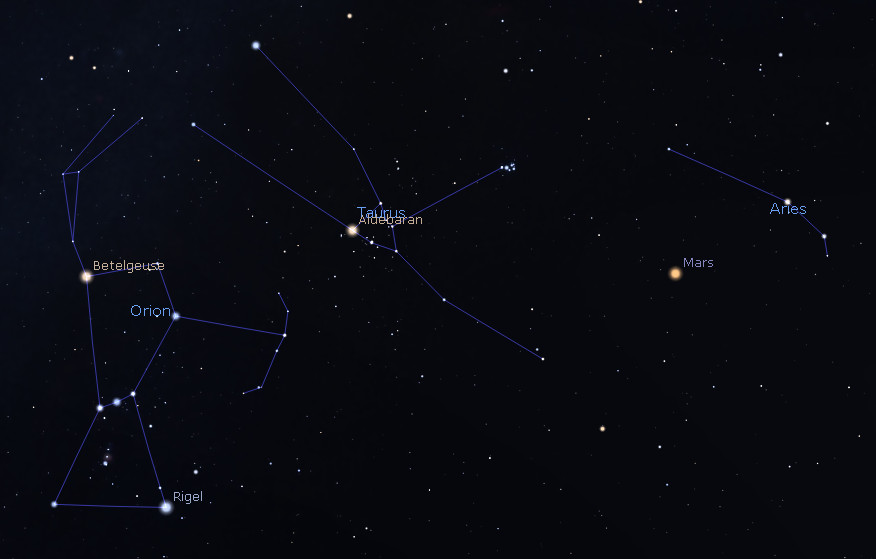
Mars finder chart. Showing Mars in Aries. Also shown are Taurus and Orion. All are seen tonight at 8 pm, February 3, 2021. Click on the image to enlarge. Created using Stellarium.
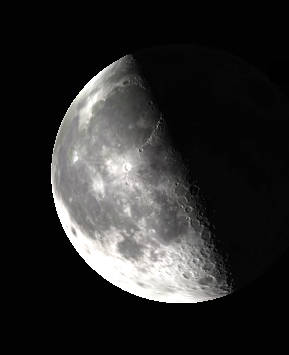
The Moon as it might look like at last quarter tomorrow morning at 6 am, February 4, 2021. Created using Stellarium.
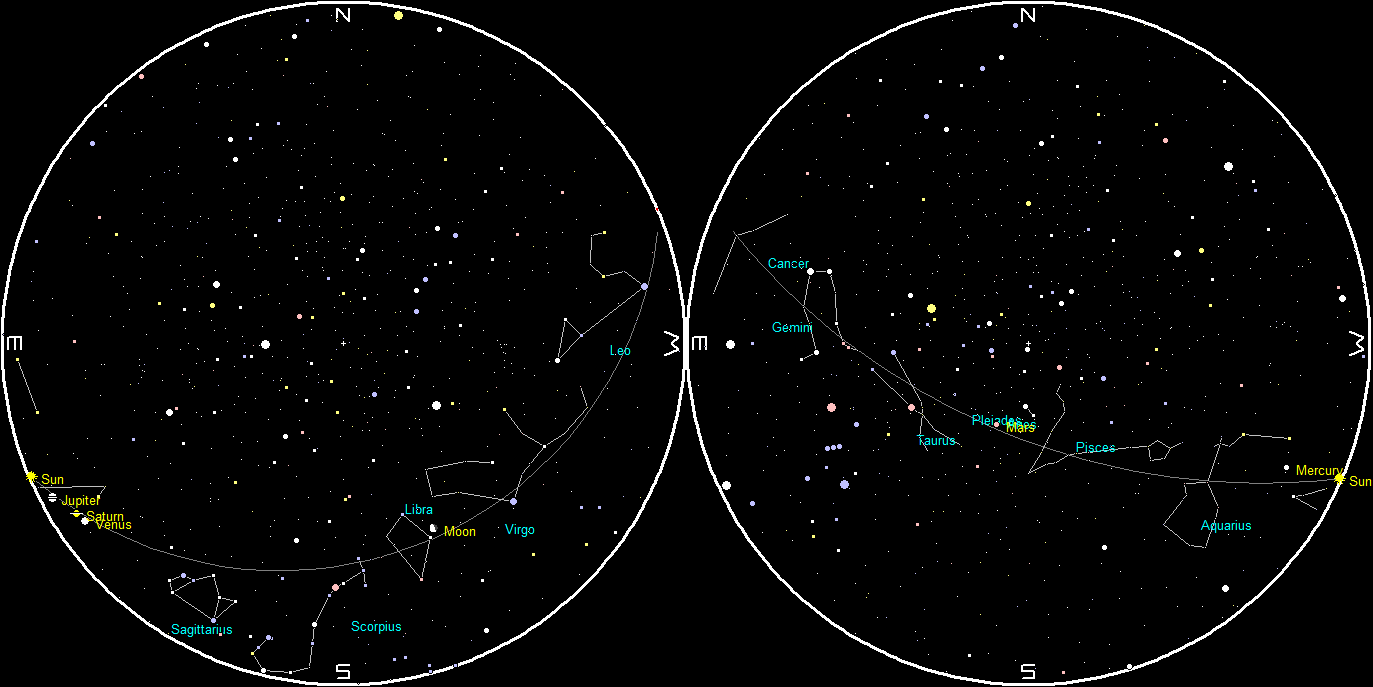
Planets and the Moon at sunset and sunrise of a single night starting with sunset on the right on February 3, 2021. The night ends on the left with sunrise on the 4th. I’m afraid that the labels for Jupiter and the Sun overlap, since the planets and Sun are very close. Click on the image to enlarge. Created using my LookingUp program.
02/02/2021 – Ephemeris – Happy Groundhog Day
This is Bob Moler with Ephemeris for Ground Hog Day, Tuesday, February 2nd. Today the Sun will be up for 9 hours and 53 minutes, setting at 5:53, and it will rise tomorrow at 7:59. The Moon, 2 days before last quarter, will rise at 11:48 this evening.
I’m not sure if Punxsutawney Phil will see his shadow this morning or not, but February 2nd was a special day to the ancients. It is also Candlemas day for the Catholic Church. It is also celebrated as a cross-quarter day. The middle of the season of Winter, though the exact date of the middle of winter is the 4th. And if Phil sees his shadow, and we do get 6 more weeks of winter, that’s OK too. By the calendar it is actually 6 weeks and 5 days to the vernal or spring equinox, the official end of winter. But this is northern Michigan. Of the other cross-quarter days, only one stands out today. It’s May 1st, May Day. The way this year has been going, winter has had a hard time getting started. But when it gets going… Look out!
The event times given are for the Traverse City/Interlochen area of Michigan. They may be different for your location.
Addendum

Poor Punxsutawney Phil, rousted out of his mid winter nap on a previous Groundhog Day. Phil looks kind of grumpy. I don’t blame him. Credit: http://www.fuzzytoday.com.
02/01/2021 – Ephemeris – Previewing February Skies
This is Ephemeris for Monday, February 1st. Today the Sun will be up for 9 hours and 50 minutes, setting at 5:51, and it will rise tomorrow at 8:00. The Moon, 3 days before last quarter, will rise at 10:33 this evening. | February is the shortest month, even so the daylight hours throughout the month will be getting longer. Daylight hours will increase from 9 hours and 50 minutes today to 11 hours and 7 minutes on the 28th. The sunrise time will decrease from 8:01 today to 7:21 at months end. The sunset times will increase from 5:51 today to 6:29 on the 28th. Along with that the altitude of the Sun at noon will increase from 28.4 degrees today to 37.6 degrees at month’s end. It will be a degree lower for folks in the Straits area because they are a degree of latitude farther north. Local noon, by the way for Interlochen and Traverse City is about 12:56 p.m.
The event times given are for the Traverse City/Interlochen area of Michigan. They may be different for your location.
Addendum
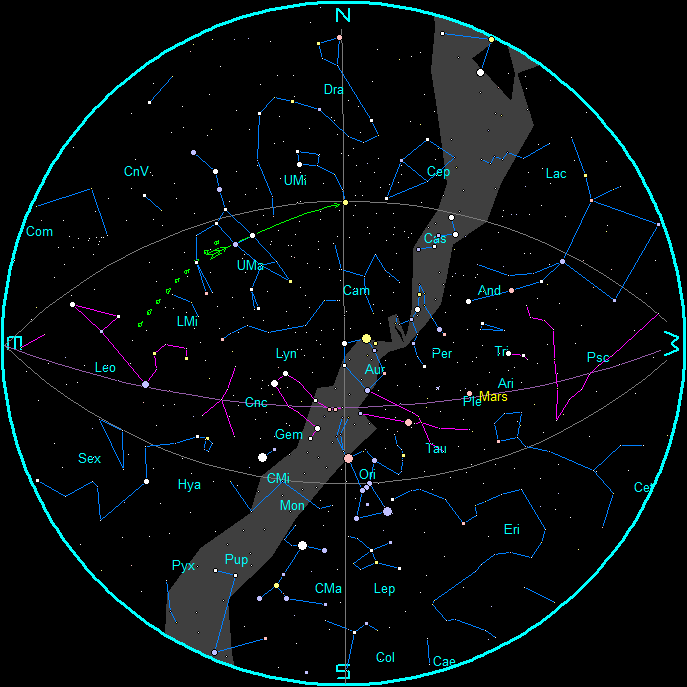
Star Chart for February 2021 (9 p.m. EST February 15, 2021). Created using my LookingUp program. Click on image to enlarge.
The planets and stars are plotted for the 15th at 9 p.m. EST in the evening and 6 a.m. for the morning chart. These are the chart times. Note that Traverse City is located approximately 45 minutes behind our time meridian. (An hour 45 minutes behind our daylight saving time meridian during EDT). To duplicate the star positions on a planisphere (rotating star finder) you may have to set it to 1 hour 45 minutes earlier than the current time.
Note the chart times of 9 p.m. and 6 a.m. are for the 15th. For each week before the 15th add ½ hour (28 minutes if you’re picky). For each week after the 15th subtract ½ hour. The planet positions are updated each Wednesday on this blog. For planet positions on dates other than the 15th, check the Wednesday planet posts on this blog.
February Morning Star Chart
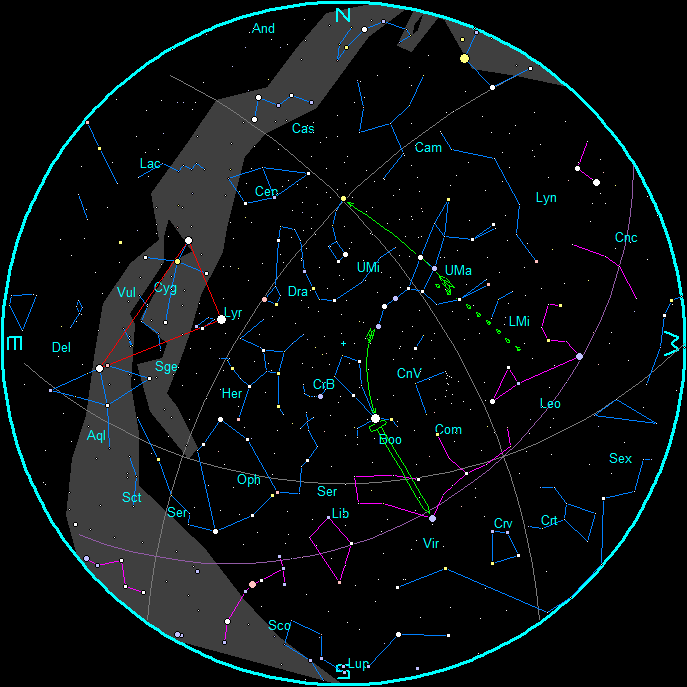
Star Chart for February mornings 2021 (6 a.m. EST February 15, 2021). Created using my LookingUp program. Click on image to enlarge.
For a list of constellation names to go with the abbreviations click here.
- Pointer stars at the front of the bowl of the Big Dipper point to Polaris the North Star.
- Follow the arc of the handle of the Big Dipper to the star Arcturus, and
- Extend like a spike to Spica,
- The Summer Triangle is in red.
Twilight Limits, Nautical and Astronomical
| EST | |||||||
| Morning twilight | Evening twilight | Dark night | Moon | ||||
| Date | Astro. | Nautical | Nautical | Astro. | Start | End | Illum. |
| 2021-02-01 | 6h22m | 6h56m | 18h56m | 19h30m | 19h30m | 22h33m | 0.78 |
| 2021-02-02 | 6h21m | 6h55m | 18h57m | 19h31m | 19h31m | 23h48m | 0.67 |
| 2021-02-03 | 6h20m | 6h54m | 18h59m | 19h33m | 19h33m | – | 0.56 |
| 2021-02-04 | 6h19m | 6h53m | 19h00m | 19h34m | 19h34m | 1h03m | 0.45 |
| 2021-02-05 | 6h18m | 6h52m | 19h01m | 19h35m | 19h35m | 2h20m | 0.34 |
| 2021-02-06 | 6h16m | 6h50m | 19h02m | 19h36m | 19h36m | 3h35m | 0.23 |
| 2021-02-07 | 6h15m | 6h49m | 19h04m | 19h38m | 19h38m | 4h48m | 0.15 |
| 2021-02-08 | 6h14m | 6h48m | 19h05m | 19h39m | 19h39m | 5h54m | 0.08 |
| 2021-02-09 | 6h13m | 6h47m | 19h06m | 19h40m | 19h40m | 6h13m | 0.03 |
| 2021-02-10 | 6h12m | 6h46m | 19h08m | 19h41m | 19h41m | 6h12m | 0 |
| 2021-02-11 | 6h10m | 6h44m | 19h09m | 19h43m | 19h43m | 6h10m | 0 |
| 2021-02-12 | 6h09m | 6h43m | 19h10m | 19h44m | 19h44m | 6h09m | 0.02 |
| 2021-02-13 | 6h08m | 6h42m | 19h11m | 19h45m | 20h14m | 6h08m | 0.06 |
| 2021-02-14 | 6h06m | 6h40m | 19h13m | 19h47m | 21h19m | 6h06m | 0.12 |
| 2021-02-15 | 6h05m | 6h39m | 19h14m | 19h48m | 22h22m | 6h05m | 0.19 |
| 2021-02-16 | 6h04m | 6h37m | 19h15m | 19h49m | 23h25m | 6h04m | 0.27 |
| 2021-02-17 | 6h02m | 6h36m | 19h17m | 19h50m | – | 6h02m | 0.35 |
| 2021-02-18 | 6h01m | 6h34m | 19h18m | 19h52m | 0h27m | 6h01m | 0.45 |
| 2021-02-19 | 5h59m | 6h33m | 19h19m | 19h53m | 1h30m | 5h59m | 0.54 |
| 2021-02-20 | 5h58m | 6h32m | 19h21m | 19h54m | 2h33m | 5h58m | 0.64 |
| 2021-02-21 | 5h56m | 6h30m | 19h22m | 19h56m | 3h35m | 5h56m | 0.73 |
| 2021-02-22 | 5h55m | 6h28m | 19h23m | 19h57m | 4h34m | 5h55m | 0.81 |
| 2021-02-23 | 5h53m | 6h27m | 19h24m | 19h58m | 5h28m | 5h53m | 0.89 |
| 2021-02-24 | 5h52m | 6h25m | 19h26m | 19h59m | – | – | 0.94 |
| 2021-02-25 | 5h50m | 6h24m | 19h27m | 20h01m | – | – | 0.98 |
| 2021-02-26 | 5h48m | 6h22m | 19h28m | 20h02m | – | – | 1 |
| 2021-02-27 | 5h47m | 6h20m | 19h30m | 20h03m | – | – | 0.99 |
| 2021-02-28 | 5h45m | 6h19m | 19h31m | 20h05m | 20h05m | 20h16m | 0.95 |
Twilight calendar was generated using Cartes du Ciel (Sky Charts).
See my blog post: Twilight Zone for the definitions of the different periods of twilight here: https://bobmoler.wordpress.com/2019/09/27/
NASA Calendar of Planetary Events
Date         Time     Event
Feb  1  Mo            Venus: 13° W
     3  We   2:33 pm  Moon Perigee: 370,100 km
     4  Th  12:37 pm  Last Quarter
     6  Sa   7:29 pm  Moon Descending Node
     8  Mo   8:39 am  Mercury Inferior Conjunction
     8  Mo  10:34 am  Moon South Dec.: 25° S
    11  Th   2:06 pm  New Moon
    18  Th   5:22 am  Moon Apogee: 404,500 km
    18  Th   5:47 pm  Moon-Mars: 4.1° N
    19  Fr   1:47 pm  First Quarter
    20  Sa   8:44 pm  Moon Ascending Node
    22  Mo   7:12 pm  Moon North Dec.: 25.1° N
    23  Tu   2:38 am  Mercury-Saturn: 4° N
    24  We   7:16 pm  Moon-Beehive: 2.5° S
    27  Sa   3:17 am  Full Moon
All event times are given for UTC-5:00: Eastern Standard or Daylight Time
Sky Events Calendar by Fred Espenak and Sumit Dutta (NASA’s GSFC),
http://eclipse.gsfc.nasa.gov/SKYCAL/SKYCAL.html
If you go to the above site you can print out a list like the above for the entire year or calendar pages for your time zone.
Sun and Moon Rising and Setting Events
LU                  Ephemeris of Sky Events for Interlochen/TC
February, 2021    Local time zone: EST
+-----------------------------------------------------------------------+
| DATE |  SUN     SUN  DAYLIGHT|   TWILIGHT*    |MOON  RISE OR    ILLUM |
|      |  RISE    SET    HOURS |  END    START  |PHASE SET** TIME FRACTN|
+=======================================================================+
|Mon  1| 08:01a  05:51p  09:50 | 06:57p  06:55a |      Rise 10:33p   79%|
|Tue  2| 08:00a  05:53p  09:53 | 06:59p  06:54a |      Rise 11:48p   69%|
|Wed  3| 07:59a  05:54p  09:55 | 07:00p  06:53a |      Rise 01:03a   58%|
|Thu  4| 07:57a  05:56p  09:58 | 07:01p  06:52a |L Qtr Rise 02:19a   47%|
|Fri  5| 07:56a  05:57p  10:00 | 07:03p  06:51a |      Rise 03:35a   36%|
|Sat  6| 07:55a  05:59p  10:03 | 07:04p  06:50a |      Rise 04:48a   25%|
+------+-----------------------+----------------+-----------------------+
|Sun  7| 07:54a  06:00p  10:06 | 07:05p  06:48a |      Rise 05:53a   16%|
|Mon  8| 07:52a  06:01p  10:09 | 07:06p  06:47a |      Rise 06:49a    9%|
|Tue  9| 07:51a  06:03p  10:11 | 07:08p  06:46a |      Rise 07:35a    4%|
|Wed 10| 07:49a  06:04p  10:14 | 07:09p  06:45a |      Rise 08:11a    1%|
|Thu 11| 07:48a  06:06p  10:17 | 07:10p  06:43a |New   Set  05:57p    0%|
|Fri 12| 07:47a  06:07p  10:20 | 07:12p  06:42a |      Set  07:07p    2%|
|Sat 13| 07:45a  06:08p  10:23 | 07:13p  06:41a |      Set  08:14p    5%|
+------+-----------------------+----------------+-----------------------+
|Sun 14| 07:44a  06:10p  10:26 | 07:14p  06:39a |      Set  09:19p   11%|
|Mon 15| 07:42a  06:11p  10:29 | 07:15p  06:38a |      Set  10:22p   17%|
|Tue 16| 07:41a  06:13p  10:32 | 07:17p  06:37a |      Set  11:24p   25%|
|Wed 17| 07:39a  06:14p  10:34 | 07:18p  06:35a |      Set  12:27a   34%|
|Thu 18| 07:38a  06:15p  10:37 | 07:19p  06:34a |      Set  01:30a   43%|
|Fri 19| 07:36a  06:17p  10:40 | 07:21p  06:32a |F Qtr Set  02:32a   52%|
|Sat 20| 07:34a  06:18p  10:43 | 07:22p  06:31a |      Set  03:34a   61%|
+------+-----------------------+----------------+-----------------------+
|Sun 21| 07:33a  06:20p  10:46 | 07:23p  06:29a |      Set  04:33a   71%|
|Mon 22| 07:31a  06:21p  10:49 | 07:25p  06:28a |      Set  05:28a   79%|
|Tue 23| 07:30a  06:22p  10:52 | 07:26p  06:26a |      Set  06:15a   87%|
|Wed 24| 07:28a  06:24p  10:55 | 07:27p  06:25a |      Set  06:56a   93%|
|Thu 25| 07:26a  06:25p  10:58 | 07:28p  06:23a |      Set  07:30a   98%|
|Fri 26| 07:24a  06:26p  11:01 | 07:30p  06:21a |      Set  07:59a  100%|
|Sat 27| 07:23a  06:28p  11:05 | 07:31p  06:20a |Full  Rise 06:59p   99%|
+------+-----------------------+----------------+-----------------------+
|Sun 28| 07:21a  06:29p  11:08 | 07:32p  06:18a |      Rise 08:16p   96%|
+-----------------------------------------------------------------------+
* Nautical Twilight
** Moonrise or moonset, whichever occurs between sunrise and sunset
Created using my LookingUp for DOS output as HTML.
 Bob Moler's Ephemeris Blog