Archive
05/17/2021 – Ephemeris – The Moon tonight
This is Ephemeris for Monday, May 17th. Today the Sun will be up for 14 hours and 54 minutes, setting at 9:06, and it will rise tomorrow at 6:11. The Moon, 2 days before first quarter, will set at 2:25 tomorrow morning.
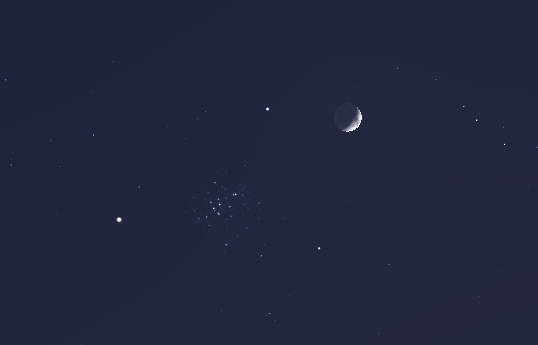
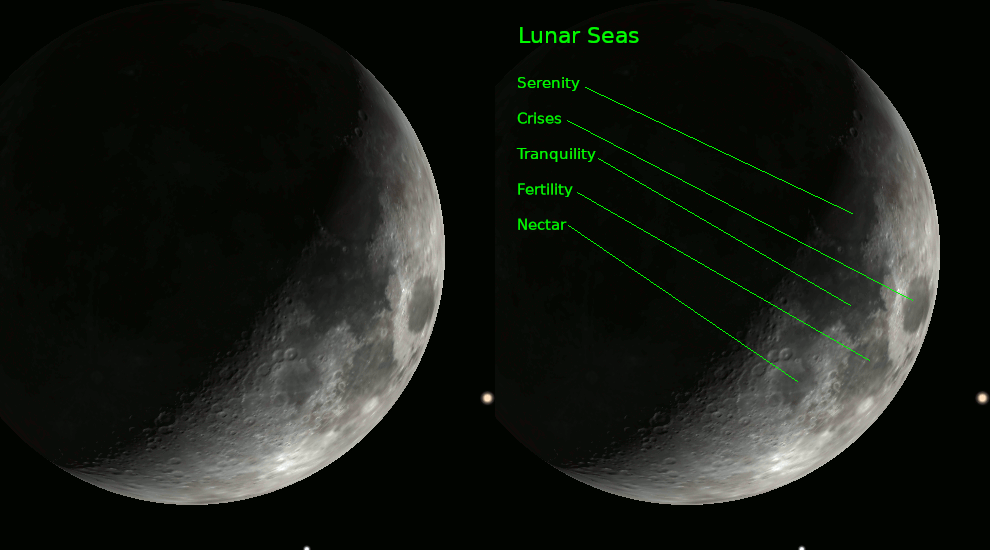
The Moon tonight reveals a bit more territory than it did last night, and will every night until full moon. The Moon’s solar day equals a lunar month of about 29 and a half of our days. As seen in binoculars, below and left of The distinctly oval Sea of Crises, or Mare Crisium, is the Sea of Fertility, or Mare Fecunditatis. To the left of the Sea of Crises, the Sea of Tranquility (Tranquilitatis) where the Apollo 11 crew landed. Above that half of Sea of Serenity has come into daylight. Tonight the Beehive star cluster will be visible below and left of the Moon. It should be easily visible in binoculars and has a vaguely triangular shape. It was known to the ancients as Praesepe, the manger, who saw it as a glowing spot on moonless nights.
The astronomical event times given are for the Traverse City/Interlochen area of Michigan. They may be different for your location.
Addendum
05/14/2021 – Ephemeris – Astronomy Day Star Party this Saturday
This is Bob Moler with Ephemeris for Friday, May 14th. Today the Sun will be up for 14 hours and 48 minutes, setting at 9:03, and it will rise tomorrow at 6:14. The Moon, 3 days past new, will set at 12:07 tomorrow morning.
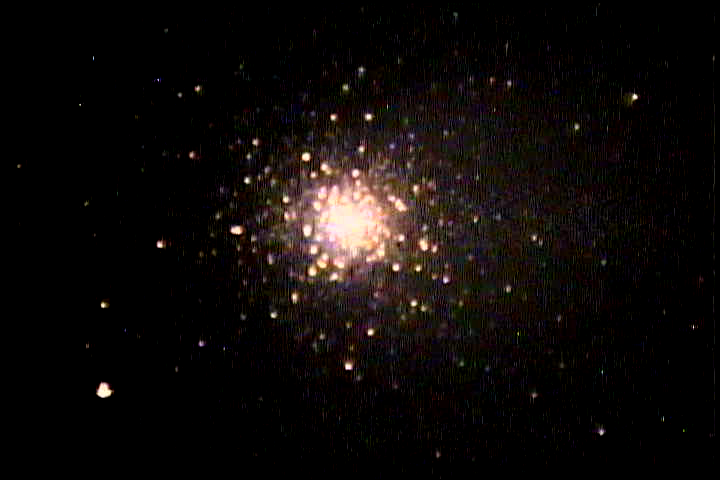
Tomorrow is International Astronomy Day, to celebrate it the Sleeping Bear Dunes National Lakeshore and Grand Traverse Astronomical Society will hold a special virtual star party via the Zoom Internet app. If it’s clear, Northwestern Michigan College’s professor Jerry Dobek will be transmitting live images of celestial objects that will look pretty much like what one sees through the eyepiece of a telescope. Dr. Dobek will be using the Joseph H. Rogers 0.4 meter main telescope and commenting will be members of the Grand Traverse Astronomical Society. Featured objects will be the 4-day-old crescent Moon, the tiny and elusive planet Mercury, star clusters and galaxies. The event starts at 9 pm though best viewing won’t begin until after about 9:30. Go to www.gtastro.org for instructions and a link.
The astronomical event times given are for the Traverse City/Interlochen area of Michigan. They may be different for your location.
Addendum
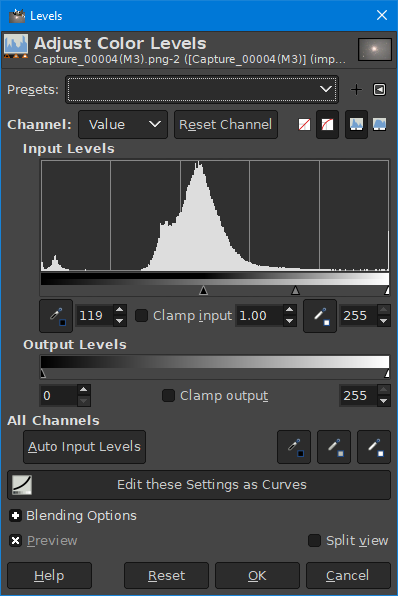
While attending the virtual star party you can capture the screen imaged with Alt/Print Screen keys. Paste the image into a paint or other program. I use GIMP (Gnu Image Manipulation Program), which fits my budget… It’s free. You can save the image of play with it. What I do with it is to darken the background. It should be black.
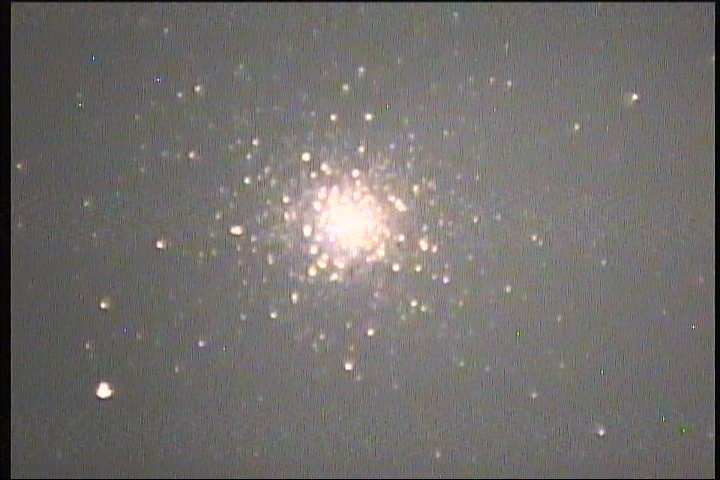
I paste this image into GIMP. I use the Levels control under the Color tab.
05/13/2021 – Ephemeris – The Moon and Mercury will appear near one another tonight
This is Ephemeris for Thursday, May 13th. Today the Sun will be up for 14 hours and 45 minutes, setting at 9:02, and it will rise tomorrow at 6:15. The Moon, 2 days past new, will set at 11:08 this evening.
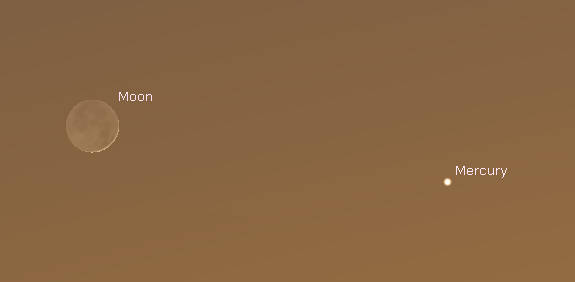
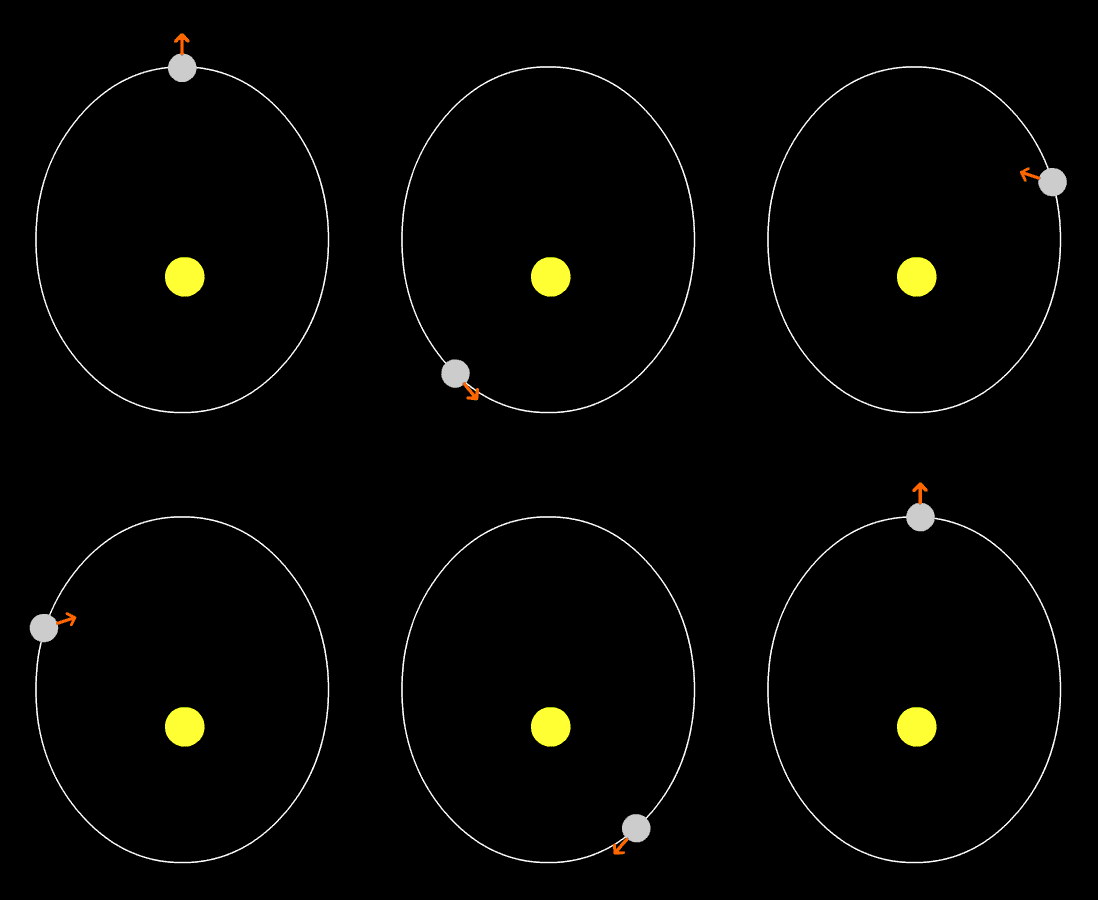
Tonight starting around 9:30, or half an hour after sunset is a good time to spot the thin crescent two day old Moon and the planet Mercury. The tiny and elusive Mercury will be about 7 moon widths to right of the Moon. With the Moon near Mercury, it should be easier to find instead of trying to locate it in the great expanse of featureless twilit sky. Mercury has a weird rotational period. In my youth astronomers thought that Mercury rotated so that one face would perpetually face the Sun, So it would rotate in the same time it orbits the Sun of 88 days. That’s what happens when the Moon orbits the Earth. However, Mercury rotates in exactly 2/3rds of its orbital time, making its solar day two of its years long or 176 Earth days.
The astronomical event times given are for the Traverse City/Interlochen area of Michigan. They may be different for your location.
Addendum
05/12/2021 – Ephemeris – Searching for the naked-eye planets for this week
This is Ephemeris for Wednesday, May 12th. Today the Sun will be up for 14 hours and 43 minutes, setting at 9:01, and it will rise tomorrow at 6:16. The Moon, 1 day past new, will set at 10:06 this evening.
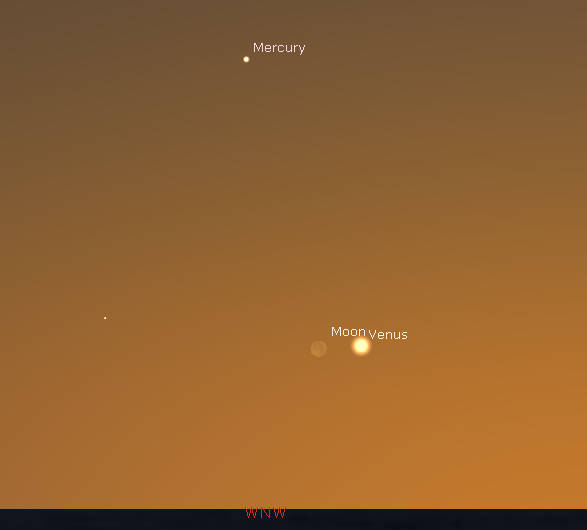
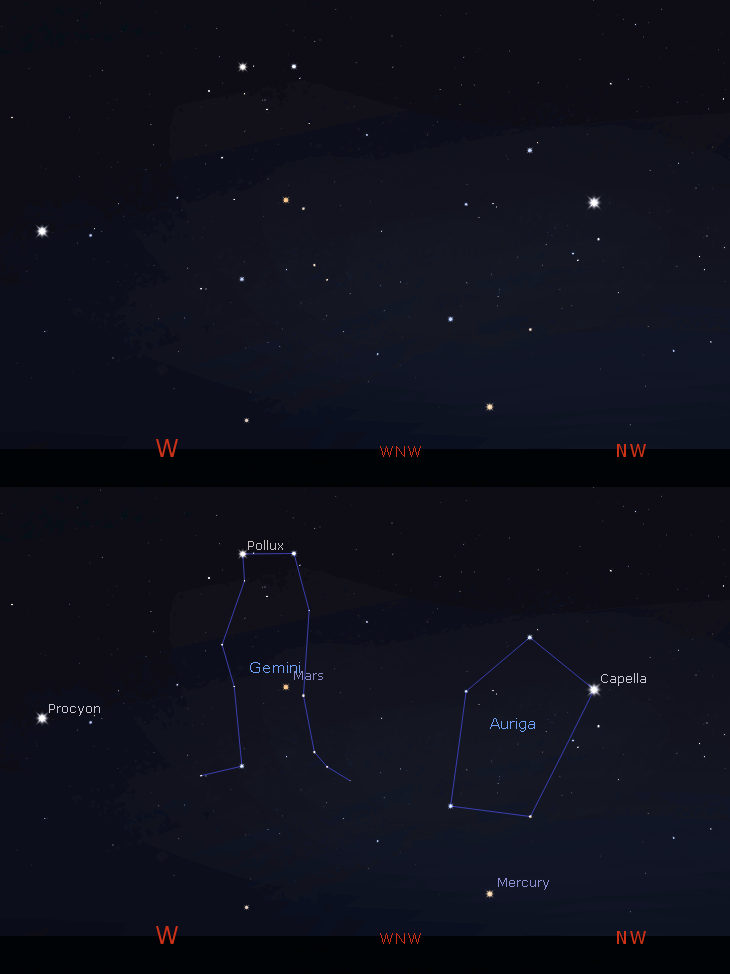
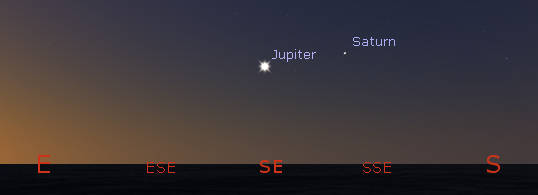
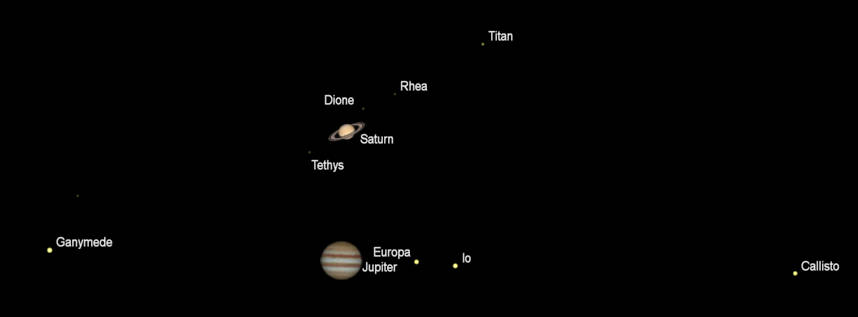
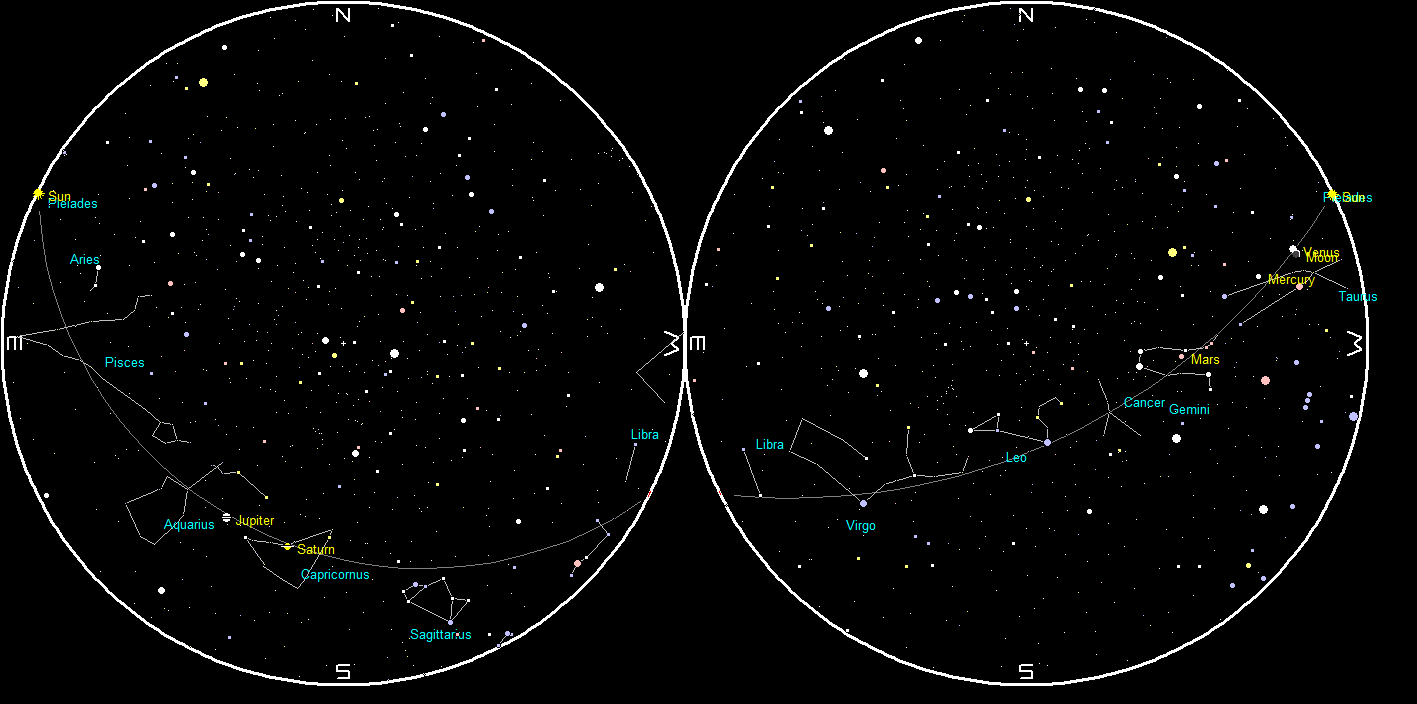
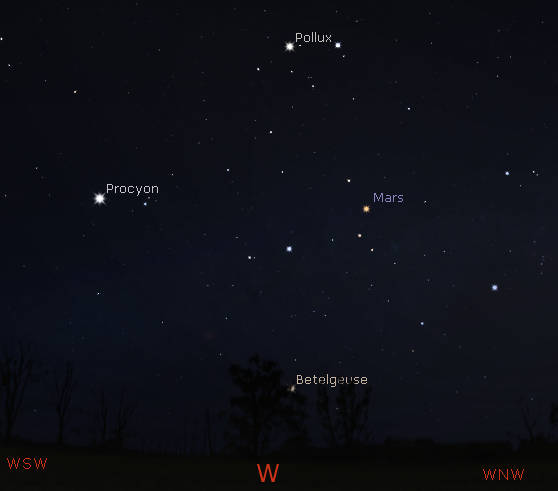
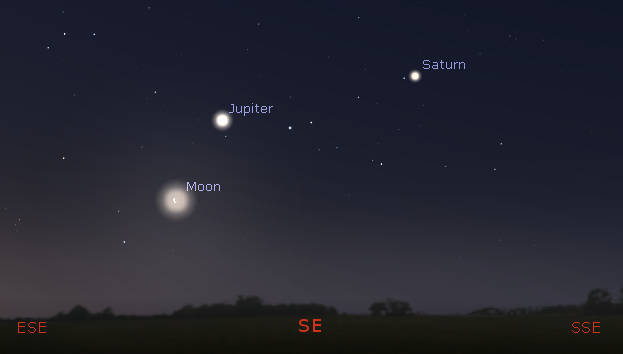
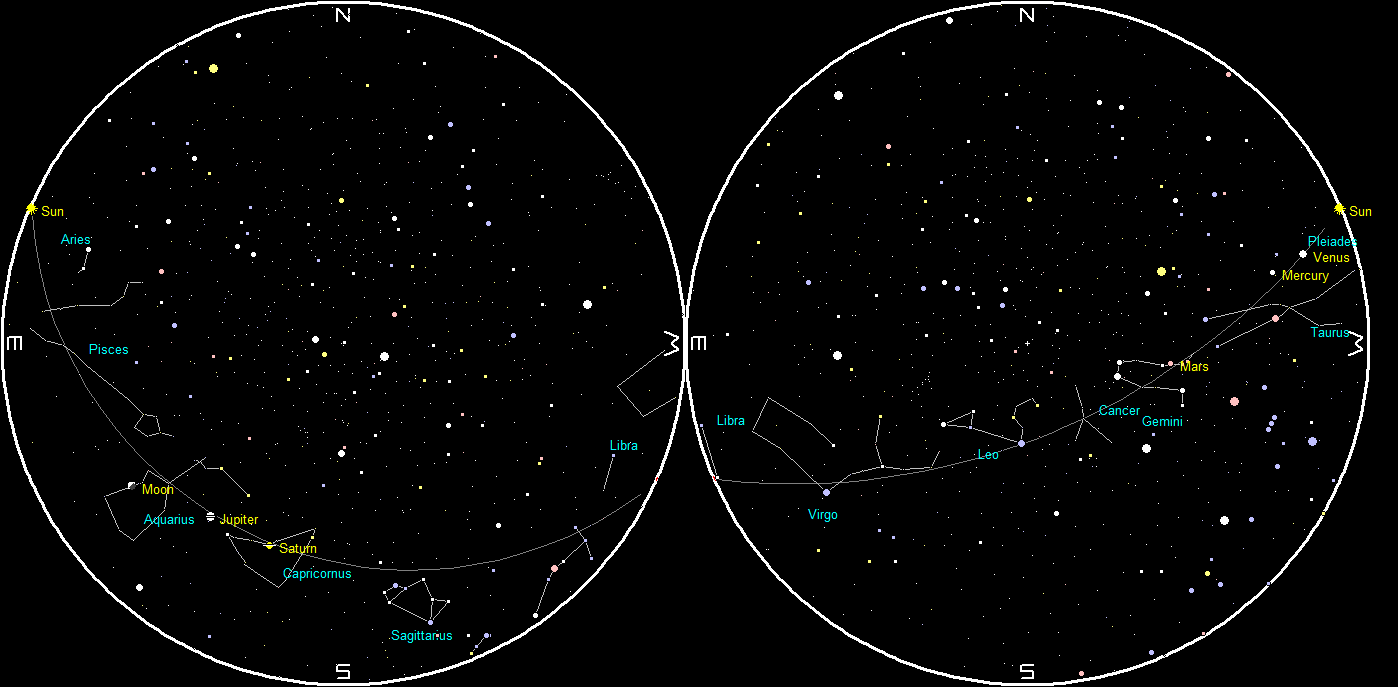
Let’s search for the naked-eye planets for this week. Mars will be joined by two more planets seen in twilight. Both Mercury and Venus are now just above where the Sun set. By 9:30 pm Mercury should be able to be spotted low in the west-northwest. Venus might be spotted lower and somewhat earlier. Venus will be setting at 10:02 pm with Mercury following at 11 pm. Mars can be found in the west at 10 pm tonight, in the constellation of Gemini the twins. Tonight it’s in the middle of the constellation. Mars will set at 1:02 am. Jupiter and Saturn, are in the morning sky. Saturn will rise at 2:30 am, with brighter Jupiter rising at 3:13 am. By 5:30 am they will be low in the southeast in the morning twilight.
The astronomical event times given are for the Traverse City/Interlochen area of Michigan. They may be different for your location.
Addendum
05/11/2021 – Ephemeris – The Big Dipper as seen by many peoples
This is Ephemeris for Tuesday, May 11th. Today the Sun will be up for 14 hours and 41 minutes, setting at 9 pm, and it will rise tomorrow at 6:17 am. The Moon is new today, and won’t be visible.
The Big Dipper is overhead, actually north of overhead this evening when it gets dark for us in Michigan, it’s seven stars shining brightly. The Big Dipper is not an actual constellation, recognized internationally. It’s part, the hind part, of Ursa Major, the great bear. The Big Dipper is an asterism or informal constellation. It is a distinctly North American constellation. For fugitive slaves, fleeing the southern states in the days before the Civil War, the Drinking Gourd, as they called it, showed the direction north to freedom. In England the dipper stars become the Plough (plow), or Charles’ Wain (Charlemagne’s Wagon). In France, known for culinary delights it was the saucepan, or the cleaver. Many cultures saw what was familiar to them in these seven bright stars.
The astronomical event times given are for the Traverse City/Interlochen area of Michigan. They may be different for your location.
Addendum
05/10/2021 – Ephemeris – The story of the constellations Boötes and Ursa Major
This is Bob Moler with Ephemeris for Monday, May 10th. Today the Sun will be up for 14 hours and 38 minutes, setting at 8:58, and it will rise tomorrow at 6:18. The Moon, 1 day before new, will rise at 6:25 tomorrow morning.
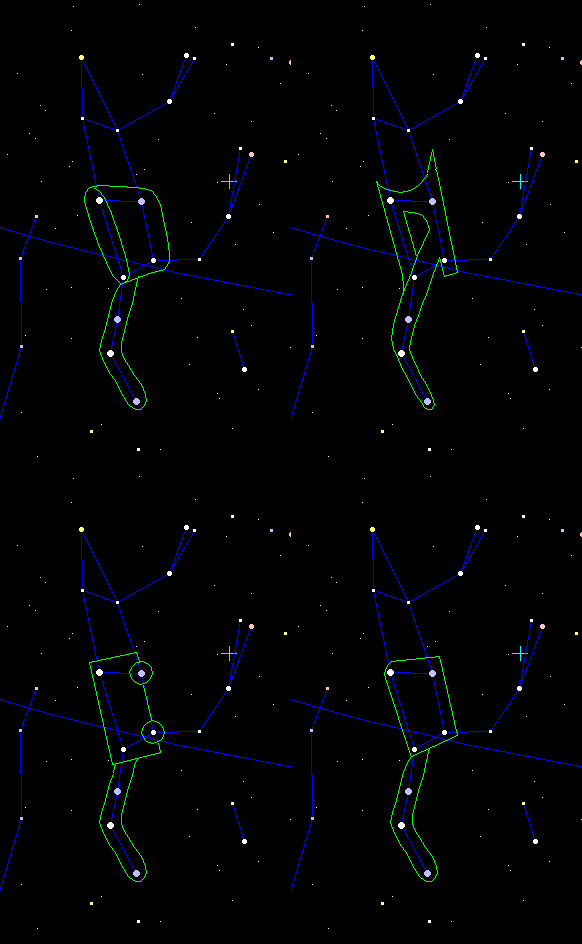
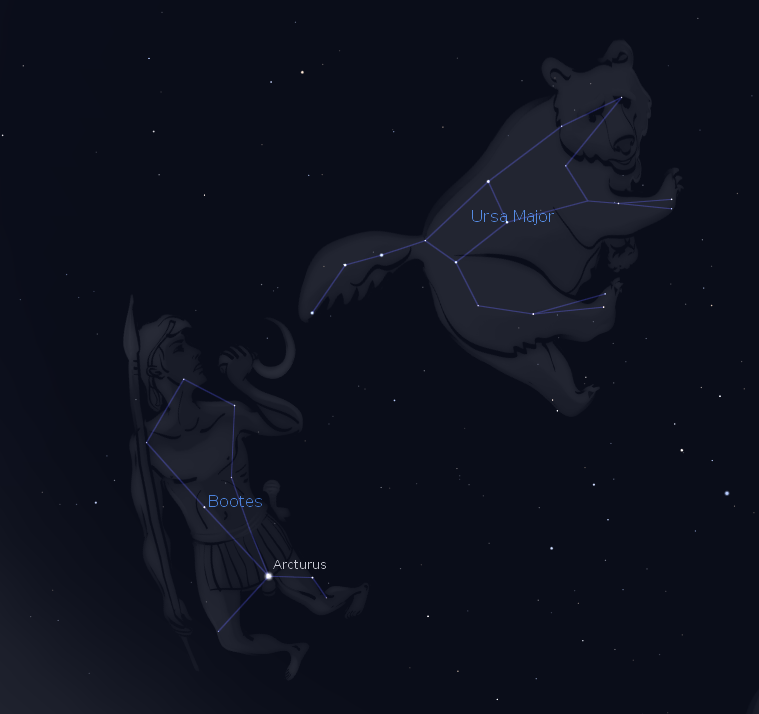
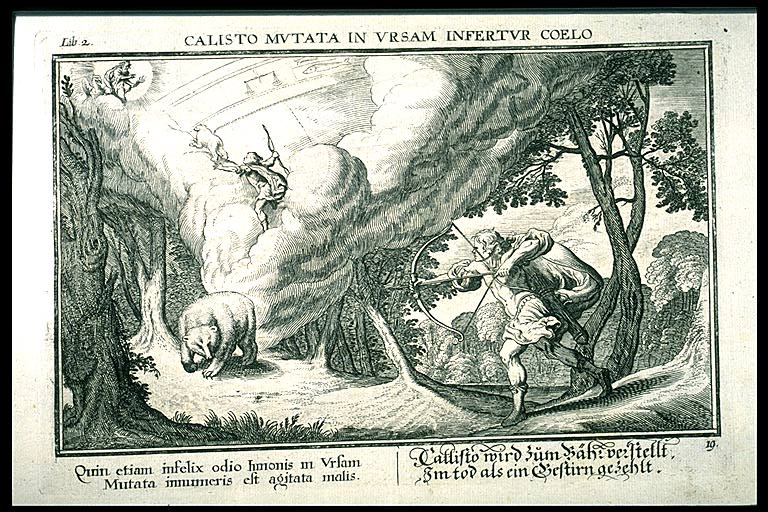
Seen in the east at 10 p.m. tonight is the kite shaped constellation of Boötes the herdsman. The bright star Arcturus is at the bottom of the kite to the right. It is pointed to by the arc of the handle of the Big Dipper, higher in the east. Boötes represents a young hunter named Arcas, son of Callisto, a beautiful young lady who had the misfortune of being loved by Zeus the chief of the Greek gods. Zeus’ wife Hera, found out about it, and since she couldn’t punish Zeus, turned the poor woman into a bear. Arcas, many years later, unaware of the events surrounding his mother’s disappearance was about to kill the bear when Zeus intervened and placed them both in the sky to save her, as Arcas still pursues her across the sky nightly.
The astronomical event times given are for the Traverse City/Interlochen area of Michigan. They may be different for your location.
Addendum
05/06/2021 – Ephemeris – Corvus, Crater, Hydra and Apollo
This is Ephemeris for Thursday, May 6th. Today the Sun will be up for 14 hours and 28 minutes, setting at 8:54, and it will rise tomorrow at 6:24. The Moon, 3 days past last quarter, will rise at 5:04 tomorrow morning.
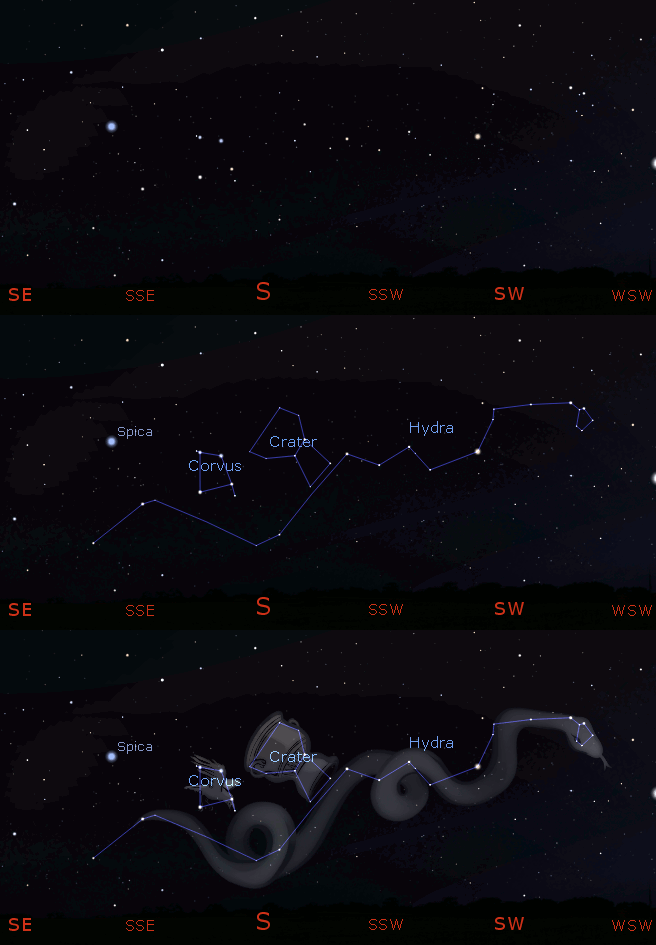
The small constellation of Corvus the crow is located low in the south at 10:30 this evening. It’s made of 5 dim stars, but the pattern is a distinctive but distorted box with two stars at the upper left marking that corner. To the right is a fainter constellation of a thick stemmed goblet called Crater. Both appear above the long constellation of Hydra the water snake who is slithering just above the southern horizon. In Greek mythology Corvus, then white, was the god Apollo’s pet. Apollo once bid Corvus to take a cup and fetch him some water. Corvus however dallied and waited for a green fig to ripen. He grabbed a snake and returned with a story as to how the snake had delayed him. The angry Apollo turned the crow and all crows to this day black.
The astronomical event times given are for the Traverse City/Interlochen area of Michigan. They may be different for your location.
Addendum
05/05/2021 – Ephemeris – Let’s search for the naked-eye planets for this week
This is Ephemeris for Cinco de Mayo, Wednesday, May 5th. Today the Sun will be up for 14 hours and 26 minutes, setting at 8:53, and it will rise tomorrow at 6:25. The Moon, 2 days past last quarter, will rise at 4:44 tomorrow morning.
Let’s search for the naked-eye planets for this week. Mars will be joined by one or two more planets, deep in twilight. Both Mercury and Venus are now just above where the Sun set. By 9:30 pm Mercury should be able to be spotted low in the west-northwest. Venus might be spotted lower and somewhat earlier. Venus will be setting at 9:46 and Mercury at 10:33. Mars can be found in the west at 10 pm tonight, in the constellation of Gemini the twins. Tonight it’s just by Castor’s leg. Mars will set at 1:11 am. Jupiter and Saturn, are in the morning sky. Saturn will rise at 2:57 am, with brighter Jupiter rising at 3:38 am. By 5:30 am they will be low in the southeast. The Eta Aquariid meteor shower will reach it’s peak early tomorrow morning.
The astronomical event times given are for the Traverse City/Interlochen area of Michigan. They may be different for your location.
Addendum

05/04/2021 – Ephemeris – We cross Halley’s Comet debris this week
This is Bob Moler with Ephemeris for Tuesday, May 4th. Today the Sun will be up for 14 hours and 23 minutes, setting at 8:51, and it will rise tomorrow at 6:26. The Moon, 1 day past last quarter, will rise at 4:20 tomorrow morning.
The Eta Aquariid meteor shower will reach their peak for us Thursday morning the 6th. The Eta Aquariids are caused by bits of Halley’s Comet, passing the Earth’s orbit heading out from the Sun. The Orionids of late October are debris of Halley’s comet passing the Earth’s orbit heading in toward the Sun. The Eta Aquariids are named for the star nearest the radiant of the meteor shower. The constellation of Aquarius has many shower radiants, which is why the shower is named for a star in Aquarius. The radiant rises shortly before 3:30am and astronomical twilight begins an hour later. There’s perhaps another half hour of visibility after that. The peak will occur Thursday morning where 20 meteors per hour or more might be seen.
The astronomical event times given are for the Traverse City/Interlochen area of Michigan. They may be different for your location.
Addendum
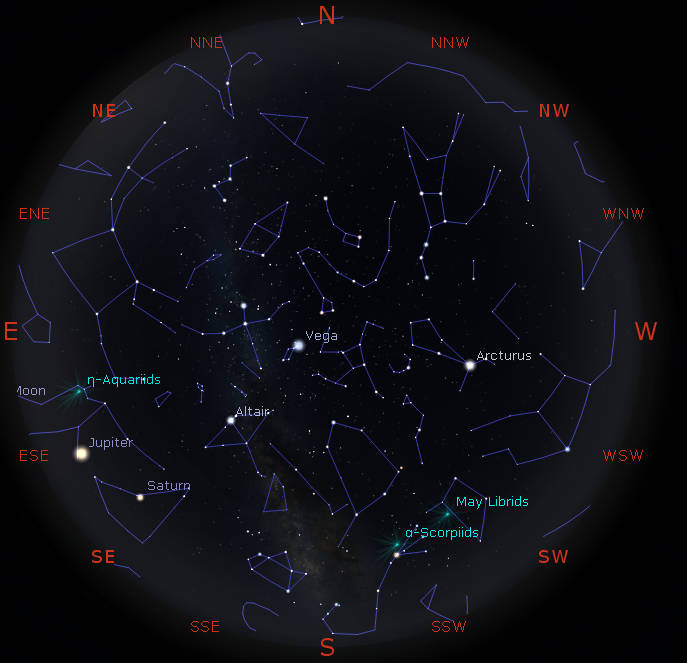
two other minor meteor showers are active then with only a handful of meteors an hour
compared to the Eta Aquariids’ somewhat higher rates. The funny looking “n” character
next to Aquariid is the Greek letter Eta. Chart created using Stellarium.
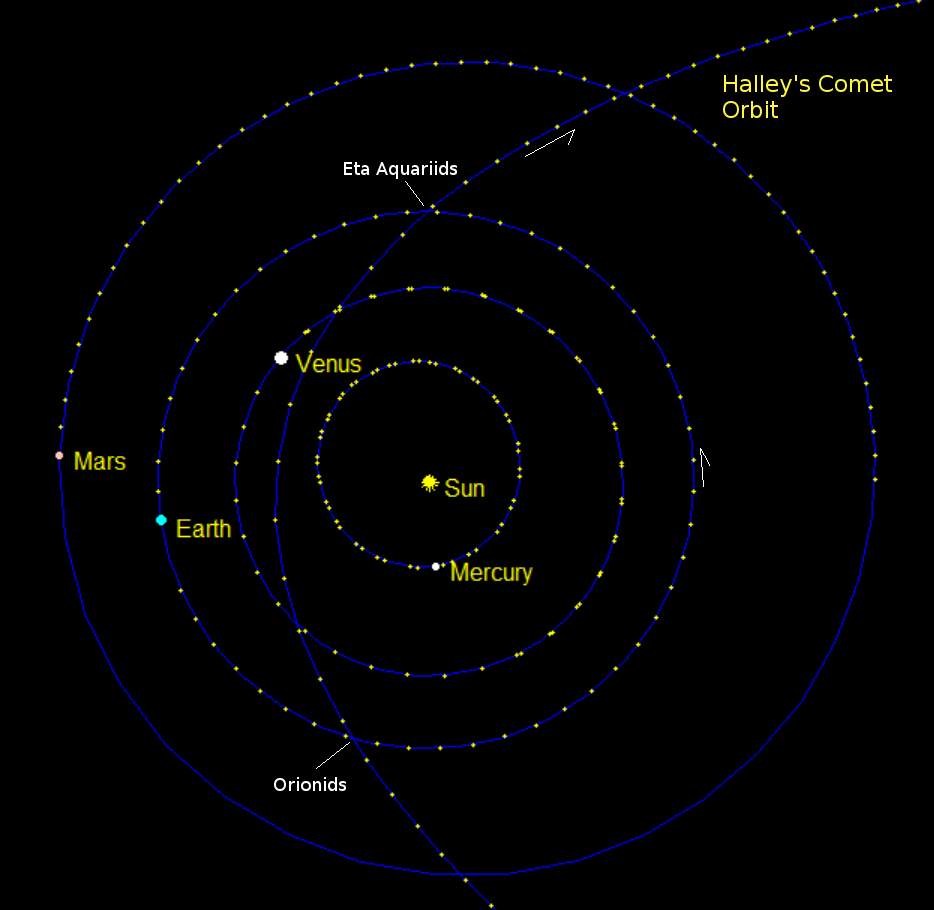
the inner solar system, and the Eta Aquariids when it’s leaving.
Credit my LookingUp program.
05/03/2021 – Ephemeris – The constellation of Virgo
This is Ephemeris for Monday, May 3rd. Today the Sun will be up for 14 hours and 21 minutes, setting at 8:50, and it will rise tomorrow at 6:28. The Moon, at last quarter today, will rise at 3:52 tomorrow morning.
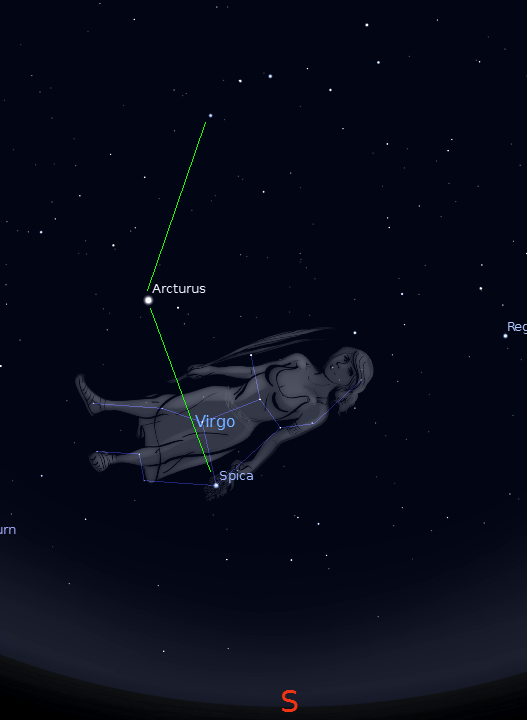
Tonight in the sky: to the southeast is the bright star Spica. Another way to find the star is to find the Big Dipper high overhead and follow the arc of the handle to the bright star Arcturus, and straighten the arc to a spike to meet Spica. It is in the constellation and member of the zodiac: Virgo the virgin. Virgo is a large constellation of a reclining woman holding a stalk of wheat. The bright star in the center of the constellation, Spica, is the head of that spike of wheat; and as such it ruled over the harvest in two of Virgo’s guises as the goddesses Persephone and Ceres. Ceres is now a dwarf planet and the root of the word cereal. Virgo is also identified as Astraea the goddess of justice. The constellation of Libra, the scales of justice, lies at her feet.
The astronomical event times given are for the Traverse City/Interlochen area of Michigan. They may be different for your location.
Addendum
 Bob Moler's Ephemeris Blog