Archive
09/16/2021 – Ephemeris – How safe is the Space Launch System (SLS) compared to the Space Shuttle?
This is Ephemeris for Thursday, September 16th. Today the Sun will be up for 12 hours and 27 minutes, setting at 7:51, and it will rise tomorrow at 7:24. The Moon, 3 days past first quarter, will set at 3:10 tomorrow morning.
Tonight, the planet Saturn will appear above the bright gibbous Moon. It might be a bit hard to spot.
The big NASA moon rocket, the Space Launch System or SLS, borrowed a lot of features from the Space Shuttle. Is it any safer? The answer is yes. The Space Shuttle had no abort system for a catastrophic failure, as we saw with the Challenger accident in 1986. However, even though the SLS uses the same type solid rocket boosters that failed Challenger, the Crew in the Orion capsule is on top of the rocket with an escape system to rocket them away from an exploding core stage. With the Orion capsule, the escape tower will be jettisoned at some point before reaching orbit, possibly making escape impossible in the latter stage of powered flight. Both SpaceX’s Dragon and Boeing’s Starliner have escape rockets built in for the entire flight.
Addendum
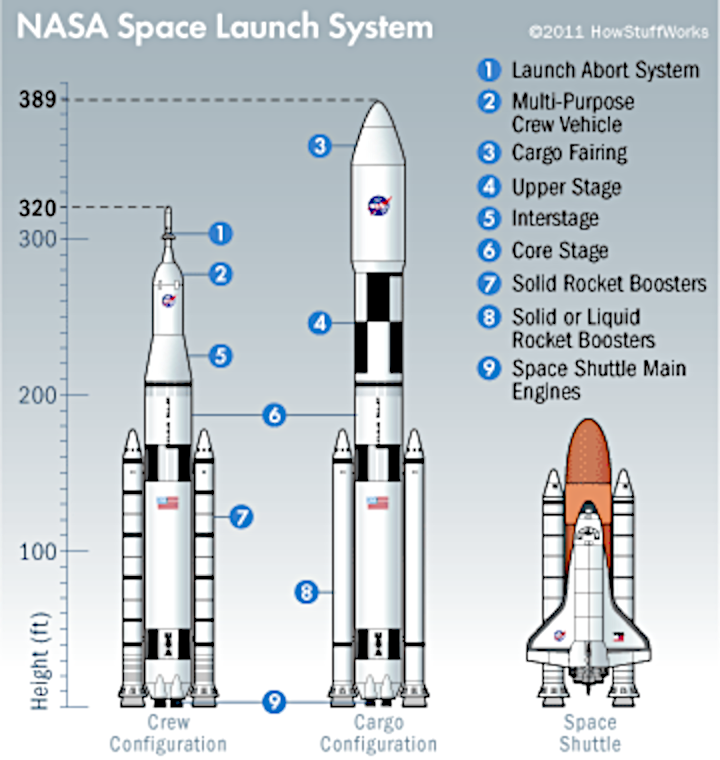
Shuttle-SLS comparisons. Note that this image is 10 years old. The center core stage will, like the external tank on the shuttle, remain unpainted. So far, the cargo version of the is still in the design stage. The Multipurpose Crew Vehicle is now called the Orion Spacecraft. Credit: How Stuff Works.
09/15/2021 – Ephemeris – Let’s search for the naked-eye planets for this week
This is Ephemeris for Wednesday, September 15th. Today the Sun will be up for 12 hours and 30 minutes, setting at 7:52, and it will rise tomorrow at 7:23. The Moon, 2 days past first quarter, will set at 1:59 tomorrow morning.
Let’s search for the naked-eye planets for this week. Venus should be visible in the western evening twilight before 8:15 tonight. It will set at 9:19 pm. By 8:30 pm, Jupiter and Saturn will be seen low in the southeastern sky. The brighter Jupiter will be easy to spot at that hour. Saturn will be dimmer, but a bit higher and to its right. Both these planets will be to the left of the bright gibbous Moon. They will be visible for most of the night, with Saturn setting first at 3:24 am, with Jupiter setting at 4:50 tomorrow morning. Saturn’s rings can be seen in a spotting scope of about 20 power magnification. Though at that power, the rings won’t appear separated from the planet, so Saturn will look like an elliptical spot. Most of Jupiter’s 4 brightest moons can even be spotted in binoculars.
The astronomical event times given are for the Traverse City/Interlochen area of Michigan (EDT, UT – 4 hr). They may be different for your location.
Addendum
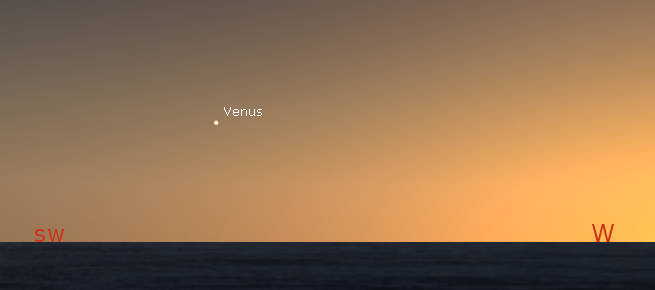
Venus in evening twilight at 8:15 tonight, about 20 minutes after sunset, September 15, 2021. Created using Stellarium.
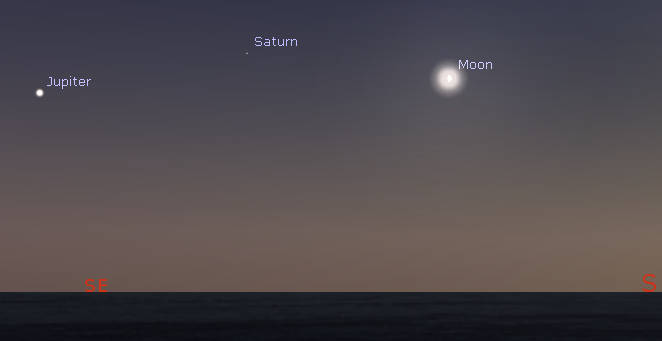
Jupiter Saturn and the Moon at 8:30 tonight, about 40 minutes after sunset, September 15, 2021. Created using Stellarium.
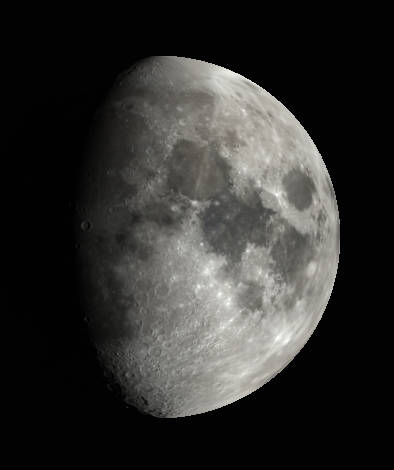
Low magnification view of the Moon tonight. The large crater Clavius is seen at the south (bottom) of the Moon. The crater Copernicus is seen near the left edge of the Moon, the sunrise terminator. Created using Stellarium.
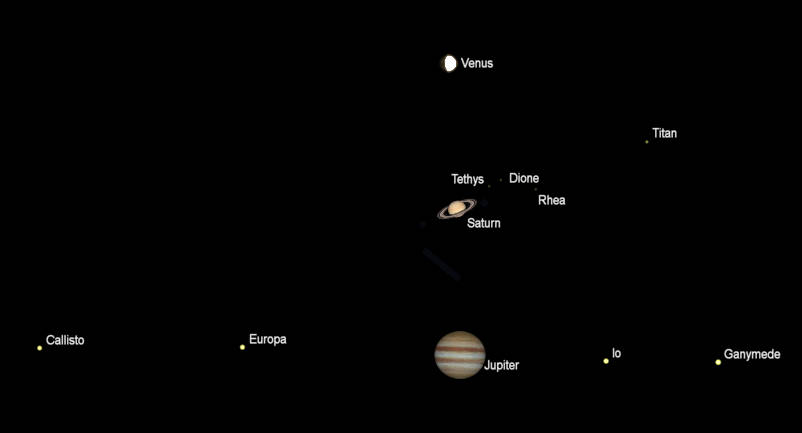
Telescopic view of the bright planets (north up) as they would be seen in a small telescope, with the same magnification, this evening. Venus at 8:30 pm, September 15, 2021. Apparent diameters: Venus, 16.70″ 68% illuminated; Saturn 18.03″, its rings 42.00″; Jupiter, 47.88″. The ” symbol means seconds of arc (1/3600th of a degree.) Created using Cartes du Ciel (Sky Charts).
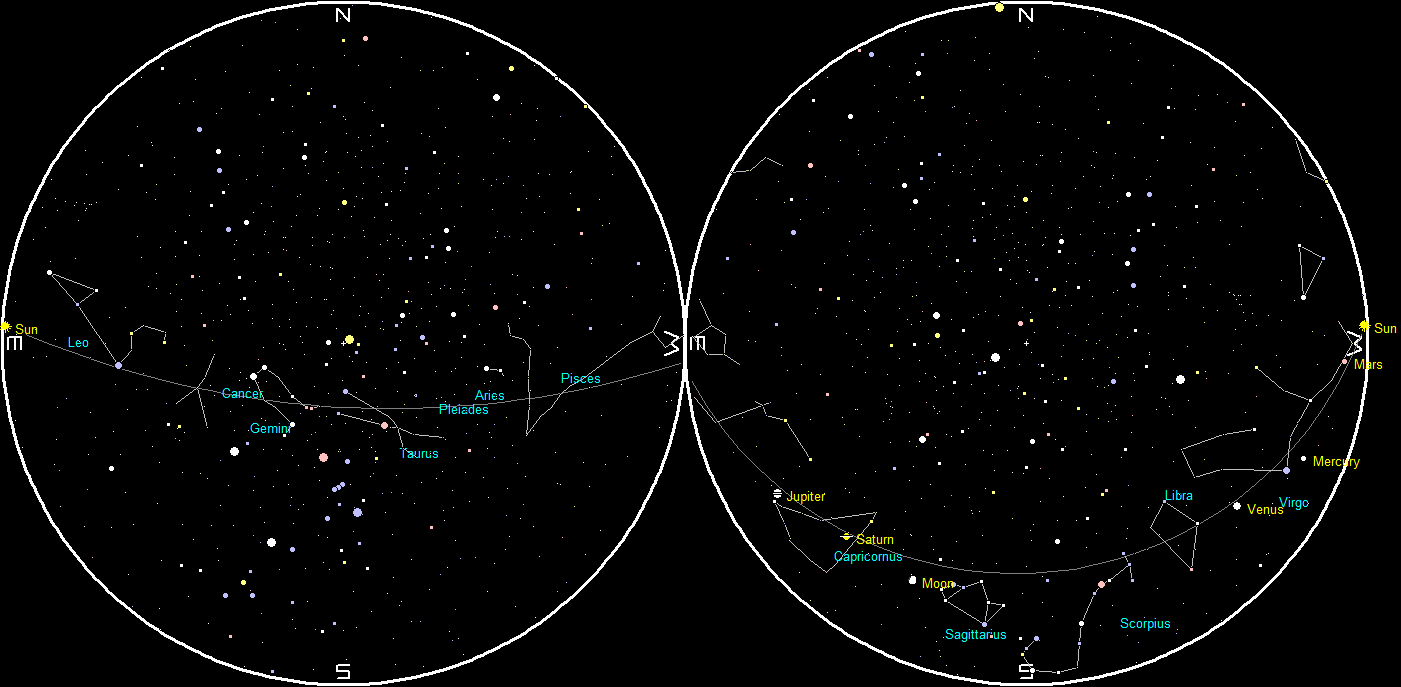
Planets and the Moon at sunset and sunrise of a single night, starting with sunset on the right on September 15, 2021. The night ends on the left with sunrise on the 16th. Click on the image to enlarge. Created using my LookingUp program.
09/14/2021 – Ephemeris – Lack of spacesuits just one of Artemis problems of getting humans back to the Moon
This is Ephemeris for Tuesday, September 14th. Today the Sun will be up for 12 hours and 33 minutes, setting at 7:54, and it will rise tomorrow at 7:21. The Moon, 1 day past first quarter, will set at 12:53 tomorrow morning.
The bright gibbous Moon is a feast for binoculars or a telescope. However, the speed-up plan to land crews on the Moon in 2024 proposed by the former President is not appearing to pan out. One major item is space suits, which must be more rugged and impervious to the Lunar regolith, or soil, whose grains are tiny, angular and sharp, and get into everything, and can destroy spacesuit joints. NASA has been working on them for 14 years, and by itself could cost a billion dollars. They might be ready by 2025. Besides delays to the SLS rocket, the contract with SpaceX to furnish a lunar lander is now tied up in litigation by one of the contract losers. NASA’s trying to land humans on the Moon on one half of one percent of the Federal budget, plus do everything else it does.
The astronomical event times given are for the Traverse City/Interlochen area of Michigan (EDT, UT – 4 hr). They may be different for your location.
Addendum
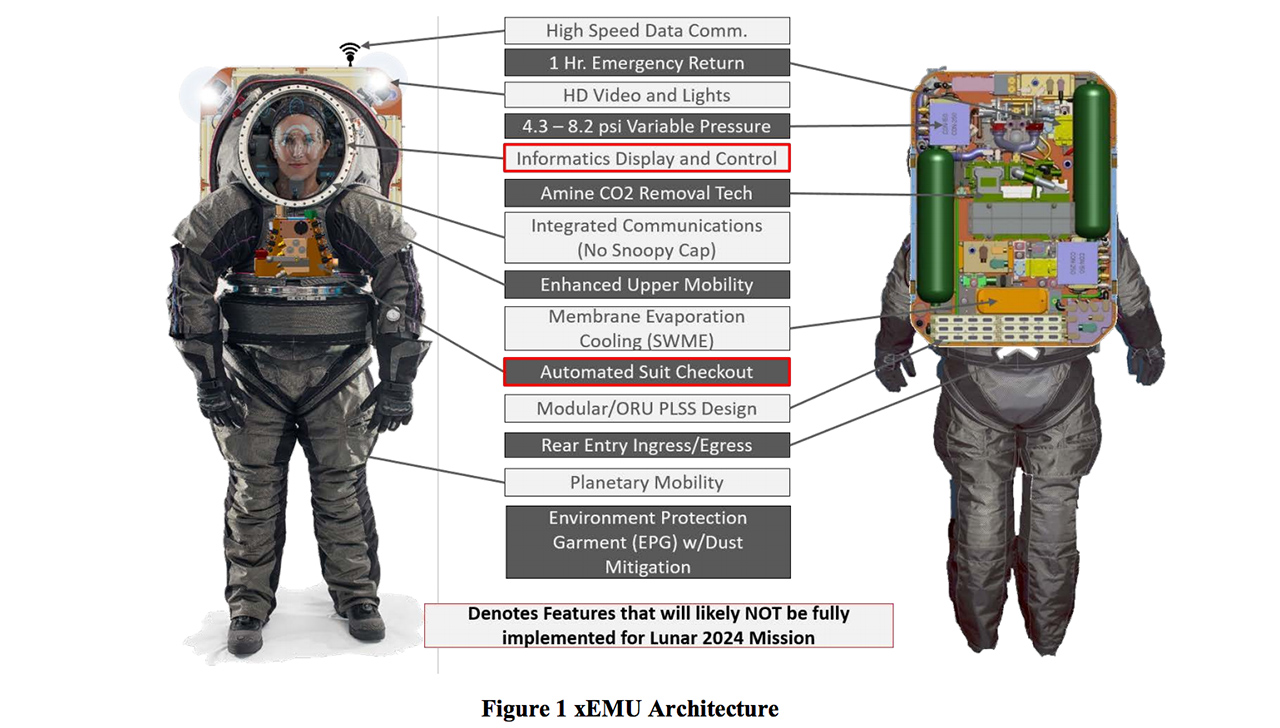
Prototype lunar spacesuit. xEMU stands for Exploration Extravehicular Activity Mobility Unit. Of course. This uncredited image is from slashgear.com in 2019, so I wouldn’t believe the date. These xEMU suits may eventually cost a billion dollars to develop and produce. Click on the image to enlarge it.
09/13/2021 – Ephemeris – The Greeks knew the size and shape of the Earth and estimated the distance to the Moon a long time ago
This is Bob Moler with Ephemeris for Monday, September 13th. Today the Sun will be up for 12 hours and 37 minutes, setting at 7:56, and it will rise tomorrow at 7:20. The Moon, at first quarter today, will set at 11:57 this evening.
The Ancient Greeks used lunar eclipses to determine that Earth is a sphere, and worked on determining the distance to the Moon. From ancient times, the Greeks knew that an eclipse of the Moon was caused by the Earth’s shadow falling on the Moon. Since the Earth’s shadow was always circular, no matter where the Moon was in the sky during an eclipse, the Earth must be a sphere since that’s the only three-dimensional body that always casts a circular shadow. They also used the size of the Earth’s shadow to estimate the distance to the Moon. The lunar distance, on average, is 60.8 times the Earth’s radius away. The first estimates were about one third of that. Hipparchus in the 2nd century BC got much closer. It got even better from there.
The astronomical event times given are for the Traverse City/Interlochen area of Michigan (EDT, UT – 4 hr). They may be different for your location.
Addendum
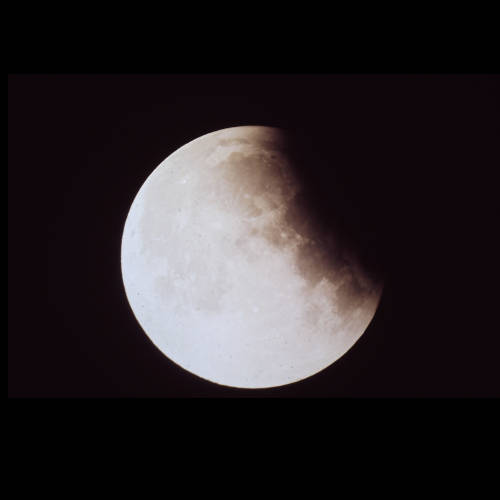
Partial Lunar Eclipse showing circular arc of the Earth’s shadow. Taken 04:15 UT August 17, 1970. Credit: the author.
The size of the Earth was unknown until Eratosthenes did in 240 BC. He came up with the circumference of the Earth to a fairly high degree. The Circumference is equal to the radius of a sphere or circle by 2πr.
09/10/2021 – Ephemeris – Rescheduled virtual Sleeping Bear Dunes/GTAS star party set for tomorrow, Saturday night the 11th
This is Bob Moler with Ephemeris for Friday, September 10th. Today the Sun will be up for 12 hours and 46 minutes, setting at 8:02, and it will rise tomorrow at 7:17. The Moon, 3 days before first quarter, will set at 10:05 this evening.
Tomorrow night the Sleeping Bear Dunes National Lakeshore and the Grand Traverse Astronomical Society (GTAS) will host an online star party starting around 9 pm via the Zoom app available for Android smartphones, iPhones and computers. This is rescheduled from last week due to clouds. Instructions for joining are on the society’s website, gtastro.org. Images will be captured live from Northwestern Michigan College’s Joseph H Rogers Observatory. The images will be pretty much what is seen at the telescope eyepiece, and definitely not Hubble Space Telescope quality, which take weeks or months to process. Visible will be the five-day-old Moon, Venus, Jupiter, Saturn and the wonders of the Milky Way.
The astronomical event times given are for the Traverse City/Interlochen area of Michigan (EDT, UT – 4 hr). They may be different for your location.
Addendum
During the GTAS board meeting, September 3rd, just before the canceled star party, it was decided to hold off the decision on in person star parties until spring of 2022. We’ll follow the state of the pandemic in our area over the winter and see where we stand. Star parties at the Northwestern Michigan College’s Joseph H. Rogers Observatory could start in March. Star parties at the Sleeping Bear Dunes National Lakeshore have in the past started in April.
We may still use imagers on our telescopes to capture celestial objects for display on laptop computers rather than viewing through the eyepiece. The society has two imagers, and the Observatory another. The society’s imagers can be used on society’s and members telescopes. This will solve the problems of having to sanitize telescope eyepieces between observers. At this point, I’m not sure what sanitizing products do to the delicate anti-reflective coatings on eyepieces.
We will also pay more attention to viewing the heavens with the naked eye or binoculars that people may have. Bring your own. Learning the constellations is always the best way to be introduced to astronomy, and the only way, up until 411 years ago. And binoculars are a great first telescope.
09/09/2021 – Ephemeris – The constellation of Cassiopeia the Queen
This is Ephemeris for Thursday, September 9th. Today the Sun will be up for 12 hours and 49 minutes, setting at 8:04, and it will rise tomorrow at 7:16. The Moon, 3 days past new, will set at 9:40 this evening.
Tonight, check out the crescent Moon, with Venus below left of it. Cassiopeia is a constellation shaped like the letter W seen in the northeast these evenings. In Greek mythology, she was the queen of Ethiopia. She was very beautiful and very boastful of that fact. She even compared her beauty with that of the sea nymphs, daughters of the sea god Poseidon. Papa was not amused. So Cassiopeia’s daughter, the Princess Andromeda, was made to suffer for it. Poseidon sent a sea monster, Cetus, to ravage the coastal cities of the country. The only way to stop it was to sacrifice Andromeda to the monster. Andromeda and Cetus are constellations we’ll meet in the coming weeks. We’ve already met Pegasus, the flying horse, rising in the east. And we are yet to meet the hero, Perseus.
The astronomical event times given are for the Traverse City/Interlochen area of Michigan (EDT, UT – 4 hr). They may be different for your location.
Addendum
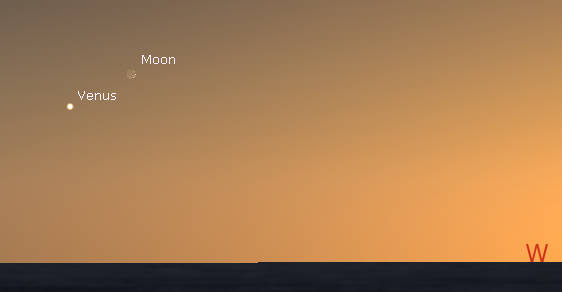
Venus and the Moon in evening twilight, about a half hour after sunset tonight, September 9, 2021. Created using Stellarium.
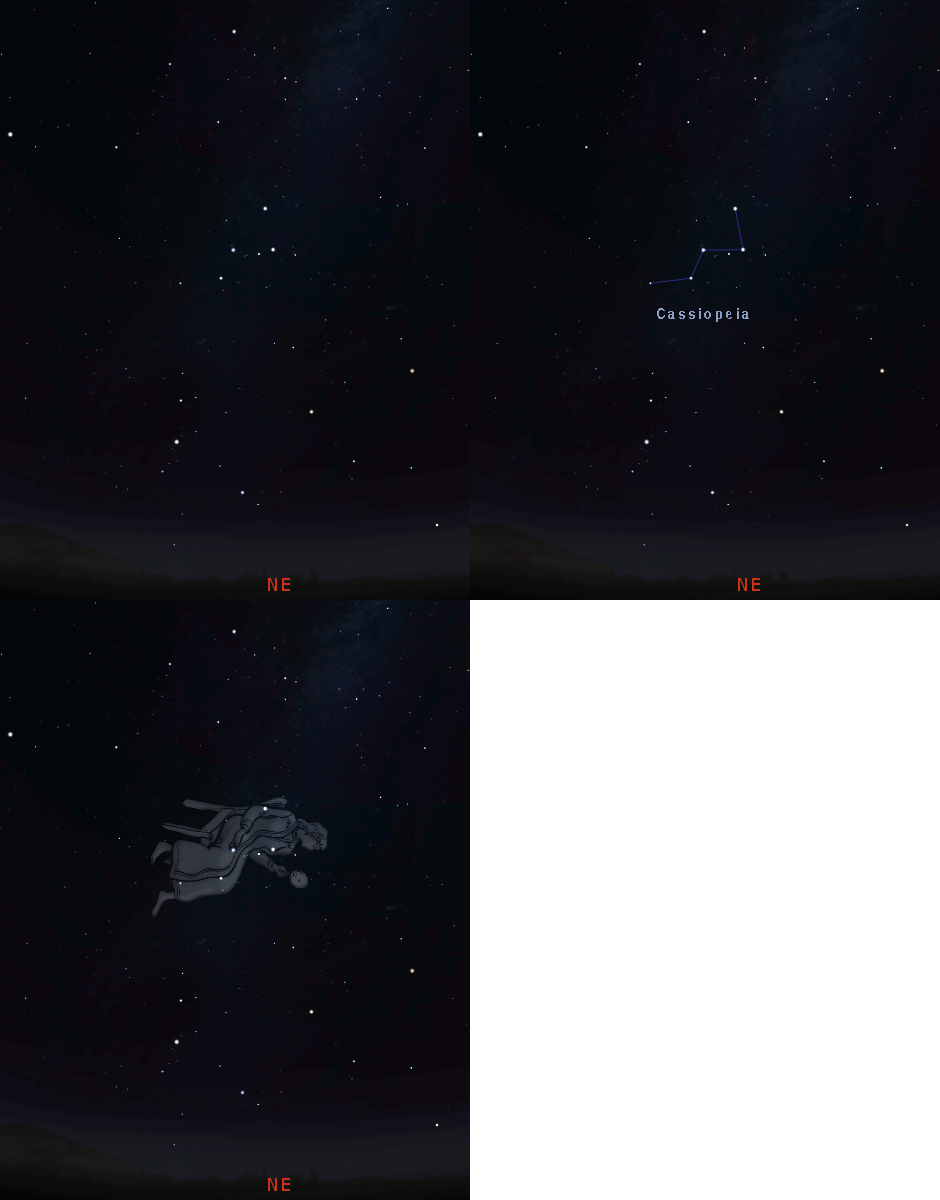
Cassiopeia finder animation looking northeast in mid-September, an hour and a half after sunset. Created using Stellarium.
09/08/2021 – Ephemeris – Let’s search for the naked-eye planets for this week
This is Ephemeris for Wednesday, September 8th. Today the Sun will be up for 12 hours and 52 minutes, setting at 8:06, and it will rise tomorrow at 7:14. The Moon, 2 days past new, will set at 9:16 this evening.
Let’s search for the naked-eye planets for this week. Venus should be visible in the western evening twilight before 8:30 tonight. It will set at 9:41 pm. By 8:30 pm, Jupiter and Saturn will be seen low in the southeastern sky. The brighter Jupiter will be easy to spot at that hour. Saturn will be dimmer, but a bit higher and to its right. Both these planets will be visible for most of the night, with Saturn setting first at 3:53 am, with Jupiter setting at 5:21 tomorrow morning. Saturn’s rings can be seen in a spotting scope of about 20 power magnification. Though at that power, the rings won’t appear separated from the planet, so Saturn will look like an elliptical spot. Most of Jupiter’s 4 brightest moons can even be spotted in binoculars.
The astronomical event times given are for the Traverse City/Interlochen area of Michigan (EDT, UT – 4 hr). They may be different for your location.
Addendum
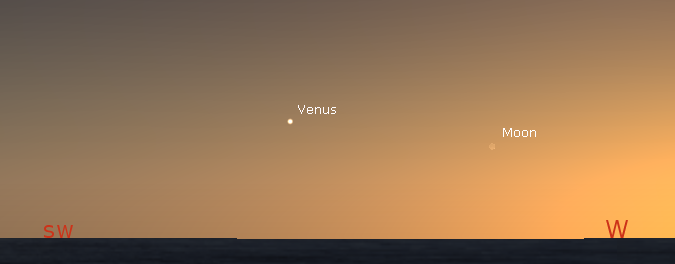
Venus and the Moon in evening twilight at 8:30 pm tonight, September 8, 2021. This is about 25 minutes after sunset. Created using Stellarium.
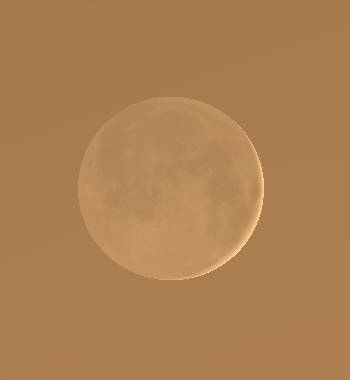
The thin crescent Moon as it might appear with earth shine in binoculars at 8:30 pm tonight, September 8, 2021. Created using Stellarium.
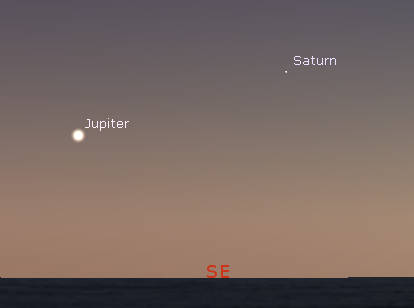
Jupiter and Saturn in the southeast at 8:30 pm, about a half hour after sunset tonight, September 8, 2021. Created using Stellarium.
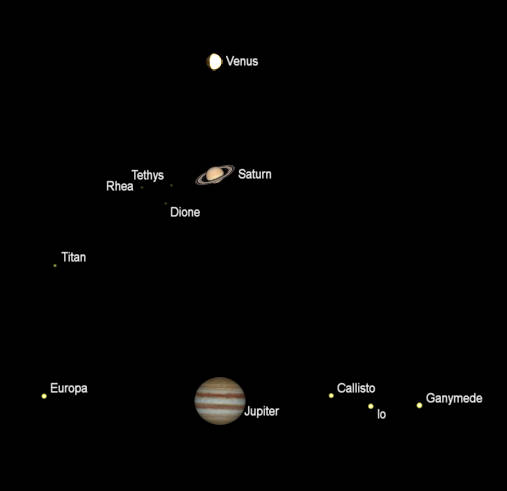
Telescopic view of the bright planets (north up) as they would be seen in a small telescope, with the same magnification, this evening. Venus at 8:30 pm, and the other two at 10 pm, September 8, 2021. Apparent diameters: Venus, 15.88″ 70% illuminated; Saturn 18.19″, its rings 42.36″; Jupiter, 48.43″. Jupiter’s moons will slowly approach the planet from our viewpoint overnight. The ” symbol means seconds of arc (1/3600th of a degree.) Created using Cartes du Ciel (Sky Charts).
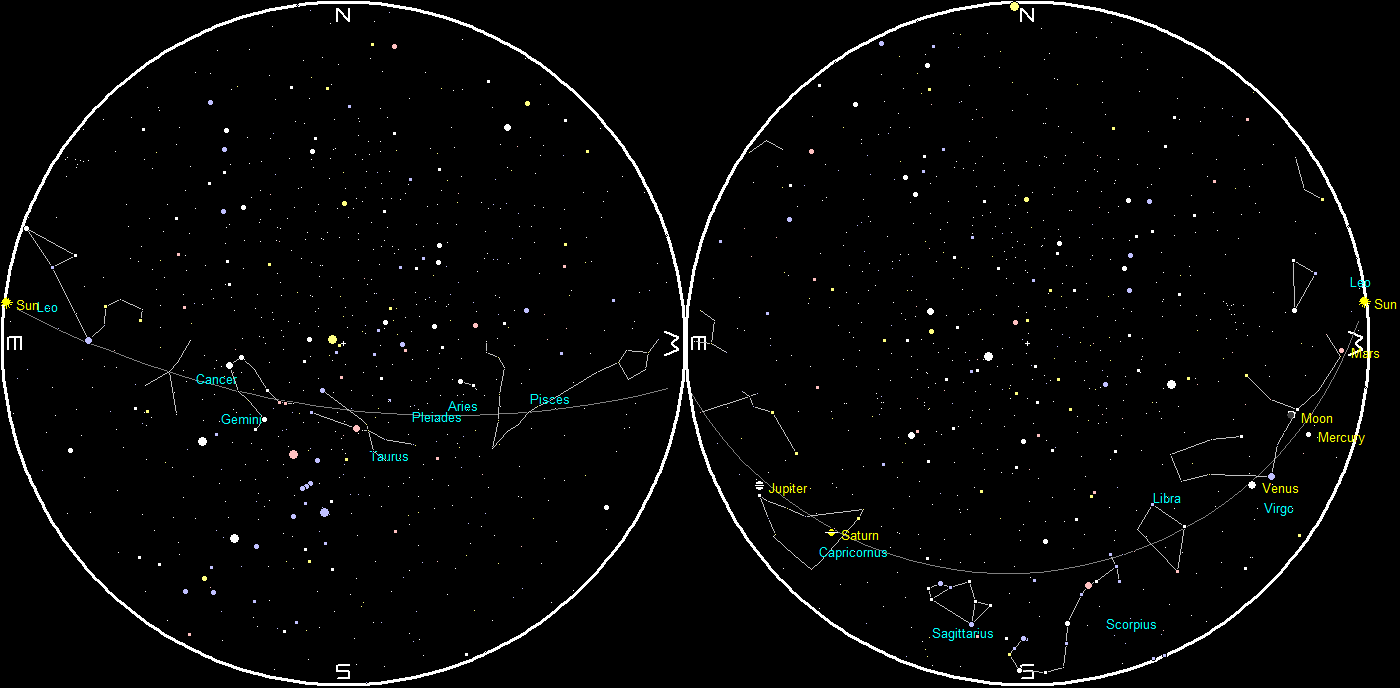
Planets and the Moon at sunset and sunrise of a single night, starting with sunset on the right on September 8, 2021. The night ends on the left with sunrise on the 9th. Click on the image to enlarge it. Created using my LookingUp program.
09/07/2021 – Ephemeris – The constellation of Cepheus the king
This is Bob Moler with Ephemeris for Tuesday, September 7th. Today the Sun will be up for 12 hours and 55 minutes, setting at 8:07, and it will rise tomorrow at 7:13. The Moon, 1 day past new, will set at 8:53 this evening.
There’s a faint constellation in the northeast above the W shaped constellation of Cassiopeia. It’s a nearly upside down church steeple of a constellation called Cepheus the king, and husband of queen Cassiopeia. Cepheus’ claim to modern astronomical fame is that one of its stars, Delta (δ) Cephei, is the archetype for the important Cepheid variable stars. Delta is the bottom most of a trio of stars at the right corner of the constellation. In the early 20th century, Henrietta Leavitt discovered that Cepheids in the nearby galaxy the Large Magellanic Cloud varied in brightness with a period that was related to their average brightness. This meant that Cepheids could be used as standard candles to measure the great distances to other galaxies.
The astronomical event times given are for the Traverse City/Interlochen area of Michigan (EDT, UT – 4 hr). They may be different for your location.
Addendum
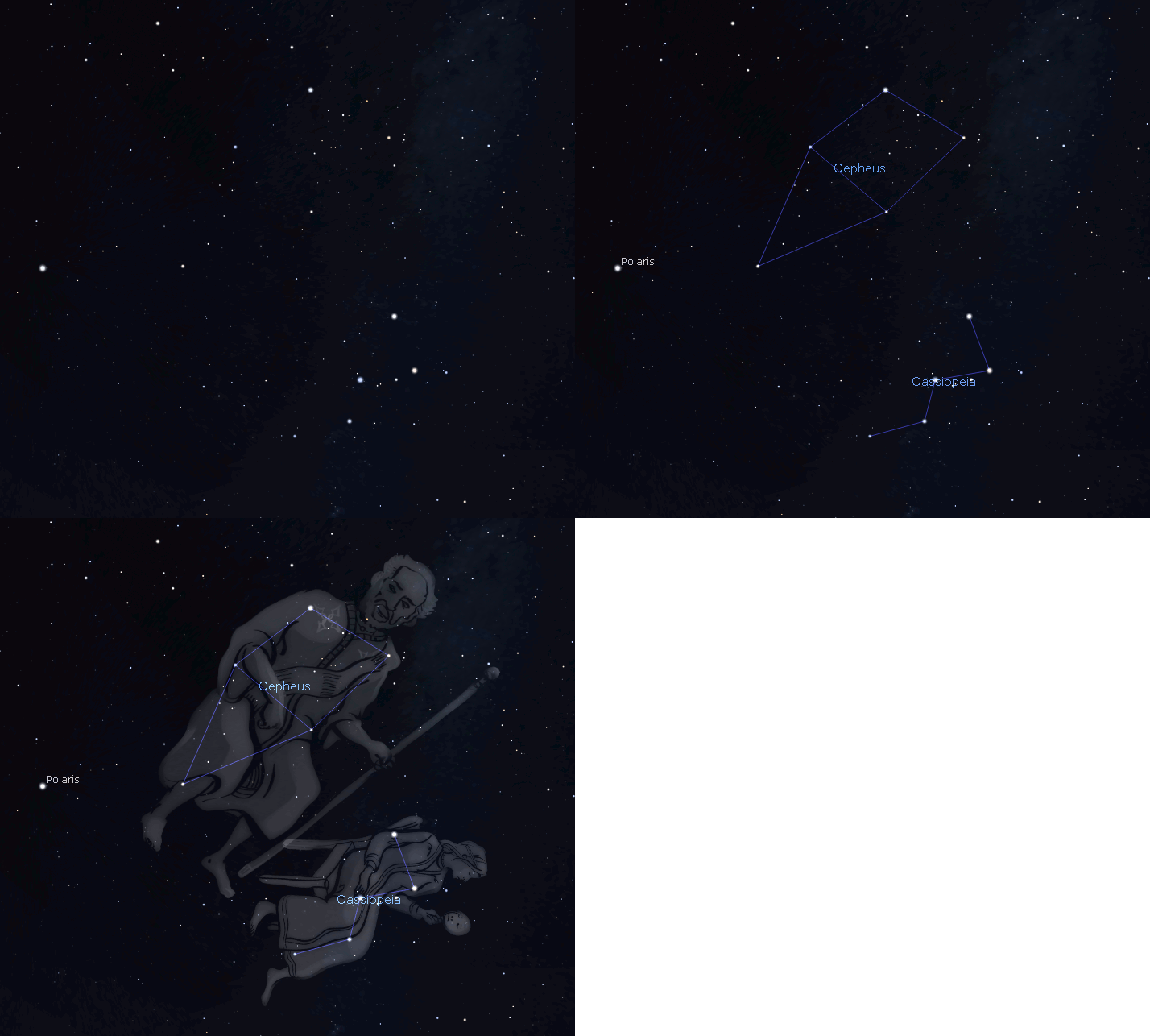
Cassiopeia and Cepheus finder animation looking in the northeast at 9-10 pm or about an hour after sunset. Created using Stellarium and GIMP.
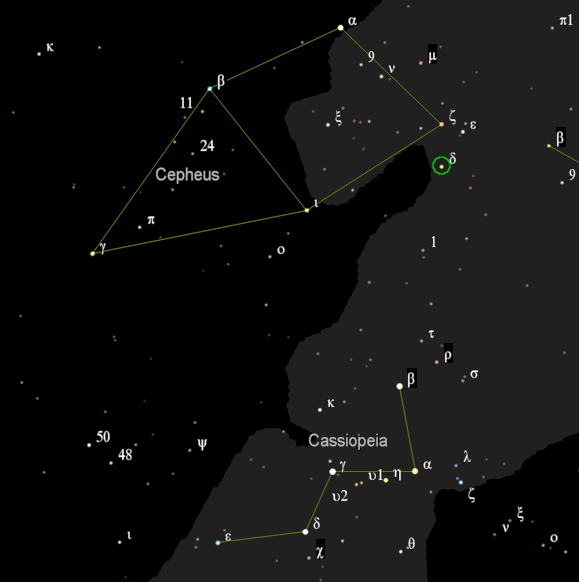
Delta Cephei finder for September at 9-10 pm, looking northeast. Created using Cartes du Ciel (Sky Chart).
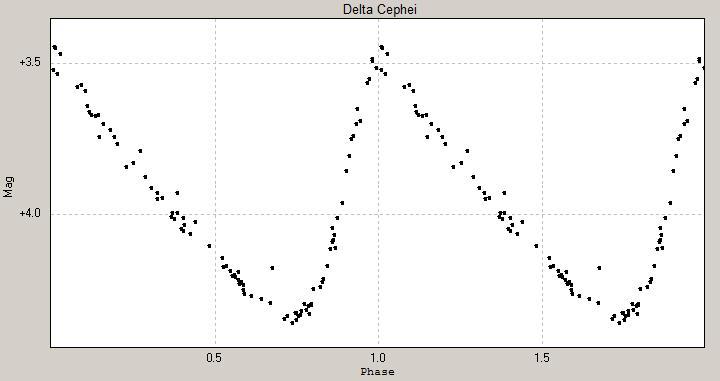
Light Curve of Delta Cephei. The pulsation period is 5.367 days. Note the Magnitude vertical axis, the lower the magnitude the brighter the star is. Blame that on the Greek astronomer Hipparchus, 2nd century BC. It’s like golf scores, the lower the score, the better the golfer. Credit: Thomas K Vbg – Own work, CC BY-SA 3.0, https://commons.wikimedia.org/w/index.php?curid=13887639.
09/03/2021 – Ephemeris – Tonight: Virtual Star Party via Zoom with the Sleeping Bear Dunes National Lakeshore
This is Ephemeris for Friday, September 3rd. Today the Sun will be up for 13 hours and 7 minutes, setting at 8:15, and it will rise tomorrow at 7:09. The Moon, 3 days before new, will rise at 4:01 tomorrow morning.
Tonight the Sleeping Bear Dunes National Lakeshore and the Grand Traverse Astronomical Society will host an online star party this evening starting around 9 pm via the Zoom app available for Android smartphones, iPhones and computers. Instructions for joining are on the society’s website, gtastro.org. Images will be captured live, if it’s clear, from Northwestern Michigan College’s Joseph H Rogers Observatory. The images will be pretty much what is seen at the telescope eyepiece, and definitely not Hubble Space Telescope quality, which take weeks to process. Visible will be the Venus, Jupiter, Saturn and wonders of the Milky Way, some really neat star clusters, and nebulae, that is clouds of gas and dust in the Milky Way.
The astronomical event times given are for the Traverse City/Interlochen area of Michigan (EDT, UT – 4 hr). They may be different for your location.
Addendum
Also, the planets Venus, Saturn and Jupiter will be visible during the session.
This post is going out at Midnight the night before, and the forecast is for clouds. It is possible that we will reschedule for Friday the 10th. If so, I’ll have a post about it then.
09/02/2021 – Ephemeris – Finding the Little Dipper
This is Bob Moler with Ephemeris for Thursday, September 2nd. Today the Sun will be up for 13 hours and 10 minutes, setting at 8:17, and it will rise tomorrow at 7:07. The Moon, 3 days past last quarter, will rise at 2:55 tomorrow morning.
10 p.m. is the best time now to spot the Little Dipper. It is difficult to spot, being much smaller and dimmer than the Big Dipper. However, it is the Big Dipper that points to it, by the two stars at the front of the bowl which point to the North Star, Polaris, the star that doesn’t appear to move. That star is the tip of the handle of the Little Dipper. The handle is seen as a curve of stars upward and to the left to a small box of stars that is its bowl. The two brighter stars at the front of the bowl are called the Guard Stars because in the past they were thought to be guardians of the pole. The Little Dipper is not an official constellation, but is Ursa Minor the lesser bear. To the Anishinaabe native peoples of this area, it represents Maang the loon.
The astronomical event times given are for the Traverse City/Interlochen area of Michigan (EDT, UT – 4 hr). They may be different for your location.
Addendum
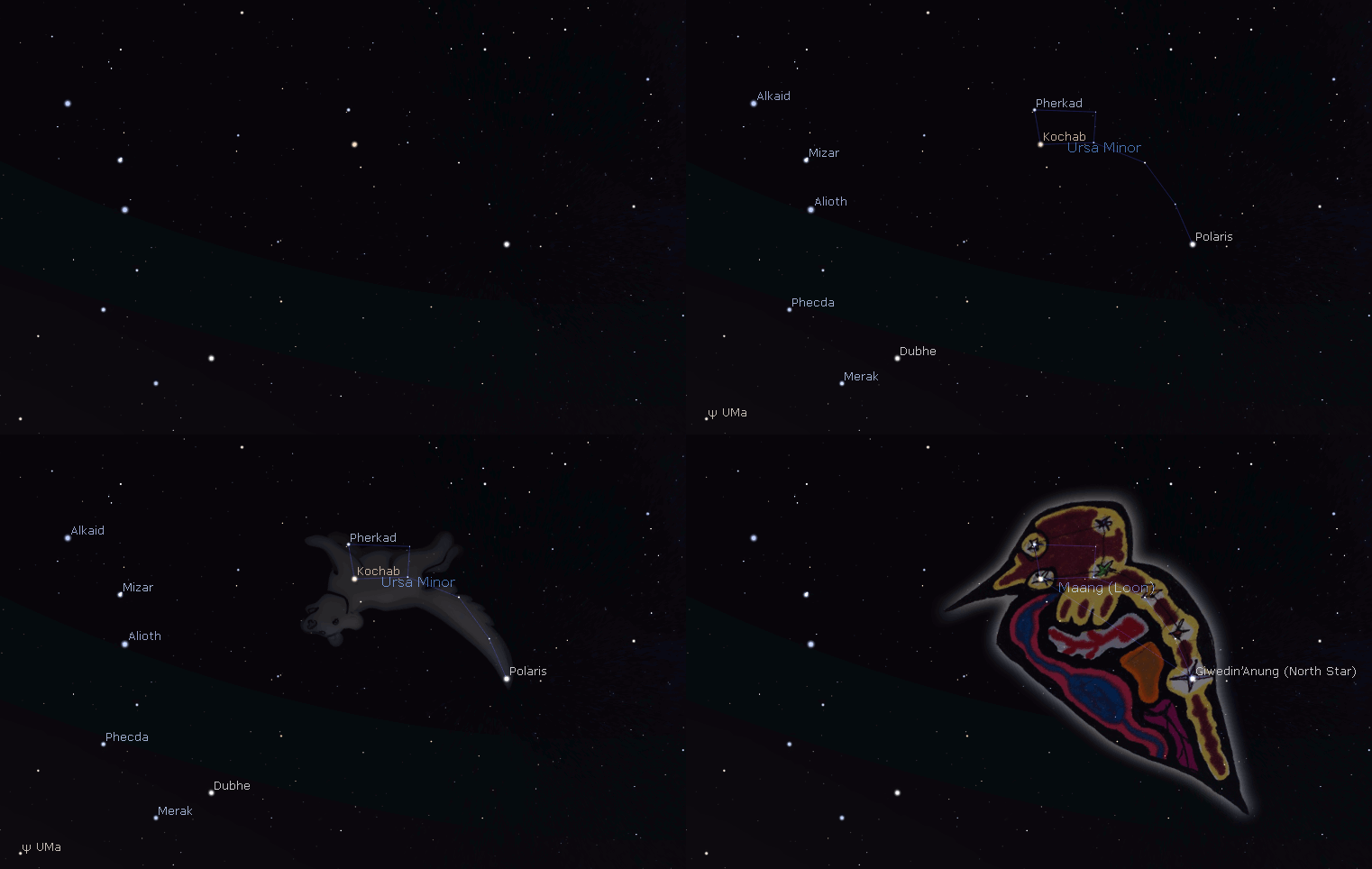
Little Dipper finder animation. The Little Dipper is also Ursa Major and the Loon. Polaris is the Pole Star and North Star. The Guard Stars are Kochab and Pherkad. Except for the named stars, the Little Dipper stars are quite faint and require moonless skies away from the city to spot. Created using Stellarium and GIMP.
 Bob Moler's Ephemeris Blog