Archive
01/17/2023 – Ephemeris – The Sun is getting active again
/
This is Ephemeris for Tuesday, January 17th. Today the Sun will be up for 9 hours and 15 minutes, setting at 5:30, and it will rise tomorrow at 8:14. The Moon, 3 days past last quarter, will rise at 5:11 tomorrow morning.
The Sun is getting active again, there are a lot of sunspots on the sun today. The sunspot number which isn’t really a count of the sunspots on the face of the Sun, but it’s sort of a weighted average was 177 yesterday, which is a really high number even for the last few sunspot cycle peaks, and we haven’t reached the peak yet. You can find this number on the website called spaceweather.com. These sunspots cannot be seen with solar eclipse glasses that we had for the last eclipse back in 2017 because they are too small, even though they are much larger than the Earth. For the most part it would require a telescope with an approved solar filter in front to see them or go to that aforementioned website to see a daily picture from them.
The astronomical event times given are for the Traverse City/Interlochen area of Michigan (EST, UT –5 hours). They may be different for your location.
Addendum
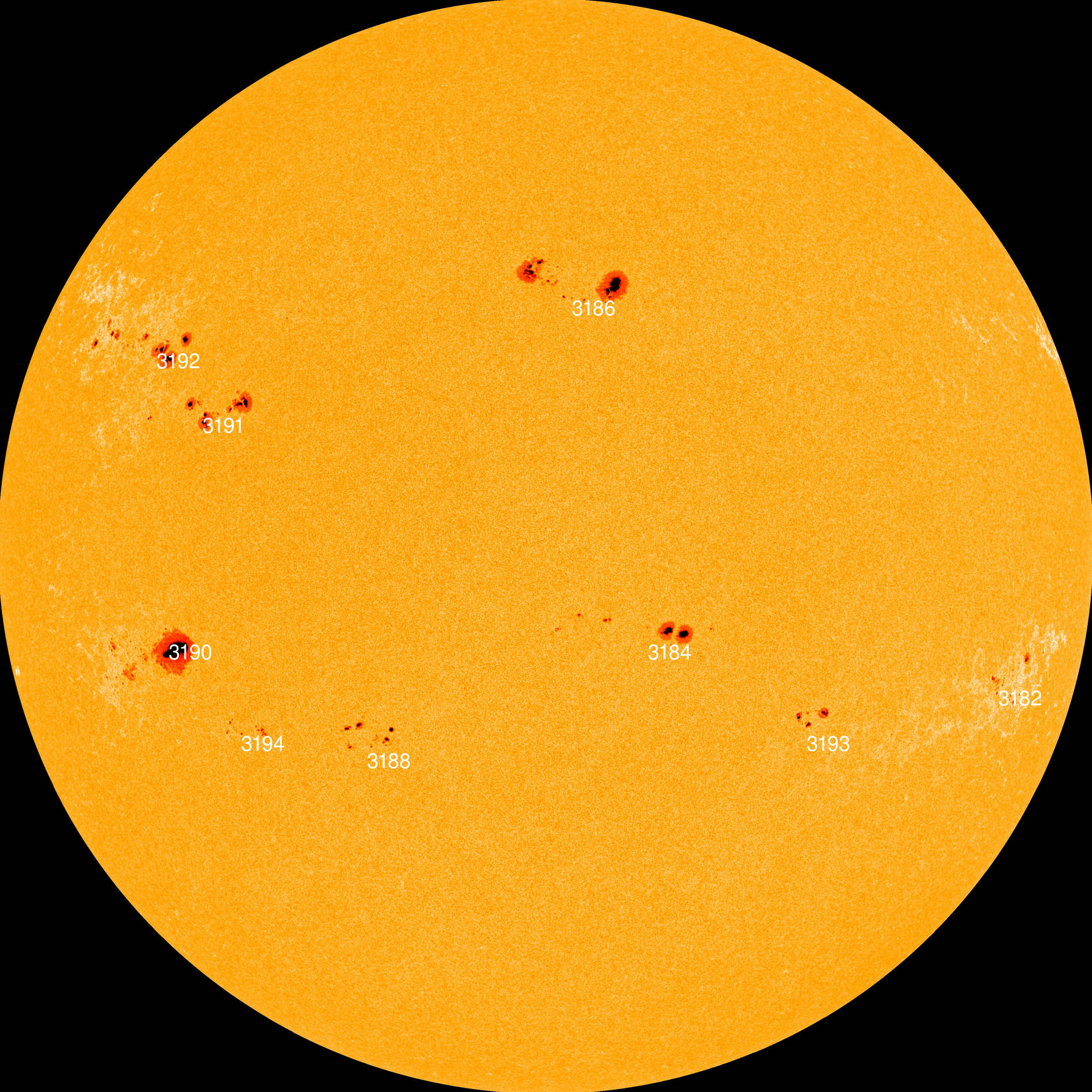
This image, from NOAA’s Solar Dynamics Observatory (SDO) downloaded last night, shows a many spotted Sun. The sunspot number by this time was up to 186. Sunspot groups are numbered as active regions. The most active region is AR 3190. Click on the image to enlarge it. Credit: NOAA’s SDO via spaceweather.com.
01/16/2023 – Ephemeris – Orion’s great nebula
This is Bob Moler with Ephemeris for Dr. Martin Luther King Jr. Day, Monday, January 16th. Today the Sun will be up for 9 hours and 13 minutes, setting at 5:29, and it will rise tomorrow at 8:15. The Moon, 2 days past last quarter, will rise at 3:52 tomorrow morning.
The brightest interstellar cloud visible in our skies is the Great Orion Nebula. The word nebula is related to the Latin “nebulum” for cloud. The constellation of Orion is filled with nebulae, most of it are dim or dark. The Great Orion Nebula is in Orion’s sword. The sword is what looks like three stars that look dimmer than the three belt stars hanging from the belt. And there are more than three stars here. Around the stars that appear as the center of the sword stars, to the eye, can be seen a haze in binoculars. A telescope with a wider aperture and low power can see detail in the cloud. With more magnification, a clutch of four baby stars can be spotted in the brightest part of the nebula. They light up the nebula and are called the Trapezium.
The astronomical event times given are for the Traverse City/Interlochen area of Michigan (EST, UT –5 hours). They may be different for your location.
Addendum
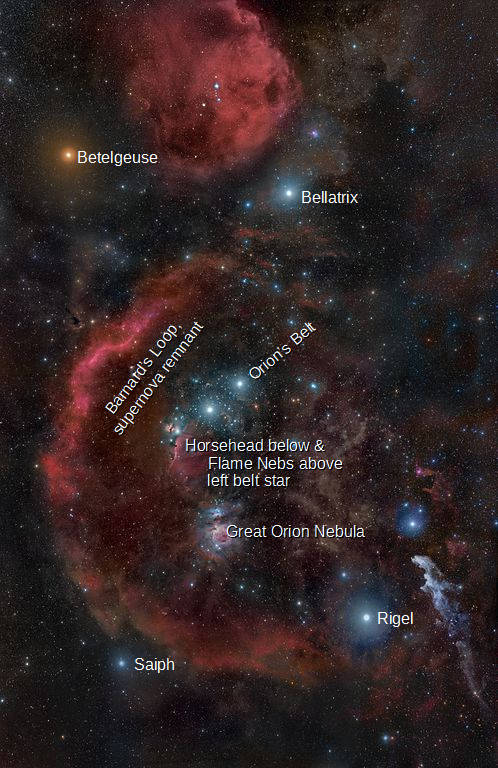
Orion is lousy with gas and dust. A regular star factory, or nursery. The red nebulae show the predominance of hydrogen in here. In actuality, the Great Orion Nebula vastly outshines all the other nebulae in Orion. The white nebulosity to the right of Rigel is the Witches Head nebula, probably the reflection of Rigel’s light off a dust cloud. Base image by Bernal Andreo, via Wikipedia. Annotations were created by myself.
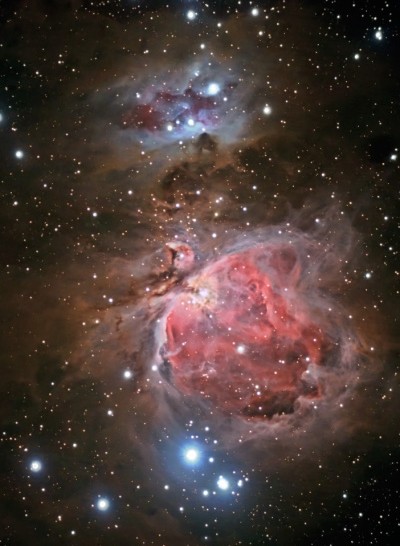
The Great Orion Nebula (M42) long exposure photograph by Scott Anttila. Includes all the sword stars.
01/10/2023 – Ephemeris – The constellation of Orion the hunter, unlucky in love
This is Bob Moler with Ephemeris for Tuesday, January 10th. Today the Sun will be up for 9 hours and 3 minutes, setting at 5:22, and it will rise tomorrow at 8:18. The Moon, halfway from full to last quarter, will rise at 9:01 this evening.
Before the Moon rises tonight, we will have two hours of darkness. Winter’s central constellation, Orion the hunter, doesn’t need the Moon to be absent to see its principal stars. He’s in the southeast before the Moon rises with red Betelgeuse in one shoulder and dimmer Bellatrix on the other, Saiph at one knee and bright blue-white Rigel at the other. Between his shoulders and knees runs his belt of three stars in a line. Above Betelgeuse, he is holding a club aloft and from Bellatrix he holds a lion skin shield to defend himself from the charge of Taurus the bull, above and right of him. I consider him a hard luck hero, with three different stories on how he died. Unlucky in love, he’s consigned to chase the Seven Sisters of the Pleiades throughout eternity.
The astronomical event times given are for the Traverse City/Interlochen area of Michigan (EST, UT –5 hours). They may be different for your location.
Addendum
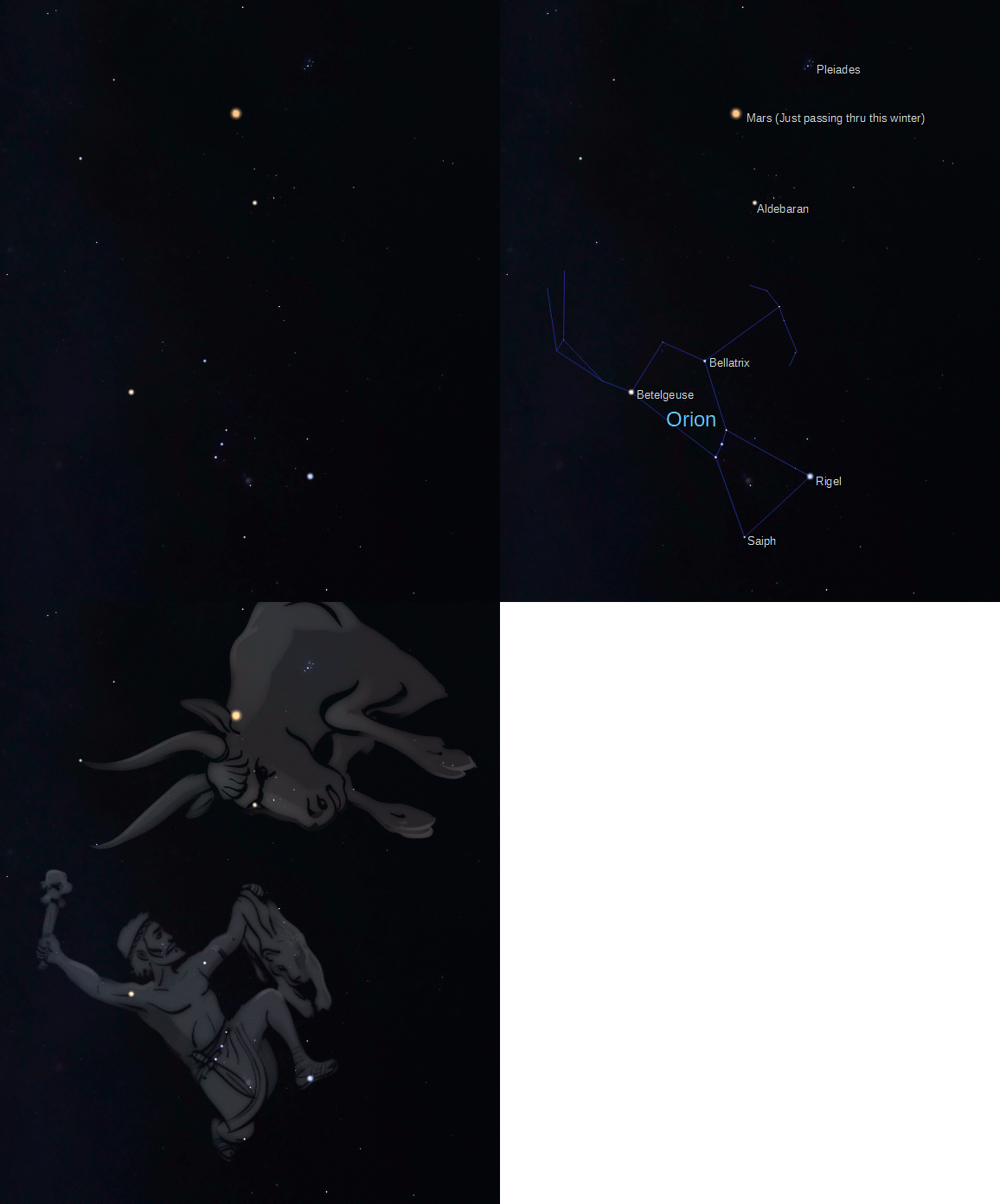
Orion finder animation with Mars. First, showing the unannotated sky looking southeast at Orion. Second, Orion with lines and labels of the stars at the corners of his body, and other bright stars in the view, plus the Pleiades and bright planet Mars, that’s just happening to be passing through this year. Third, the constellation art for Orion and Taurus the bull. Created using Stellarium, LibreOffice Draw and GIMP.
Here are the three stories of how Orion died: One: Orion raped the goddess Artemis, and so she killed him. Two: Orion was betrothed to Artemis, but her twin brother Apollo was jealous and caused her to kill him in a hunting “accident”. Three: Orion was killed by the sting of a scorpion, which is the reason Orion and Scorpius are never in the sky at the same time.
01/09/2023 – Ephemeris – The Summer Triangle is still with us in the early evening
This is Ephemeris for Monday, January 9th. Today the Sun will be up for 9 hours and 1 minute, setting at 5:21, and it will rise tomorrow at 8:18. The Moon, 3 days past full, will rise at 7:56 this evening.
The bright Moon is now slowly leaving the evening sky tonight, giving us nearly an hour of dark skies after 7 pm. At 7pm, Orion is holding forth in the east-southeast. At that time, also, the Summer Triangle is still in the sky, west and northwest. The Northern Cross, which is also the constellation of Cygnus the swan, is standing upright in the west northwestern sky. Its top star Deneb, dimmest of the three Summer Triangle stars, will not set for observers north of Traverse City, though it will take a flat northern horizon and exceptionally clear skies to spot it at its lowest in the north. Altair, the southernmost of the triangle stars will set first in the west at 7:57 pm, Vega, the brightest will set in the northwest at 9:41 pm.
The astronomical event times given are for the Traverse City/Interlochen area of Michigan (EST, UT –5 hours). They may be different for your location.
Addendum
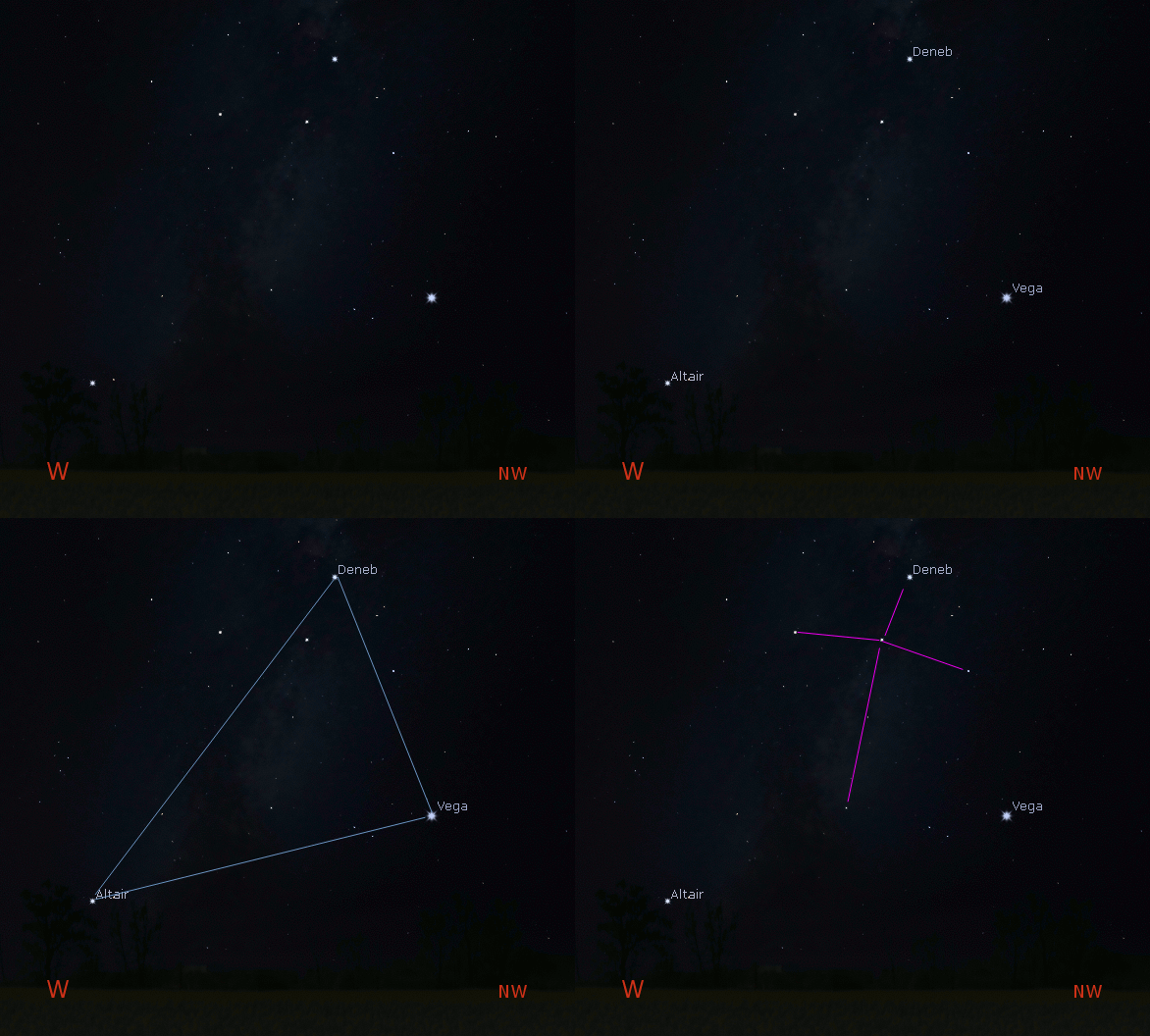
The setting Summer Triangle and Northern Cross in the west and northwestern sky at 7 pm tonight, January 9th.
01/06/2023 – Ephemeris – Telescope Clinic tonight at the Grand Traverse Astronomical Society Meeting tonight
This is Ephemeris for Friday, January 6th. Today the Sun will be up for 8 hours and 57 minutes, setting at 5:17, and it will rise tomorrow at 8:19. The Moon, at full today, will rise at 4:47 this evening.
The Grand Traverse Astronomical Society will hold their monthly meeting tonight with their annual Telescope Clinic, at 8 pm at Northwestern Michigan College’s Rogers Observatory. This is a chance to bring in that new Christmas telescope or even that old telescope gathering dust in the attic to learn how to use it. The society telescope experts will help in instruction and, if need be, adjustments to make the telescope work properly. In the past few years, the society has donated telescopes to public libraries in the region for patrons to check out and use. This is another way in which to learn to use a telescope and enjoy the sky at night. The observatory is located south of Traverse City on Birmley Road, south of Hammond, and between Garfield and Keystone roads. There will, if it’s clear after the meeting, be a star party or observing period using the observatory telescopes.
The astronomical event times given are for the Traverse City/Interlochen area of Michigan (EST, UT –5 hours). They may be different for your location.
Addendum
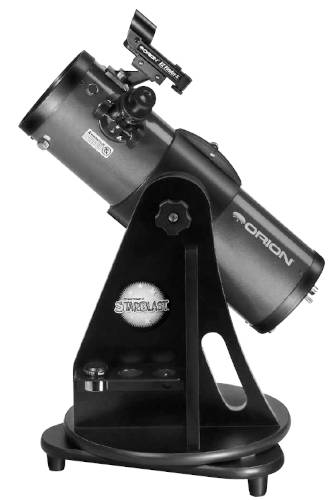
This is the type of telescope that the GTAS is donating to local libraries to lend out. The telescope can be set up on a table. The device on top is a red-dot finder. Looking through it will place a red dot on the object it’s pointed to. It has no magnification of its own. The telescope has a 4.5 inch diameter mirror, which produces a brighter image than the skinny refractor telescopes sold in most stores. The telescope eyepiece is a zoom type, so there is no need to remove it or change eyepieces to change magnification. The magnification range is from approximately 20 to 60 times (power). This is plenty for most objects in the sky, including the Moon, Jupiter and Saturn. Mars is a challenge for even the largest of amateur astronomer’s telescopes. Even then it’s best seen for a few months every 26 months.
The GTAS has a library telescope program where they donate small telescopes to local libraries to lend out. These are small tabletop telescopes with a 4.5 inch aperture. The telescope type is that invented by Sir Isaac Newton. In a telescope, magnification is secondary and usually variable. The real power of a telescope is light gathering power, the ability to gather in light to see objects too dim to be seen with the naked eye. Also, a telescope’s ability to see fine detail is tied to the telescope’s aperture or diameter of its primary mirror or lens. That’s not magnification, but the ability to use higher power to produce crisp images, rather than fuzzy ones.
01/05/2023 – Ephemeris – I’m Sirius about this being the brightest nighttime star!
Jan 5. This is Bob Moler with Ephemeris for Thursday, January 5th. Today the Sun will be up for 8 hours and 56 minutes, setting at 5:16, and it will rise tomorrow at 8:19. The Moon, 1 day before full, will set at 8:33 tomorrow morning.
The brightest nighttime star, Sirius, rises before 8 pm tonight. It can be found by following the constellation Orion’s three belt stars downward to near the east-southeastern horizon. As far as star-like objects go, Jupiter and Venus can always outshine Sirius. Mars can too, but only when it is near the Earth and this early evening when Mars is high in the sky and Sirius is low in the sky. When the Moon clears out of the evening sky, and Sirius rises higher, the other stars of its constellation will become visible. That constellation is Canis Major, Orion’s great hunting dog, from which it gets its nickname: Dog Star. The name Sirius means Dazzling One, an allusion to its great brightness and, being low in the sky, it twinkles mightily.
The astronomical event times given are for the Traverse City/Interlochen area of Michigan (EST, UT –5 hours). They may be different for your location.
Addendum
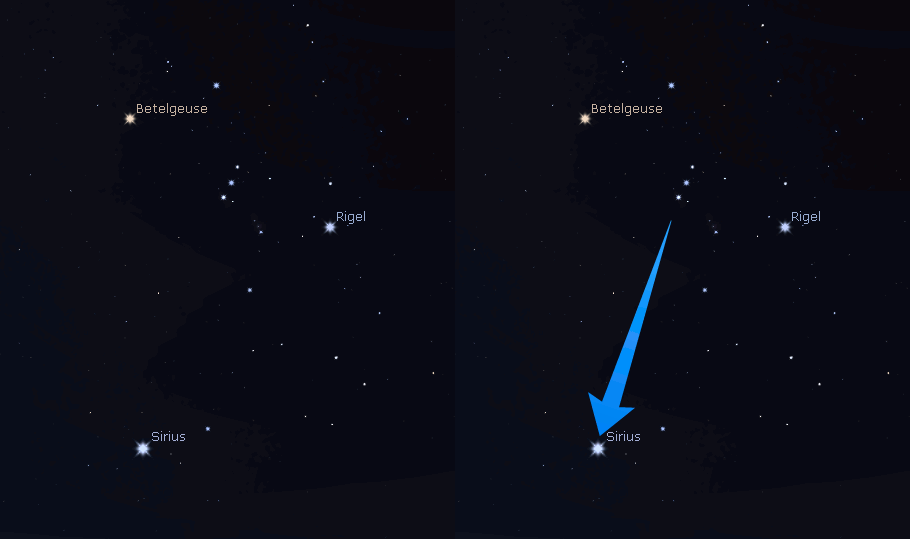
A Sirius finder animation for January/early February at around 8 pm. Even in bright moonlight, the seven bright stars of Orion can be seen. The three stars of Orion’s belt make a great pointer to Sirius. Created using Stellarium, GIMP and LibreOffice (for the arrow).
01/04/2023 – Ephemeris – Let’s see where the naked-eye planets have wandered off to this first week of 2023
This is Ephemeris for Wednesday, January 4th. The Sun will rise at 8:20. It’ll be up for 8 hours and 55 minutes, setting at 5:15. The Moon, 2 days before full, will set at 7:41 tomorrow morning.
Let’s see where the naked-eye planets have wandered off to this first week of 2023. Very early after sunset, Venus might be spotted very low in the southwest, even by 5:45 pm. Mars, Jupiter and Saturn will be visible this evening, in the east to southwestern sky at 7 pm. Mars will be in the east-southeast. Jupiter is the brightest of the three in the south-southwest, while dimmer Saturn will be very low in the southwest at that time. Mars will be above Orion as it rises in the early evening. As Orion straightens up as it moves to the south later in the evening, Mars will be to the upper right of it in Taurus near the red star Aldebaran. Saturn, the westernmost of the bright planets, will set around 8:29 this evening.
The astronomical event times given are for the Traverse City/Interlochen area of Michigan (EST, UT –5 hours). They may be different for your location.
Addendum
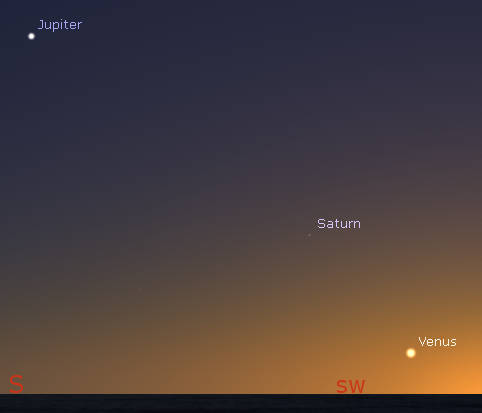
Venus, Saturn and Jupiter at 6 pm, or about 45 minutes after sunset. Created using Stellarium.
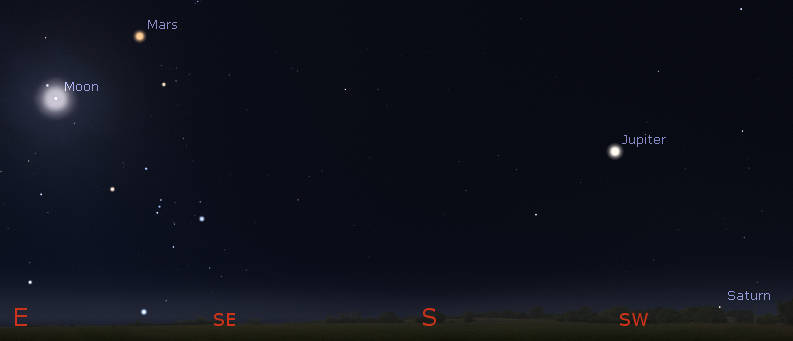
Mars, Jupiter, Saturn and the Moon at 8 pm tonight, January 4, 2023, in this panorama. Created using Stellarium.
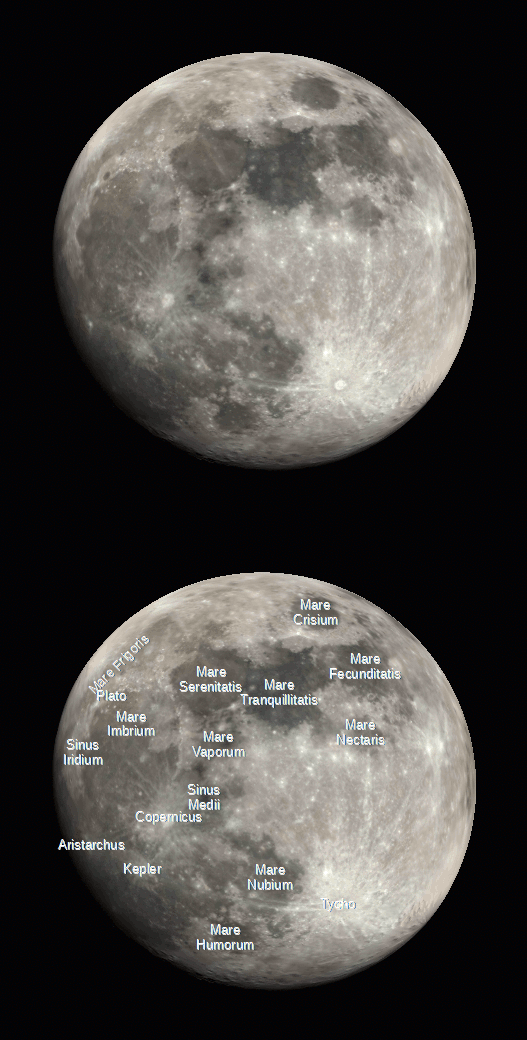
The Moon tonight as it might be seen in binoculars or low power telescopes tonight, January 4, 2023. Labels of prominent features are alternately shown with the unlabeled chart. Created using Stellarium, LibreOffice Draw and GIMP.
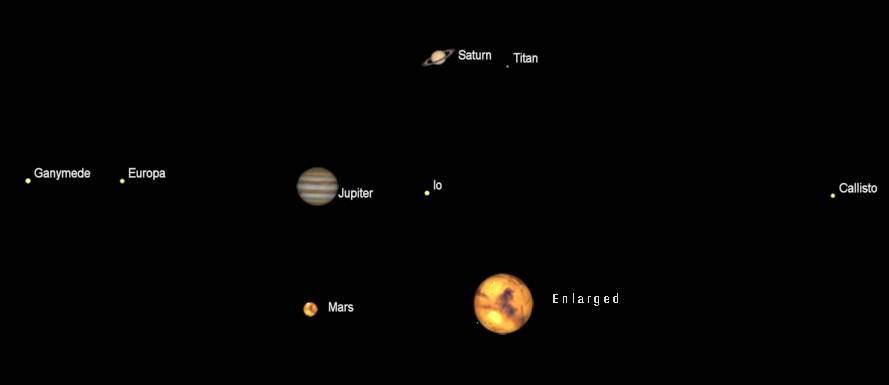
Telescopic views of Saturn Jupiter and Mars (north up) as they would be seen in a small telescope, with the same magnification. The image of Mars doesn’t show it, but the white north polar cap will appear at the top or north limb of Mars. The planets are shown at 8 pm tonight, January 4, 2023. Apparent diameters: Saturn 15.70″, its rings 36.57″; Jupiter 38.86″. Mars 14.12″. Mars’ distance is 61.6 million miles (99.1 million kilometers). The ” symbol means seconds of arc (1/3600th of a degree.) Click on the image to enlarge it. Created using Cartes du Ciel (Sky Charts).
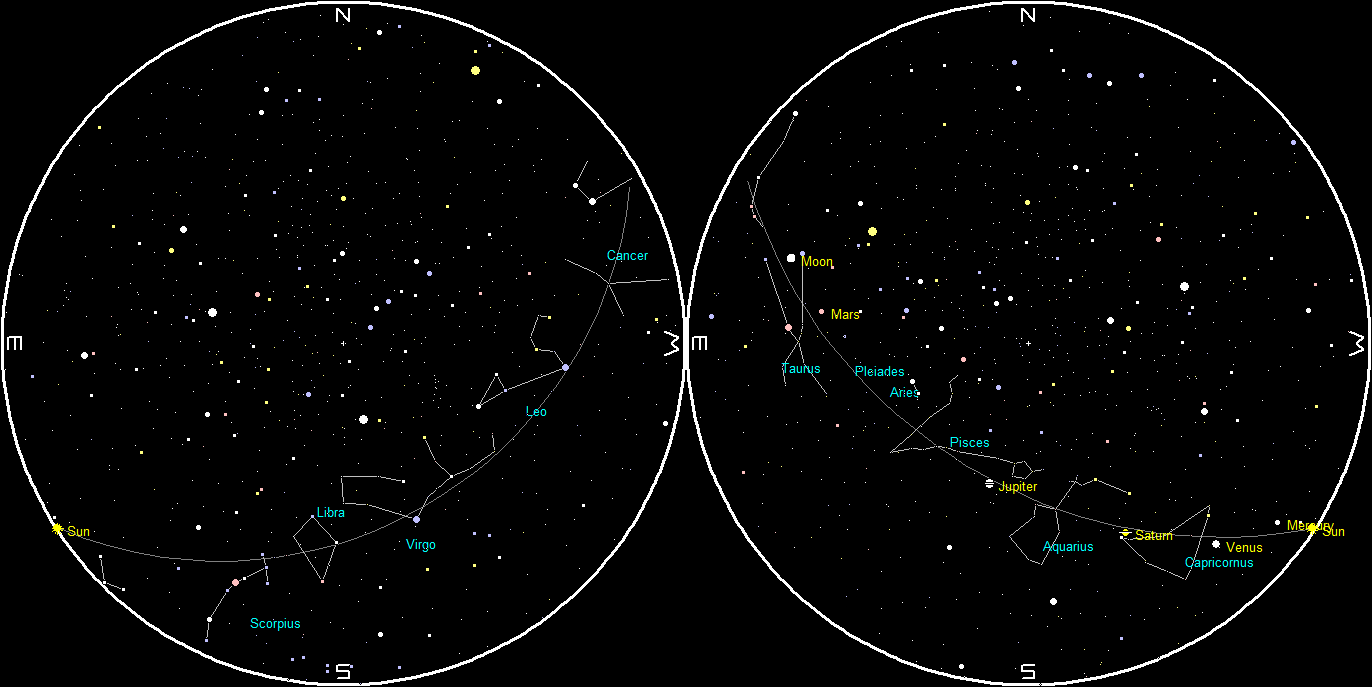
The naked-eye planets and the Moon at sunset and sunrise on a single night, starting with sunset on the right on January 4, 2023. The night ends on the left with sunrise on the 5th. Click on the image to enlarge it. Created using my LookingUp app and GIMP.
01/03/2023 – Ephemeris – A belated preview of January skies
This is Ephemeris for Tuesday, January 3rd. The Sun will rise at 8:20. It’ll be up for 8 hours and 54 minutes, setting at 5:14. The Moon, 3 days before full, will set at 6:41 tomorrow morning.
I’m starting the January preview a bit late. We’re a day past the latest sunrise at about the same time as today, 8:20 a.m. and will back down to 8:03 by the 31st. Sunset times are currently increasing by a minute a day, from 5:14 p.m. today to 5:49 at month’s end. Listeners will have about the same sunrise time in Ludington, Interlochen/Traverse City, Petoskey and Mackinaw City, but the sunset times will vary markedly with the sunset times earlier in the north and later in the south. The Quadrantid meteor shower will reach peak this evening. It will have competition all night from the bright Moon. Tomorrow, the Earth will be its closest to the Sun for the entire year. This afternoon the Moon skated past Mars, so tonight the Red Planet will appear above and right of the Moon.
The astronomical event times given are for the Traverse City/Interlochen area of Michigan (EST, UT –5 hours). They may be different for your location.
Addendum
January Evening Star Chart
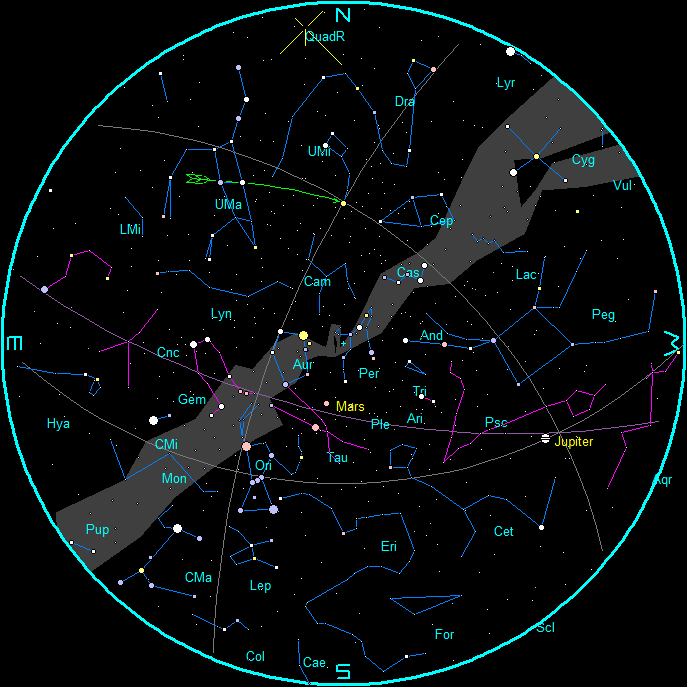
Star Chart for January 2023 evenings, based on 9 pm EST, January 15, 2023. Click on image to enlarge. Created using my LookingUp program.
January Morning Star Chart
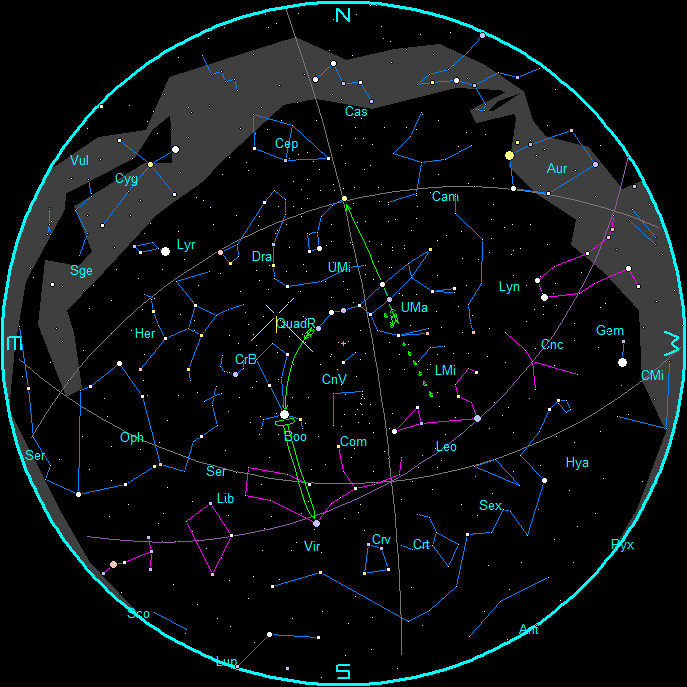
Star Chart for January 2023 mornings, based on 6 am EST, January 15, 2023. Click on image to enlarge. Created using my LookingUp program.
Note that Traverse City is located approximately 45 minutes behind our time meridian, West 75° longitude. (An hour 45 minutes behind our daylight saving time meridian during EDT). For a list of constellation names to go with the abbreviations, click here.
The planets are also plotted for the 15th. For a check on the current whereabouts of the five naked eye planets, see the Wednesday post most weeks.
- Pointer stars at the front of the bowl of the Big Dipper point to Polaris, the North Star.
- The leaky bowl of the Big Dipper drips on Leo.
- Follow the arc of the handle of the Big Dipper to the star Arcturus, then
- Follow the spike to Spica.
- QuadR on the star charts is the radiant of the Quadrantid meteor shower, which peaks on the 3rd, but is best seen in the early morning hours of the 3rd or 4th.
Twilight Limits, Nautical and Astronomical
| EST | |||||||
| Morning | Twilight | Evening | Twilight | Dark | Night | Moon | |
| Date | Astro. | Nautical | Nautical | Astro. | Start | End | Illum. |
| 2023-01-01 | 6h35m | 7h11m | 18h22m | 18h57m | 3h19m | 6h35m | 0.80 |
| 2023-01-02 | 6h35m | 7h11m | 18h23m | 18h58m | 4h28m | 6h35m | 0.88 |
| 2023-01-03 | 6h35m | 7h11m | 18h24m | 18h59m | 5h36m | 6h35m | 0.93 |
| 2023-01-04 | 6h35m | 7h11m | 18h24m | 19h00m | – | – | 0.97 |
| 2023-01-05 | 6h35m | 7h11m | 18h25m | 19h01m | – | – | 0.99 |
| 2023-01-06 | 6h35m | 7h11m | 18h26m | 19h01m | – | – | 1.00 |
| 2023-01-07 | 6h35m | 7h11m | 18h27m | 19h02m | – | – | 0.99 |
| 2023-01-08 | 6h35m | 7h10m | 18h28m | 19h03m | – | – | 0.96 |
| 2023-01-09 | 6h35m | 7h10m | 18h29m | 19h04m | 19h04m | 19h56m | 0.91 |
| 2023-01-10 | 6h35m | 7h10m | 18h30m | 19h05m | 19h05m | 21h01m | 0.85 |
| 2023-01-11 | 6h35m | 7h10m | 18h31m | 19h06m | 19h06m | 22h06m | 0.77 |
| 2023-01-12 | 6h35m | 7h10m | 18h32m | 19h07m | 19h07m | 23h10m | 0.69 |
| 2023-01-13 | 6h34m | 7h09m | 18h33m | 19h08m | 19h08m | – | 0.59 |
| 2023-01-14 | 6h34m | 7h09m | 18h34m | 19h09m | 19h09m | 0h16m | 0.49 |
| 2023-01-15 | 6h34m | 7h09m | 18h35m | 19h10m | 19h10m | 1h24m | 0.38 |
| 2023-01-16 | 6h33m | 7h08m | 18h37m | 19h11m | 19h11m | 2h36m | 0.28 |
| 2023-01-17 | 6h33m | 7h08m | 18h38m | 19h13m | 19h13m | 3h52m | 0.18 |
| 2023-01-18 | 6h32m | 7h07m | 18h39m | 19h14m | 19h14m | 5h11m | 0.10 |
| 2023-01-19 | 6h32m | 7h07m | 18h40m | 19h15m | 19h15m | 6h29m | 0.04 |
| 2023-01-20 | 6h31m | 7h06m | 18h41m | 19h16m | 19h16m | 6h31m | 0.01 |
| 2023-01-21 | 6h31m | 7h05m | 18h42m | 19h17m | 19h17m | 6h31m | 0.00 |
| 2023-01-22 | 6h30m | 7h05m | 18h44m | 19h18m | 19h18m | 6h30m | 0.03 |
| 2023-01-23 | 6h30m | 7h04m | 18h45m | 19h19m | 20h05m | 6h30m | 0.08 |
| 2023-01-24 | 6h29m | 7h03m | 18h46m | 19h20m | 21h26m | 6h29m | 0.16 |
| 2023-01-25 | 6h28m | 7h03m | 18h47m | 19h22m | 22h43m | 6h28m | 0.25 |
| 2023-01-26 | 6h28m | 7h02m | 18h48m | 19h23m | 23h57m | 6h28m | 0.35 |
| 2023-01-27 | 6h27m | 7h01m | 18h50m | 19h24m | – | 6h27m | 0.46 |
| 2023-01-28 | 6h26m | 7h00m | 18h51m | 19h25m | 1h09m | 6h26m | 0.56 |
| 2023-01-29 | 6h25m | 6h59m | 18h52m | 19h26m | 2h19m | 6h25m | 0.66 |
| 2023-01-30 | 6h24m | 6h58m | 18h53m | 19h28m | 3h28m | 6h24m | 0.75 |
| 2023-01-31 | 6h23m | 6h58m | 18h55m | 19h29m | 4h35m | 6h23m | 0.82 |
Twilight calendar was generated using Cartes du Ciel (Sky Charts).
See my blog post: Twilight Zone for the definitions of the different periods of twilight here: https://bobmoler.wordpress.com/2018/09/27/.
NASA Calendar of Planetary Events
Date          Time    Event
Jan  1  Su            Venus: 17.3° E
     1  Su  10:25 am  Moon Ascending Node
     2  Mo   8:24 pm  Moon-Pleiades: 2.8° N
     3  Tu   2:35 pm  Moon-Mars:  0.6° N
     3  Tu  10:06 pm  Quadrantid shower: ZHR = 120
     4  We   2:59 pm  Perihelion:  0.9833 AU
     5  Th  10:08 pm  Moon North Dec.: 27.4° N
     6  Fr   6:08 pm  Full Wolf Moon
     7  Sa   7:53 am  Mercury Inferior Conj.
     7  Sa   8:40 am  Moon-Pollux: 2.1° N
     8  Su   4:19 am  Moon Apogee: 406,500 km
     8  Su  10:23 am  Moon-Beehive: 4° S
    14  Sa   9:10 pm  Last Quarter
    16  Mo   1:32 am  Moon Descending Node
    18  We   4:32 am  Moon-Antares: 2.1° S
    20  Fr  12:06 am  Moon South Dec.: 27.5° S
    21  Sa   3:53 pm  New Moon
    21  Sa   3:58 pm  Moon Perigee: 356,600 km
    22  Su   4:53 pm  Venus-Saturn:  0.3° N
    23  Mo   2:22 am  Moon-Saturn: 3.8° N
    23  Mo   3:20 am  Moon-Venus: 3.4° N
    25  We   9:00 pm  Moon-Jupiter: 1.8° N
    28  Sa  10:19 am  First Quarter
    28  Sa  11:05 am  Moon Ascending Node
    30  Mo  12:59 am  Mercury Elongation: 25° W
    30  Mo   2:21 am  Moon-Pleiades: 2.6° N
    30  Mo  11:24 pm  Moon-Mars:  0.1° N
Feb  1  We            Venus: 24.4° E
All event times are given for UTC-5 Eastern Standard Time.
Sky Events Calendar by Fred Espenak and Sumit Dutta (NASA’s GSFC),
http://eclipse.gsfc.nasa.gov/SKYCAL/SKYCAL.html.
If you go to the above site you can print out a list like the above for the entire year or calendar pages for your time zone.
Sun and Moon Rising and Setting Events
LU                  Ephemeris of Sky Events for Interlochen/TC
January, 2023    Local time zone: EST
+-----------------------------------------------------------------------+
| DATE |  SUN     SUN  DAYLIGHT|   TWILIGHT*    |MOON  RISE OR    ILLUM |
|      |  RISE    SET    HOURS |  END    START  |PHASE SET** TIME FRACTN|
+=======================================================================+
|Sun  1| 08:20a  05:12p  08:52 | 06:23p  07:09a |      Set  04:28a   79%|
|Mon  2| 08:20a  05:13p  08:53 | 06:24p  07:09a |      Set  05:36a   86%|
|Tue  3| 08:20a  05:14p  08:54 | 06:24p  07:09a |      Set  06:41a   92%|
|Wed  4| 08:20a  05:15p  08:55 | 06:25p  07:10a |      Set  07:41a   96%|
|Thu  5| 08:19a  05:16p  08:56 | 06:26p  07:10a |      Set  08:33a   99%|
|Fri  6| 08:19a  05:17p  08:57 | 06:27p  07:09a |Full  Rise 04:47p  100%|
|Sat  7| 08:19a  05:18p  08:59 | 06:28p  07:09a |      Rise 05:47p   99%|
+------+-----------------------+----------------+-----------------------+
|Sun  8| 08:19a  05:19p  09:00 | 06:29p  07:09a |      Rise 06:51p   96%|
|Mon  9| 08:19a  05:21p  09:01 | 06:30p  07:09a |      Rise 07:56p   92%|
|Tue 10| 08:18a  05:22p  09:03 | 06:31p  07:09a |      Rise 09:01p   86%|
|Wed 11| 08:18a  05:23p  09:04 | 06:32p  07:09a |      Rise 10:05p   79%|
|Thu 12| 08:18a  05:24p  09:06 | 06:33p  07:08a |      Rise 11:10p   70%|
|Fri 13| 08:17a  05:25p  09:08 | 06:34p  07:08a |      Rise 12:16a   61%|
|Sat 14| 08:17a  05:26p  09:09 | 06:35p  07:08a |L Qtr Rise 01:24a   51%|
+------+-----------------------+----------------+-----------------------+
|Sun 15| 08:16a  05:28p  09:11 | 06:36p  07:07a |      Rise 02:36a   41%|
|Mon 16| 08:16a  05:29p  09:13 | 06:38p  07:07a |      Rise 03:52a   30%|
|Tue 17| 08:15a  05:30p  09:15 | 06:39p  07:07a |      Rise 05:11a   21%|
|Wed 18| 08:14a  05:32p  09:17 | 06:40p  07:06a |      Rise 06:28a   12%|
|Thu 19| 08:14a  05:33p  09:19 | 06:41p  07:06a |      Rise 07:38a    5%|
|Fri 20| 08:13a  05:34p  09:21 | 06:42p  07:05a |      Rise 08:34a    1%|
|Sat 21| 08:12a  05:35p  09:23 | 06:43p  07:04a |New   Set  05:13p    0%|
+------+-----------------------+----------------+-----------------------+
|Sun 22| 08:11a  05:37p  09:25 | 06:45p  07:04a |      Set  06:40p    2%|
|Mon 23| 08:11a  05:38p  09:27 | 06:46p  07:03a |      Set  08:05p    7%|
|Tue 24| 08:10a  05:40p  09:29 | 06:47p  07:02a |      Set  09:26p   14%|
|Wed 25| 08:09a  05:41p  09:32 | 06:48p  07:02a |      Set  10:42p   23%|
|Thu 26| 08:08a  05:42p  09:34 | 06:49p  07:01a |      Set  11:56p   33%|
|Fri 27| 08:07a  05:44p  09:36 | 06:51p  07:00a |      Set  01:08a   43%|
|Sat 28| 08:06a  05:45p  09:39 | 06:52p  06:59a |F Qtr Set  02:18a   54%|
+------+-----------------------+----------------+-----------------------+
|Sun 29| 08:05a  05:47p  09:41 | 06:53p  06:58a |      Set  03:28a   64%|
|Mon 30| 08:04a  05:48p  09:44 | 06:54p  06:57a |      Set  04:34a   73%|
|Tue 31| 08:03a  05:49p  09:46 | 06:56p  06:56a |      Set  05:36a   81%|
+-----------------------------------------------------------------------+
* Nautical Twilight
** Moonrise or moonset, whichever occurs between sunrise and sunset
Generated using my LookingUp for DOS program.
01/02/2023 – Ephemeris – The Earth is actually closest to the Sun this week
This is Ephemeris for Monday, January 2nd 2023. The Sun will rise at 8:20, the latest of the year. It’ll be up for 8 hours and 53 minutes, setting at 5:13. The Moon, halfway from first quarter to full, will set at 5:36 tomorrow morning.
We have a fun week ahead. The first week of the year is an active one in astronomy. Not all the events are visible, though some could, if it weren’t cloudy, as it is so much this time of the year. But active nonetheless. Like Wednesday’s perihelion. A what? The date the Earth is closest to the Sun in its orbit. We’re a million and a half miles closer to the Sun than average. It’s a teensy bit hotter, which is more than offset by the Sun’s arc low in the sky, plus it’s up less than 9 hours. However, it does make winter the shortest season, because the Earth moves faster when closer to the Sun. This is Northern Michigan, so you probably don’t believe me. Get out a calendar and count the days. Winter has 89 days, while summer has 93.
The astronomical event times given are for the Traverse City/Interlochen area of Michigan (EST, UT –5 hours). They may be different for your location.
Addendum
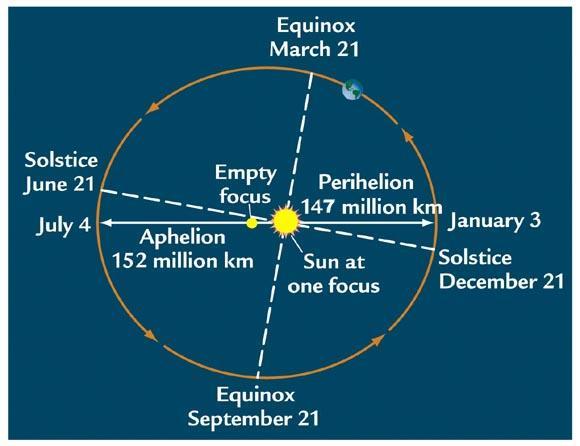
The Earth’s orbit, somewhat exaggerated, showing perihelion and the seasons. Credit “Starts with a Bang” blog by Ethan Siegel.
 Bob Moler's Ephemeris Blog