Archive
Ephemeris: 04/30/2025 – Let’s take our weekly look at the whereabouts of the naked-eye planets
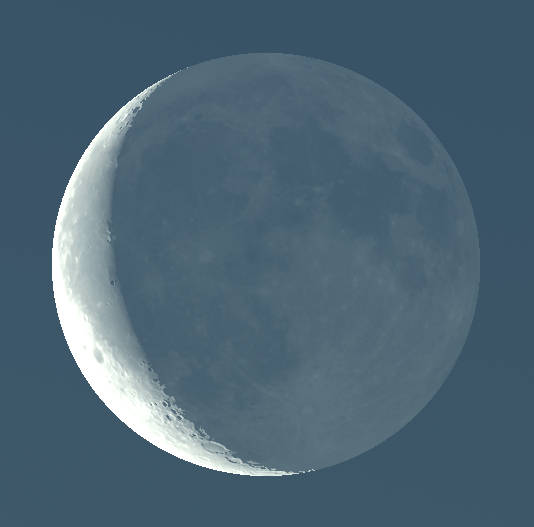
This is Bob Moler with Ephemeris for Wednesday, April 30th. Today the Sun will be up for 14 hours and 13 minutes, setting at 8:46, and it will rise tomorrow at 6:32. The Moon, 3 days past new, will set at 1:08 tomorrow morning.
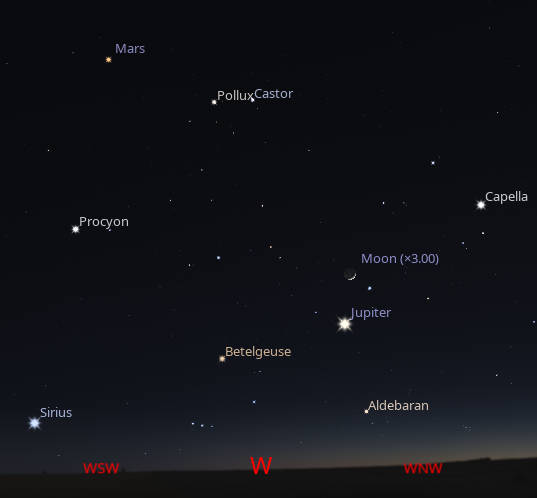
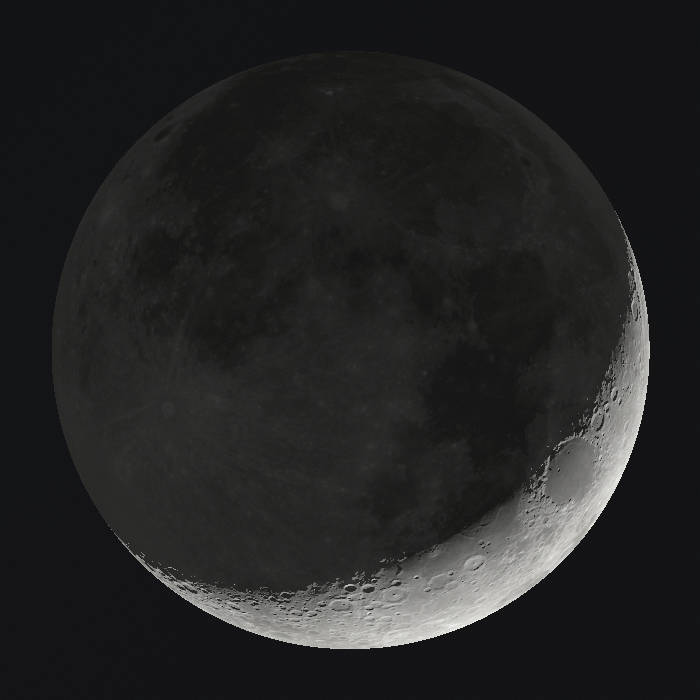
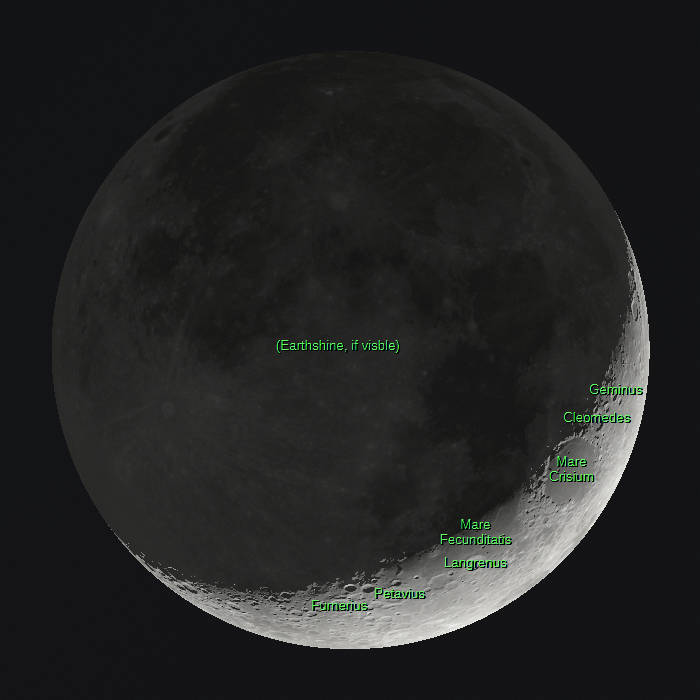
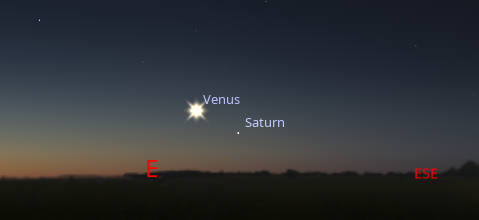
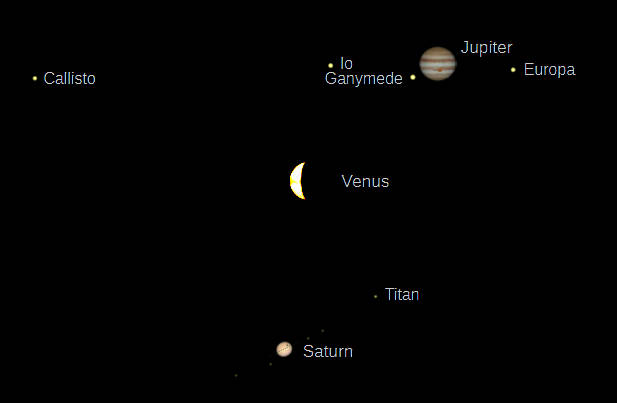
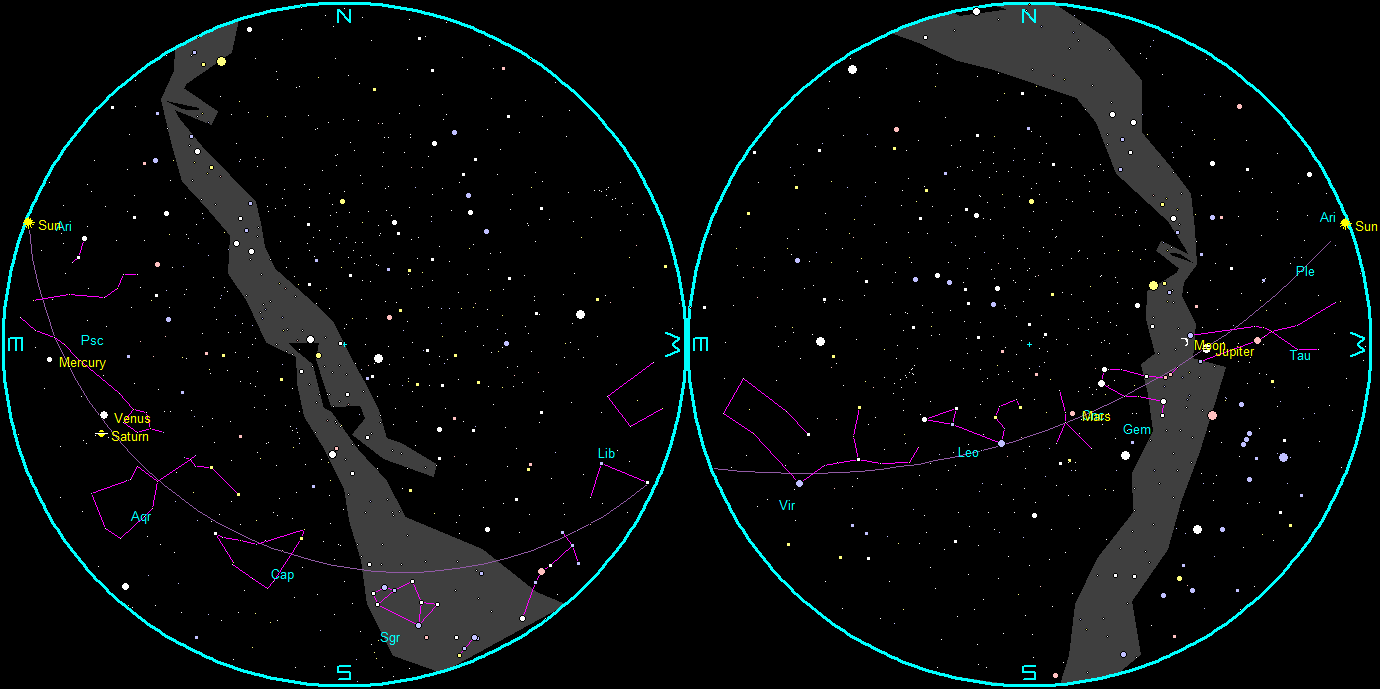
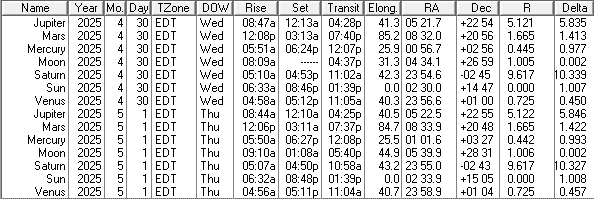
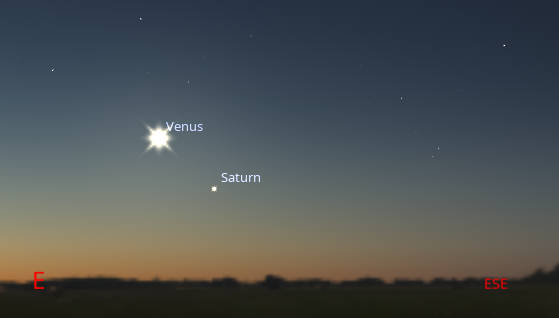
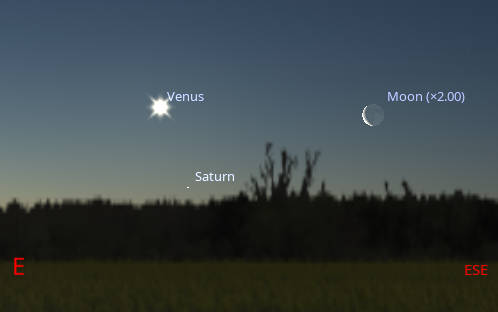
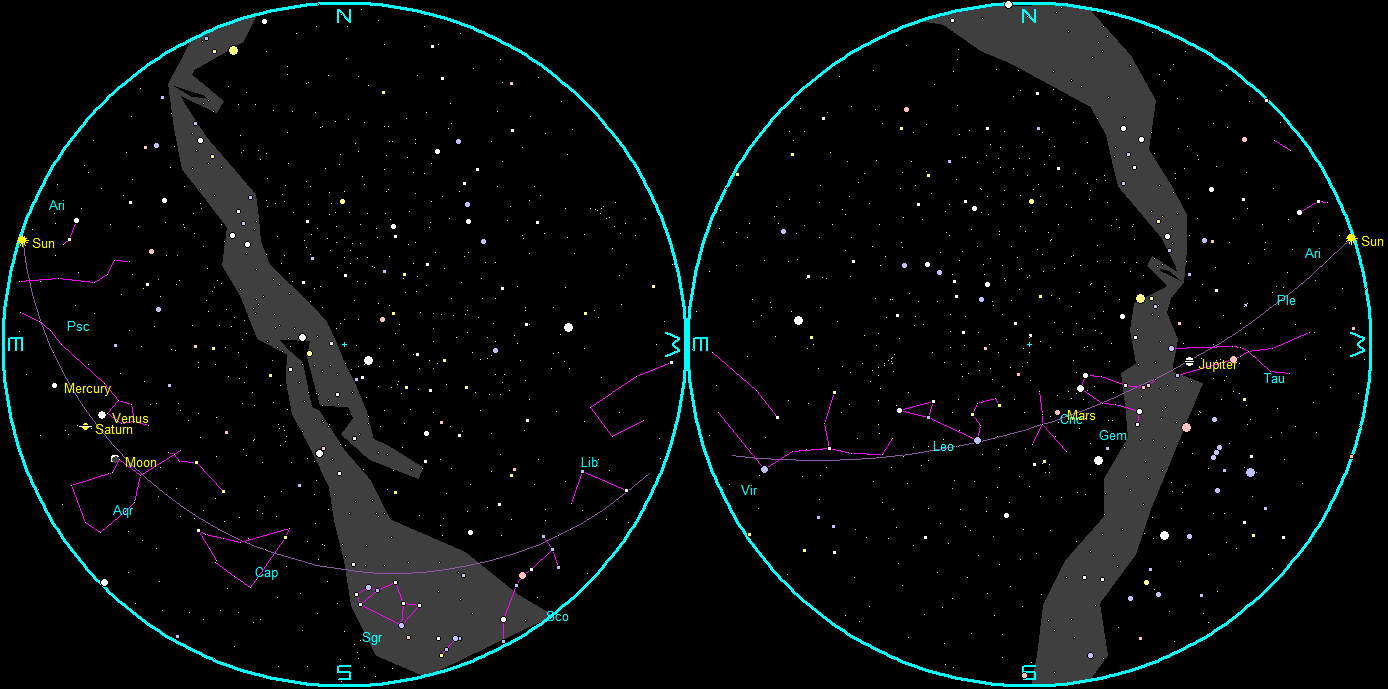
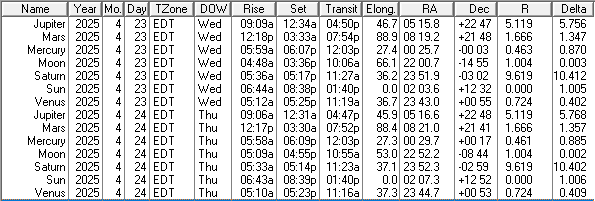
Let’s take our weekly look at the whereabouts of the naked-eye planets. At 9:30 PM this evening two of the five naked eye planets will be out. Jupiter, is now the brightest evening planet, our substitute evening star if you will. It will be in the western sky. Tonight it will be below the crescent Moon. To its lower left, the great constellation of Orion will be beginning to set. The rapidly fading Mars, with its distinctive reddish hue, is high in the southwest, with the stars Castor and Pollux in Gemini to the right of it. By 5:30 AM Venus will be seen very low in the east, as the Morning Star. It will require a low eastern horizon. It should be visible until a bit after 6:30. Saturn is visible close and to its lower right.
The astronomical event times given in this blog are for the Traverse City/Interlochen area of Michigan (Lat 44.7° N, Long 85.7° W; EDT, UT – 4 hours) unless stated otherwise. Times will be different for other locations.
Addendum
Ephemeris: 04/29/2025 – Using the Sun as a telescope
This is Ephemeris for Tuesday, April 29th. Today the Sun will be up for 14 hours and 10 minutes, setting at 8:45, and it will rise tomorrow at 6:33. The Moon, 2 days past new, will set at 11:56 this evening.
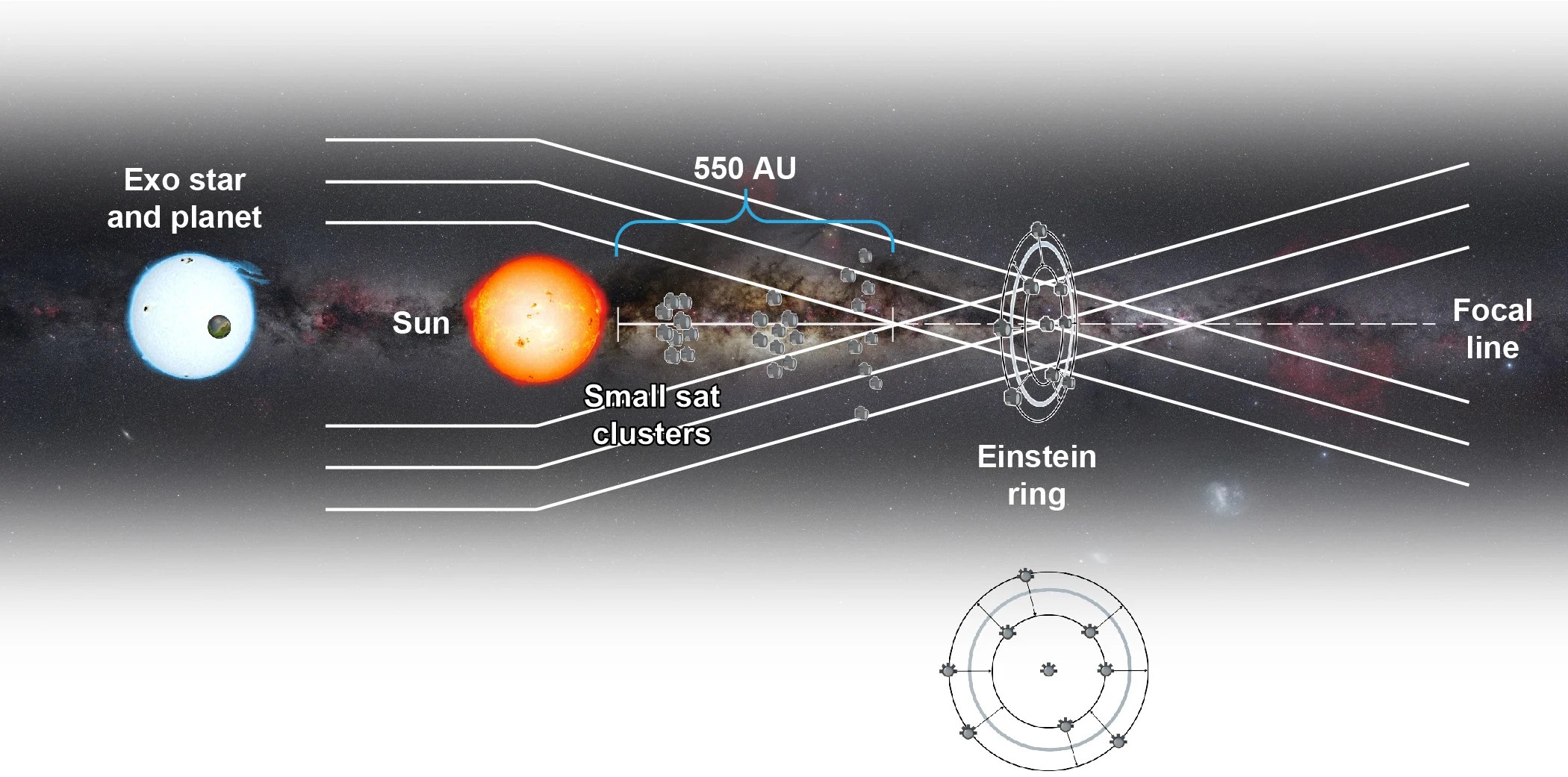
One idea of a telescope I find very fantastic. This is a telescope that uses the Sun and its mass curving spacetime to alter the path of light from a distant object to act like a lens in a telescope. This is called gravitational lensing. The length of this telescope would have to be about 542 times the earth’s distance from the Sun, 542 astronomical units. In the 48 years since Voyager 1 was launched it has achieved only about 1/3 of that distance. What would be the use of this telescope would be to image exoplanets. So far exoplanets, if they are visible at all, don’t even cover a single pixel in even our largest telescopes. The problems are huge, starting with gravitational lenses don’t bend light the same way as optical ones do.
The astronomical event times given in this blog are for the Traverse City/Interlochen area of Michigan (Lat 44.7° N, Long 85.7° W; EDT, UT – 4 hours) unless stated otherwise. Times will be different for other locations.
Addendum
Here are some sources of additional information on this topic:
https://www.universetoday.com/articles/how-can-the-sun-become-a-telescope
https://www.livescience.com/space/the-sun/could-we-turn-the-sun-into-a-gigantic-telescope
https://nasaspacenews.com/2025/04/see-alien-planets-in-4k-the-suns-gravitational-lens-explained/
https://news.stanford.edu/stories/2022/05/gravity-telescope-image-exoplanets
https://www.space.com/sun-gravity-could-help-observe-exoplanets-in-detail
Ephemeris: 04/28/2025 – Venus and Saturn appear together in the morning sky
This is Bob Moler with Ephemeris for Monday, April 28th. Today the Sun will be up for 14 hours and 7 minutes, setting at 8:44, and it will rise tomorrow at 6:35. The Moon, 1 day past new, will set at 10:33 this evening.
At about 3:30 this afternoon Saturn and Venus will appear closest together. They will be up at that time. However, it’s during the daytime, so they will be invisible. By tomorrow morning Saturn will still be very close to Venus. The ringed planet will appear to the lower right of Venus by about half the width of a fist held in arm’s length. It will be very low in the sky at about 5:30 AM. Saturn is at its dimmest, because in a telescope, especially in twilight those rings would be missing. The rings are nearly edge on and the Sun happens to be shining on the other side of them, so the most that would be seen would be a very thin shadow of the rings across the center of the planet. In coming days Saturn will be moving away from the Sun, while Venus falls back to it.
The astronomical event times given in this blog are for the Traverse City/Interlochen area of Michigan (Lat 44.7° N, Long 85.7° W; EDT, UT – 4 hours) unless stated otherwise. Times will be different for other locations.
Addendum
Ephemeris: 04/25/2025 – The star that opened a World’s Fair
This is Ephemeris for Arbor Day, Friday, April 25th. Today the Sun will be up for 13 hours and 59 minutes, setting at 8:40, and it will rise tomorrow at 6:39. The Moon, 2 days before new, will rise at 5:50 tomorrow morning.
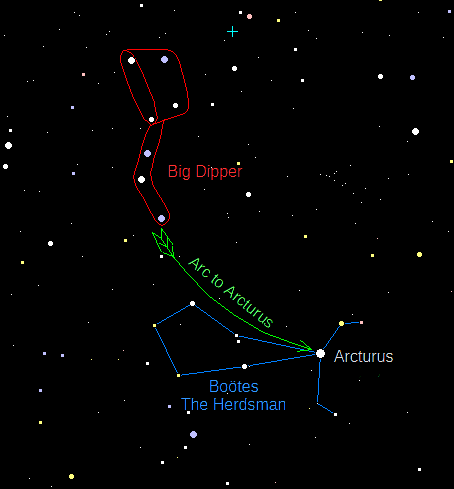
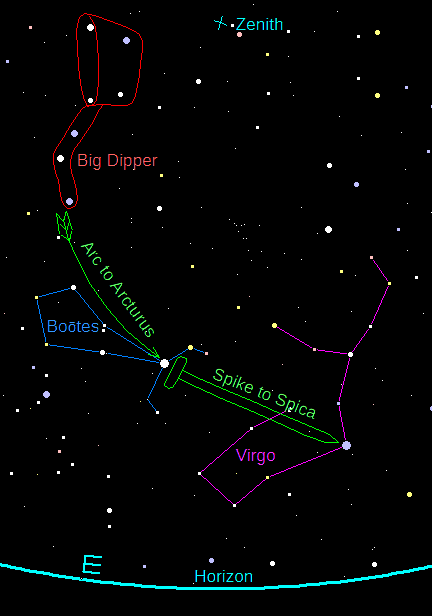
High in the eastern sky at 10 tonight can be found the kite shaped constellation of Boötes the herdsman, chasing or herding the Great Bear Ursa Major of which the Big Dipper is the hind end, across the sky. The bright star at the base of the kite is the 4th brightest nighttime star, Arcturus. It can be found and name remembered by first locating the Big Dipper and by following the arc or curve of the handle to Arcturus. This star is an orange-colored giant star, 37 light years away. Its light was used to open the 1933 Chicago Worlds Fair believing its light left the star in 1893 the year of the previous Chicago Worlds Fair. It turns out that Arcturus is 3 light years closer than what they thought.
The astronomical event times given are for the Traverse City/Interlochen area of Michigan (EDT, UT – 4 hours). Times will be different for other locations.
Addendum

For more on how they did it go to: https://chicagology.com/centuryprogress/1933fair54/
Ephemeris: 04/24/2025 – A constellation that’s a queen’s offering of her hair
This is Bob Moler with Ephemeris for Thursday, April 24th. Today the Sun will be up for 13 hours and 56 minutes, setting at 8:39, and it will rise tomorrow at 6:41. The Moon, 3 days before new, will rise at 5:29 tomorrow morning.
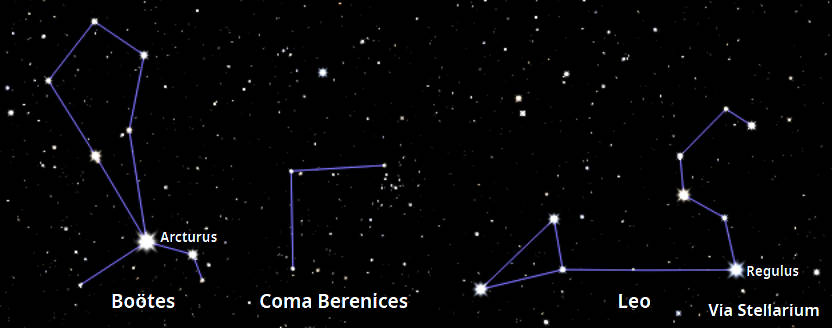
High in the east-southeast at 10 p.m. is a tiny and faint constellation of Coma Berenices, or Berenice’s hair. In it are lots of faint stars arrayed to look like several strands of hair. The whole group will fit in the field of a pair of binoculars, which will also show many more stars. The hank of hair was supposed to belong to Berenice, a real Queen of Egypt, of the 3rd century BCE who cut off her golden tresses and offered them to the gods for the safe return of her husband from war. Her husband did return safe, and at that same time her hair disappeared from the temple. The oracle of the temple pointed to this constellation showing that her sacrifice was enshrined in the stars.
The astronomical event times given are for the Traverse City/Interlochen area of Michigan (EDT, UT – 4 hours). Times will be different for other locations.
Addendum
Ephemeris: 04/23/2025 – Taking our weekly look at where the naked eye planets have wandered off to
This is Ephemeris for Wednesday, April 23rd. Today the Sun will be up for 13 hours and 53 minutes, setting at 8:38, and it will rise tomorrow at 6:43. The Moon, 3 days past last quarter, will rise at 5:09 tomorrow morning.
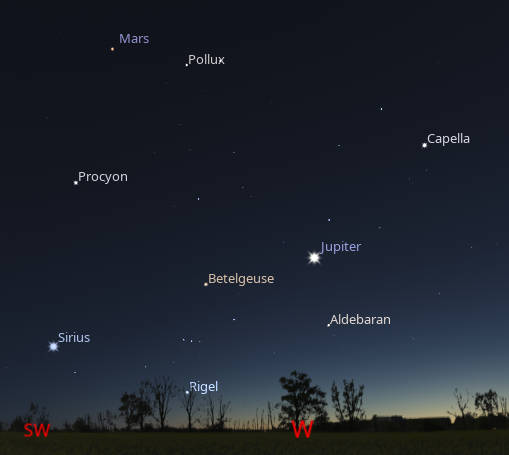
Let’s take our weekly look at the whereabouts of the naked-eye planets. At 9:30 PM this evening two of the five naked eye planets will be out. Jupiter, is now the brighter evening planet, outshining all the stars, and being our substitute Evening Star, if you will. It will be in the west. Below it is the bright star Aldebaran. To its lower left, the great constellation of Orion. The rapidly fading Mars, with its distinctive reddish hue, is high in the southwest, with the stars Castor and Pollux in Gemini to the right and below it. By 5:30 AM Venus will be seen very low in the east, as the Morning Star. It will require a low eastern horizon to spot it at that hour. It should be visible until a bit after 6:30. Saturn should be visible in the morning by the end of the month.
The astronomical event times given are for the Traverse City/Interlochen area of Michigan (EDT, UT – 4 hours). Times will be different for other locations.
Addendum
Ephemeris: 04/22/2025 – Earth Day
This is Ephemeris for Earth Day, Tuesday, April 22nd. Today the Sun will be up for 13 hours and 50 minutes, setting at 8:37, and it will rise tomorrow at 6:44. The Moon, 2 days past last quarter, will rise at 4:48 tomorrow morning.
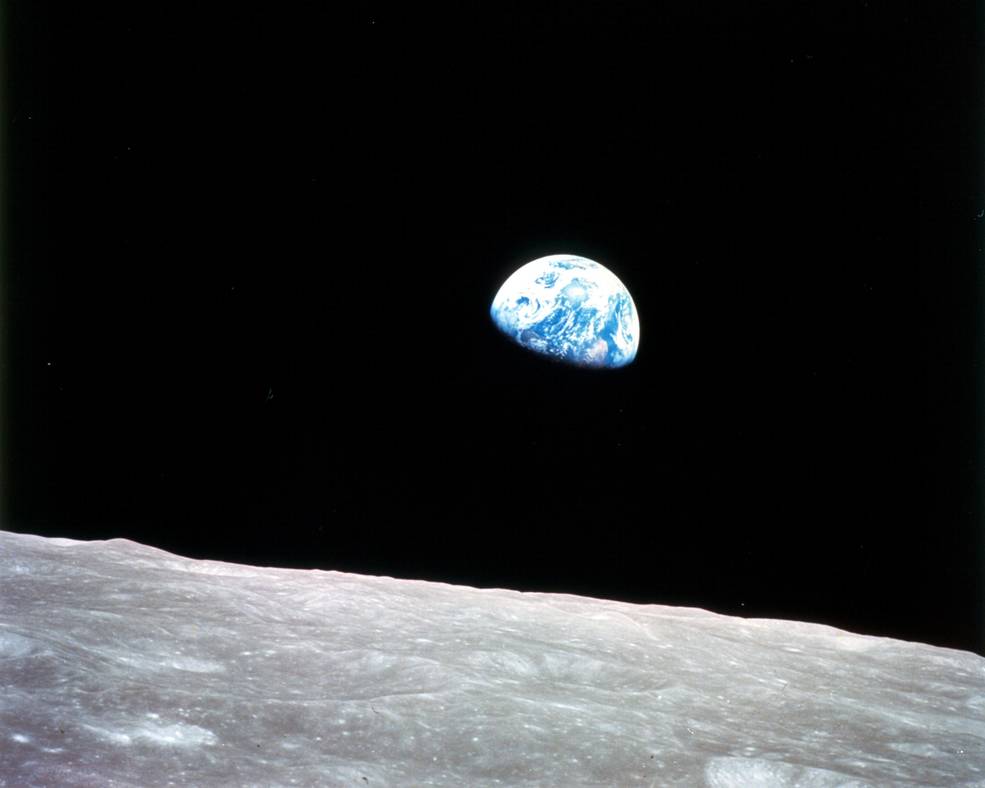
Earth Day was established in 1970, 2 years after William Anders in Apollo 8 took a picture of the Earth rising over the desolate moon, the Earth, a blue white oasis, in a hostile universe. I say support your local planet, there is no Planet B in case you messed this one up. Elon Musk wants to make the human race multi-planetary, which is a fine idea over time. It may take over a century to make any kind of Mars Base self-sustaining, if ever. I can’t see how we can terraform Mars, that is make Mars earth-like, because of lack of material. Mars was more earth-like in its first billion years, but it has no magnetic field. Any large atmosphere it had when it had oceans has long been stripped away by the solar wind.
The astronomical event times given are for the Traverse City/Interlochen area of Michigan (EDT, UT – 4 hours). Times will be different for other locations.
Addendum

Look again at that dot. That’s here. That’s home. That’s us. On it everyone you love, everyone you know, everyone you ever heard of, every human being who ever was, lived out their lives. The aggregate of our joy and suffering, thousands of confident religions, ideologies, and economic doctrines, every hunter and forager, every hero and coward, every creator and destroyer of civilization, every king and peasant, every young couple in love, every mother and father, hopeful child, inventor and explorer, every teacher of morals, every corrupt politician, every “superstar,” every “supreme leader,” every saint and sinner in the history of our species lived there-on a mote of dust suspended in a sunbeam.
― Carl Sagan, Pale Blue Dot: A Vision of the Human Future in Space
The Earth is a very small stage in a vast cosmic arena. Think of the endless cruelties visited by the inhabitants of one corner of this pixel on the scarcely distinguishable inhabitants of some other corner, how frequent their misunderstandings, how eager they are to kill one another, how fervent their hatreds. Think of the rivers of blood spilled by all those generals and emperors so that, in glory and triumph, they could become the momentary masters of a fraction of a dot.
Our posturings, our imagined self-importance, the delusion that we have some privileged position in the Universe, are challenged by this point of pale light. Our planet is a lonely speck in the great enveloping cosmic dark. In our obscurity, in all this vastness, there is no hint that help will come from elsewhere to save us from ourselves.
The Earth is the only world known so far to harbor life. There is nowhere else, at least in the near future, to which our species could migrate. Visit, yes. Settle, not yet. Like it or not, for the moment the Earth is where we make our stand.
It has been said that astronomy is a humbling and character-building experience. There is perhaps no better demonstration of the folly of human conceits than this distant image of our tiny world. To me, it underscores our responsibility to deal more kindly with one another, and to preserve and cherish the pale blue dot, the only home we’ve ever known.
Ephemeris: 04/21/2025 – Follow the spike to Spica
This is Ephemeris for Monday, April 21st. Today the Sun will be up for 13 hours and 47 minutes, setting at 8:35, and it will rise tomorrow at 6:46. The Moon, 1 day past last quarter, will rise at 4:25 tomorrow morning.
In the south-southeast at 10:30 p.m. is the bright star Spica, which can be found from all the way back overhead to the Big Dipper. Follow the arc of the handle of the Big Dipper to the bright star Arcturus below it in the east-southeast. Then straighten the curve of the arc to a straight spike which points to Spica, the brightest star in Virgo the virgin. Arcturus is much brighter than Spica and has an orange tint to Spica’s bluish hue. In fact, Spica is the bluest of the 21 first magnitude stars. That means that it has a really hot surface temperature. Actually, Spica is really two blue-white stars orbiting each other in 4 days. Spica is 250 light years away. It also was an important star to the ancient Greeks. One temple was built and aligned to its setting point. The astronomical event times given are for the Traverse City/Interlochen area of Michigan (EDT, UT – 4 hours). Times will be different for other locations.
The astronomical event times given are for the Traverse City/Interlochen area of Michigan (EDT, UT – 4 hours). Times will be different for other locations.
Addendum
Ephemeris: 04/18/2025 – How the date of Easter is calculated
This is Ephemeris for Good Friday, Friday, April 18th. Today the Sun will be up for 13 hours and 39 minutes, setting at 8:32, and it will rise tomorrow at 6:51. The Moon, 2 days before last quarter, will rise at 2:40 tomorrow morning.
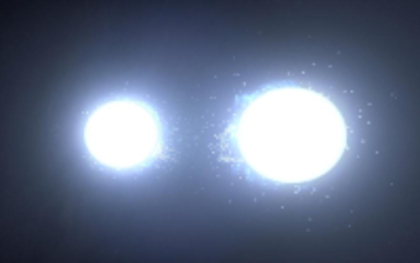
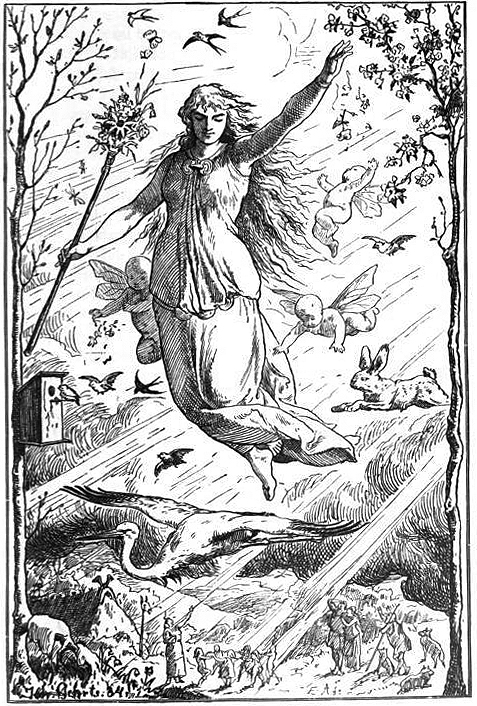
Easter will be celebrated by all Christian churches this Sunday. Easter is a movable feast in that it falls on a different date each year following the first full moon of spring. It’s an attempt to follow the Jewish Passover, which starts on the 15th of the month of Nisan. The Jewish calendar being a lunar calendar, the 15th is generally the night of the full moon. And since the Last Supper was a Seder, according to at least one Gospel, the Christian church wanted to link Easter with Passover as closely as possible using the Roman solar based (Julian) calendar. The months didn’t follow the cycle of the Moon anymore and where the year was 365.25 days long. Passover started at sunset last Sunday. The western churches adopted the Gregorian calendar to keep in sync with the seasons. The Orthodox churches didn’t, but Easter is so late that they match this year. They kept the old Julian Calendar and other considerations to calculate the date of Easter.
The astronomical event times given are for the Traverse City/Interlochen area of Michigan (EDT, UT – 4 hours). Times will be different for other locations.
Addendum
Ephemeris: 04/17/2025 – Finding the celestial crow
This is Ephemeris for Thursday, April 17th. Today the Sun will be up for 13 hours and 36 minutes, setting at 8:30, and it will rise tomorrow at 6:52. The Moon, 3 days before last quarter, will rise at 1:48 tomorrow morning.
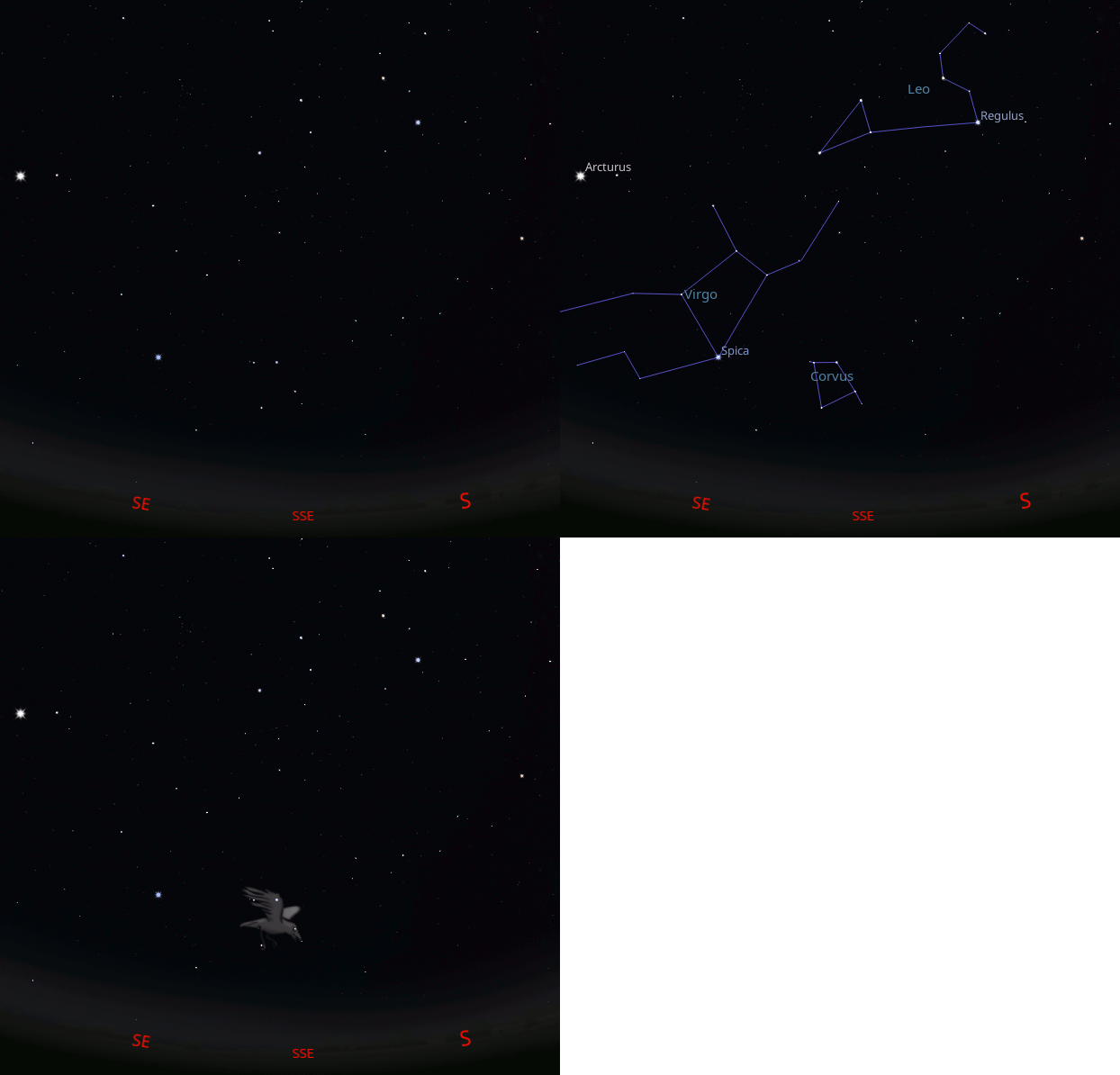
The small constellation of Corvus the crow is located low in the south-southeast at 10:30 this evening. It’s made of 6 dim stars, but the pattern is a distinctive but distorted box with two stars at the upper left marking that corner, and another two marking the lower right corner. I usually don’t notice the extra star at these corners. To me the box stands out enough. It’s pretty much alone below Virgo and its bright star Spica, left an above it. I don’t see a crow here, but the box is distinctive in that no two sides are parallel. In the US we call the shape a trapezium. The British call it a trapezoid. Anyway it is a very interesting shape, at least to me.
The astronomical event times given are for the Traverse City/Interlochen area of Michigan (EDT, UT – 4 hours). Times will be different for other locations.
Addendum
 Bob Moler's Ephemeris Blog