Archive
Ephemeris: 12/27/2024 – Orion’s story
This is Ephemeris for Friday, December 27th. Today the Sun will be up for 8 hours and 49 minutes, setting at 5:09, and it will rise tomorrow at 8:19. The Moon, 3 days before new, will rise at 6:32 tomorrow morning.
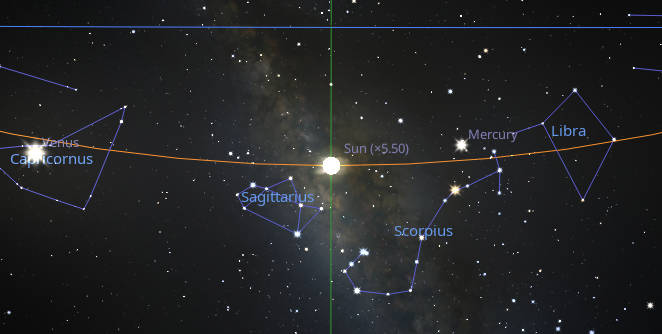
It may seem unfair that the greatest mythological hero Hercules gets a little constellation of dim stars on the border between the spring and summer constellations, while Orion, a virtual nobody, a hard luck hero gets the splashiest constellation in the sky. Orion’s claim to fame or infamy is how he died. And the Greeks had two completely different stories on how that happened. First, that he was killed by a sting of a giant scorpion represented by the constellation Scorpius, and second that he was killed by an arrow shot by the goddess he loved, the arrow being deflected by her brother who didn’t want her to marry a mere mortal.
The astronomical event times given are for the Traverse City/Interlochen area of Michigan (EST, UT – 5 hours). Times will be different for other locations.
Addendum
Ephemeris: 12/26/2024 – Finding Orion the hunter
This is Bob Moler with Ephemeris for Thursday, December 26th. Today the Sun will be up for 8 hours and 49 minutes, setting at 5:08, and it will rise tomorrow at 8:19. The Moon, halfway from last quarter to new, will rise at 5:24 tomorrow morning.
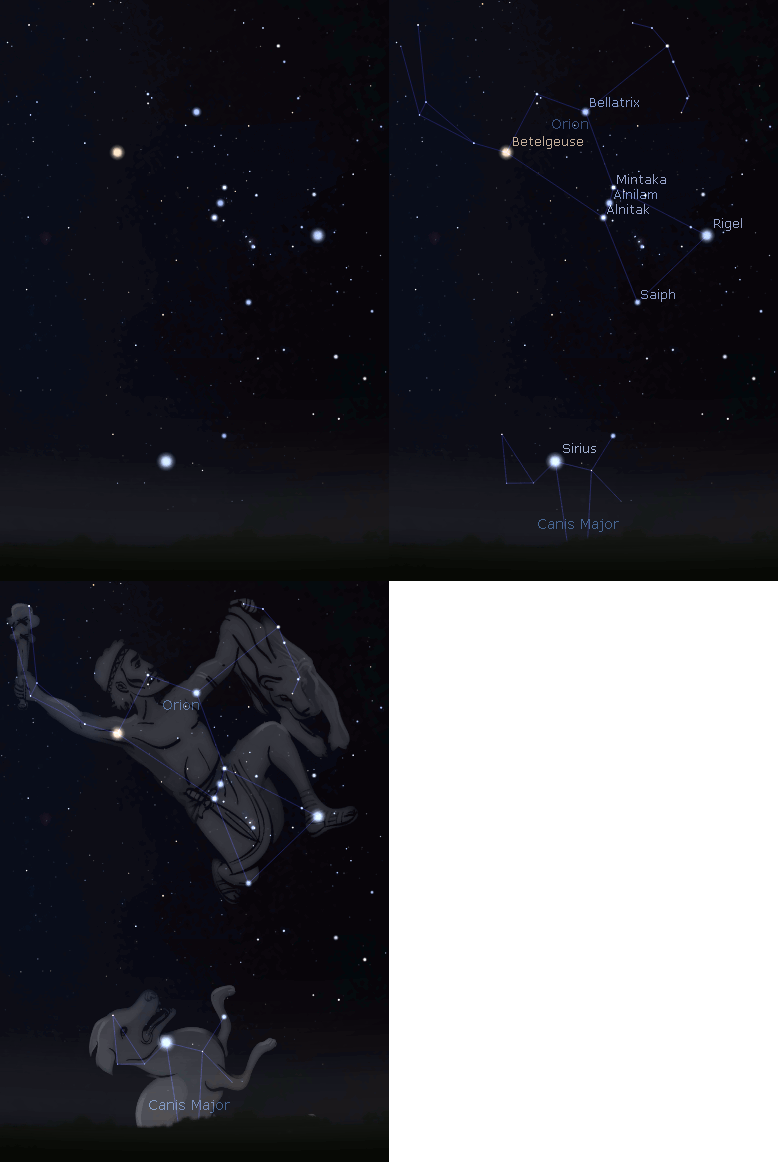
The constellation of Orion the hunter is the most famous constellation in the sky. At 8 o’clock tonight he is seen in the east southeast. Two of its stars are first magnitude, among the brightest in the sky while five are second magnitude, as bright as the brightest Big Dipper stars. His torso is a rectangle of stars, now tilted to the left, framed by Betelgeuse and Bellatrix in his shoulders and Rigel and Saiph and Rigel at his knees. Betelgeuse and Rigel are first magnitude stars at opposite corners of that rectangle. His most easily found feature is his belt of three stars in a straight line in the center of that rectangle, now nearly vertically aligned, which makes them easy to spot even if you don’t know the pattern of the rest of the stars.
The astronomical event times given are for the Traverse City/Interlochen area of Michigan (EST, UT – 5 hours). Times will be different for other locations.
Addendum
Ephemeris: 12/25/2024 – A Christmas week look at the naked-eye planets
This is Ephemeris for Christmas Day, Wednesday, December 25th. Today the Sun will be up for 8 hours and 48 minutes, setting at 5:07, and it will rise tomorrow at 8:19. The Moon, 3 days past last quarter, will rise at 4:16 tomorrow morning.
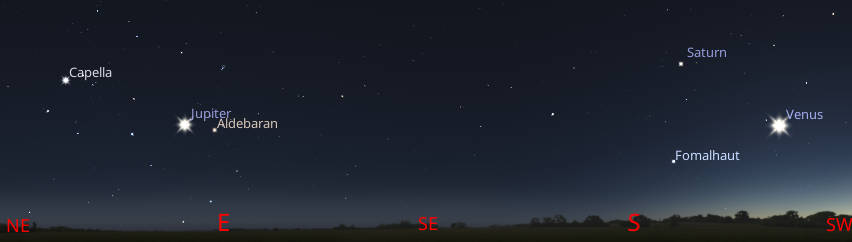
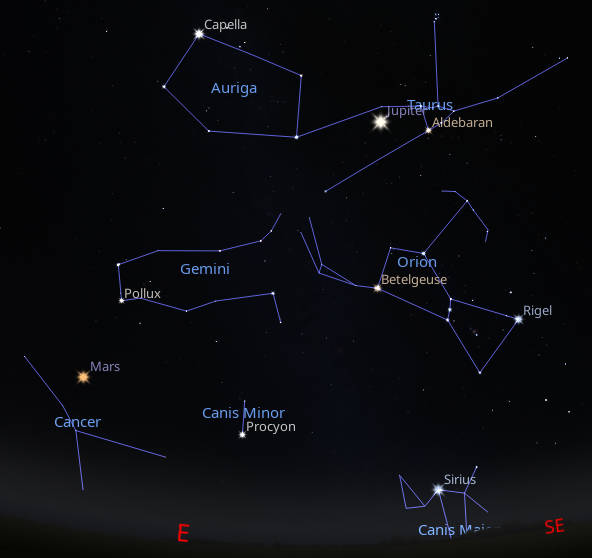
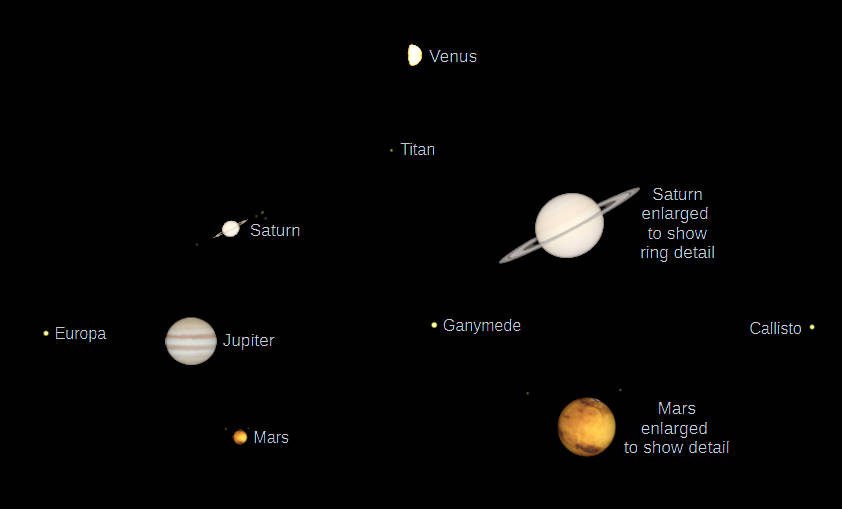
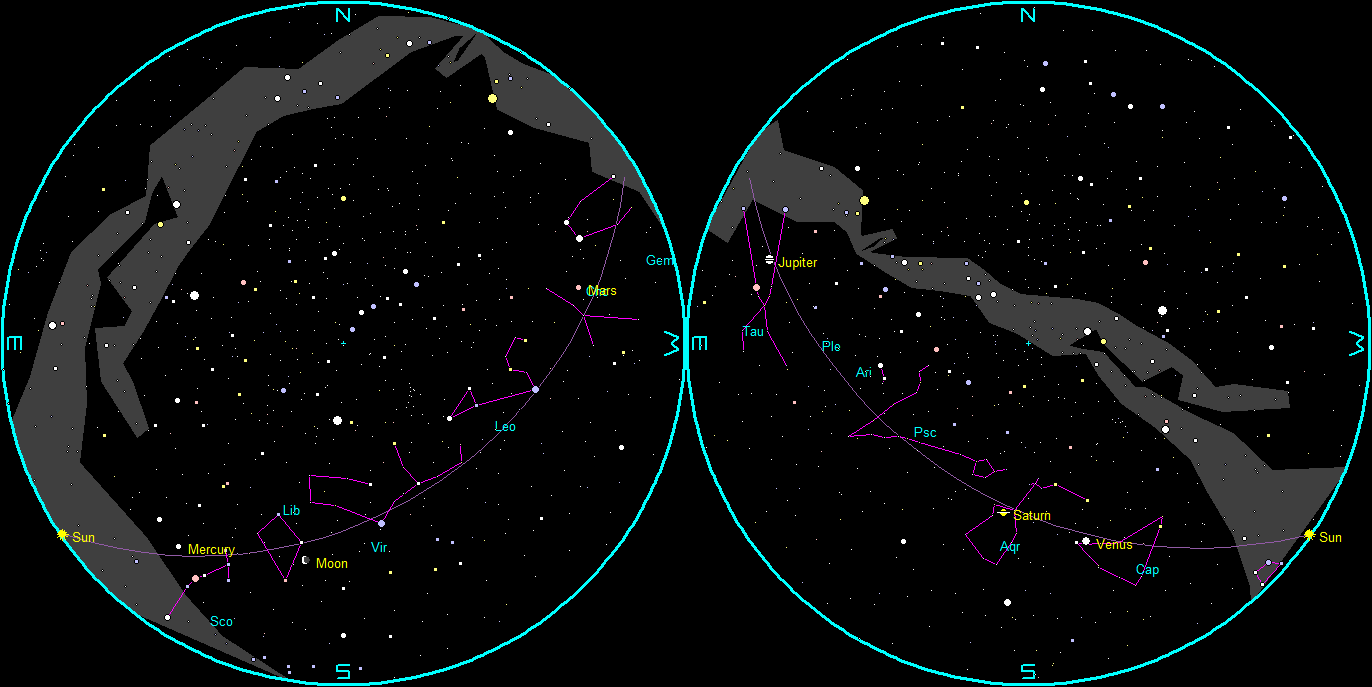
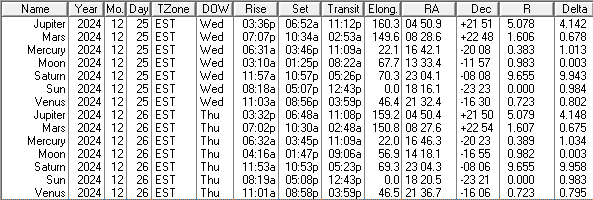
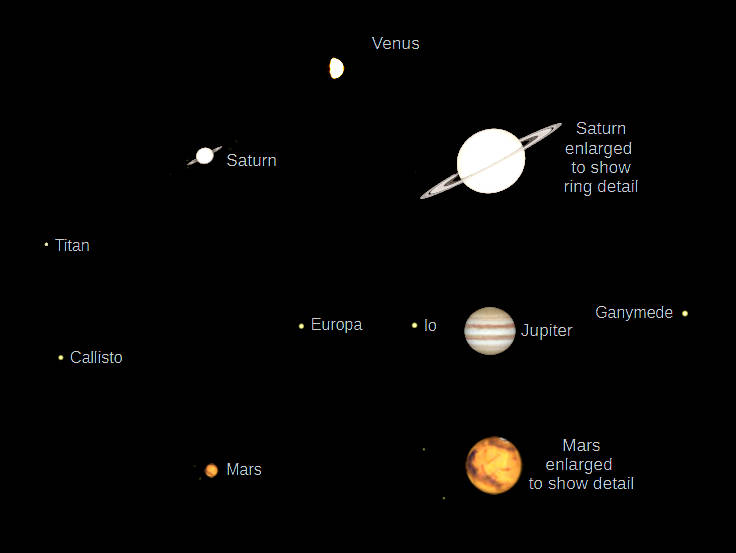
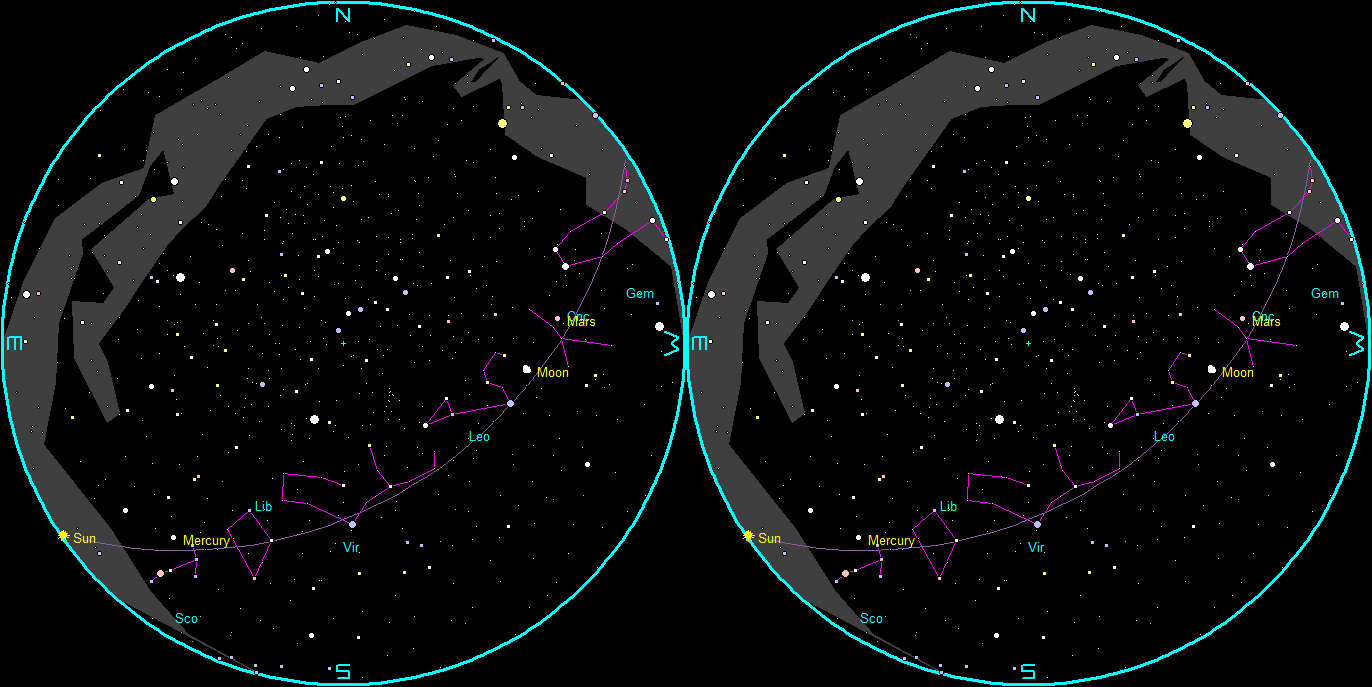
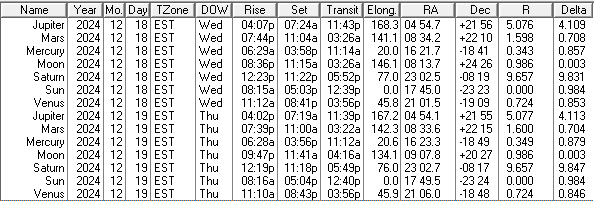
Let’s take our weekly look at the whereabouts of the naked-eye planets. Venus can be spotted in the south-southwestern sky by 5:30 PM, about 30 minutes after sunset. It will set at 8:41 PM. Saturn will be in the south at 6 PM, way above the bright star Fomalhaut. Jupiter is low in the east-northeast, about the same time Venus is first spotted. It will be a good object for the small telescope about an hour later. Mars, rises tonight at 7:44, It will appear above the Moon in the evening. Mars is still considered a morning planet since it is still up at sunrise. By 6:00 AM tomorrow Jupiter will be low in the west-northwest, to the right of the setting Orion, while reddish Mars will be high in the west-southwest.
The astronomical event times given are for the Traverse City/Interlochen area of Michigan (EST, UT – 5 hours). Times will be different for other locations.
Addendum
Ephemeris: 12/24/2024 – Looking at another possibility for the Star of Bethlehem
This is Ephemeris for Christmas Eve, Tuesday, December 24th. Today the Sun will be up for 8 hours and 48 minutes, setting at 5:07, and it will rise tomorrow at 8:18. The Moon, 2 days past last quarter, will rise at 3:10 tomorrow morning.
Many writers of the 2nd and 3rd centuries CE place Jesus’ birth, via Roman events, around 2 BCE. So the Star of Bethlehem could appear several years later than the triple conjunction of Jupiter and Saturn in 7 BCE that’s been popular. In 3 and again in 2 BCE there were star-like conjunctions or apparent joining of the planets Jupiter and Venus against the backdrop of the constellation of Leo the Lion. A lion is related to Judah, son of Jacob, by a blessing the latter gave his 12 sons in Genesis. The first conjunction occurred in August in the morning sky. On June 16th of the next year the two planets got together again, this time in the evening sky, a month or more after Jesus would have been born in the vulnerable spring lambing season when shepherds would most likely be out at night guarding the flocks, not December 25th.
The astronomical event times given are for the Traverse City/Interlochen area of Michigan (EST, UT – 5 hours). Times will be different for other locations.
Addendum
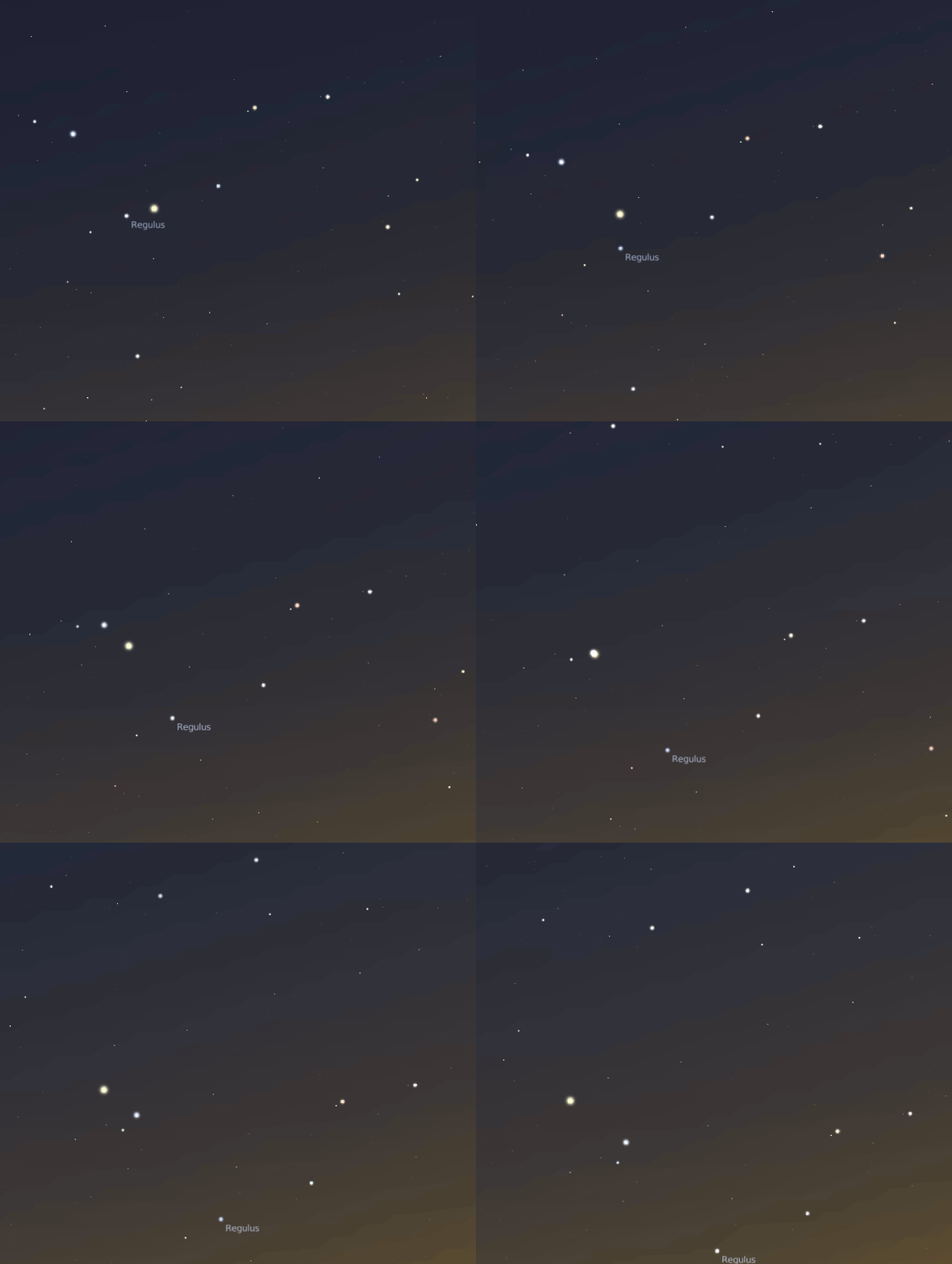
An edited excerpt from this year’s Star of Bethlehem presentation I gave to the Grand Traverse Astronomical Society on December 6th.
The triple conjunction of Jupiter and Saturn in 7 BCE is the generally accepted Star of Bethlehem, with Jesus being born in 6 or 5 BCE and Herod’s death being in 4 BCE after a lunar eclipse. What if the lunar eclipse in question was in 1 BCE? If so, there is that other possibility. It involves the constellation Leo, which is a lion. There is a passage in Genesis in which Jacob, who, by this time, is called Israel, is blessing his sons, each the heads of the twelve tribes of Israel. In Genesis 49 9-10 He compares him to a lion cub, the king of beasts, from whom the leaders of Israel will come. We can make a connection between Judah and the celestial lion, Leo. Let’s take a look at the celestial happenings against the constellation of Leo with Jupiter and Venus in 3 and 2 BCE.
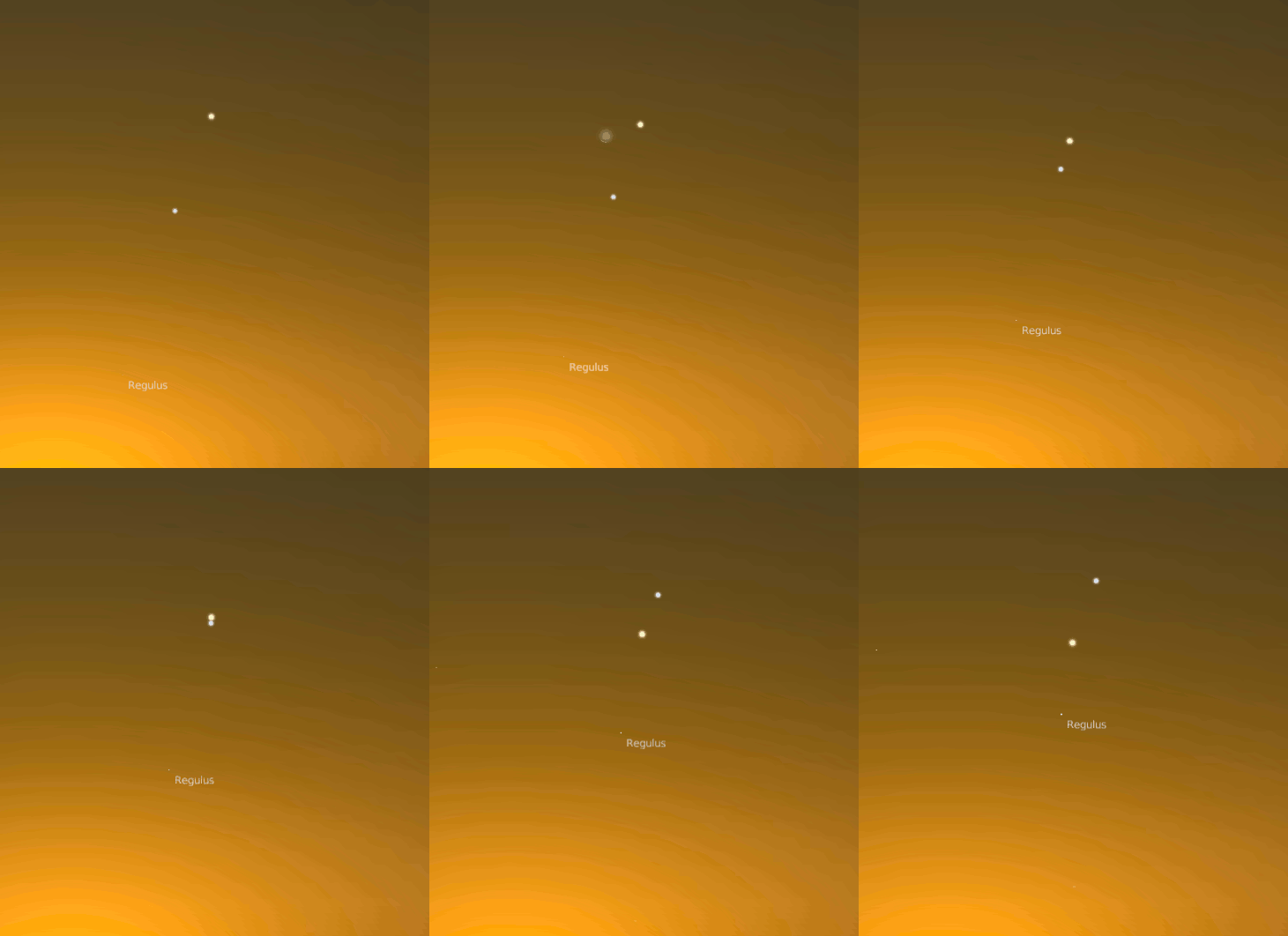
On August 12th of 3 BCE Jupiter and Venus appeared to come together so close as to be separable only in telescopes. This may have been the Star at its rising mentioned to Herod. Could this predawn celestial mating of Jupiter, who the Babylonians saw as the god Marduk and Venus as Ishtar, the goddess of fertility, to bring forth a powerful king? The Magi, I’m pretty sure, would have known that 10 months later, a little longer than the human gestation period, by the way, that the two planets would again come together.
Ten months after the first conjunction of Jupiter and Venus, perhaps as the Magi neared Jerusalem, they saw Jupiter and Venus approaching each other again. Later as they left Herod’s palace on the evening of June 16th, 2 BCE the conjunction was at its tightest. They saw the “Star” again, as Matthew relates. Telescopes, which wouldn’t be invented for another sixteen hundred years, could have seen this extremely close conjunction of Jupiter and Venus. Venus, near its greatest eastern elongation from the Sun, would appear half illuminated. But even to the best naked eye observer, Jupiter and Venus would merge into a single star. Venus was much brighter than Jupiter than it appears here. In fact, it was nearly twelve times brighter, so Jupiter’s added brightness wouldn’t contribute much to the combined brightness. Jupiter would seem to disappear at their closest.
Also, there was a conjunction of Jupiter with the “Little King” star Regulus on September 14th 3 BCE, one or two days after the beginning of the Jewish New Year. Was this another sign that a new King of the Jews would be born? It is actually the first of three conjunctions Jupiter has with Regulus in the next 9 months. Yes, another triple conjunction. Jupiter passed Regulus the second time on February 17, of 2 BCE and for a final time on May 9th. During this time Venus had moved back toward the Sun and entered the evening sky where Jupiter met it once again.
Ephemeris: 12/23/2024 – What was the Star of Bethlehem? Part 1
This is Ephemeris for Monday, December 23rd. Today the Sun will be up for 8 hours and 48 minutes, setting at 5:06, and it will rise tomorrow at 8:18. The Moon, 1 day past last quarter, will rise at 2:05 tomorrow morning.
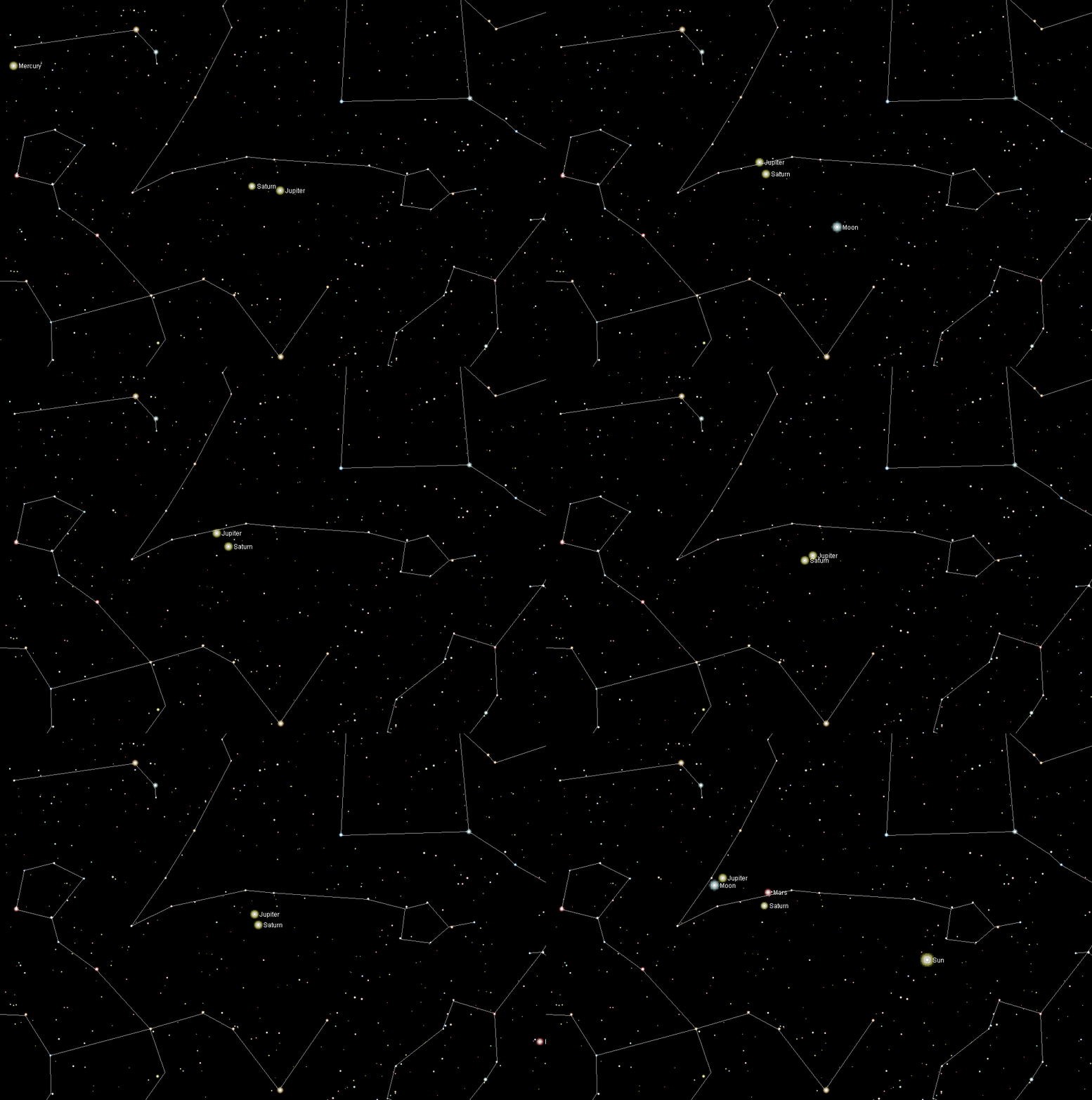
The most popular solution to what the Star of Bethlehem may have been, is a triple conjunction of Jupiter and Saturn that occurred in 7 BCE, where Jupiter passed Saturn three times in a few months time. So the event should more probably be called a celestial sign, rather than a star. The conjunction occurred against the constellation of Pisces the fish which was thought to represent the Jews or whoever lived in that area. Such a series of conjunctions against a particular zodiacal constellation would occur only about once every 800 to 900 years. Triple conjunctions aren’t super rare, if you don’t care which constellation it’s happening in front of. We had one in 1981, but it was against the constellation of Virgo.
The astronomical event times given are for the Traverse City/Interlochen area of Michigan (EST, UT – 5 hours). Times will be different for other locations.
Addendum
Ephemeris: 12/20/2024 – Winter is coming tomorrow!
Dec 20. This is Bob Moler with Ephemeris for Friday, December 20th. Today the Sun will be up for 8 hours and 48 minutes, setting at 5:04, and it will rise tomorrow at 8:17. The Moon, 2 days before last quarter, will rise at 10:55 this evening.
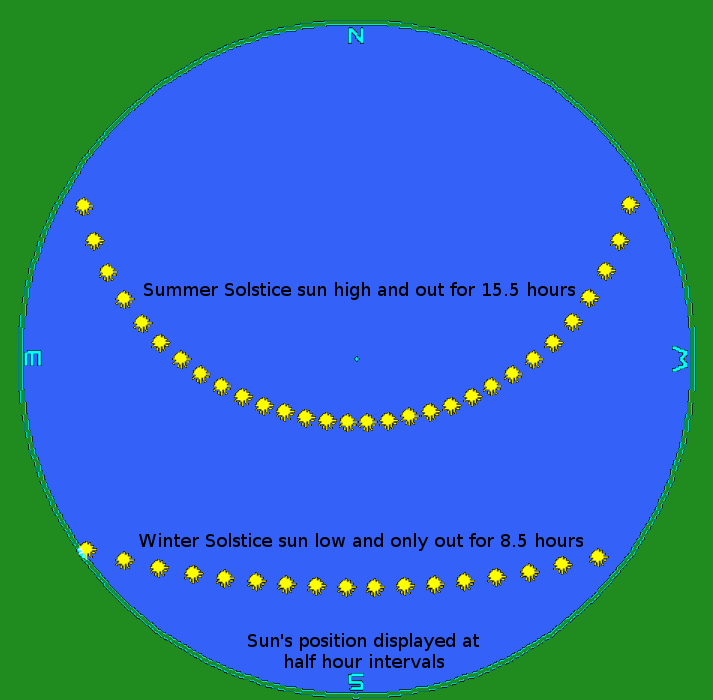
Today is the last full day of autumn. Tomorrow at 4:40 a.m. winter will begin as the Sun passes the winter solstice and stops its southward movement in the sky. Immediately it will slowly climb northward again. It will lengthen the daytime hours and increase the power of the Sun as it gets higher in our sky. The cooling of the Northern Hemisphere will continue until late January, on average, until the lengthening days and increased solar altitude will finally overcome it. Ancient cultures weren’t all that sure that the Sun would come back, since they didn’t understand what was really happening. So when the solstice finally arrived it was a time for great celebrations which survive to this day.
The astronomical event times given are for the Traverse City/Interlochen area of Michigan (EST, UT – 5 hours). Times will be different for other locations.
Addendum
Ephemeris: 12/19/2024 – Jupiter’s dark moon Callisto
This is Bob Moler with Ephemeris for Thursday, December 19th. Today the Sun will be up for 8 hours and 48 minutes, setting at 5:04, and it will rise tomorrow at 8:16. The Moon, 3 days before last quarter, will rise at 9:47 this evening.
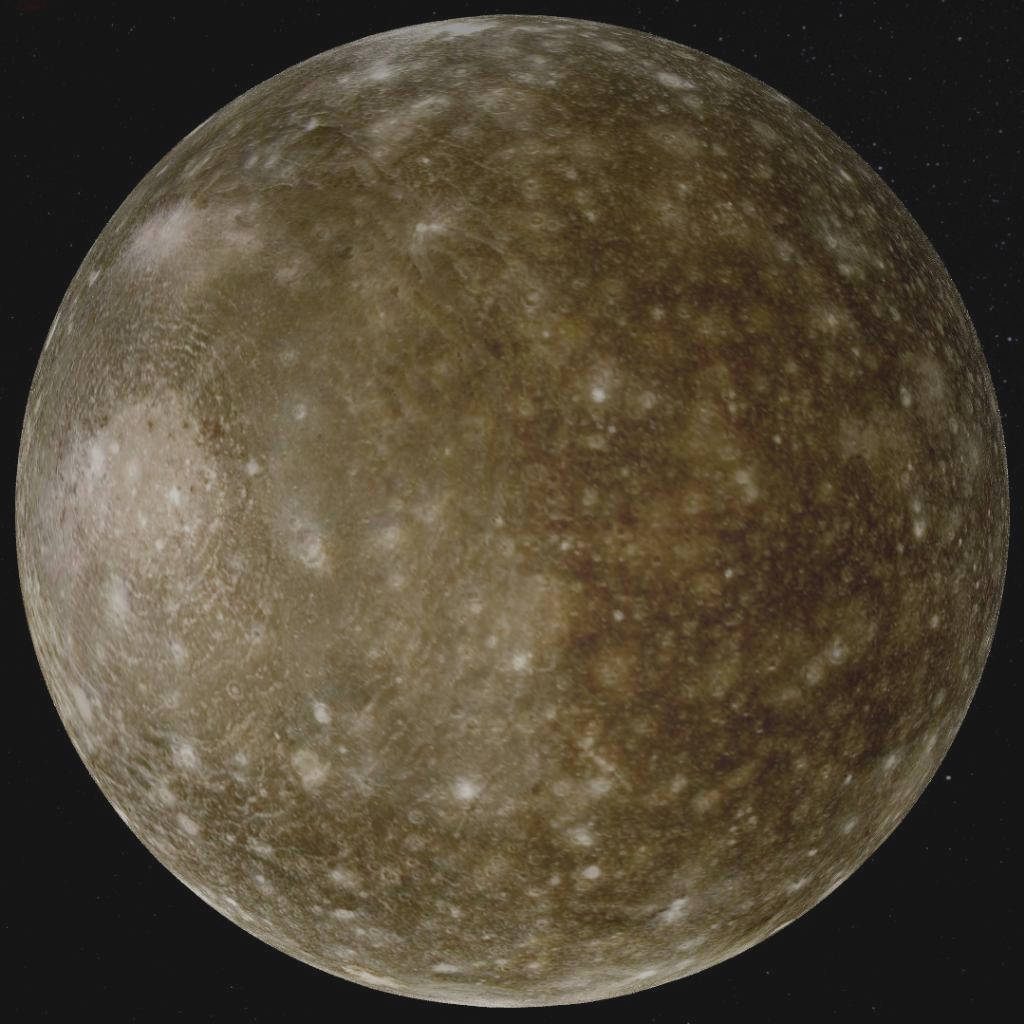
Callisto is the most distant of the Galilean moons from Jupiter, visible in small telescopes or even binoculars. It has the darkest surface of the four moons, and so appears the dimmest, even though it’s the second largest after Ganymede. The largest crater on Callisto is called Valhalla, and it doesn’t look like a crater at all. There’s many concentric, what look like, frozen ripples surrounding it, and it covers a good percentage of the moon’s surface. It is probably the only moon of Jupiter that we could send a crew to, since it’s the farthest from the intense radiation belts of Jupiter. Made of approximately equal parts of water mostly in the form of ice and rock, Callisto probably has a liquid water ocean underneath its icy crust, like Ganymede and Europa.
Addendum
Ephemeris: 12/18/2024 – Taking our weekly look at the whereabouts of the naked-eye planets
This is Ephemeris for Wednesday, December 18th. Today the Sun will be up for 8 hours and 48 minutes, setting at 5:03, and it will rise tomorrow at 8:16. The Moon, 3 days past full, will rise at 8:36 this evening.
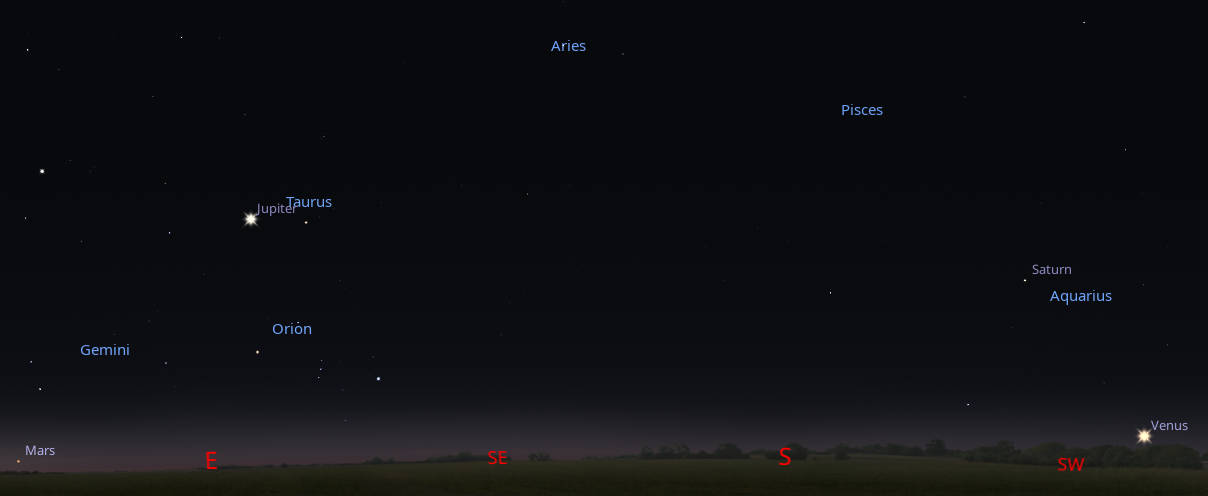
Let’s take our weekly look at the whereabouts of the naked-eye planets. Venus can be spotted in the south-southwestern sky by 5:30 PM, about 30 minutes after sunset. It will set at 8:41 PM. Saturn will be in the south at 6 PM, way above the bright star Fomalhaut. Jupiter is low in the east-northeast, about the same time Venus is first spotted. It will be a good object for the small telescope about an hour later. Mars, rises tonight at 7:44, It will appear above the Moon in the evening. Mars is still considered a morning planet since it is still up at sunrise. By 6:00 AM tomorrow Jupiter will be low in the west-northwest, to the right of the setting Orion, while reddish Mars will be high in the west-southwest.
The astronomical event times given are for the Traverse City/Interlochen area of Michigan (EST, UT – 5 hours). Times will be different for other locations.
Addendum
Ephemeris: 12/17/2024 – A closeup look at Ganymede
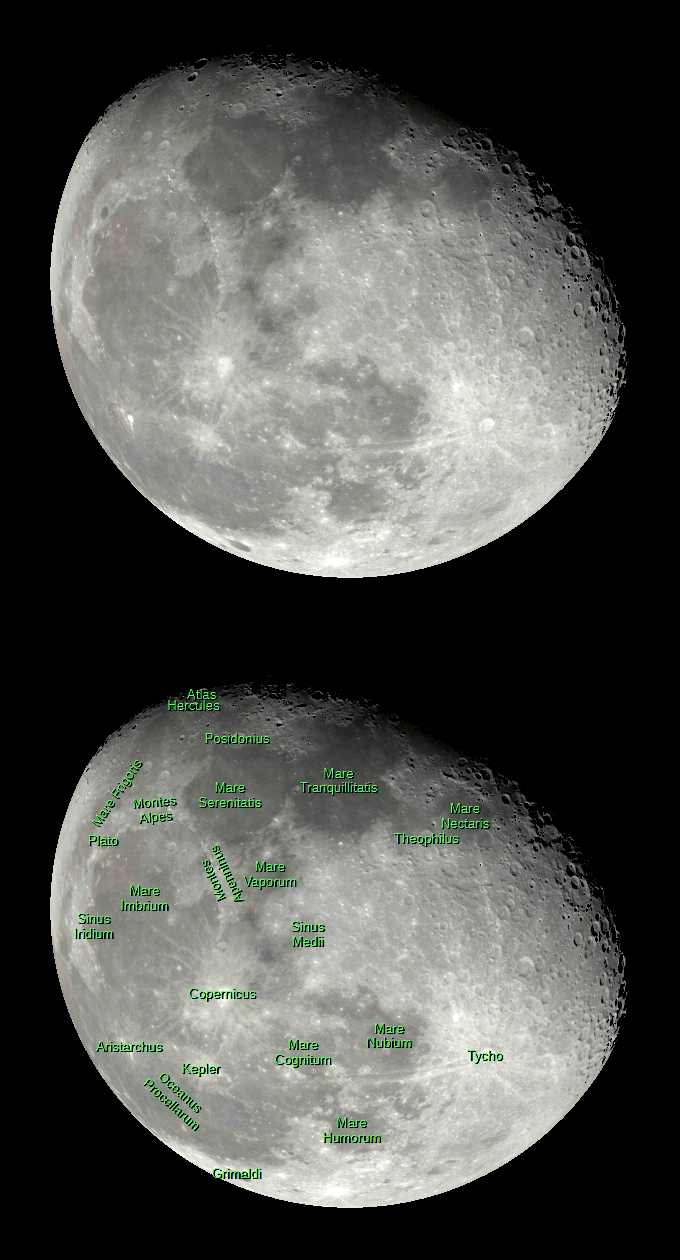
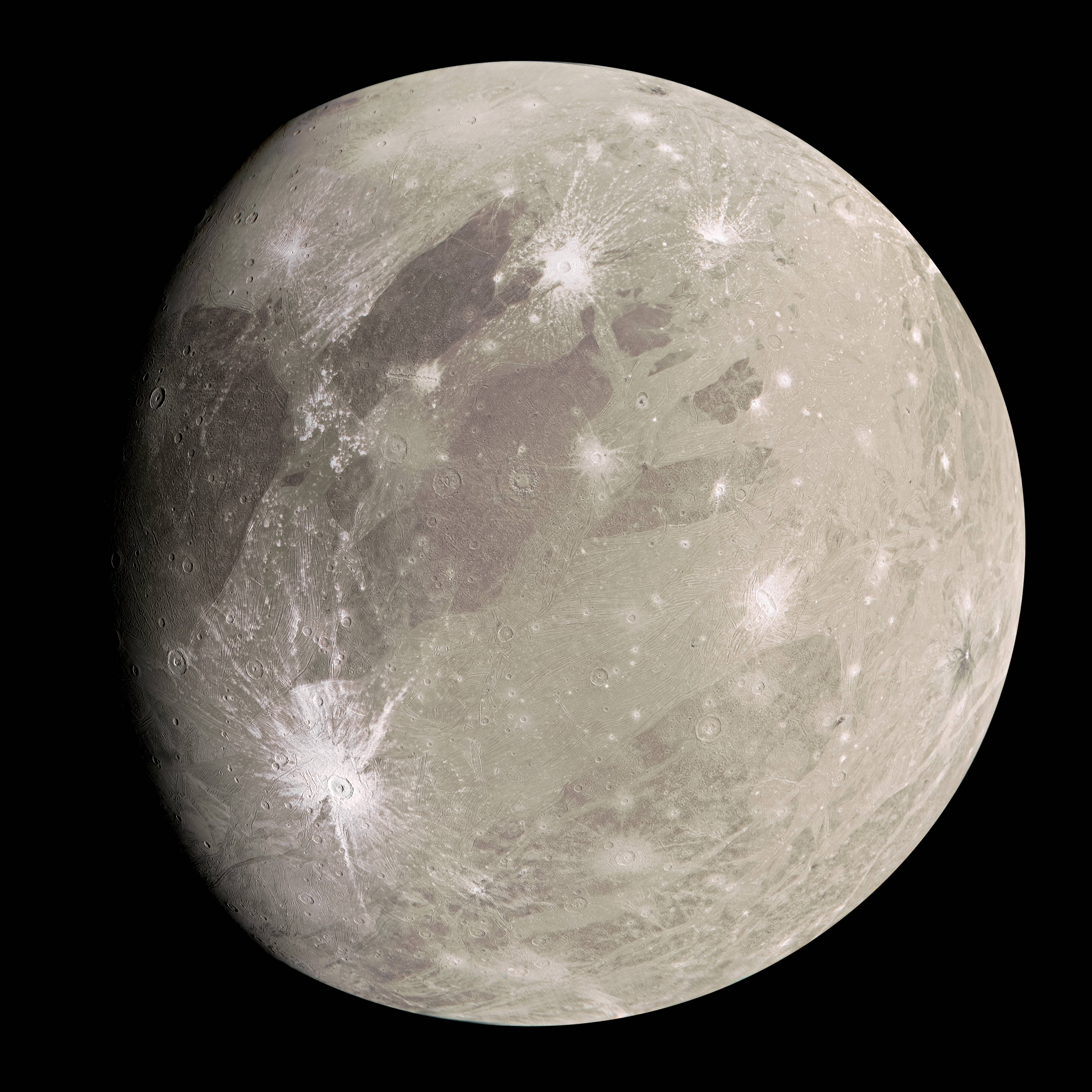
This is Bob Moler with Ephemeris for Tuesday, December 17th. Today the Sun will be up for 8 hours and 48 minutes, setting at 5:03, and it will rise tomorrow at 8:15. The Moon, 2 days past full, will rise at 7:23 this evening. | Ganymede is the largest satellite in the solar system orbiting the largest planet in the solar system, Jupiter. It is 1 1/2 times the diameter of our Moon, and slightly larger than the planet Mercury. It is an icy moon, being about half made-up of water ice and silica. Ganymede appears to have a below surface ocean of water like Europa. And its surface appears to be quite smooth, not as smooth as Europa’s but parts of it are literally devoid of craters for the most part, and many of the craters it does appear to have inner craters in the center which looks quite weird. The Juno spacecraft, still orbiting Jupiter, took some very close images of Ganymede back in 2021 using its relatively simple camera. These were some of the best images of it.
The astronomical event times given are for the Traverse City/Interlochen area of Michigan (EST, UT – 5 hours). Times will be different for other locations.
Addendum
Ephemeris: 12/16/2024 – The Europa Clipper mission
This is Bob Moler with Ephemeris for Monday, December 16th. Today the Sun will be up for 8 hours and 48 minutes, setting at 5:03, and it will rise tomorrow at 8:14. The Moon, 1 day past full, will rise at 6:09 this evening.
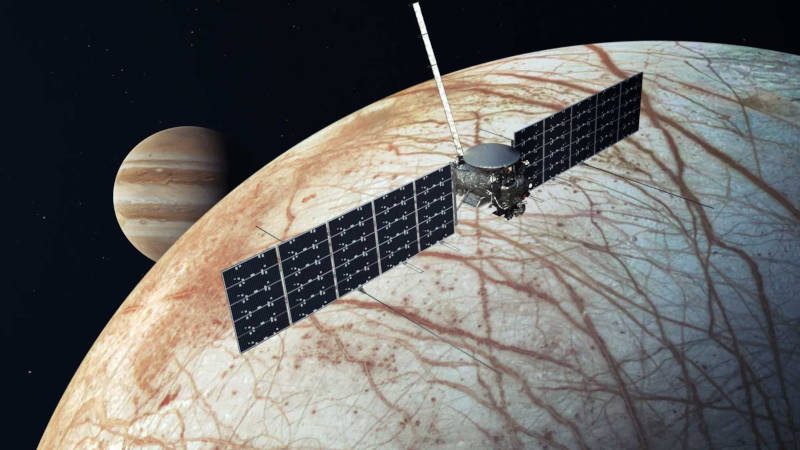
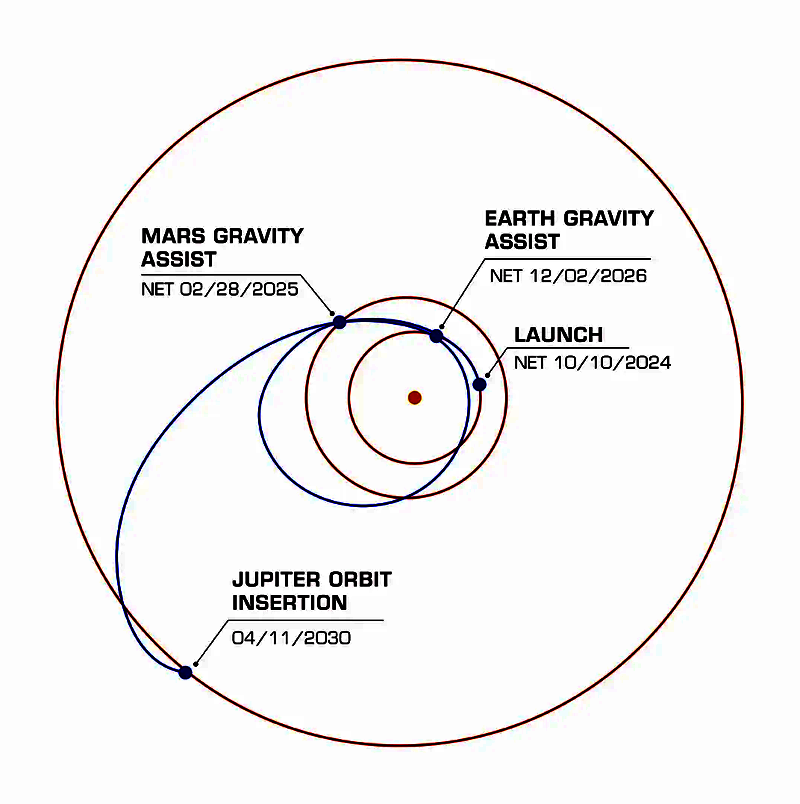
Just two months ago the satellite to closely study Jupiter’s second Galileo moon Europa was launched from Cape Canaveral on a Falcon Heavy rocket. The satellite’s name is Europa Clipper. It was originally scheduled to be launched by the SLS rocket but this rocket which is used for the Artemis program was not going to be ready for the mission so they dropped back to the somewhat less powerful SpaceX Falcon Heavy rocket. Europa Clipper will take 5 1/2 years to travel out to Jupiter with first a gravitational boost from a flyby of Mars and then another one a flyby of Earth to gain enough speed to make it to Jupiter. There it would orbit Jupiter in such a way as to fly by Europa multiple times. Jupiter’s radiation is harsh at Europa’s distance, so the satellite has to get in and get out quickly.
The astronomical event times given are for the Traverse City/Interlochen area of Michigan (EST, UT – 5 hours). Times will be different for other locations.
Addendum
 Bob Moler's Ephemeris Blog