Archive
Ephemeris: 11/22/2024 – Finding Aquarius
This is Ephemeris for Friday, November 22nd. Today the Sun will be up for 9 hours and 18 minutes, setting at 5:08, and it will rise tomorrow at 7:50. The Moon, at last quarter today, will rise at 12:04 tomorrow morning.
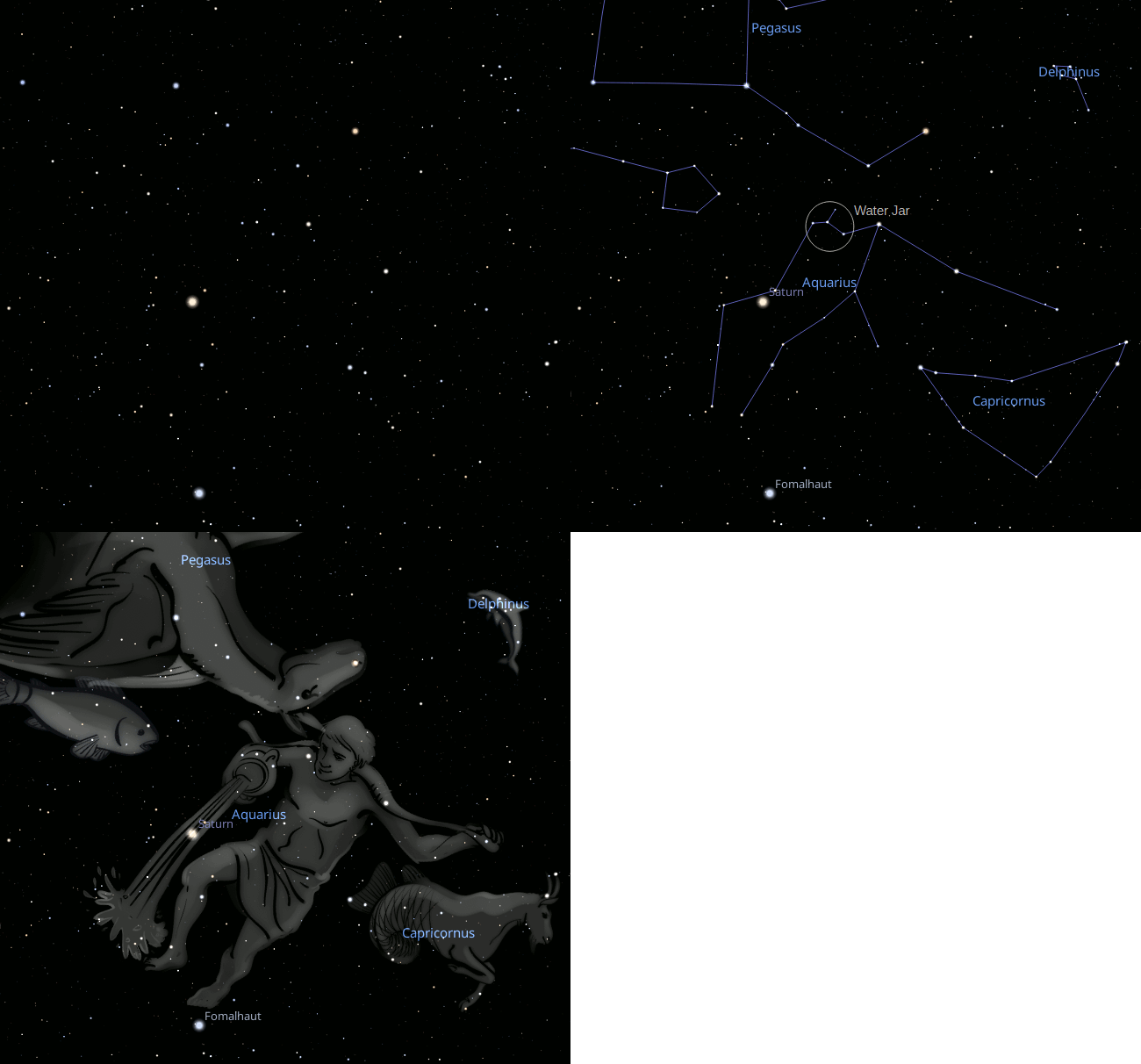
One of the constellations of the zodiac is in the southern sky at 8 in the evening, where Saturn is located this year. It’s the constellation of Aquarius, the water bearer. The image that is supposed to be depicted in the stars is that of a fellow carrying a stone jar of water. Aquarius is fairly hard to spot because it is made of faint stars. One part of him, though, is easier to spot. That is the Water Jar, an asterism or informal constellation. It is a distinctive small nearly equilateral triangle of stars with another star in the center. Aquarius is not a very good water bearer because he’s spilling the water out of his jar. The Water jar is above and to the right of Saturn this year and the water is flowing down a line of stars to the lower left.
The astronomical event times given are for the Traverse City/Interlochen area of Michigan (EST, UT – 5 hours). Times will be different for other locations.
Addendum
Ephemeris: 08/29/2024 – Centaur or Teapot, you decide!
This is Bob Moler with Ephemeris for Thursday, August 29th. Today the Sun will be up for 13 hours and 21 minutes, setting at 8:23, and it will rise tomorrow at 7:03. The Moon, 3 days past last quarter, will rise at 3:02 tomorrow morning.
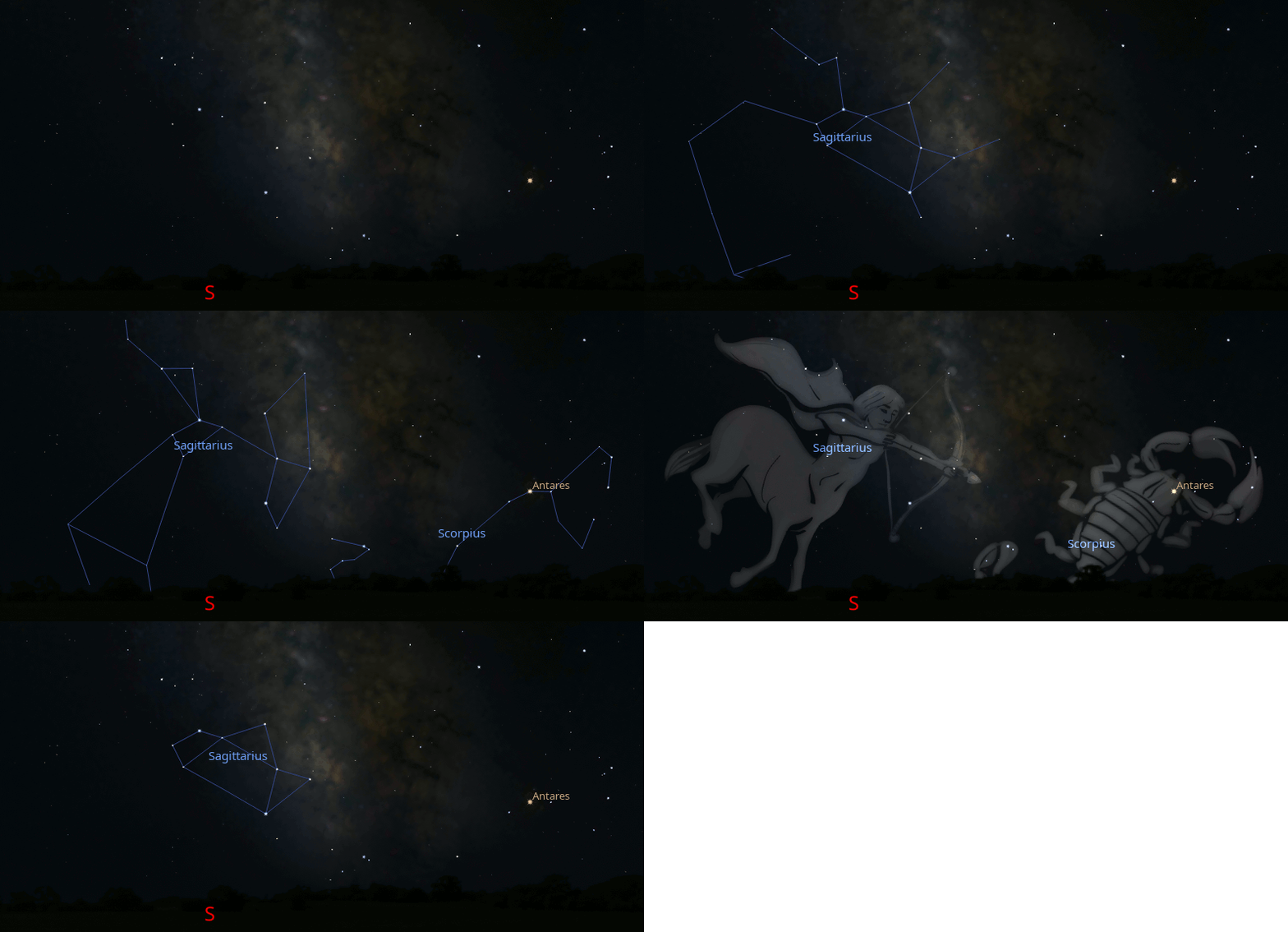
Low in the south at 10 PM shines the heart of summer Milky Way. The constellation that’s seen there is Sagittarius which is supposed to be a centaur with a bow and arrow. We modern folk haven’t seen a centaur outside a Harry Potter movie, so we see its stars looking like a teapot, a short and stout little teapot like in the children’s song. It is tipped to the West with the Milky Way like steam rising from its spout, which is about to pour its tea on the southwestern horizon later tonight. Sagittarius is just begging to be explored with binoculars or a very low power telescope to see its myriad of stars, star clusters and nebulae. As fabulous as all this appears, we cannot see into the heart of the Milky Way for all the clouds of dust and gas in the way.
The astronomical event times given are for the Traverse City/Interlochen area of Michigan (EDT, UT–4 hours). Times will be different for other locations.
Addendum
My first guide to the constellations was Stars by Zim and Baker, a Golden Guide. I checked, it has been revised and is still available. H. A. Rey’s book is also still available.
Ephemeris: 08/02/2024 – The Northern Cross
This is Ephemeris for Friday, August 2nd. Today the Sun will be up for 14 hours and 35 minutes, setting at 9:06, and it will rise tomorrow at 6:31. The Moon, 2 days before new, will rise at 5:12 tomorrow morning.
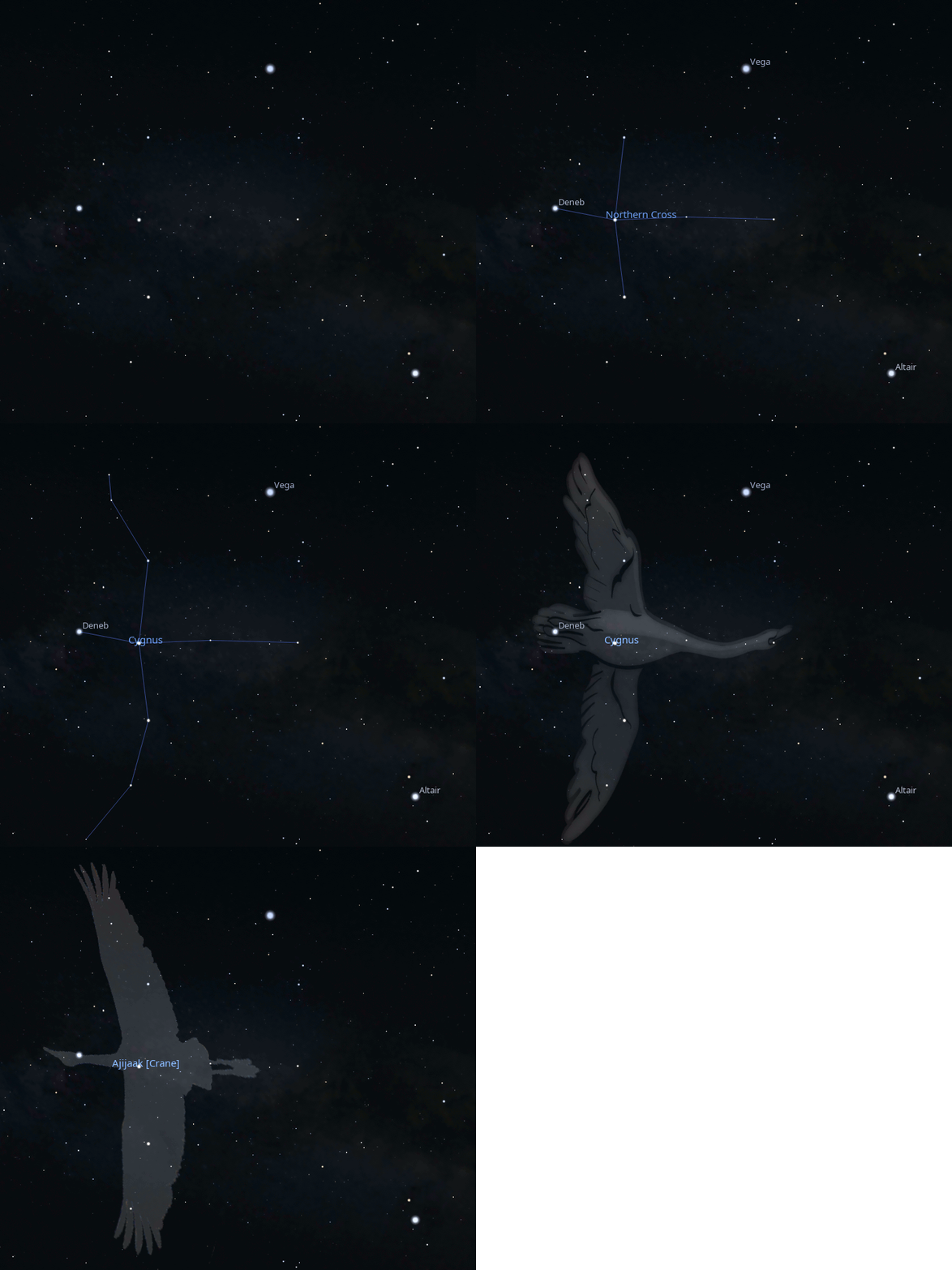
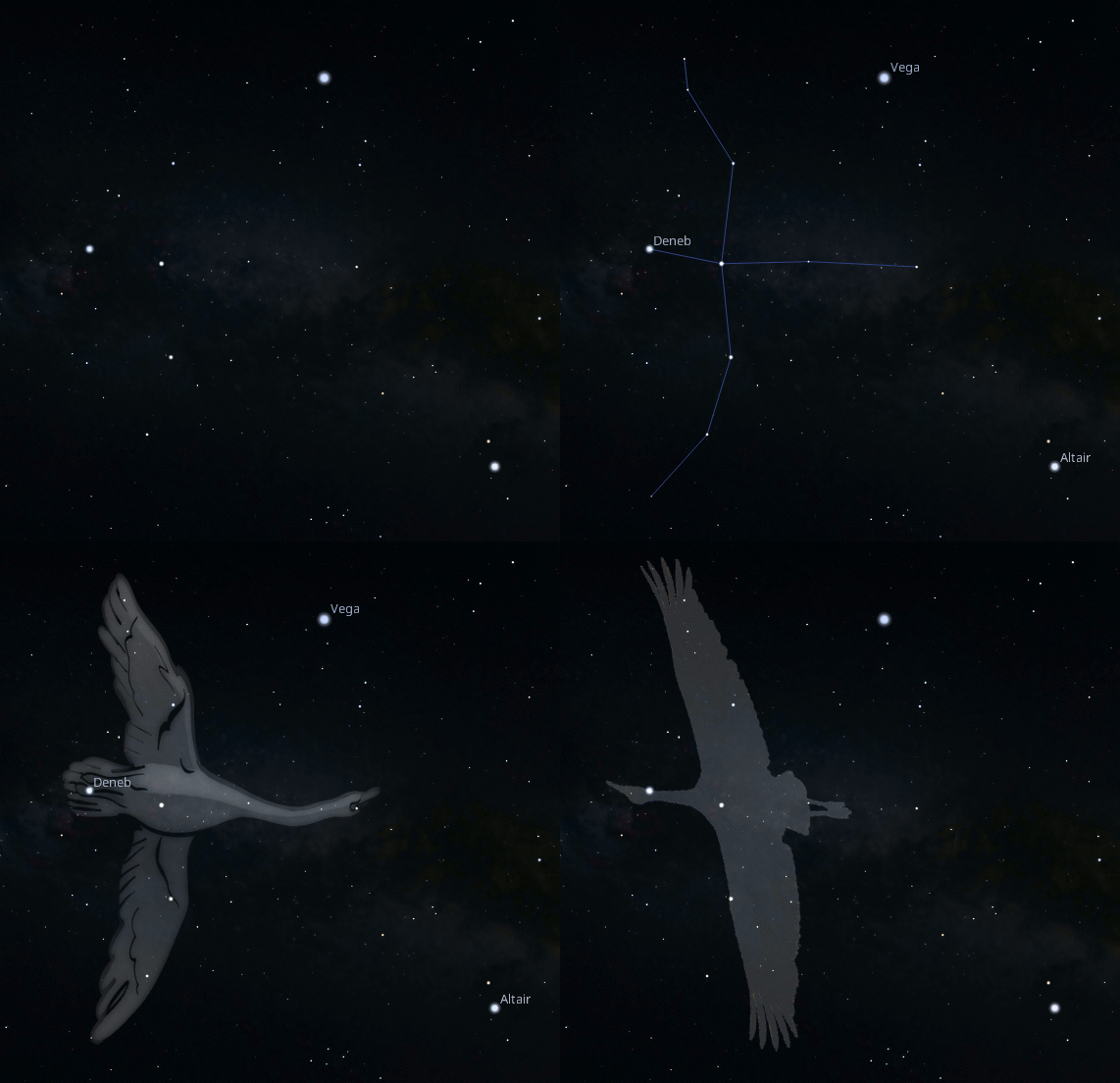
The star Deneb is high in the east-northeast. It is the dimmest of the three stars of the Summer Triangle. It is at the head of the Northern Cross, an informal constellation or asterism. The upright extends to the South. The crossbeam can be seen crossing the star just south of Deneb. There’s also a constellation there. It’s actually Cygnus the swan flying southward along the Milky Way with its neck outstretched. The Anishinaabe natives peoples of our area see Ajijaak the crane, also with a long neck flying north, but also long legs trailing to the south, its wings outstretched. In Greek mythology Cygnus was the guise of the god Zeus when he seduced Leda, whose offspring was Pollux, one of the Gemini twins.
The astronomical event times given are for the Traverse City/Interlochen area of Michigan (EDT, UT–4 hours). They may be different for your location.
Addendum
Ephemeris: 07/08/2024 – The Summer Triangle dominates the eastern sky
This is Ephemeris for Monday, July 8th. Today the Sun will be up for 15 hours and 23 minutes, setting at 9:29, and it will rise tomorrow at 6:06. The Moon, 3 days past new, will set at 11:34 this evening.
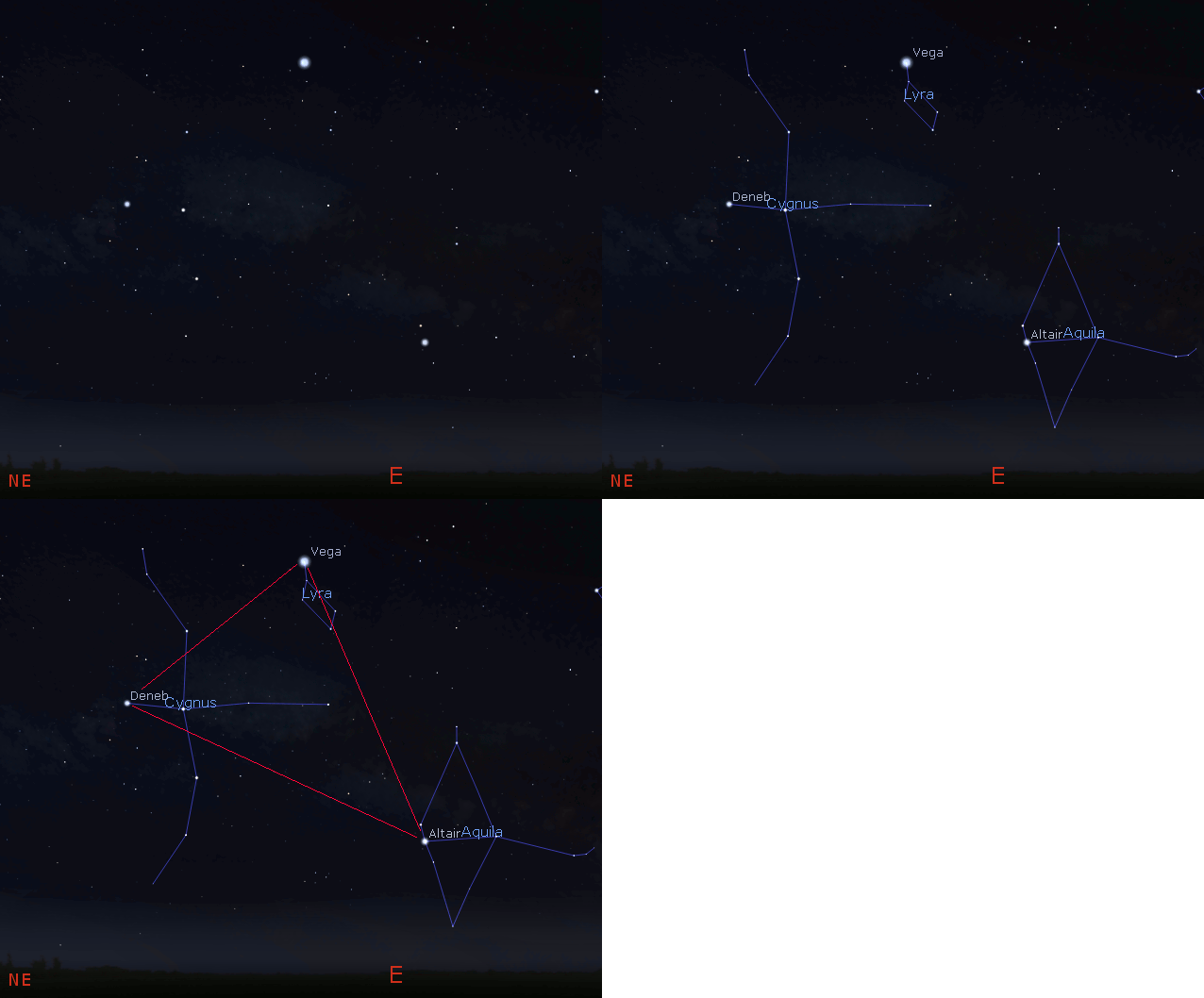
We’re two weeks into summer, and the asterism or informal constellation called the Summer Triangle can be seen in the eastern sky as it gets dark. The highest of the three bright stars is Vega in the constellation Lyra the harp, whose body is seen in a narrow parallelogram just below it. The second star of the triangle is Deneb, in Cygnus the swan, lower and left of Vega, It appears dimmer than Vega because it is by far the most distant of the three. The third star of the Summer Triangle is seen farther below and a right of Vega. It is Altair in Aquila the eagle, and the closest. Altair is 16.5 light years away, Vega is 27 light years, while Deneb may be a whopping 2,600 light years away. One light year by the way, is 6 trillion miles (9 trillion kilometers).
The astronomical event times given are for the Traverse City/Interlochen area of Michigan (EDT, UT–4 hours). They may be different for your location.
Addendum
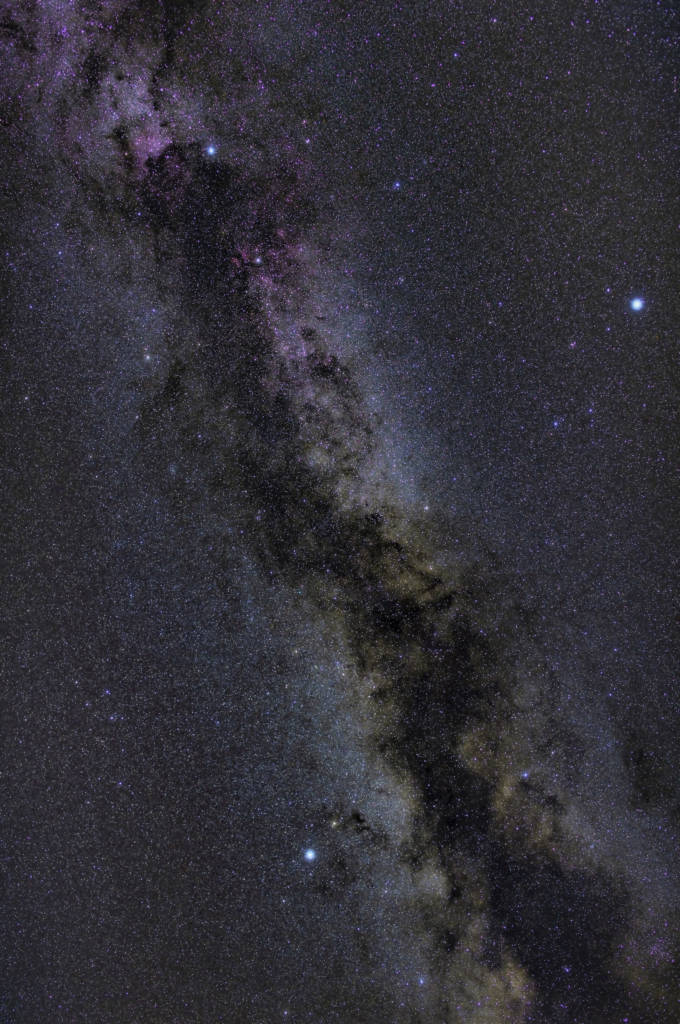
Ephemeris: 06/04/2024 – Finding the Little Dipper
This is Ephemeris for Tuesday, June 4th. Today the Sun will be up for 15 hours and 25 minutes, setting at 9:24, and it will rise tomorrow at 5:58. The Moon, 2 days before new, will rise at 4:51 tomorrow morning.
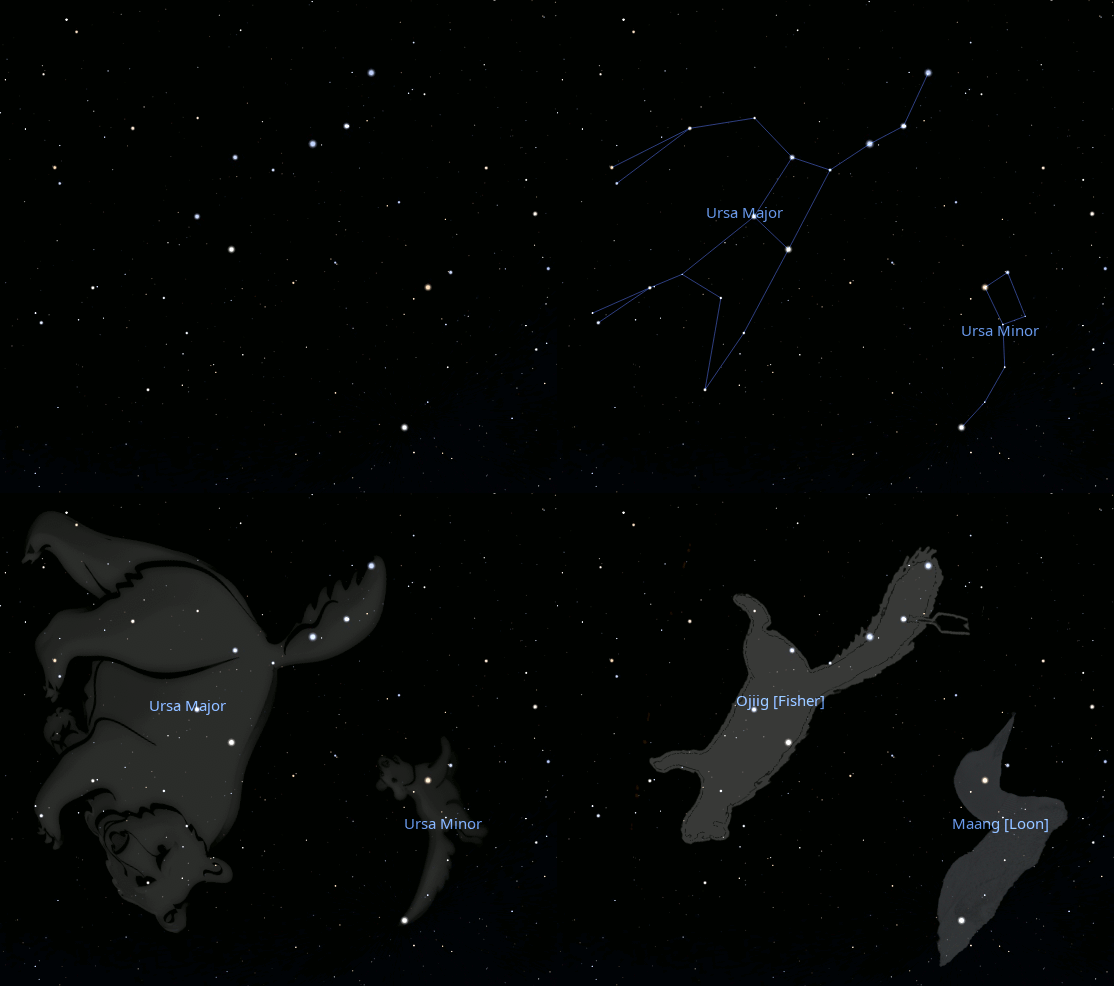
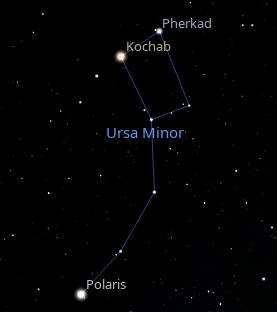
One of the constellations I don’t talk about much, except in passing is Ursa Minor, the Little Bear with an impossibly long tail. It is better known as the Little Dipper. As a dipper goes, its handle is bent the wrong way, like someone stepped on it. Anyway, this time of year in the evening, it’s standing on the tip of it’s handle, which is the North Star, Polaris. Polaris is pointed to by the front two stars of the Big Dipper. As dippers go they pour their contents into each other. The second and third-brightest stars of the Little Dipper are at the front of the bowl, and are Kochab and Pherkad, the Guard Stars, that is, Guardians of the Pole. To the Anishinaabe native peoples of our area the Little Dipper is Maang, the Loon.
The astronomical event times given are for the Traverse City/Interlochen area of Michigan (EDT, UT–4 hours). They may be different for your location.
Addendum
Ephemeris: 01/04/2024 – Viewing Orion’s Belt
This is Ephemeris for Thursday, January 4th. The Sun will rise at 8:20. It’ll be up for 8 hours and 55 minutes, setting at 5:15. The Moon, 1 day past last quarter, will rise at 2:10 tomorrow morning.
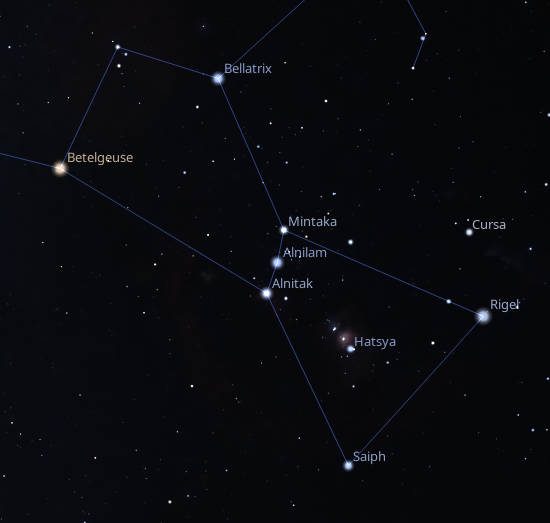
Orion’s belt of three stars is one of the most noticeable star groupings in the sky. There are no other groups of three bright stars in a straight line visible anywhere else in the sky. The star’s names from left to right are Alnitak, Alnilam and Mintaka. They are actually a bit farther away than the other bright stars of Orion. Alnilam, the center star, is over three times the distance of red giant Betelgeuse above them and over twice as far as blue white giant star Rigel below them. Alnilam is 375 thousand times brighter than the Sun. These three stars were also known as Frigga’s Spindle by the Norsemen. Frigga, also known as Freya, is the goddess from which we get the name of the day of the week we call Friday.
The astronomical event times given are for the Traverse City/Interlochen area of Michigan (EST, UT –5 hours). They may be different for your location.
Addendum
Ephemeris: 12/07/2023 – Auriga, the charioteer
This is Ephemeris for Thursday, December 7th. Today the Sun will be up for 8 hours and 56 minutes, setting at 5:02, and it will rise tomorrow at 8:07. The Moon, 2 days past last quarter, will rise at 3:20 tomorrow morning.
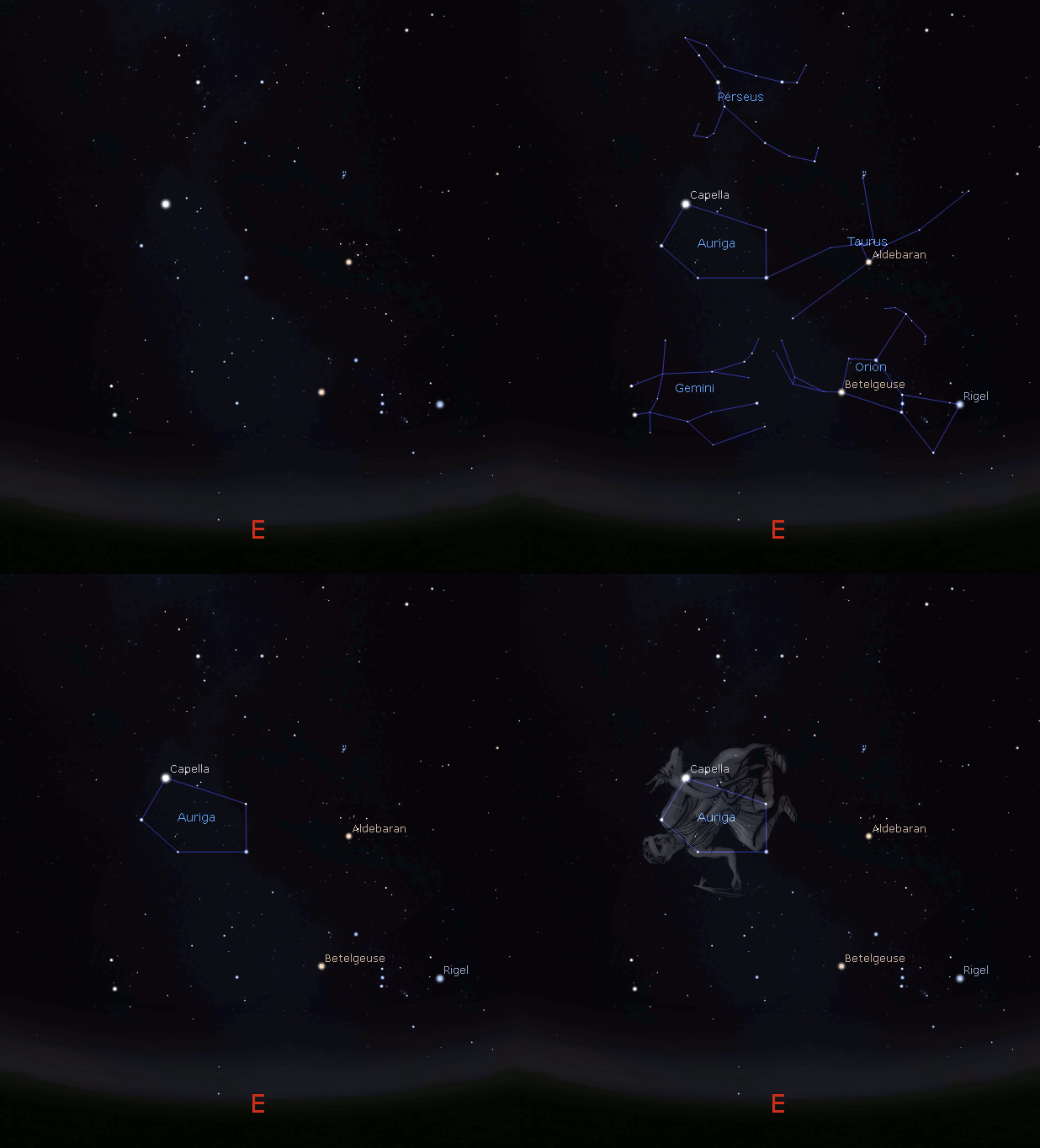
The first constellation of winter is in the northeastern sky, called Auriga the charioteer. It’s to the upper left of Orion and directly left of Taurus. Auriga actually never really quite leaves us, because its brightest star, Capella is the star that never leaves us even in the heat of summer, Though for most of us it’s in the trees in the north. Auriga is a pentagon of stars with the Capella on top. Just right of Capella is a thin triangle of three faint stars, an asterism or informal constellation called the Kids, baby goats. Capella is their mother. For some reason they are all held by a charioteer, who is without his chariot. And from all the Hollywood Biblical epic movies I’ve seen, it takes two hands to drive a chariot, and it doesn’t have a rumble seat.
The astronomical event times given are for the Traverse City/Interlochen area of Michigan (EST, UT –5 hours). They may be different for your location.
Addendum
Ephemeris: 09/14/2023 – The stars of Cygnus the swan represent a few different figures
This is Ephemeris for Thursday, September 14th. Today the Sun will be up for 12 hours and 35 minutes, setting at 7:55, and it will rise tomorrow at 7:21. The Moon is new today, and won’t be visible.
Nearly directly overhead in the evening is the bright star Deneb, part of the Summer Triangle of bright stars It’s at the top of the Northern Cross, an informal constellation or asterism. It makes a perfectly proportioned Christian cross. Deneb is also the tail of Cygnus the swan, seen flying southward through the Milky Way with its neck outstretched. Extra stars added to the Northern Cross extend the wings nicely. To the Anishinaabe native peoples of our area the stars here also represent two constellations, both are birds. The first is Ajijaak, the Sand Hill crane, The other is Bineshi Okanin, the Skeleton Bird, so named probably because the stars make a stick figure of a bird rather than an outline of one.
The astronomical event times given are for the Traverse City/Interlochen area of Michigan (EDT, UT –4 hours). They may be different for your location.
Addendum
Ephemeris: 08/07/2023 – Sagittarius, centaur or teapot?
This is Bob Moler with Ephemeris for Monday, August 7th. Today the Sun will be up for 14 hours and 25 minutes, setting at 9:00, and it will rise tomorrow at 6:36. The Moon, 1 day before last quarter, will rise at 12:06 tomorrow morning.
Looking due south and low in the sky at 11 pm, now is one of my favorite asterisms, the Teapot of the constellation Sagittarius. Sagittarius, classically, represents a centaur with a bow and arrow aimed at the heart of the constellation Scorpius to its west. I can find the bow and arrow here, but the half man, half horse figure of the centaur eludes me. However, the stout little teapot of the children’s song is quite obvious, with its base, lid on top, handle to the left and the spout to the right. To make things more realistic, the bright Milky Way seems to rise like steam from its spout. The Teapot is an asterism, an informal constellation. As the night goes on, the Teapot moves westward and appears to tilt, pouring its tea on the southwestern horizon.
The astronomical event times given are for the Traverse City/Interlochen area of Michigan (EDT, UT –4 hours). They may be different for your location.
Addendum
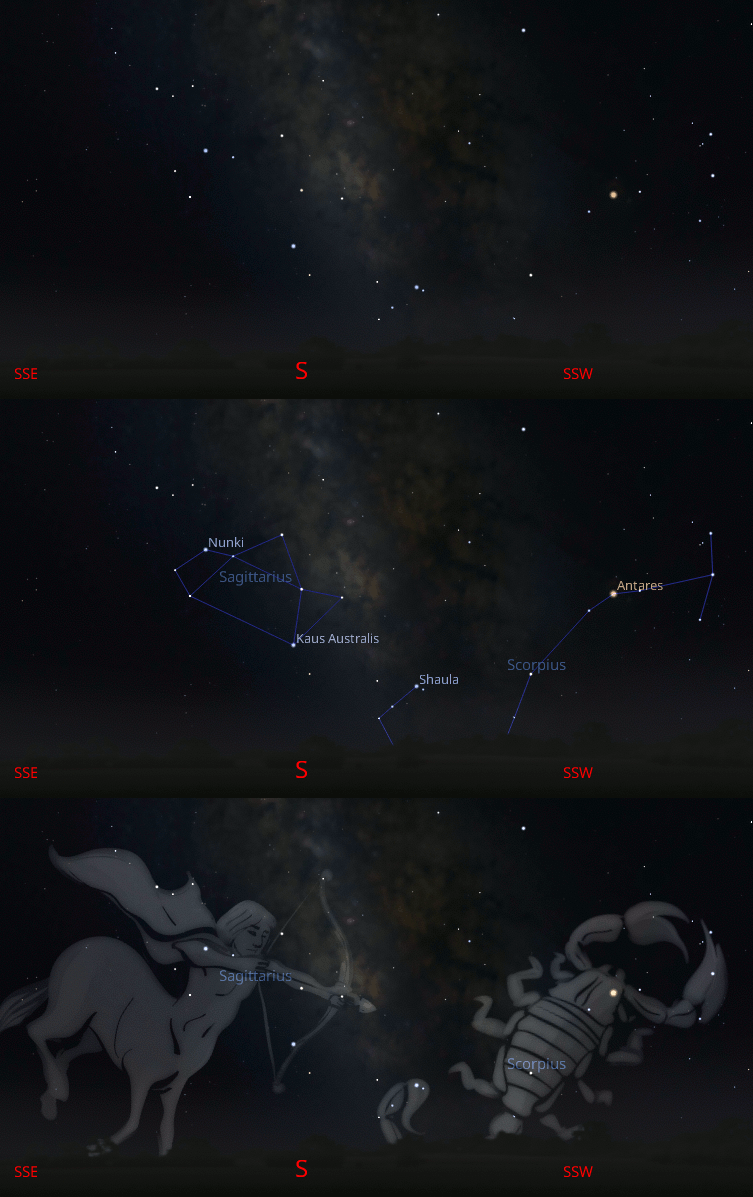
Sagittarius-Teapot finder animation for 11 pm, August 7, 2023. I’ve omitted all the lines in Sagittarius except the teapot stars from Stellarium, so there are more lines connecting the stars, most too far south to really spot easily from our latitude (45 degrees north). Click or tap on the image to enlarge it. Created using Stellarium and GIMP.
Named stars that are shown in the image above are Nunki, from an ancient tablet of thirty stars – The proclaimer of the sea. This is because the next four constellations to the east are water constellations: Capricornus, the sea goat; Aquarius, the water bearer; Pisces the fish; and Piscis Australis, the southern fish. Antares, in Scorpius, is of course the Rival of Mars, due to its reddish hue, and Mars passes Antares regularly on its journey through the Zodiac. An archer has to have his bow. Kaus Australis is the southern bow star. The star above that is Kaus Media, the middle bow star. And the star above and left of that is Kaus Borealis, the northern bow star. The constellation art that comes with Stellarium doesn’t match up with the stars of the bow.
The five stars on the left side of the Teapot is another asterism called the Milk Dipper.
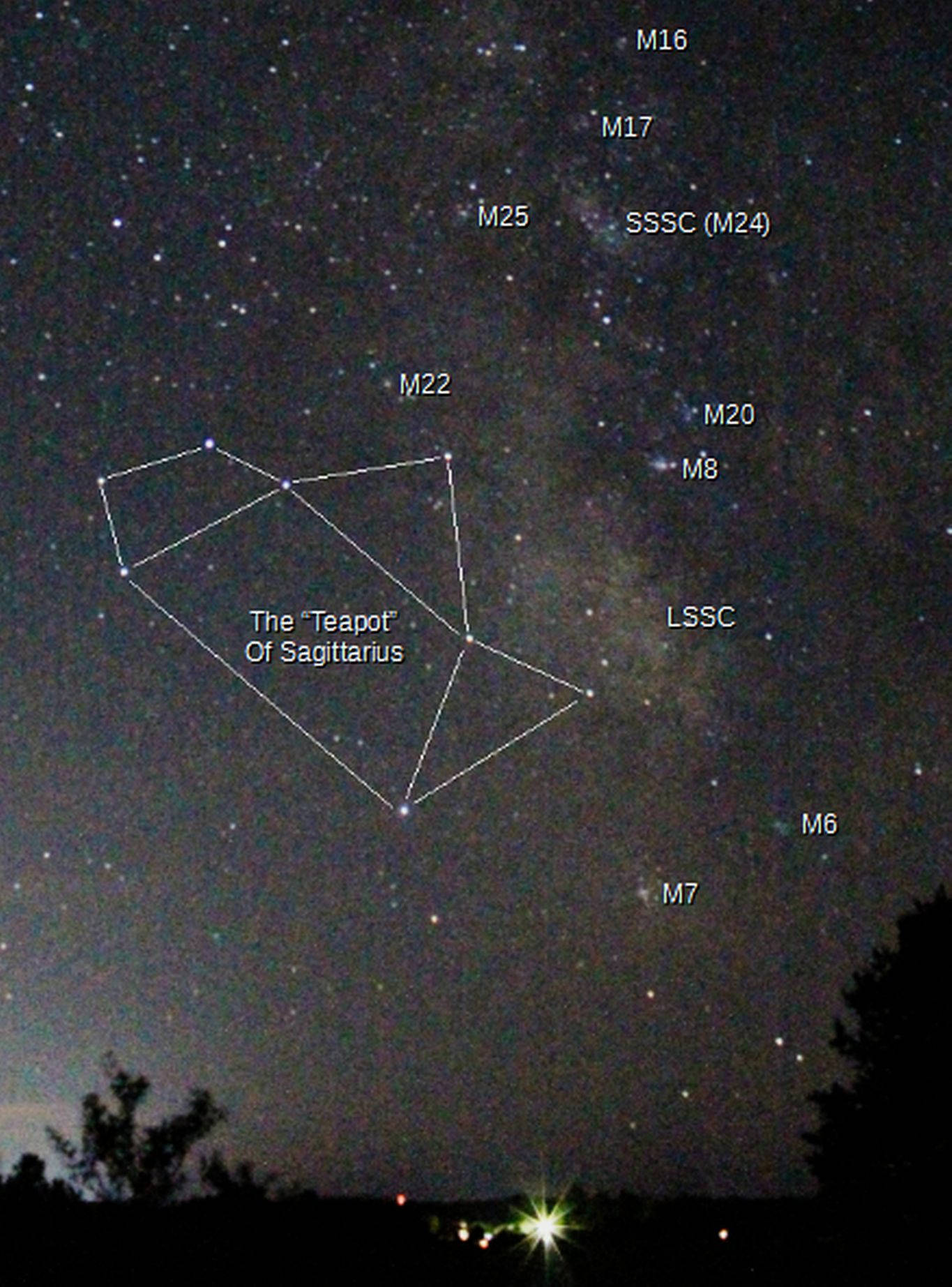
Sagittarius in a short time exposure with added annotations. This would be later in the evening, around midnight. The “M” designations are objects in Charles Messier’s catalog created in the latter half of the 18th century. LSSC is the Large Sagittarius Star Cloud, SSSC is the Small Sagittarius Star Cloud. These will be easily visible in binoculars. Credit Bob Moler.
02/13/2023 – Ephemeris – Follow the Drinking Gourd
This is Bob Moler with Ephemeris for Monday, February 13th. Today the Sun will be up for 10 hours and 21 minutes, setting at 6:08, and it will rise tomorrow at 7:44. The Moon, at last quarter today, will rise at 2:51 tomorrow morning.
In the decades before the Civil War, runaway slaves would travel, often at night, northward from the slave states in the south to the northern free states and Canada over the metaphorical Underground Railroad following the Drinking Gourd, the Big Dipper as their compass. For millennia, the North Pole of the sky had been passing near the handle of the Big Dipper or bear’s tail. As an amateur astronomer, who loves the dark, starlit skies, I’ve noticed that everyone is the same color in the dark! This year the Grand Traverse Astronomical Society will, once again, team with the Sleeping Bear Dunes for more Sun and star parties.
The astronomical event times given are for the Traverse City/Interlochen area of Michigan (EST, UT –5 hours). They may be different for your location.
Addendum

“Follow the Drinking Gourd,” a show at the Virginia Living Museum’s Abbit Planetarium based on Jeanette Winter’s children’s book of the same name, tells the story of a slave family who used the stars to make their way north. Visitors can watch the free show Saturdays in February. (Courtesy of Virginia Living Museum) Via Daily Press, Newport News, VA.
 Bob Moler's Ephemeris Blog