Archive
Ephemeris: 01/02/2025 – Today we have the latest sunrise
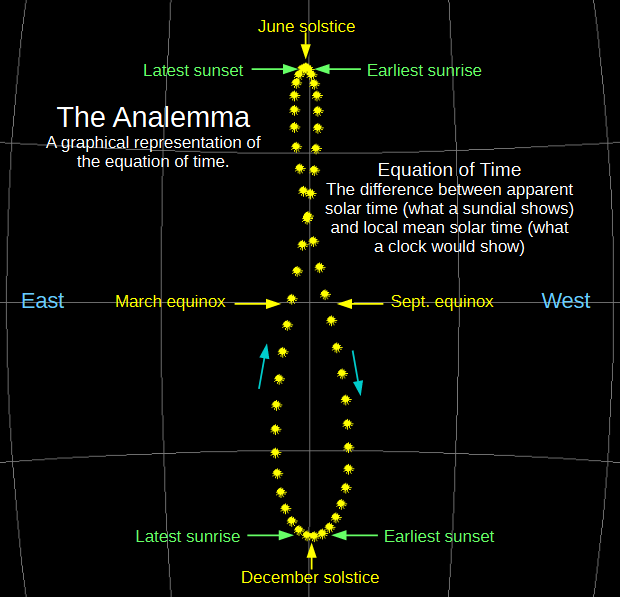
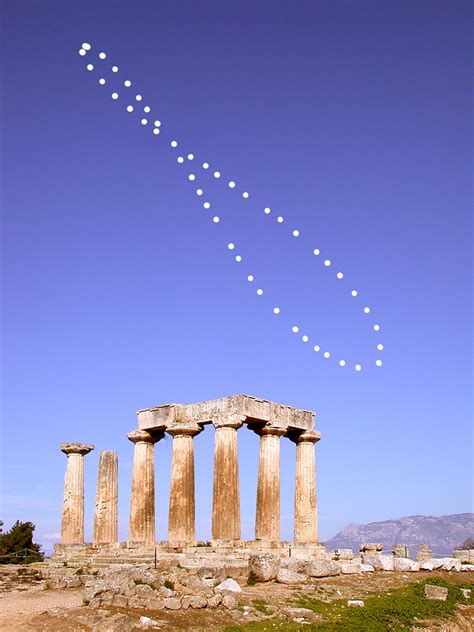
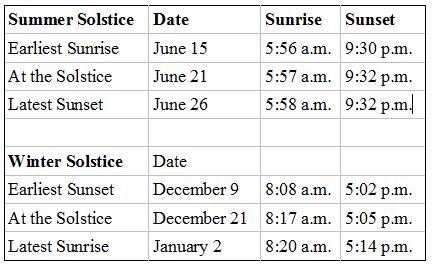
This is Bob Moler with Ephemeris for Thursday, January 2nd. The Sun will rise at 8:20. It’ll be up for 8 hours and 54 minutes, setting at 5:14. The Moon, 3 days past new, will set at 8:20 this evening. | As an amateur astronomer I am fascinated by time, the so-called 4th dimension. For example, being at the right place at the right time such as to view a total solar eclipse. The universe isn’t going to wait for you if you’re off in the three dimensions of location or of the time. But today is a different story. Today is the day of the latest sunrise, which is at 8:20 AM. From today to June 15th, the day of the earliest sunrise, is on average about 165 days. That’s about 5 ½ months. We had our earliest sunset back on December 9th. That was 24 days ago so it’s got a head start from there to the latest sunset that it will need because the latest sunset will be on June 26th. So the sunrise times will decrease faster than the sunset times will increase into the June summer solstice period.
The astronomical event times given are for the Traverse City/Interlochen area of Michigan (EST, UT – 5 hours). Times will be different for other locations.
Addendum:
Ephemeris: 12/09/2024 – Today’s sunset is the earliest of the year
This is Ephemeris for Monday, December 9th. Today the Sun will be up for 8 hours and 53 minutes, setting at 5:02, and it will rise tomorrow at 8:09. The Moon, 1 day past first quarter, will set at 2:20 tomorrow morning.
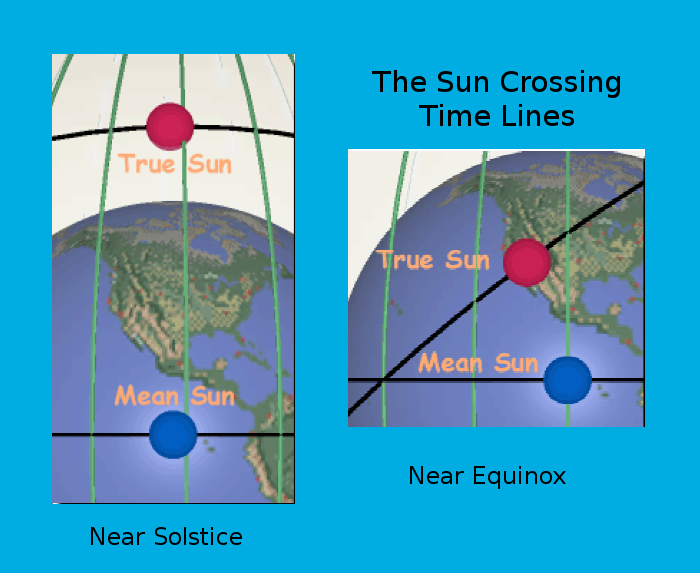
Today is the date of the earliest sunset, in the middle of a 13-day stretch where the Sun sets within the same minute. We are still 12 days from the winter solstice, the day of the shortest daylight hours, on the 21st. The reason is twofold. The Sun is approaching its farthest position south of the equator, where the longitude lines are closer together, so it takes less time to cross them. 15 degrees in longitude equals one hour in Earth’s rotation. Add to that we are less than a month from Earth’s perihelion in its orbit of the Sun, that is at its closest, and is moving faster than average. The combined effects delay sunrise and sunset, from what they’d be if the Sun stayed on the equator and the Earth’s orbit was circular. We will have our latest sunrise on January 2nd.
The astronomical event times given are for the Traverse City/Interlochen area of Michigan (EST, UT – 5 hours). Times will be different for other locations.
Addendum
Ephemeris: 11/18/2024 – How to get two spacecraft to come together gently in space
This is Bob Moler with Ephemeris for Monday, November 18th. Today the Sun will be up for 9 hours and 26 minutes, setting at 5:11, and it will rise tomorrow at 7:45. The Moon, 3 days past full, will rise at 7:22 this evening.
Orbital mechanics is a science of how orbits work around the Earth, Sun, or any other body. Back in the mid 1960s when NASA was starting it’s work to get to the Moon with the Gemini program they had quite a time getting rendezvous and docking right. Buzz Aldrin, the second man to step foot on the Moon, who is still around by the way, figured it all out – before he became an astronaut. It’s counter-intuitive. To speed up you slow down to drop into a lower orbit which is faster. To slow down, speed up and climb into a higher orbit which slows you down. There’s more to it than that, but basically objects in orbit just don’t seem to behave the way you think they ought to. And that’s how things work in space.
The astronomical event times given are for the Traverse City/Interlochen area of Michigan (EST, UT – 5 hours). Times will be different for other locations.
Addendum
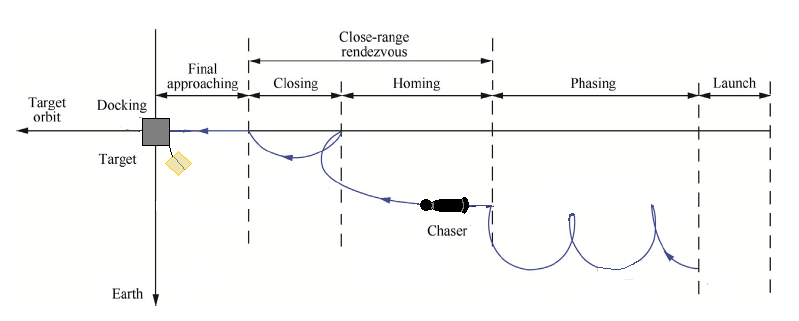
In this diagram time is represented on the horizontal axis from right to left, the altitude of the spacecraft and its target is on the vertical axis. The chaser vehicle is launched as the launch site crosses the plane of the orbit of the target. Changing the plane of an orbit is very expensive, energywise, so it’s best to launch in the same orbital plane. It enters an elliptical orbit, most initial orbits are pretty elliptical and so there’s a low point, or perigee, where the chaser enters orbit, and a high point which is the apogee. This is below the target orbit so that the chasing vehicle can catch up to the target. Lower orbits are faster than higher orbits, this is the phasing part. When the chaser gets pretty close it raises its orbit so that the starting point apogee is the new perigee and the new apogee is the altitude of the orbit of the target. The orbit stays elliptical for a little while so that the chasing spacecraft can slowly catch up to the target. In the final approach the orbits just about match so that the chaser very slowly catches up to the target.
I’ve seen similar diagrams on NASA broadcasts of Crew Dragon launches.
Ephemeris: 11/15/2024 – What causes the tides?
This is Ephemeris for Friday, November 15th. Today the Sun will be up for 9 hours and 33 minutes, setting at 5:14, and it will rise tomorrow at 7:41. The Moon, at full today, will rise at 4:48 this evening.
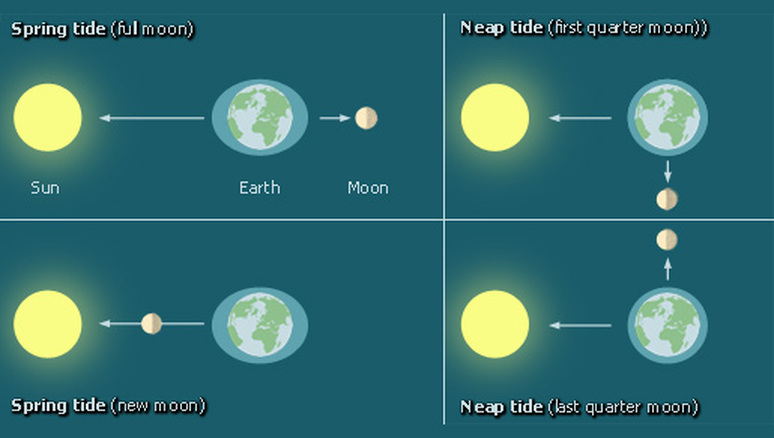
Today, at full moon, is one of the two highest tides of the month, the lunar month that is. The other highest tide comes at new moon. Both the Moon and the Sun cause tides because of their gravitational pull on the Earth. At new and full moon’s their gravitational pull gangs up on us. Since Earth is not a point body the gravitational pull of an object on the near side of the Earth pulls harder than it does on the opposite side of the Earth. Gravitational force diminishes with the square of the distance so it is the difference in the gravitational pull from one side to the other of the Earth that causes the tides to rise up on the side nearest and farthest from the gravitational pull of the moon and/or Sun. Since the Earth has a worldwide ocean, the water is free to slosh around and cause the tides.
The astronomical event times given are for the Traverse City/Interlochen area of Michigan (EST, UT – 5 hours). Times will be different for other locations.
Addendum
Ephemeris: 11/12/2024 – SpaceX uses Cargo Dragon to change orbit of the ISS
This is Bob Moler with Ephemeris for Tuesday, November 12th. Today the Sun will be up for 9 hours and 40 minutes, setting at 5:17, and it will rise tomorrow at 7:37. The Moon, halfway from first quarter to full, will set at 4:39 tomorrow morning.
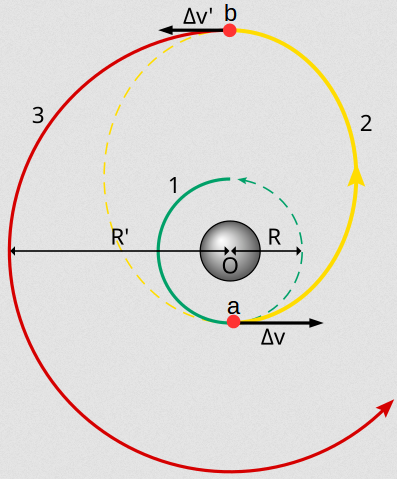
After the last SpaceX cargo mission arrived at the International Space Station, they used the thrusters on the SpaceX capsule to raise the orbital space station a little bit as a test. SpaceX capsules dock at the forward end of the space station according to direction of travel so in order to boost the station’s orbit they had to flip the station around so that the docking port was at the rear before they could apply the needed thrust. When thrust is applied to an object in orbit the effect of the change occurs mostly at the opposite side of the orbit. In order to permanently raise or lower an object’s circular orbit one must make 2 adjustments 180° away from each other. This is the essence of the Hohmann Transfer Orbit, proposed by German scientist Walter Hohmann in 1925.
The astronomical event times given are for the Traverse City/Interlochen area of Michigan (EST, UT – 5 hours). Times will be different for other locations
Addendum
Ephemeris: 11/07/2024 – The Moon wobbles from Earth’s point of view
This is Ephemeris for Thursday, November 7th. Today the Sun will be up for 9 hours and 53 minutes, setting at 5:22, and it will rise tomorrow at 7:31. The Moon, 2 days before first quarter, will set at 10:08 this evening.
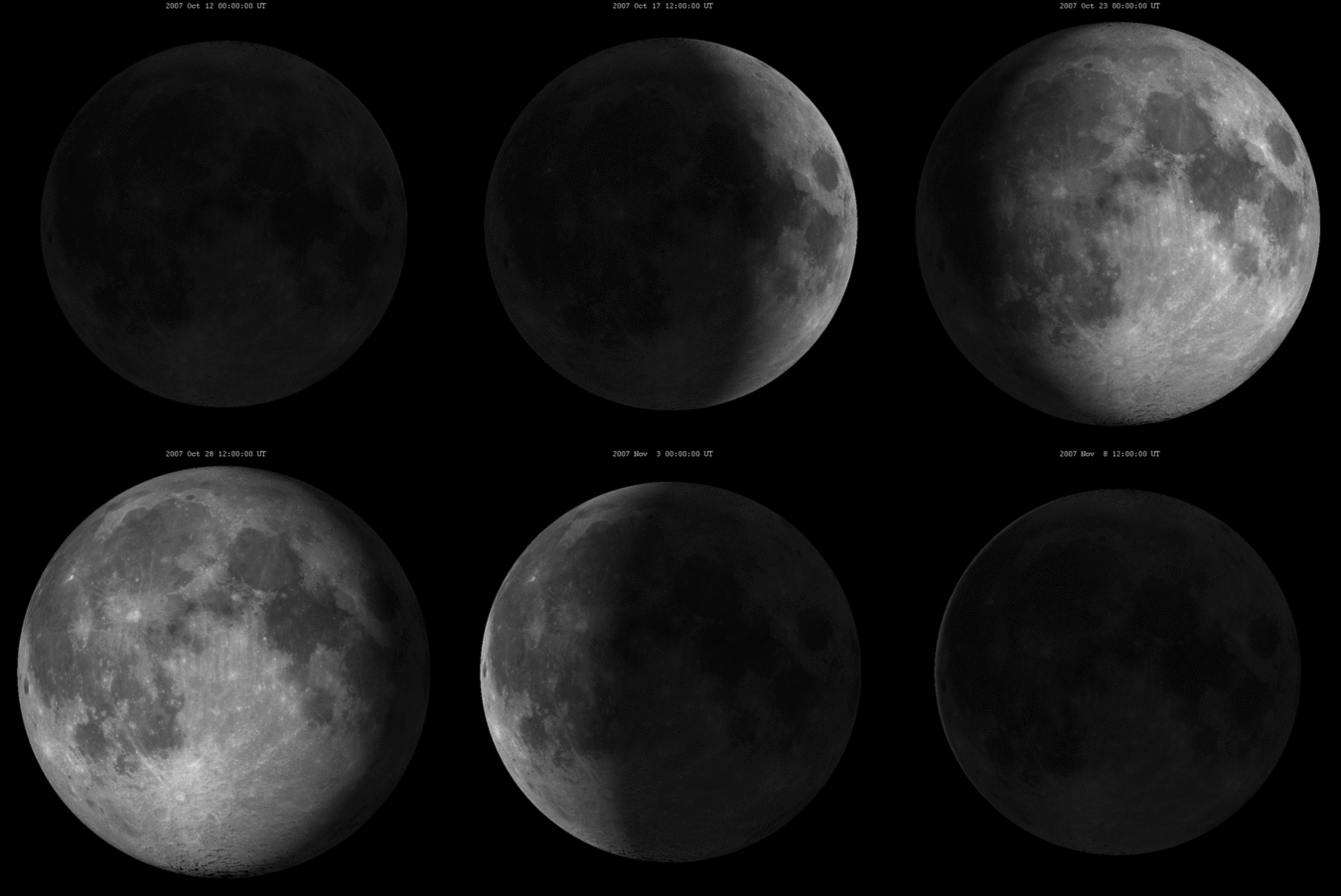
The nearly seven day old Moon appears very low in the southwestern sky tonight. It appears as a fat crescent. The small sea called Mare Crisium or Sea of Crises, near the west edge of the Moon is a good indicator of what we call libration, that is the Moon’s slow wobbling back and forth over the month as it orbits the Earth. One can judge the amount of libration by the distance of that small round sea from the edge of the Moon. This happens because the Moon’s rotation is steady while its orbital velocity around the Earth is not, because its orbit is slightly elliptical. So sometimes the rotation gets ahead of its revolution about the Earth, and sometimes it’s behind. Right now that libration is pushing that small sea towards the edge of the Moon.
The astronomical event times given are for the Traverse City/Interlochen area of Michigan (EST, UT – 5 hours). Times will be different for other locations.
Addendum
Ephemeris: 10/10/2024 – Where did Comet Tsuchinshan-ATLAS come from?
This is Ephemeris for Thursday, October 10th. Today the Sun will be up for 11 hours and 13 minutes, setting at 7:05, and it will rise tomorrow at 7:53. The Moon, at first quarter today, will set at 12:05 tomorrow morning.
The comet Tsuchinshan-ATLAS will get far enough from the direction of the Sun so we can see it in the evening this weekend. It comes from the Oort Cloud of comets in the far reaches of the solar system probably extends maybe three quarters* of the way to the nearest other star to us Alpha Centauri. Somebody figured out that it has an orbital period of around 80,000 years. Every few million years or so a star comes close enough to the Sun to stir up the comets in the Oort Cloud, sending some of them out escaping the Sun and some sent in towards the inner solar system. This of course is one of the latter. No two comets are exactly alike so they’re quite unpredictable. Some have a lot of dust and some are mostly frozen gases.
The astronomical event times given are for the Traverse City/Interlochen area of Michigan (EDT, UT – 4 hours). Times will be different for other locations.
* On the radio program I stated a “quarter of the way”.
Addendum
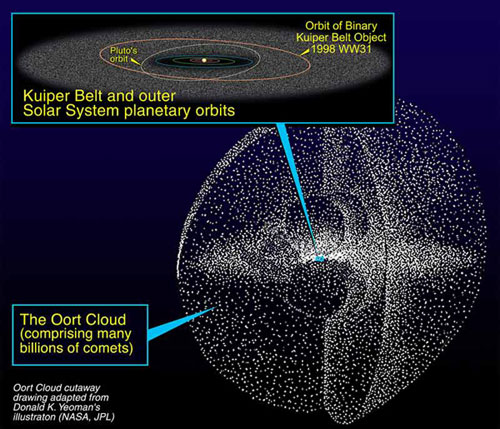
The Oort Cloud is named after Jan Oort, a Dutch astronomer, who proposed a cloud of comets in 1950 as the source of long period comets. The cloud would extend from 2,000 to 200,000 times Earth’s distance from the Sun. The shape of the cloud is roughly spherical. Comet encounters with Jupiter can cause them to become short period comets, or be ejected from the solar system.
Ephemeris: 09/10/2024 – What last Saturday’s opposition from the Sun means
This is Ephemeris for Tuesday, September 10th. Today the Sun will be up for 12 hours and 45 minutes, setting at 8:01, and it will rise tomorrow at 7:17. The Moon, 1 day before first quarter, will set at 11:17 this evening.
Last Saturday the planet Saturn moved in opposition to the Sun. It’s not an insurrection or anything, but Saturn was opposite the Sun in the sky. At that time Saturn would be closest to the Earth of some 806 million miles (900 km). Saturn is 9 1/2 times the distance of the Earth to the Sun so over the year as Saturn moves from opposition through conjunction with the Sun to opposition again it does not vary in size very much, unlike Venus and Mars which are closer to us and vary a lot in size over their period around our sky. Saturn is now an evening planet and so will become a fixture in our evening skies for the next 4 or so months. It lies in a star poor part of the sky so it’s easy to find. Saturn’s rings are now nearly edge on to us so in a small telescope Saturn looks like a tiny disk stapled onto the sky with the staple being a bright line through the planet.
The astronomical event times given are for the Traverse City/Interlochen area of Michigan (EDT, UT – 4 hours). Times will be different for other locations.
Addendum
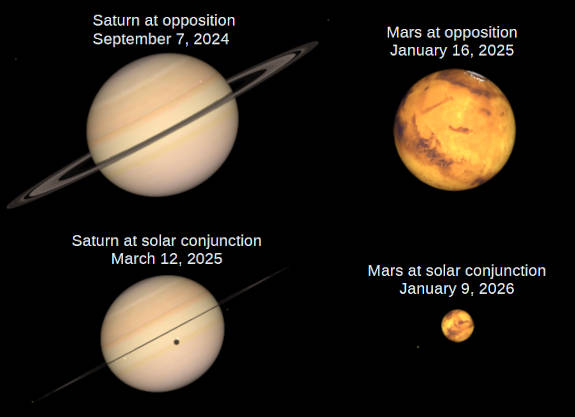
* Mars has a fairly elliptical orbit and next January’s opposition is almost at its farthest. In 2003 Mars was as close as that it has gotten in 50,000 years, or so they tell me. At that time Mars’ apparent size was 72% larger than it will be next January. Mars has its closest oppositions to the Earth every 15 or 17 years. The last time it occurred was in 2018, and the next time will be in 2035.
Ephemeris: 08/19/24 – Dark Energy
This is Ephemeris for Monday, August 19th. Today the Sun will be up for 13 hours and 50 minutes, setting at 8:41, and it will rise tomorrow at 6:51. The Moon, at full today, will rise at 9:02 this evening.
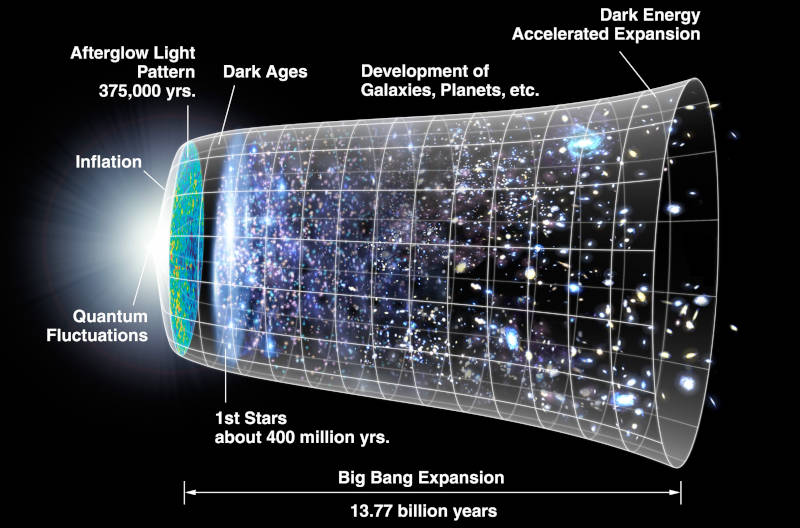
The Big Bang, nearly 14 billion years ago set the universe to be expanding. All the mass of ordinary matter and the dark matter I talked about last week should be slowing that expansion. However, it was discovered, about 20 years ago, that the universal expansion is not slowing down. It is increasing its expansion rate. Astronomers do not really know why. Since expansion requires energy. This new property is called dark energy. It is actually the expansion of space itself. The galaxies are not fleeing by their own motion through space. They are carried by the expanding space around them. It turns out that objects with mass cannot exceed the speed of light, but the expansion of space itself has no speed limit. At least that’s how I understand it.
The astronomical event times given are for the Traverse City/Interlochen area of Michigan (EDT, UT–4 hours). Times will be different for other locations.
Addendum
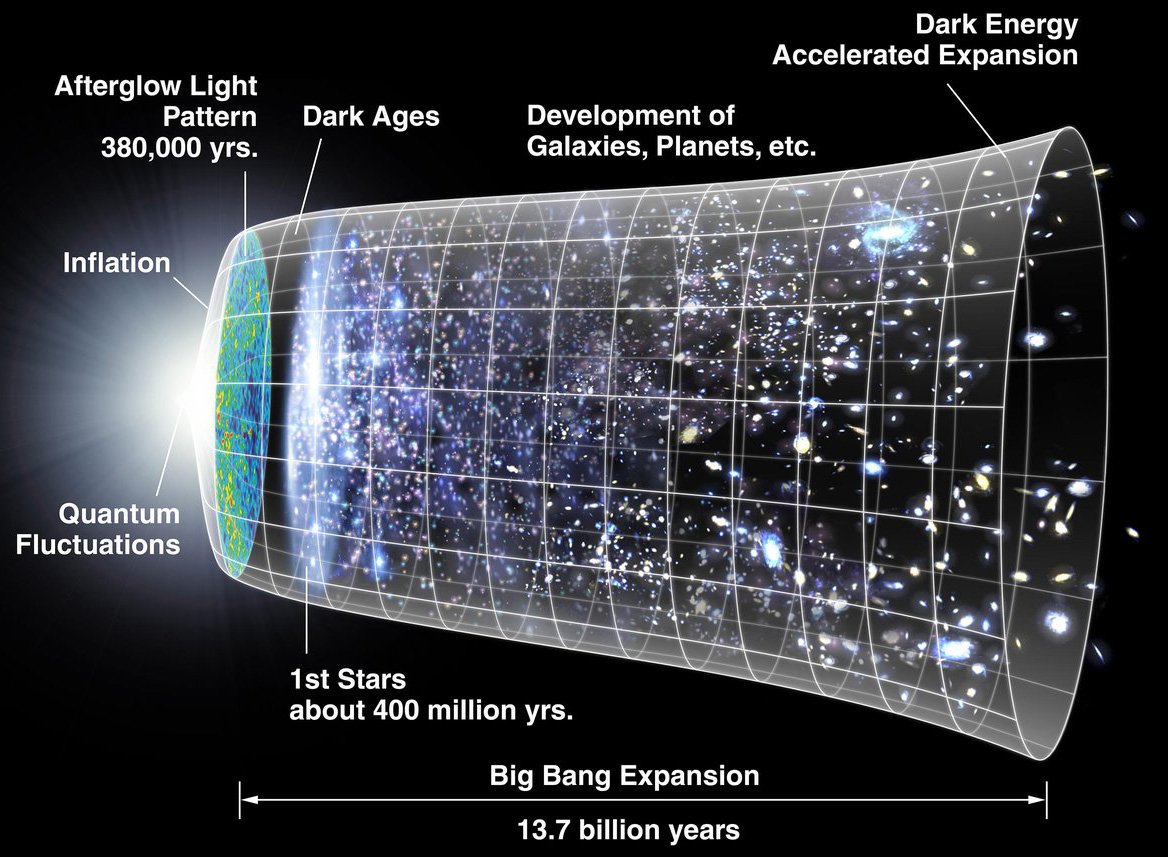
Timeline of the universe. A representation of the evolution of the universe over 13.77 billion years. The far left depicts the earliest moment we can now probe, when a period of “inflation” produced a burst of exponential growth in the universe. (Size is depicted by the vertical extent of the grid in this graphic.) For the next several billion years, the expansion of the universe gradually slowed down as the matter in the universe pulled on itself via gravity. More recently, the expansion has begun to speed up again as the repulsive effects of dark energy have come to dominate the expansion of the universe. The afterglow light seen by WMAP was emitted about 375,000 years after inflation and has traversed the universe largely unimpeded since then. The conditions of earlier times are imprinted on this light; it also forms a backlight for later developments of the universe. Public Domain.
Ephemeris: 08/16/2024 – WIMPs and MACHOs
This is Ephemeris for Friday, August 16th. Today the Sun will be up for 13 hours and 58 minutes, setting at 8:46, and it will rise tomorrow at 6:48. The Moon, 3 days before full, will set at 3:34 tomorrow morning.
The dark matter that holds the clusters of galaxies together in the universe may be made of weakly interacting massive particles which astronomers have dubbed WIMPs. These particles would be more massive than the particles that ordinary matter is made of, but do not interact with ordinary matter or give off or absorb light. They are detected by the influence of their gravitational force alone. An alternative idea is Massive Compact Halo Objects or MACHOs. These may be made-up of ordinary matter. Since there are many more low mass stars, like red dwarfs, than there are high mass stars, perhaps there’s the creation of planet sized bodies like brown dwarfs. These are planets more massive than Jupiter, but not massive enough to become stars. As such, they should be practicably invisible.
The astronomical event times given are for the Traverse City/Interlochen area of Michigan (EDT, UT–4 hours). Times will be different for other locations.
Addendum
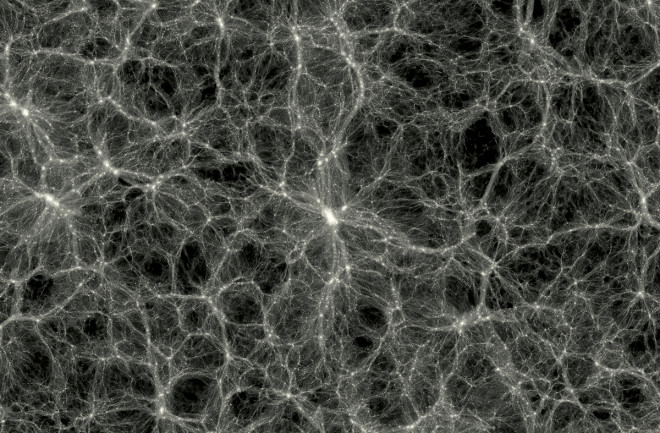
For more information on Dark Matter search for it on the internet. One Article I found is here: https://sciencenotes.org/what-is-dark-matter/. They dismiss MACHOs by not mentioning them at all, concentrating on the much more likely WIMPs.
 Bob Moler's Ephemeris Blog