Archive
Ephemeris: 03/12/2026 – Cancer the crab used to welcome summer
This is Ephemeris for Thursday, March 12th. Today the Sun will be up for 11 hours and 44 minutes, setting at 7:45, and it will rise tomorrow at 7:58. The Moon, 1 day past last quarter, will rise at 5:25 tomorrow morning.
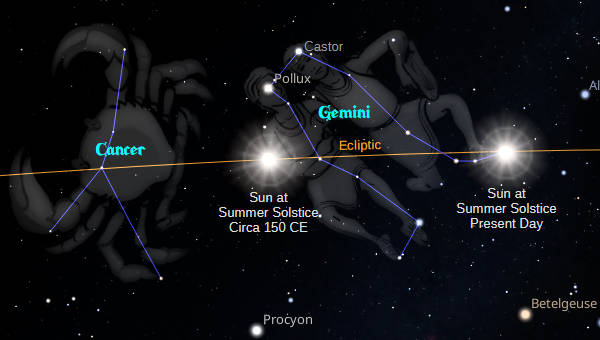
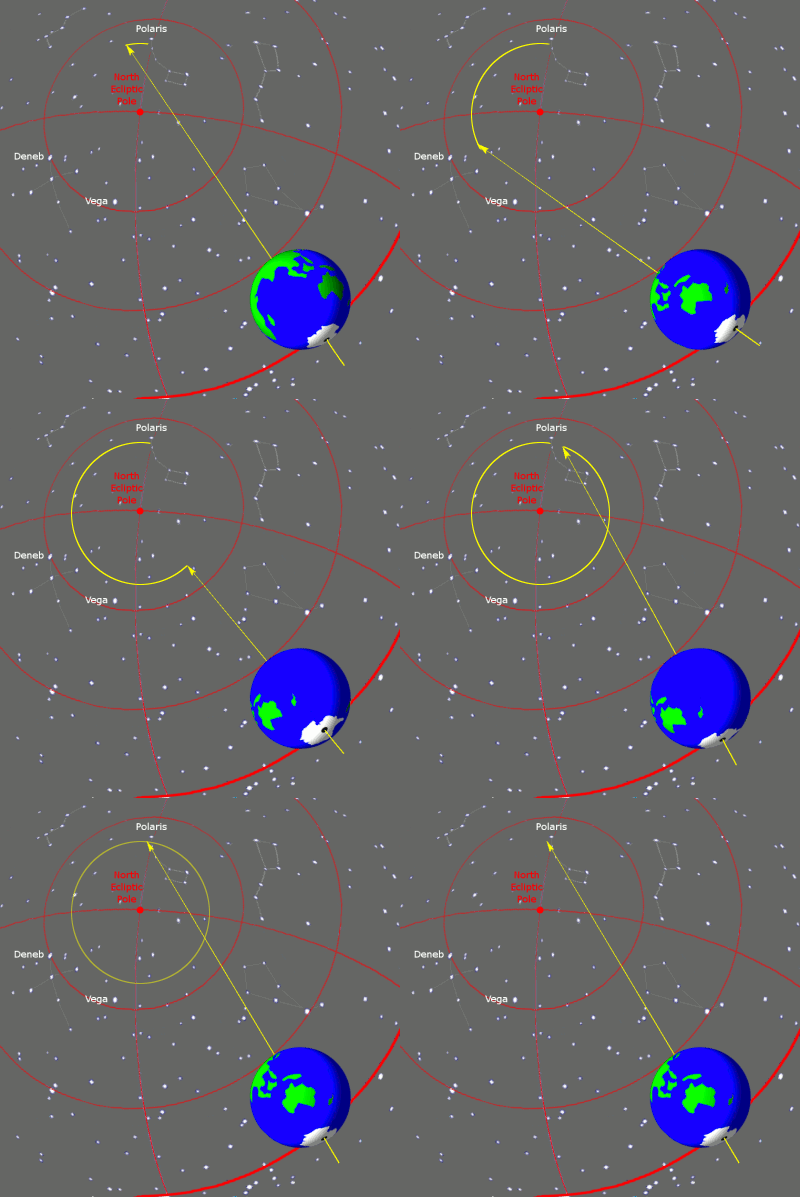
There’s a line on some globes and maps at approximately 23 1/2° north latitude called the Tropic of Cancer. It’s related to the constellation Cancer the crab. However, Cancer no longer fits that role that it was named to a couple of thousand years ago, when the sun entered the constellation of Cancer on the first day of summer. That’s the latitude on the Earth where the Sun was directly overhead on the first day of summer. Now that an honor goes to Gemini. The way we draw the figure of that constellation, the Sun is right near Castor’s big toe on the first day of summer. But I don’t think they’re going to change the name anytime soon. The reason for the change is that the Earth’s axis slowly wobbles like a top or gyroscope as they slow down. The effect is called precession.
The astronomical event times given in this blog are for the Traverse City/Interlochen area of Michigan (Lat 44.7° N, Long 85.7° W; EST, UT – 5 hours) unless stated otherwise. Times will be different for other locations.
Addendum
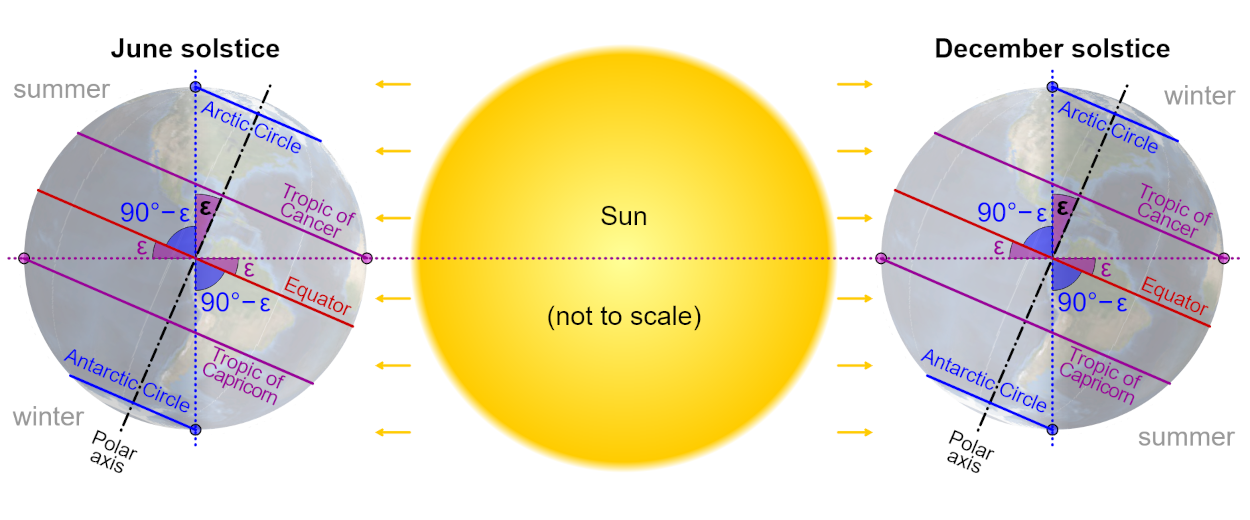
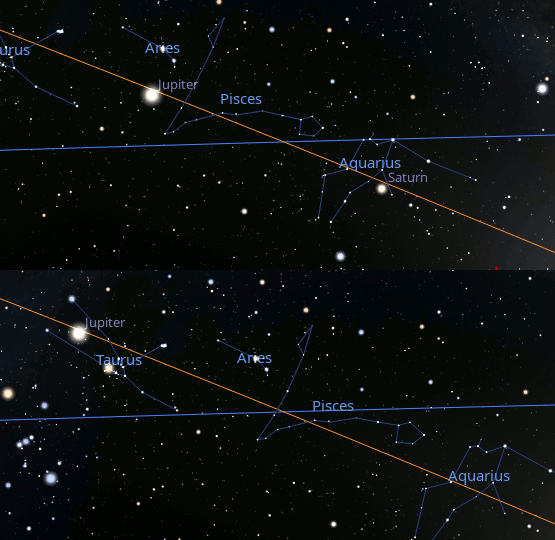
The Greek letter epsilon in the image above represents the tilt of the Earth’s axis of around 23.5°. Astronomers call it the obliquity of the ecliptic, the angle between the ecliptic and the celestial equator as seen in the illustration below.
Ephemeris: 03/10/2026 – Finding Cancer the crab
This is Ephemeris for Tuesday, March 10th. Today the Sun will be up for 11 hours and 38 minutes, setting at 7:42, and it will rise tomorrow at 8:02. The Moon, 1 day before last quarter, will rise at 3:50 tomorrow morning.
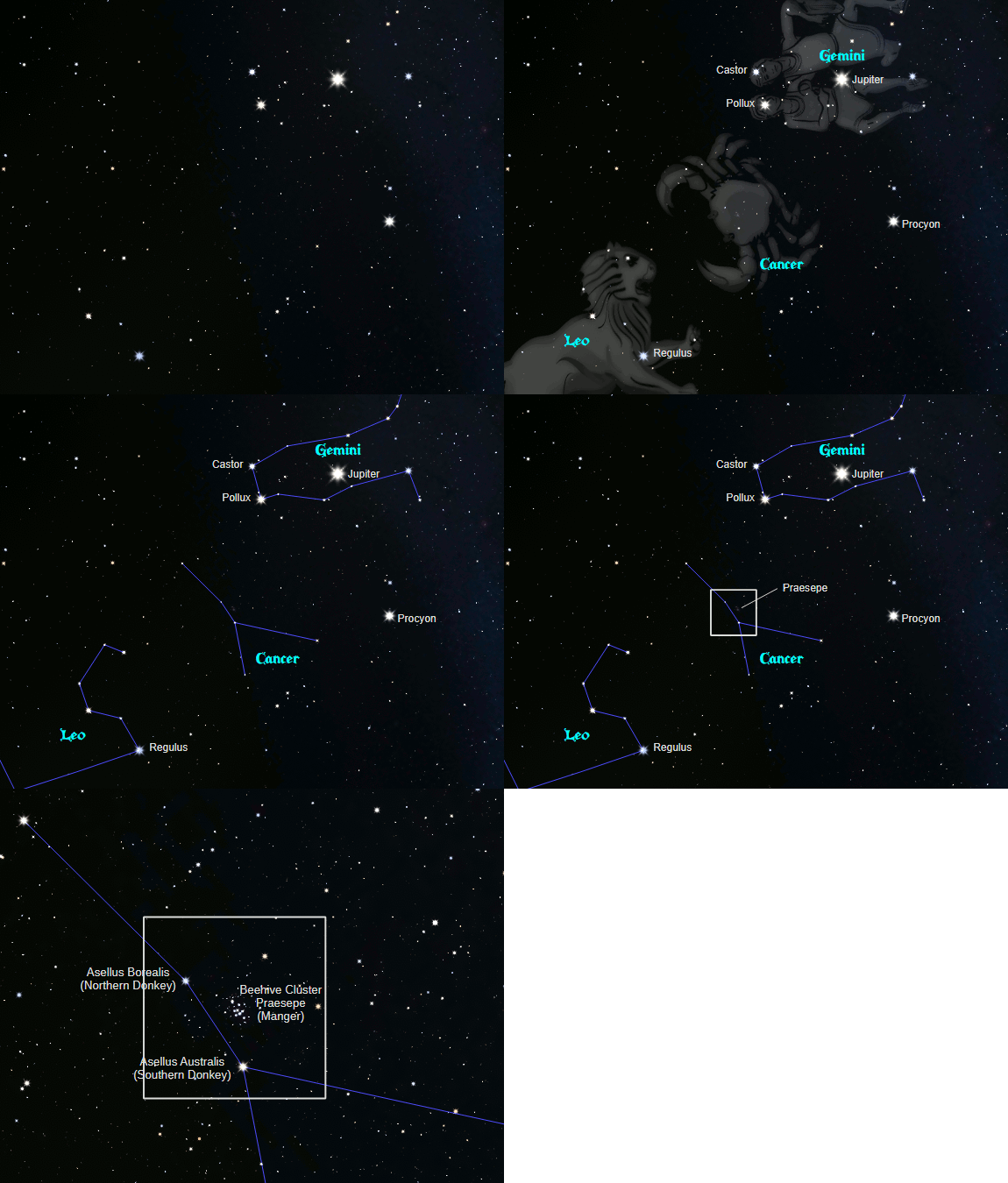
The constellation of Cancer the crab is made of dim stars, which are generally connected, in constellation charts, with lines that make either the letter K or an upside down Y. It lies directly between the star pair Castor and Pollux in Gemini and Regulus in Leo. In the center of the constellation is, what to the naked-eye is a fuzzy spot called Praesepe, or the manger. The two nearby stars, one above left, and one below left are Asellus Borealis, and Asellus Australis, the northern and southern donkey colts feeding out of the manger. Viewing that fuzzy spot with a pair of binoculars will reveal that it’s not fuzzy at all. It resolves into a cluster of stars, which astronomers, over the years, have called the Beehive cluster.
The astronomical event times given in this blog are for the Traverse City/Interlochen area of Michigan (Lat 44.7° N, Long 85.7° W; EST, UT – 5 hours) unless stated otherwise. Times will be different for other locations.
Addendum
Ephemeris: 02/20/2026 – The star that’s called “Before the Dog”
This is Ephemeris for Friday, February 20th. Today the Sun will be up for 10 hours and 43 minutes, setting at 6:18, and it will rise tomorrow at 7:33. The Moon, 3 days past new, will set at 10:21 this evening.
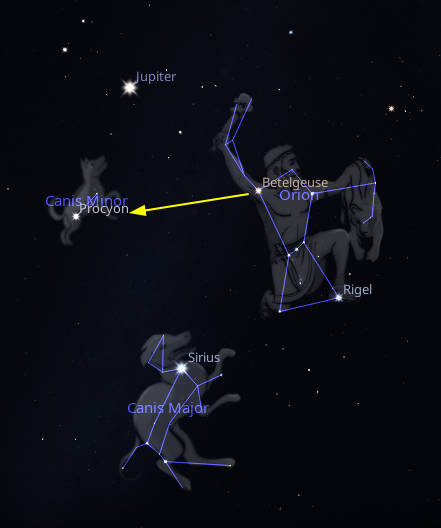
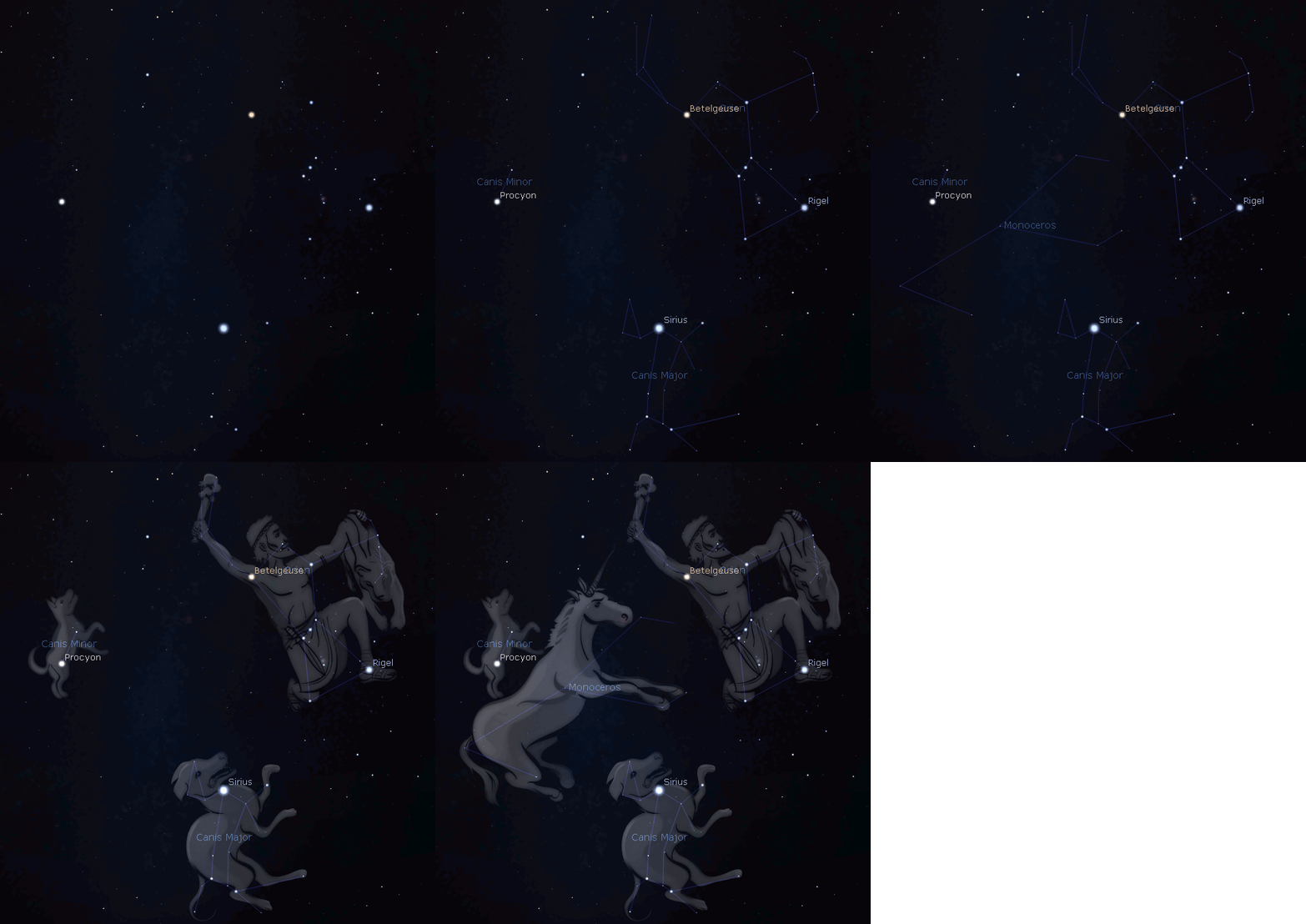
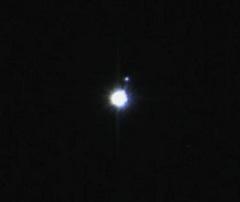
The star Procyon is in Orion’s little hunting dog, Canis Minor, which contains only one other star. It can be found by using the shoulder stars of Orion, Bellatrix and Betelgeuse, pointing to the left and down a bit to Procyon at 9 PM. With Jupiter above, Betelgeuse to the right and Sirius below, it makes an imposing diamond of stars. The word Procyon means “Before the Dog” meaning that rises before the Dog Star, Sirius, even though it is east of it. Procyon is also north of Sirius, which for observers above 30° north latitude, it does indeed rise before the Dog Star. It is a star like Sirius, though it’s not as bright, or white. Procyon is 11.5 light years away while Sirius is 8.6. Both have tiny white dwarf companion stars.
The astronomical event times given in this blog are for the Traverse City/Interlochen area of Michigan (Lat 44.7° N, Long 85.7° W; EST, UT – 5 hours) unless stated otherwise. Times will be different for other locations.
Addendum
Ephemeris: 02/16/2026 – The Dog Star
This is Bob Moler with Ephemeris for President’s Day, Monday, February 16th. Today the Sun will be up for 10 hours and 31 minutes, setting at 6:12, and it will rise tomorrow at 7:39. The Moon, 1 day before new, will rise at 7:51 tomorrow morning.
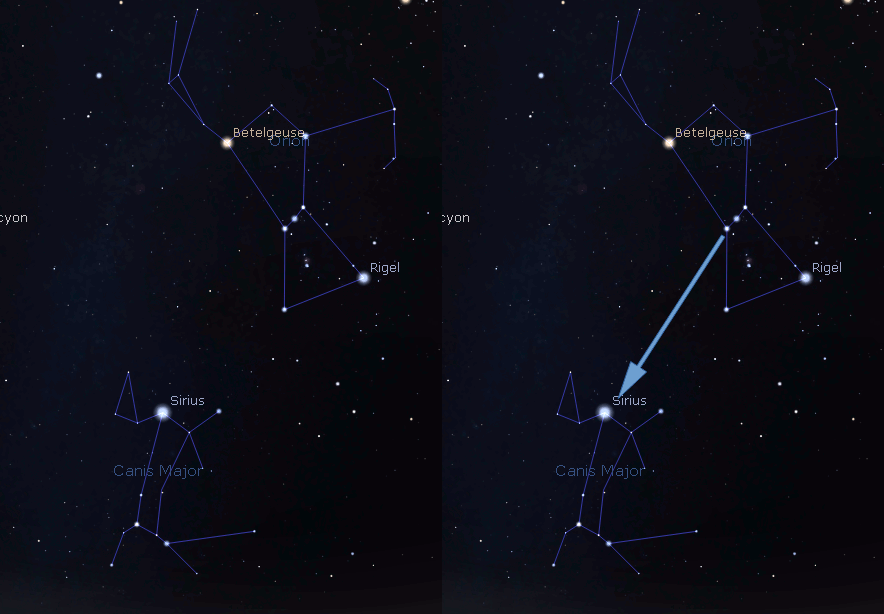
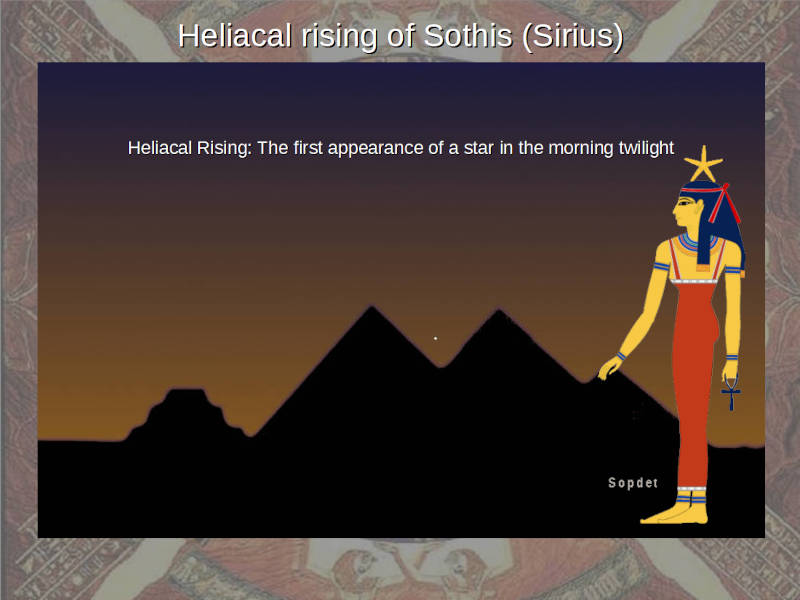
The second-brightest star-like object in the evening sky is Sirius, also known as the Dog Star. It also is the brightest nighttime star in our skies period. Tonight at 9 p.m. it’s located in the southern sky. The Dog Star name comes from its position at the heart of the constellation Canis Major, the great dog of Orion the hunter. The three stars of Orion’s belt tilt to the lower left to Sirius. Sirius means ‘Dazzling One’, because of its great brilliance and twinkling. Its Egyptian name was Sopdet, and its first appearance in the dawn skies around July 20th signaled the flooding of the Nile, and the beginning of the agricultural year. The relationship of the heliacal rising of Sirius and the seasonal or tropical year lasted from about 2900 BCE to the start of the Common Era. Sirius owes much of its brilliance to the fact that it lies close to us, only 8.6 light years away.
The astronomical event times given in this blog are for the Traverse City/Interlochen area of Michigan (Lat 44.7° N, Long 85.7° W; EST, UT – 5 hours) unless stated otherwise. Times will be different for other locations.
Addendum
Trivia Note
The Greeks invented the term “Dog days of summer” for the hottest days of July because they thought that Sirius added its intensity to the heat of the Sun to make it hotter out. So why doesn’t Sirius help warm our winter nights? Just asking.
Ephemeris: 02/09/2026 – Orion’s amazing belt stars
This is Ephemeris for Monday, February 9th. Today the Sun will be up for 10 hours and 11 minutes, setting at 6:02, and it will rise tomorrow at 7:50. The Moon, at last quarter today, will rise at 3:01 tomorrow morning.
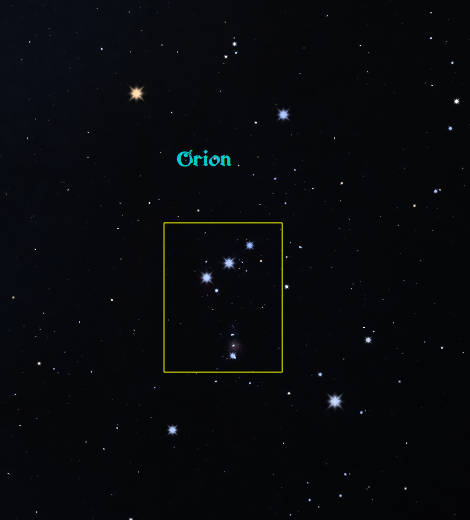
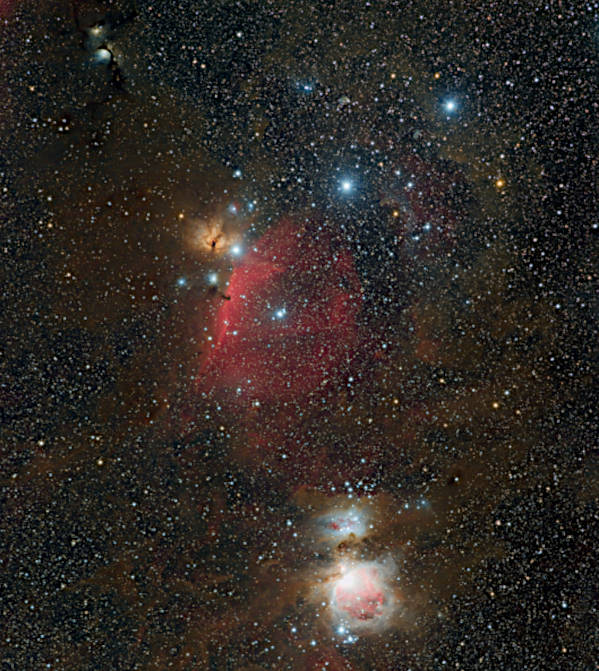
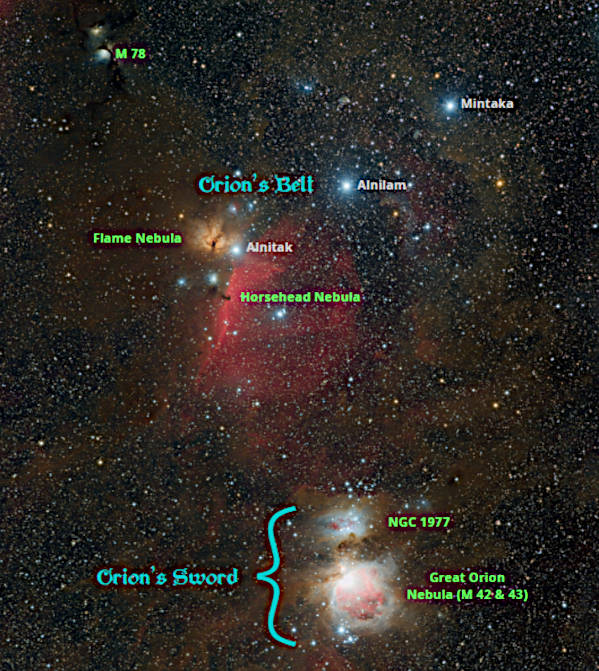
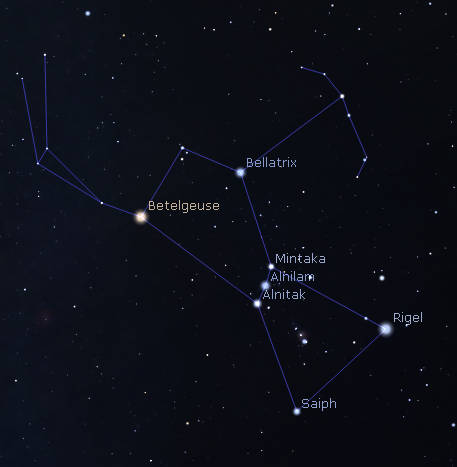
Orion’s belt of three stars is one of the most noticeable star groupings in the sky. There are no other groups of three bright stars in a straight line visible anywhere else in the sky. The star’s names from left to right are Alnitak, Alnilam and Mintaka. They are actually a bit farther away than the other bright stars of Orion. Alnilam, the center star, is over three times the distance of red giant Betelgeuse above them and over twice as far as blue white giant star Rigel below them. Alnilam is 375 thousand times brighter than the Sun. These three stars were also known as Frigga’s Spindle by the Norsemen. Frigga, also known as Freya, is the goddess from which we get the name of the day of the week we call Friday.
The astronomical event times given in this blog are for the Traverse City/Interlochen area of Michigan (Lat 44.7° N, Long 85.7° W; EST, UT – 5 hours) unless stated otherwise. Times will be different for other locations.
Addendum
Ephemeris: 02/05/2026 – The celestial unicorn
Feb 5. This is Ephemeris for Thursday, February 5th. Today the Sun will be up for 10 hours even, setting at 5:57, and it will rise tomorrow at 7:55. The Moon, halfway from full to last quarter, will rise at 10:34 this evening.
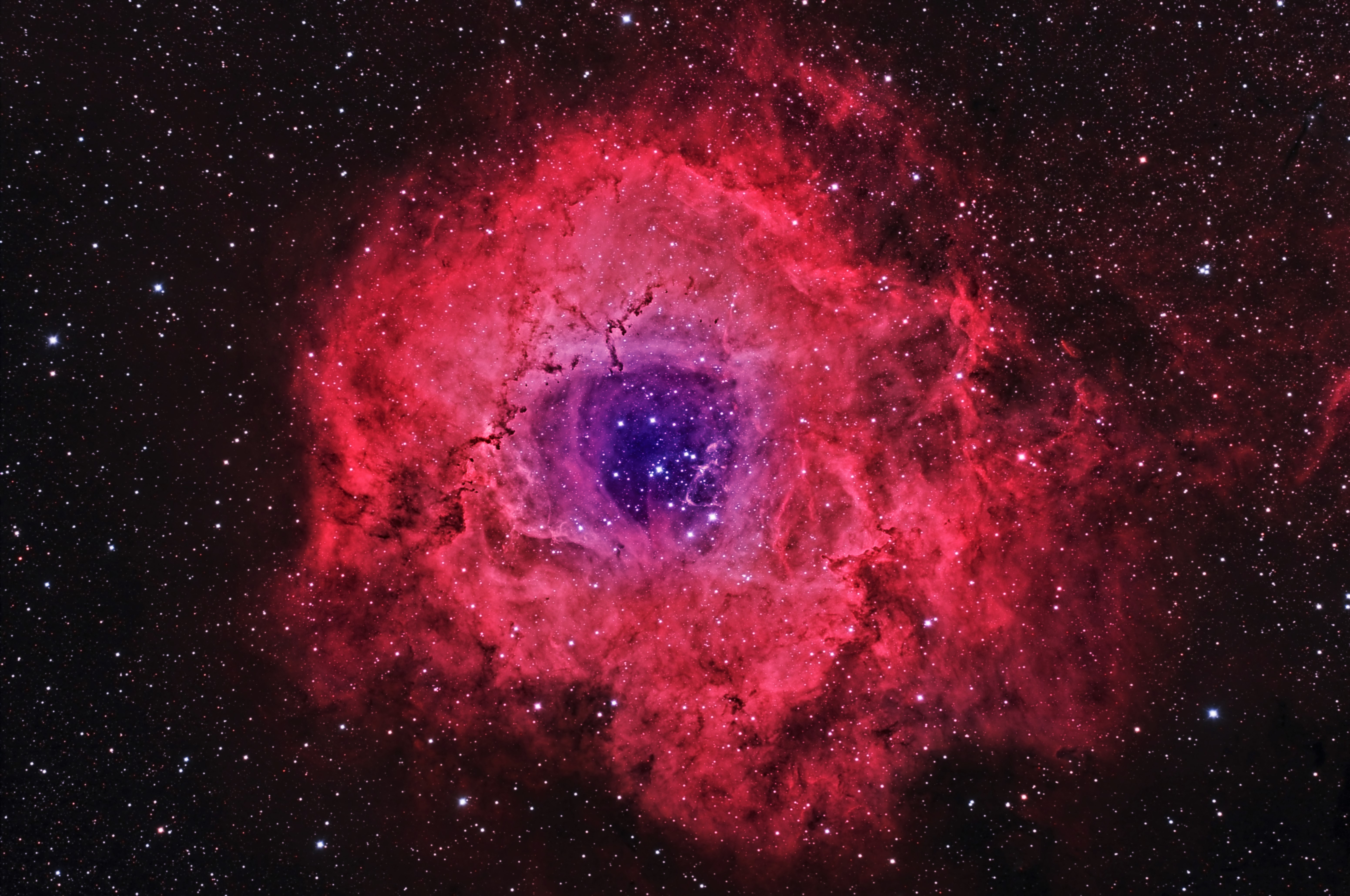
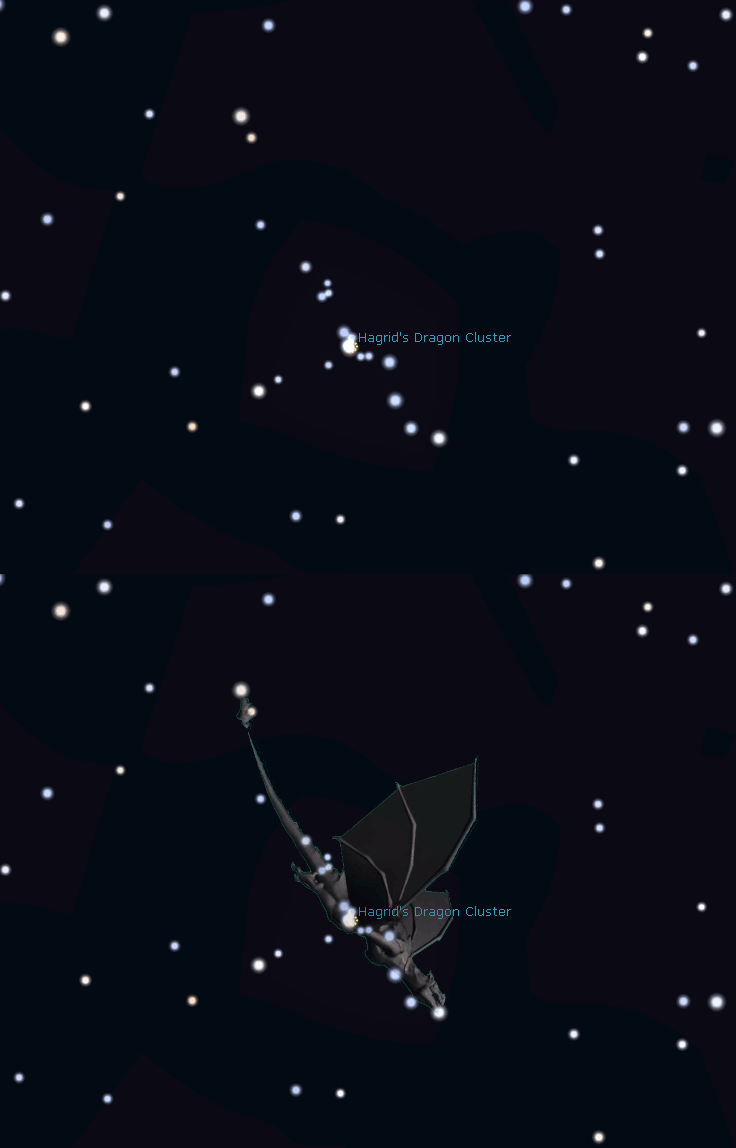
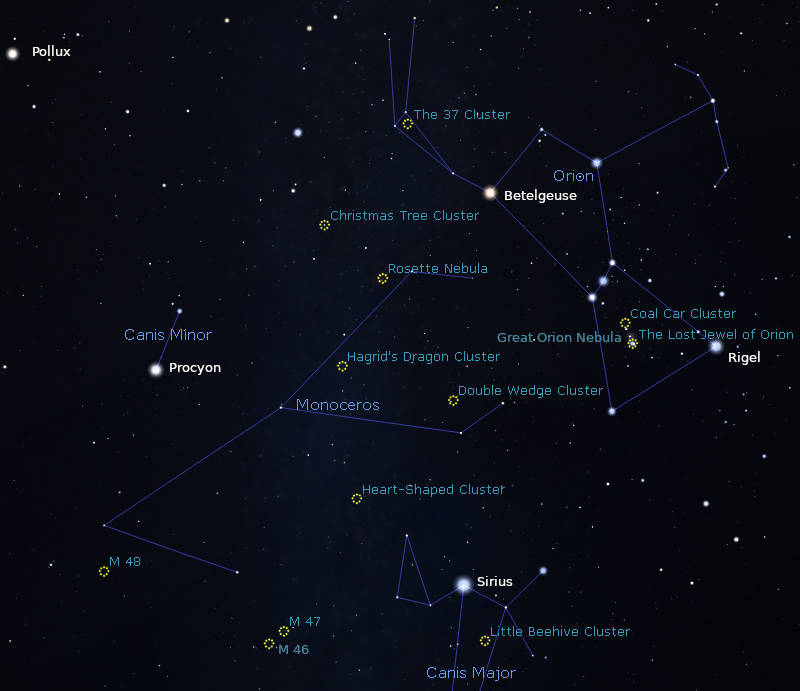
Among all the constellations in the sky of animals real and mythical, there is also a unicorn. It’s called Monoceros, and inhabits the southeastern sky at 8 p.m. mostly bounded by Orion on the right, Canis Major, the great dog below and Canis Minor, the little dog to the left and above. Unfortunately for observers without a telescope Monoceros, is devoid of any but the faintest stars. Maybe that’s why no one sees unicorns anymore. Though it lacks bright stars Monoceros is full of wonders revealed by telescopes and photography. A feast of faint nebulae or clouds of gas and dust, the birthplace of stars, including the red rose of the Rosette Nebula, and the more recently named Hagrid’s Dragon Cluster (NGC 2301).
The astronomical event times given in this blog are for the Traverse City/Interlochen area of Michigan (Lat 44.7° N, Long 85.7° W; EST, UT – 5 hours) unless stated otherwise. Times will be different for other locations.
Addendum
Ephemeris: 02/03/2026 – Canis Major, Orion’s greater hunting dog
This is Ephemeris for Tuesday, February 3rd. Today the Sun will be up for 9 hours and 55 minutes, setting at 5:54, and it will rise tomorrow at 7:58. The Moon, 2 days past full, will rise at 8:14 this evening.
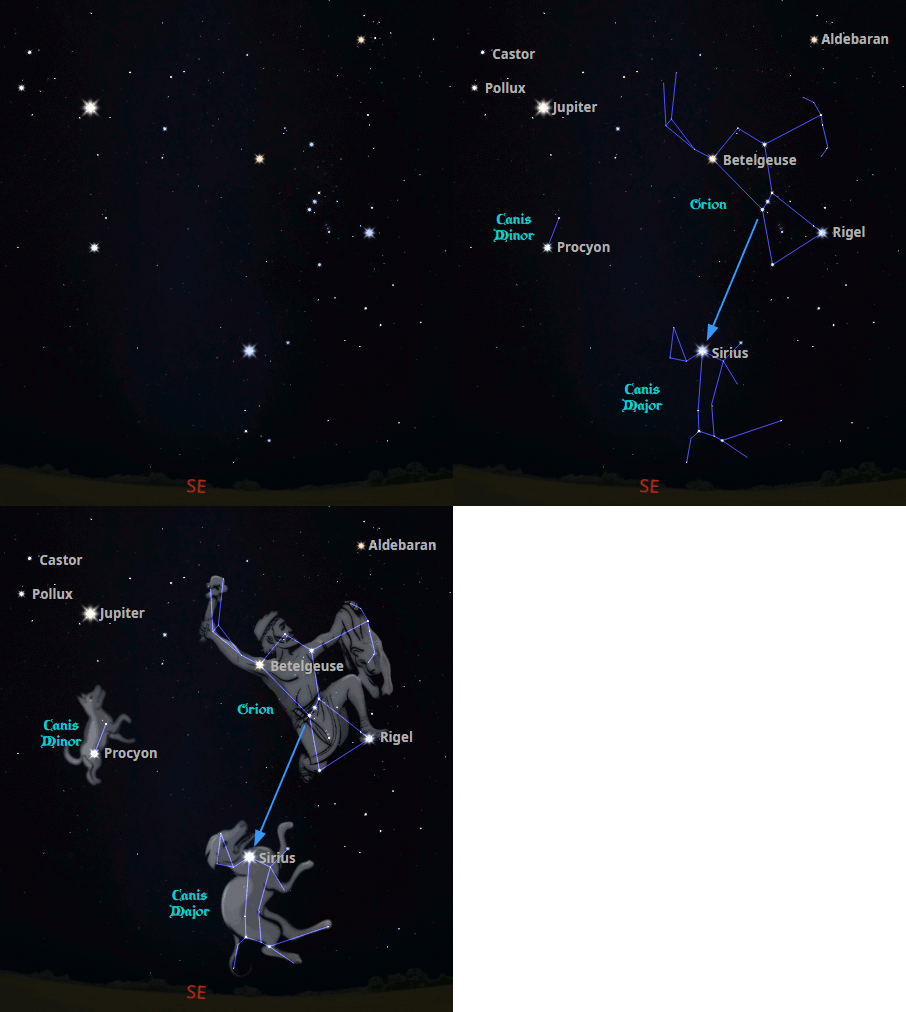
What kind of hunter would the constellation Orion be without his trusty hunting dogs. The larger of his two dogs is Canis Major which can be found if you extend Orion’s belt stars down to the left. There in the southeast by 8 PM, will appear the brightest nighttime star Sirius the Dog Star. It is in the heart of the dog, which appears to be begging. Well it’s tilted funny. Other than that it’s a pretty good representation of a dog as a stick figure. The name Sirius doesn’t mean Dog Star, but means Dazzling One due to its great brightness. It outshines all other nighttime stars, only to be out shown by the planets Venus, Jupiter and occasionally, Mars. Binoculars will show a nice little star cluster a short ways below Sirius known as M41.
The astronomical event times given in this blog are for the Traverse City/Interlochen area of Michigan (Lat 44.7° N, Long 85.7° W; EST, UT – 5 hours) unless stated otherwise. Times will be different for other locations.
Addendum
Ephemeris: 01/19/2026 – Follow the drinkin’ gourd!
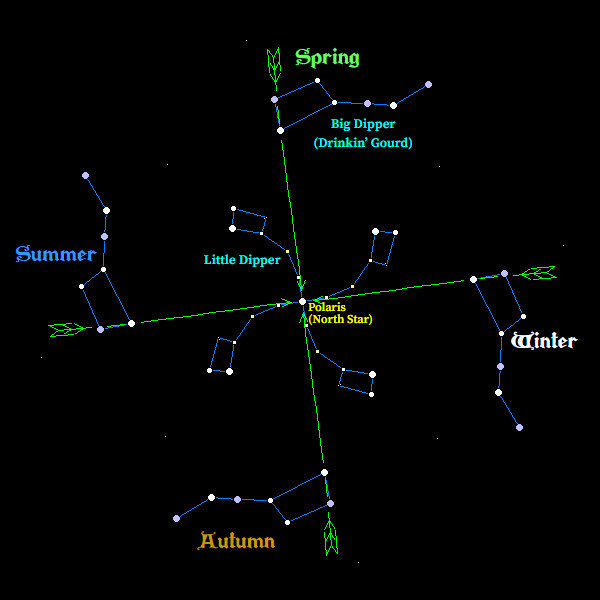
This is Bob Moler with Ephemeris for Martin Luther King Jr. Day, Monday, January 19th. Today the Sun will be up for 9 hours and 19 minutes, setting at 5:33, and it will rise tomorrow at 8:13. The Moon, 1 day past new, will set at 6:30 this evening. | This day is set aside to honor the Reverend Dr. Martin Luther King Jr. who gave his life for the struggle for equality for blacks and other minorities and to end segregation. A struggle that continues to this day. In the decades before the Civil War runaway slaves would travel, often at night, northward from the slave states of the south to the northern free states and Canada over the metaphorical Underground Railroad. They followed the Drinking Gourd, the Big Dipper as their compass. Over the last several millennia the Great Bear, Ursa Major had been that northward pointer. For the past few millennia the North Pole of the sky had been passing near the handle of the Big Dipper or bear’s tail. Though the Big Dipper isn’t always north, the two stars at the front of the bowl, or gourd, point to the star Polaris, which is nearly at the true North Pole of the sky.
The astronomical event times given in this blog are for the Traverse City/Interlochen area of Michigan (Lat 44.7° N, Long 85.7° W; EST, UT – 5 hours) unless stated otherwise. Times will be different for other locations.
Addendum
Ephemeris: 01/16/2026 – Comparing Orion’s two brightest stars
This is Ephemeris for Friday, January 16th. Today the Sun will be up for 9 hours and 13 minutes, setting at 5:29, and it will rise tomorrow at 8:15. The Moon, 2 days before new, will rise at 7:54 tomorrow morning.
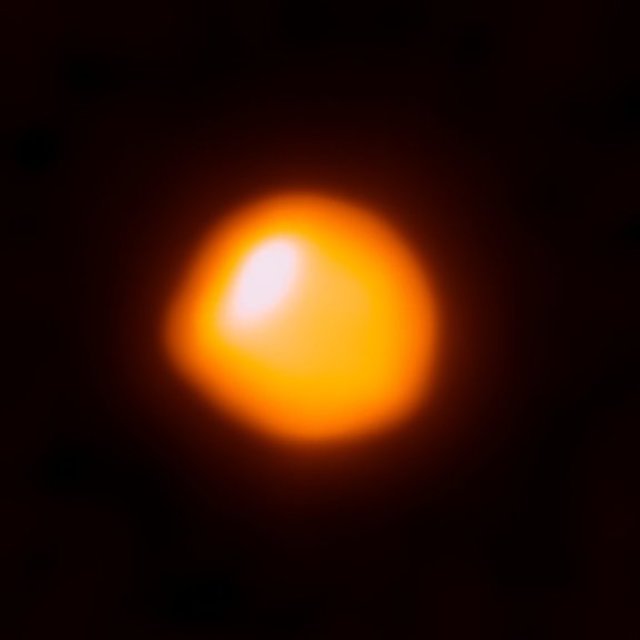
Orion’s two brightest stars are kind of the same but different. Let me explain. Betelgeuse is a red giant star, extremely massive, maybe 14 to 19 times the sun’s mass. It is somewhere between 8 and 14 million years old, which compared to the sun is just a baby, except it is so massive that it is in the last million or so years of its life. Rigel is a bluish white and a bit more massive, about 21 times the mass of the sun, and maybe 8 million years old. It has used most of the hydrogen in its core, and is beginning to transition into its final years which is a few more millions of years. So it’s not as far along in its evolution as Betelgeuse and has not bloated out and turned red. Betelgeuse is 500 light years away, while Rigel is almost 900.
The astronomical event times given in this blog are for the Traverse City/Interlochen area of Michigan (Lat 44.7° N, Long 85.7° W; EST, UT – 5 hours) unless stated otherwise. Times will be different for other locations.
Addendum
Ephemeris: 01/15/2026 – Orion’s great cloud
This is Ephemeris for Thursday, January 15th. Today the Sun will be up for 9 hours and 12 minutes, setting at 5:28, and it will rise tomorrow at 8:15. The Moon, 3 days before new, will rise at 7:09 tomorrow morning.
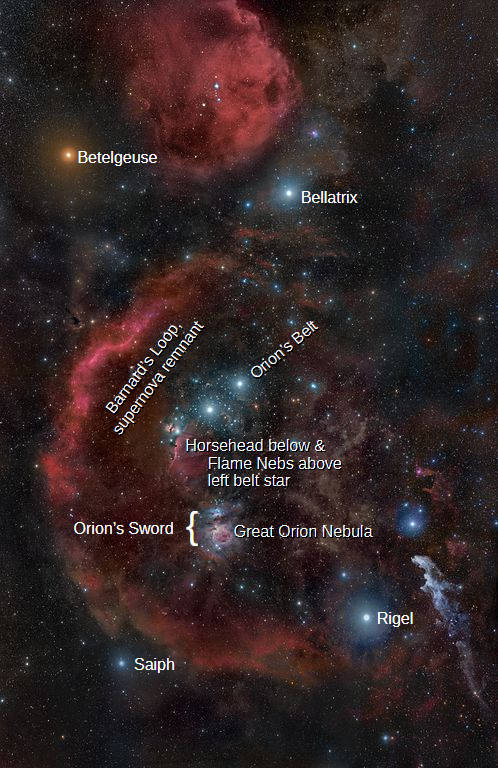
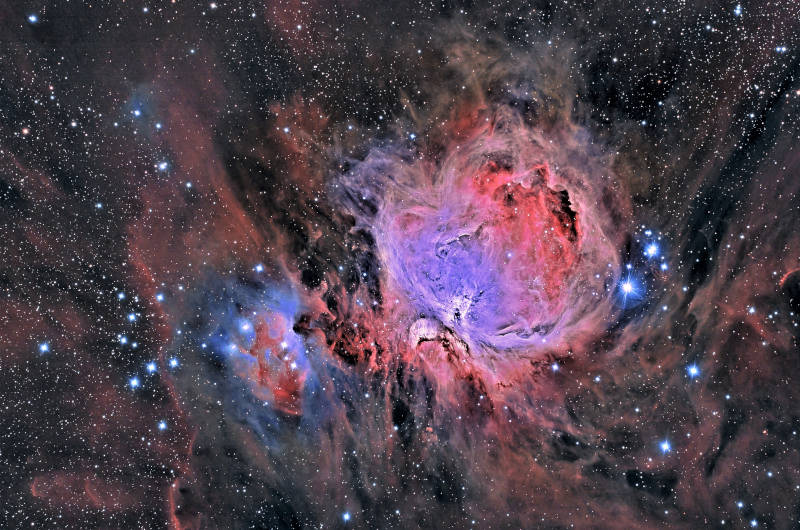
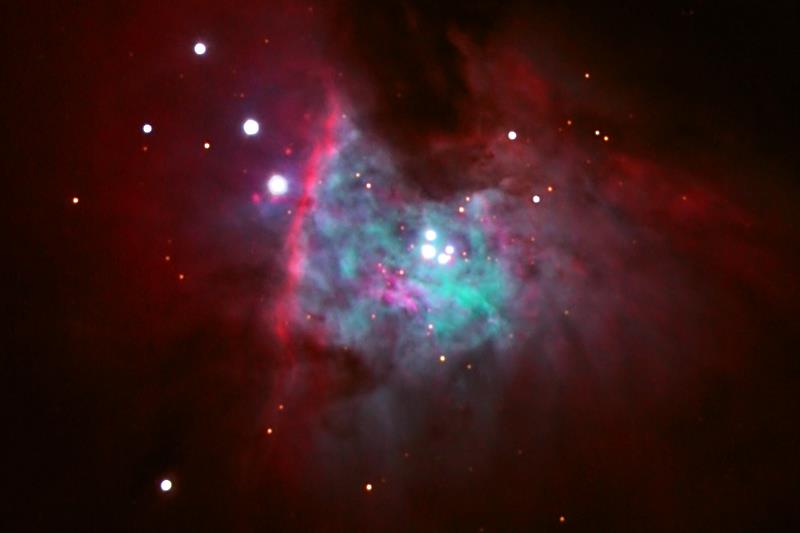
The brightest interstellar cloud visible in our skies is the Great Orion Nebula. The word nebula is from the Latin “nebulum” for cloud. The constellation of Orion is filled with nebulae, most of it are dim or dark. The Great Orion Nebula is in Orion’s sword. The sword is what looks like three stars that look dimmer than the three belt stars hanging from the belt. There are actually more than three stars here. Around the stars that appear as the center of the sword stars, to the eye, can be seen a haze in binoculars. A telescope with a wider aperture and low power can see detail in the cloud. With more magnification, a clutch of four baby stars can be spotted in the brightest part of the nebula. They light up the nebula and are called the Trapezium.
The astronomical event times given in this blog are for the Traverse City/Interlochen area of Michigan (Lat 44.7° N, Long 85.7° W; EST, UT – 5 hours) unless stated otherwise. Times will be different for other locations.
Addendum
 Bob Moler's Ephemeris Blog