Archive
Ephemeris: 02/16/2026 – The Dog Star
This is Bob Moler with Ephemeris for President’s Day, Monday, February 16th. Today the Sun will be up for 10 hours and 31 minutes, setting at 6:12, and it will rise tomorrow at 7:39. The Moon, 1 day before new, will rise at 7:51 tomorrow morning.
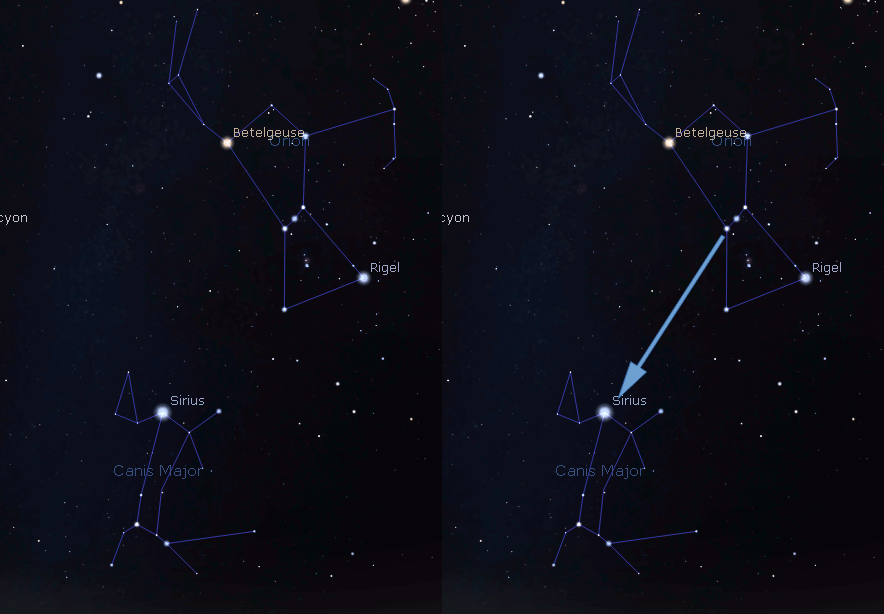
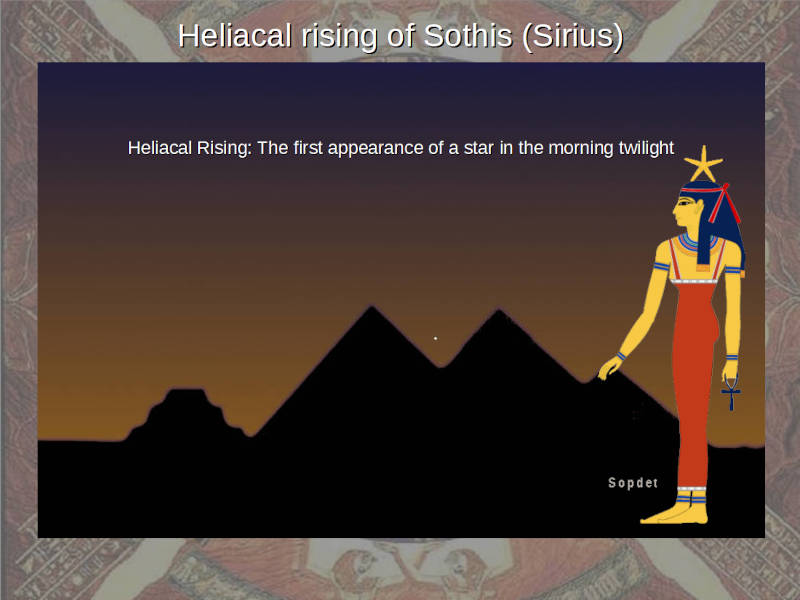
The second-brightest star-like object in the evening sky is Sirius, also known as the Dog Star. It also is the brightest nighttime star in our skies period. Tonight at 9 p.m. it’s located in the southern sky. The Dog Star name comes from its position at the heart of the constellation Canis Major, the great dog of Orion the hunter. The three stars of Orion’s belt tilt to the lower left to Sirius. Sirius means ‘Dazzling One’, because of its great brilliance and twinkling. Its Egyptian name was Sopdet, and its first appearance in the dawn skies around July 20th signaled the flooding of the Nile, and the beginning of the agricultural year. The relationship of the heliacal rising of Sirius and the seasonal or tropical year lasted from about 2900 BCE to the start of the Common Era. Sirius owes much of its brilliance to the fact that it lies close to us, only 8.6 light years away.
The astronomical event times given in this blog are for the Traverse City/Interlochen area of Michigan (Lat 44.7° N, Long 85.7° W; EST, UT – 5 hours) unless stated otherwise. Times will be different for other locations.
Addendum
Trivia Note
The Greeks invented the term “Dog days of summer” for the hottest days of July because they thought that Sirius added its intensity to the heat of the Sun to make it hotter out. So why doesn’t Sirius help warm our winter nights? Just asking.
Ephemeris: 01/12/2026 – How to find the twins of Gemini
This is Ephemeris for Monday, January 12th. Today the Sun will be up for 9 hours and 6 minutes, setting at 5:24, and it will rise tomorrow at 8:17. The Moon, 2 days past last quarter, will rise at 4:08 tomorrow morning.
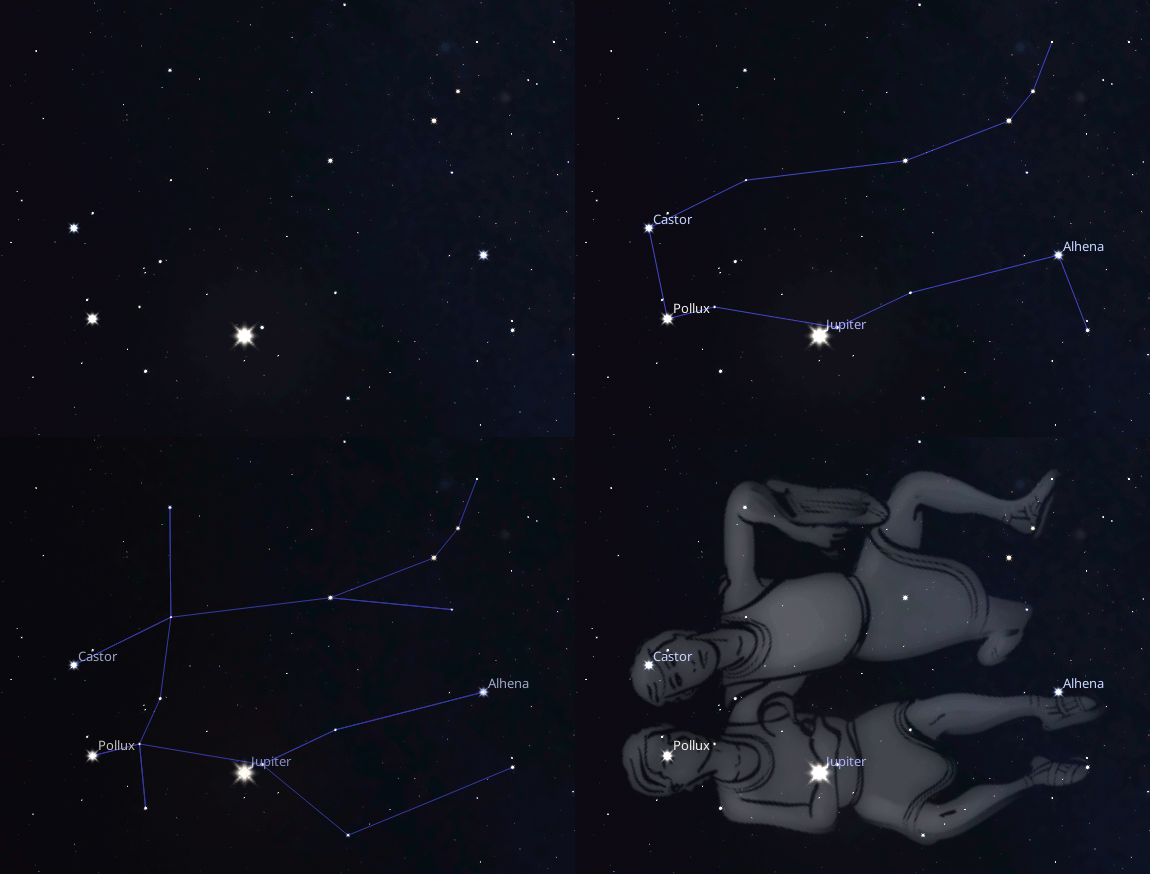
Another famous winter constellation is Gemini. The constellation of Gemini the Twins is visible halfway to the zenith in the east, at the top and left of Orion the hunter, at 9 pm. The namesake stars of the two lads, are the two bright stars at the left end of Gemini, and are high and are due east. Castor is on top, while Pollux is below. From them come two lines of stars that outline the two, extending horizontally toward Orion. Currently, Jupiter in its retrograde motion is situated level with Pollux at 9 PM. Pollux is left of the much brighter Jupiter. In Greek mythology the Gemini twins were half brothers, Castor was fathered by a mere mortal, while Pollux was fathered by Zeus, but were born together as twins. When Castor was killed during the quest for the Golden Fleece, Pollux pleaded with Zeus to let him die also, so Zeus placed them together in the sky.
The astronomical event times given in this blog are for the Traverse City/Interlochen area of Michigan (Lat 44.7° N, Long 85.7° W; EST, UT – 5 hours) unless stated otherwise. Times will be different for other locations.
Addendum

Ephemeris: 12/18/2025 – Orion and Scorpius
This is Ephemeris for Thursday, December 18th. Today the Sun will be up for 8 hours and 48 minutes, setting at 5:03, and it will rise tomorrow at 8:16. The Moon, 1 day before new, will rise at 8:22 tomorrow morning.
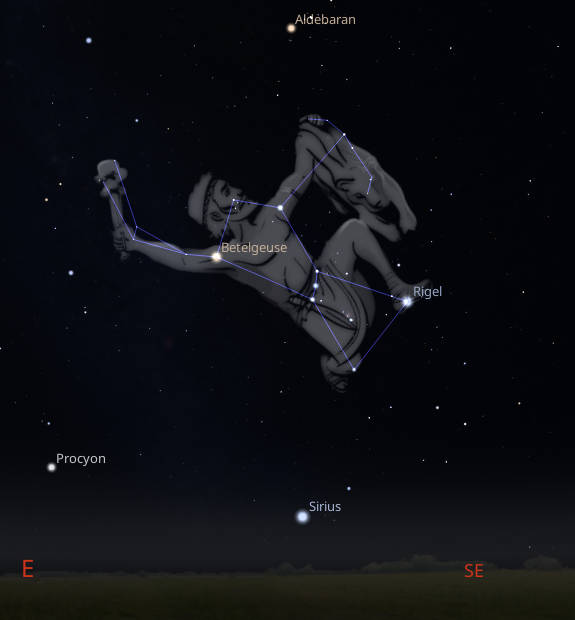
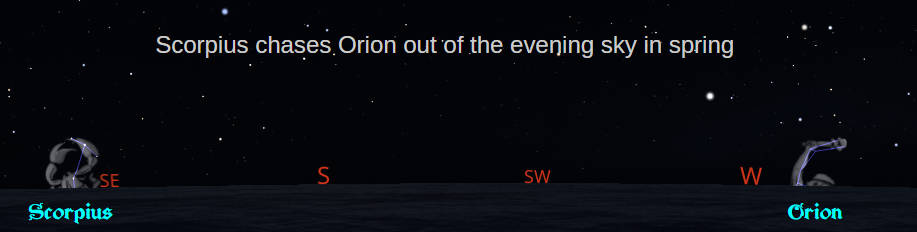
The wonderful constellation of Orion the hard luck hunter is seen rising in the east as twilight fades. According to one Greek myth he was killed by the sting of a giant scorpion, thus he can only rise after the summer constellation of Scorpius the scorpion sets in the southwest, and he must set as the scorpion rises on early spring evenings. By 9 pm, he is located in the southeast. His three belt stars are nearly vertically arranged in a line and equally spaced. They point down to the horizon, at the brightest nighttime star Sirius which rose 13 minutes before. The belt stars lie within a large rectangle of stars tilted to the left. His shoulders and knees. The top left star is the bright red Betelgeuse. The bottom right star is blue-white Rigel.
The astronomical event times given in this blog are for the Traverse City/Interlochen area of Michigan (Lat 44.7° N, Long 85.7° W; EST, UT – 5 hours) unless stated otherwise. Times will be different for other locations.
Addendum
Ephemeris: 11/21/2025 – Finding Taurus the bull
This is Ephemeris for Friday, November 21st. Today the Sun will be up for 9 hours and 21 minutes, setting at 5:09, and it will rise tomorrow at 7:49. The Moon, 1 day past new, will set at 5:36 this evening.
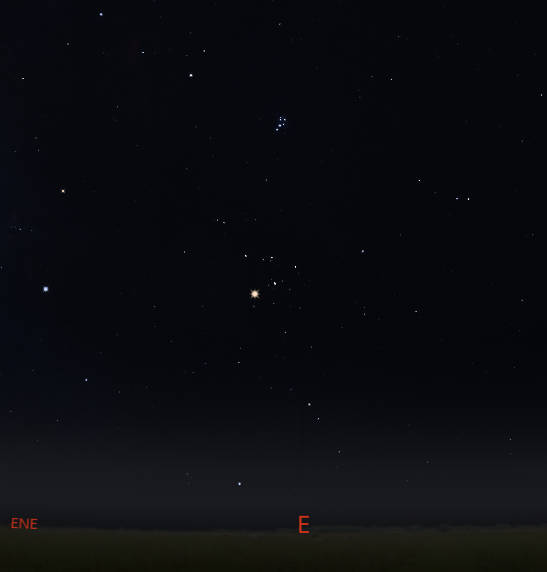
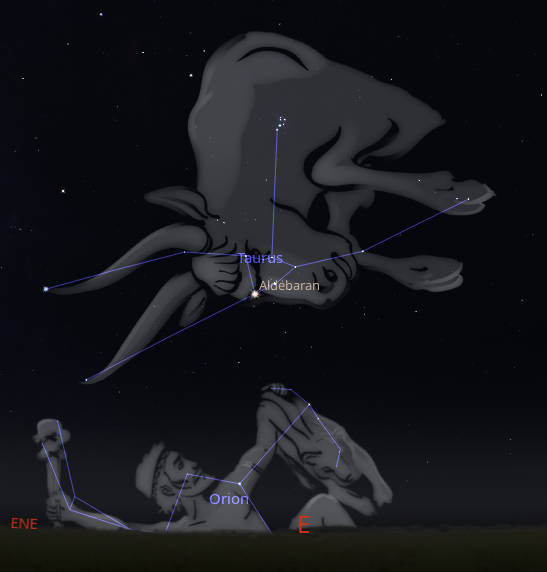
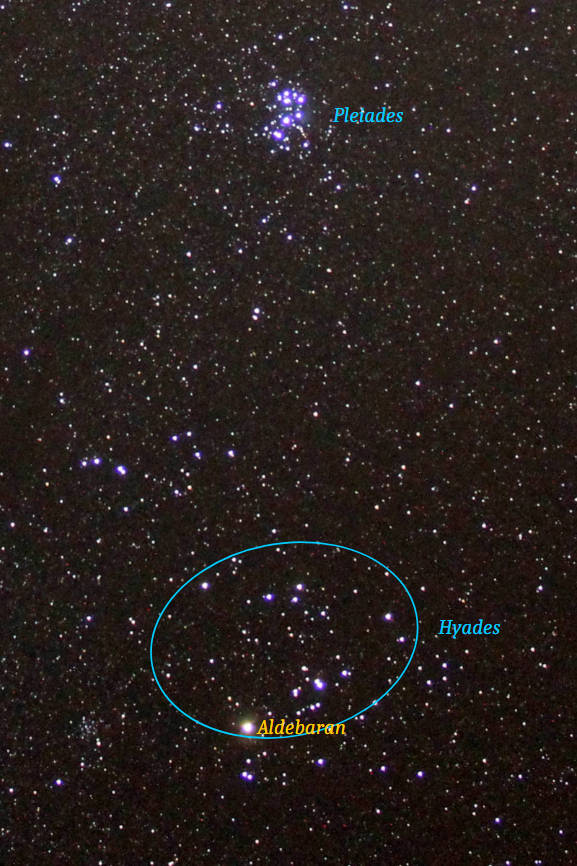
Low in the east at 8 this evening and below the beautiful Pleiades star cluster is Taurus the bull. His face is a letter V shape of stars lying on its side, the star cluster Hyades, which in Greek Mythology were the half-sisters of the Pleiades, with the bright orange-red star Aldebaran at one tip of the V as its angry bloodshot eye. Aldebaran is actually about halfway between us and the cluster. The Pleiades star cluster is in his shoulder. Taurus is seen charging downward at that hour, the rising constellation of Orion. Taurus in Greek mythology was the form the god Zeus assumed when he carried off the maiden Europa. Europa’s still with him as a moon orbiting Zeus’ Roman counterpart, the planet Jupiter.
The astronomical event times given in this blog are for the Traverse City/Interlochen area of Michigan (Lat 44.7° N, Long 85.7° W; EDT, UT – 4 hours) unless stated otherwise. Times will be different for other locations.
Addendum
Ephemeris: 11/18/2025 – What other cultures see in the Pleiades
This is Ephemeris for Tuesday, November 18th. Today the Sun will be up for 9 hours and 27 minutes, setting at 5:11, and it will rise tomorrow at 7:45. The Moon, 2 days before new, will rise at 7:22 tomorrow morning.
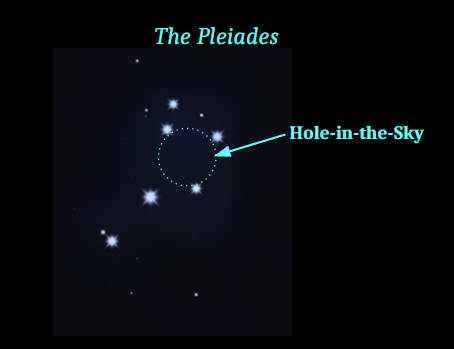
Let’s look at how some other cultures saw the Pleiades, the star cluster that is seen in the eastern sky these evenings. To the Anishinaabe native peoples around here, the Pleiades is the “Hole in the Sky” or the seven stones that are heated for the sweat lodge ceremony. To the Kiowa, these were sisters who were whisked up into the sky from the top of Devil’s Tower in Wyoming, where they were threatened by a huge bear. An Iroquoian legend has seven daughters who danced all day and were drawn into the sky, along with a black bear who danced with them. One daughter heard her mother’s call and fell back down to the Earth. In Norse mythology, these were the goddess Freya’s hens.
The astronomical event times given in this blog are for the Traverse City/Interlochen area of Michigan (Lat 44.7° N, Long 85.7° W; EDT, UT – 4 hours) unless stated otherwise. Times will be different for other locations.
Addendum
Ephemeris: 11/17/2025 – More about the Pleiades
This is Bob Moler with Ephemeris for Monday, November 17th. Today the Sun will be up for 9 hours and 29 minutes, setting at 5:12, and it will rise tomorrow at 7:44. The Moon, 3 days before new, will rise at 6:16 tomorrow morning.
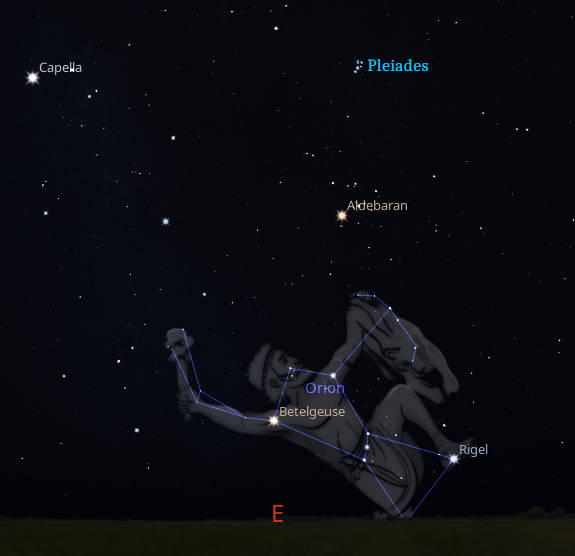
Around 8 in the evening the marvelous small star group called the Pleiades, or Seven Sisters will be in the eastern sky. Most people can see six stars, but they’re called the Seven Sisters, so the story has come up about the Lost Pleiad. It was said that her star was dimmed because she married a mere mortal. In Greek mythology the Pleiades were the daughters of the god Atlas and Pleione. By 9 PM the hunter Orion is rising in the east to chase the Pleiades across the sky until dawn. The word Pleiades is related to the Greek word for sail, and in ancient times the sailing season in the Mediterranean Sea started with the heliacal * rising of the Pleiades at dawn in mid-spring.
The astronomical event times given in this blog are for the Traverse City/Interlochen area of Michigan (Lat 44.7° N, Long 85.7° W; EDT, UT – 4 hours) unless stated otherwise. Times will be different for other locations.
* Heliacal Rising – The first appearance in the morning of a celestial body after disappearing in evening twilight.
Addendum
Ephemeris: 11/04/2025 – The Persephone Period starts tomorrow
This is Bob Moler with Ephemeris for Election Day for some, Tuesday, November 4th. Today the Sun will be up for 10 hours and 1 minute, setting at 5:26, and it will rise tomorrow at 7:26. The Moon, 1 day before full, will set at 7:41 tomorrow morning.
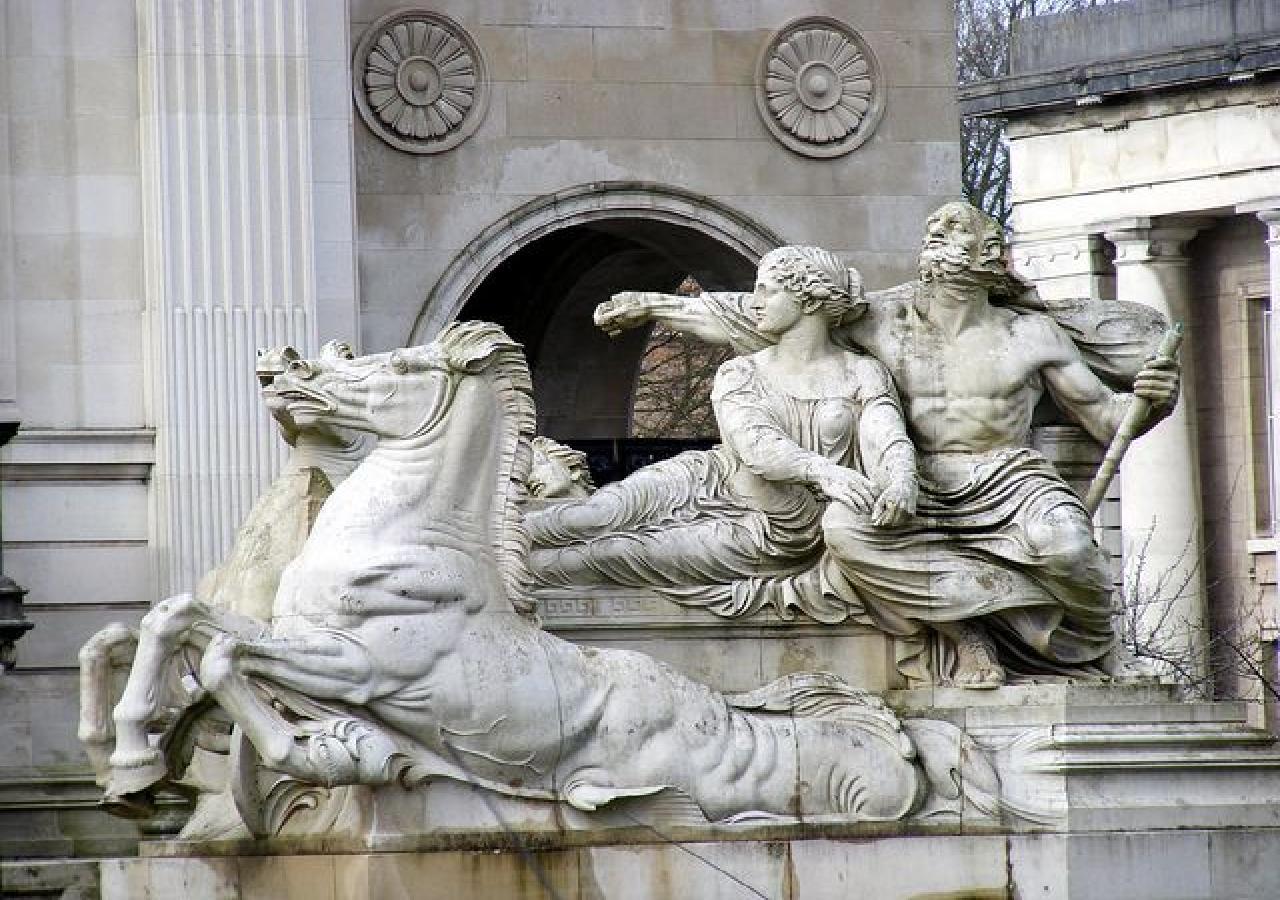
Tomorrow the daylight hours drops below 10 hours. This begins something which has been called the Persephone Period. It is named after the Greek goddess Persephone, goddess of spring, who is abducted by Hades the god of the underworld to be his bride. When he did, all the vegetation on the earth began to die. So he had to allow her to appear above ground for a part of the year so that the vegetation and the grain would grow. So the Persephone Period is the time when she is in the underworld. It lasts from now to early February. That may have worked for a country like Greece around the Mediterranean, but we have harsher weather here. It takes a much longer time for spring to arrive.
The astronomical event times given in this blog are for the Traverse City/Interlochen area of Michigan (Lat 44.7° N, Long 85.7° W; EDT, UT – 4 hours) unless stated otherwise. Times will be different for other locations.
Addendum
Ephemeris: 10/23/2025 – Finding Perseus the hero
This is Ephemeris for Thursday, October 23rd. Today the Sun will be up for 10 hours and 35 minutes, setting at 6:44, and it will rise tomorrow at 8:10. The Moon, 2 days past new, will set at 7:21 this evening.
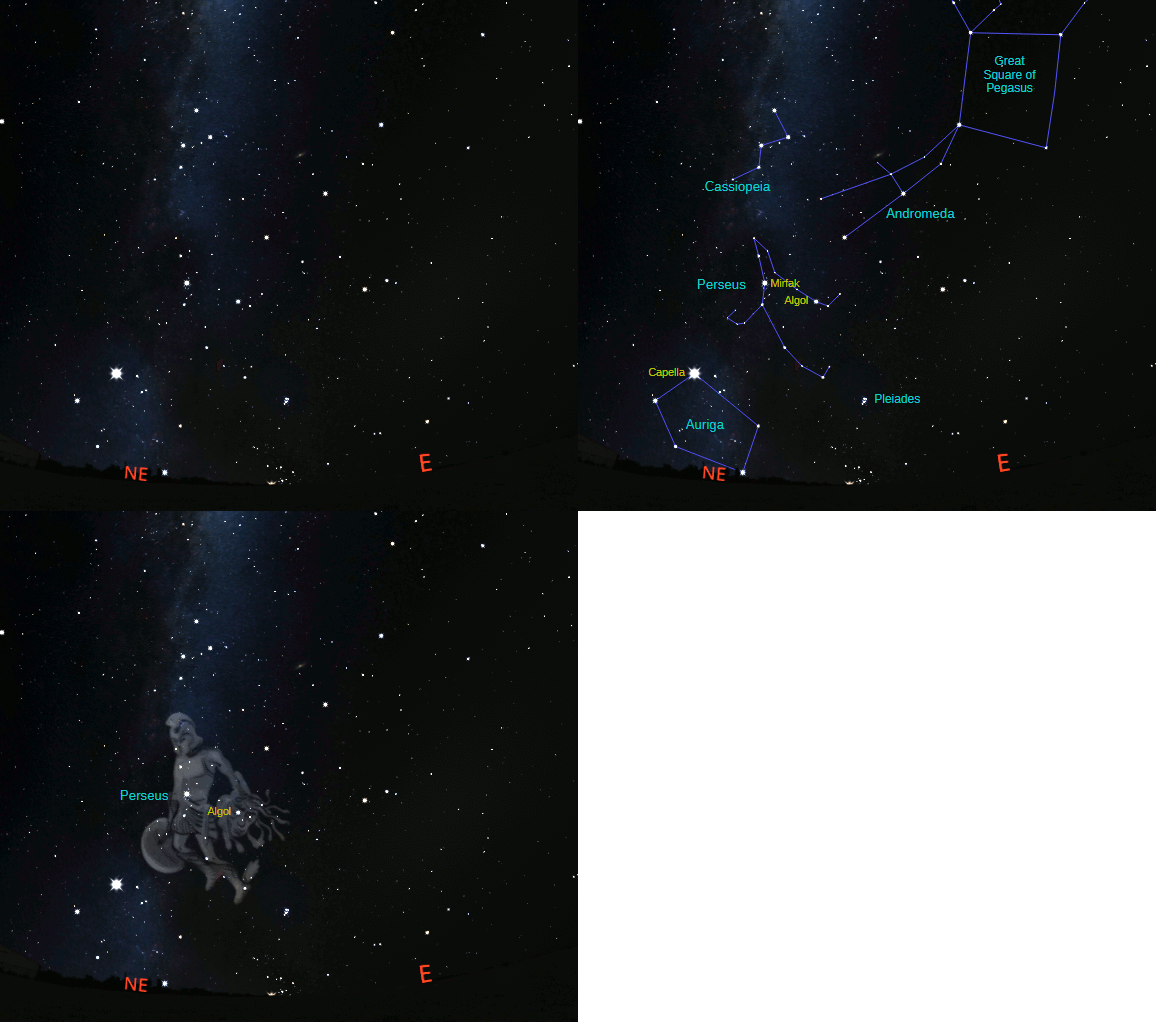
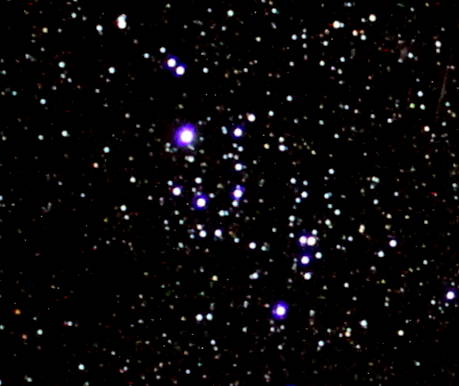
About a third the way from the east northeastern horizon to the zenith at 9 p.m. and below the letter W shaped constellation of Cassiopeia the queen is Perseus the hero. It’s kind of an odd shape for a hero, To me it looks kinda like the cartoon roadrunner. To those who’re mathematically inclined its shape is also like the Greek letter pi on its side. It’s two brightest stars are Mirfak and Algol the demon star, the still winking eye of Medusa. Look at the area around Mirfak with binoculars and a large group of stars just below naked eye visibility will appear. It’s called the Alpha Persei Association. That’s because Mirfak is also known as Alpha Persei. The group is about 560 light years away, which are farther away than the Pleiades, which is below and to the right of them.
The astronomical event times given in this blog are for the Traverse City/Interlochen area of Michigan (Lat 44.7° N, Long 85.7° W; EDT, UT – 4 hours) unless stated otherwise. Times will be different for other locations.
Addendum
Ephemeris: 10/21/2025 – Finding Andromeda
This is Ephemeris for Tuesday, October 21st. Today the Sun will be up for 10 hours and 41 minutes, setting at 6:47, and it will rise tomorrow at 8:07. The Moon is new today, and won’t be visible.
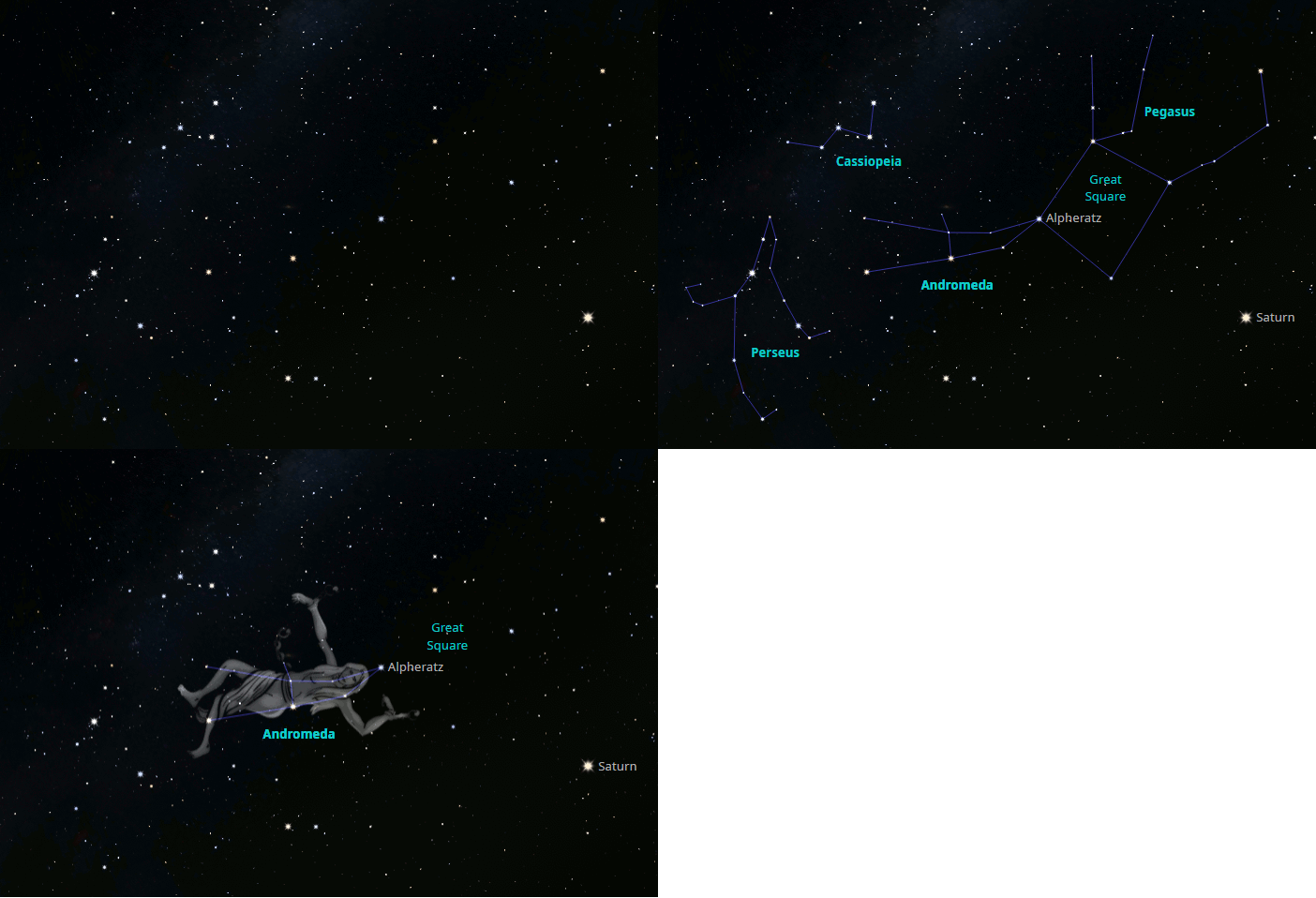
Tonight at 9:00 PM Saturn is in the southeast, with the Great Square of Pegasus above and to the left. Off the leftmost star of the Great Square, called Alpheratz, are two curved lines of stars to the left and a bit below, and slightly diverging. They might be mistaken for the hind legs of the horse, which is flying upside down. It’s another constellation, that of Andromeda the Princess, daughter of Cassiopeia, the W shaped constellation to the upper left. Andromeda was rescued by hero Perseus which is another constellation left of her, which we’ll get to later on this week. Andromeda’s claim to scientific fame is the large galaxy located there, the Great Andromeda Galaxy, probably the farthest thing one can spot with the naked eye.
The astronomical event times given in this blog are for the Traverse City/Interlochen area of Michigan (Lat 44.7° N, Long 85.7° W; EDT, UT – 4 hours) unless stated otherwise. Times will be different for other locations.
Addendum
Andromeda is part of the Great Star Story of Autumn. My take on it is linked Here.
Ephemeris: 08/25/2025 – Two fascinating constellations in and near the Summer Triangle
This is Bob Moler with Ephemeris for Monday, August 25th. Today the Sun will be up for 13 hours and 33 minutes, setting at 8:31, and it will rise tomorrow at 6:58. The Moon, 2 days past new, will set at 9:27 this evening.
There are two small constellations in and near the Summer Triangle of bright stars. Both are near Altair the bottom star of the triangle in the southeast. The first is Delphinus the dolphin to the left of Altair. Delphinus is made-up of a small squished box of stars with another star below. It does look a dolphin leaping out of the water. The legendary Greek poet Arion, according to myth, was rescued by a dolphin. Also, the little squished box is an asterism called Job’s Coffin, though no one knows the origin of that name. The second constellation is above Altair, and within the Summer Triangle. It is called Sagitta the arrow. The stars do line up to look like a short arrow. It’s supposed to represent Cupid’s dart.
The astronomical event times given in this blog are for the Traverse City/Interlochen area of Michigan (Lat 44.7° N, Long 85.7° W; EDT, UT – 4 hours) unless stated otherwise. Times will be different for other locations.
Addendum