Archive
12/08/2020 – Ephemeris – Finding Taurus the bull
This is Ephemeris for Tuesday, December 8th. Today the Sun will be up for 8 hours and 54 minutes, setting at 5:02, and it will rise tomorrow at 8:08. The Moon, 1 day past last quarter, will rise at 1:39 tomorrow morning.
Orion is the big splashy constellation in the east southeast by 9 in the evening. Above it is another famous constellation Taurus the bull. Its face is a letter V shape of stars on its side with the open end of the V to the left. The bright star at the lower left end of the sideways V is the ruddy star Aldebaran, the Bull’s angry bloodshot eye. The bull is charging down at Orion. The Pleiades, also known as the seven sisters, is the cluster of stars in his shoulder, above the V. The stars in the face of Taurus, except for Aldebaran belong to a star cluster like the Pleiades, but closer and older, called the Hyades. In Greek mythology the Hyades are half sisters to the Pleiades, all fathered by the god Atlas.
The event times given are for the Traverse City/Interlochen area of Michigan. They may be different for your location.
Addendum
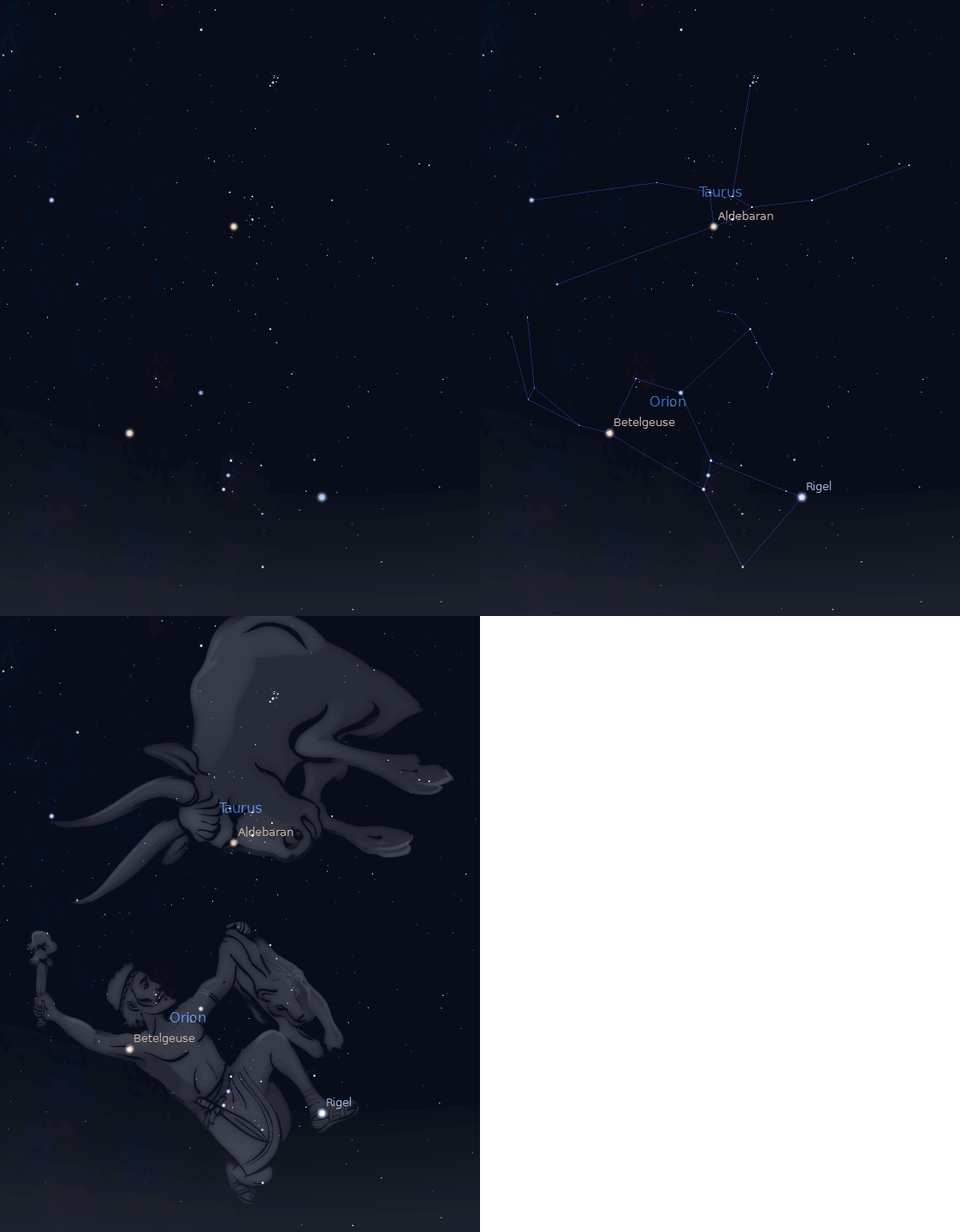
Three views of Taurus the bull and Orion the hunter for 9 p.m. on December 8th. Created using Stellarium and GIMP.
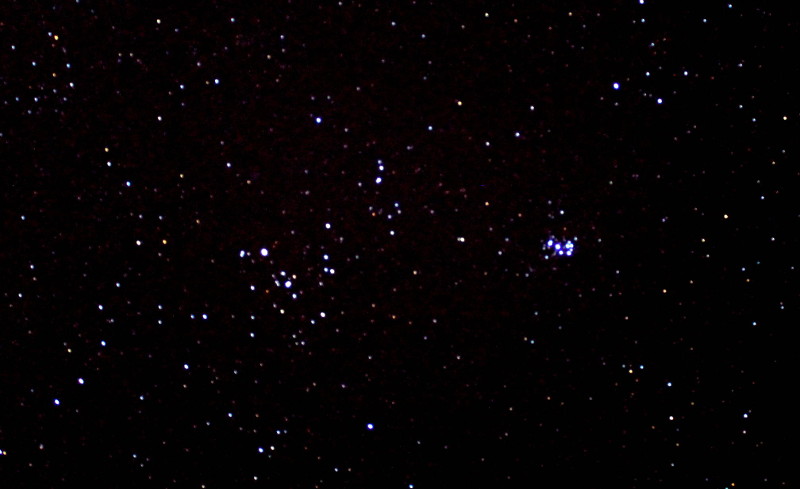
The Pleiades (right) and the Hyades (left) in this photograph I took January 4, 2016. The orientation is a bit different from how it appears in early December.
12/07/2020 – Ephemeris – Looking forward to the best of winter: Orion
This is Ephemeris for Monday, December 7th. Today the Sun will be up for 8 hours and 55 minutes, setting at 5:02, and it will rise tomorrow at 8:07. The Moon, at last quarter today, will rise at 12:25 tomorrow morning.
Orion, the central constellation of the winter evening sky will be completely risen by 9 this evening. Then it can be seen low in the east-southeast it’s upright rectangle of stars tilted to the left. The topmost star to the left in this rectangle is the famous red giant star Betelgeuse, which is reportedly dimming again. It’s in Orion’s shoulder. In his other shoulder is Bellatrix, a name known to Harry Potter fans. In his knees are Rigel, a blue-white giant star and Saiph. In the center of the rectangle are three stars in a straight line, now almost vertically arranged, Orion’s belt. And below his belt what seem to be three more stars, his sword. In the center of the sword stars can be found, with binoculars or telescope, Orion’s most famous feature, the Great Orion Nebula.
The event times given are for the Traverse City/Interlochen area of Michigan. They may be different for your location.
Addendum
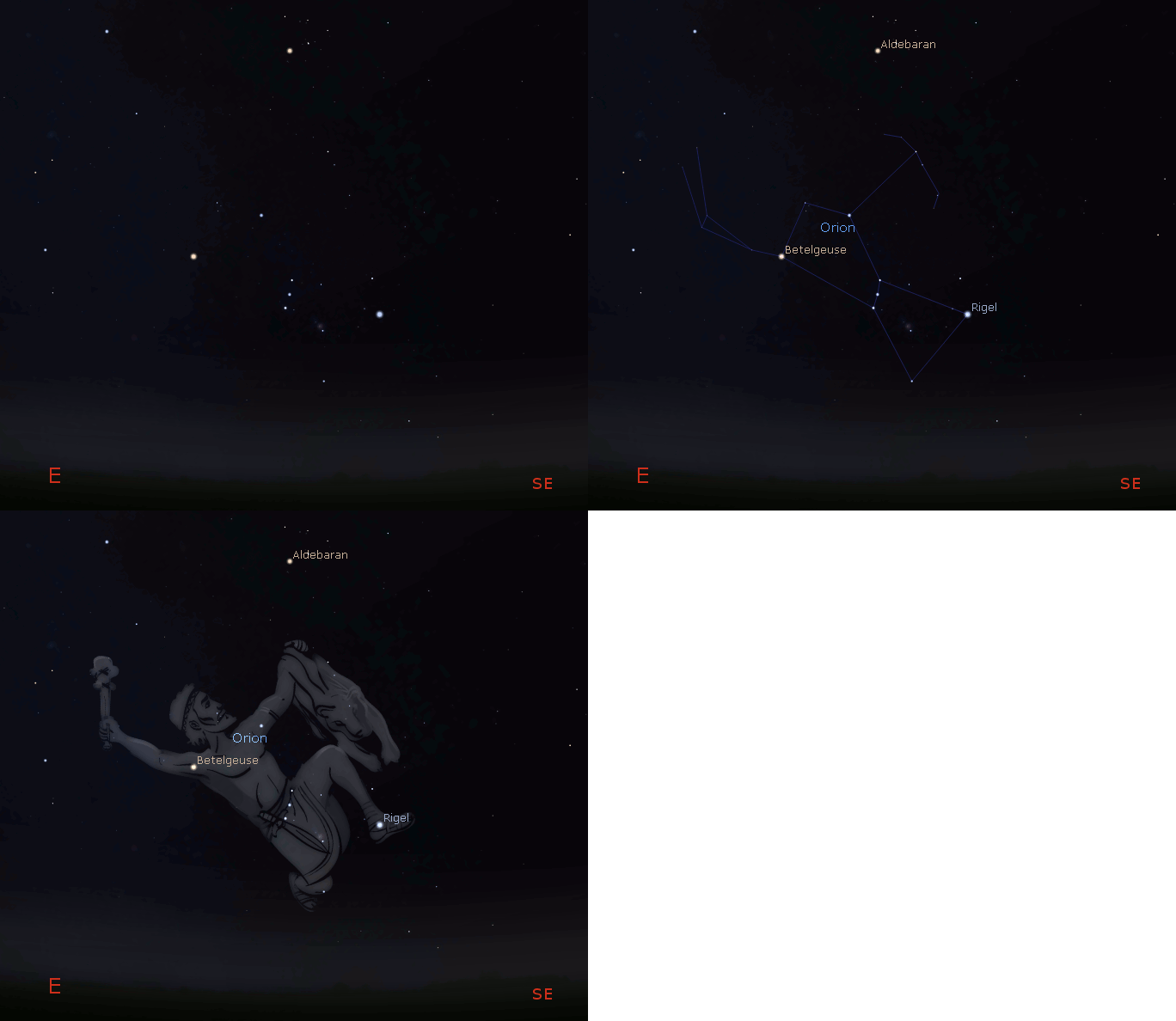
Orion early December finder animation for 9 pm December 7th. Created using Stellarium and GIMP.
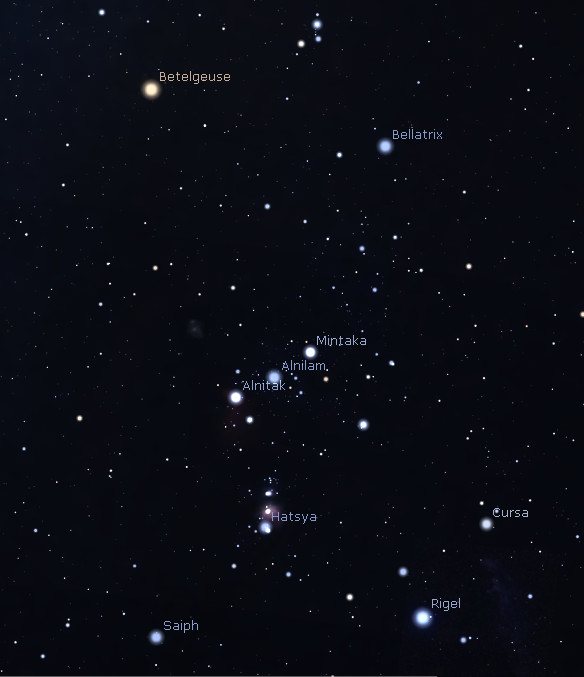
Orion’s named stars including the belt stars. Cursa, though named belongs to the neighboring constellation Eridanus the river. Created using Stellarium.
11/17/2020 – Ephemeris – The Pleiades in legends from different cultures
This is Ephemeris for Tuesday, November 17th. Today the Sun will be up for 9 hours and 29 minutes, setting at 5:12, and it will rise tomorrow at 7:44. The Moon, 2 days past new, will set at 7:23 this evening.
Let’s look at how some other cultures saw the Pleiades, the star cluster that is seen in the eastern sky these evenings. To the Anishinaabe native peoples around here the Pleiades is the “Hole in the Sky” or the seven stones that are heated for the sweat lodge ceremony. To the Kiowa these were sister stars that had been whisked into the sky from the top of Devils Tower in Wyoming where they were threatened by a huge bear. In Norse mythology these were the goddess Freya’s hens. The name we know them by has rather misty origins. Some think the Greek name is from the mother of the seven sisters, Pleione. The Greek word for sail is similar to Pleiades, and it seems the appearance of the Pleiades in the morning sky saw the best sailing weather in the Mediterranean.
The event times given are for the Traverse City/Interlochen area of Michigan. They may be different for your location.
Addendum

Seven maidens being attacked by a giant bear, having fled to the top of Devil’s Tower in Wyoming. Painting by Herbert Collins, https://www.nps.gov/deto.
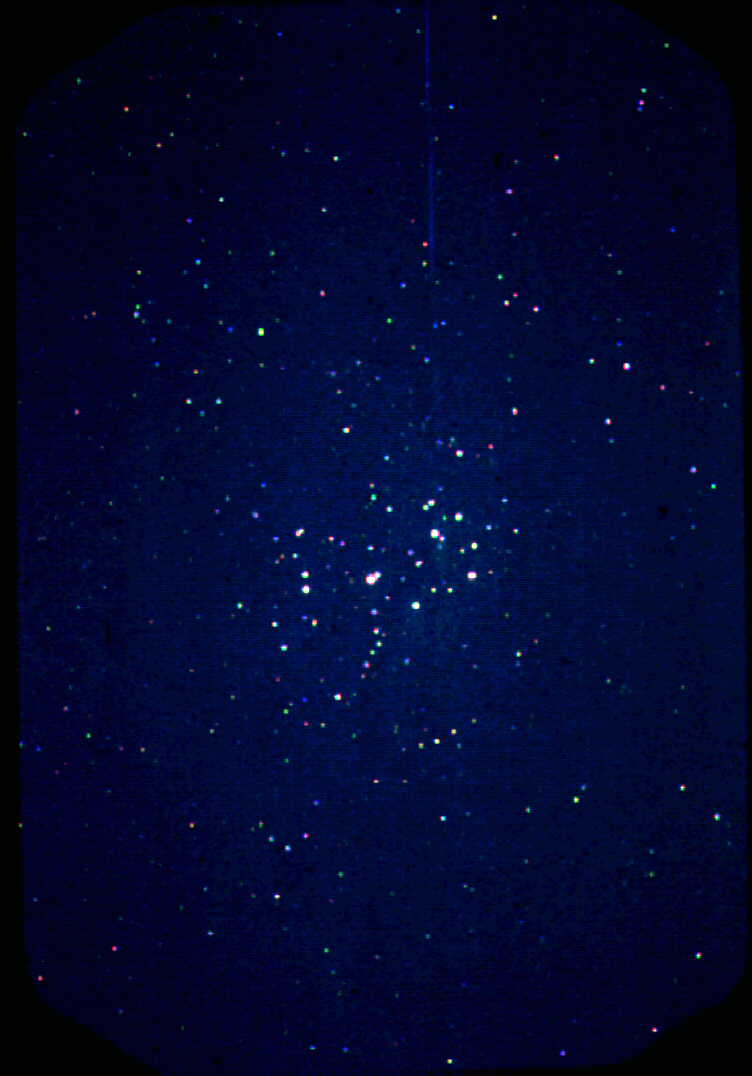
The Pleiades, about what you’d see in binoculars, more than the 6 or 7 stars visible to the naked eye. The brighter stars are Freya’s Hens and also the Seven Sisters and Indian maidens. Credit Bob Moler.
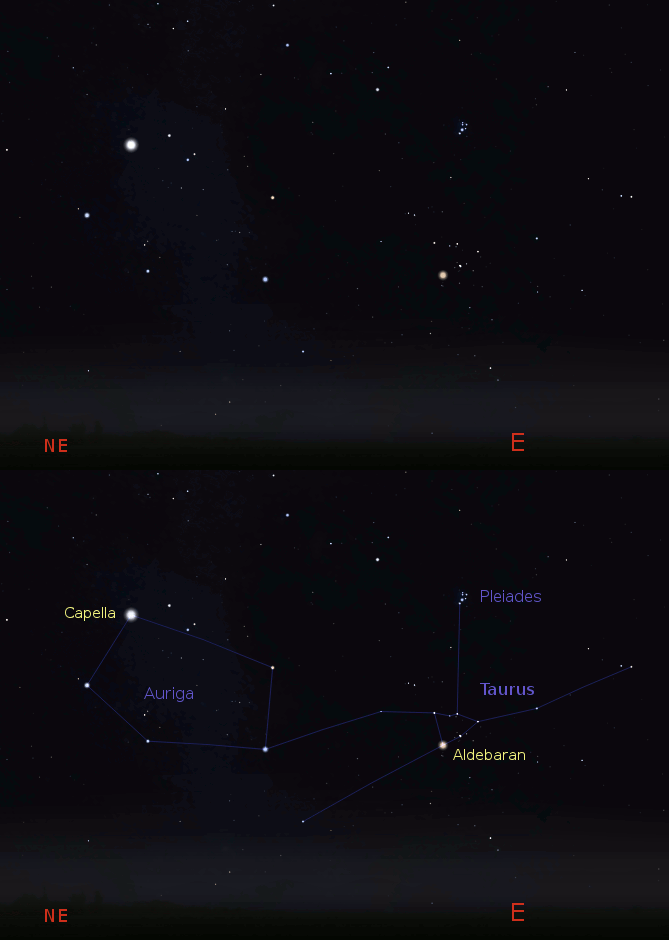
Pleiades finder animation looking east about 8 pm in mid-November. Created using Stellarium.
11/13/2020 – Ephemeris – Finding Perseus the hero in the stars
This is Ephemeris for Friday, November 13th. Today the Sun will be up for 9 hours and 38 minutes, setting at 5:16, and it will rise tomorrow at 7:39. The Moon, 2 days before new, will rise at 6:41 tomorrow morning.
About a third the way from the east northeastern horizon to the zenith at 8 p.m. and below the letter W shaped constellation of Cassiopeia the queen is Perseus the hero. It’s kind of an odd shape for a hero, To me it looks kinda like the cartoon roadrunner. To those who’re mathematically inclined its shape is also like the Greek letter pi on its side. It’s two brightest stars are Mirfak and Algol the demon star, the still winking eye of Medusa. Look at the area around Mirfak with binoculars and a large group of stars just below naked eye visibility will appear. It’s called the Alpha Persei Association. That’s because Mirfak is also known as Alpha Persei. The group is about 560 light years away, which means, though close, are farther away than the Pleiades, which is below and to the right of them.
The event times given are for the Traverse City/Interlochen area of Michigan. They may be different for your location.
Addendum
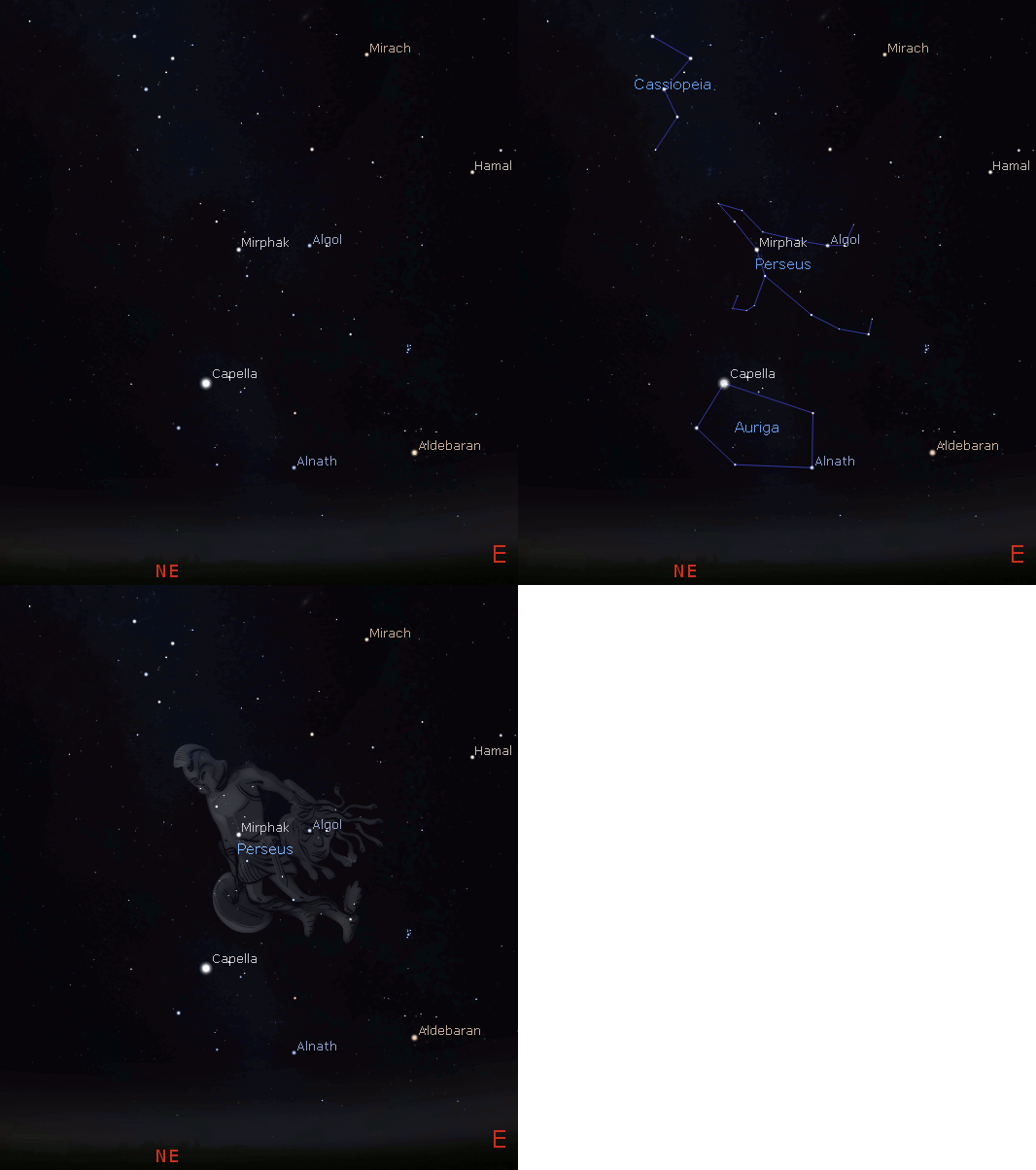
Perseus finder animation for 8 pm November 13, 2020. The star Mirphak in the image is generally spelled Mirfak and is also designated Alpha Persei.
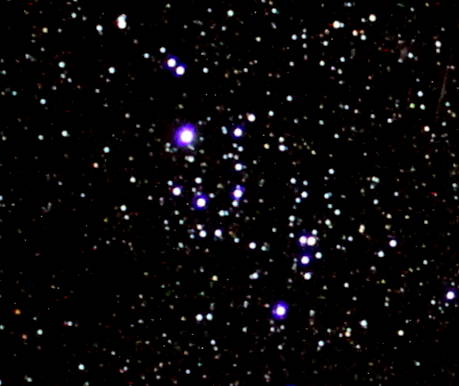
The Alpha Persei Association. The brightest star is Mirfak (Alpha Persei). This a an extreme crop from a photograph taken February 18, 2017, Canon EOS Rebel T5, 121 seconds, f/3.5, 18mm fl., ISO 3200. Credit Bob Moler.
10/19/2020 – Ephemeris – This zodiacal constellation seems fishy
This is Bob Moler with Ephemeris for Monday, October 19th. Today the Sun will be up for 10 hours and 46 minutes, setting at 6:50, and it will rise tomorrow at 8:05. The Moon, 3 days past new, will set at 8:58 this evening.
High in the southeast at 9 p.m. are the four bright stars of the Great Square of Pegasus, the upside down flying horse. Lying along the left and bottom sides of the great square is the constellation of Pisces the fish, one of the 12 constellations of the Zodiac. Even though the constellation is called the fish, the fish themselves are not well represented in the stars. What can be traced in the stars is the rope, that’s tied to their tails, anchored at the extreme southeastern part of the constellation that is seen in the stars. It is near where the bright red planet Mars currently is. The right or western end of Pisces is the asterism, or informal constellation, of the Circlet. It’s the loop of 5 stars, the rope around the tail of one of the two fish.
The event times given are for the Traverse City/Interlochen area of Michigan. They may be different for your location.
Addendum
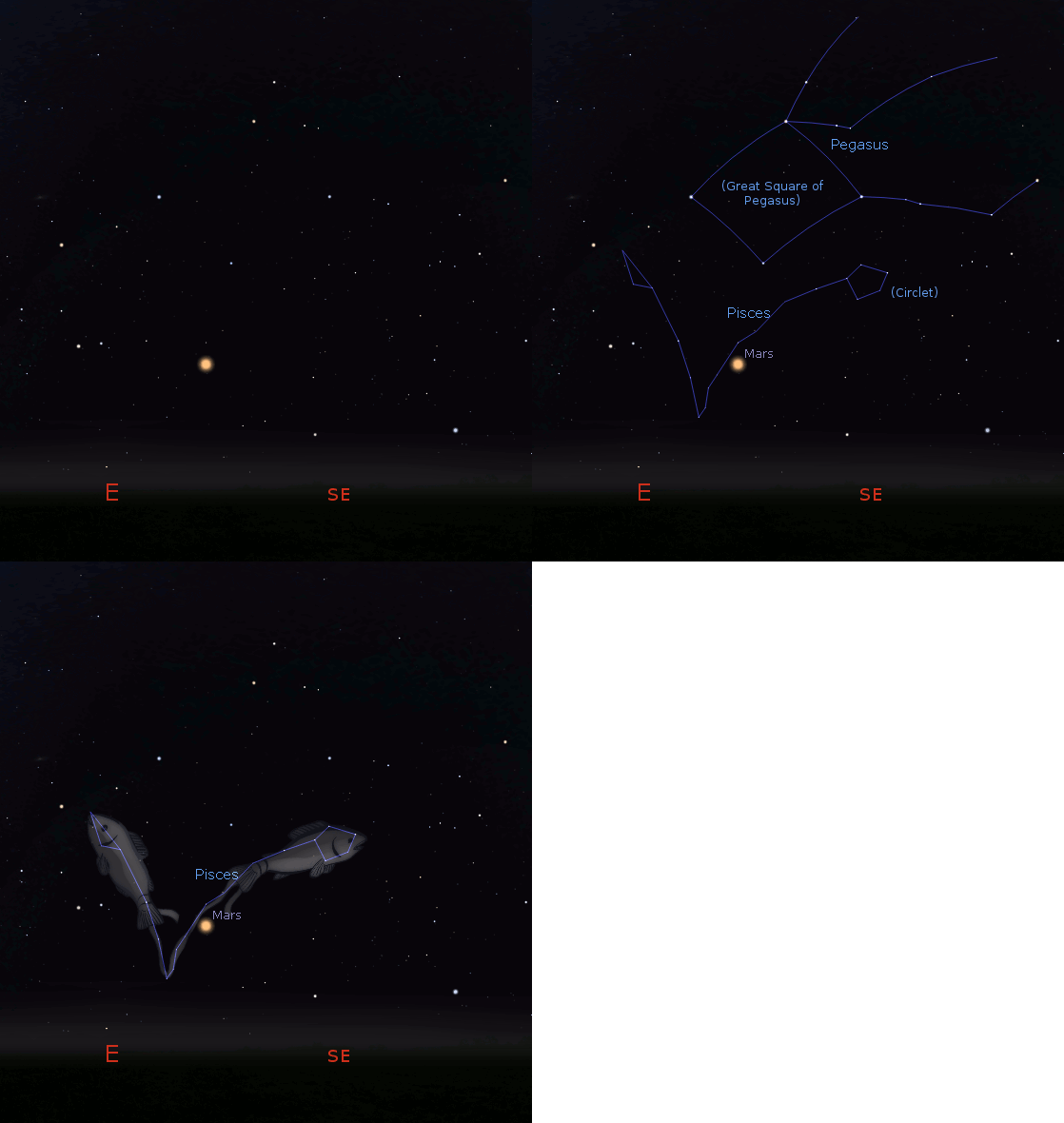
Pisces finder animation showing the Great Square of Pegasus as a way to find it, though this year bright Mars will show where it is. Created using Stellarium and GIMP.
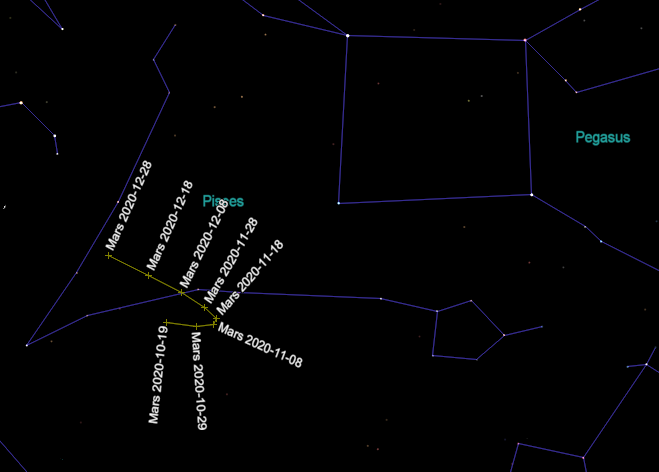
Mars’ apparent path for the rest of 2020 stays within Pisces. Mars doesn’t do a loop de loop as the ancients thought when they thought the Earth was motionless. It’s the effect of the Earth passing Mars in their orbits. Mars will stop its westward or retrograde motion around November 13th and resume its normal eastward motion. This view created using Cartes du Ciel (Sky Charts).
10/08/2020 – Ephemeris – A lady with a not so hidden jewel
This is Ephemeris for Thursday, October 8th. Today the Sun will be up for 11 hours and 19 minutes, setting at 7:09, and it will rise tomorrow at 7:51. The Moon, 1 day before last quarter, will rise at 11:09 this evening.
The stars of the constellations Andromeda the chained princess look like they’re supposed to be the hind legs of Pegasus the flying horse which is high in the southern sky above Mars at 9 p.m. Andromeda is high in the southeast She is seen in the sky as two diverging curved strings of stars that curve to the left and up from the upper leftmost star of the Great Square of Pegasus. Her predicament was caused by her boastful mother Cassiopeia, and the wrath of the god Poseidon. She was rescued by the hero Perseus, a nearby constellation, riding his steed Pegasus. Andromeda’s claim to astronomical fame is the large galaxy barely visible to the unaided eye just above the upper line of stars, the Great Andromeda Galaxy 2.5 million light years away.
The event times given are for the Traverse City/Interlochen area of Michigan. They may be different for your location.
Addendum
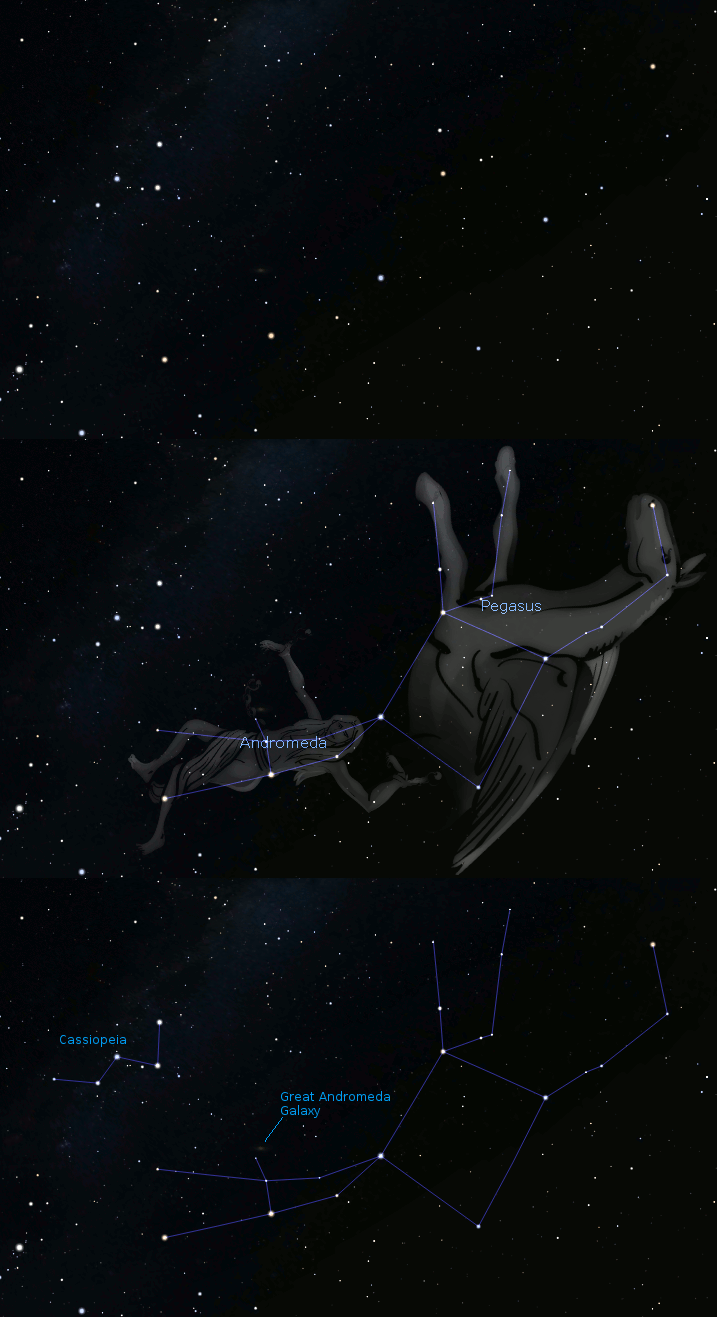
Andromeda animated finder, including the Great Andromeda Galaxy. I’ve added Cassiopeia that some folks use to find the galaxy. I start with the leftmost star of the Great Square of Pegasus that connects to Andromeda. I count off two star on the lower curve because they are brighter than the upper curve. Then count two stars up. Next to that top star is a little smudge. That is the core of the Great Andromeda Galaxy. Created using Stellarium and GIMP.
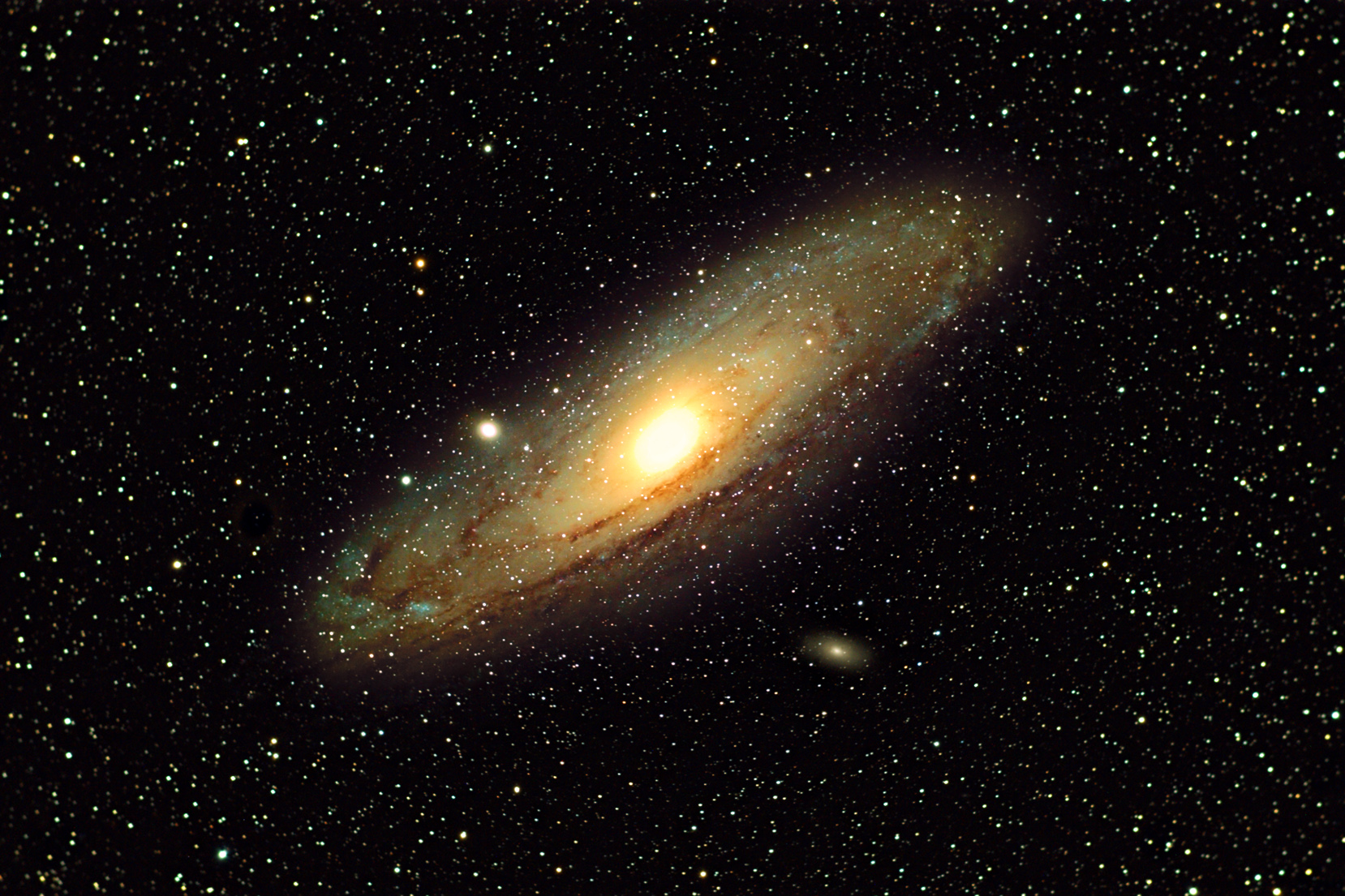
The Great Andromeda Galaxy (M31) and two of its satellite galaxies M31 (left) and M110. Image taken by Scott Anttila.
09/18/2020 – Ephemeris – A closer look at Cepheus the king’s most famous star
This is Ephemeris for Friday, September 18th. Today the Sun will be up for 12 hours and 20 minutes, setting at 7:46, and it will rise tomorrow at 7:27. The Moon, 1 day past new, will set at 8:52 this evening.
There’s a faint constellation in the northeast above the W shaped constellation of Cassiopeia. It’s a nearly upside down church steeple of a constellation called Cepheus the king, and husband of queen Cassiopeia. Cepheus’ claim to astronomical fame is that one of its stars, Delta (δ) Cephei, is the archetype for the important Cepheid variable stars. Delta is the bottom most of a trio of stars at the right corner of the constellation. In the early 20th century Henrietta Leavitt discovered that Cepheids in the nearby galaxy the Large Magellanic Cloud varied in brightness with a period that was related to their average brightness. This meant that Cepheids could be used as standard candles to measure the great distances to other galaxies.
The event times given are for the Traverse City/Interlochen area of Michigan. They may be different for your location.
Addendum
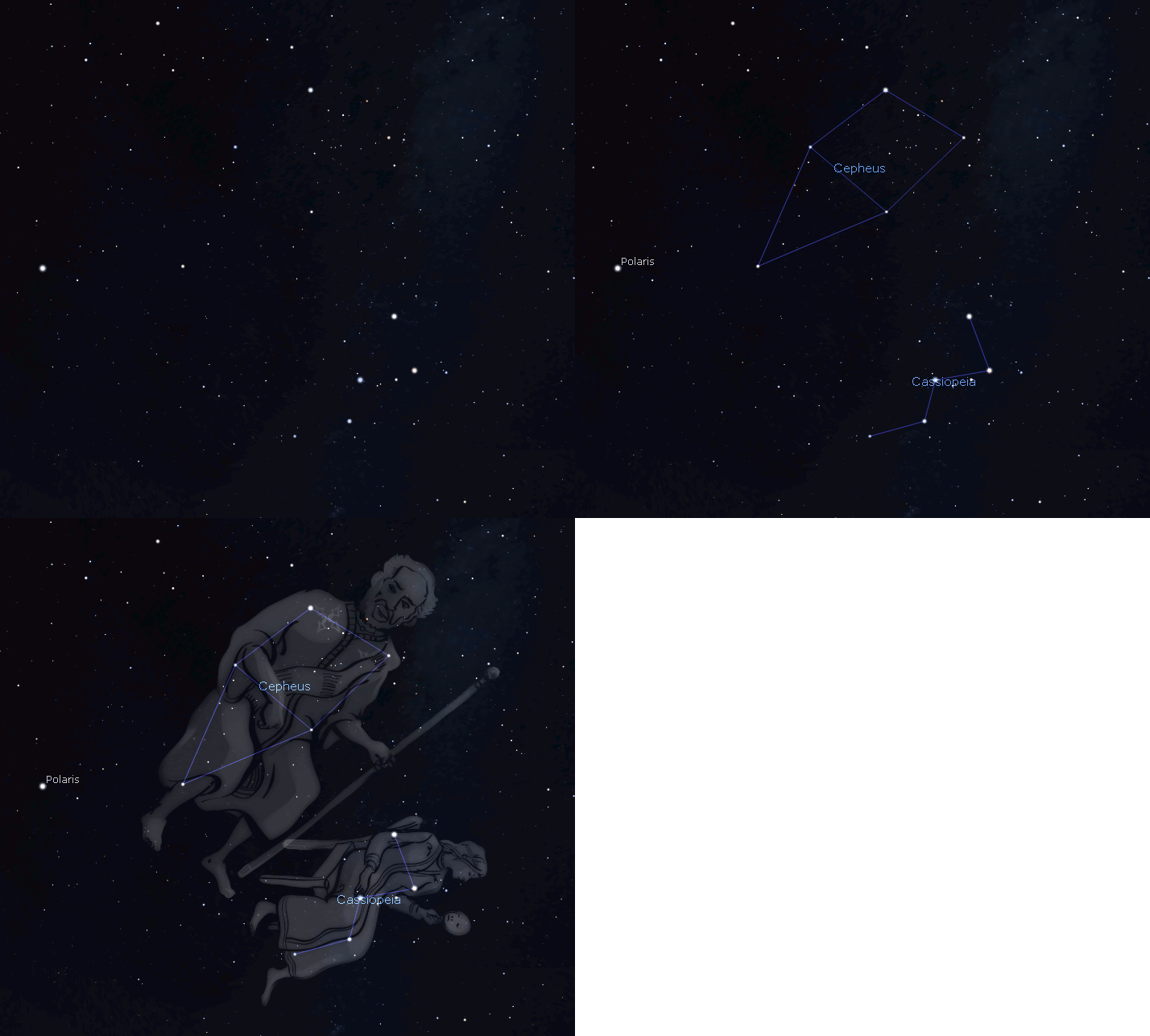
Cassiopeia and Cepheus finder animation looking in the northeast at 9 pm or about an hour after sunset in mid-September. Created using Stellarium and GIMP.
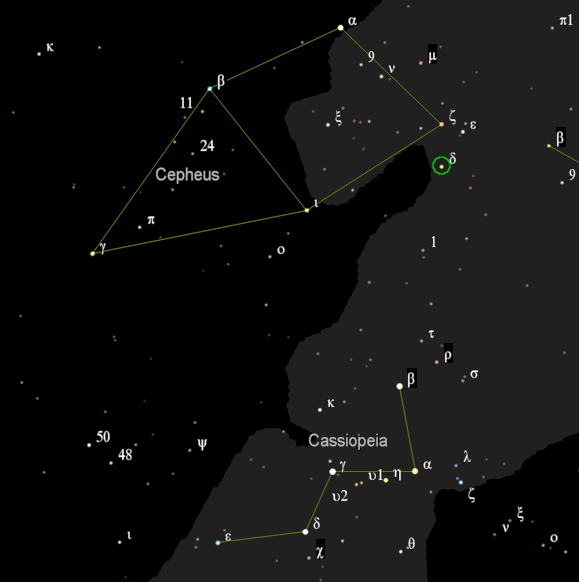
Delta Cephei (circled) finder for mid-September at 9 pm or about an hour after sunset looking northeast. The brighter stars are marked by their Bayer Greek letters. Numerical designations are Flamsteed numbers. Created using Cartes du Ciel (Sky Chart).
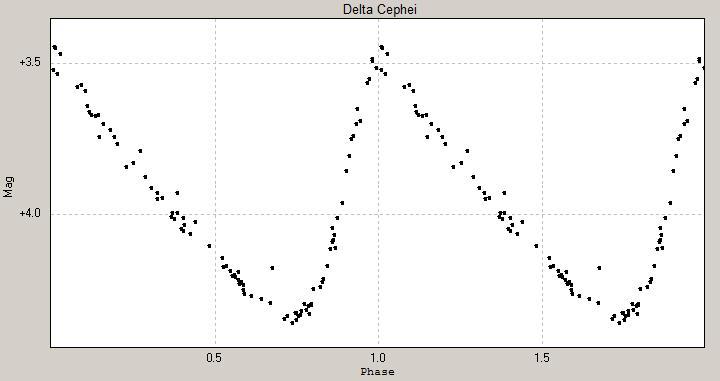
Light Curve of Delta Cephei. The pulsation period is 5.367 days. Credit: ThomasK Vbg – Own work, CC BY-SA 3.0, https://commons.wikimedia.org/w/index.php?curid=13887639
09/17/2020 – Ephemeris – Finding Cassiopeia the queen and Cepheus the king
This is Ephemeris for Thursday, September 17th. Today the Sun will be up for 12 hours and 24 minutes, setting at 7:48, and it will rise tomorrow at 7:25. The Moon is new today, and won’t be visible.
The stars of the autumn skies are slowly replacing the summer stars from the east. Look midway up in the northeastern sky in the evening and you can find the W shaped constellation of Cassiopeia the queen. Cassiopeia is so far north that it never sets for us in Michigan. It is opposite the pole star Polaris from the handle of Big Dipper. There’s a dim star that appears above the middle star of the W which turns it into a very crooked backed chair, Cassiopeia’s throne. Above and left of Cassiopeia is a dim upside down church steeple shaped constellation of Cepheus the king, her husband. The Milky Way flows through Cassiopeia toward the northeastern horizon. She is a character in an autumn star story with five other constellations.
For my retelling of the Greek myth that links these autumn constellations click here.
The event times given are for the Traverse City/Interlochen area of Michigan. They may be different for your location.
Addendum
Cassiopeia and Cepheus finder animation looking in the northeast at 9 pm or about an hour after sunset in mid-September. Created using Stellarium and GIMP.
09/15/2020 – Ephemeris – The dolphin and the arrow, small summer constellations
This is Bob Moler with Ephemeris for Tuesday, September 15th. Today the Sun will be up for 12 hours and 30 minutes, setting at 7:52, and it will rise tomorrow at 7:23. The Moon, 2 days before new, will rise at 6:01 tomorrow morning.
Located below the eastern edge of the Summer Triangle of three of the brightest stars in the sky, which is nearly overhead in our sky at 10 p.m., is the tiny constellation of Delphinus the dolphin. Delphinus’ 6 stars in a small parallelogram with a tail, really does look like a dolphin leaping out of the water. The parallelogram itself has the name Job’s Coffin. The origin of this asterism or informal constellation is unknown. Of the dolphin itself: the ancient Greeks appreciated this aquatic mammal as we do, and told stories of dolphins rescuing shipwrecked sailors. There’s another tiny constellation to the right of Delphinus, Sagitta the arrow a small thin group of 5 stars, which represents Cupid’s dart.
The event times given are for the Traverse City/Interlochen area of Michigan. They may be different for your location.
Addendum
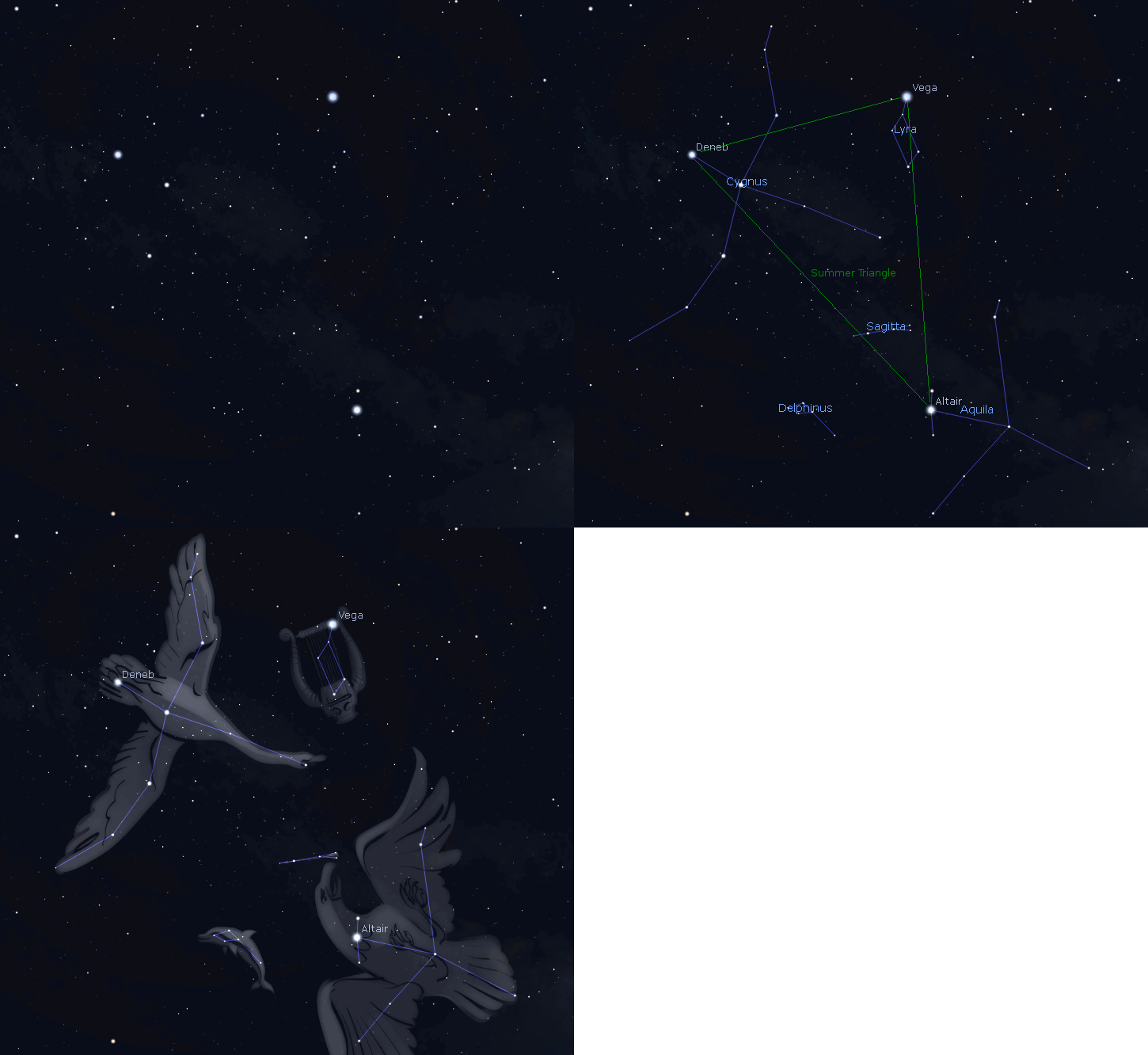
Delphinus and Sagitta finder animation. Created using Stellarium and GIMP.
09/14/2020 – Ephemeris – Not exactly a mermaid
This is Bob Moler with Ephemeris for Monday, September 14th. Today the Sun will be up for 12 hours and 33 minutes, setting at 7:54, and it will rise tomorrow at 7:22. The Moon, 3 days before new, will rise at 4:42 tomorrow morning.
Nearly 2000 years ago the southernmost of the constellations of the zodiac was Capricornus which is a water goat. That’s why the latitude on the Earth where the Sun is overhead on the winter solstice is called the Tropic of Capricorn. Not any more, Sagittarius, one constellation west past Jupiter and Saturn this year, has that honor today. Actually Capricornus does need the press. It’s large, but made up of dim stars. To me it looks like a 45 degree isosceles triangle, long side up, but which all the sides are sagging. The constellation is found low in the south-southeast at 10 p.m. The image that is supposed to be represented by the stars is that of a goat whose hind quarters are replaced by a fish’s tail, not a mermaid but a mergoat.
The event times given are for the Traverse City/Interlochen area of Michigan. They may be different for your location.
Addendum
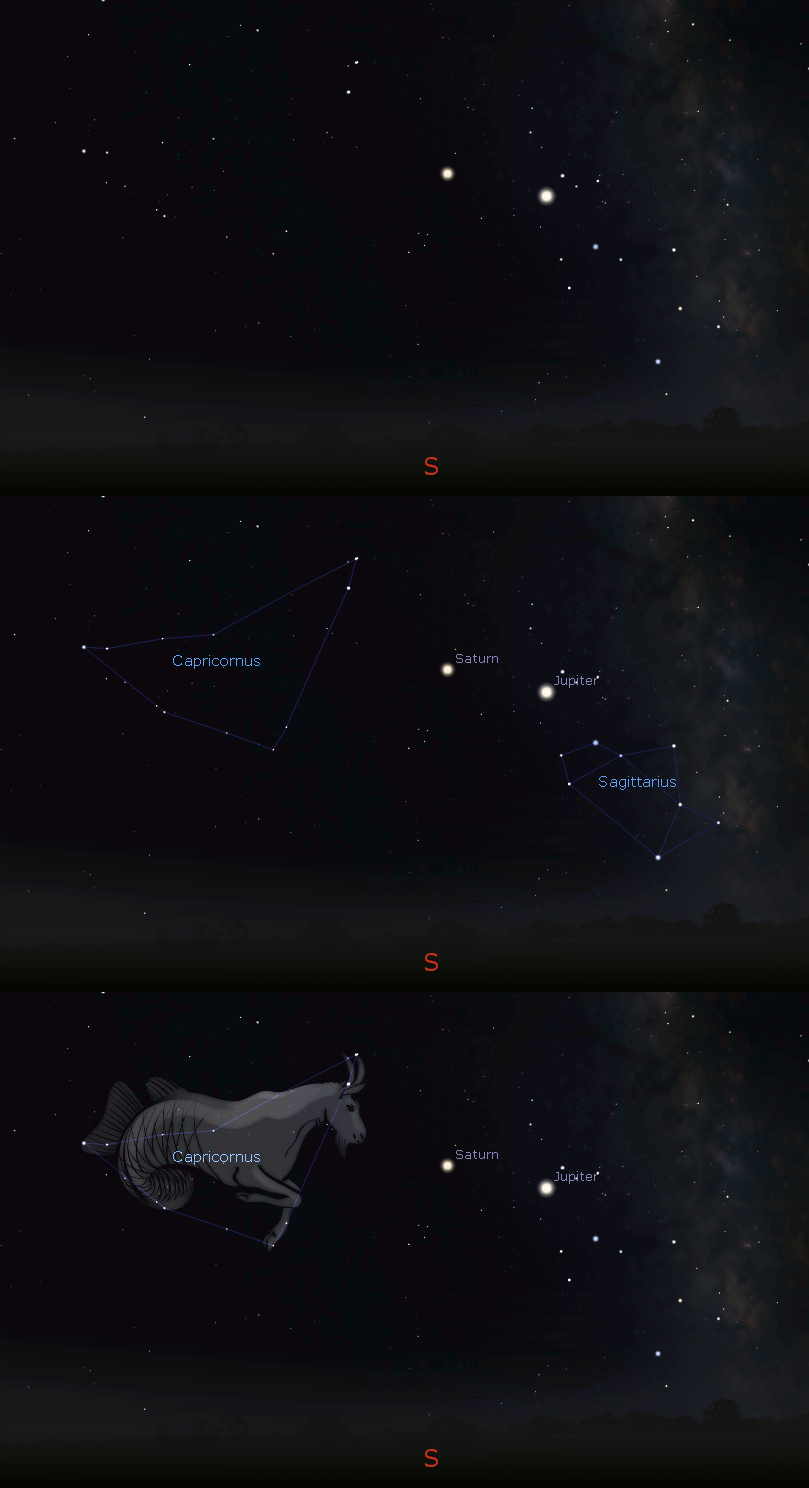
Capricornus finder animation for September 14, 2020 at 10 pm for western Michigan. Note that the Teapot of Sagittarius is pouring its contents on the southwestern horizon is to the right. Created using Stellarium and GIMP.
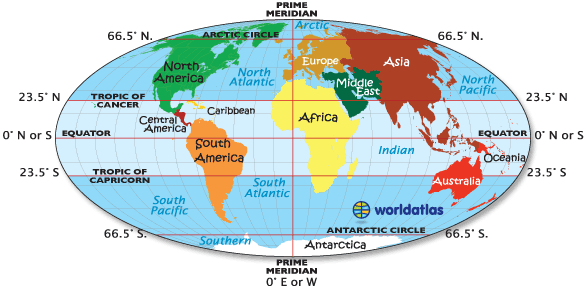
Important seasonal latitudes on the Earth. Source: worldatlas.com
 Bob Moler's Ephemeris Blog